
A YouTube video gets 1,000 likes and 80 comments.
Is that good engagement?
What about another video with 10,000 likes but only 150 comments?
Both videos received positive reactions. But one generated substantially more discussion relative to its likes.
Most YouTube engagement guides focus on likes per view or comments per view. Those are useful measurements, but they don't directly answer another important question:
How often do people move beyond liking a video and participate in the conversation?
To investigate, OverseerOS analyzed 22,196 YouTube videos across 1,570 channels, comparing public comment counts with public like counts.
The results revealed a major difference between video formats.
The median long-form video received 7.90 comments for every 100 likes. Short-form videos received 1.82 comments per 100 likes.
That is a difference of approximately 4.3 times.
And the pattern wasn't limited to comparing unrelated channels.
Among 253 channels with enough qualifying videos in both formats, 218 channels (86.2%) had a higher median comments-to-likes ratio on their long-form videos.
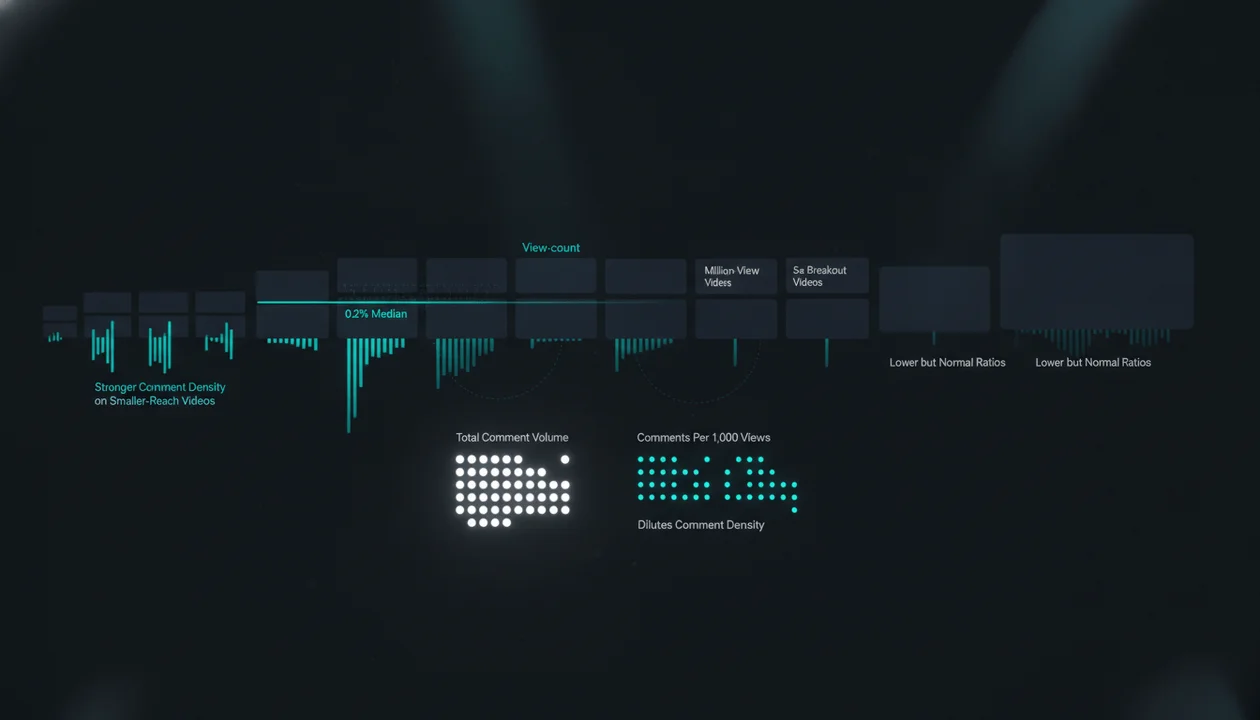
Another finding was just as interesting: videos with millions of views generally had fewer comments per 100 likes than videos in smaller view-count categories.
This doesn't prove that longer videos create better communities or that increased reach suppresses discussion.
But it gives creators a new way to benchmark audience interaction, without confusing a large like count with an active conversation.
Key Findings: YouTube Comments per 100 Likes
Here are the most important findings from our October 2026 research.
| Research finding | Result |
|---|---|
| Videos analyzed | 22,196 |
| Distinct channels | 1,570 |
| Long-form videos | 13,137 |
| Short-form videos | 9,059 |
| Video age at measurement | 7–30 days |
| Minimum likes per qualifying video | 100 |
| Median long-form comments per 100 likes | 7.90 |
| Median short-form comments per 100 likes | 1.82 |
| Long-form 75th percentile | 14.44 |
| Short-form 75th percentile | 4.21 |
| Channels with sufficient uploads in both formats | 253 |
| Paired channels where long-form had the higher ratio | 218 (86.2%) |
| Long-form videos with at least 10 comments per 100 likes | 39.3% |
| Short-form videos with at least 10 comments per 100 likes | 7.7% |
Source: OverseerOS original research, October 28, 2026. Public YouTube video observations collected September 28–October 28, 2026. These are descriptive benchmarks for the sampled videos, not official YouTube thresholds.
The direct answer: What is a good YouTube comments-to-likes ratio?
In this sample, the median was approximately:
- 8 comments per 100 likes for long-form videos.
- 2 comments per 100 likes for short-form videos.
For long-form, approximately 14.4 comments per 100 likes marked the 75th percentile of the observed video-level distribution.
For short-form, the comparable 75th-percentile value was approximately 4.2 comments per 100 likes.
These provide useful reference points when your videos meet similar selection conditions.
However, a higher ratio is not automatically better. Controversial videos, arguments, spam, creator replies, and comment-moderation settings can all influence the count.
What Is the YouTube Comments-to-Likes Ratio?
The comments-to-likes ratio measures the number of public comments a video receives relative to its public likes.
It answers:
For every 100 likes, how many comments did the video generate?
The formula is:
Comments per 100 likes = (Public comments ÷ Public likes) × 100
For example, imagine a video has:
- 5,000 likes.
- 400 comments.
Its ratio is:
400 ÷ 5,000 × 100 = 8 comments per 100 likes.
That is close to the long-form median in our study.
Now imagine another video has:
- 5,000 likes.
- 100 comments.
Its ratio is:
100 ÷ 5,000 × 100 = 2 comments per 100 likes.
That is close to our observed short-form median.
Both videos have the same number of likes.
But the first has four times the number of public comments.
Comments-to-likes ratio vs. engagement rate
These metrics are related, but they are not interchangeable.
| Metric | Formula | What it describes |
|---|---|---|
| Like-to-view ratio | Likes ÷ Views × 100 | Likes relative to total recorded views |
| Comment-to-view ratio | Comments ÷ Views × 100 | Comments relative to total recorded views |
| Combined public engagement rate | (Likes + Comments) ÷ Views × 100 | Total public likes and comments relative to views |
| Comments per 100 likes | Comments ÷ Likes × 100 | Discussion volume relative to likes |
A video can have a strong combined engagement rate but relatively few comments.
Another can have a modest like-to-view ratio yet generate substantial discussion.
That's why this study focuses specifically on comments relative to likes rather than combining every public interaction into one percentage.
For more context, see our earlier research on YouTube engagement rate benchmarks.
How We Analyzed 22,196 YouTube Videos
We used public YouTube video observations stored by OverseerOS research systems.
The analysis was conducted on October 28, 2026.
To make the comparison more meaningful, we limited the study to videos with publicly available engagement information during a comparable early period.
Video eligibility requirements
Each qualifying video needed:
- A recorded public view count of at least 1,000.
- At least 100 public likes.
- An available public comment count, including zero.
- A recorded age between 7 and 30 days.
- A recognized long-form or short-form classification.
- A valid video ID and channel ID.
The final sample contained 22,196 unique videos.
We used one observation per video, selecting the eligible observation closest to 21 days after publication, with the more recent observation breaking ties.
This prevented a frequently observed video from receiving more weight merely because our systems had checked it more often.
Why require at least 100 likes?
Ratios become unstable when the denominator is very small.
Consider a video with two likes.
If it has four comments, its comments-to-likes ratio is:
200 comments per 100 likes.
That sounds enormous.
But it is based on only six interactions.
Such examples can overwhelm comparisons without providing a stable measure of audience behavior.
Requiring at least 100 likes reduces this problem.
However, the threshold also introduces selection bias.
Videos with fewer than 100 likes are excluded, including many ordinary small-channel uploads.
The sample therefore does not represent every video published to YouTube.
How were formats classified?
We used OverseerOS's video-format classification.
The principal groups were:
Long-form: Videos longer than three minutes.
Short-form: Videos classified as short-form by the research system, generally three minutes or less.
A short-form classification does not independently verify that every video appeared in YouTube's Shorts feed.
We therefore use the terms long-form and short-form throughout the research instead of treating every shorter video as a confirmed YouTube Short.
What did we calculate?
We measured:
- Comments per 100 likes for every qualifying video.
- Median and percentile distributions by format.
- Channel-level medians to reduce the influence of prolific uploaders.
- Within-channel comparisons where both formats were available.
- Differences by public view-count range.
- Results under different minimum-like thresholds.
- Results across different video-age windows.
We did not use comments as a substitute for audience retention, satisfaction, or video quality.
Finding 1: Long-Form Videos Received Over Four Times as Many Comments per Like
This was the clearest difference in the dataset.
| Benchmark | Long-form | Short-form |
|---|---|---|
| Qualifying videos | 13,137 | 9,059 |
| Channels represented | 1,337 | 659 |
| 25th percentile | 4.26 | 0.75 |
| Median | 7.90 | 1.82 |
| 75th percentile | 14.44 | 4.21 |
| 90th percentile | 25.15 | 8.40 |
All comment figures are expressed as comments per 100 likes.
The median long-form ratio was approximately 4.34 times the short-form median.
That is a substantial difference.
But the percentiles reveal something else.
The 75th percentile of short-form videos, at 4.21 comments per 100 likes, was slightly below the 25th percentile of long-form videos, at 4.26.
In other words, the lower quartile boundary of the long-form distribution was already above the upper quartile boundary of the short-form distribution.
These are two separate groups of videos, so we shouldn't immediately conclude that format caused the difference.
The subjects, audiences, channels, and commenting conventions may differ.
Still, the descriptive contrast is difficult to ignore.
What might explain the difference?
Several possibilities deserve consideration.
Long-form videos may provide more opportunities for viewers to develop opinions, ask follow-up questions, or respond to specific claims.
Short-form viewing may involve a faster consumption pattern with a different balance between liking and writing a comment.
The channel types contributing to each format may also differ.
But these are possible explanations.
Our dataset measures public reactions, not the psychological reasons viewers left them.
The strongest conclusion is that long-form videos in this selected sample had considerably more comments relative to likes.
Finding 2: The Long-Form Advantage Remained When We Compared the Same Channels
Comparing separate groups of long-form and short-form creators creates a problem.
Maybe long-form channels simply attract audiences more likely to comment.
To investigate that possibility, we performed a within-channel comparison.
We identified channels with at least three qualifying long-form videos and at least three qualifying short-form videos.
That produced:
253 channels with both formats represented.
For each channel, we calculated its median comments per 100 likes separately for the two formats.
Then we compared the results.
The paired-channel results
| Measure | Result |
|---|---|
| Channels with both formats | 253 |
| Qualifying long-form videos in those channels | 3,642 |
| Qualifying short-form videos | 4,789 |
| Median paired-channel long-form ratio | 7.24 |
| Median paired-channel short-form ratio | 2.67 |
| Channels with a higher long-form ratio | 218 |
| Channels with equal median ratios | 22 |
| Channels with a higher short-form ratio | 13 |
86.2% of the paired channels had a higher median comments-to-likes ratio on long-form videos.
The median of the individual channels' long-form-to-short-form ratio comparisons was approximately 2.79x, among comparisons where a nonzero short-form denominator was available.
The format gap remained even when we compared videos belonging to the same channel.
This helps address a significant source of bias in the overall comparison.
Does this prove long-form causes more commenting?
No.
A channel's long-form and short-form videos can still differ in subject, audience intent, tone, and presentation.
They may also reach different groups of viewers.
The study did not randomly assign video formats while holding everything else constant.
What we can say is:
The observed difference was not limited to comparing unrelated long-form creators with unrelated short-form creators. It appeared within most qualifying mixed-format channels too.
That makes format-specific benchmarking considerably more useful than applying one comments-to-likes target to all uploads.
Finding 3: The Typical Channel-Level Result Was Similar to the Video-Level Result
Large research samples can be misleading when a few channels contribute many videos.
One high-volume channel might publish a hundred uploads while another contributes only three.
If we simply pool everything together, the first channel has far more influence.
To reduce that problem, we calculated a separate median comments-to-likes ratio for each channel.
We included only channels with at least three qualifying videos in a format.
Then we took the median of those channel-level medians.
Channel-balanced results
| Measure | Long-form | Short-form |
|---|---|---|
| Channels with at least 3 eligible videos | 993 | 496 |
| Videos represented | 12,636 | 8,837 |
| 25th percentile of channel medians | 4.80 | 0.80 |
| Median channel's ratio | 7.75 | 1.79 |
| 75th percentile of channel medians | 13.60 | 3.74 |
The difference remained remarkably similar.
At the video level:
- Long-form: 7.90.
- Short-form: 1.82.
At the channel-balanced level:
- Long-form: 7.75.
- Short-form: 1.79.
This means the headline finding was not solely an artifact of a few prolific channels contributing large numbers of videos.
But the results are still based on a nonrandom collection of channels observed by OverseerOS.
Equal weighting reduces concentration bias.
It does not make the sample representative of all YouTube creators.
Finding 4: Million-View Videos Had Fewer Comments per 100 Likes
This was one of the most interesting secondary findings.
We grouped videos by their public view counts at the observation checkpoint.
The comments-to-likes ratio generally declined as recorded views increased.
Long-form videos
| Recorded views | Videos | Median comments per 100 likes |
|---|---|---|
| 1K–9.9K | 1,107 | 10.87 |
| 10K–99.9K | 6,553 | 8.96 |
| 100K–999K | 4,382 | 6.77 |
| 1M+ | 1,095 | 5.24 |
Among qualifying long-form videos, the median ratio in the lowest view band was approximately twice the value in the million-view group.
Short-form videos
| Recorded views | Videos | Median comments per 100 likes |
|---|---|---|
| 1K–9.9K | 1,223 | 3.27 |
| 10K–99.9K | 3,968 | 2.41 |
| 100K–999K | 2,441 | 1.46 |
| 1M+ | 1,427 | 0.72 |
The pattern was even more pronounced among short-form videos.
The median million-view short-form video received fewer than one public comment for every 100 likes.
Why might bigger videos have fewer comments relative to likes?
One possibility is audience composition.
A video reaching a broad audience may receive many casual likes from people who do not feel strongly enough to write a comment.
A smaller video may reach a more concentrated community of viewers who are highly invested in the subject.
But we cannot establish that explanation from public counts alone.
Other possibilities include differences in topics, channel size, audience demographics, moderation, and format.
And there is an important methodological issue: requiring at least 100 likes disproportionately selects highly liked videos from the lowest view bands.
That makes the low-view categories less representative of all small videos.
The practical takeaway
A falling comments-to-likes ratio is not automatically evidence that a video is deteriorating.
A video can reach substantially more people while attracting a lower share of comments relative to likes.
When that happens, inspect both the total interaction volume and the ratio.
For example:
Video A
- 10,000 likes.
- 800 comments.
- 8 comments per 100 likes.
Video B
- 100,000 likes.
- 3,000 comments.
- 3 comments per 100 likes.
Video B has the lower ratio.
But it also generated far more total comments.
Calling Video B unsuccessful would ignore most of the actual engagement.
The ratio describes the composition of public interaction, not total reach or business value.
Finding 5: The Format Difference Survived Higher Like Thresholds
We required at least 100 likes in the primary study.
But what if that minimum was too low?
What happens when we focus on videos with much larger like counts?
We repeated the analysis with alternative thresholds.
| Minimum public likes | Long-form median | Short-form median |
|---|---|---|
| 25 | 7.94 | 1.94 |
| 100, primary study | 7.90 | 1.82 |
| 500 | 7.48 | 1.57 |
| 1,000 | 7.18 | 1.41 |
The alternative-threshold analyses independently selected eligible observations and can therefore contain slightly different video sets.
As the minimum like count increased, the median comments-to-likes ratio declined modestly in both formats.
That is consistent with the broader observation that videos with larger public reach often had fewer comments relative to their likes.
More importantly, the long-form versus short-form gap remained visible at every threshold.
At 1,000 minimum likes:
- Long-form: 7.18 comments per 100 likes.
- Short-form: 1.41.
The difference was still substantial.
This makes the result less dependent on choosing 100 likes as the primary cutoff.
Finding 6: The Gap Appeared in Both the First and Second Halves of the Month
Engagement counts accumulate over time.
If one format's videos were older, that could influence the results.
Our primary study included videos between seven and thirty days old, selecting one eligible observation per video.
We split that sample into two age groups.
| Video age | Long-form videos | Long-form median | Short-form videos | Short-form median |
|---|---|---|---|---|
| Days 7–14 | 3,829 | 8.48 | 3,204 | 1.91 |
| Days 15–30 | 9,308 | 7.64 | 5,855 | 1.77 |
The ratios were somewhat higher in the younger group for both formats.
But the difference between formats persisted.
This does not establish that comments-to-likes ratios naturally decline as individual videos age.
The two age groups contain different videos.
To measure how a particular video's ratio changes over time, we would need to repeatedly observe the same videos and analyze their trajectories.
Our result is a cross-sectional comparison within two age bands.
Still, it supports the central conclusion:
Long-form videos showed a substantially higher comments-to-likes ratio in both age groups.
Finding 7: A Zero Comment Count Needs Careful Interpretation
In the primary sample:
- 497 long-form videos had zero recorded public comments.
- 620 short-form videos had zero recorded public comments.
That represents approximately:
- 3.8% of qualifying long-form videos.
- 6.8% of qualifying short-form videos.
A zero count does not always mean the audience had nothing to say.
YouTube allows creators to turn comments off, pause commenting, limit who can comment, and hold comments for review.
These settings can affect what is publicly visible.
YouTube explains those controls in its official comment-settings documentation.
Our dataset did not reliably identify the moderation configuration of every video.
So we cannot always distinguish genuine zero discussion from restricted commenting.
What happened when we excluded zero-comment videos?
The median ratios increased slightly:
| Sample | Long-form median | Short-form median |
|---|---|---|
| Primary sample, including zero counts | 7.90 | 1.82 |
| Videos with at least one public comment | 8.20 | 2.02 |
The format difference remained.
But excluding zero-comment videos creates its own bias because it removes a real category of observed public outcomes.
For the headline research, we retained videos with zero recorded comments whenever the public metric was available.
Why Comments per 100 Likes Can Be More Informative Than Raw Comments
Consider two hypothetical videos.
| Metric | Video A | Video B |
|---|---|---|
| Views | 40,000 | 400,000 |
| Likes | 2,000 | 20,000 |
| Comments | 200 | 400 |
| Comments per 100 likes | 10 | 2 |
Video B has more views, likes, and comments.
But Video A generated substantially more comments relative to its likes.
That suggests a different composition of visible audience interaction.
It does not necessarily mean Video A is better.
But it tells you something that raw counts alone hide.
Different metrics answer different questions
If you care about reach, examine views and impressions.
If you care about viewer satisfaction, examine retention and the other relevant analytics available to you.
If you care about public interaction relative to reach, examine likes and comments per view.
If you want to understand how discussion compares with passive positive reactions, examine comments per 100 likes.
And if you want to understand what viewers are actually discussing, read and classify the comments.
No single number captures every dimension of audience engagement.
Does a Higher Comments-to-Likes Ratio Mean Better YouTube Performance?
Not necessarily.
Imagine two comment sections.
Video A
Viewers are discussing the subject thoughtfully.
They are sharing relevant experiences, asking questions, and contributing useful information.
Video B
Viewers are arguing intensely about a misleading claim.
The conversation includes repeated disputes, spam, and angry exchanges.
Video B could have more comments per 100 likes.
But that doesn't mean its audience had a more satisfying experience.
The ratio measures quantity relative to likes.
It does not classify sentiment, authenticity, or value.
This is particularly important for:
- Political commentary.
- Controversial news.
- Heated debates.
- Celebrity drama.
- Polarizing social topics.
A video generating intense disagreement may look unusually discussion-heavy even if much of the response is negative.
The metric should be a diagnostic signal
A high ratio is a reason to investigate the conversation.
A low ratio is a reason to consider the format, audience, and topic.
Neither is a sufficient verdict by itself.
Comments per 100 likes measures a kind of audience behavior, not the quality of the video or how the recommendation system will distribute it.
Does YouTube Reward Videos With More Comments?
YouTube does not publish a universal rule stating that a particular comments-to-likes ratio guarantees additional distribution.
Our study did not test whether changing the ratio causes an increase in recommendations.
It would be inaccurate to interpret 7.90 comments per 100 likes as an algorithmic target.
YouTube's Engagement analytics documentation describes reports such as watch time, average view duration, audience retention, and likes.
Those metrics provide different views of how audiences respond.
A creator should not optimize one public engagement ratio while ignoring the rest of the viewer experience.
The useful question is not:
"How can I force every video to reach ten comments per 100 likes?"
It is:
"Does this video create the kind of engagement that matters for its audience and purpose?"
That question leads to better content decisions.
How to Interpret Your YouTube Comments-to-Likes Ratio
Start by separating three cases.
Case 1: Your ratio is low, but your video is reaching many people
Suppose a long-form video receives:
- 500,000 views.
- 15,000 likes.
- 450 comments.
That gives you:
3 comments per 100 likes.
This is below the long-form median in our sample.
But the video still received substantial public attention and hundreds of comments.
A lower ratio may reflect the topic, audience composition, or wider reach.
Before changing your strategy, inspect its retention, traffic sources, and performance compared with similar videos.
Case 2: Your ratio is high, but your views are low
Suppose your video receives:
- 5,000 views.
- 200 likes.
- 40 comments.
That gives:
20 comments per 100 likes.
This is above the observed long-form 75th percentile.
The video may have stimulated discussion among a relatively small audience.
But it still has modest total reach.
The logical next step is not necessarily to chase more comments.
It may be to investigate why the subject did not reach more viewers.
Case 3: Your ratio and reach are both strong
Suppose your video receives:
- 200,000 views.
- 10,000 likes.
- 1,000 comments.
That gives:
10 comments per 100 likes.
The video combines substantial reach with a relatively high volume of discussion.
This may be worth studying.
Look at the comment themes.
What questions are viewers asking?
Are they requesting more detail?
Do they disagree with an important part of the explanation?
Are they discussing a subject that could support another original video?
Those observations can help identify follow-up opportunities.
They do not prove that a high ratio caused the strong view count.
How to Improve Meaningful YouTube Comments
The best objective is not to maximize the ratio at any cost.
It's to create useful opportunities for viewers to participate.
Here are several editorial approaches worth testing.
1. Ask a question the video genuinely raises
A weak call to action is:
"Comment below!"
A stronger question connects directly to the content.
For a finance video:
"Which part of this calculation would you approach differently?"
For a technology explainer:
"Which limitation matters most for the way you'd actually use this tool?"
For a history documentary:
"Which part of this event would you like to see examined in more detail?"
These are original examples, not experimentally validated engagement formulas.
The goal is to invite a relevant response.
2. Give viewers something specific to respond to
People may find it easier to discuss a concrete choice than an open-ended request for opinions.
For example:
"Would you prioritize lower cost or better reliability in this situation?"
A useful question should follow naturally from the video's subject.
Avoid forcing artificial controversy merely to generate comments.
3. Treat comments as research, not just engagement
A thoughtful audience comment may reveal:
- A confusing explanation.
- An unanswered question.
- An overlooked example.
- A disagreement worth examining.
- A useful alternative perspective.
- Demand for a follow-up topic.
Reading comments systematically can improve your future scripts.
This is especially useful for channels producing explainers, educational videos, and documentary-style content.
4. Respond when you can add something useful
Replies can help continue meaningful conversations.
But replying to every comment with generic language may create activity without improving the discussion.
Prioritize questions, corrections, and contributions that deserve a real answer.
And remember that creator replies can influence the public comment count itself.
A high comments-to-likes ratio does not necessarily mean a high number of distinct commenters.
5. Compare similar videos before drawing conclusions
A gaming Short and a 40-minute documentary should not automatically share the same comments-to-likes target.
Neither should a polarizing news video and a relaxing sleep video.
Compare similar:
- Formats.
- Subjects.
- Audiences.
- Video ages.
- Channel publishing periods.
Then evaluate whether the difference is large enough to be worth investigating.
How to Research YouTube Engagement With OverseerOS
You can calculate comments per 100 likes manually from public video counts.
But if you're researching competing channels, one ratio is rarely enough.
You need to understand the video in context.
Step 1: Analyze a relevant channel
Open the OverseerOS AI YouTube Channel Analyzer.
Paste the channel URL or handle.
The analyzer collects supported public video and channel information, including view counts, likes, comments, recent uploads, and performance distributions.
It also provides public engagement comparisons such as likes per view and comments per view.
Step 2: Compare similar videos
Identify recent uploads in the same format.
Check:
- Public views.
- Likes.
- Comments.
- Video age.
- Channel-relative performance.
Then calculate comments per 100 likes for the videos you want to investigate.
The comments-to-likes ratio used in this study should not be confused with the separate engagement metrics already displayed by the analyzer.
Step 3: Find unusual combinations
Some of the most interesting videos may have:
- High views and low discussion relative to likes.
- Modest views and unusually high discussion.
- Strong channel-relative view performance and substantial comments.
- Repeated audience questions across several uploads.
Each combination suggests a different research question.
Step 4: Extract audience demand from comments
Instead of copying a competitor's successful video, investigate what viewers still want to know.
Our earlier article on finding YouTube video ideas from comments explains how comments can reveal unmet information needs.
Turn those insights into original topics, scripts, and content plans.
The aim is to turn engagement research into better content decisions, not simply to chase a bigger engagement number.
A Practical Comments-to-Likes Benchmark Calculator
Use this simple formula for any public YouTube video.
Comments per 100 likes = Comments × 100 ÷ Likes
| Public likes | Public comments | Comments per 100 likes |
|---|---|---|
| 100 | 2 | 2 |
| 500 | 10 | 2 |
| 1,000 | 50 | 5 |
| 2,000 | 160 | 8 |
| 5,000 | 500 | 10 |
| 10,000 | 1,500 | 15 |
These are arithmetic examples, not observations drawn from individual videos in the research dataset.
To use the benchmark responsibly:
- Start with your video's format.
- Calculate the ratio using public comment and like counts from the same point in time.
- Compare with the corresponding long-form or short-form distribution.
- Review your own comparable uploads.
- Read the comments before interpreting their meaning.
If the video has zero likes, the ratio is undefined. Do not report it as zero.
If commenting is disabled or restricted, the ratio may not reflect viewers' willingness to participate.
Why Different YouTube Engagement Studies Report Different Benchmarks
You may find a lower or higher comments-to-likes benchmark elsewhere.
That does not automatically mean one source is wrong.
Studies can differ in important ways.
Video-level medians vs. pooled totals
Our primary benchmark is the median ratio across qualifying videos.
That gives each video one observation.
But there is another approach:
Add all comments together.
Add all likes together.
Then divide.
We calculated that pooled measure too.
| Measurement method | Long-form | Short-form |
|---|---|---|
| Median video-level comments per 100 likes | 7.90 | 1.82 |
| Total comments ÷ total likes × 100 | 6.98 | 1.43 |
Even within the same underlying cohort, the measurement method changes the result.
The pooled ratio gives videos with very large like totals more influence.
The video-level median describes the middle qualifying video.
Neither should be presented without identifying the denominator and aggregation method.
Differences in sampling
Another study may include:
- All public videos instead of recent videos.
- Videos with fewer than 100 likes.
- Only channels with more than 10,000 subscribers.
- Only one country.
- Only long-form uploads.
- Older videos measured years after publication.
- Videos with comments disabled.
- A different mix of niches.
Those differences can materially change engagement statistics.
For example, CommentShark's 2026 YouTube comment report includes comments-per-100-likes comparisons across subscriber bands using pooled engagement counts.
That is not directly equivalent to our recent-video medians.
The right question when comparing research is:
Are these studies measuring the same thing, with comparable videos, at comparable ages, using the same aggregation method?
If not, a disagreement between headline numbers may be methodological rather than factual.
The YouTube Audience Discussion Audit
Use this checklist when reviewing your next ten uploads.
| Metric | What to record | Why it matters |
|---|---|---|
| Video format | Long-form or short-form | Establishes the relevant benchmark |
| Video age | Days since publication | Keeps comparisons more consistent |
| Views | Public or private view count | Measures overall reach |
| Likes | Positive public reactions | Provides the denominator |
| Comments | Public comment count | Measures visible discussion volume |
| Comments per 100 likes | Comments ÷ Likes × 100 | Describes discussion relative to likes |
| Comments per 1,000 views | Comments ÷ Views × 1,000 | Describes discussion relative to reach |
| Top comment themes | Questions, praise, disputes, suggestions | Adds qualitative context |
| Moderation status | On, limited, paused, or off | Helps explain count differences |
| Follow-up opportunities | Repeated questions or unmet needs | Supports future content planning |
Once you have a sufficient sample of your own videos, establish your channel's typical comments-to-likes ratio.
That baseline is more directly relevant than an industry-wide number.
And if a video differs sharply from your usual pattern, read the comment section to find out what happened.
Limitations of This Study
The findings are useful, but they need to be interpreted carefully.
1. This is not a random sample of YouTube
The 22,196 videos came from public-video observations encountered by OverseerOS research systems.
Some channel types and publishing patterns may be more likely to appear in that corpus.
The results are not platform-wide probabilities.
2. We excluded videos with fewer than 100 likes
This reduces denominator instability but excludes many small and low-engagement videos.
The benchmark should not be applied uncritically to brand-new videos with only a handful of likes.
3. Only videos aged 7–30 days qualified
This provides a narrower measurement window than lifetime totals.
It does not establish the typical comments-to-likes ratio for videos several years old.
4. A comment is not necessarily a unique engaged viewer
One person can post multiple comments.
Creators can reply to their own audiences.
Public counts do not reveal the number of distinct people contributing to the conversation.
5. Comments can be disabled, held, or moderated
The research did not verify the commenting configuration for every video.
This can influence the public count, including zero-comment observations.
6. Comments can be negative or low quality
The study measured comment quantity relative to likes.
It did not classify every comment's sentiment, authenticity, relevance, or usefulness.
7. The shorter-video category is not a verified Shorts-feed sample
Our research format classification groups shorter videos together.
It should not be interpreted as proof that every short-form video received distribution through YouTube Shorts.
8. Format differences are not causal proof
Even within the same channel, long-form and short-form videos can address different topics and attract different viewers.
The format comparison is observational, not an experiment.
9. Higher ratios do not prove better distribution
We did not test whether increasing public comments relative to likes causes more impressions, recommendations, subscribers, or revenue.
10. The data is a snapshot, not a complete lifetime engagement history
Public likes and comments can change after the recorded observation.
The findings describe engagement at the sampled video ages, not final lifetime behavior.
Final Verdict: How Many YouTube Comments per 100 Likes Is Good?
A useful starting benchmark is approximately eight comments per 100 likes for recent long-form YouTube videos and two comments per 100 likes for recent short-form videos, but your format, topic, audience, and comment settings matter.
In OverseerOS's October 2026 research:
- We analyzed 22,196 videos across 1,570 channels.
- Long-form videos had a median 7.90 comments per 100 likes.
- Short-form videos had a median 1.82.
- Among 253 mixed-format channels, 86.2% had a higher long-form median.
- Long-form videos reaching one million views had a lower median comments-to-likes ratio than videos in smaller public-view categories.
- The format difference persisted under different like-count thresholds and video-age bands.
The broader lesson is that likes and comments describe different kinds of public interaction.
A like is a simple positive reaction.
A comment represents a visible contribution to a conversation, although not necessarily a positive or valuable one.
You should not expect the same ratio from every type of content.
Nor should you chase a high number without looking at what viewers are actually saying.
The better operating approach is to establish your own baseline, investigate unusual videos, and use meaningful audience discussion to improve future content.
For competitor research, start with the OverseerOS Channel Analyzer to understand a channel's public views, likes, comments, and performance context before drawing conclusions from one engagement number.
Because the most useful question isn't simply how many comments your video received.
It's what those comments reveal about the audience you reached.
Frequently Asked Questions
What is a good comments-to-likes ratio on YouTube?
In OverseerOS's October 2026 study of 22,196 recent videos, the median long-form video received 7.90 comments per 100 likes, while the median short-form video received 1.82. These are sample benchmarks, not official YouTube performance targets.
How do you calculate comments per 100 likes on YouTube?
Divide the video's public comment count by its public like count, then multiply by 100. For example, 160 comments divided by 2,000 likes equals eight comments per 100 likes.
Is 10 comments per 100 likes good on YouTube?
For long-form videos meeting the study's selection criteria, ten comments per 100 likes was above the observed median of 7.90. For short-form videos, ten was above the observed 90th percentile of 8.40. A high ratio does not automatically indicate positive discussion or stronger performance.
Is 5 comments per 100 likes good?
Five comments per 100 likes was below the long-form median of 7.90 but above the short-form 75th-percentile value of 4.21 in the OverseerOS sample. The relevant comparison depends on the format and channel.
How many comments should a video with 1,000 likes have?
Applying the study's median ratios gives a rough reference of approximately 79 comments for a long-form video or 18 for a short-form video with 1,000 likes. These are illustrative benchmarks, not predictions or requirements.
How many YouTube comments per 100 likes is considered high?
In our primary sample, approximately 14.4 comments per 100 likes marked the long-form 75th percentile. For short-form videos, the comparable value was 4.2. Results vary by topic, reach, and moderation settings.
Do long YouTube videos get more comments than Shorts?
In the observed sample, long-form videos had substantially more comments relative to likes. The video-level median was 7.90 for long-form versus 1.82 for short-form. The gap remained in most channels with qualifying uploads in both formats. The research does not prove format alone caused the difference.
Why do my YouTube videos get likes but few comments?
Possible explanations include viewer habits, topic type, video format, broader casual reach, and commenting restrictions. A low comments-to-likes ratio should be interpreted alongside your video's reach, retention, and actual comment content.
Does a higher comments-to-likes ratio mean a video is better?
No. A higher ratio measures more public comments relative to likes. It does not measure positive sentiment, viewer satisfaction, retention, or revenue. Controversy and repeated replies can also raise the ratio.
Does YouTube reward videos for getting more comments?
This study did not test any causal relationship between comments and recommendations. There is no universal comments-to-likes threshold established here that guarantees more impressions or views.
What is the difference between a like rate and a comments-to-likes ratio?
Like rate usually measures likes relative to views. Comments-to-likes ratio measures comments relative to likes. They answer different questions and should not be used interchangeably.
Why do viral videos sometimes have fewer comments per like?
In this sample, videos with at least one million views generally had lower comments-to-likes ratios than smaller-view videos within each format. One possible explanation is broader casual audiences, but the study did not determine the cause.
Should I compare YouTube engagement by video format?
Yes. The observed differences between long-form and short-form were substantial. Comparing similar videos at similar ages is more informative than applying one engagement benchmark to every upload.
Do comments from the channel owner affect the ratio?
Public comment counts can include multiple contributions within a discussion, including replies. The metric does not measure unique commenting viewers, so creator participation can influence the observed ratio.
Do disabled comments affect the benchmark?
Yes. Videos with commenting disabled or restricted may have zero or fewer publicly visible comments. The OverseerOS analysis did not verify every video's moderation settings, so zero counts require caution.
Is comments-to-likes ratio better than engagement rate?
Neither is universally better. Combined engagement rate describes likes and comments relative to views. Comments per 100 likes describes the balance between discussion and positive reactions. Use the metric that matches the question you're trying to answer.
How can I improve meaningful comments on my YouTube videos?
Ask relevant, specific questions, address genuine audience interests, respond thoughtfully, and use recurring viewer questions to guide future content. Evaluate the quality and usefulness of discussion rather than optimizing comment quantity alone.
How can I analyze competitor YouTube engagement?
Use public views, likes, comments, publication dates, and channel context. OverseerOS Channel Analyzer provides public engagement and performance signals that can support competitor research, while private retention and traffic-source information remains available only to authorized channel owners.