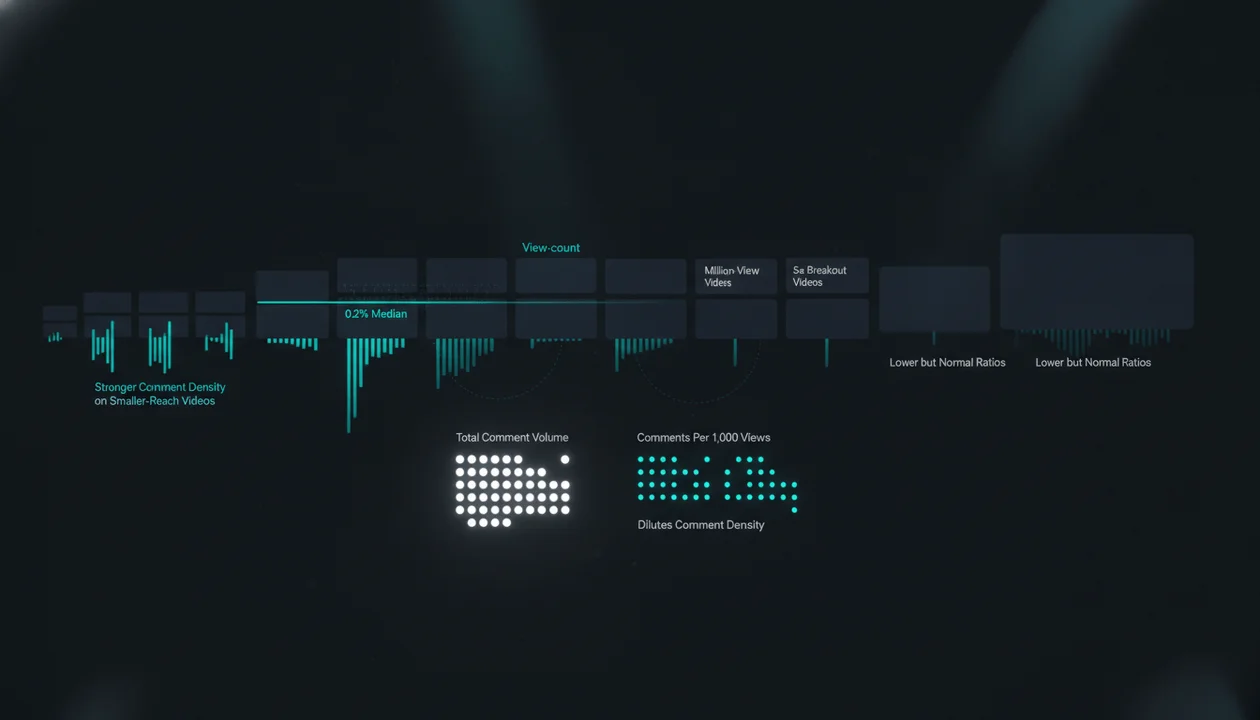
A good YouTube comment-to-view ratio for mature long-form videos is roughly 0.2%, based on OverseerOS data.
We analyzed 3,521 mature long-form videos across 91 public YouTube channels. Because a recorded zero comment count can be ambiguous in public data, our primary benchmark uses the 3,233 videos across 90 channels with positive public comment counts.
For those videos:
- 10th percentile: 0.051%
- 25th percentile: 0.093%
- Median: 0.203%
- 75th percentile: 0.469%
- 90th percentile: 1.039%
That means a practical long-form benchmark is:
| Comment-to-view ratio | Interpretation in this study |
|---|---|
| Below 0.05% | Very low relative to the positive-comment cohort |
| 0.05% to 0.10% | Below typical |
| 0.10% to 0.20% | Lower-middle range |
| Around 0.20% | Typical |
| 0.30%+ | Above median |
| 0.50%+ | Roughly top-quarter territory |
| 1%+ | Roughly top-10% territory |
| 2%+ | Rare |
In simpler terms:
About 2 comments per 1,000 views was typical. Around 5 comments per 1,000 was strong. Around 10 comments per 1,000 was top-decile territory.
But the biggest finding was not the benchmark.
It was this:
Videos with more views generally had lower comment-to-view ratios.
Videos below 10,000 views had a median comment rate of:
0.610%.
Videos with at least 1 million views:
0.089%.
And videos performing at least:
5x their channel-year baseline
had a median comment rate of only:
0.137%.
Videos performing below baseline had a higher median:
0.263%.
So a high comment rate does not automatically mean a video is more viral.
Comment rate measures:
conversation density.
It does not directly measure:
reach.
Key Findings
| Finding | OverseerOS result |
|---|---|
| Full mature long-form cohort | 3,521 videos |
| Public channels | 91 |
| Videos with positive comment counts | 3,233 |
| Channels with positive-comment videos | 90 |
| Recorded zero-comment videos | 288 |
| Primary median comment rate | 0.203% |
| 25th percentile | 0.093% |
| 75th percentile | 0.469% |
| 90th percentile | 1.039% |
| Median comments per 1,000 views | 2.03 |
| 75th percentile comments per 1,000 | 4.69 |
| 90th percentile comments per 1,000 | 10.39 |
| Videos at 0.1%+ | 73.0% |
| Videos at 0.2%+ | 50.4% |
| Videos at 0.5%+ | 23.4% |
| Videos at 1%+ | 10.6% |
| Videos at 2%+ | 5.3% |
| Equal-channel median | 0.206% |
| Recent 90-730 day median | 0.216% |
| 5x+ breakout median comment rate | 0.137% |
| Million-view median comment rate | 0.089% |
The direct answer is:
For mature long-form YouTube videos, around 0.2% comments per view was typical in this study. Around 0.5% was strong, and around 1% was uncommon enough to place a video near the top decile of the positive-comment cohort.
What Is a YouTube Comment-to-View Ratio?
The formula is:
Comment-to-view ratio =
Comments
÷
Views
×
100
Example:
A video receives:
100,000 views
and:
200 comments.
Then:
200 ÷ 100,000 × 100
=
0.20%
The comment-to-view ratio is:
0.20%.
Another useful way to express it is:
Comments per 1,000 views =
Comments
÷
Views
×
1,000
In this example:
200 ÷ 100,000 × 1,000
=
2
So the video generated:
2 comments per 1,000 views.
That is almost exactly the median found in this study.
Is a 0.2% Comment Rate Good on YouTube?
It was approximately typical.
The primary median was:
0.203%.
That equals:
2.03 comments per 1,000 views.
Or roughly:
1 comment for every 493 views.
So if your mature long-form video has around:
0.2%
public comments relative to views, it sits close to the middle of this dataset.
That does not mean:
0.2% is an algorithm threshold.
It is simply a descriptive benchmark.
Is a 0.5% Comment-to-View Ratio Good?
Yes.
A 0.5% comment rate means:
5 comments
per
1,000 views
Only:
23.4%
of qualifying positive-comment videos reached at least:
0.5%.
The 75th percentile was:
0.469%.
So:
0.5%
was approximately top-quarter territory.
Is a 1% Comment Rate Good?
It was unusually strong.
A 1% rate means:
10 comments per 1,000 views.
Only:
10.6%
of positive-comment videos reached at least 1%.
The 90th percentile was:
1.039%.
So a mature long-form video around:
1%
was approximately top-decile territory in this cohort.
Is a 2% YouTube Comment Rate Good?
It was rare.
Only:
5.3%
of the positive-comment videos reached:
2% or higher.
That means roughly:
1 in 19
qualified videos had at least:
20 comments per 1,000 views.
But rare does not automatically mean:
better reach.
That distinction becomes extremely important later.
How Many Comments per 1,000 YouTube Views Is Good?
This may be the easiest way to use the benchmark.
Median
2.03 comments per 1,000 views
75th percentile
4.69 comments per 1,000
90th percentile
10.39 comments per 1,000
So a practical table is:
| Comments per 1,000 views | Approximate interpretation |
|---|---|
| Under 0.5 | Low |
| 1 | Below median |
| 2 | Typical |
| 3 | Above median |
| 5 | Strong |
| 10+ | Top-decile territory |
These are descriptive ranges from this dataset.
They are not universal YouTube requirements.
How Many Comments Should 10,000 Views Get?
At the primary median of:
0.203%
a 10,000-view video would correspond to approximately:
10,000 × 0.00203
=
20.3
So:
about 20 comments.
At the 75th percentile:
10,000 × 0.00469
=
46.9
About:
47 comments.
At the 90th percentile:
approximately:
104 comments.
How Many Comments Should 100,000 Views Get?
At the median:
203 comments.
At the 75th percentile:
469 comments.
At the 90th percentile:
approximately:
1,039 comments.
Again, these are simple translations of the study ratios.
They are not quotas.
How Many Comments Should 1 Million Views Get?
Using the overall primary median:
approximately:
2,030 comments.
But that is where the simple calculation becomes misleading.
Videos with at least:
1 million views
had a much lower actual median comment rate:
0.089%.
At exactly 1 million views, that corresponds to:
890 comments.
That is less than half the count predicted by the overall 0.203% benchmark.
Why?
Because comment rate changes substantially with reach.
Finding 1: Comment Rate Fell Dramatically as Views Increased
This was one of the strongest patterns in the study.
| Video views | Videos | Channels | 25th percentile | Median | 75th percentile |
|---|---|---|---|---|---|
| Under 10K | 845 | 54 | 0.289% | 0.610% | 1.429% |
| 10K-100K | 821 | 70 | 0.121% | 0.259% | 0.467% |
| 100K-1M | 942 | 72 | 0.089% | 0.150% | 0.264% |
| 1M+ | 625 | 55 | 0.059% | 0.089% | 0.139% |
Look at the medians.
Under 10K views
0.610%.
10K-100K
0.259%.
100K-1M
0.150%.
1M+
0.089%.
The typical sub-10K video had a comment rate almost:
6.9x
higher than the typical million-view video.
That is a huge difference.
A Million-View Video Does Not Need a 0.5% Comment Rate
Suppose a million-view video receives:
900 comments.
Comment rate:
900 ÷ 1,000,000 × 100
=
0.09%
Against the overall benchmark:
that may look low.
Against the actual million-view subgroup:
it is almost exactly median.
This is why universal comment benchmarks fail.
Why Does Comment Rate Fall as Reach Increases?
The study is observational, so we cannot prove the cause.
But one plausible mechanism is audience expansion.
A smaller video's early or limited audience may be:
- More loyal
- More invested
- More familiar with the creator
- More motivated to discuss the topic
A larger breakout can reach:
- Casual viewers
- First-time viewers
- Search viewers
- Broad recommendation audiences
- People interested in only that one topic
Views can expand much faster than commenting behavior.
The result is:
more total comments
but:
fewer comments per view.
A Lower Comment Rate Can Still Mean Far More Conversation
Consider two videos.
Video A
Views:
10,000
Comment rate:
1%.
Comments:
100
Video B
Views:
1,000,000
Comment rate:
0.1%.
Comments:
1,000
Video B has a comment rate:
10x lower.
Yet it generated:
10x more comments.
The ratio measures:
density.
The raw count measures:
scale.
You need both.
Finding 2: Comment Rate Had a Negative Relationship With Views
Across the positive-comment mature cohort, the relationship between:
log view count
and:
comment-to-view ratio
was:
r = -0.358.
That is a moderate negative descriptive relationship.
As view scale increased:
comment density generally decreased.
This closely mirrors what we found in our YouTube like-to-view ratio study.
But the comment-rate decline was especially pronounced.
Finding 3: Breakout Videos Had Lower Comment Rates
This is where the article gets especially interesting.
We compared videos with their own channel-year view baseline.
Each video was grouped by relative performance.
| Relative performance | Videos | Median comment rate |
|---|---|---|
| Below 1x baseline | 1,451 | 0.263% |
| 1x-2x | 834 | 0.184% |
| 2x-5x | 419 | 0.164% |
| 5x+ | 311 | 0.137% |
The strongest view outliers had:
lower
comment-to-view ratios.
Below-normal videos
Median:
0.263%.
5x+ breakouts
0.137%.
That is almost:
48% lower.
Does a High Comment Rate Make a YouTube Video Viral?
This study does not support that simple conclusion.
A video can be:
highly discussed
without receiving exceptional reach.
And a video can become:
a massive reach outlier
while generating fewer comments per view.
That means you should not use comment rate as:
a virality score.
A 5x Breakout With a 0.14% Comment Rate Can Be Excellent
Imagine a channel normally gets:
20,000 views.
New video:
100,000 views.
That is:
5x normal.
Comments:
140.
Comment rate:
140 ÷ 100,000 × 100
=
0.14%
Someone using a universal 0.5% target may conclude:
Engagement is terrible.
But the video is doing:
five times normal reach.
That is a major result.
The better diagnosis is:
Reach expanded dramatically while comment density declined.
That is much more informative.
Finding 4: High Comment Rate Can Belong to an Underperforming Video
Now reverse the example.
Channel normally gets:
50,000 views.
New video:
10,000 views.
Comments:
100.
Comment rate:
1%.
Top-decile engagement density.
But view performance:
10K ÷ 50K
=
0.2x
The video reached only:
20% of normal.
Was it successful?
It depends on your goal.
It may have:
- Deeply engaged a small audience
- Reached the wrong audience
- Had weak packaging
- Targeted a niche subject
- Failed distribution despite strong discussion
The high comment rate alone cannot answer the question.
The Better Two-Axis Model
Use:
Axis 1: Reach
Measure:
- Views
- Views at a fixed age
- Channel-relative performance
- Breakout multiple
Axis 2: Conversation density
Measure:
- Comments/views
- Comments per 1,000 views
Then classify videos.
High Reach + High Comment Rate
Potentially exceptional.
The video expands and remains highly discussable.
High Reach + Lower Comment Rate
Common breakout pattern.
Broad distribution may dilute comment density.
Low Reach + High Comment Rate
Strong community response but limited reach.
Potentially valuable for:
- Loyal audience topics
- Community development
- Deep niche content
Low Reach + Low Comment Rate
Likely deserves investigation.
But you still need:
- CTR
- Retention
- Topic context
- Traffic sources
before diagnosing why.
Comment Rate Is Not Engagement Rate
Comment rate is:
Comments
÷
Views
A broader public YouTube engagement rate is often calculated as:
Likes + comments
÷
Views
Those metrics should not be treated as interchangeable.
Our existing YouTube engagement-rate benchmark study found that likes account for most of the visible engagement total.
Comments happen at a much lower frequency.
That is why a:
0.2% comment rate
can be perfectly normal even when total visible engagement is several percentage points.
Finding 5: Comments Were Much Rarer Than Likes
Among videos with positive comments and positive likes, the median video generated approximately:
7.48 comments per 100 likes.
That is roughly:
1 comment for every 13 likes.
This explains why comment-rate benchmarks look so small.
A difference between:
0.1%
and:
0.3%
may look trivial.
But it represents:
3x as many comments per view.
The Math of Small Comment Percentages
At:
100,000 views
0.05%
50 comments.
0.10%
100 comments.
0.20%
200 comments.
0.50%
500 comments.
1%
1,000 comments.
So small-looking percentages can represent substantial conversation.
Finding 6: Half of Videos Reached About 0.2%
Threshold distribution among the positive-comment cohort:
| Comment rate | Videos at or above threshold |
|---|---|
| 0.05% | 90.2% |
| 0.10% | 73.0% |
| 0.20% | 50.4% |
| 0.30% | 37.9% |
| 0.50% | 23.4% |
| 1.00% | 10.6% |
| 2.00% | 5.3% |
The:
0.20%
threshold is particularly useful.
Almost exactly half of the positive-comment videos:
50.4%
reached it.
That independently confirms the:
0.203% median.
Is 0.1% a Bad YouTube Comment Rate?
It was below median.
But:
73%
of positive-comment videos still reached at least 0.1%.
At:
1 comment per 1,000 views
you are in the lower half of the distribution.
Whether that is concerning depends heavily on:
- View scale
- Channel baseline
- Video topic
- Video age
For a million-view video:
0.1% was close to typical.
For a sub-10K video:
it was low relative to that group's median.
Is 0.3% Good?
Yes.
Only:
37.9%
of the positive-comment cohort reached at least:
0.3%.
That puts it comfortably above the overall median.
Is 0.5% Good?
Strong.
Roughly:
23.4%
reached it.
That is approximately:
top-quarter territory.
Is 1% Good?
Very strong for a mature long-form video.
Only:
10.6%
reached it.
But remember:
million-view videos had a median of only:
0.089%.
Context still wins.
Comment Rate by View Scale
Here is the benchmark I would actually use.
Under 10,000 views
25th percentile:
0.289%.
Median:
0.610%.
75th:
1.429%.
10,000 to 100,000 views
25th:
0.121%.
Median:
0.259%.
75th:
0.467%.
100,000 to 1 million views
25th:
0.089%.
Median:
0.150%.
75th:
0.264%.
1 million+ views
25th:
0.059%.
Median:
0.089%.
75th:
0.139%.
This is far more actionable than one universal benchmark.
What Is a Good Comment Rate for a Million-View Video?
Based on this cohort:
around 0.09% was typical.
A rough range:
- 0.06%: lower quartile
- 0.09%: median
- 0.14%: upper quartile
That translates into approximately:
600 to 1,400 comments per million views
around the central 50% range.
Again, actual public counts can vary enormously.
What Is a Good Comment Rate for a 100K-View Video?
For videos between 100K and 1M views:
median comment rate:
0.150%.
At exactly:
100,000 views
that corresponds to:
150 comments.
Upper-quartile rate:
0.264%.
Approximately:
264 comments per 100K views.
What Is a Good Comment Rate Under 100K Views?
For the:
10K-100K
group:
median:
0.259%.
That equals:
2.59 comments per 1,000 views.
The upper quartile started around:
0.467%.
Why Small Videos Can Have Huge Comment Rates
Suppose a loyal audience of 500 people watches quickly.
50 leave comments.
Views:
500.
Comments:
50.
Rate:
10%.
Now the same video reaches:
50,000 viewers/views
but finishes with:
300 comments.
Total comments grew:
6x.
Yet the ratio becomes:
300 ÷ 50,000
=
0.6%
The video gained reach.
The percentage collapsed.
That is why percentages without scale can mislead you.
Finding 7: Channel-Weighted Results Confirmed the Benchmark
Some channels contribute more videos than others.
So we calculated:
one median comment rate for every channel
and gave all channels one equal vote.
Across:
90 channels
the distribution was:
25th percentile channel median
0.095%.
Median channel
0.206%.
75th percentile
0.385%.
The pooled-video median was:
0.203%.
The equal-channel result:
0.206%.
Nearly identical.
That makes the 0.2% headline benchmark more robust.
Finding 8: Recent Videos Produced Almost the Same Result
We also restricted the mature cohort to videos approximately:
90 to 730 days old.
That produced:
2,277 videos across 84 channels.
Results:
25th percentile
0.102%.
Median
0.216%.
75th percentile
0.469%.
Compare:
Full positive-comment cohort median:
0.203%.
Recent cohort:
0.216%.
Very close.
So the main benchmark was not simply being driven by very old YouTube videos.
What Is a Good Comment Rate in the First 24 Hours?
We separately analyzed recent tracked long-form uploads with a public snapshot between:
20 and 28 hours
after publication.
For each video, we selected the snapshot closest to:
24 hours.
The full snapshot sample contained:
88 videos across 60 channels.
Of those:
76
had a positive captured comment count.
Median snapshot age:
24.69 hours.
Among the positive-comment subset:
25th percentile
0.092%.
Median
0.171%.
75th percentile
0.306%.
90th percentile
0.450%.
So around the first day:
0.17%
was the median in this smaller exploratory cohort.
Do Not Compare a Brand-New Video With a Mature Benchmark Blindly
A new upload at:
0.15%
after 24 hours
should not automatically be judged against:
0.203%
from mature videos.
Different lifecycle stages can have different audience composition and engagement patterns.
For first-day performance:
use first-day comparisons.
For mature videos:
use mature comparisons.
The same principle applies to views.
Our first-24-hour YouTube views study uses fixed-age snapshots for exactly this reason.
Does Asking for Comments Increase Comment Rate?
It can change viewer behavior, but this study did not experimentally test calls to action.
We cannot responsibly claim:
Ask one question and your comment rate increases by X%.
Different creators use:
- Questions
- Pinned comments
- Community prompts
- Controversial topics
- Direct comment CTAs
with very different audiences.
The study measures:
the outcome.
It does not isolate:
the CTA that caused it.
What Kind of Videos Naturally Generate More Comments?
Public ratio data cannot tell us exactly why a viewer commented.
But conceptually, videos are more commentable when viewers have something meaningful to contribute.
Examples include:
- A choice
- A disagreement
- A personal experience
- A prediction
- A question
- A controversial interpretation
- A ranking
- A community identity
- A request for advice
- A strong emotional reaction
Compare:
Here's how to change one software setting.
with:
Which AI video model actually looks the most real?
The second naturally gives the audience something to respond to.
But a more commentable idea is not automatically a more viewable idea.
“Talkable” and “Watchable” Are Different
This is one of the most useful distinctions for creators.
A topic can be:
highly watchable
but not generate much discussion.
Another can be:
highly discussable
but have narrow appeal.
Your strategic goal determines which matters.
If you want maximum reach
Prioritize:
- Demand
- Packaging
- Audience fit
- Retention
If you want community depth
Comments may matter more as a diagnostic.
If you want both
Look for videos that achieve:
high relative reach + high comment density.
Those are especially interesting.
Comments Can Reveal More Than the Ratio
A raw comment count does not tell you:
what people said.
One video can receive 500 comments saying:
Great video!
Another can receive 200 detailed questions exposing:
- New topic demand
- Viewer confusion
- Objections
- Follow-up opportunities
- Strong emotions
The second comment section may contain much more strategic value.
So comment analysis has two layers.
Quantitative
How many comments relative to views?
Qualitative
What are viewers actually telling you?
Both matter.
A High Comment Rate With Negative Sentiment Is Still a High Comment Rate
This sounds obvious.
But it matters.
The formula:
Comments ÷ views
does not distinguish:
- Praise
- Criticism
- Debate
- Confusion
- Questions
- Spam
- Anger
So a high rate does not automatically mean:
positive audience satisfaction.
It means:
a lot of visible conversation relative to view volume.
Comment Rate Is Not Retention
A viewer can:
- Watch the whole video
- Love it
- Never comment
Another can:
- Watch 90 seconds
- Disagree strongly
- Leave a long comment
So comment rate cannot substitute for:
- Average view duration
- Average percentage viewed
- Watch time
Those are different behaviors.
Comment Rate Is Not CTR
CTR happens before the view.
Comments happen after at least some viewing.
A thumbnail can have:
excellent CTR
but the video generates few comments.
Or:
weak CTR
with highly engaged viewers among those who do click.
Again, use the correct metric for the question.
Comment Rate Is Not Subscriber Conversion
A viewer commenting does not necessarily subscribe.
A viewer subscribing does not necessarily comment.
Do not treat all forms of engagement as interchangeable.
The Right Metric for Each Question
| Question | Better metric |
|---|---|
| Did people click? | CTR |
| Did they keep watching? | Retention / watch time |
| Did the video travel beyond normal? | Relative views |
| Did viewers visibly discuss it? | Comment rate |
| Did viewers express lightweight approval? | Like rate |
| Did the channel grow? | Subscriber conversion |
| Was this video a breakout? | Channel-relative view multiple |
No single number tells the whole story.
The Comment-Rate Trap
Imagine:
Video A
Views:
15,000
Comments:
150
Rate:
1%.
Video B
Views:
300,000
Comments:
600
Rate:
0.2%.
Which did better?
If you optimize:
comment density
Video A.
If you optimize:
reach
Video B.
If the channel normally gets:
20,000 views
then Video B is also:
15x normal.
That may be a much more important strategic signal.
Use Comments to Understand Why, Not Just Whether
Suppose Video B became a:
15x outlier.
Its 600 comments can help explain:
- What viewers loved
- What confused them
- What they want next
- Which part of the title attracted them
- What expectation the thumbnail created
- Which follow-up topics exist
The raw 0.2% ratio tells you very little compared with the content of those comments.
How to Benchmark Your Own Comment Rate
Take your last:
10 to 20 comparable long-form videos.
Record:
| Video | Views at fixed age | Comments | Comment rate |
|---|---|---|---|
| 1 | |||
| 2 | |||
| 3 | |||
| 4 | |||
| 5 | |||
| 6 | |||
| 7 | |||
| 8 | |||
| 9 | |||
| 10 |
Then calculate:
Median comment rate
Do not use only the average.
One controversial video can distort it heavily.
Then Calculate Relative View Performance
Relative view performance =
Video views
÷
Median views of comparable videos
Now you can build a matrix.
| Low comment rate | High comment rate | |
|---|---|---|
| Low reach | Weak discussion + weak reach | Core-audience conversation |
| High reach | Broad breakout | Potentially exceptional |
This tells you far more than:
My comment rate is 0.4%. Is that good?
A Better Benchmarking Hierarchy
First
Your own comparable videos.
Second
Videos at a similar view scale.
Third
Videos at a similar age.
Fourth
Similar format and audience.
Fifth
Global benchmark.
This study should be:
context.
Your channel's own history should be:
the primary benchmark.
How to Find Comment-Rich Competitor Videos
Use the free OverseerOS YouTube Channel Analyzer to establish a competitor's normal performance first.
Then identify videos with:
- High relative views
- High comment counts
- Unusual topic performance
Do not simply sort by:
most comments.
A giant channel will naturally dominate.
Instead ask:
Which video generated unusual discussion relative to the channel and its reach?
That can reveal:
- Audience pain
- Polarizing ideas
- Unanswered questions
- Strong community topics
- Follow-up demand
The Best Competitor Research Sequence
Establish normal views
→
Find 2x / 5x / 10x outliers
→
Calculate comment rate
→
Read the comment section
→
Identify recurring viewer language
→
Extract unmet demand
→
Create an original video angle
The key is:
outlier first, comments second.
Why?
Because a highly commented video with weak reach may reveal community depth.
A highly commented breakout can reveal:
depth + demand.
Those are especially valuable.
How This Relates to Like-to-View Ratio
Our YouTube like-to-view ratio study found a mature long-form median of roughly:
3%.
Comment rate:
roughly:
0.2%.
So comments are much less frequent.
That is expected from the observed data.
The median comment-to-like relationship was approximately:
7.5 comments per 100 likes.
This means you should never benchmark:
likes
and:
comments
using the same percentage expectations.
How This Relates to Overall Engagement Rate
If your public engagement formula is:
(likes + comments) ÷ views
then likes will usually dominate the total.
That can hide a major difference.
Two videos can both have:
3% total public engagement
while one gets much more discussion.
Example:
Video A
Likes:
2.9%.
Comments:
0.1%.
Total:
3%.
Video B
Likes:
2%.
Comments:
1%.
Total:
3%.
Same combined engagement rate.
Very different audience behavior.
That is why comments deserve their own benchmark.
Comments per 1,000 Views May Be Easier Than Percentages
A percentage like:
0.203%
does not feel intuitive.
Instead think:
2 comments per 1,000 views.
Then:
Typical
2 per 1,000.
Strong
Around 5 per 1,000.
Top-decile territory
Around 10 per 1,000.
That is much easier to monitor.
The Comment Benchmark Card
For mature long-form videos in this study:
0.05% = 0.5 comments per 1,000 views

0.10% = 1 per 1,000

0.20% = 2 per 1,000

0.30% = 3 per 1,000

0.50% = 5 per 1,000

1.00% = 10 per 1,000
Keep this card.
But always pair it with:
view scale.
Example: 50K-View Video
Views:
50,000.
0.1%
50 comments.
0.2%
0.5%
1%
A 250-comment video at 50K views would sit around:
0.5%
which is strong relative to the full mature cohort.
Example: Million-View Video
Views:
1,000,000.
Comments:
1,000.
Rate:
0.1%.
That looks modest against the full benchmark.
But the million-view cohort median was:
0.089%.
So this is actually around normal for that reach scale.
Again:
context completely changes the interpretation.
Should You Try to Maximize Comments?
Not necessarily.
A creator could increase comment rate by making:
- More controversial claims
- More divisive videos
- More direct prompts
- More argument-driven content
That does not automatically create:
- Better audience satisfaction
- More reach
- More revenue
- More trust
- Better long-term channel positioning
Optimize for:
the business and audience outcome.
Use comments as one diagnostic.
When Comment Rate Matters More
It may be especially useful when your objective includes:
Community building
You want viewers talking to each other and the creator.
Product research
Questions and objections can reveal demand.
Personal brands
Discussion can deepen audience connection.
Educational channels
Questions expose where explanations were incomplete.
Opinion content
Comments can show where ideas create debate.
New topic discovery
Repeated viewer requests can become future videos.
When It Matters Less
Comment rate may be less central for:
Pure utility tutorials
The viewer wants one answer and leaves.
Ambient content
Music, relaxation, background viewing.
Highly searchable reference content
The primary job is solving a narrow problem.
Massive broad-reach entertainment
Millions may watch passively without discussing.
This is another reason niche and format context matter.
What If Your Comment Rate Is Falling?
Do not immediately assume the audience cares less.
Check whether:
views are expanding.
If:
Views ↑↑↑
Comments ↑
Comment rate ↓
you may simply be reaching a broader audience.
If:
Views ↓
Comments ↓
Comment rate ↓
that is a different pattern.
Always inspect numerator and denominator.
What If Comment Rate Is Rising?
Again, ask why.
Good scenario
Views rise and comment rate rises.
Very strong.
Different scenario
Views collapse while comments remain stable.
The rate rises mechanically.
A percentage can improve while the video's overall reach gets worse.
That is why ratios can be dangerous when viewed alone.
How We Analyzed the Data
This study used public YouTube video and channel observations captured through OverseerOS research workflows.
The analysis was frozen on:
September 6, 2026.
The latest public video observation available during the research was approximately:
08:21 UTC.
Channel Qualification
A channel needed:
- At least 20 mature long-form videos
- Strong public-catalog coverage
- Captured public video count approximately 80% to 120% of its latest reported public video count
This was designed to reduce the risk of analyzing only a tiny fragment of a channel.
Video Qualification
Videos needed:
- Duration greater than three minutes
- Age of at least approximately 90 days
- Positive public view count
This produced:
3,521 mature long-form videos across 91 channels.
Why the Primary Benchmark Uses 3,233 Videos
The full cohort contained:
288 videos with a recorded comment count of zero.
A zero can represent genuinely no visible comments, but in a public research dataset it can also be affected by comment availability and channel/video settings.
We therefore report both views of the data.
If every recorded zero is treated literally
Median:
0.175%.
25th percentile:
0.071%.
75th:
0.436%.
90th:
0.981%.
Positive-comment primary cohort
3,233 videos across 90 channels.
Median:
0.203%.
25th:
0.093%.
75th:
0.469%.
90th:
1.039%.
The conclusions are very similar either way.
That gives us more confidence in the practical:
roughly 0.2%
benchmark.
Primary Formula
For each positive-comment video:
Comment rate =
Latest public comment count
÷
Latest public view count
×
100
We then calculated:
- Percentiles
- Threshold frequencies
- View-scale buckets
- Channel-level medians
- Relative-performance groups
- Recent-video sensitivity checks
View-Scale Analysis
Videos were grouped by latest public views:
- Under 10K
- 10K to 100K
- 100K to 1M
- 1M+
The median comment rate declined in every successive reach band.
Channel-Relative Performance Analysis
We compared each video's current public views with the median views of videos from:
- The same channel
- The same publication year
Channel-year groups needed at least:
five qualifying videos.
The videos were then grouped into:
- Below 1x
- 1x-2x
- 2x-5x
- 5x+
This allowed us to test:
Do stronger view outliers also generate more comments per view?
They did not.
Equal-Channel Sensitivity Test
To prevent prolific channels from dominating the result, we calculated:
one median comment rate per channel.
Then each of the:
90 channels with positive-comment videos
received equal weight.
The resulting median:
0.206%.
Very close to the pooled:
0.203%.
Recent-Video Sensitivity Test
We restricted the primary cohort to videos approximately:
90 to 730 days old.
That produced:
2,277 videos across 84 channels.
Median:
0.216%.
Again, very close to the main result.
First-24-Hour Exploratory Study
We separately selected recent long-form video snapshots between:
20 and 28 hours after publication.
The snapshot closest to 24 hours was retained for each video.
Full sample:
88 videos across 60 channels.
Positive-comment subset:
76 videos.
Median selected snapshot age:
24.69 hours.
Positive-comment median:
0.171%.
This analysis is secondary because the sample is much smaller.
Limitations
Public comments are not a complete measure of community engagement
Not every viewer who cares comments.
Comment count does not reveal sentiment
A comment can be:
- Positive
- Negative
- Neutral
- A question
- A correction
- Spam
- Debate
The rate treats all visible comments as comments.
Public comments can be affected by moderation and availability
This is why recorded zero-comment videos were handled cautiously.
Views are not unique viewers
The denominator is public views.
Not necessarily unique people.
Older and newer videos have different lifecycles
The primary cohort requires maturity, and the 90-730 day sensitivity result was similar, but videos were not all exactly the same age.
Different niches produce different discussion behavior
This study does not claim every niche should target exactly 0.2%.
Creator behavior differs
Some creators actively ask questions or encourage discussion.
Others do not.
The study is observational
It cannot prove comments caused or prevented reach.
The cohort is selected
These channels had mature long-form catalogs and strong public data coverage.
This is not a random census of every YouTube video.
Shorts were excluded
The primary study focused on videos longer than:
three minutes.
Do not automatically apply the benchmark to Shorts.
We cannot see private analytics
For competitor videos we cannot see:
- Impressions
- CTR
- Retention
- Watch time
- Traffic sources
- Unique viewers
- Subscriber conversion
Public comments are only one layer of performance.
What the Data Actually Says
The strongest defensible conclusion is:
Across 3,521 mature long-form videos from 91 high-coverage public YouTube channels, the 3,233 videos with positive public comment counts had a median comment-to-view ratio of 0.203%, or about 2 comments per 1,000 views. The 75th percentile was 0.469% and the 90th percentile 1.039%. Including recorded zero-comment videos lowered the overall median only modestly to 0.175%.
And the most important secondary result is:
Comment rate declined sharply as reach increased. Videos below 10,000 views had a 0.610% median comment rate, compared with 0.089% among million-view videos. Channel-relative 5x breakouts also had a lower median comment rate, 0.137%, than below-baseline videos at 0.263%.
That means:
A high comment-to-view ratio is not automatically evidence of stronger YouTube performance.
Final Verdict
What is a good comment-to-view ratio on YouTube?
For mature long-form videos in this OverseerOS study:
around 0.2% was typical.
Use these rough reference points:
0.05%
Low.
About:
0.5 comments per 1,000 views.
0.10%
Below median.
1 comment per 1,000 views.
0.20%
Typical.
2 comments per 1,000 views.
0.30%
Above median.
0.50%
Strong.
Around top-quarter territory.
1%
Very strong relative to the overall cohort.
Around top-decile territory.
2%
Rare.
But do not make:
1% comment rate
your universal target.
A million-view video had a median of only:
0.089%.
A 5x channel breakout:
0.137%.
So if a video goes from:
20K normal views
to:
500K
while comment rate falls from:
0.5%
to:
0.15%,
that does not automatically mean engagement failed.
The video may simply have reached:
a much larger, colder audience.
Use comment rate to answer:
How dense is the conversation?
Use relative views to answer:
How far did this video travel?
Use the comments themselves to answer:
Why are viewers talking?
Those three questions together are far more valuable than trying to force every video above one magic percentage.
Analyze any public YouTube channel with OverseerOS, establish what normal performance looks like, identify the videos that escape that baseline, and use their comments to understand what the audience wants next.
Frequently Asked Questions
What is a good comment-to-view ratio on YouTube?
Around 0.2% was typical among the 3,233 mature long-form videos with positive comment counts in the OverseerOS study.
What is the average YouTube comment rate?
The primary study uses the median because ratios are skewed. The median was 0.203%. The arithmetic mean was higher at 0.700%.
How many comments per 1,000 YouTube views is good?
Around 2 comments per 1,000 views was typical. Around 5 per 1,000 was strong, and around 10 per 1,000 was near top-decile territory.
Is a 0.1% YouTube comment rate good?
It was below the study median but still common. A 0.1% rate equals one comment per 1,000 views.
Is 0.2% a good comment rate?
Yes. It was almost exactly the median.
Is 0.3% good?
Yes. Only 37.9% of positive-comment videos reached at least 0.3%.
Is a 0.5% comment rate good on YouTube?
Yes. Only 23.4% reached 0.5%+, making it approximately top-quarter territory.
Is 1% comments-to-views good?
It was unusually high. Only 10.6% of videos reached 1% or better.
Is a 2% comment rate good?
It was rare. Only 5.3% of the positive-comment cohort reached 2%.
How many comments should 1,000 YouTube views get?
At the study median, approximately two comments.
How many comments should 10,000 views get?
At the median rate, approximately 20 comments.
How many comments should 100,000 YouTube views get?
At the overall median, about 203 comments.
How many comments should 1 million YouTube views get?
Using the overall median would imply roughly 2,030 comments, but actual million-view videos in the study had a much lower median rate of 0.089%, or about 890 comments per million views.
What is a good comment rate for a million-view video?
Around 0.09% was typical in this cohort. The central 50% ranged approximately from 0.059% to 0.139%.
Why do million-view videos have lower comment rates?
One plausible explanation is audience expansion. Views can grow faster than comments as a video reaches broader and less-engaged audiences, although this observational study cannot establish the exact cause.
Do viral YouTube videos have more comments per view?
Not necessarily. 5x+ channel-relative outliers had a median comment rate of 0.137%, below the 0.263% median for below-baseline videos.
Does a high comment rate mean a video will go viral?
No. The data does not support comment rate as a simple virality predictor.
Can a viral video have a low comment rate?
Yes. Strong reach outliers commonly had lower comment density in this study.
Is comment rate more important than views?
They answer different questions. Views measure reach. Comment rate measures visible discussion density.
Is comment rate the same as engagement rate?
No. Comment rate uses comments divided by views. A broader engagement-rate formula often combines likes and comments.
What is a good YouTube engagement rate?
See the OverseerOS YouTube engagement-rate benchmark study for combined public engagement benchmarks.
What is a good YouTube like-to-view ratio?
The separate OverseerOS like-to-view ratio study found a mature long-form median of roughly 3%.
How many comments occur for every 100 likes?
The median positive-engagement video in this cohort generated approximately 7.5 comments per 100 likes.
Is comment rate the same as CTR?
No. CTR measures clicks relative to impressions. Comment rate measures comments relative to views.
Is comment rate the same as audience retention?
No. A viewer can watch without commenting, or comment without watching most of the video.
Does YouTube reward comments?
This study cannot isolate how YouTube's internal recommendation systems weight comments. It should not be used to claim that reaching a specific comment-rate threshold triggers distribution.
Should I ask viewers to comment?
You can invite relevant discussion, but this study did not experimentally test comment CTAs and cannot quantify their effect.
What question should I ask viewers to get more comments?
Questions work best when viewers have a meaningful opinion, experience, choice, prediction, or problem to contribute. Avoid asking for comments purely to inflate a metric.
Are lots of comments always positive?
No. Comment count does not distinguish praise, criticism, debate, questions, or other sentiment.
Can negative comments raise the comment-to-view ratio?
Yes. The mathematical ratio counts public comments regardless of sentiment.
What is a good first-24-hour YouTube comment rate?
In a smaller exploratory sample of recent long-form uploads with positive comments, the median around 24.7 hours was 0.171%.
Should I compare first-day comment rate with mature videos?
Prefer same-age comparisons. A brand-new video and a mature video can have different audience composition and engagement patterns.
Why is median better than average comment rate?
A small number of extremely high ratios can pull the average upward. Median better describes the typical video in a skewed distribution.
What if my comment rate is falling while views rise?
That can happen when reach expands faster than comments. Inspect total comments, relative views, audience mix, and first-party analytics before deciding something is wrong.
What if my comment rate rises while views fall?
The percentage can improve simply because the view denominator fell. Check both raw reach and engagement density.
Should I optimize for comment rate?
Not in isolation. Optimize for the audience and business outcome you want, then use comment rate as one diagnostic.
How do I calculate YouTube comment-to-view ratio?
Divide comments by views and multiply by 100.
How do I calculate comments per 1,000 views?
Divide comments by views and multiply by 1,000.
How should I benchmark competitor comments?
Compare similar-age videos, use channel-relative view baselines, control for view scale, then examine both comment rate and the actual content of the comments.
Can comments help find YouTube video ideas?
Yes. Repeated questions, objections, confusion, and requests in competitor comment sections can reveal unsatisfied audience demand.
Can OverseerOS help analyze YouTube channels?
Yes. OverseerOS Channel Analysis lets you inspect public videos, views, titles, thumbnails, durations, top performers, recent uploads, and channel patterns so unusually strong videos can be identified before their comments are studied for deeper audience insight.