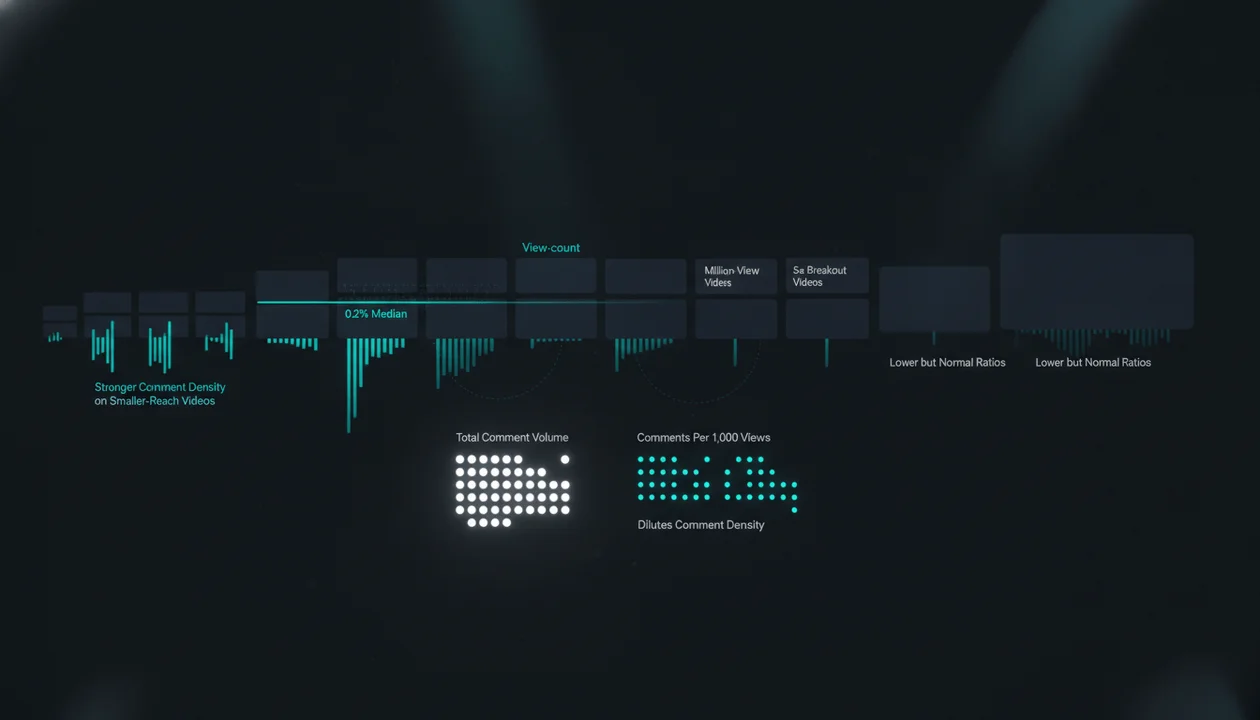

Comments do not appear to be a simple lever that makes a YouTube video get more views.
OverseerOS analyzed 3,521 mature long-form videos across 91 public YouTube channels. Our primary comment-rate benchmark used 3,233 videos with positive public comment counts, and the channel-relative performance analysis matched 2,973 videos across 85 channels.
The result challenges a common creator assumption:
Videos with the highest comment-to-view ratios were not the videos with the strongest view performance.
When we divided matched videos into four equal groups by comment rate:
Lowest comment-rate quartile
Median comment rate:
0.057%
Median channel-relative views:
1.18x baseline
2x+ outlier rate:
31.5%
5x+ breakout rate:
14.4%
Highest comment-rate quartile
Median comment rate:
0.862%
Median channel-relative views:
0.81x baseline
2x+ rate:
14.5%
5x+ rate:
3.5%
That does not mean comments hurt a video.
The more defensible explanation is:
As videos reach larger and broader audiences, views can grow much faster than comments, causing comment density to fall even while total comments increase.
We found exactly that pattern elsewhere:
- Videos under 10K views had a median comment rate of 0.610%
- Million-view videos had a median of only 0.089%
- Below-baseline videos had a median comment rate of 0.263%
- 5x+ channel breakouts had a lower median of 0.137%
- Total comments and total views were still strongly associated, with r = 0.902 on a log scale
So the practical answer is:
Comments are useful audience feedback and community data, but a high comments-per-view ratio is not a reliable public predictor that a YouTube video will get more views or go viral.
Key Findings
| Finding | OverseerOS result |
|---|---|
| Mature long-form videos in full cohort | 3,521 |
| Public channels | 91 |
| Positive-comment videos used for primary ratio research | 3,233 |
| Matched videos in channel-relative analysis | 2,973 |
| Matched channels | 85 |
| Overall positive-comment median | 0.203% |
| Median comments per 1,000 views | 2.03 |
| Correlation: total comments vs total views | 0.902 |
| Correlation: comment rate vs total views | -0.338 |
| Correlation: comment rate vs relative views | -0.038 |
| Lowest-comment quartile median rate | 0.057% |
| Lowest-comment quartile relative views | 1.18x |
| Lowest-comment quartile 2x rate | 31.5% |
| Lowest-comment quartile 5x rate | 14.4% |
| Highest-comment quartile median rate | 0.862% |
| Highest-comment quartile relative views | 0.81x |
| Highest-comment quartile 2x rate | 14.5% |
| Highest-comment quartile 5x rate | 3.5% |
| Million-view median comment rate | 0.089% |
| Under-10K median comment rate | 0.610% |
| 5x+ breakout median comment rate | 0.137% |
The central finding is:
More comments in absolute terms often accompany more views, but more comments per view did not predict more reach.
Do Comments Help YouTube Videos Get More Views?
Public observational data cannot prove that comments themselves cause additional views.
To establish causation, you would need something close to a controlled experiment where two otherwise identical videos received different comment behavior while holding constant:
- Topic
- Title
- Thumbnail
- Viewer mix
- Retention
- Watch time
- Satisfaction
- Competition
- Publication context
That is not possible from public competitor data.
What we can test is:
Do videos with unusually high comment rates also tend to receive unusually high views?
In this dataset:
not reliably.
The highest-comment-rate quartile actually had weaker median channel-relative performance than the lowest-comment-rate quartile.
But that should not be interpreted as:
Fewer comments cause more views.
The ratio itself is affected by the number of views.
Total Comments and Comment Rate Are Different Metrics
Consider two videos.
Video A
Views:
10,000
Comments:
100
Comment rate:
100 ÷ 10,000
=
1%
Video B
Views:
1,000,000
Comments:
1,000
Comment rate:
1,000 ÷ 1,000,000
=
0.1%
Video A has:
10x higher comment density.
But Video B generated:
10x more total comments
and:
100x more views.
Which one has stronger engagement?
That depends on what you mean.
Conversation density
Video A.
Conversation scale
Video B.
Reach
Video B.
These are different questions.
Finding 1: Total Comments Rose Strongly With Total Views
Within the matched research cohort, the correlation between:
log total comments
and:
log total views
was:
0.902.
That is a strong positive relationship.
Videos with more views generally had more comments.
That is not surprising.
A video with:
5 million views
has vastly more opportunities to receive comments than a video with:
5,000 views.
But this does not prove:
comments
→
views
Views also create:
more chances to comment
The final public totals cannot tell us which direction caused which.
Correlation Is Not the Same as Causation
Imagine:
Video 1
10,000 views.
20 comments.
Video 2
100,000 views.
200 comments.
Video 3
1,000,000 views.
2,000 comments.
Comments rise almost perfectly with views.
But comment rate remains:
0.2%
on all three.
The relationship may simply reflect scale.
Now imagine the million-view video gets only:
1,000 comments.
Its comment rate falls to:
0.1%.
The video is still dramatically larger.
This is why raw comments and comment ratios must be separated.
Finding 2: Higher Comment Rates Did Not Mean Higher Relative Views
We ranked 2,973 matched videos by comment-to-view ratio and divided them into quartiles.
| Comment-rate quartile | Median comment rate | Median relative views | 2x+ | 5x+ |
|---|---|---|---|---|
| Lowest | 0.057% | 1.18x | 31.5% | 14.4% |
| Lower-middle | 0.138% | 1.06x | 28.0% | 13.1% |
| Upper-middle | 0.307% | 0.96x | 22.7% | 9.8% |
| Highest | 0.862% | 0.81x | 14.5% | 3.5% |
The pattern was striking.
As comment density increased:
median relative view performance declined.
The lowest-comment-density group had almost:
2x the 5x-breakout frequency
of the highest-comment-density group.
Calculation:
14.4 ÷ 3.5
≈
4.1
Actually, the difference is even larger than 2x:
the low-comment quartile's 5x rate was roughly:
4.1 times
the high-comment quartile's.
That sounds dramatic.
But it still does not prove low comments are beneficial.
Why the Quartile Result Does Not Mean “Comments Hurt”
The denominator is:
views.
A breakout can rapidly expand the denominator.
Suppose a video starts with:
5,000 views
and:
50 comments.
Comment rate:
1%.
Then recommendations expand.
The video reaches:
500,000 views.
Comments rise to:
1,000.
Now the comment rate is:
1,000 ÷ 500,000
=
0.2%
Total comments increased:
20x.
Views increased:
100x.
The ratio fell:
80%.
Nothing about this pattern means the video became worse.
It means:
Reach expanded faster than conversation.
Engagement Dilution
A useful concept is:
engagement dilution
As a video reaches broader audiences, the audience composition can change.
Early viewers may include:
- Subscribers
- Returning viewers
- Core fans
- Highly interested niche viewers
Later distribution may include:
- Casual viewers
- First-time viewers
- Search traffic
- Suggested traffic
- Broader recommendation audiences
These people may still:
- Watch
- Enjoy
- Continue watching
without feeling motivated to comment.
So a video can become:
far more successful
while its:
comments per 1,000 views
fall.
Finding 3: Comment Rate Fell Sharply as View Scale Increased
This is one of the strongest pieces of evidence for the dilution interpretation.
| Video views | Videos | Median comment rate |
|---|---|---|
| Under 10K | 845 | 0.610% |
| 10K-100K | 821 | 0.259% |
| 100K-1M | 942 | 0.150% |
| 1M+ | 625 | 0.089% |
The decline is substantial.
Under 10K
About:
6.1 comments per 1,000 views.
1M+
About:
0.89 comments per 1,000 views.
The smaller-view group had roughly:
0.610 ÷ 0.089
≈
6.9x
the comment density.
That does not mean sub-10K videos were nearly seven times better.
It means their audiences generated far more comments relative to the smaller number of views.
Million-View Videos Often Have “Low” Comment Rates
Suppose you publish a video with:
1 million views
and:
900 comments.
Comment rate:
0.09%.
If you compare it with the overall positive-comment median of:
0.203%
you might think:
My comments are terrible.
But among the:
625 million-view videos
the median was:
0.089%.
So your video would be almost exactly typical for that reach band.
This is why global engagement benchmarks can badly mislead creators.
Finding 4: 5x Breakouts Had Lower Comment Rates Than Underperformers
We also grouped videos according to their view performance relative to the median of the same channel and publication year.
| Relative view performance | Videos | Median comment rate |
|---|---|---|
| Below 1x | 1,451 | 0.263% |
| 1x-2x | 834 | 0.184% |
| 2x-5x | 419 | 0.164% |
| 5x+ | 311 | 0.137% |
This pattern matters.
The videos with the strongest relative reach had:
lower comments per view.
Below-baseline videos
Median:
0.263%.
5x+ breakouts
Median:
0.137%.
That is roughly:
48% lower.
So a breakout can be performing exceptionally well while looking mediocre on a generic comment-rate benchmark.
Example: High Comment Rate, Weak Video Reach
A channel normally gets:
50,000 views.
New video:
10,000 views.
Comments:
100.
Comment rate:
100 ÷ 10,000
=
1%
That is strong conversation density.
But relative views:
10,000 ÷ 50,000
=
0.2x
The video reached only:
20% of normal.
The people who watched may have cared deeply.
But distribution was weak.
Example: Low Comment Rate, Massive Breakout
Same channel.
Normal:
50,000 views.
New video:
500,000 views.
Comments:
700.
Comment rate:
700 ÷ 500,000
=
0.14%
That rate looks much weaker.
Yet:
500,000 ÷ 50,000
=
10x
The video is a massive channel-relative breakout.
Which video should a growth-focused creator study more closely?
Usually:
the 10x breakout.
Finding 5: Video-Level Correlation With Relative Views Was Nearly Zero
There is another important nuance.
Although quartile medians showed a clear pattern, the direct video-level correlation between:
comment rate
and:
log channel-relative views
was only:
-0.038.
That is almost zero.
This tells us something crucial:
Comment rate by itself is a poor linear predictor of how far an individual video will outperform its channel.
Why can that coexist with the quartile result?
Because real YouTube performance is messy.
Within every comment-rate band, there are:
- Flops
- Normal videos
- 2x videos
- Huge outliers
The overall composition shifts across quartiles, but comment rate alone cannot tell you where one specific video will land.
That makes the practical conclusion even stronger:
Do not use comments per view as a prediction score.
The Recent 2024-2026 Sample Showed the Same Pattern
We repeated the quartile analysis using only mature videos published within roughly the last two years.
The recent matched cohort produced:
Lowest comment-rate quartile
Median comment rate:
0.057%.
Median relative views:
1.24x.
2x+ rate:
34.5%.
5x+:
16.2%.
Highest comment-rate quartile
Median comment rate:
0.721%.
Median relative views:
0.76x.
2x+:
14.2%.
5x+:
4.2%.
So the pattern did not disappear when older YouTube eras were removed.
But again:
association is not causation.
Do Comments Matter to the YouTube Algorithm?
The question contains two very different meanings.
Meaning 1
Does viewer behavior matter to YouTube recommendations?
Clearly, viewer response as a whole matters to video performance and recommendation systems.
Meaning 2
Does generating one extra comment mechanically buy a fixed number of extra impressions?
Our public data cannot demonstrate that.
And there is no public threshold in this study such as:
Comment rate reaches 0.5%
↓
Recommendation boost activates
The data actually argues against thinking this way.
Videos with the highest comment density did not have the strongest relative reach.
There Is No “Magic Comment Percentage” in This Dataset
We tested a broad distribution of mature videos.
The median public comment rate was around:
0.2%.
Some videos had:
1%+
and reached narrow audiences.
Others had:
0.1%
and became million-view or 5x breakouts.
There was no obvious threshold where:
everything above this level becomes viral.
That is the wrong mental model.
What Comments Are Actually Good For
Comments can be extremely valuable.
Just not because you should treat them as a magic distribution button.
Comments can reveal:
Audience language
How viewers naturally describe the problem.
Objections
What stops them believing or acting.
Confusion
What the video failed to explain.
Follow-up demand
What they want to see next.
Strong emotions
What parts triggered unusually intense response.
Community identity
What viewers believe about themselves.
Topic opportunities
Which unanswered questions keep repeating.
That qualitative information can be worth far more than the raw comment ratio.
One Useful Comment Can Be Worth More Than 100 Generic Ones
Consider:
Comment A
Great video!
Positive.
Useful as social proof.
But strategically limited.
Comment B
This makes sense for channels with 100K subscribers, but what happens under 10K? Does the ratio work differently?
That single comment gives you:
- A new audience segment
- A follow-up question
- A possible article
- A possible video
- A possible product feature
- Search-intent language
The value of comments is not only:
quantity.
It is:
information.
Comment Count Is Not Comment Quality
A video can have:
5,000 comments
because viewers are arguing about something irrelevant.
Another can have:
300
high-quality comments full of:
- Questions
- Experiences
- Requests
- Objections
The second may contain much more usable audience intelligence.
So creators should measure both:
Quantitative layer
How many comments?
Qualitative layer
What are viewers actually saying?
Comments Can Be Positive or Negative
The comment-to-view ratio does not know sentiment.
A comment can say:
This changed how I think about the topic.
or:
This is completely wrong.
Both count exactly the same in:
comments ÷ views
That means a high comment rate should not automatically be interpreted as:
high viewer satisfaction.
It can mean:
high conversation.
Those are not identical.
Controversy Can Inflate Comments
Suppose a divisive video generates:
2% comment rate.
A calm tutorial generates:
0.1%.
Does that mean the divisive video is:
20x more satisfying?
No.
It may simply be:
more arguable.
This is why optimizing for comments alone can create bad incentives.
You could increase conversation by making content:
- More polarizing
- More provocative
- More inflammatory
- More ambiguous
That does not automatically make the channel healthier.
Comments Are a Community Metric Before They Are a Growth Metric
For many creators, the most useful interpretation is:
Comments show how much visible conversation the video created.
That can matter enormously for:
- Personal brands
- Education
- Opinion channels
- Communities
- Product research
- Membership businesses
- Creator-led companies
But if your primary objective is:
maximum reach
you should not sacrifice:
- Topic demand
- Packaging
- Viewer satisfaction
just to create more comments.
Do Comments Help Small YouTube Channels?
Comments can be valuable for small channels because the creator can often personally:
- Reply
- Learn audience language
- Identify recurring viewers
- Discover topic requests
- Build relationships
But the public data does not support:
Small channel + more comments = guaranteed algorithm boost.
A better goal is:
Get the right viewers talking about the right things.
Should You Ask Viewers to Comment?
You can.
But the question you ask matters.
Weak CTA:
Comment below!
The viewer has no idea what to say.
Stronger:
Which of these three mistakes has cost you the most views?
Now the viewer has:
- A clear prompt
- Personal relevance
- A low-effort response
Even better:
If you've had a video suddenly stop at 5K or 10K views, tell me where it stalled. I want to compare the patterns.
Now the comments can produce:
research data.
The Best Comment CTA Gives the Viewer Something to Contribute
Useful categories include:
Choice
Which option would you choose?
Experience
Has this happened on your channel?
Prediction
Which model do you think wins next year?
Diagnosis
What is the biggest problem you're seeing right now?
Disagreement
Which part do you disagree with?
Follow-up
Which one should I test next?
The goal is not:
inflate the comment counter.
The goal is:
create meaningful audience participation.
Do Replies to Comments Help Views?
Public data in this study does not isolate:
- Creator replies
- Reply timing
- Number of reply threads
- Whether a reply caused another recommendation
So we cannot make a causal claim.
Replying may still be valuable because it can:
- Deepen relationships
- Encourage discussion
- Clarify confusion
- Surface more audience information
That is a community strategy.
Not a proven impression hack from this dataset.
Do Pinned Comments Help Views?
Again, this study did not test pinned-comment status.
Pinned comments can be useful for:
- Asking a follow-up question
- Correcting information
- Linking resources
- Driving discussion
- Clarifying a CTA
But we cannot responsibly assign:
view lift
to the pin itself from public observations.
Do More Comments Mean Better Engagement?
They mean:
more visible discussion in absolute terms.
If you use:
comments ÷ views
they can also indicate:
denser discussion.
But "better engagement" is broader.
It may include:
- Likes
- Comments
- Watch time
- Completion
- Returning viewers
- Shares
- Subscribers
- Conversions
Do not reduce the entire audience relationship to one counter.
Comments vs Likes
Our YouTube like-to-view ratio study found a mature long-form median of roughly:
3% likes per view.
Our comment-to-view ratio study found roughly:
0.2% comments per view.
Comments are far less frequent.
That makes sense.
Clicking Like takes almost no effort.
Writing a comment requires:
- Thought
- Time
- Motivation
So the two engagement signals should not be benchmarked using the same expectations.
Likes vs Comments for Predicting Views
Neither ratio behaved like a clean virality predictor in our studies.
For likes:
higher like-rate quartiles did not produce stronger view performance.
For comments:
the pattern was similar.
That suggests a broader lesson:
Engagement ratios are often outcomes of audience composition and distribution, not simple inputs you can maximize to force reach.
Reach Comes First in the Denominator
Remember:
comment rate =
comments
÷
views
If the denominator explodes:
the ratio can fall.
That makes ratios particularly dangerous during breakouts.
What Happens When a Video Starts Going Viral?
Imagine:
Stage 1
5K views.
50 comments.
Rate:
1%.
Stage 2
50K views.
200 comments.
Rate:
0.4%.
Stage 3
500K views.
750 comments.
Rate:
0.15%.
Stage 4
2M views.
2,000 comments.
Rate:
0.10%.
Total comments rose:
50
→
200
→
750
→
2,000
But the ratio fell:
1%
→
0.4%
→
0.15%
→
0.10%
If you only watch the ratio:
the video looks worse and worse.
If you watch reach:
it is exploding.
This Is Why Engagement Ratios Can Mislead During Virality
A percentage is not inherently a success score.
It is:
a relationship between two moving numbers.
If the denominator changes faster:
the ratio can move opposite to overall success.
This is the same issue we found in our study of whether likes help YouTube videos get more views.
The Better Two-Axis Framework
Judge videos with:
Axis 1: Reach
Use:
- Fixed-age views
- Channel-relative views
- 2x / 5x / 10x outlier status
Axis 2: Conversation
Use:
- Total comments
- Comments per 1,000 views
- Comment quality
- Viewer questions
Now every video falls into one of four useful categories.
High Reach + High Comment Density
Potentially exceptional.
The video reached beyond normal while maintaining unusually strong discussion.
Study:
- Topic
- Packaging
- Comment themes
carefully.
High Reach + Low Comment Density
Often a broad-audience breakout.
The video may be attracting many casual viewers who do not participate in the comments.
Still highly valuable.
Low Reach + High Comment Density
Potentially strong core-community content.
The viewers who arrived cared enough to talk.
The problem may instead be:
- Packaging
- Topic breadth
- Search demand
- Distribution
Low Reach + Low Comment Density
Worth investigating further.
But you still cannot diagnose the reason from comments alone.
The Most Valuable Videos Can Sit in Different Quadrants
A channel might intentionally produce:
Broad reach videos
Designed to bring new people in.
Community videos
Designed for the core audience.
Those videos should not necessarily have the same:
- View goals
- Comment goals
- Conversion goals
A sophisticated channel strategy can use both.
Should You Optimize for Comments or Views?
It depends on the objective.
If your goal is awareness
Prioritize reach.
If your goal is community
Comments may matter more.
If your goal is product research
Comment quality may matter more than comment rate.
If your goal is revenue
Track actual conversion.
If your goal is channel growth
Use:
reach + satisfaction + repeatability.
One metric cannot optimize every objective.
Comments Can Create Better Future Videos
This may be the most valuable indirect way comments help a creator.
A comment does not need to boost the current video's views to create value.
It can help the next video.
Suppose 40 viewers ask:
Does this also work for channels under 10K subscribers?
That can become:
We Analyzed Small YouTube Channels Under 10K Subscribers. Here's What Changes
Now the comment section has created:
- Topic validation
- Audience language
- A specific pain
- A follow-up angle
That can create more future value than trying to manipulate the comment rate of the current upload.
The Comment-to-Content Loop
A strong workflow is:
Publish
↓
Collect comments
↓
Cluster repeated questions
↓
Identify unsatisfied demand
↓
Research the strongest question
↓
Create next video
↓
Repeat
That is a much more defensible way for comments to contribute to growth.
Use Comments as Research Data
For every strong video, classify comments into:
Questions
What viewers still do not understand.
Objections
Why they reject the argument.
Experiences
What actually happened to them.
Requests
What they want next.
Language
How they describe the problem.
Emotion
What created excitement, fear, anger, or surprise.
Alternatives
What tools, creators, or methods they compare.
Those clusters can improve:
- Titles
- Topics
- Hooks
- Scripts
- Offers
- Product positioning
A Comment Can Improve SEO and AEO Research Too
Viewer comments often contain natural-language questions such as:
Is 2% a good like rate?
How many views should I get with 10K subscribers?
Does posting late hurt a video?
Those are exactly the kinds of long-tail questions people also ask:
- Search engines
- YouTube Search
- AI assistants
So comment research can expose:
real question language.
That makes comments valuable far beyond the public engagement percentage.
The Wrong Comment Strategy
Need more views
↓
Need algorithm engagement
↓
Ask everyone to comment anything
↓
More comments
↓
Expect viral boost
Our public data does not support that simplistic model.
The Better Comment Strategy
Deliver useful video
↓
Invite meaningful audience response
↓
Analyze comment themes
↓
Use them to understand demand
↓
Improve future topics and videos
That is much more likely to create durable value.
How to Analyze Competitor Comments Properly
Do not start with:
Which competitor video has the most comments?
A giant channel will naturally dominate raw totals.
Instead:
Step 1: Establish the channel baseline
Find normal views across comparable videos.
Step 2: Identify outliers
Look for:
- 2x
- 5x
- 10x
view performance.
Step 3: Calculate comment rate
comments
÷
views
Step 4: Read the comments
Now ask:
- Why did people care?
- What did they disagree with?
- What do they want next?
Step 5: Compare multiple channels
A repeated audience question across several creators is much stronger evidence than one comment section.
Use Outlier First, Comments Second
This sequence is important.
Imagine:
Video A
100K views.
2,000 comments.
2% comment rate.
Channel baseline:
500K views.
Relative performance:
0.2x.
Video B
300K views.
300 comments.
0.1% comment rate.
Channel baseline:
30K.
Relative performance:
10x.
Video A is more comment-dense.
Video B is the much stronger audience-demand signal.
For content opportunity research:
Video B may be more valuable.
Then its 300 comments help explain:
why it broke out.
How OverseerOS Helps
Use the free OverseerOS YouTube Channel Analyzer to analyze public channel performance.
Start with:
- Top videos
- Recent videos
- Public views
- Titles
- Thumbnails
- Duration
- Publishing patterns
Then establish:
what normal looks like.
Only after that should you judge engagement.
A video with:
200 comments
can be:
- Huge discussion for one channel
- Normal for another
- Almost nothing for a third
Context is everything.
The Comments-and-Reach Audit
Track your own recent comparable videos.
| Video | Fixed-age views | Relative views | Comments | Comment rate |
|---|---|---|---|---|
| 1 | ||||
| 2 | ||||
| 3 | ||||
| 4 | ||||
| 5 | ||||
| 6 | ||||
| 7 | ||||
| 8 | ||||
| 9 | ||||
| 10 |
Calculate:
Median views
median(comparable views)
Relative views
video views
÷
median comparable views
Comment rate
comments
÷
views
×
100
Then interpret both axes.
Do Not Compare Different Video Ages
A video at:
24 hours
should not be benchmarked against one after:
six months.
Audience composition and view totals can change.
Our separate first-day analysis found a positive-comment median comment rate around:
0.171%
at approximately:
24.7 hours.
The mature positive-comment benchmark was:
0.203%.
Those are not identical cohorts.
Compare similar ages whenever possible.
Do Not Compare Shorts and Long-Form Blindly
This study focused on videos longer than:
three minutes.
Shorts operate in a different consumption environment.
A Shorts comment benchmark may behave differently.
Do not take:
0.2%
and automatically call it the universal YouTube comment standard.
Do Comments Matter More Than Likes?
Not universally.
They represent different actions.
Like
Low-friction positive feedback.
Comment
Higher-friction participation.
A comment can contain much more information than a like.
But that does not make it more important for every goal.
If you are doing audience research:
comments are often more valuable.
If you are measuring simple positive reaction:
likes may be easier.
If you are measuring reach:
neither replaces views.
Do Comments Matter More Than Watch Time?
This study cannot compare private competitor watch-time data.
For your own channel:
watch behavior deserves separate analysis.
A viewer can watch:
95% of the video
and never comment.
Another can comment after:
30 seconds.
Comments and watch time answer different questions.
Does Replying to Every Comment Make a Video Perform Better?
This study cannot establish that.
Reply because:
- You want to build community
- You want more information
- The viewer deserves an answer
- You want to clarify something
Do not reply mechanically because you believe:
100 replies = X more views.
We do not have evidence for that equation.
Do Comment Threads Count as More Engagement?
Public comment counts can include visible conversation activity depending on how YouTube reports the metric, but this study does not distinguish:
- Top-level comments
- Replies
- Creator replies
- Viewer replies
So we treat the public count as:
public comment activity.
We do not claim each count represents one independent viewer.
Can Comments Hurt a Video?
This study does not show that high comments cause weak reach.
A high comment rate can occur because:
- The topic is controversial
- Reach is narrow
- Audience is loyal
- The video invites discussion
- Views remain concentrated among core viewers
The direction of causality is unresolved.
So do not intentionally suppress comments because the low-comment quartile had stronger relative views.
That would badly misunderstand the research.
What Would Prove Comments Cause More Views?
A stronger causal study would need to control:
- Video
- Topic
- Thumbnail
- Title
- Audience
- Retention
- Traffic source
while independently changing:
comment behavior.
Then we would compare future distribution.
Public observational data cannot do this cleanly.
That is why the correct conclusion is deliberately narrow:
Comment-to-view ratio is not a reliable standalone predictor of view performance.
How We Analyzed the Data
This study used public YouTube video and channel observations captured through OverseerOS research workflows.
The analysis builds on the same current research layer used for the comment-rate benchmark study.
Channel Qualification
Channels needed:
- Strong public-catalog coverage
- Captured video count approximately 80% to 120% of the latest reported public video count
- A substantial mature long-form catalog
Video Qualification
The full mature long-form cohort contained:
3,521 videos across 91 channels.
Videos needed:
- Duration greater than three minutes
- Age of at least approximately 90 days
- Positive public view count
Primary Comment-Rate Cohort
Because recorded zero comment counts can be ambiguous in public datasets, the primary ratio research used videos with:
positive recorded public comment counts.
That produced:
3,233 videos across 90 channels.
The positive-comment median was:
0.203%.
Channel-Relative Performance Matching
For the causal-association analysis, each video's views were compared with a baseline from:
- The same channel
- The same publication year
We required at least:
five qualifying videos
within the relevant channel-year.
The final matched analysis contained:
2,973 videos across 85 channels.
Relative View Formula
Relative views =
Video views
÷
Median views of its same-channel, same-year comparison group
A relative result of:
1.0x
means approximately normal for the comparison group.
2x
means twice baseline.
5x
is treated as a strong breakout in OverseerOS research.
These are research labels.
They are not official YouTube thresholds.
Comment Rate Formula
Comment rate =
Public comments
÷
Public views
×
100
Quartile Analysis
The 2,973 matched videos were ordered by comment rate and divided into:
four approximately equal groups.
We then calculated:
- Median comment rate
- Median relative views
- 2x frequency
- 5x frequency
for each group.
Correlation Analysis
Within the matched cohort:
Total comments vs total views
Log correlation:
0.902.
Comment rate vs total views
-0.338.
Comment rate vs log relative views
-0.038.
These are descriptive relationships.
They do not establish causality.
Recent-Era Sensitivity Test
We repeated the quartile analysis on videos published within roughly:
2024 through 2026.
The same broad pattern remained.
Lowest comment-rate quartile:
- Median relative views: 1.24x
- 2x rate: 34.5%
- 5x rate: 16.2%
Highest quartile:
- Median relative views: 0.76x
- 2x rate: 14.2%
- 5x rate: 4.2%
View-Scale Analysis
We also examined positive-comment videos by absolute view level:
- Under 10K
- 10K-100K
- 100K-1M
- 1M+
Median comment rate declined consistently as reach increased.
That makes view-scale dilution an important confounder.
Limitations
This is observational research
It cannot prove comments cause or do not cause recommendations.
The denominator creates mechanical effects
When views expand faster than comments, comment rate falls automatically.
Public comments do not reveal sentiment
Positive and negative comments both count.
Public comments may include reply activity
We do not treat each recorded comment as one unique person.
Views are not unique viewers
The denominator is public view count.
Different niches have different discussion behavior
A politics channel, meditation channel, tutorial channel, and documentary channel may have very different normal comment patterns.
Creators use different CTAs
Some aggressively solicit comments.
Others rarely do.
Public videos can change over time
Titles and thumbnails can be edited after publication.
Video age differs
The primary analysis uses mature videos, but they are not all exactly the same age.
We cannot observe private competitor metrics
Including:
- Impressions
- CTR
- Retention
- Watch time
- Traffic source
- Unique viewers
- Viewer satisfaction
- Subscriber conversion
Quartile differences do not establish causal direction
The highest-comment quartile's weaker relative views should not be interpreted as comments suppressing reach.
The cohort is selected
These are channels with substantial mature public catalogs and usable research coverage.
Long-form only
The study focuses on videos longer than three minutes.
What the Data Actually Says
The strongest defensible conclusion is:
Across 3,521 mature long-form videos, total public comments rose strongly with total views, but comment-to-view ratio was not a reliable positive predictor of channel-relative performance. In a 2,973-video matched analysis, the lowest comment-rate quartile had a 1.18x median view result and 14.4% 5x-breakout rate, compared with 0.81x median relative views and a 3.5% 5x rate in the highest-comment quartile.
At the same time:
Comment density declined sharply with absolute reach, from a 0.610% median below 10K views to 0.089% among million-view videos.
And:
The direct correlation between comment rate and log channel-relative views was almost zero at -0.038.
Therefore:
Comments should not be treated as a simple algorithmic growth switch or standalone virality score.
Final Verdict
Do comments help YouTube videos get more views?
Comments can be extremely valuable.
But not in the simplistic way creators often assume.
In our data:
Total comments and views
Moved strongly together:
r = 0.902.
But:
Comment rate and total views
Moved in the opposite direction:
r = -0.338.
And:
Comment rate vs channel-relative views
Was almost uncorrelated:
r = -0.038.
The quartile comparison was even more revealing.
Lowest-comment-rate quartile
Median relative views:
1.18x.
5x breakout rate:
14.4%.
Highest-comment-rate quartile
Median:
0.81x.
5x breakout rate:
3.5%.
Again:
Do not try to reduce comments.
That would be the wrong conclusion.
The better interpretation is:
Videos that expand beyond the core audience can accumulate views much faster than comments, causing comment density to fall during broad distribution.
So use comments for what they are exceptionally good at:
- Understanding viewers
- Finding new topics
- Discovering objections
- Identifying confusion
- Building community
- Learning audience language
- Finding follow-up demand
Do not reduce them to:
algorithm fuel.
The better growth question is:
Which videos are reaching unusually far, what are viewers saying about them, and what can I learn from that combination?
Analyze any public YouTube channel with OverseerOS, identify the videos that escape the creator's normal view baseline, and use their comment sections to understand the demand behind the breakout.
Frequently Asked Questions
Do comments help YouTube videos get more views?
This study found no evidence that higher comments-per-view reliably predicts more views. Total comments rose strongly with total views, but high comment rates did not correspond to stronger channel-relative reach.
Do comments matter on YouTube?
Yes, they can be valuable indicators of conversation, audience questions, objections, and community engagement. They should not be treated as a standalone virality score.
Does YouTube push videos with more comments?
Public observational data cannot isolate whether an additional comment causes additional recommendation distribution.
Do more comments make a video go viral?
Not reliably. 5x+ channel breakouts had lower comment rates than below-baseline videos in this study.
What comment rate did viral YouTube videos have?
The 5x+ channel-relative breakout group had a median comment rate of 0.137%.
Can a video go viral with a low comment rate?
Yes. Million-view videos and 5x channel outliers frequently had relatively low comments-per-view.
Is a 0.1% comment rate bad?
Not necessarily. Million-view videos had a median comment rate of only 0.089%.
Is a 0.5% comment rate good?
Yes. In the broader benchmark study, roughly 23% of positive-comment mature videos reached 0.5% or more.
Is a 1% comment rate good?
It is unusually high relative to the overall mature-video cohort.
Does a high comment rate mean the algorithm likes a video?
No. A high comment rate indicates dense visible conversation, not proof of algorithmic preference.
Why do viral videos sometimes have fewer comments per view?
One plausible explanation is audience expansion. Views can grow much faster than comments when a video reaches broader, less-engaged audiences.
Can total comments increase while comment rate decreases?
Yes. This is common whenever views grow faster than comment count.
What was the correlation between comments and views?
Log total comments and log total views had a correlation of 0.902 in the matched cohort.
What was the correlation between comment rate and views?
Comment rate and log total views had a negative correlation of approximately -0.338.
What was the correlation between comment rate and relative performance?
Approximately -0.038, which is very close to zero.
Did high-comment-rate videos outperform?
Not in the quartile comparison. The highest-comment-rate quartile had lower median channel-relative views than the lowest quartile.
What was the lowest comment-rate quartile's performance?
Median comment rate was 0.057%, median relative views were 1.18x, and 14.4% reached at least 5x baseline.
What was the highest comment-rate quartile's performance?
Median comment rate was 0.862%, median relative views were 0.81x, and 3.5% reached 5x.
Does that mean fewer comments are better?
No. The relationship is observational and heavily affected by reach, audience composition, topic, and denominator expansion.
Should I ask viewers to comment?
You can invite meaningful participation, especially when viewers have an experience, opinion, prediction, or question worth contributing.
What should I ask viewers to comment?
Ask a specific question related to the video's value rather than simply saying “comment below.”
Does replying to comments increase views?
This study did not isolate creator replies, so it cannot quantify a causal view effect.
Do pinned comments increase views?
This study did not test pinned-comment status.
Do comment replies count as engagement?
They are visible discussion activity, but this research does not distinguish every top-level comment from every reply.
Are negative comments good for the algorithm?
This study does not classify comments by sentiment and cannot establish that negative discussion improves distribution.
Does controversy increase comment rate?
It can plausibly generate discussion, but this study did not isolate controversy as a causal variable.
Are comments more important than likes?
They represent different behaviors. Comments generally require more effort and provide richer qualitative information, while likes are a lower-friction positive action.
Are comments more important than watch time?
They measure different things. A viewer can watch an entire video without commenting.
Is comment rate the same as engagement rate?
No. Comment rate uses comments divided by views. Overall public engagement may combine likes and comments.
What is a good comment-to-view ratio?
The separate OverseerOS comment-to-view ratio study found a mature positive-comment median near 0.2%.
What is a good YouTube like-to-view ratio?
The OverseerOS like-to-view ratio study found a mature long-form median near 3%.
Do likes help videos get more views?
Our separate study of likes and YouTube views found that higher like-to-view ratios also did not reliably predict stronger relative reach.
How many comments per 1,000 views is normal?
Around two comments per 1,000 views was the mature positive-comment median in the benchmark study.
How many comments do million-view videos get per 1,000 views?
The million-view median rate of 0.089% corresponds to roughly 0.89 comments per 1,000 views.
Should I worry if comment rate falls while views rise?
Not automatically. It may indicate that reach is expanding faster than conversation.
What if comments rise but views fall?
Comment density can rise mechanically when the view denominator falls. Check both total comments and relative reach.
Should I optimize for comment rate?
Not in isolation. Optimize for your actual audience and business objective, then use comment rate as one diagnostic.
Can comments help find YouTube video ideas?
Yes. Repeated questions, objections, requests, and viewer experiences can reveal unsatisfied demand and strong follow-up topics.
Should I analyze competitor comments?
Yes, but first identify which competitor videos are actual channel-relative outliers. Then use comments to understand why the topic resonated.
What matters more than comment count?
For growth diagnosis, topic demand, packaging, relative views, retention, and audience fit all deserve attention alongside comments.
Can OverseerOS help analyze competitor performance?
Yes. OverseerOS Channel Analysis lets you inspect public video views, top performers, titles, thumbnails, durations, and publishing patterns so comment activity can be interpreted in the context of actual channel-relative reach.