Most YouTube creators do not need more video ideas.
They need a better way to reject weak ones.
That is the part nobody wants to hear.
AI can now generate 100 YouTube ideas in seconds. YouTube itself has been moving toward AI-assisted inspiration inside YouTube Studio, and many creator tools now promise ideas, titles, outlines, and scripts from a single prompt.
But more ideas do not mean better videos.
More ideas can actually make the problem worse.
Because now the creator has a bigger pile of average topics, vague titles, generic thumbnails, and scripts that never should have been written.
A serious YouTube workflow needs an idea validator before it needs an idea generator.
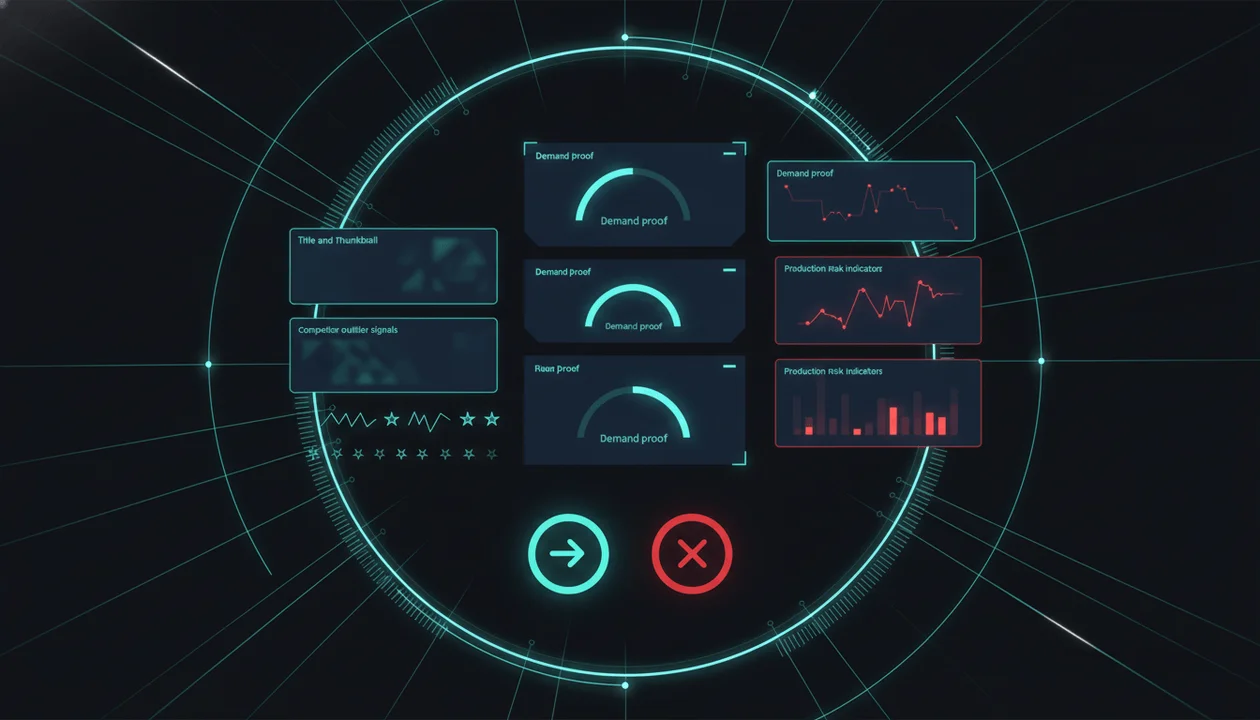
An AI YouTube video idea validator helps you score a video idea before production. It checks whether the idea has demand, audience fit, packaging strength, thumbnail potential, hook potential, originality, retention depth, production realism, and business value.
The goal is simple:
Do not spend 12 hours producing a video that should have been rejected in 12 minutes.
This guide gives you a complete framework to validate YouTube video ideas before you write the script, design the thumbnail, record the voiceover, or send the project to an editor.
Key Takeaways
- Most creators do not fail because they lack ideas. They fail because they produce too many unvalidated ideas.
- An AI YouTube video idea validator scores whether a topic is worth making before production begins.
- A strong video idea needs more than search volume. It needs demand proof, audience fit, click promise, thumbnail potential, hook potential, retention depth, originality, timing, production realism, and business value.
- The best validation process uses competitor outliers, recent winners, title-thumbnail fit, viewer pain, and production cost.
- A weak idea can sometimes become strong if the angle changes.
- You should reject, reframe, or delay any idea that has weak packaging, unclear audience value, no proof of demand, or no strong visual promise.
- OverseerOS helps creators validate ideas by analyzing channels, finding breakout videos, using Viral X-Ray, tracking competitors, building channel blueprints, and turning proven patterns into original content plans.
- The best creators do not ask, “Can we make this video?” They ask, “Does this video deserve to be made?”
What Is an AI YouTube Video Idea Validator?
An AI YouTube video idea validator is a tool or workflow that scores a YouTube video idea before you produce it.
It helps answer:
Is this idea worth making?
A basic AI video idea generator gives you topics.
A validator judges whether those topics are strong enough to survive YouTube.
That difference matters.
| Tool | Main Job | Risk |
|---|---|---|
| AI video idea generator | Creates topic ideas | Can produce generic ideas |
| AI title generator | Creates title variations | Can make weak ideas sound clickable |
| AI script generator | Writes a script | Can waste time on the wrong topic |
| AI video idea validator | Scores whether the idea deserves production | Forces better decisions before work begins |
A good validator should check:
- Does the idea have proof of demand?
- Does it fit the channel?
- Can the title create a strong click promise?
- Can the thumbnail communicate the idea visually?
- Can the intro hook the viewer fast?
- Is the angle original enough?
- Does the video have enough depth to hold attention?
- Is it realistic to produce at the required quality?
- Does it attract the right viewer?
- Does it support the channel’s larger strategy?
That is what separates a real YouTube idea from a random topic.
Why AI Video Idea Generators Are Not Enough
AI idea generators are useful.
But they are dangerous when used alone.
Ask AI for 30 YouTube video ideas and it will usually give you topics like:
- 10 Tips to Grow on YouTube
- Best AI Tools for Creators
- How to Make Better Thumbnails
- YouTube Algorithm Explained
- How to Get More Views
These are not automatically bad.
But they are incomplete.
They do not tell you:
- Why this idea should be made now
- Who exactly will click it
- What competitor proof supports it
- What the thumbnail should show
- What the title promise is
- What makes the angle different
- Whether the video can hold attention
- Whether the audience has already seen this 100 times
- Whether your channel can realistically produce it well
That is the trap.
AI gives you the illusion of strategy because the list looks organized.
But YouTube does not reward organized lists.
YouTube rewards videos that make viewers click and stay.
A video idea is not strong until it can pass the validation test.
Video Idea Generator vs Video Idea Validator
Here is the difference.
Generator Output
“Make a video about YouTube thumbnails.”
That is a topic.
Validator Output
“This idea is too broad. Reframe it around a specific pain: creators whose thumbnails look professional but still get ignored. Use the title ‘Your Thumbnail Looks Good But Nobody Clicks It’ and a thumbnail showing a clean design with a red warning mark. This has stronger emotional tension and clearer packaging.”
That is strategy.
The generator gives you raw material.
The validator turns the idea into a decision.
The 10-Part YouTube Video Idea Validation Framework
Use this framework before producing any serious video.
Score each category from 0 to 10.
Then decide whether to produce, reframe, delay, or reject the idea.
1. Demand Proof
Question:
Is there evidence that viewers care about this idea?
Demand proof can come from:
- Competitor outlier videos
- Recent breakout videos
- Search demand
- Comment requests
- Trend movement
- Repeated audience pain
- Your own past winners
- High-performing formats in adjacent niches
- Viewer questions in communities
- Sponsor or buyer demand
Weak validation:
“I think people will like this.”
Strong validation:
“Three smaller channels in this niche published similar angles in the last 90 days and each video performed 4x above their channel average.”
That is real proof.
Demand Proof Score
| Score | Meaning |
|---|---|
| 0-2 | No proof. Pure guess. |
| 3-5 | Some weak signals, but not enough. |
| 6-8 | Clear proof from competitors, comments, or search. |
| 9-10 | Multiple strong proof points from recent outliers or repeated demand. |
If demand proof is below 5, be careful.
You may still make the video, but the idea needs a stronger strategic reason.
2. Audience Fit
Question:
Is this idea clearly for our target viewer?
A video can be interesting and still wrong for your channel.
Example:
A faceless YouTube growth channel could make a video about:
The Future of AI Robots
That topic might get views.
But does it attract the right viewer?
Maybe not.
A better fit:
How AI Agents Will Change Faceless YouTube Production
Now the audience is clear.
Audience fit matters because every video trains YouTube and viewers what your channel is about.
Ask:
- Would our target viewer immediately care?
- Does this fit one of our content pillars?
- Would subscribers expect this from us?
- Does this topic attract the type of viewer we want more of?
- Does this idea strengthen or confuse the channel?
Audience Fit Score
| Score | Meaning |
|---|---|
| 0-2 | Wrong audience |
| 3-5 | Related, but loose |
| 6-8 | Strong fit |
| 9-10 | Perfect fit for the channel promise |
Do not chase every idea that looks viral.
Chase ideas that make your channel stronger.
3. Click Promise
Question:
Can this idea become a title people actually want to click?
A topic is not a click promise.
Topic:
YouTube content strategy
Click promise:
Your Content Strategy Is Keeping You Busy, Not Growing
Topic:
AI tools
Click promise:
I Tested 7 AI YouTube Tools. Only 2 Were Worth Using.
Topic:
Thumbnails
Click promise:
Your Thumbnail Looks Good But Nobody Clicks It
A strong click promise has:
- Specific pain
- Specific outcome
- Curiosity
- Tension
- Stakes
- Clear audience relevance
- A reason to watch now
Use the YouTube click promise framework if the idea sounds interesting but the title feels weak.
Click Promise Score
| Score | Meaning |
|---|---|
| 0-2 | No clear title angle |
| 3-5 | Clickable only with heavy rewriting |
| 6-8 | Strong title potential |
| 9-10 | Obvious, powerful click promise |
If you cannot write five strong titles for the idea, the idea may not be ready.
4. Thumbnail Potential
Question:
Can this idea become a thumbnail people understand in one second?
This is one of the most important validation checks.
Some ideas sound smart but have no visual hook.
Weak thumbnail potential:
How to improve your mindset
Strong thumbnail potential:
Your Brain Is Tricking You
Weak:
YouTube strategy explained
Strong:
50 Channels Studied
Weak:
AI content quality
Strong:
AI SLOP
A good thumbnail can show:
- A result
- A mistake
- A contrast
- A shocking object
- A proof point
- A before/after
- A visual metaphor
- A human emotion
- A specific number
- A conflict
If you cannot imagine a strong thumbnail, the idea may be too abstract.
Use an AI YouTube thumbnail generator built from proven styles to pressure-test whether the idea has visual strength before you commit.
Thumbnail Potential Score
| Score | Meaning |
|---|---|
| 0-2 | No clear visual |
| 3-5 | Possible, but abstract |
| 6-8 | Strong visual direction |
| 9-10 | Thumbnail idea is instantly obvious |
A video idea with no thumbnail potential is risky for browse-heavy channels.
5. Hook Potential
Question:
Can the first 30 seconds make the viewer feel the promise immediately?
A good idea should create a strong intro naturally.
Example idea:
Best YouTube tips for beginners
Weak hook potential.
Better idea:
The YouTube Advice That Keeps Beginners Stuck
Stronger hook:
Most beginner YouTube advice sounds helpful, but it quietly trains you to make videos nobody asked for.
That has tension.
Hook potential matters because the click is not enough.
The intro must prove the click was worth it.
Ask:
- Can we open with a surprising claim?
- Can we create a strong first sentence?
- Can we show the stakes quickly?
- Can we make the viewer feel seen?
- Can we connect the title promise in the first two sentences?
If not, the idea may need a sharper angle.
Use a YouTube hook analyzer once you have a draft intro.
Hook Potential Score
| Score | Meaning |
|---|---|
| 0-2 | No strong opening angle |
| 3-5 | Intro will likely be generic |
| 6-8 | Strong hook possible |
| 9-10 | Hook almost writes itself |
The best video ideas usually have obvious hook tension.
6. Retention Depth
Question:
Is there enough substance to keep viewers watching?
Some ideas are clickable but thin.
They get the click, then collapse.
Example:
This AI Tool Will Change YouTube Forever
Maybe clickable.
But can you support it for 8 to 12 minutes without fluff?
Retention depth means the idea has enough:
- Examples
- Proof
- Steps
- Story
- Conflict
- Transformation
- Surprises
- Practical value
- Visual moments
- Curiosity loops
Weak depth:
3 generic tips everyone knows
Strong depth:
A full breakdown of why one channel grew, what changed, what pattern repeated, and how viewers responded
Ask:
- Can we outline 5 to 7 strong sections?
- Can we show proof or examples?
- Can we avoid repeating the same point?
- Can the video build toward a payoff?
- Can we make the viewer feel progress?
Retention Depth Score
| Score | Meaning |
|---|---|
| 0-2 | Thin idea |
| 3-5 | Needs heavy support |
| 6-8 | Enough material for a solid video |
| 9-10 | Deep, layered, naturally engaging |
Do not produce clicky ideas that cannot deliver.
That damages trust.
7. Original Angle
Question:
Is our version meaningfully different from what already exists?
You do not need a completely new topic.
You need a new angle.
Common topic:
YouTube thumbnails
Original angle:
Your Thumbnail Shows the Topic But Not the Reason to Care
Common topic:
AI YouTube tools
Original angle:
Most AI YouTube Tools Save Time in the Wrong Part of the Workflow
Common topic:
Faceless YouTube niches
Original angle:
The Best Faceless Niches Are Not the Easiest. They Are the Most Repeatable.
Originality can come from:
- A stronger opinion
- Better proof
- A narrower audience
- A different format
- A fresh example
- A new framework
- A contrarian insight
- A clearer workflow
- A better visual concept
- A more useful template
Original Angle Score
| Score | Meaning |
|---|---|
| 0-2 | Duplicate idea |
| 3-5 | Common topic with weak twist |
| 6-8 | Clear original angle |
| 9-10 | Fresh, memorable, hard to confuse with competitors |
A familiar topic with a fresh angle is better than a random topic nobody cares about.
8. Timing and Momentum
Question:
Is now a good time to make this video?
Timing matters.
Some videos are evergreen.
Some are trend-driven.
Some are urgent now but useless later.
Score timing based on:
- Current news
- New platform features
- Niche conversation
- Competitor momentum
- Search trend
- Seasonal relevance
- Audience readiness
- Product or business timing
Example:
A video about AI-generated YouTube ideas became more relevant as platforms and creator tools started adding AI inspiration features.
A video about “YouTube Trending page strategy” became less useful after YouTube moved away from the old Trending experience and pushed more discovery through personalized recommendations, charts, and other tools.
Timing does not mean chasing every trend.
It means knowing whether the idea is early, current, late, or evergreen.
Timing Score
| Score | Meaning |
|---|---|
| 0-2 | Too late or irrelevant |
| 3-5 | Weak timing |
| 6-8 | Good current or evergreen timing |
| 9-10 | Strong urgency right now |
If timing is weak, save the idea for later or reframe it.
9. Production Realism
Question:
Can we make this video well with our current resources?
A video idea can be great and still wrong for your team.
Example:
I Studied 1,000 YouTube Channels
Great idea.
But can you actually do the research?
Can your writer handle it?
Can your editor visualize it?
Can your team finish it without delaying other videos?
Production realism includes:
- Research time
- Script difficulty
- Visual complexity
- Editing workload
- Voiceover needs
- Thumbnail difficulty
- Data collection
- Fact-checking
- Team capacity
- Deadline pressure
A simple video executed well usually beats an ambitious video executed badly.
Production Realism Score
| Score | Meaning |
|---|---|
| 0-2 | Unrealistic |
| 3-5 | Possible but risky |
| 6-8 | Realistic with planning |
| 9-10 | Easy to execute well |
Do not let ambition destroy consistency.
10. Business Value
Question:
Does this idea attract the right kind of viewer?
Not every view is equal.
Some videos bring casual viewers.
Some bring subscribers.
Some bring buyers.
Some bring sponsors.
Some build authority.
Some attract the exact audience your product serves.
Business value matters if your channel supports:
- SaaS
- Courses
- Sponsorships
- Affiliate income
- Consulting
- Agency services
- Digital products
- Newsletters
- Communities
Example:
Low business value:
Funniest YouTube Fails
High business value:
Best YouTube Production Workflow Software for Multi-Channel Teams
Both can get views.
Only one attracts serious buyers.
For OverseerOS-style content, business value often comes from topics around:
- YouTube strategy
- Competitor analysis
- Faceless production
- AI scripts
- Thumbnails
- Content planning
- Channel cloning
- Retention
- Workflow automation
- Multi-channel operations
Business Value Score
| Score | Meaning |
|---|---|
| 0-2 | Attracts low-value or wrong audience |
| 3-5 | Some relevance |
| 6-8 | Strong fit for business goals |
| 9-10 | High buyer-intent topic |
If your goal is revenue, do not only validate for views.
Validate for the right viewer.
The YouTube Video Idea Validator Scorecard
Use this scorecard.
| Validation Factor | Score 0-10 |
|---|---|
| Demand proof | |
| Audience fit | |
| Click promise | |
| Thumbnail potential | |
| Hook potential | |
| Retention depth | |
| Original angle | |
| Timing and momentum | |
| Production realism | |
| Business value | |
| Total | /100 |
Score Interpretation
| Total Score | Decision |
|---|---|
| 0-39 | Reject |
| 40-59 | Reframe heavily |
| 60-74 | Possible, but improve before production |
| 75-84 | Strong idea |
| 85-100 | Priority idea |
Do not treat the total score blindly.
A video can score 80 overall but still fail if one critical category is weak.
For example:
- Strong demand but no thumbnail = risky
- Strong title but no depth = clickbait risk
- Strong topic but wrong audience = channel confusion
- Strong idea but unrealistic production = execution failure
Use the score as a decision tool, not a decoration.
Red Flag Rules
Reject or reframe the idea if any of these happen:
| Red Flag | Why It Matters |
|---|---|
| Demand proof below 4 | You are guessing |
| Audience fit below 5 | It may confuse the channel |
| Click promise below 5 | The title will struggle |
| Thumbnail potential below 5 | Browse traffic may suffer |
| Retention depth below 5 | The video may collapse after the click |
| Original angle below 4 | It may feel like a copy |
| Production realism below 4 | The team may execute it badly |
A weak score does not always mean the idea is dead.
Sometimes it means the angle is not sharp enough yet.
Example: Weak Idea vs Validated Idea
Raw Idea
Best AI tools for YouTube creators
This is not bad, but it is too broad.
Validation Score
| Factor | Score | Reason |
|---|---|---|
| Demand proof | 8 | Strong demand for AI creator tools |
| Audience fit | 8 | Fits YouTube creators |
| Click promise | 4 | Too generic |
| Thumbnail potential | 5 | Possible, but likely looks like a tool grid |
| Hook potential | 4 | Intro may feel like another list |
| Retention depth | 6 | Depends on examples |
| Original angle | 3 | Very saturated topic |
| Timing | 7 | AI tools remain relevant |
| Production realism | 8 | Easy to make |
| Business value | 8 | High buyer intent |
| Total | 61 | Needs reframing |
Decision:
Reframe before production.
Stronger Version
I Tested 7 AI YouTube Tools. Only 2 Were Actually Worth Using.
Now the idea has:
- Proof
- Experiment format
- Curiosity
- Specific number
- Stronger thumbnail
- Stronger hook
- Better retention structure
- Clear viewer value
Updated Score
| Factor | Score | Reason |
|---|---|---|
| Demand proof | 8 | Strong topic demand |
| Audience fit | 9 | Very clear audience |
| Click promise | 9 | Specific and curiosity-driven |
| Thumbnail potential | 8 | “ONLY 2 WORKED” is visual |
| Hook potential | 8 | Easy to open with wasted-time pain |
| Retention depth | 8 | Tool-by-tool structure |
| Original angle | 7 | More specific than a generic list |
| Timing | 8 | Relevant now |
| Production realism | 7 | Requires real testing |
| Business value | 9 | High buyer intent |
| Total | 81 | Strong idea |
Same topic.
Better angle.
That is the power of validation.
The Best AI Prompt to Validate a YouTube Video Idea
Use this prompt.
Act as a YouTube strategist and video idea validator.

Validate this YouTube video idea before production.

Channel niche:
[Your niche]

Target viewer:
[Specific viewer]

Channel positioning:
[What the channel helps viewers do]

Video idea:
[Raw idea]

Possible title:
[Title if available]

Thumbnail concept:
[Describe thumbnail if available]

Competitor proof:
[Paste similar videos, views, channel size, or outlier data if available]

Production capacity:
[Team size, upload frequency, editing style, budget, timeline]

Business goal:
[Ads, subscribers, SaaS users, sponsors, affiliate revenue, leads, authority, etc.]

Score the idea from 0 to 10 for:
1. Demand proof
2. Audience fit
3. Click promise
4. Thumbnail potential
5. Hook potential
6. Retention depth
7. Original angle
8. Timing and momentum
9. Production realism
10. Business value

Then give:
- Total score out of 100
- Decision: reject, reframe, delay, or produce
- Biggest weakness
- Best reframe
- 5 stronger title options
- 3 thumbnail concepts
- First 3 sentences of a stronger intro
- Recommended video format
- Production risk
- What proof we still need before producing

Rules:
Do not be nice.
Do not validate weak ideas just because they sound okay.
Do not invent proof.
If the idea is generic, say so.
If the idea needs reframing, give a stronger version.
This prompt works because it does not ask AI to be creative first.
It asks AI to judge.
That is what creators need more often.
The Video Idea Validation Workflow
Use this workflow before every important upload.
Step 1: Start With the Raw Idea
Write the idea in one line.
Example:
A video about AI tools for YouTube.
Do not improve it yet.
Just capture the raw thought.
Step 2: Find Proof
Look for evidence.
Sources:
- Competitor outliers
- Recent winners
- YouTube search
- Viewer comments
- Your own analytics
- Trend movement
- Channel requests
- Sponsor interest
- Tool demand
- Forum questions
- Community posts
Use the YouTube competitor analysis template to find stronger proof before deciding.
Step 3: Write 5 Title Angles
Do not settle on the first title.
Generate different promise types:
| Promise Type | Example |
|---|---|
| Proof | I Tested 7 AI YouTube Tools |
| Warning | Most AI YouTube Tools Waste Your Time |
| Result | This Workflow Saved 5 Hours Per Video |
| Mistake | The AI Tool Mistake Killing Faceless Channels |
| Comparison | AI Script Tools vs Real YouTube Writers |
Different titles reveal different ideas.
Sometimes the best version of the video appears only after the fifth title.
Step 4: Sketch 3 Thumbnail Concepts
If all thumbnail concepts feel weak, the idea is not ready.
Try:
- Proof thumbnail
- Problem thumbnail
- Result thumbnail
- Before/after thumbnail
- Shock thumbnail
- Curiosity thumbnail
- Object-focused thumbnail
If none work, reframe.
Step 5: Draft the First 30 Seconds
A video idea is stronger if the intro writes itself.
Example:
Most AI tools do not save creators time. They just move the work to a different place.
That line instantly creates tension.
If your intro starts with:
AI tools are becoming very popular among YouTube creators...
The angle is probably too soft.
Step 6: Score the Idea
Use the 10-part scorecard.
Be strict.
Do not produce ideas that barely pass.
Step 7: Decide
There are four possible outcomes.
| Decision | Meaning |
|---|---|
| Produce | Strong idea. Move into script and thumbnail planning. |
| Reframe | Topic has potential, but the angle is weak. |
| Delay | Idea may work later, but timing or proof is weak now. |
| Reject | Not worth production. |
Rejecting ideas is not failure.
It is strategy.
How OverseerOS Helps Validate YouTube Video Ideas
OverseerOS is useful because it helps creators validate ideas from proof instead of guessing.
A strong validation workflow inside OverseerOS can look like this:
- Analyze channels in your niche.
- Find top-performing and recent breakout videos.
- Use competitor tracking to monitor what is gaining traction.
- Use Viral X-Ray to study individual winning videos.
- Extract title, thumbnail, hook, emotion, and structure patterns.
- Build a channel blueprint so ideas match your positioning.
- Add strong ideas into the Smart Content Planner.
- Turn validated topics into scripts, thumbnails, and voiceovers.
- Track production status so only approved ideas move forward.
This matters because the hardest part of YouTube is not producing.
It is choosing what deserves production.
A bad idea can still become a finished video.
That is the danger.
The script can be written.
The voiceover can be recorded.
The thumbnail can be designed.
The edit can be finished.
The upload can go live.
And the entire thing can still fail because the idea was weak from the beginning.
OverseerOS helps reduce that risk by starting from channel data, competitor proof, breakout patterns, and workflow context.
That is a better foundation than asking AI:
“Give me 20 viral video ideas.”
Video Idea Validator Template
Copy this into your own workflow.
YouTube VIDEO IDEA VALIDATOR

Raw idea:
[Write the idea]

Target viewer:
[Who is this for?]

Channel pillar:
[Which content pillar does this support?]

Strategic goal:
[Views, subscribers, buyer intent, authority, trend response, retention, etc.]

Competitor proof:
- Competitor video 1:
- Views:
- Channel average:
- Why it matters:

- Competitor video 2:
- Views:
- Channel average:
- Why it matters:

Viewer pain:
[What problem or desire does this idea hit?]

Click promise:
[Why would someone click?]

Possible titles:
1.
2.
3.
4.
5.

Thumbnail concepts:
1.
2.
3.

Hook idea:
[First 1-3 sentences]

Video format:
[List, tutorial, case study, documentary, experiment, breakdown, comparison, template, etc.]

Retention structure:
[What keeps people watching?]

Original angle:
[How is this different?]

Production notes:
[Research, script, edit, assets, difficulty]

Business value:
[Why this attracts the right viewer]


SCORECARD

Demand proof: /10
Audience fit: /10
Click promise: /10
Thumbnail potential: /10
Hook potential: /10
Retention depth: /10
Original angle: /10
Timing and momentum: /10
Production realism: /10
Business value: /10

Total: /100

Decision:
[Reject / Reframe / Delay / Produce]

Biggest weakness:
[What needs fixing?]

Best reframe:
[Stronger version of the idea]

Next action:
[Find proof / rewrite title / sketch thumbnail / outline video / move to production]
Common Mistakes When Validating YouTube Ideas
Mistake 1: Confusing Interest With Demand
You may be interested in the topic.
That does not mean viewers want it.
Interest is internal.
Demand is external.
Look for proof.
Mistake 2: Only Checking Search Volume
Search can be useful, but YouTube is not only a search engine.
Many videos win through browse, suggested videos, trends, emotional curiosity, and repeatable audience behavior.
Validate with search and competitor proof.
Not search alone.
Mistake 3: Ignoring the Thumbnail Until Later
This is one of the biggest mistakes.
If the idea cannot become a strong thumbnail, it may struggle before the video even starts.
Think thumbnail early.
Not after the script is done.
Mistake 4: Producing Ideas Because They Are Easy
Easy ideas are tempting.
But easy does not mean valuable.
A video can be easy to produce because it is too generic.
Ask:
Is this easy because our system is good, or because the idea is shallow?
Mistake 5: Letting AI Approve Everything
AI assistants often try to be helpful.
That means they may improve a weak idea instead of telling you to kill it.
You need strict scoring.
Tell AI to reject weak ideas.
Mistake 6: Overvaluing Competitor Views
A competitor video with high views is useful, but it is not the whole story.
Ask:
- Was the video an outlier?
- Was it recent?
- Did the channel already have a huge audience?
- Is the format repeatable?
- Can we create a different version?
- Does our audience care?
- Can we produce it well?
Views are a signal.
Not a strategy.
Mistake 7: Ignoring Business Value
Some ideas can get views from the wrong people.
If your goal is revenue, SaaS users, sponsors, or authority, validate the viewer quality.
Ask:
Who does this video attract?
That question matters.
What to Do With Low-Scoring Ideas
Do not automatically delete them.
First decide what kind of weak idea it is.
| Weakness | Fix |
|---|---|
| No demand proof | Find competitor outliers or delay |
| Weak click promise | Rewrite titles |
| Weak thumbnail | Reframe around a visual contrast |
| Weak hook | Add tension, stakes, or contradiction |
| Low originality | Narrow the audience or change the format |
| Thin depth | Add proof, examples, or case study structure |
| Poor production realism | Simplify the format |
| Low business value | Reframe for a higher-intent viewer |
Example:
Weak idea:
How to grow on YouTube
Reframes:
- Why Your YouTube Channel Feels Stuck Even When You Upload Weekly
- I Studied 50 Small Channels That Suddenly Broke Out
- The YouTube Growth Advice That Keeps Beginners Making Weak Videos
- How to Find Video Ideas That Already Have Proof of Demand
- Stop Uploading More. Validate the Idea First.
The topic was too broad.
The reframes create sharper promises.
Best Use Cases for an AI YouTube Video Idea Validator
Use a validator when:
| Use Case | Why It Helps |
|---|---|
| Before writing a script | Prevents wasted writing time |
| Before hiring an editor | Protects production budget |
| Before creating a thumbnail | Makes packaging sharper |
| Before building a content calendar | Keeps weak ideas out |
| Before launching a channel | Validates the first 10 videos |
| Before chasing a trend | Checks timing and fit |
| Before copying a competitor pattern | Forces originality |
| Before using an AI script generator | Makes sure the prompt starts from a strong idea |
| Before producing faceless videos | Saves team cost and revisions |
| Before scaling uploads | Protects quality as volume increases |
The more expensive your production workflow, the more important validation becomes.
If each video costs money, weak ideas are not harmless.
They are margin killers.
The Best Video Ideas Pass Three Tests
Before you approve an idea, make it pass these three tests.
1. The Proof Test
Can you point to real evidence that this idea has demand?
If not, you are guessing.
2. The Packaging Test
Can you write a strong title and sketch a strong thumbnail?
If not, the idea may not earn the click.
3. The Payoff Test
Can the video deliver enough value to justify the click?
If not, it may hurt retention and trust.
A strong YouTube idea passes all three.
Proof. Packaging. Payoff.
That is the simple version.
Final Verdict
An AI YouTube video idea validator is more valuable than another idea generator.
Because most creators already have too many ideas.
What they lack is selection.
A weak idea can consume the same production time as a strong idea.
The script still needs writing.
The thumbnail still needs designing.
The voiceover still needs recording.
The editor still needs footage.
The upload still needs metadata.
But after all that work, YouTube only cares whether viewers clicked and stayed.
So validate before production.
Score the idea.
Find proof.
Pressure-test the title.
Sketch the thumbnail.
Write the hook.
Check the depth.
Measure the business value.
Then decide if the video deserves to exist.
If you want to validate ideas from real channel and competitor patterns instead of guessing from a blank prompt, use OverseerOS to analyze winning channels, find breakout videos, reverse-engineer video patterns, and turn proof-backed ideas into scripts, thumbnails, and production workflows.
The goal is not more ideas.
The goal is fewer weak ones.
That is how serious YouTube channels are built.
FAQ
What is an AI YouTube video idea validator?
An AI YouTube video idea validator is a tool or workflow that scores a YouTube video idea before production. It checks demand proof, audience fit, title potential, thumbnail potential, hook strength, retention depth, originality, timing, production realism, and business value.
How do I know if a YouTube video idea is good?
A good YouTube video idea has proof of demand, a clear target viewer, a strong click promise, a visual thumbnail angle, a strong hook, enough depth to hold attention, and a reason to exist on your channel.
What is the difference between a video idea generator and a video idea validator?
A video idea generator creates topics. A video idea validator judges whether those topics are worth producing. A generator helps with brainstorming, while a validator helps with decision-making.
How should I score YouTube video ideas?
Score each idea from 0 to 10 across demand proof, audience fit, click promise, thumbnail potential, hook potential, retention depth, original angle, timing, production realism, and business value. A total score above 75 usually means the idea is strong.
Should I reject low-scoring YouTube ideas?
Yes, or reframe them. Low-scoring ideas often need a stronger angle, better title, clearer thumbnail, more proof, or a narrower audience. Do not produce weak ideas just because they are easy.
Can AI validate YouTube video ideas?
Yes. AI can help evaluate video ideas if you give it the channel niche, target viewer, competitor proof, possible title, thumbnail concept, production capacity, and business goal. The output is strongest when the AI is forced to score strictly.
What makes a YouTube idea high buyer intent?
A high buyer-intent idea attracts viewers who are likely to buy tools, services, products, courses, software, templates, or consulting. For creator tools, topics around workflow, automation, competitor analysis, scripts, thumbnails, and production systems often have stronger buyer intent.
How do I validate faceless YouTube video ideas?
For faceless channels, validate the topic, title, thumbnail, script depth, voiceover potential, visual production difficulty, and competitor proof. Faceless videos depend heavily on packaging and script strength because there is no personal brand face carrying the video.
Can a weak YouTube idea become strong?
Yes. Many weak ideas become strong when reframed around a sharper pain, clearer title, stronger thumbnail, better proof, or more original format.
Can OverseerOS help validate YouTube video ideas?
Yes. OverseerOS helps creators analyze channels, find breakout videos, use Viral X-Ray, track competitors, create channel blueprints, and turn proven patterns into original topic ideas, scripts, thumbnails, and production workflows.