Most YouTube videos do not fail because the idea is terrible.
They fail because the promise is broken.
The title promises one thing. The thumbnail suggests another. The first 30 seconds start somewhere else. The video finally delivers the payoff too late, too weakly, or not at all.
That gap is what kills the video.
A YouTube click promise is the expectation a viewer forms before they click. It is created by the topic, title, thumbnail, and sometimes the channel itself. After the click, the hook and video structure must prove that promise fast.
If the promise is strong, specific, and delivered, the video has a chance.
If the promise is confusing, weak, or misleading, the video loses before the audience even understands the idea.
This guide shows you how to build a stronger YouTube click promise, align your title and thumbnail, write hooks that match the packaging, avoid accidental clickbait, and turn proven competitor patterns into original videos people actually want to watch.
Key Takeaways
- A YouTube click promise is the expectation created before a viewer clicks your video.
- The promise is built from the topic, title, thumbnail, channel context, and viewer intent.
- The first 30 seconds must prove that the title and thumbnail were honest, relevant, and worth the click.
- YouTube says a high intro percentage can mean the first 30 seconds matched the viewer’s expectation from the thumbnail and title. Source: YouTube Help
- Strong packaging is not just “high CTR.” It is a clear promise that earns the click and keeps the viewer watching.
- Misleading titles or thumbnails are risky because YouTube’s policy says creators should not use titles, thumbnails, or descriptions to make viewers believe the content is something it is not. Source: YouTube Help
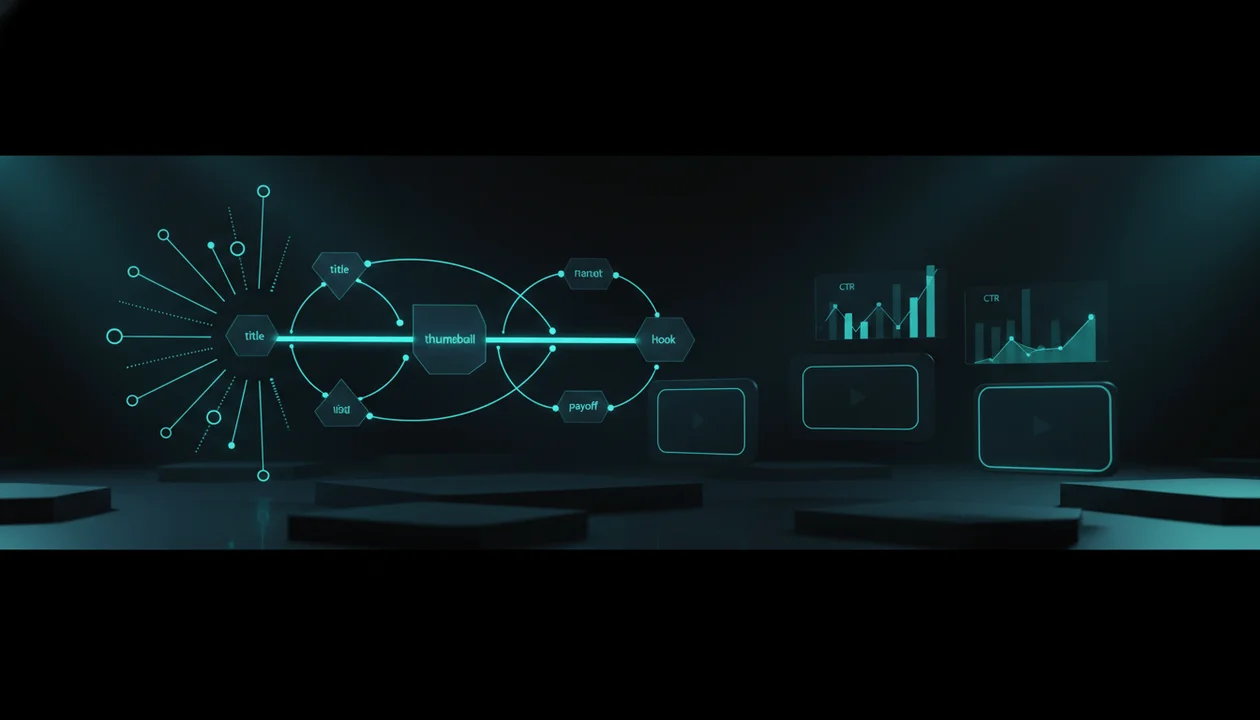
- The best YouTube packaging connects five things: topic, title, thumbnail, hook, and payoff.
- OverseerOS helps creators analyze titles, thumbnails, hooks, competitor videos, viral patterns, and channel blueprints so the click promise is not built from guesswork.
What Is a YouTube Click Promise?
A YouTube click promise is the reason a viewer believes your video is worth clicking.
It is not just the title.
It is not just the thumbnail.
It is the expectation created by the full package.
A viewer sees your video and instantly asks:
“What will I get if I click this?”
The answer is your click promise.
Examples:
| Video package | Click promise |
|---|---|
| “I Tried Waking Up at 5AM for 30 Days” | You will see a real experiment and learn whether it changed anything |
| “Why Your Videos Stop Getting Views” | You will discover the hidden reason your channel is declining |
| “I Analyzed 100 Viral Thumbnails” | You will get proof-backed thumbnail patterns |
| “This AI Tool Replaced My Editor” | You will see a tool that may save time, money, or effort |
| “The Boring Niche Making Millions” | You will discover an overlooked opportunity |
The promise is the mental contract between the creator and the viewer.
If the video delivers, the viewer feels satisfied.
If the video does not deliver, the viewer feels tricked.
That is why click promise matters more than clever titles.
Why Click Promise Matters More Than CTR Alone
CTR is important, but CTR alone can mislead creators.
A title and thumbnail can get clicks by exaggerating, confusing, or overpromising.
But if viewers leave quickly, the video has a promise problem.
YouTube’s audience retention help page explains that the intro tells creators what percentage of the audience is still watching after the first 30 seconds. It also says a high intro percentage could mean the first 30 seconds matched the viewer’s expectation of the thumbnail and title. Source: YouTube Help
That means the click is only step one.
The real goal is:
Get the right click, then prove the click was worth it.
A weak creator asks:
“How do I make people click?”
A stronger creator asks:
“What promise can I make that my video can actually fulfill better than competitors?”
That is the difference between packaging and clickbait.
Click Promise vs Clickbait
A strong click promise creates curiosity and then satisfies it.
Clickbait creates curiosity and then betrays it.
The difference is delivery.
| Type | What it does | Viewer reaction |
|---|---|---|
| Strong promise | Creates curiosity and pays it off | “That was worth clicking.” |
| Weak promise | Sounds unclear or boring | “I do not know why I should care.” |
| Overpromise | Makes the video sound bigger than it is | “This was exaggerated.” |
| Misleading clickbait | Promises something the video does not contain | “I was tricked.” |
YouTube’s policy on misleading metadata or thumbnails says creators should not use the title, thumbnail, or description to trick users into believing the content is something it is not. It specifically includes cases where titles, thumbnails, or descriptions lead viewers to believe they will see something in a video, but the video does not include it. Source: YouTube Help
So the goal is not to make boring titles.
The goal is to make sharp promises that are true.
Example:
Clickbait:
I Made $1,000,000 With This AI Tool
But the video only shows a random tool demo with no proof.
Strong promise:
I Tested This AI Tool to See If It Could Replace My Research Workflow
The second title still creates curiosity, but it is more honest, more specific, and easier to deliver.
The 5 Parts of a Strong YouTube Click Promise
A strong click promise has five connected parts:
- Topic
- Title
- Thumbnail
- Hook
- Payoff
If one part breaks, the whole package weakens.
1. Topic: the real reason viewers care
The topic is the foundation.
If the topic has no demand, the title and thumbnail have to work too hard.
A good topic usually connects to one of these viewer desires:
| Viewer desire | Example topic |
|---|---|
| Make money | “How small channels monetize faster” |
| Avoid pain | “Why your views suddenly dropped” |
| Save time | “AI tools that reduce editing work” |
| Gain status | “Skills that separate top creators from beginners” |
| Understand change | “What the new YouTube update means” |
| Find opportunity | “Small niches breaking out right now” |
| Fix a problem | “Why your thumbnails get ignored” |
| See proof | “I tested 5 hooks on real videos” |
Before writing titles, ask:
What viewer desire is this video serving?
If you cannot answer that, the click promise will be weak.
2. Title: the verbal promise
The title tells the viewer what question the video will answer.
A strong title usually does at least one of these:
- Names a specific problem
- Creates a curiosity gap
- Shows a transformation
- Promises proof
- Signals urgency
- Challenges a belief
- Gives a clear outcome
- Makes the viewer feel personally involved
Weak title:
YouTube Thumbnails Explained
Stronger title:
Why Good-Looking Thumbnails Still Get Ignored
The stronger title has a sharper promise. It tells the viewer there is a hidden problem: the thumbnail may look good but still fail.
3. Thumbnail: the visual promise
The thumbnail must make the title easier to feel.
A good thumbnail does not repeat the title word for word.
It creates visual tension.
Example:
Title:
Why Good-Looking Thumbnails Still Get Ignored
Weak thumbnail:
Text that says “Thumbnail Tips” with random icons
Stronger thumbnail:
A polished thumbnail on the left with low clicks, a messy but high-performing thumbnail on the right, and a confused creator looking at the difference
The title creates the question.
The thumbnail makes the problem visible.
That is alignment.
4. Hook: the first proof
The hook is where most creators break the promise.
They create a strong title and thumbnail, then start the video with:
“Hey guys, welcome back to the channel.”
That wastes the click.
The first 30 seconds should answer:
- Why did the viewer click?
- What is at stake?
- What will the video prove?
- Why should they keep watching?
- What payoff is coming?
If your title promises an experiment, start with the rules of the experiment.
If your title promises a mistake, show the mistake fast.
If your title promises proof, show proof early.
If your title promises a hidden reason, reveal that there is a real pattern, then open the loop.
5. Payoff: the delivered value
The payoff is where the video fulfills the promise.
A strong payoff can be:
- A clear answer
- A transformation
- A reveal
- A result
- A framework
- A decision
- A diagnosis
- A template
- A lesson
- A warning
The payoff should not feel like generic advice.
If the title says:
I Analyzed 100 Viral Thumbnails and Found the Same Pattern
The payoff cannot be:
“Use bright colors and big text.”
That is too weak.
The payoff should be more specific:
“The winning thumbnails were not just bright. They reduced the idea to one emotional conflict, used fewer visual objects, and made the viewer understand the stakes before reading the title.”
That is a real payoff.
The YouTube Click Promise Formula
Use this formula before publishing:
This video is for [viewer]
who wants [desire]
but is struggling with [problem].
The title promises [specific question or outcome].
The thumbnail makes that promise visible through [visual tension].
The hook proves the promise by [first 30-second setup].
The payoff delivers [specific result, lesson, proof, or transformation].
Example:
This video is for small YouTube creators
who want more views
but are struggling with thumbnails that look good but do not get clicked.
The title promises to explain why good-looking thumbnails still fail.
The thumbnail makes that promise visible through a polished thumbnail with weak results.
The hook proves the promise by showing two thumbnails where the uglier one performed better.
The payoff delivers a framework for building thumbnails around emotional contrast, not just design quality.
If you cannot fill this out clearly, your video package is not ready.
Good Click Promise vs Bad Click Promise
Example 1: AI tools video
Weak package:
Title:
Best AI Tools for Creators
Thumbnail:
AI logos and “Top Tools”
Hook:
“AI is changing everything, and in this video we’ll discuss some tools.”
Problem:
This is generic. The viewer has seen it before.
Stronger package:
Title:
I Replaced My YouTube Research Workflow With AI for 7 Days
Thumbnail:
Creator looking at an AI dashboard with one video idea glowing
Hook:
“For seven days, I was not allowed to choose my own video ideas. I gave AI my competitors, my niche, and my channel goal. Then I let it decide what I should make next.”
Why it works:
The promise is specific, visual, testable, and proof-driven.
Example 2: YouTube growth video
Weak package:
Title:
How to Get More Views on YouTube
Thumbnail:
Graph going up
Hook:
“Today we’ll talk about how to grow your channel.”
Problem:
Too broad. No tension. No unique promise.
Stronger package:
Title:
Why Your Views Dropped Even Though Your Videos Got Better
Thumbnail:
Creator confused between “better video” and “lower views”
Hook:
“If your videos are better but your views are lower, the problem may not be quality. It may be impressions, topic demand, or a broken click promise.”
Why it works:
It names a specific painful situation and gives the viewer a reason to keep watching.
Example 3: Thumbnail video
Weak package:
Title:
How to Make Better Thumbnails
Thumbnail:
Before and after design
Hook:
“Thumbnails are important because they help people click.”
Problem:
The promise is too basic.
Stronger package:
Title:
Your Thumbnail Looks Good. That’s Why It Failed.
Thumbnail:
Beautiful thumbnail stamped “ignored” next to a rough thumbnail getting clicks
Hook:
“Most creators judge thumbnails like designers. Viewers judge them like decisions. That difference is why some ugly thumbnails win.”
Why it works:
It challenges a belief and creates a clear payoff.
The Click Promise Alignment Test
Before publishing, run this test.
Question 1: Can the viewer understand the promise in two seconds?
If the title and thumbnail need too much explanation, the promise is weak.
The viewer should instantly understand:
- What the video is about
- Why it matters
- What tension exists
- What they might gain by clicking
Question 2: Do the title and thumbnail create the same question?
Bad alignment:
Title:
I Tested 5 AI Tools for YouTube
Thumbnail:
Robot destroying jobs
The title promises a test.
The thumbnail promises fear about job replacement.
That mismatch can create the wrong click.
Better alignment:
Title:
I Tested 5 AI Tools to See Which One Actually Saves Time
Thumbnail:
Stopwatch, creator, five tools, one winner highlighted
Now the promise is aligned.
Question 3: Does the hook continue the promise immediately?
If the video starts with background information, the promise gets weaker.
Bad hook:
“AI tools have become very popular in recent years.”
Better hook:
“I gave five AI tools the same YouTube task: find a video idea, write the hook, and build a thumbnail concept. Only one actually saved time.”
The second hook proves the click faster.
Question 4: Is the payoff specific?
A weak payoff is generic.
A strong payoff gives the viewer something concrete.
Weak payoff:
“Make better thumbnails.”
Strong payoff:
“Use one emotional conflict, one focal point, and one curiosity gap. Remove anything that does not support that promise.”
Question 5: Would the viewer feel tricked?
This is the honesty test.
Ask:
If someone clicked because of this title and thumbnail, would they feel the video delivered?
If not, change the package or change the video.
The Click Promise Scorecard
Use this scorecard before publishing.
| Element | Question | Score 1-5 |
|---|---|---|
| Viewer desire | Does the video target a clear viewer desire? | |
| Specificity | Is the promise specific enough to feel valuable? | |
| Curiosity | Does the package create a real open loop? | |
| Clarity | Can the viewer understand the idea fast? | |
| Visual tension | Does the thumbnail make the promise visible? | |
| Title-thumbnail alignment | Do the title and thumbnail create the same question? | |
| Hook alignment | Does the first 30 seconds continue the promise? | |
| Payoff strength | Does the video deliver a specific answer or result? | |
| Honesty | Is the promise accurate, not misleading? | |
| Repeatability | Could this promise become a repeatable format? |
Score each from 1 to 5.
| Total score | Meaning |
|---|---|
| 10-24 | Weak package. Rebuild before publishing. |
| 25-34 | Decent but unclear. Tighten the promise. |
| 35-44 | Strong enough to test. |
| 45-50 | Excellent click promise. Publish or A/B test. |
The 6 Most Common Click Promise Mistakes
Mistake 1: The title and thumbnail repeat each other
If the title says:
How to Make Better Thumbnails
And the thumbnail says:
Better Thumbnails
You wasted one part of the package.
The title and thumbnail should work together, not duplicate each other.
Better:
Title:
Why Good Thumbnails Still Get Ignored
Thumbnail:
A good-looking thumbnail with “0.8% CTR” next to a rough one with “6.1% CTR”
The title creates the question.
The thumbnail shows the contradiction.
Mistake 2: The title promises a result, but the video gives tips
Title:
I Doubled My Views With This Thumbnail System
Video:
Generic thumbnail tips with no actual system or proof
That breaks trust.
If the title promises a result, show the result and explain the system.
Mistake 3: The thumbnail promises drama, but the video is calm
Thumbnail:
Shocked face, explosion, red arrows, “IT’S OVER”
Video:
Normal tutorial
This attracts the wrong viewer expectation.
Drama is fine if the video actually has stakes.
If not, make the thumbnail more accurate.
Mistake 4: The hook starts too far away from the promise
Title:
I Studied 100 Viral Hooks and Found the Same Pattern
Bad hook:
“Hooks are important on YouTube because people have short attention spans.”
Better hook:
“I put 100 viral intros into a spreadsheet. At first they looked different, but 73 of them used the same structure: threat, curiosity, proof, payoff.”
The second hook proves the title immediately.
Mistake 5: The payoff is too shallow
If the title promises a deep discovery, the answer cannot be basic.
Title:
I Analyzed 50 Faceless Channels and Found the Pattern
Weak payoff:
“Be consistent and pick a niche.”
Strong payoff:
“The fastest-growing faceless channels were not posting random evergreen topics. They built repeatable episode formats around one recurring viewer desire: hidden opportunity, status improvement, or fear avoidance.”
The stronger payoff feels earned.
Mistake 6: The package is built after the script
Many creators write the full script first, then create a title and thumbnail at the end.
That often creates misalignment.
A better order:
- Topic
- Viewer desire
- Click promise
- Title
- Thumbnail concept
- Hook
- Structure
- Payoff
- Script
The package should guide the video, not be pasted on later.
Search Promise vs Browse Promise
Not every YouTube promise should be built the same way.
Search-driven videos and Browse-driven videos need different promises.
Search promise
Search viewers already know what they want.
They need clarity.
Example:
How to Use Claude for YouTube Scripts
The promise is direct.
The viewer wants a tutorial.
A good search promise should be:
- Clear
- Specific
- Useful
- Keyword-aligned
- Easy to understand
- Directly answered in the video
Browse promise
Browse viewers were not necessarily looking for your video.
They need curiosity.
Example:
I Let Claude Rewrite My Worst YouTube Script
The promise is more story-driven.
A good Browse promise should have:
- Tension
- Curiosity
- Stakes
- Visual contrast
- A strong hook
- A reason to care now
Suggested-video promise
Suggested viewers are coming from another video.
They need continuation.
Example:
If the viewer watched:
Why Your YouTube Views Dropped
A strong suggested promise might be:
The Thumbnail Mistake That Kills Impressions
The promise should feel like the next natural question.
The Title-Thumbnail-Hook Triangle
A strong YouTube video has a triangle:
| Element | Job |
|---|---|
| Title | Creates the question |
| Thumbnail | Makes the question visual |
| Hook | Proves the question is worth staying for |
If all three say different things, the video feels confused.
Example of broken triangle:
Title:
I Tested 5 AI Tools for YouTube
Thumbnail:
Robot replacing humans
Hook:
“Today we’ll talk about the history of AI tools.”
This video has three different promises.
Better triangle:
Title:
I Tested 5 AI Tools to See Which One Saves the Most Time
Thumbnail:
Five tools, one stopwatch, one winner
Hook:
“I gave every tool the same task: find a YouTube idea, write the opening hook, and create a thumbnail concept. The fastest tool was not the best one.”
Now the promise is consistent.
How to Build a Click Promise From Competitor Research
Competitor research is not copying.
It is pattern extraction.
When a competitor video performs well, do not copy the title.
Decode the promise.
Ask:
- What desire did this video target?
- What fear did it trigger?
- What question did the title create?
- What visual tension did the thumbnail show?
- What format did the video use?
- What payoff did viewers expect?
- Can this promise be adapted to my audience?
Example competitor title:
I Tried Running My Business With AI for 7 Days
Do not copy:
I Tried Running My Channel With AI for 7 Days
Better adaptation:
I Let AI Pick My Next 10 YouTube Ideas
Why better?
- Same broad demand: AI replacing work
- Different audience: YouTube creators
- Different proof: topic research
- Different payoff: better video ideas
- Different visual: AI choosing winners
The click promise is inspired by a proven pattern, but the video is original.
How OverseerOS Helps Build Better Click Promises
OverseerOS is built for creators who want to make stronger content decisions before they publish.
A click promise is not just a title-writing task. It connects research, competitor analysis, titles, thumbnails, hooks, scripts, and planning.
That is where OverseerOS fits.
Channel Analyzer
Use Channel Analyzer to study which videos are working on a channel and identify patterns behind the winners.
This helps answer:
- Which topics get attention?
- Which titles keep appearing in successful videos?
- Which thumbnails create clear visual tension?
- Which videos outperform the channel baseline?
- What promises does this audience already respond to?
Viral X-Ray
Viral X-Ray helps analyze individual videos so you can understand why they worked.
Use it to inspect:
- The title promise
- The thumbnail psychology
- The hook
- The structure
- The audience emotion
- The repeatable pattern
This is useful when you find a competitor video and need to understand the promise behind the performance.
Thumbnail Analyzer
A thumbnail is not just an image.
It is part of the click promise.
OverseerOS thumbnail analysis helps creators think through visual psychology, composition, text overlays, emotional triggers, and click potential.
That matters because a beautiful thumbnail can still fail if it does not support the title promise.
AI YouTube Thumbnail Generator
The AI YouTube Thumbnail Generator helps creators create thumbnail concepts from proven packaging patterns instead of generic image prompts.
That means you can start from the video promise, then build a thumbnail that makes the promise visible.
Use it to think through:
- Main subject
- Visual tension
- Text hierarchy
- Emotional contrast
- Simplicity
- Style reference
- Viewer expectation
Channel Blueprint Cloner
The Channel Blueprint Cloner helps turn a public YouTube channel into a strategy blueprint with tone DNA, hook patterns, pacing, viral topic formulas, tags, keywords, hidden insights, and untapped topic opportunities.
For click promise strategy, this matters because it helps you understand what a channel repeatedly promises its audience.
Some channels win with fear.
Some win with proof.
Some win with hidden opportunity.
Some win with transformation.
Some win with drama.
Some win with calm authority.
A blueprint helps you understand the promise pattern behind the channel, not just individual titles.
Viral Channel Finder
The Viral Channel Finder helps discover breakout channels in a niche using public YouTube signals.
That gives creators more examples of fresh click promises that are currently working, especially from smaller channels that may reveal opportunities before bigger creators copy the pattern.
The Click Promise Workflow
Use this workflow before writing your next script.
Step 1: Choose the viewer desire
Write one sentence:
The viewer wants to...
Examples:
The viewer wants to fix low views.
The viewer wants to save time with AI.
The viewer wants to find a profitable niche.
The viewer wants to understand why their thumbnails fail.
The viewer wants to avoid wasting months on bad topics.
Step 2: Define the tension
Write:
But they are afraid that...
Examples:
But they are afraid their channel is dying.
But they are afraid competitors are moving faster.
But they are afraid their thumbnails look good but do not work.
But they are afraid they are making videos nobody wants.
Tension creates urgency.
Step 3: Write the title promise
Use one of these title structures:
Why [good thing] still fails
I tested [thing] and found [unexpected result]
The [mistake/system/pattern] behind [pain/result]
I analyzed [proof] and found [pattern]
How [specific audience] can [desired result] without [pain]
Examples:
Why Good Thumbnails Still Get Ignored
I Tested 5 AI Tools and Only One Saved Time
The Hidden Pattern Behind Small Channels That Break Out
I Analyzed 100 Viral Hooks and Found the Same Structure
How Faceless Channels Find Ideas Without Copying Competitors
Step 4: Create the thumbnail promise
The thumbnail should answer:
What is the visual conflict?
Examples:
| Title | Thumbnail conflict |
|---|---|
| Why Good Thumbnails Still Get Ignored | Beautiful design vs low clicks |
| I Tested 5 AI Tools and Only One Saved Time | Five tools vs one winner |
| The Hidden Pattern Behind Small Channels That Break Out | Small channel rising past big channels |
| I Analyzed 100 Viral Hooks | Spreadsheet of hooks with one pattern highlighted |
Step 5: Write the hook proof
The first 30 seconds should prove the title was worth clicking.
Example:
Title:
Why Good Thumbnails Still Get Ignored
Hook:
“This thumbnail looks better. Cleaner design, better colors, sharper text. But it lost to this one. The reason is simple: creators judge thumbnails like designers. Viewers judge them like decisions.”
That hook directly continues the promise.
Step 6: Define the payoff
Before writing the full script, define the final payoff.
Example:
By the end, the viewer will know how to test whether a thumbnail has a clear emotional conflict, a visible focal point, and a promise that matches the title.
If you cannot define the payoff, the video is not ready.
Click Promise Template
Use this template for every video idea.
Video idea:
Target viewer:
Viewer desire:
Viewer fear:
Core problem:
Click promise:
Title:
Thumbnail concept:
Visual conflict:
Opening hook:
First proof:
Main payoff:
Why the viewer should trust this:
Why this is not clickbait:
What the video must include:
What the video must avoid:
Example:
Video idea:
Why good thumbnails fail

Target viewer:
Small YouTube creators

Viewer desire:
Get more clicks without becoming clickbait

Viewer fear:
Their videos are good but nobody clicks

Core problem:
They judge thumbnails by design quality instead of viewer decision clarity

Click promise:
You will learn why a good-looking thumbnail can fail and what actually makes viewers click

Title:
Your Thumbnail Looks Good. That’s Why It Failed.

Thumbnail concept:
A polished thumbnail with low CTR next to a rough but clear thumbnail with high CTR

Visual conflict:
Pretty design vs clear decision

Opening hook:
Most creators judge thumbnails like designers. Viewers judge them like decisions. That is why this ugly thumbnail beat this beautiful one.

First proof:
Show two thumbnail concepts and explain why one creates a stronger viewer question

Main payoff:
A three-part framework: emotional conflict, focal point, and title alignment

Why the viewer should trust this:
The video uses real examples, competitor patterns, and clear before-after breakdowns

Why this is not clickbait:
The title sounds provocative, but the video directly explains and proves the claim

What the video must include:
Examples of good-looking thumbnails that fail, stronger replacements, and a repeatable checklist

What the video must avoid:
Generic advice like “use bright colors” without explaining the promise
Click Promise Checklist
Before publishing, check:
- The viewer desire is clear.
- The title creates one specific question.
- The thumbnail makes that question visual.
- The title and thumbnail do not repeat each other word for word.
- The thumbnail is understandable without reading small text.
- The first 30 seconds continues the promise immediately.
- The video includes the thing the title and thumbnail imply.
- The payoff is specific, not generic.
- The video does not mislead viewers.
- The title is strong enough for Browse or clear enough for Search.
- The package matches the target audience.
- The promise can be explained in one sentence.
If the checklist fails, fix the promise before you fix the script.
Final Verdict
The click promise is the bridge between packaging and retention.
A title gets attention.
A thumbnail makes the idea visible.
A hook proves the click was worth it.
A payoff makes the viewer feel satisfied.
When those pieces align, your video feels clear, honest, and worth watching.
When they do not align, even a good idea can underperform.
So before you publish your next video, do not just ask:
“Is the title good?”
Ask:
“Does the topic, title, thumbnail, hook, and payoff all make the same promise?”
That is the real packaging test.
If you want to build stronger click promises faster, use OverseerOS to analyze competitor videos, decode viral title and thumbnail patterns, run Viral X-Ray, generate thumbnail concepts, and turn proven YouTube patterns into original video strategy.
FAQ
What is a YouTube click promise?
A YouTube click promise is the expectation a viewer forms before clicking a video. It is created by the topic, title, thumbnail, channel context, and viewer intent. The video then needs to deliver on that promise through the hook, structure, and payoff.
Why is the click promise important?
The click promise matters because it connects CTR and retention. A strong promise helps earn the click, while a strong hook and payoff prove that the click was worth it.
What is title and thumbnail alignment?
Title and thumbnail alignment means the title and thumbnail create the same viewer question. The title usually creates the verbal promise, while the thumbnail makes the promise visual.
Is a strong click promise the same as clickbait?
No. A strong click promise creates curiosity and then delivers. Clickbait creates curiosity but misleads the viewer or fails to deliver what the title and thumbnail suggested.
How do I know if my click promise is weak?
Your click promise may be weak if viewers click but leave early, if the title and thumbnail suggest different ideas, if the first 30 seconds starts too far away from the promise, or if the payoff is generic.
What should come first: title, thumbnail, or script?
The best order is topic, viewer desire, click promise, title, thumbnail concept, hook, structure, payoff, then script. This keeps the video aligned from the beginning.
How does YouTube measure whether the intro worked?
YouTube’s audience retention report shows what percentage of viewers are still watching after the first 30 seconds. YouTube says a high intro percentage may mean the first 30 seconds matched the viewer’s expectation from the title and thumbnail. Source: YouTube Help
Can I use competitor videos to build better click promises?
Yes, but you should not copy. Study competitor videos to understand the viewer desire, title mechanism, thumbnail tension, hook, and payoff. Then create an original version for your own audience.
How does OverseerOS help with click promise strategy?
OverseerOS helps creators analyze winning channels, run Viral X-Ray on individual videos, study title and thumbnail patterns, generate thumbnail concepts, and use channel blueprints to understand repeatable promise patterns.
What is the simplest click promise test?
Ask: “If someone clicks because of this title and thumbnail, will the first 30 seconds prove they made the right decision?” If the answer is no, the package or hook needs work.