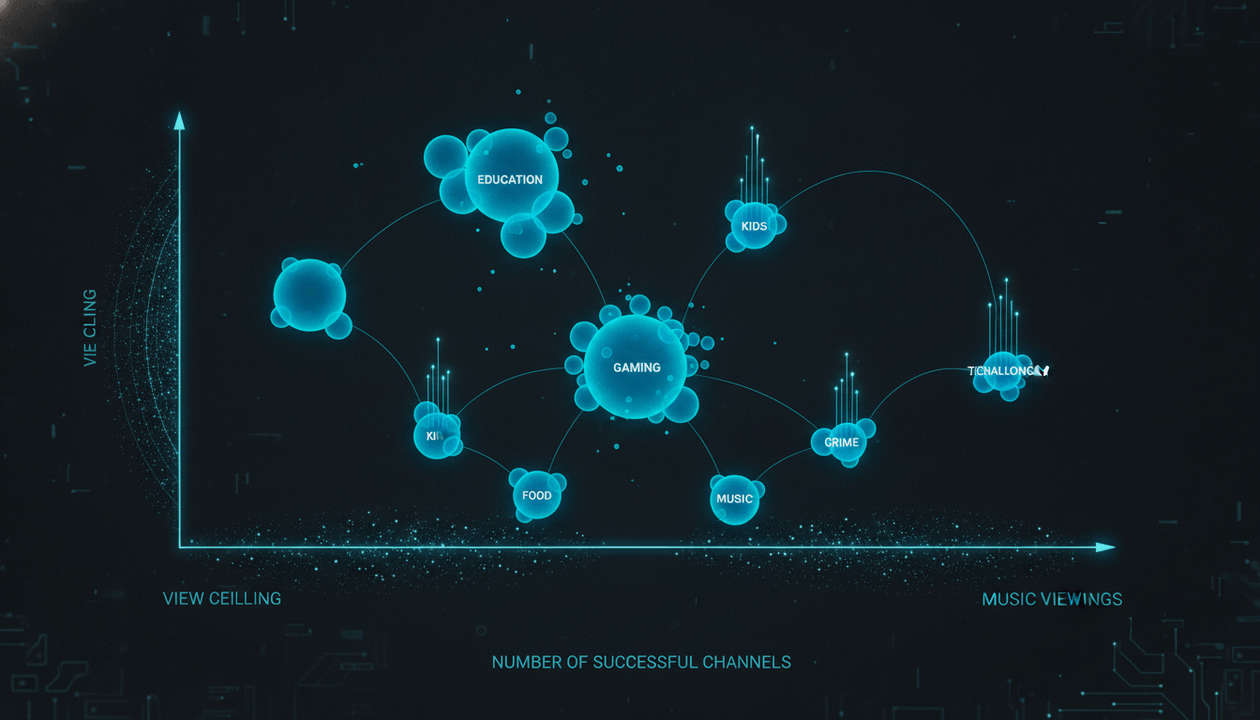
What topics get the most views on YouTube?
The usual answer is a list:
Gaming. Finance. AI. Fitness. Tutorials. Music. True crime.
But that skips an important distinction.
A topic can produce many million-view videos without producing the largest million-view videos.
Another topic can have a massive ceiling but be dominated by a relatively small number of channels.
And a topic with huge global demand may still be a terrible opportunity for your channel if competition is extreme or the audience does not overlap with yours.
So we analyzed the question differently.
OverseerOS studied 17,683 long-form YouTube videos with at least 1 million public views across 1,054 channels.
Then, to reduce the advantage older videos have had to accumulate views, we created a more recent primary cohort:
7,151 million-view videos published since August 16, 2023, across 844 channels.
The results revealed several very different kinds of "popular" topic.
Among our conservatively recognized topic families:
- Education and explainers produced the largest number of recent million-view videos and appeared across the widest range of channels.
- Kids and family had by far the highest median view count, at 15.9 million views, but those wins were much more concentrated among a smaller group of channels.
- Crime, mystery and horror combined scale with breadth: 491 recent million-view videos across 94 channels, with a median of 4.51 million views.
- Gaming produced 391 recent million-view videos with a median of 4.27 million views.
- Challenges and experiments had a median of 3.50 million views, and 18.2% crossed 10 million.
- Food and cooking was a smaller recognized sample, but its 85 recent million-view videos had a median of 5.11 million views.
The bigger finding is not that one of these is the "best niche."
It is this:
YouTube topics have different performance shapes. Some are broad. Some have extreme ceilings. Some are concentrated around powerful incumbents. Some create repeatable million-view opportunities across hundreds of unrelated channels.
That is a much more useful way to choose what to make.
Key Findings
Recent million-view videos, published within the last three years
| Topic family | Million-view videos | Channels | Median views | 10M+ share |
|---|---|---|---|---|
| Education & explainers | 728 | 234 | 2.09M | 5.6% |
| Crime, mystery & horror | 491 | 94 | 4.51M | 24.2% |
| Gaming | 391 | 56 | 4.27M | 14.1% |
| Kids & family | 367 | 45 | 15.92M | 60.2% |
| Entertainment & comedy | 270 | 75 | 2.33M | 13.7% |
| Tech & science | 228 | 87 | 2.38M | 6.6% |
| Music & performance | 224 | 54 | 2.55M | 20.5% |
| Sports | 209 | 60 | 2.98M | 7.7% |
| News & politics | 186 | 55 | 2.57M | 5.9% |
| Animals & nature | 175 | 87 | 2.30M | 14.3% |
| Challenges & experiments | 148 | 77 | 3.50M | 18.2% |
| Travel & luxury | 142 | 56 | 2.63M | 7.0% |
| Money & business | 108 | 41 | 1.90M | 0.9% |
One smaller category also stood out:
Food and cooking: 85 videos, 39 channels, median 5.11M views, 24.7% above 10M.
The sample is smaller, so we do not rank it above the larger families. But its scale deserves attention.
The Direct Answer: What YouTube Topics Get the Most Views?
There is no single correct answer because "most views" can mean at least four different things.
Highest median views
Among the larger topic families in our recent cohort:
Kids and family was the clear leader.
Median:
15.92 million views
And:
60.2%
of the recognized million-view videos in this family had crossed 10 million views.
Most million-view videos
Among our high-confidence mapped categories:
Education and explainers
produced the most.
We identified:
728 recent million-view videos across 234 channels.
Strong combination of scale and breadth
Crime, mystery and horror stood out.
It produced:
491 videos across 94 channels
with a median:
4.51 million views
and:
24.2%
crossing 10 million.
Strong high-scale entertainment categories
Gaming, challenges, music and food also produced large multi-million-view outcomes.
So if someone asks:
What is the most popular YouTube topic?
the more accurate response is:
Popular according to which dimension? Audience ceiling, number of successful videos, number of successful channels, current momentum, or repeatability?
Those are not the same thing.
YouTube itself explicitly says that topic interest affects the potential audience size of a video, while competition determines how many other videos are fighting for that viewer's attention. A broad-interest topic can therefore have more potential viewers while simultaneously being harder to win.
That distinction appears clearly in our data.
How We Analyzed 17,683 Million-View Videos
The full dataset contained:
17,683 long-form YouTube videos
from:
1,054 channels
with every video having at least:
1,000,000 public views.
The public-video library contained publication dates ranging from 2008 through August 2026.
That creates a major analytical problem.
A video uploaded eight years ago has had far more time to accumulate views than a video uploaded 18 months ago.
So we did not use the entire historical dataset as the primary ranking of current topic families.
Instead, we created a recent cohort containing videos published since:
August 16, 2023
That left:
7,151 million-view videos across 844 channels.
The historical dataset is still useful for understanding long-term ceilings.
But the recent cohort is a cleaner basis for comparing topic families.
How We Classified Topics
This part matters.
YouTube videos do not fit perfectly into neat niche boxes.
A video might simultaneously be:
- A science explainer
- A challenge
- A travel video
- A luxury video
- A documentary
Forcing every video into a category creates fake precision.
So we used a conservative deterministic classification system based on recognizable title and channel-name signals.
Examples included high-confidence markers for families such as:
- Gaming
- Kids
- Music
- Crime
- Sports
- Education
- Technology
- Food
- Challenges
- News
- Animals
- Travel
- Health
- Business
Each video received at most one primary family under ordered rules.
We deliberately left ambiguous videos unclassified
In the recent 7,151-video cohort:
3,020 videos, or 42.2%, were left in an "other / not rule-matched" group.
That is intentional.
We would rather publish:
"We cannot classify this confidently from the available public metadata."
than pretend a fuzzy machine-generated taxonomy is objective truth.
Therefore the category counts in this article should be read as:
Conservatively recognized examples of each topic family
not:
The exact market share of every topic on YouTube.
The categories are lower-bound counts.
This makes the study less flashy.
It also makes it more useful.
Finding 1: The Biggest Topic Was Not the Broadest Topic
Kids and family content produced the highest median view count by a huge margin.
Recent million-view cohort:
367 videos
across:
45 channels
Median:
15.92 million views
Videos above 10M:
60.2%
Videos above 50M:
20.7%
That is extraordinary.
For comparison:
Crime, mystery and horror median:
4.51M
Gaming:
4.27M
Challenges:
3.50M
Sports:
2.98M
Education:
2.09M
Kids content was operating on a completely different scale.
But this does not automatically make "kids content" the best niche.
Because the next statistic changes the interpretation.
Finding 2: Kids Content Had a Massive Ceiling, but the Wins Were Concentrated
The 367 recent kids-and-family million-view videos came from only:
45 channels.
The top five channels in that family accounted for:
41.4%
of the recognized videos.
The most prolific single channel contributed:
42 videos.
So kids content shows a pattern we can call:
High ceiling, high concentration
It can produce astonishing view totals.
But a meaningful portion of that evidence comes from channels with powerful established content systems and repeatable catalogs.
This matters.
A creator should never translate:
"Kids videos have huge median views"
into:
"If I make kids videos, I am likely to get huge views."
Our study cannot calculate that probability.
We selected videos that had already crossed one million views.
There is no denominator containing every failed kids video uploaded to YouTube.
The data tells us about the shape of successful videos, not the chance of success.
Finding 3: Education Was the Widest Million-View Opportunity
Education and explainers produced:
728 recognized recent million-view videos
across:
234 channels.
No other high-confidence family in our map came close to that channel breadth.
Median views:
2.09 million
10M+ share:
5.6%
This is almost the opposite of the kids result.
Kids:
Huge ceiling, concentrated winners
Education:
Lower median ceiling, distributed winners
Even channel concentration tells the same story.
The top five education/explainer channels accounted for only:
12.5%
of the recognized recent million-view videos in the category.
Compare that with:
- Kids: 41.4%
- Gaming: 44.0%
- Music: 42.9%
- Sports: 53.1%
Education was far less dependent on a handful of dominant channels.
That makes it a very different opportunity structure.
What this does not mean
It does not mean:
Educational videos are easiest to get to 1 million views.
Again, we do not have the denominator required to calculate that.
It means:
Million-view educational and explainer videos appeared across a particularly broad set of channels in our captured sample.
For creator research, that breadth is valuable.
You are less likely to be studying one franchise, artist or mega-brand ecosystem.
Finding 4: Crime, Mystery and Horror Had One of the Strongest Combinations
If I had to identify the most interesting middle ground in the study, it would be:
Crime, mystery and horror.
Recent cohort:
491 million-view videos
across:
94 channels
Median:
4.51 million views
10M+:
24.2%
It had:
- More recognized million-view videos than gaming
- More represented channels than gaming
- A higher median view count than gaming
- A much higher 10M+ rate than education
- Less concentration than gaming or kids
The top five channels represented:
38.7%
of the category.
That is still meaningful concentration.
But the pattern appeared across nearly 100 channels.
This is why simply asking for the "most popular niche" loses information.
Crime and mystery did not beat kids on ceiling.
It did not beat education on breadth.
But it occupied an unusually strong position between them.
Finding 5: Gaming Was Still a Major Million-View Engine
Gaming produced:
391 recent million-view videos
across:
56 channels
Median:
4.27 million views
10M+:
14.1%
The category also showed strong channel concentration.
Top five channels represented:
44.0%
of the recognized gaming videos.
So gaming has a familiar structure:
Enormous audience, enormous competition, strong franchises and powerful incumbent creators.
That is consistent with YouTube's own explanation that broad topic interest and competitive intensity both influence the number of potential impressions available to a creator.
This is why:
Gaming is popular
is not a content strategy.
You need to go several layers deeper.
For example:
Gaming → Minecraft → survival challenges → hardcore constraints → unusual resource rule
That final layer is where a usable video idea begins.
Finding 6: Challenge Content Had a Strong Ceiling Across Many Channels
Challenges and experiments produced:
148 recent million-view videos
across:
77 channels.
Median views:
3.50 million
10M+:
18.2%
Top-five-channel concentration:
30.4%
That is an interesting combination.
The recognized sample was smaller than education, gaming or crime.
But it was spread across many channels relative to its video count.
It also maintained a relatively high 10-million-view rate.
The important insight may not be:
"Challenge" is a niche.
It is not.
Challenge is often better understood as a video mechanism.
You can apply it to:
- Fitness
- Money
- Food
- Travel
- Gaming
- Technology
- Survival
- Social experiments
- Productivity
- Education
That is one reason broad topic lists are often strategically weak.
Some of the most powerful YouTube ideas are not niches.
They are structures layered onto topics.
Finding 7: Food Had a Smaller Sample but a Large View Ceiling
Food and cooking produced only:
85 recognized recent million-view videos
across:
39 channels.
That is too small for us to rank it alongside the biggest families with the same confidence.
But its performance distribution was notable.
Median:
5.11 million views
10M+:
24.7%
50M+:
5.9%
Among the recognized recent families, that is a very strong ceiling.
Why might food travel well?
Our public data cannot prove the mechanism.
But food has several properties that could expand addressable demand:
- Highly visual
- Globally recognizable
- Transformation-driven
- Strong before/after potential
- Sensory
- Compatible with spectacle
- Compatible with tutorials
- Compatible with challenges
- Compatible with culture and travel
Those are hypotheses for further testing, not causal findings from this dataset.
Finding 8: Music Looked Much Bigger in the Historical Dataset Than the Recent One
This is exactly why age control matters.
In the recent three-year cohort:
Music and performance:
224 videos
Median:
2.55 million views
10M+:
20.5%
Now look at the full historical dataset:
603 recognized million-view videos
Median:
7.61 million views
10M+:
45.6%
50M+:
12.6%
100M+:
6.0%
That is a completely different picture.
Did music somehow stop working?
That conclusion would be unjustified.
The historical videos simply had much more time to accumulate enormous totals, and famous music videos can continue collecting views for years.
This is an important methodological lesson for any YouTube niche study:
Do not compare lifetime views across categories without considering publication age.
A niche with older surviving videos will appear artificially stronger.
Finding 9: The Historical Kids Numbers Were Even More Extreme
The same age effect appears even more dramatically in kids content.
Across the full 17,683-video historical pool, our conservative kids-and-family classifier recognized:
1,437 million-view videos
Median:
28.69 million views
10M+:
75.1%
50M+:
39.5%
100M+:
27.3%
Median publication age:
roughly:
4.7 years
The recent cohort median was already massive at:
15.92M
but the lifetime cohort was nearly twice as high.
Again, do not interpret that as a probability.
It demonstrates the extraordinary cumulative ceiling of some successful kids catalogs.
Finding 10: "Most Popular" Has at Least Two Different Meanings
The topic map becomes clearer when we place categories on two conceptual axes.
Axis 1: Breadth
How many different channels are producing million-view evidence?
Axis 2: Ceiling
How far beyond 1 million do successful videos tend to travel?
That creates four broad opportunity types.
1. Broad + moderate ceiling
Example: Education and explainers
Many channels.
Many million-view videos.
Lower median among the winners.
This is a distributed opportunity.
2. Concentrated + enormous ceiling
Example: Kids and family
Fewer represented channels.
Massive median.
Huge 10M, 50M and historical 100M rates.
This is a power-law catalog opportunity.
3. Broad + strong ceiling
Example: Crime, mystery and horror
Many channels.
Hundreds of million-view examples.
Strong multi-million median.
This is a narrative demand opportunity.
4. Smaller + high ceiling
Examples: Challenges and food
Fewer observations.
Strong medians and 10M+ rates.
These are mechanism-driven opportunity spaces worth researching more deeply.
That framework is far more useful than ranking:
- Gaming
- Finance
- Fitness
without explaining what "best" actually means.
High Views Do Not Mean High Opportunity
This may be the most important strategic point in the article.
Suppose Topic A has:
- 100 million potential viewers
- 10,000 highly optimized competitors
Topic B has:
- 10 million potential viewers
- 100 serious competitors
Which is the better opportunity?
You cannot answer from audience size alone.
YouTube's own current guidance explicitly identifies topic interest and competition as separate external factors affecting performance.
So:
High demand is valuable only when you evaluate it alongside competition.
This explains why searching:
most popular YouTube niches
is often the wrong starting point.
You do not need the biggest market.
You need an attractive imbalance between:
demand
and:
available quality supply.
Search Popularity Is Not the Same as Video Opportunity
Another common mistake is using search volume as the entire topic strategy.
YouTube Studio's Trends tools can show creators information such as:
- Top searches
- Audience interest
- Breakout videos from similar creators
- Recently watched topics
- Content gaps
YouTube explicitly positions these signals as inputs for discovering future video ideas.
That makes search demand useful.
But consider two hypothetical topics.
Topic A
100,000 searches.
Every top result is excellent.
Twenty powerful channels already dominate it.
Topic B
25,000 searches.
Existing videos are three years old.
Several smaller channels are suddenly breaking baseline.
Which one deserves production?
Maybe Topic B.
This is why topic research should combine:
search demand + breakout evidence + competition + audience fit.
The Best YouTube Topic Is Relative to the Channel
YouTube's recommendation system is personalized around what individual viewers watch and enjoy, including their favored topics and formats.
That makes this question:
What topic is popular on YouTube?
less useful than:
What topic is unusually strong among viewers I can realistically serve?
Imagine you run an engineering channel.
Kids content may have a much higher platform-wide ceiling.
That does not mean you should suddenly publish nursery rhymes.
YouTube's own creator guidance recommends analyzing content in meaningful buckets, looking for recurring themes in what your audience responds to, and considering whether a trend actually fits your existing audience.
The correct topic should sit at the intersection of:
- Viewer demand
- Channel fit
- Evidence that similar content can break out
- Competitive opportunity
- Your ability to execute it well
The Five-Signal YouTube Topic Framework
Before producing a video, score the topic on five questions.
1. Is there audience demand?
Use:
- YouTube Trends
- Search behavior
- Recent high-performing videos
- Comments
- Adjacent communities
- Competitor uploads
YouTube Studio's Trends tab can surface top searches, audience interest and breakout videos among similar creators.
2. Is there breakout evidence?
Find channels publishing around the topic.
Then ask:
Are those videos merely large?
or:
Are they abnormal relative to the channel?
A 2-million-view video can be weak on one channel.
A 300,000-view video can be an extraordinary outlier on another.
3. Does the signal exist across more than one channel?
One winner is weak evidence.
Five unrelated channels breaking out on the same audience desire is much stronger.
4. Is competition already saturated?
Look at:
- Number of serious competitors
- Quality of current packaging
- Freshness of top videos
- Whether small channels can still break through
- Whether the same few giants dominate every result
5. Can your channel credibly satisfy the audience?
A huge niche is irrelevant if the viewer would not choose your execution.
Topic opportunity should be relative to:
your audience + your format + your production advantages.
How to Find Million-View Topic Opportunities Instead of Copying Million-View Videos
This distinction matters.
A million-view video is not automatically a topic opportunity.
Start with the video, then move outward.
Step 1: Find the outlier
Prefer:
channel-relative breakout
over:
large raw view count alone.
Step 2: Extract the underlying viewer desire
For example:
Video:
I Survived 7 Days in the World's Coldest City
The topic is not merely:
cold city
Possible underlying desires include:
- Extreme environments
- Survival
- Human limits
- Unknown places
- Transformation
- Experiential curiosity
Those themes can produce many original executions.
Step 3: Search horizontally
Find other channels serving the same desire.
Do they win with:
- Different locations?
- Different stakes?
- Different characters?
- Different formats?
- Different budgets?
Step 4: Search historically
Are six-month-old or one-year-old videos around the concept still winning?
Our evergreen YouTube content study showed why this matters.
Step 5: Search downward in channel size
Can smaller channels break out on it?
Our small-channel viral study found strong outliers across every subscriber tier.
If only global celebrities can make the concept work, the opportunity may depend more heavily on creator identity.
Step 6: Create a different execution
Do not recreate the source.
Change:
- Question
- Angle
- Stakes
- Example
- Story
- Audience
- Proof
- Format
- Structure
- Packaging
You are looking for:
the market signal
not:
the video to clone.
How to Do This With OverseerOS
This is where broad topic lists become actionable.
1. Start with the niche, then find the channels actually breaking out
OverseerOS Viral Channel Finder lets creators search by niche and filter channels by subscriber range, video count, language and content format. It then surfaces recent public breakout evidence behind the channels rather than returning only keyword scores.
Instead of asking:
Is true crime popular?
search true crime and ask:
Which true-crime channels are breaking out now?
Then narrow by channel size.
2. Analyze the channel baseline
Send interesting channels into the OverseerOS Channel Analyzer.
The broader OverseerOS analysis workflow is built around public top videos, recent uploads, outlier patterns and channel strategy rather than treating a single high raw view count as sufficient evidence.
Now you can distinguish:
popular topic
from:
unexpectedly strong topic for this channel.
3. Look for repeated topic patterns
If several outliers share the same underlying audience desire, the signal becomes more interesting.
Examples:
Crime
Not:
murder
but:
case where one tiny inconsistency exposed the entire story
Technology
Not:
AI
but:
technology quietly replacing something people assumed was permanent
Gaming
Not:
Minecraft
but:
severe constraint that forces an unusual survival strategy
You want repeatable mechanisms.
4. Reverse-engineer the winning executions
Once a reference is worth studying, OverseerOS Reverse Engineer can analyze transferable patterns across titles, thumbnails, hooks, scripts, outlines and packaging while using those patterns as a foundation for a new original execution.
The workflow becomes:
Market → breakout channel → breakout video → audience desire → repeated pattern → original execution
not:
popular niche → random video idea.
The Topic Opportunity Matrix
Use this for practical research.
| Evidence | What it tells you |
|---|---|
| High search interest | People actively ask for it |
| High topic interest | Addressable audience may be large |
| Recent 5x+ outliers | Something is working now |
| Small-channel outliers | Distribution may extend beyond incumbent audiences |
| Multiple unrelated winners | Signal is less dependent on one creator |
| Older strong outliers | Demand may persist |
| Weak current competition | Opportunity may still be open |
| Same audience as your channel | Better strategic fit |
| Transferable mechanism | Can become an original series |
| One celebrity-only winner | Weak evidence for a normal creator |
No individual row proves an opportunity.
The strongest topics accumulate evidence across several rows.
What Should a New YouTube Channel Make Videos About?
Do not start with:
Which topic gets the most views?
Start with three levels.
Level 1: Market
Example:
Science
Level 2: Audience desire
Example:
Understanding frightening future technologies
Level 3: Repeatable content promise
Example:
The technology that sounds impossible until you see who is already building it.
Now you have a channel direction.
A niche name alone is not enough.
"Finance" is not a strategy.
"Gaming" is not a strategy.
"Education" is not a strategy.
The channel becomes defensible when it owns a repeatable intersection of:
audience + desire + angle + format.
What This Study Does Not Prove
The limitations are critical.
This is not a random sample of YouTube
The 17,683 videos came from the OverseerOS million-view reference library.
They represent public videos encountered through the product's research workflows.
They are not every million-view video on YouTube.
This study covers long-form videos
Every video in this specific million-view library was stored as long-form.
So do not use these topic percentages as a Shorts market-share report.
For Shorts versus long-form, see our study of 938 breakout videos.
Topic classification is conservative and incomplete
We deliberately left:
42.2%
of the recent cohort unclassified.
That means category counts are lower bounds.
A family may contain more million-view videos than our system confidently recognized.
The categories overlap conceptually
A food challenge could fit both:
Food
and:
Challenges.
A science documentary could fit:
Science
and:
Education.
Our deterministic taxonomy assigns one primary family under ordered rules.
It does not claim human culture fits into perfectly separated buckets.
Raw view totals are age-dependent
Older videos have had more time to accumulate views.
That is why the primary family comparison uses the three-year cohort rather than relying entirely on the historical pool.
Million-view videos are selected winners
Every video crossed one million views.
We therefore cannot calculate the success rate of a niche.
For example:
60.2% of recent kids videos in this study exceeded 10M
does not mean:
60.2% of kids videos uploaded to YouTube reach 10M.
It means 60.2% of the already-million-view kids videos recognized in our captured cohort had crossed 10M.
We cannot establish causation
A topic does not independently cause views.
Performance can depend on:
- Creator
- Existing audience
- Thumbnail
- Title
- Timing
- Retention
- Satisfaction
- Competition
- Recommendation context
- Search demand
- Production quality
- External events
Our analysis is descriptive.
Final Verdict
So, what YouTube topics get the most views?
The data does not give one universal winner.
It gives different types of winners.
Highest view ceiling
Kids and family
Recent recognized median:
15.92M
10M+:
60.2%
Broadest million-view evidence
Education and explainers
728 videos across 234 channels
Strongest combination of breadth and high median views
Crime, mystery and horror
491 videos across 94 channels
Median:
4.51M
Major entertainment engine
Gaming
391 videos
Median:
4.27M
Strong format mechanism
Challenges and experiments
Median:
3.50M
across:
77 channels
Smaller but notable high-scale family
Food and cooking
Median:
5.11M
But the most useful finding is not any of those numbers.
It is this:
The size of a YouTube topic and the quality of a YouTube opportunity are not the same thing.
YouTube itself says topics differ in audience interest and competition.
So do not chase the biggest niche.
Find a topic where:
viewers want more
competitors are proving demand
outliers are appearing
the signal exists across multiple channels
and:
your channel has a credible reason to win.
That is a much stronger question than:
What niche is popular?
Because millions of views do not come from publishing inside a category.
They come from finding a specific piece of demand inside that category and serving it better than the alternatives.
FAQ
What YouTube topics get the most views?
In our recent long-form million-view dataset, kids and family had the highest median views among the larger recognized topic families at 15.92 million. However, education and explainers produced the largest number of recognized million-view videos and appeared across the most channels.
What is the most popular YouTube topic?
There is no single answer. A topic can be considered popular by total audience interest, search demand, number of million-view videos, number of successful channels or average view ceiling. Those measures produce different winners.
What type of YouTube videos get millions of views?
Our 17,683-video dataset contained million-view long-form videos across education, gaming, crime and mystery, kids, entertainment, technology, music, sports, challenges, food, animals, travel, business and many other topics.
Which YouTube niche has the highest views?
Kids and family had the highest recognized median view count in our recent cohort, but the category was more concentrated among a smaller group of channels. High median views should therefore not be interpreted as the highest probability of success.
What YouTube topics are easiest to get views in?
This study cannot determine which topic is easiest because it contains successful million-view videos rather than every successful and unsuccessful upload. Calculating difficulty would require a representative denominator for each topic.
What are the best YouTube topics for beginners?
Look for topics with proven audience demand where smaller channels are also producing relative outliers. Avoid choosing solely from platform-wide popularity because a huge market can also contain extreme competition.
Are educational videos popular on YouTube?
Yes. Education and explainers were the broadest recognized family in our recent million-view cohort, with 728 videos across 234 channels. Their median was lower than categories such as kids, gaming and crime, suggesting broad distribution rather than the highest ceiling.
Is gaming still a good YouTube niche?
Gaming produced 391 recent recognized million-view videos across 56 channels in our study, with a median of 4.27 million views. But YouTube says topic interest must be considered alongside competition, so "gaming" alone is far too broad to determine whether a particular channel opportunity is attractive.
Is true crime popular on YouTube?
Crime, mystery and horror was one of the strongest recognized families in the study, with 491 recent million-view videos across 94 channels and a median of 4.51 million views.
Are kids videos the most viewed content on YouTube?
Our captured million-view sample cannot establish platform-wide market share. However, kids and family content had by far the highest median view count among the larger topic families we could confidently recognize.
How do I find trending YouTube topics?
YouTube Studio's Trends tab can surface audience interest, top searches, breakout videos and content gaps. Use those signals alongside competitor breakout analysis rather than relying only on search popularity.
Should I choose a YouTube niche based on views?
No. Consider topic interest, competition, audience fit, breakout evidence, repeatability and your ability to execute the idea. YouTube itself notes that both topic interest and competitive alternatives affect performance.
How do I know if a YouTube topic has potential?
Look for recent channel-relative outliers across several unrelated channels, confirm that the viewer demand fits your audience, assess how competitive the existing videos are and check whether older winners suggest durable demand.
How many videos were in this study?
The full OverseerOS dataset contained 17,683 long-form videos with at least 1 million public views across 1,054 channels. The primary recent comparison used 7,151 videos published since August 16, 2023, across 844 channels.
What is more important, niche or video idea?
Both matter, but a niche is too broad to determine performance. The more actionable unit is a specific viewer desire expressed through an original topic, angle and packaging concept. A strong channel then turns those ideas into a repeatable content system.