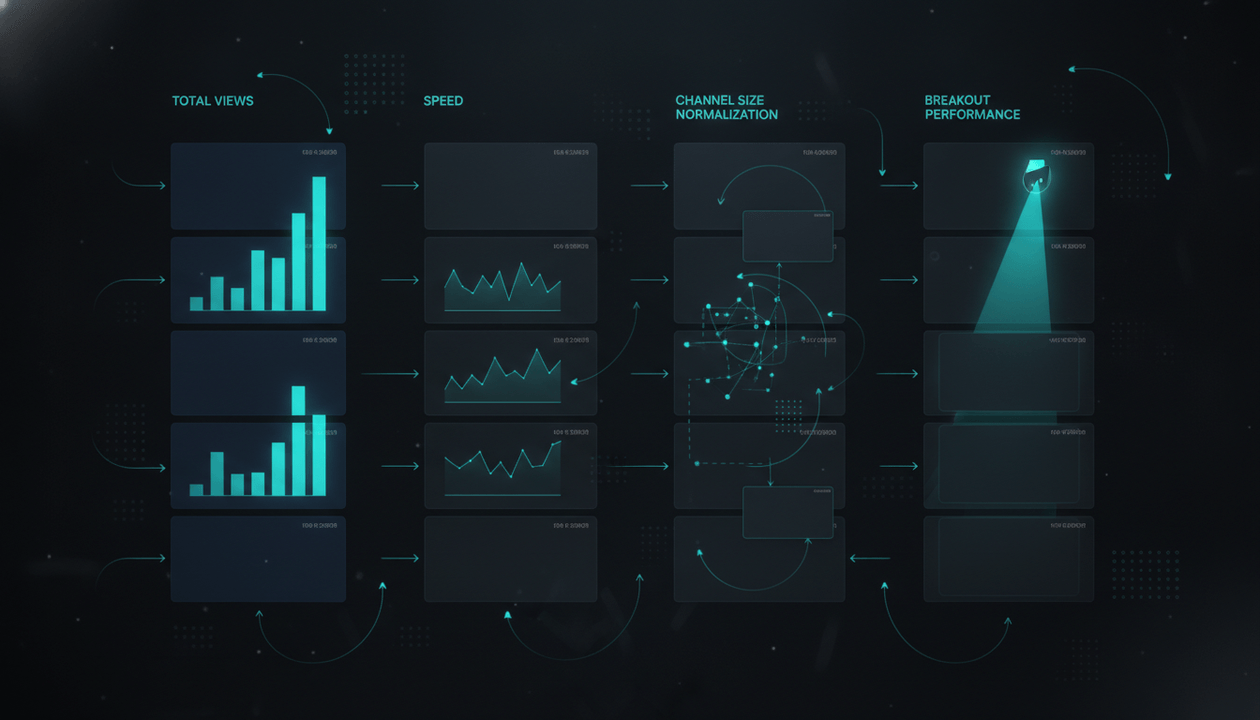

A competitor video explodes.
It gets five times, ten times, maybe fifty times the views that channel normally gets.
Now you have a decision to make:
Was the topic itself unusually strong?
Or:
Was an ordinary topic packaged exceptionally well?
Creators make expensive mistakes here because both situations look identical from the outside.
A huge view count does not tell you which one happened.
So we analyzed the problem using public YouTube performance and topic data collected by OverseerOS.
The final study included 1,345 million-view long-form videos with enough channel history to compare each video against the previous 10 long-form uploads from the same channel.
Of those, 401 videos across 216 channels were genuine channel-relative breakouts, reaching at least 3x the median views of the previous 10 uploads.
The data gave us a more precise answer than "topic vs packaging":
Repeatable topic demand leaves a measurable cross-channel footprint. Packaging does not leave an equally clean public fingerprint.
When a million-view video covered a specific topic that had already produced an independent winner on another channel in the same niche, 47.5% became a 3x+ channel breakout.
When we could not find that prior independent topic confirmation, 27.8% became 3x+ breakouts.
But there was an equally important finding.
Among the videos that did break out, prior topic-confirmed videos reached a median 5.66x baseline.
The isolated breakouts reached 5.48x.
Almost identical.
That means the size of the viral spike does not tell you whether the topic was repeatable.
And when we tested structural changes in the titles, title novelty did not cleanly explain the difference either.
The practical lesson is simple:
You can gather evidence that a viral video tapped repeatable topic demand.
But when that evidence is missing, you should not automatically conclude:
"The packaging made it viral."
The correct label is:
Unresolved outlier. Investigate further.
Key Findings
| Finding | OverseerOS result |
|---|---|
| Million-view long-form videos analyzed | 1,345 |
| 3x+ channel-relative breakouts | 401 |
| Channels represented among 3x+ breakouts | 216 |
| Median breakout strength | 5.50x baseline |
| 25th percentile breakout strength | 3.75x |
| 75th percentile breakout strength | 9.61x |
| Median recorded views among 3x+ breakouts | 3.88 million |
| Prior topic-confirmed videos that became 3x+ breakouts | 47.5% |
| Videos without prior topic confirmation that became 3x+ breakouts | 27.8% |
| 3x+ breakouts with prior topic confirmation | 66 of 401, 16.5% |
| Sub-3x million-view videos with prior confirmation | 73 of 944, 7.7% |
| Median score, topic-confirmed breakouts | 5.66x |
| Median score, isolated breakouts | 5.48x |
| Eligible prior-confirmed breakouts with another independent topic win within 365 days | 17 of 38, 44.7% |
| Eligible isolated breakouts with another independent topic win within 365 days | 9 of 244, 3.7% |
| 3x+ breakouts making a major title-structure shift | 17.2% |
| Sub-3x million-view videos making the same level of title shift | 15.3% |
The central result is not that packaging does not matter.
It obviously can.
The result is:
Public performance data can give you positive evidence that a topic is repeatable, but the absence of that evidence does not prove packaging was responsible.
That distinction changes how competitor research should be done.
How We Analyzed the Data
This study used public YouTube information observed and analyzed by OverseerOS.
We deliberately designed the study around a creator decision:
I found a competitor video that massively outperformed. What evidence should I look at before making my own version of the idea?
Step 1: Require Enough Channel History
Every candidate needed at least 10 earlier long-form videos from the same channel with usable public view observations.
That allowed us to establish a channel-specific baseline.
Step 2: Define a Real Breakout
For each candidate, we calculated:
Breakout score =
Candidate video views
÷
Median views of the previous 10 long-form uploads
A video reaching:
- 1x = approximately normal for that channel
- 2x = twice its recent baseline
- 3x = strong breakout
- 5x = major breakout
- 10x = extreme breakout
We used 3x as the primary breakout threshold.
The final qualifying corpus contained:
1,345 million-view long-form videos.
Of those:
401 reached at least 3x baseline.
Their median performance was:
5.50x baseline.
For more on why channel-relative performance is more useful than raw views alone, see our guide to YouTube outlier analysis.
Step 3: Look for Independent Topic Confirmation
We then asked whether the video's subject had already demonstrated demand somewhere else.
OverseerOS extracts structured topic information from qualifying videos, including concrete topic entities.
For example, broad categories such as:
Finance
are too vague.
More useful topic signals might be:
credit score
Grey Goose
Roman Empire
reincarnation
Minecraft
Panera Bread
We looked for an earlier million-view video:
- From a different channel
- Inside the same niche
- Published during the previous 730 days
- Sharing a sufficiently specific topic signal
We also filtered overly broad entities.
A topic signal had to appear on more than one channel, but could not be so common that it appeared across more than roughly 10% of the channels in that niche.
This was designed to distinguish:
"Several creators independently won on this actual subject."
from:
"Several finance channels happened to talk about money."
We call the first group:
prior topic-confirmed
and the second:
not previously confirmed in our dataset.
That second label is important.
It does not mean the topic had never worked anywhere on YouTube.
It means our dataset did not contain qualifying prior independent confirmation under the study's rules.
Step 4: Test the Title Side of Packaging Separately
Full packaging includes much more than a title:
- Topic
- Angle
- Title
- Thumbnail
- Timing
- Audience fit
- Promise
- Hook
- Distribution
We could not responsibly claim to isolate all of those from public competitor data.
So we tested one narrower question:
Did breakout videos suddenly use a substantially different title structure from their channel's previous 10 titles?
We encoded 13 visible title characteristics, including whether the title:
- Used a number
- Asked a question
- Started with a question word
- Used first-person framing
- Addressed the viewer directly
- Used a superlative
- Used negative or contrarian language
- Used a colon
- Used brackets or parentheses
- Used an exclamation mark
- Used quotation marks
- Was unusually short
- Was unusually long
This is deliberately a structural test.
It does not pretend to measure every psychological difference between two titles.
Step 5: Test What Happened Afterward
Finally, for older videos where enough future time had elapsed, we asked:
Did another independent channel produce a million-view video on the same specific topic afterward?
For the primary forward-looking test, every video needed a complete 365-day observation window.
This helps distinguish a one-off event from a topic that continued appearing in successful videos across the market.
Finding 1: Cross-Channel Topic Confirmation Was a Strong Signal
Among all 1,345 qualifying million-view videos:
139 had prior independent topic confirmation.
Of those:
66 became 3x+ channel-relative breakouts.
That is:
47.5%.
Among the 1,206 videos without prior confirmation:
335 became 3x+ breakouts.
That is:
27.8%.
| Topic evidence before publication | Videos | 3x+ breakouts | Breakout rate |
|---|---|---|---|
| Prior independent topic confirmation | 139 | 66 | 47.5% |
| No qualifying prior confirmation found | 1,206 | 335 | 27.8% |
This does not prove that cross-channel topic confirmation caused the performance.
Channels choosing proven subjects could differ in many other ways.
But it does establish something useful for competitor research:
A topic that has already worked independently across channels carries meaningfully more market evidence than a topic represented by one isolated winner.
This complements our earlier study asking whether one viral competitor is enough to validate a YouTube topic.
The difference here is important.
That study asked:
Does independent repetition make a topic more credible?
This study asks:
Once a competitor video has already exploded, can that evidence help us understand what probably deserves further investigation?
The answer is yes.
Finding 2: A Huge Outlier Score Did Not Tell Us Why the Video Won
This may be the most important finding in the study.
Among the 401 genuine 3x+ breakouts:
66 had prior topic confirmation.
Their median breakout score:
5.66x.
The remaining 335 did not have prior confirmation under our rules.
Their median breakout score:
5.48x.
| Breakout type | Videos | Median breakout score | Median recorded views |
|---|---|---|---|
| Prior topic-confirmed | 66 | 5.66x | 4.40M |
| No prior confirmation found | 335 | 5.48x | 3.86M |
Those breakout scores are remarkably close.
So imagine you find two competitor videos.
Video A gets:
5.7x the channel's normal views.
Video B gets:
5.5x.
One may sit inside a topic that has already worked across several independent channels.
The other may be a completely isolated event.
The magnitude alone cannot tell you which one you found.
This is why:
"It got 10x more views than normal."
is useful evidence that a video is worth studying.
But it is weak evidence for:
"This topic is proven."
Those are different claims.
Finding 3: Even an Extreme Isolated Outlier Was Weak Topic Validation
We pushed this further.
Among breakouts where we found no prior independent topic confirmation, we looked only at videos old enough to have a complete year of future observation.
Then we grouped them by how extreme the original breakout was.
| Original breakout strength | Eligible videos | Later independent topic confirmation within 365 days |
|---|---|---|
| 3x to under 5x | 121 | 2.5% |
| 5x to under 10x | 81 | 4.9% |
| 10x+ | 42 | 4.8% |
A 10x isolated winner looked much more spectacular than a 3x winner.
But it was not dramatically more likely to be followed by another independent winner on the same specific topic.
This is a major practical warning.
Creators often use viral intensity as validation:
"This didn't only work. It EXPLODED. So the topic must be incredible."
Our data does not support using breakout magnitude that way.
An extreme result can come from many combinations of:
- Topic
- Packaging
- Timing
- Audience
- Novelty
- Distribution
- Channel authority
- External events
- Execution
The public view count tells you the combination worked.
It does not decompose the combination for you.
Finding 4: Title Novelty Was Not a Reliable Packaging Fingerprint
If isolated viral videos were primarily packaging wins, one possible hypothesis would be:
They should frequently look very different from the titles that channel normally publishes.
We tested that.
The result was weak.
Among all 3x+ breakout videos:
17.2% changed at least three of the 13 title-structure signals relative to the dominant pattern in their previous titles.
Among million-view videos that stayed below 3x:
15.3% made the same level of structural shift.
That difference exists.
It is not large enough to treat title-format novelty as a diagnostic.
We also compared topic-confirmed and isolated breakouts.
Among topic-confirmed breakouts:
47.0% had no previous title among the prior 10 that matched the breakout across all 13 structural features.
Among isolated breakouts:
43.0% had no exact structural match.
Again, extremely similar.
And among the breakout sample, changing more title characteristics did not produce a clean upward performance ladder:
| Structural changes vs channel norm | Breakout videos | Median breakout score |
|---|---|---|
| 0 | 118 | 4.97x |
| 1 | 118 | 5.51x |
| 2 | 96 | 6.13x |
| 3+ | 69 | 5.20x |
If radical title novelty were the main universal explanation, we would expect a cleaner relationship.
We did not find one.
That does not mean titles do not matter.
It means simplistic title features cannot tell you why a competitor video exploded.
A title can become dramatically stronger without changing obvious surface characteristics.
Compare:
Why This Company Failed
with:
Why Panera Bread Fooled Everyone
Both follow a "Why X" structure.
They are not equally compelling promises.
Packaging analysis still requires judgment.
For a broader framework, see our guide to YouTube video packaging.
Finding 5: Repeatable Topics Kept Leaving New Evidence
The strongest validation came from what happened later.
We restricted the analysis to 3x+ breakouts old enough to have a complete 365-day future observation window.
Among breakouts with prior independent topic confirmation:
- Eligible videos: 38
- Another independent million-view topic confirmation within 365 days: 17
- Rate: 44.7%
Among isolated breakouts:
- Eligible videos: 244
- Later confirmation: 9
- Rate: 3.7%
| Existing topic evidence | Eligible breakouts | Another independent winner within 365 days |
|---|---|---|
| Prior topic confirmation | 38 | 44.7% |
| No prior confirmation found | 244 | 3.7% |
Within this sample, another independent topic confirmation appeared about 12 times as often after previously confirmed breakouts.
The longer 730-day window showed the same direction:
- Prior confirmed: 15 of 24, 62.5%
- Not previously confirmed: 16 of 169, 9.5%
This does not mean:
"A confirmed topic has a 44.7% chance of making your next video viral."
That would be an invalid interpretation.
The unit of analysis is the market, not your future upload.
The result means:
Topics with independent evidence before the breakout were much more likely to keep producing qualifying independent winners somewhere else in the dataset afterward.
That is exactly the kind of signal a creator should want before betting production resources on a competitor idea.
The Result Survived Basic Robustness Checks
We changed several assumptions to see whether one convenient definition was driving the conclusion.
We Made the Topic-Specificity Rule Stricter
Our primary rule excluded topic entities appearing across more than roughly 10% of channels in a niche.
We tightened that to approximately 5%.
The direction remained.
Under the stricter rule:
- 46.2% of topic-confirmed million-view videos became 3x+ outliers.
- 28.4% of unconfirmed videos did.
Among videos with a complete 365-day follow-up:
- Prior-confirmed: 25.0% later received another independent confirmation.
- Unconfirmed: 3.9% did.
The smaller samples make the exact percentages less stable.
The directional result survived.
We Restricted the Study to Newer Videos
Older videos have had more time to accumulate public views.
So we also looked at more recent publication cohorts.
For videos published from 2024 onward:
- Prior-confirmed videos reaching 3x+: 49.1%
- Unconfirmed videos reaching 3x+: 34.3%
For videos published from 2025 onward:
- Prior-confirmed: 51.3%
- Unconfirmed: 37.1%
The gap narrowed compared with the full historical sample.
It did not disappear.
The Most Important Distinction: "No Topic Evidence" Is Not "Packaging Win"
This is where competitor research usually becomes too confident.
Suppose you find a competitor video that is:
- 8x above channel baseline
- On a subject nobody else in the niche appears to have won with
- Using a strong title
- Using an excellent thumbnail
It is tempting to say:
"Clearly the packaging caused the breakout."
You still do not know that.
Maybe the video discovered new demand before competitors.
Maybe an external event created temporary demand.
Maybe YouTube found an unexpected audience.
Maybe the creator's existing audience had unusually strong interest.
Maybe the title and thumbnail mattered enormously.
Maybe all of those things were true simultaneously.
With public competitor data, you generally do not have access to the private counterfactual:
How would the same exact video have performed with weaker packaging?
You also do not see the competitor's complete private impression and click history.
So the correct analytical language is:
No repeatable topic evidence found yet. Packaging merits deeper inspection.
Not:
Packaging caused the views.
That sounds less dramatic.
It is far more useful.
A Better Framework for Diagnosing Competitor Winners
When you find a viral competitor video, use four evidence layers.
| Evidence layer | Question | What it tells you |
|---|---|---|
| Outlier evidence | Did the video beat its own channel's normal performance? | Whether the result is actually unusual |
| Topic evidence | Has the same specific demand worked independently elsewhere? | Whether the idea may transfer across channels |
| Packaging evidence | Is the title/thumbnail promise unusually strong or different? | What may have increased click appeal |
| Private performance evidence | How did impressions, CTR, watch behavior and tests change? | Strongest evidence available to the channel owner |
Do not collapse these into one score.
They answer different questions.
The Topic vs Packaging Diagnostic
Here is the workflow we would use.
1. Confirm That the Video Is Actually an Outlier
Do not start with raw views.
A competitor with 10 million subscribers getting 500,000 views may have underperformed.
A creator averaging 15,000 views getting 250,000 may have found something important.
Start with:
Video performance
÷
Comparable channel baseline
OverseerOS Channel Analysis is built around this kind of channel-relative context.
2. Search for Independent Topic Confirmation
Ask:
- Has another channel in this niche won on the same underlying subject?
- Did it happen recently enough to still matter?
- Is the common topic actually specific?
- Are several channels confirming the demand, or one creator repeating themselves?
If the answer is yes, your confidence in the topic should increase.
Not to 100%.
But materially.
3. Inspect the Packaging Separately
Now examine:
- Title promise
- Thumbnail idea
- Curiosity gap
- Emotional framing
- Specificity
- Stakes
- Contrast
- Audience targeting
- Whether the title and thumbnail create one coherent click promise
This is where OverseerOS Thumbnail X-Ray and OverseerOS Viral Title Architect become useful.
But do not reverse the logic.
You are not asking:
"Can I find something clever about this thumbnail?"
You are asking:
"How much of the available evidence points to repeatable demand, and what part of the remaining advantage might come from the way the idea was presented?"
4. Keep Unresolved Cases Unresolved
This is the most underused research skill.
Sometimes the evidence says:
We do not know yet.
That is a valid result.
Do not force every viral video into:
- Topic win
- Packaging win
A better classification is:
| Classification | Evidence |
|---|---|
| Strong topic signal | Genuine outlier + independent cross-channel topic confirmation |
| Likely mixed win | Strong topic evidence + unusually compelling packaging |
| Unresolved isolated outlier | Genuine outlier, but little independent topic evidence |
| Weak research signal | High raw views but not unusual for the channel |
The third bucket is especially important.
That is where deeper reverse-engineering earns its value.
How to Apply This With OverseerOS
A useful competitor workflow should not begin by asking AI to invent another video.
It should begin with evidence.
Step 1: Analyze the Competitor Channel
Use the free OverseerOS YouTube Channel Analyzer to understand:
- Normal channel performance
- Recent videos
- Top videos
- View distribution
- Breakout behavior
- Upload patterns
- Which videos are genuinely unusual relative to the channel
The goal is to find the cases worth reverse-engineering.
Step 2: Investigate the Winning Video
Inside OverseerOS Reverse Engineer, inspect the parts of the video separately instead of treating "viral" as one mysterious property.
That can include:
- Title
- Transcript
- Outline
- Hook
- SEO context
- Thumbnail
The question is not:
"How do I copy this?"
It is:
"Which parts represent transferable market evidence, and which parts are creator-specific execution?"
Step 3: Stress-Test the Packaging
Use OverseerOS Thumbnail X-Ray to inspect the visual click promise.
Use OverseerOS Viral Title Architect to explore stronger title directions around the underlying idea.
Then compare those directions against the evidence you already collected.
Step 4: Build an Original Version From the Mechanism
Once you understand:
- What demand is proven
- What is still uncertain
- What packaging mechanism is interesting
- What your audience needs
you can turn that evidence into an original angle and move it into the rest of the OverseerOS creation workflow.
That is very different from pasting a viral URL into a generic AI model and asking:
"Give me something similar."
The goal is not similarity.
The goal is transferable understanding.
A Practical Competitor Video Scorecard
Before committing a competitor-inspired idea to production, answer these questions.
Outlier
- Is the video meaningfully above the channel's normal baseline?
- Am I comparing it with the same format?
- Am I avoiding raw views as the only signal?
Topic
- Has this subject worked on another independent channel?
- Is the confirmation inside the same niche?
- Is the shared topic specific enough to mean something?
- Is the evidence recent?
- Are multiple creators validating it?
Packaging
- Is the title promise unusually specific?
- Does the thumbnail communicate the promise instantly?
- Do title and thumbnail complement rather than repeat each other?
- Is there a clear curiosity, stakes, transformation or tension mechanism?
- Does the packaging feel meaningfully stronger than that channel's normal work?
Originality
- Can I serve the same underlying demand with a different angle?
- Do I have something new to add?
- Can I create a distinct thumbnail concept?
- Can the hook and script deliver a genuinely different experience?
If the only box you can check is:
"The competitor got lots of views."
you have not finished the research.
Limitations
This study has important limitations.
First, the sample is not a random sample of every YouTube video. It consists of public videos encountered through OverseerOS research and channel-analysis systems, with additional requirements for usable topic and channel-history data.
Second, the candidate cohort is intentionally biased toward high-performing videos because the study begins with million-view videos. The findings should therefore be interpreted as a study of successful competitor videos, not average YouTube uploads.
Third, the study used public view counts. We did not have competitors' private impressions, click-through rates, watch-time curves or controlled title/thumbnail experiments.
Fourth, topic matching used structured topic information extracted from video content. That system is useful for consistent large-scale comparison but is not a perfect semantic oracle. Two videos can share an entity without satisfying exactly the same viewer intent.
Fifth, public view counts were not observed at an identical video age for every historical upload. Older videos have had more time to accumulate views. We therefore ran newer-video sensitivity checks, but this limitation remains.
Sixth, our packaging test examined visible structural characteristics of titles. It did not attempt to reduce thumbnail creativity or title psychology to one universal score.
Most importantly:
This study can identify stronger evidence for repeatable topic demand. It cannot prove that every remaining unexplained breakout was caused by packaging.
That is a feature of the methodology, not a weakness we should hide.
Final Verdict
So how can you tell whether a viral YouTube video is a topic win or a packaging win?
Start by abandoning the idea that one huge view count can answer the question.
In the OverseerOS dataset:
- Prior topic-confirmed million-view videos became 3x+ channel breakouts 47.5% of the time, versus 27.8% without prior confirmation.
- Prior topic confirmation appeared more than twice as often among 3x breakouts as among sub-3x million-view videos: 16.5% vs 7.7%.
- Once a video had broken out, its magnitude did not reveal the cause: topic-confirmed and isolated breakouts had nearly identical median scores of 5.66x and 5.48x.
- Major title-structure changes were only slightly more common among 3x breakouts than among other million-view videos.
- Among eligible historical breakouts, prior-confirmed topics received another independent market confirmation within a year 44.7% of the time, versus 3.7% for isolated outliers.
The best rule is therefore:
Use independent cross-channel success as evidence that the topic itself has transferable demand. Treat packaging as a separate hypothesis that must be investigated, not as the automatic explanation for everything left over.
A viral competitor video is evidence.
Your job is to determine what it is evidence of.
That is the difference between copying what looks successful and actually reverse-engineering why something may be worth making.
FAQ
How Do You Know if a YouTube Topic Is Proven?
Look for independent success across multiple channels in the same niche, not repeated success from only one creator.
The more specific the shared subject and the more independent confirmations it has, the stronger the evidence that demand may transfer.
Does a 10x YouTube Outlier Mean the Topic Is Good?
Not necessarily.
In our isolated-outlier cohort with a full year of follow-up, 10x+ breakouts were only modestly more likely to receive later independent topic confirmation than 3x to 5x breakouts.
Extreme performance proves that the complete video worked exceptionally well for that channel.
It does not isolate the topic as the cause.
Can a Great Thumbnail Make an Average Topic Go Viral?
It can contribute to much stronger click performance, but public competitor view counts alone cannot prove that the thumbnail caused the breakout.
You need to analyze topic demand and packaging separately.
How Many Competitor Videos Should I Study Before Choosing a Topic?
There is no universal number, but one winner is weak market validation.
Independent success across several channels is much stronger evidence than multiple winners from one creator.
See our research on independent topic confirmation.
Should I Copy a Viral Competitor's Title or Thumbnail?
No.
Study the mechanism.
Ask what the title promises, what the thumbnail communicates, what audience demand the topic serves and what made the combination unusually compelling.
Then create an original execution for your own audience.
What Should I Analyze First: the Topic, Title or Thumbnail?
Start with the topic and channel-relative performance.
First determine whether the video is a genuine outlier and whether the underlying demand has independent market evidence.
Then analyze the title and thumbnail as the packaging layer around that demand.
What Is the Biggest Mistake in Competitor Research?
Treating the entire performance result as one signal.
A viral video combines topic, packaging, timing, audience, channel context and execution.
Good research separates those layers instead of assuming the most visible element caused the result.