Most advice about evergreen YouTube content starts with the topic.
Make tutorials.
Answer timeless questions.
Avoid news.
Target search.
Choose ideas people will care about next year.
That advice can be useful, but it leaves out the most important question:
Did the video actually keep outperforming after the initial launch window disappeared?
So we measured evergreen performance differently.
We analyzed 1,336 YouTube videos across 130 channels that were already between 181 and 364 days old and were still performing at least 5 times above their relevant channel-level median baseline at the time of analysis.
The median video was:
271 days old
with:
983,619 views
and was still sitting at:
19.35x its channel-relative baseline.
Nearly half of the entire cohort was above 20x baseline.
More than one-quarter was above 50x.
And among videos already 301 to 364 days old, the median remained:
19.31x baseline.
That leads to a more useful definition of evergreen YouTube content:
Evergreen is not just a topic that could stay relevant. It is content that proves it can keep generating abnormal performance after freshness is gone.
That distinction changes how you should research video ideas.
Key Findings
| Finding | Result |
|---|---|
| Strong evergreen outliers analyzed | 1,336 |
| Channels represented | 130 |
| Video age range | 181 to 364 days |
| Median video age | 271 days |
| Median public views | 983,619 |
| Median channel-relative performance | 19.35x |
| Still at least 10x baseline | 73.5% |
| Still at least 20x baseline | 49.1% |
| Still at least 50x baseline | 27.2% |
| 301-364 day videos analyzed | 452 |
| Median score at 301-364 days | 19.31x |
| Median views at 301-364 days | 1.41M |
| Channels below 100K subscribers represented | 50 |
| Videos below 100K-subscriber channels | 503 |
| Median evergreen title length in metadata subset | 51 characters |
| Median long-form runtime in metadata subset | 17:07 |
The headline finding is not simply that old videos can still receive views.
That is already known.
The more interesting result is that hundreds of videos remained extreme outliers relative to their own channels many months after publication.
The Direct Answer: What Is Evergreen YouTube Content?
Evergreen YouTube content is content that continues attracting meaningful viewer demand well after its initial publication window.
But there are two ways to define "evergreen."
Topic evergreen
The idea itself appears timeless.
Examples might include:
- How to tie a tie
- How compound interest works
- Beginner photography tips
- How to change a tire
- How to improve public speaking
This is how most evergreen-content guides frame the concept. TubeBuddy, for example, emphasizes timeless tutorials, educational videos and explainers that can remain useful over long periods.
Performance evergreen
The video has actually demonstrated lasting abnormal performance.
That is what this study measures.
A video had to be:
- 181 to 364 days old
- Still at least 5x above its relevant channel-relative median baseline
That is a much harder test.
A topic can sound evergreen and still produce a dead video.
A topical video can sound temporary and still attract viewers for months.
The label should not come only from the idea.
It should eventually come from the data.
Why This Matters for YouTube Strategy
Creators often think about videos in two categories:
Trending video: Big initial opportunity, short lifespan.
Evergreen video: Slower start, smaller but steady long-term traffic.
Our dataset shows why that mental model is too simplistic.
Some older videos were not merely surviving.
They were still enormous channel-relative outliers.
Among the 1,336 evergreen videos:
73.5% were at least 10x baseline
49.1% were at least 20x
27.2% were at least 50x
Those are not weak residual tails.
They are videos that remained unusually strong long after publication.
YouTube itself says publish time is not known to determine a video's long-term performance and that its recommendation system aims to surface relevant videos regardless of when they were uploaded.
So an old upload does not automatically become invisible because something newer exists.
The more important question is whether viewers still want what the video offers.
How We Analyzed the Data
This study uses public YouTube performance information encountered through OverseerOS channel-analysis workflows.
The dataset was frozen at:
August 16, 2026, 09:38 UTC
before the final analysis was calculated.
We deduplicated repeat observations by YouTube video ID and retained the latest qualifying observation available before that cutoff.
The research layer is designed to retain public-video metadata and observations such as duration, format and title features without requiring additional YouTube or AI calls for the research itself.
Our breakout framework
We use age-aware performance comparisons rather than placing every video against one generic lifetime average.
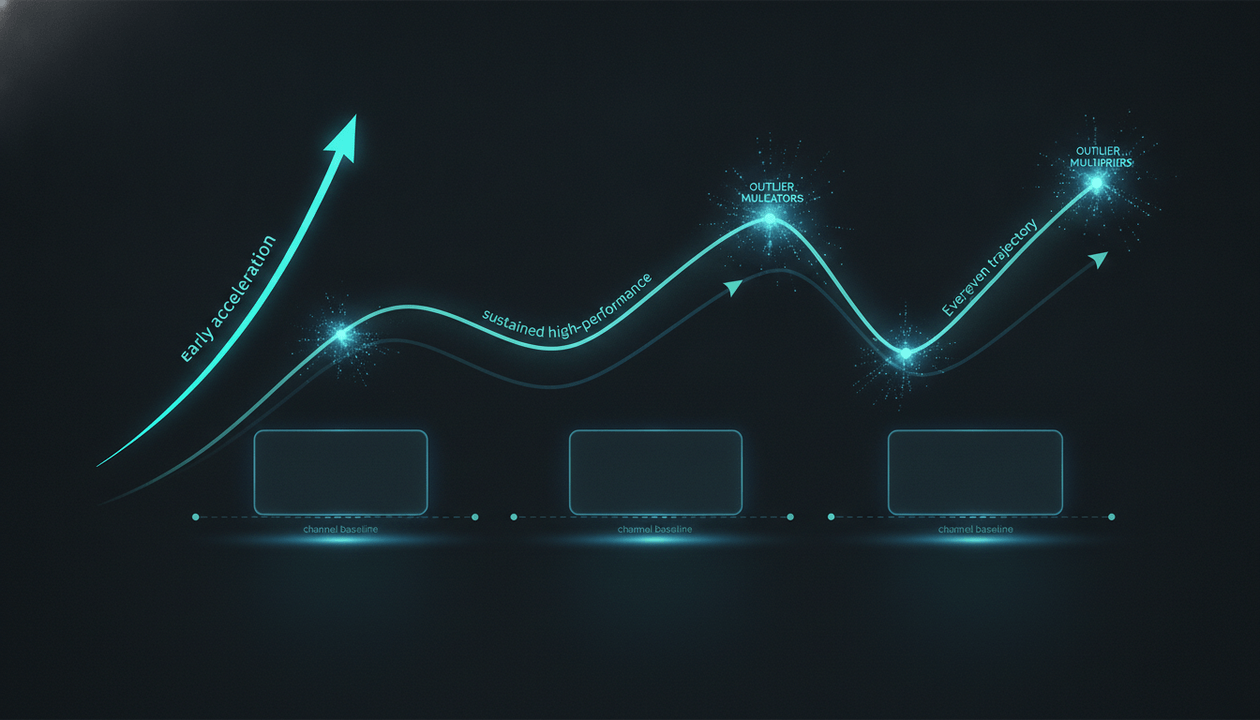
Early breakout
0 to 30 days old
Must be at least 5x the relevant velocity baseline.
Sustained breakout
31 to 180 days old
Must be at least 5x the relevant median-relative view baseline.
Evergreen breakout
181 to 364 days old
Must still be at least 5x the relevant median-relative view baseline.
For this article, the primary cohort is that final group.
What "5x" means
It does not mean:
Five times the subscriber count.
And it does not simply mean:
Five times more views than another random video.
It means the video's performance was at least five times the relevant median baseline derived from the channel being analyzed.
This matters because 500,000 views means something completely different on a channel that normally gets 20,000 views than on a channel that normally gets 2 million.
For a deeper explanation, see our YouTube outlier analysis.
Finding 1: 1,336 Videos Were Still Strong Outliers After Six Months
The primary cohort contained:
1,336 videos
across:
130 channels.
Median age:
271 days
or roughly nine months.
Median relative performance:
19.35x baseline.
Median views:
983,619.
That is already a striking result.
Remember, our minimum threshold was only 5x.
The typical qualifying evergreen winner was far above that floor.
Distribution of evergreen strength
25th percentile:
9.49x
Median:
19.35x
75th percentile:
55.25x
That means even the 25th-percentile video in this selected evergreen cohort was still almost 10 times baseline.
And the upper quarter was above roughly 55x.
These are extreme survivors.
But that word matters:
survivors.
We selected videos that remained strong.
This study therefore cannot tell you that a typical YouTube video becomes a 19x outlier after nine months.
It tells you what the strong long-lived winners in our dataset looked like once they had already demonstrated that durability.
Finding 2: Videos Nearing One Year Old Were Still Massive Outliers
We split the evergreen cohort into three age bands.
| Video age | Videos | Channels | Median outlier score | Median views | 20x+ | 50x+ |
|---|---|---|---|---|---|---|
| 181-240 days | 463 | 84 | 17.59x | 661,682 | 46.0% | 25.1% |
| 241-300 days | 421 | 80 | 22.40x | 1,042,084 | 53.4% | 29.7% |
| 301-364 days | 452 | 88 | 19.31x | 1,405,091 | 48.2% | 27.0% |
The final row matters most.
These were videos roughly 10 to 12 months old.
There were:
452 of them.
Median age:
336 days.
Median performance:
19.31x baseline.
Almost:
one in two was still at least 20x baseline.
More than:
one in four was still at least 50x.
So the evergreen tail was not confined to videos that had only just crossed our six-month boundary.
Strong outliers existed throughout the entire age window.
Finding 3: The Oldest Group Did Not Show an Obvious Performance Collapse
If breakout strength simply faded predictably with age, we might expect the relative-performance numbers to fall sharply from month six toward month twelve.
They did not.
Median scores were:
181-240 days: 17.59x
241-300 days: 22.40x
301-364 days: 19.31x
The oldest group still had a median above 19x.
But there is an important statistical trap here.
Do not conclude:
YouTube videos become stronger as they get older.
That is not what the study shows.
The older groups are subject to survivor selection.
To qualify at 300+ days, a video had to remain an extreme outlier long enough to still pass our threshold.
Weak videos disappear from the cohort.
Therefore the correct interpretation is:
Among videos that remained strong enough to qualify, extreme channel-relative performance was still visible deep into the first year.
That is very different from claiming age caused the performance.
Finding 4: Evergreen Does Not Necessarily Mean "Slow and Small"
There is a popular picture of evergreen content as something that quietly accumulates a few search views every day.
That can happen.
But it is not the only form evergreen performance takes.
Median views across our primary evergreen cohort were:
983,619.
For the 301-to-364-day group:
1,405,091.
Again, this is a winner-enriched dataset.
You should not interpret those values as expected views for an evergreen upload.
But they do show that:
Evergreen and high-scale breakout performance can exist in the same video.
A video does not have to choose between:
viral
and
evergreen.
Some videos can become both.
They can achieve unusually strong distribution and remain unusually strong long after the original publication window.
That is a much more interesting target than simply producing a "timeless topic."
Finding 5: Evergreen Winners Appeared at Every Channel Size
The long-lived outliers were not restricted to giant established channels.
We grouped the evergreen cohort by the public subscriber count available around analysis time.
| Channel subscribers | Evergreen videos | Channels | Median outlier score | Median views | Median views ÷ subscribers |
|---|---|---|---|---|---|
| Under 1K | 80 | 11 | 12.06x | 1,563 | 11.71x |
| 1K-9.9K | 129 | 15 | 17.73x | 17,773 | 3.30x |
| 10K-99.9K | 294 | 24 | 15.94x | 277,110 | 6.82x |
| 100K-999.9K | 481 | 47 | 24.10x | 1,277,472 | 3.73x |
| 1M+ | 352 | 33 | 21.61x | 10,326,150 | 2.45x |
There were:
503 evergreen videos from channels below 100K subscribers.
That extends the finding from our small-channel breakout study.
Small channels did not only produce fresh anomalies.
Some had videos that remained strong relative outliers six to twelve months later.
The under-1K result needs caution
Channels under 1,000 subscribers showed a median views-to-subscriber ratio of:
11.71x.
And 97.5% of their evergreen outliers had more views than the channel's subscriber snapshot.
That sounds enormous.
But a tiny subscriber denominator can produce huge ratios from relatively modest absolute view counts.
The median raw views in that group were only:
1,563.
So both numbers need to be read together.
Relative performance tells you how abnormal the video was.
Absolute performance tells you the scale.
Finding 6: Evergreen Outliers Were Not Dominated by a Handful of Channels
Multiple videos from one creator can make a dataset look larger than it really is.
We checked for that.
Across the 130 channels:
Median evergreen winners per channel:
5
Maximum from any one channel:
7
Top 10 channels' share of the entire video sample:
11.4%
Top 25 channels:
28.3%
So the 1,336 videos were not created by one or two prolific channels flooding the dataset.
The pattern appeared across a meaningful spread of channels.
That does not make the observations statistically independent.
Videos from the same creator are still related.
But it reduces the risk that the entire evergreen result is one-channel behavior disguised as a broad finding.
Finding 7: Both Short-Form and Long-Form Videos Appeared Among Older Outliers
Duration and format metadata were available for a smaller subset of the historical winner cohort.
For the evergreen group, that metadata subset contained:
370 videos.
Within it:
209 were in our duration-based short-form proxy
160 were long-form
with one additional non-matching format record.
Median short-form duration:
33 seconds
Median long-form duration:
17 minutes, 7 seconds
This is important because evergreen content is often discussed as though it automatically means long tutorials or search-heavy explainers.
Our data does not support that narrow assumption.
Older strong outliers existed in both duration groups.
Important Shorts caveat
Our research layer currently classifies the short-form proxy primarily from duration.
Official YouTube Shorts categorization also depends on factors such as aspect ratio and upload conditions, so this should not be interpreted as a perfect internal Shorts flag. YouTube's current rules describe eligible Shorts as square or vertical videos up to three minutes under the applicable upload conditions.
That is why we call it a short-form proxy rather than claiming all 209 are officially verified Shorts.
For the deeper format comparison, see our YouTube Shorts vs long-form study.
Finding 8: Evergreen Titles Were Not Exceptionally Long
The same metadata subset gave us another useful descriptive signal.
Among 370 evergreen winners with title metadata:
Median title length:
51 characters
Median words:
9
Compare that with the other lifecycle groups in the available metadata:
| Breakout state | Median title characters | Median words |
|---|---|---|
| Early | 62 | 10 |
| Sustained | 55 | 9 |
| Evergreen | 51 | 9 |
The older winners had somewhat shorter titles in this subset.
But the difference is not large enough to justify a rule like:
Evergreen titles should be 51 characters.
That would confuse correlation with instruction.
The more useful conclusion is:
Long-lived outliers did not require unusually long, keyword-stuffed titles.
That matters because evergreen content is often treated as a synonym for SEO content.
Search can absolutely contribute to long-term discovery.
But an evergreen-performing YouTube video is still a video competing for human attention.
The title still has to create a reason to click.
Evergreen Content Is Not the Same Thing as Search Content
This distinction deserves its own section.
Many evergreen guides naturally focus on YouTube search.
That makes sense.
A recurring search query can create durable demand.
But YouTube recommendations can also surface older videos.
YouTube says its long-term recommendation system aims to connect viewers with relevant videos regardless of when those videos were uploaded.
Its recommendation system is personalized around viewer behavior and satisfaction signals rather than simply prioritizing the newest upload.
So evergreen potential should not be reduced to:
Does this keyword still get searched?
A better question is:
Will new viewers continue having a reason to want this video?
That demand can come from:
- Search
- Home
- Suggested videos
- Playlists
- External discovery
- A recurring audience problem
- A durable entertainment premise
- A topic new people continuously enter
- A repeatable curiosity
- An enduring story
- A recommendation chain around related content
Public competitor data cannot tell us exactly which source drove each video's views.
But it can tell us whether a video's relative performance remained exceptional.
The Biggest Mistake: Calling a Topic Evergreen Before It Proves It
A creator finds:
How to Start Investing
and calls it evergreen.
Maybe.
Then they find:
Why Everyone Is Suddenly Buying Gold
and call it trending.
Maybe.
Those labels describe the idea.
They do not describe the actual performance curve.
An "evergreen" tutorial can fail immediately.
A timely news-adjacent video can continue attracting viewers long after the event because the deeper story remains interesting.
So use two separate labels.
Evergreen candidate
A topic has characteristics that suggest durable demand.
Proven evergreen
The published video continues performing materially above its normal comparison set after enough time has passed.
This simple vocabulary prevents a lot of bad strategy.
The Evergreen Confidence Ladder
Instead of labeling a topic permanently before publishing it, evaluate evidence in stages.
Stage 1: Candidate
Before publishing.
Look for:
- Recurring viewer problem
- Durable curiosity
- Repeatable search intent
- Stable audience desire
- Historical examples
- Similar older videos still performing
- Multiple channels proving demand
You are estimating durability.
Nothing is proven yet.
Stage 2: Early breakout
0 to 30 days.
Measure velocity.
Ask:
Is this moving unusually fast relative to comparable videos?
Do not confuse early speed with longevity.
An early winner can still burn out.
Stage 3: Sustained winner
31 to 180 days.
Now ask:
Is the video still materially above baseline once the launch window is gone?
Our current strong sustained cohort contained 1,690 videos with a median relative score of 13.51x.
That is a different signal from launch velocity.
Stage 4: Proven evergreen outlier
181 to 364 days.
Now the video has survived long enough to become strong evidence of durable demand.
Our primary cohort's median was:
19.35x baseline.
At this stage you should not merely admire the video.
You should study what remains transferable.
What Makes an Evergreen Winner Worth Reverse-Engineering?
The age of the video alone is not enough.
Before using an older winner as evidence for your next topic, ask five questions.
1. Is it still an outlier?
A 3-million-view video sounds impressive.
But if the channel normally gets 5 million, it is not useful breakout evidence.
Normalize first.
2. Is the underlying demand still alive?
Look for newer videos around the same audience desire.
If an eight-month-old winner has no modern confirmation, the opportunity may already have expired.
3. Did the mechanism repeat?
One old winner can be a coincidence.
Several creators winning around the same problem is much stronger evidence.
4. Is the packaging transferable?
Separate:
topic
from:
angle
from:
title
from:
thumbnail
from:
format.
Sometimes the durable demand is not the subject itself.
It is the way the subject was framed.
5. Can you make a genuinely different version?
A proven evergreen opportunity is not permission to remake the same video.
The goal is to identify the durable audience desire and create a new execution.
Fast-Burn vs Evergreen: How to Tell the Difference Before You Commit
You cannot know with certainty before publishing.
But you can estimate.
Fast-burn signals
Often include:
- Breaking event
- Product launch
- Celebrity event
- Temporary controversy
- New policy announcement
- One-time meme
- Short-lived novelty
- Time-sensitive price or ranking
- Content that loses meaning once viewers know the outcome
Evergreen-candidate signals
Often include:
- Problem new viewers repeatedly encounter
- Skill new viewers repeatedly need
- Recurring fear
- Recurring aspiration
- Repeatable transformation
- Historical curiosity
- Stable comparison
- Durable entertainment premise
- Topic with older proven outliers
- Question continuously asked by new entrants to the niche
But do not stop there.
YouTube itself warns that trend-driven viewership can rise and fall with the popularity of the trend and recommends creators build sustainable, repeatable content rather than depending entirely on the hottest current topic.
The best strategy is therefore not:
Never make trends.
It is:
Know which content is designed to catch current demand and which content is intended to keep earning attention after the event disappears.
A Better Evergreen Research Method
Most evergreen-content research starts with keywords.
Try this instead.
Step 1: Find videos that are already old
Do not start by searching only recent uploads.
Look for relevant videos at least:
6 months old.
Step 2: Calculate channel-relative performance
For every candidate, compare it with the channel's normal performance.
A nine-month-old video sitting at 8x normal is much more interesting than a nine-month-old video with a large raw number but below baseline.
Step 3: Split by age
Use bands such as:
- 181-240 days
- 241-300 days
- 301-364 days
- 1 year+
Now you can distinguish recent persistence from deep durability.
Step 4: Find cross-channel confirmation
Search for the same underlying viewer desire on unrelated channels.
The strongest signal is not one old winner.
It is a pattern.
Step 5: Check for modern confirmation
Now look at newer uploads.
Ask:
Are newer videos still breaking out around this audience desire?
If yes, you may have found something powerful:
historical durability + current demand.
Step 6: Separate the topic from the execution
Extract:
- Audience desire
- Promise
- Emotional frame
- Title structure
- Thumbnail mechanism
- Hook
- Video format
- Runtime
- Narrative structure
Then decide which part is actually repeatable.
The Two-Axis Topic Framework
A topic should be judged on at least two dimensions.
Axis 1: Momentum
How strongly is the topic moving now?
Axis 2: Durability
How long has similar demand continued producing outliers?
That creates four opportunity types.
| Low durability | High durability | |
|---|---|---|
| High momentum | Emerging trend | Compound opportunity |
| Low momentum | Weak opportunity | Evergreen library play |
Emerging trend
High current velocity.
Little historical durability evidence.
Useful when speed matters.
Compound opportunity
High current velocity.
Older proven outliers also exist.
This may be the highest-value research pattern because the topic has evidence of both:
now
and:
later.
Evergreen library play
Not exploding today.
But older videos repeatedly remain strong.
Useful for building durable catalog depth.
Weak opportunity
Little current momentum.
Little historical persistence.
Usually needs another reason before production.
This framework is more useful than asking:
Should I make trending or evergreen videos?
You can search for ideas that have both.
How to Find Evergreen Opportunities With OverseerOS
The research workflow becomes much easier when discovery and analysis are separated.
Step 1: Find channels showing current demand
Use OverseerOS Viral Channel Finder to discover channels currently producing breakout videos in your niche.
Viral Channel Finder uses recent public YouTube signals, subscriber and format filters, and both absolute and channel-relative breakout evidence.
This answers:
What is moving now?
Step 2: Analyze the channel's older catalog
Send the strongest channels into OverseerOS Channel Analyzer.
Channel Analyzer examines public top-performing and recent videos alongside channel performance distributions and breakout signals.
Now stop looking only at the newest winner.
Look backward.
Ask:
- Which older videos remain outliers?
- Which topics repeatedly appear?
- Which old winners still dwarf baseline?
- Which themes appear in both old and recent winners?
This answers:
What survived?
Step 3: Look for the intersection
Your strongest research candidates are often ideas where:
recent breakout evidence
overlaps with:
older durable evidence.
That gives you both momentum and persistence.
Step 4: Reverse-engineer the pattern, not the copy
Use OverseerOS Reverse Engineer to study the title, thumbnail, hook, structure, outline and other transferable elements behind a validated reference.
Reverse Engineer is explicitly designed to separate patterns from copying and turn successful public examples into original assets.
The workflow becomes:
Current signal → historical validation → channel baseline → pattern extraction → original execution
That is significantly stronger than:
Ask AI for evergreen YouTube ideas.
What This Study Does Not Prove
The limitations are important.
We did not track the same videos from launch to one year
This is a cross-sectional study.
The early, sustained and evergreen cohorts contain different videos.
We cannot say:
34% of early breakouts become evergreen.
We do not have the longitudinal transition data required to calculate that probability.
We cannot calculate an evergreen success rate
The dataset is winner-enriched.
It contains analyzed breakout candidates rather than a random census of every YouTube upload.
Therefore we cannot say:
12% of YouTube videos become evergreen.
That statistic is not available from this study.
Older winners are affected by survivor selection
A video must still be strong to appear in the evergreen cohort.
That means the older group is naturally filtered toward exceptional survivors.
The higher evergreen median does not prove videos become stronger simply because they age.
We do not know the traffic source
Public competitor data does not reveal another creator's private:
- Search traffic
- Browse impressions
- Suggested-video impressions
- CTR
- Retention
- Returning viewers
- External traffic
- Watch time
- Revenue
So we cannot tell whether a specific evergreen video survived because of search, recommendations, playlists or another source.
Subscriber counts are snapshots
The subscriber number used for channel-size comparisons reflects the public channel snapshot around analysis time.
A successful older video may itself have helped the channel gain subscribers.
Views-to-subscriber ratios therefore describe the snapshot, not the exact ratio on publication day.
Metadata coverage is smaller than the full cohort
Duration, short-form proxy and title-feature findings come from a subset of the main evergreen cohort.
We disclose those sample sizes rather than pretending all 1,336 videos had identical metadata coverage.
Final Verdict
Evergreen YouTube content should not be defined only by whether the topic sounds timeless.
It should eventually prove durability in performance.
In our study:
1,336 videos across 130 channels
were already:
181 to 364 days old
and were still at least:
5x above their relevant channel baseline.
The median video was:
271 days old
with:
983,619 views
and a relative-performance score of:
19.35x.
Among videos already 301 to 364 days old:
48.2% were still at least 20x baseline.
27.0% were still at least 50x.
Evergreen outliers appeared on:
- Tiny channels
- Mid-sized channels
- Million-subscriber channels
- Short-form videos
- Long-form videos
So the durable opportunity is bigger than "make tutorials for search."
The better strategy is to look for proven recurring demand.
Find what is breaking out now.
Then look backward.
Find what was breaking out six months ago.
Nine months ago.
Eleven months ago.
If the same audience desire keeps producing abnormal winners across time and across channels, you have something much stronger than a trend.
You have evidence that demand can persist.
And that is what evergreen YouTube research should actually be trying to find.
FAQ
What is evergreen content on YouTube?
Evergreen YouTube content remains useful or desirable long after publication. In performance terms, a stronger definition is a video that continues materially outperforming its relevant channel baseline after its initial launch period.
How long does a YouTube video stay relevant?
There is no universal lifespan. YouTube says upload timing is not known to determine long-term performance and that older videos can continue being recommended when relevant to viewers.
Can YouTube videos still get views after one year?
Yes. YouTube does not automatically stop recommending a video because it is old. Our study focused on videos up to 364 days old and found hundreds still dramatically above channel baseline near the end of that period.
How many evergreen YouTube videos did you analyze?
The primary OverseerOS study contained 1,336 strong evergreen outliers across 130 channels, each between 181 and 364 days old and still at least 5x above its relevant median-relative channel baseline.
How strong were evergreen YouTube videos after six months?
The median evergreen winner in the study was 19.35x above baseline. 73.5% were at least 10x, 49.1% were at least 20x, and 27.2% were still at least 50x.
Do evergreen videos need to be tutorials?
No. Tutorials can have durable demand, but evergreen performance is not limited to one content type. A video can remain relevant because of recurring curiosity, entertainment value, search demand, recommendations or another persistent viewer need.
Are viral videos and evergreen videos opposites?
Not necessarily. A video can break out strongly and also remain a major outlier months later. "Viral" describes unusually strong reach or acceleration, while "evergreen" describes durability. The same video can potentially exhibit both characteristics.
Is trending content bad for YouTube growth?
No. Trend content can capture real current demand. YouTube advises creators to consider sustainability because trend-driven viewership may rise and fall with the trend itself. The useful strategy is understanding whether a video is intended for temporary momentum, durable demand or both.
How can I find evergreen YouTube topics?
Look for older videos in your niche that remain far above their channel baseline, identify the underlying viewer desire, confirm the pattern across unrelated channels, then check whether recent videos around the same demand are also performing.
Is search traffic required for evergreen YouTube videos?
No. Search can create durable traffic, but YouTube's recommendation system can continue surfacing older videos when they are relevant to a viewer. Public competitor data generally cannot reveal exactly which traffic source is responsible.
Can YouTube Shorts be evergreen?
Short-format videos appeared among the older strong outliers in our metadata subset. However, our study uses a duration-based short-form proxy rather than YouTube's private internal format classification, so this should not be interpreted as an exact census of official Shorts.
How old should a video be before calling it evergreen?
There is no official YouTube threshold. For this study, OverseerOS used 181 days as the start of the evergreen-performance window so a video had to survive at least roughly six months before qualifying.
What is the best evergreen YouTube strategy?
Combine current and historical evidence. Find topics breaking out now, then verify that similar audience desires produced strong older outliers. The strongest candidates may have both current momentum and proven durability.