

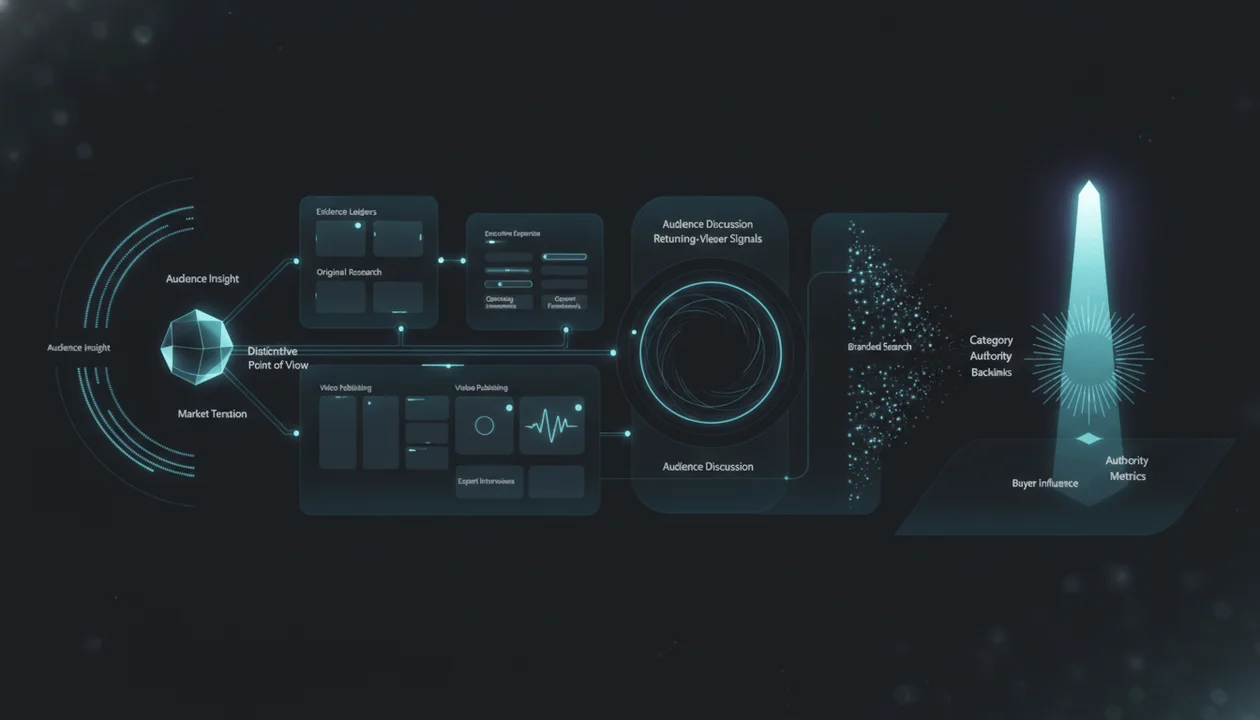
Most thought leadership content is not thought leadership.
It is recycled advice delivered by someone with a senior job title.
The camera is expensive.
The lighting is polished.
The executive sounds confident.
But the audience learns nothing they could not have found in the first page of search results.
Real thought leadership does something harder.
It gives the audience a useful way to understand a problem that previously felt confusing, invisible, or inevitable.
It may:
- Name a problem before the market has agreed on the language
- Challenge an assumption most competitors repeat
- Explain why the accepted approach keeps failing
- Introduce a stronger decision framework
- Reveal evidence the audience has not seen
- Connect several market changes into one clear argument
- Show how an experienced operator thinks through uncertainty
- Help buyers make a difficult decision with greater confidence
A strong YouTube thought leadership strategy turns that thinking into a repeatable video system.
It allows founders, executives, subject-matter experts, operators, researchers, and customer-facing leaders to build authority before a buyer enters a sales conversation.
The viewer does not merely learn what your company sells.
They learn how your company thinks.
That distinction matters.
Product marketing explains the offer.
Thought leadership shapes the beliefs that determine whether the offer will feel relevant.
This guide gives you a complete YouTube thought leadership strategy for B2B SaaS companies, agencies, professional services firms, creator businesses, consultancies, financial brands, technical companies, research organizations, and expert-led businesses.
It includes:
- The difference between thought leadership and ordinary educational content
- The seven foundations of credible authority
- Founder-led, executive-led, expert-led, and brand-led models
- A Thought Leadership Territory Map
- A Point-of-View Development System
- Evidence standards
- Video formats and repeatable series
- YouTube search, browse, suggested, podcast, Shorts, and post strategies
- Titles, thumbnails, hooks, scripts, chapters, playlists, cards, and end screens
- Production workflows for busy executives
- AI use without manufacturing expertise
- A 100-point Thought Leadership Authority Score
- Measurement beyond views and leads
- A 90-day implementation plan
- Complete briefs, templates, and prompts
- An OverseerOS workflow for research, planning, scripting, packaging, production, distribution, and performance analysis
Key Takeaways
- Thought leadership is not content from a leader. It is content that gives the audience distinctive, credible, and useful thinking.
- Expertise explains what is known. Thought leadership helps the audience interpret what is changing, disputed, misunderstood, or likely to happen next.
- A strong point of view needs evidence, experience, reasoning, implications, and an honest limitation.
- Generic advice weakens authority because it shows no unique judgment.
- YouTube is well suited to thought leadership because long-form video can reveal reasoning, examples, trade-offs, personality, and practical judgment.
- YouTube Search considers relevance, engagement, and quality, including signals that help identify expertise, authoritativeness, and trustworthiness on a topic. Source: YouTube Help
- Build thought leadership around an audience problem and market tension, not the executive’s desire for visibility.
- Founders are not the only possible thought leaders. Operators, researchers, engineers, strategists, customers, and subject-matter experts may hold stronger authority for specific topics.
- One recognizable territory is more valuable than random opinions across every industry issue.
- Thought leadership should connect market insight to buyer decisions without becoming a disguised product advertisement.
- Search-led videos capture explicit questions. Browse-led videos can introduce an argument the viewer was not actively seeking.
- Interviews and podcasts create raw material, but unedited conversations do not automatically become strong thought leadership.
- Shorts can distribute one sharp argument. Long-form video is usually better for proving complex reasoning.
- YouTube posts can extend the conversation through polls, questions, images, quizzes, text, and video.
- Measure qualified attention, returning viewers, idea adoption, branded search, sales usage, buyer influence, product evaluation, and customer impact separately.
- Do not claim that thought leadership caused revenue when the evidence only shows that it assisted or influenced a buying journey.
- OverseerOS helps teams study public YouTube patterns, identify market opportunities, organize a thought leadership system, write original videos, create packaging, produce supporting visuals, distribute each asset, and review connected-channel performance.
What Is YouTube Thought Leadership?
YouTube thought leadership is the strategic use of video to publish distinctive, evidence-backed ideas that help a defined audience understand important problems, decisions, or market changes.
A thought leadership video should answer at least one of these questions:
- What is changing?
- Why is it changing?
- What are most people misunderstanding?
- Why does the accepted approach fail?
- Which new decision does the audience need to make?
- What evidence should influence that decision?
- What framework makes the problem easier to understand?
- What should leaders do differently?
- Which trade-off is being ignored?
- What is likely to matter next?
Thought leadership is not defined by the speaker’s title.
A CEO can publish generic content.
A frontline operator can publish exceptional thought leadership.
The determining factors are:
- Relevance
- Distinctiveness
- Credibility
- Evidence
- Reasoning
- Decision usefulness
- Consistency
A useful definition is:
YouTube thought leadership is a repeatable video system that turns credible experience, evidence, and perspective into ideas that improve how a specific audience thinks and acts.
Thought Leadership vs Educational Content
Educational content explains information.
Thought leadership interprets information.
Educational content:
Here are five ways to improve your YouTube research process.
Thought leadership:
Most content teams do not have a research shortage. They have a decision-quality problem caused by separating research from production.
Educational content:
Here is how customer onboarding works.
Thought leadership:
Most onboarding programs teach product navigation when customers need outcome navigation.
Educational content:
Here are the latest AI marketing trends.
Thought leadership:
AI generation is becoming abundant. The competitive advantage is moving toward evidence, judgment, and proprietary workflow.
Both forms are useful.
Thought leadership becomes necessary when the audience needs more than instructions.
It needs interpretation.
Thought Leadership vs Content Marketing
Content marketing is the broader discipline of creating and distributing useful content to attract, educate, convert, and retain an audience.
Thought leadership is one category inside that discipline.
| Content Marketing | Thought Leadership |
|---|---|
| Answers known questions | Reframes important questions |
| May summarize established knowledge | Adds interpretation or original insight |
| Can target any funnel stage | Often shapes awareness, trust, and evaluation |
| May be brand-led | Often benefits from a credible human voice |
| Can prioritize search demand | May create demand for new language or beliefs |
| Usually aims to be useful | Must also be distinctive |
| Can be outsourced extensively | Requires genuine access to expertise |
A complete YouTube strategy needs both.
Searchable tutorials may capture existing demand.
Thought leadership can shape the beliefs that create future demand.
Thought Leadership vs Personal Branding
Personal branding makes a person recognizable.
Thought leadership makes their thinking valuable.
A founder may build a personal brand through:
- Daily routines
- Career stories
- Lifestyle content
- Behind-the-scenes videos
- Opinions
- Interviews
- Social posts
Those assets may build familiarity without establishing meaningful authority.
Thought leadership requires a stronger connection between:
- Audience problem
- Relevant expertise
- Distinct perspective
- Supporting evidence
- Actionable implication
The best founder-led channels often combine both.
Personal stories create human connection.
Thought leadership gives the connection commercial and intellectual value.
Thought Leadership vs Product Marketing
Product marketing explains:
- What the product does
- Who it serves
- Why it is different
- Which use cases it supports
- Why someone should choose it
Thought leadership explains:
- Why the market problem exists
- Why the current approach is insufficient
- Which new method is required
- What buyers should value
- How the category may evolve
Example product marketing:
OverseerOS helps creators analyze public YouTube patterns and move from channel research into original topics, scripts, thumbnails, and content plans.
Example thought leadership:
AI has made content generation abundant. The scarce capability is no longer producing more ideas. It is deciding which ideas deserve production.
The second idea creates the intellectual context in which the product becomes more relevant.
Thought Leadership vs Demand Generation
Thought leadership can become a major component of a YouTube demand generation strategy.
Demand generation creates:
- Problem awareness
- Category awareness
- Trust
- Familiarity
- Preference
- Future buying intent
Thought leadership contributes by helping the audience:
- Recognize a hidden problem
- Adopt new language
- Reevaluate an old belief
- Understand a new category
- Trust the company’s judgment
- Remember the company when timing changes
Not every demand-generation video needs to contain an original thesis.
Not every thought leadership video needs an immediate commercial CTA.
The two systems overlap when the idea changes how a relevant buyer understands the market.
Why YouTube Works for Thought Leadership
1. Video Reveals Reasoning
A written statement shows the conclusion.
Video can show:
- How the speaker reaches the conclusion
- Which evidence they prioritize
- How they respond to objections
- Where they acknowledge uncertainty
- Which examples they choose
- How clearly they explain trade-offs
The audience evaluates more than information.
It evaluates judgment.
2. Long-Form Video Supports Nuance
Some ideas cannot be explained responsibly in 200 words or a 30-second clip.
A strong market argument may require:
- Historical context
- Definitions
- Evidence
- Counterarguments
- Examples
- Limitations
- Implications
- Recommended action
Long-form YouTube gives the idea enough space to become credible.
3. Search Can Preserve the Idea
YouTube Search evaluates relevance, engagement, and quality. Its systems also consider signals that help identify whether a channel demonstrates expertise, authoritativeness, and trustworthiness on a topic. Source: YouTube Help
A useful thought leadership video may continue appearing when buyers search:
- Market problem
- New category
- Strategic framework
- Industry change
- Product alternative
- Executive question
- Implementation concern
The idea can remain discoverable after the original publishing moment.
4. Browse Can Introduce a New Belief
A buyer cannot search for a problem they do not recognize.
Browse-led packaging can introduce:
- A contradiction
- A surprising market shift
- A costly mistake
- A new thesis
- An unexpected result
- A story that reveals a wider problem
Example:
The AI Tool Stack Is Making Content Teams Slower
The viewer may not have searched that phrase.
The video earns attention by describing a recognizable tension.
5. Suggested Videos Can Build Intellectual Progression
One argument can lead naturally into another.
Example sequence:
- Why More Content Ideas Reduce Decision Quality
- The Evidence-Backed Topic Selection Framework
- Why Keyword Research Is Not Enough for YouTube
- What a YouTube Intelligence Platform Actually Does
- How an Agency Uses the Workflow
The viewer moves from problem recognition into method, category, product relevance, and proof.
6. A Human Voice Builds Memory
People may forget a corporate article.
They are more likely to remember:
- A clear face
- A distinctive phrase
- A repeated framework
- A strong analogy
- A credible disagreement
- A recognizable voice
That does not mean every video requires a founder on camera.
It means authority becomes stronger when ideas have an accountable source.
7. YouTube Supports Several Thought Leadership Formats
A thought leadership system can include:
- Direct-to-camera videos
- Documentary essays
- Interviews
- Podcasts
- Roundtables
- Screen-led analysis
- Annotated case studies
- Live Q&A sessions
- Keynote adaptations
- Research breakdowns
- Shorts
- Posts
On YouTube, a podcast show is managed as a playlist and the episodes are videos inside that playlist. Eligible podcasts may receive discovery benefits across YouTube and YouTube Music. Source: YouTube Help
Why Thought Leadership Matters in Complex B2B Decisions
Complex purchases are rarely controlled by one visible buyer.
The 2025 Edelman and LinkedIn B2B Thought Leadership Impact Report focused on both visible and hidden decision-makers. It reported that more than 40% of B2B deals stall because of internal misalignment within buying groups, and found that hidden buyers actively discover and evaluate thought leadership. Source: Edelman
That creates an important role for YouTube.
A strong video can reach people the sales team has never met:
- Executive sponsor
- Technical reviewer
- Finance stakeholder
- Operations leader
- End user
- Procurement representative
- Internal skeptic
- Future champion
Those viewers may evaluate:
- Whether the company understands the problem
- Whether the proposed method is credible
- Whether the leadership team shows sound judgment
- Whether the product category deserves investment
- Whether the vendor belongs on the shortlist
Thought leadership helps shape the decision before sales enters the room.
The Seven Foundations of Credible Thought Leadership
A useful thought leadership system rests on seven foundations.
1. Audience Relevance
The idea must matter to a defined audience.
Weak:
The Future of Business
Stronger:
Why B2B SaaS Teams Are Rebuilding Product Education Around Buyer Questions
Weak:
AI Is Changing Everything
Stronger:
Why AI Script Generation Is Making Distinctive YouTube Voice More Valuable
The narrower framing creates stronger relevance.
2. Lived or Earned Expertise
Authority may come from:
- Operating experience
- Customer experience
- Research
- Technical expertise
- Repeated implementation
- Industry observation
- First-party data
- Formal study
- Documented experiments
The speaker should have a credible relationship with the subject.
3. A Distinct Point of View
The audience should understand what the speaker believes.
Weak:
Companies should focus on customers.
Stronger:
Most customer education fails because it teaches the interface instead of the customer outcome.
A clear point of view creates intellectual ownership.
4. Evidence
Evidence may include:
- Original data
- Public data
- Customer patterns
- Product behavior
- Interviews
- Experiments
- Case studies
- Research
- Operational examples
- First-hand observation
The evidence must match the strength of the claim.
5. Reasoning
Do not jump from observation to conclusion.
Show:
- What was observed
- What may explain it
- Which alternative explanation exists
- What the evidence supports
- What remains uncertain
- Which decision follows
6. Decision Utility
The viewer should know what to do differently.
The idea may change:
- What they prioritize
- Which metric they trust
- Which risk they assess
- Which question they ask
- Which process they redesign
- Which product category they evaluate
7. Commercial Relevance
Thought leadership does not need to mention the product constantly.
It should still connect to a problem the company is qualified to solve.
A cybersecurity company publishing restaurant reviews may build an audience.
It is unlikely to strengthen its authority in cybersecurity.
The Thought Leadership Value Chain
Use this sequence:
- Experience or evidence
- Observation
- Interpretation
- Point of view
- Framework
- Practical implication
- Buyer relevance
- Product or service connection
- Repeated publication
- Market recognition
The chain breaks when a company skips the early stages and begins with a slogan.
The Thought Leadership Maturity Ladder
| Level | Content Behavior | Audience Effect |
|---|---|---|
| 1. Commentary | Repeats news or common advice | Low differentiation |
| 2. Expertise | Explains established knowledge clearly | Builds competence |
| 3. Experience | Shares specific operational lessons | Builds credibility |
| 4. Point of view | Takes a defensible position | Builds recognition |
| 5. Framework | Gives the market a reusable model | Builds intellectual ownership |
| 6. Evidence | Produces original findings or proof | Builds authority |
| 7. Category influence | Shapes market language and buying criteria | Builds durable preference |
A company does not need to begin at Level 7.
It should know which level each video is attempting to reach.
Who Should Become the Thought Leader?
Do not automatically assign the CEO.
Choose the person with the strongest combination of:
- Relevant expertise
- Clear communication
- Credibility
- Access to evidence
- Availability
- Consistency
- Strategic fit
Founder-Led Thought Leadership
Best when the founder:
- Has a strong market thesis
- Understands customers deeply
- Can explain product decisions
- Has meaningful operating stories
- Is willing to publish consistently
- Represents the company well
Useful topics:
- Market shifts
- Company beliefs
- Category design
- Customer lessons
- Product principles
- Strategic mistakes
- Predictions
Risks:
- Content becomes self-centered
- Every story becomes company promotion
- Publishing stops when the founder becomes busy
- Personal controversy affects the company
- The company becomes dependent on one voice
Executive-Led Thought Leadership
Executives can own topics connected to their function.
Examples:
| Executive | Possible Territory |
|---|---|
| CEO | Market direction, category, leadership decisions |
| CTO | Technical architecture, AI, security, infrastructure |
| CMO | Demand generation, brand, go-to-market |
| CRO | Buying behavior, sales systems, revenue strategy |
| COO | Operations, scaling, process design |
| CPO | Customer problems, product decisions, adoption |
| CFO | Economics, investment, risk, efficiency |
| Head of Customer Success | Activation, retention, customer education |
The title does not create authority.
The topic must match the executive’s earned experience.
Subject-Matter Expert-Led Thought Leadership
A technical specialist or operator may create greater trust than an executive.
Examples:
- Security engineer explaining threat-model decisions
- Product researcher explaining customer behavior
- YouTube strategist explaining topic validation
- Editor explaining retention mistakes
- Customer success leader explaining onboarding friction
- Data scientist explaining measurement limitations
This model distributes authority across the organization.
Customer-Led Thought Leadership
Customers can help explain:
- Emerging practices
- Implementation lessons
- Category evolution
- Operational trade-offs
- Real workflow changes
A customer story becomes thought leadership when it teaches a wider market lesson.
Use the customer testimonial video framework to preserve authenticity, permissions, and claim accuracy.
Partner or Expert-Led Thought Leadership
External experts can contribute:
- Independent context
- Adjacent expertise
- Debate
- Peer learning
- New audiences
- Stronger evidence
Do not invite a guest merely for reach.
Choose guests who strengthen the argument.
Brand-Led Thought Leadership
The brand may use:
- Narration
- Documentary storytelling
- Animation
- Data visualization
- Research
- Interviews
- Multi-expert analysis
This model works when the authority comes from the organization’s research or system rather than one personality.
The Thought Leadership Territory Map
A territory is the strategic area the company intends to own in the audience’s mind.
The strongest territory sits at the intersection of five factors:
- Audience importance
- Company expertise
- Evidence access
- Market tension
- Commercial relevance
Territory Mapping Table
| Factor | Question |
|---|---|
| Audience | Which people need this thinking? |
| Problem | Which expensive or important problem do they face? |
| Expertise | Why are we qualified to discuss it? |
| Evidence | Which data, stories, or experiences can we access? |
| Tension | Which belief, shift, or disagreement makes the topic interesting? |
| Commercial relevance | How does this connect to what we solve? |
| Durability | Can this produce 50 useful videos? |
| Distinctiveness | Are competitors already saying the same thing? |
Weak Territory
AI and marketing.
This is too broad.
Stronger Territory
How AI abundance changes the value of judgment, evidence, and original voice in YouTube content production.
This territory can produce:
- Market analysis
- Experiments
- Frameworks
- Customer stories
- Product education
- Predictions
- Comparisons
Thought Leadership Territory Template
AUDIENCE

[Specific audience]


IMPORTANT PROBLEM

[Problem]


CURRENT MARKET BELIEF

[What the audience or competitors generally believe]


OUR POINT OF VIEW

[What we believe instead]


EARNED EXPERTISE

[Why we are qualified]


AVAILABLE EVIDENCE

[Data, customer patterns, product usage, public research, experience]


PRACTICAL IMPLICATION

[What the audience should do differently]


COMMERCIAL CONNECTION

[How this connects to the company’s work]


BOUNDARIES

[Topics we will not claim authority over]


REPEATABLE SUBTOPICS

1.
2.
3.
4.
5.
Build a Point of View That Deserves Attention
A point of view should contain more than disagreement.
It should explain:
- The accepted belief
- Why it became accepted
- Which evidence challenges it
- What better interpretation exists
- What the audience should do differently
- Where the new argument may not apply
The Point-of-View Equation
Use this structure:
Most [audience] believe [accepted belief], but [evidence or experience] shows [contradiction]. The real problem is [root cause], which means the better approach is [method]. This matters because [consequence].
Example 1: YouTube Strategy
Most creators believe they need more video ideas, but AI has already made ideas abundant. The real problem is deciding which idea deserves production, which means research and evidence must come before generation.
Example 2: Customer Education
Most SaaS teams organize tutorials around product navigation, but customers think in desired outcomes. Customer education should be structured around jobs, not menus.
Example 3: Demand Generation
Most B2B companies treat YouTube as a distribution channel for campaigns. The stronger opportunity is using YouTube as the place where the market learns how to understand the problem.
Example 4: AI Content
AI is not making expertise irrelevant. It is making unsupported information cheaper, which increases the value of evidence, judgment, and accountability.
The Point-of-View Stress Test
Before publishing, ask:
- Is the argument specific?
- Is it meaningfully different from common advice?
- Can we explain why we believe it?
- Do we have evidence or experience?
- Can a reasonable expert disagree?
- Have we considered the strongest counterargument?
- Does the argument lead to a practical decision?
- Is the product connection natural?
- Can this become a repeatable series?
- Are we overstating certainty?
A statement nobody could disagree with is usually not a strong point of view.
Build an Evidence System
Thought leadership without evidence becomes opinion marketing.
The Evidence Hierarchy
Level 1: Assertion
Most creators choose weak topics.
This provides no support.
Level 2: Example
One team produced several videos before realizing its topics targeted the wrong audience.
Better, but limited.
Level 3: Repeated Experience
Across several channel audits, we repeatedly found that topic approval happened before competitor and audience research.
Useful operational evidence.
Level 4: Documented Case
The company shows:
- Initial process
- Intervention
- timeline
- outcome
- limitation
Level 5: Original Dataset or Research
The company publishes:
- Research question
- dataset
- methodology
- findings
- limitations
Level 6: Multi-Source Evidence
The argument combines:
- Original research
- Customer patterns
- Public data
- Independent research
- Operational examples
- Counterevidence
Stronger claims require stronger evidence.
Sources of Thought Leadership Evidence
- Product analytics
- Customer interviews
- Sales-call patterns
- Support tickets
- Public YouTube data
- Market reports
- Surveys
- Experiments
- Benchmarks
- Internal operating history
- Case studies
- Expert interviews
- Longitudinal observations
- Failed projects
- Financial models
- Workflow audits
Build an Evidence Ledger
CLAIM

[Claim]


CLAIM TYPE

[Observation, interpretation, prediction, recommendation]


SOURCE

[Source]


TIME PERIOD

[Period]


SAMPLE OR CONTEXT

[Context]


WHAT THE EVIDENCE SUPPORTS

[Supported conclusion]


WHAT IT DOES NOT SUPPORT

[Unsupported conclusion]


COUNTERARGUMENT

[Strongest alternative explanation]


APPROVED WORDING

[Wording]


OWNER

[Owner]


REVIEW DATE

[Date]
Separate Observation, Interpretation, and Prediction
Observation
Several customers used one feature but did not continue into the connected workflow.
Interpretation
The product may be teaching isolated features more clearly than complete outcomes.
Prediction
A role-based onboarding path may improve connected-feature adoption.
Do not present the prediction as an established fact.
The Eight Jobs of Thought Leadership Videos
Job 1: Name an Unrecognized Problem
Help the audience see what it has normalized.
Examples:
- Why More AI Tools Are Making Content Teams Slower
- The Decision Debt Hidden Inside Your Content Calendar
- Why Product Tutorials Create Usage but Not Mastery
Job 2: Reframe a Familiar Problem
Change the explanation.
Example:
The problem is not that your team lacks ideas. The problem is that nobody trusts the criteria used to approve them.
Job 3: Challenge a Market Belief
Examples:
- Why More Leads Do Not Automatically Create More Demand
- Why Publishing Consistently Is Not a Strategy
- Why More Personalization Can Make B2B Content Less Memorable
Job 4: Introduce a Framework
Examples:
- The Evidence-to-Production Loop
- The Customer Outcome Education Model
- The Eight-Stage YouTube Marketing Funnel
- The Thought Leadership Territory Map
A framework should make decisions easier.
Job 5: Interpret a Market Change
Examples:
- What AI Abundance Changes About Content Strategy
- Why Hidden Buyers Change B2B Video Planning
- What the Rise of Video Podcasts Means for Expert Brands
Job 6: Publish Original Evidence
Examples:
- We Analyzed 1,000 YouTube Video Openings
- What 500 Customer Questions Reveal About SaaS Onboarding
- The State of B2B Product Education on YouTube
Job 7: Demonstrate Judgment
Show how an expert:
- Diagnoses a case
- Prioritizes evidence
- Rejects weak options
- Handles uncertainty
- Makes a decision
Job 8: Shape Buying Criteria
Teach the audience how to evaluate:
- A category
- Vendor
- Product
- Agency
- Method
- Investment
- Risk
This is where thought leadership can connect directly to commercial advantage.
The Eight Thought Leadership Content Pillars
Pillar 1: Market Diagnosis
Explain what is changing and why.
Formats:
- Market analysis
- Trend interpretation
- Industry audit
- State-of-the-market video
- Hidden problem breakdown
Pillar 2: Contrarian Point of View
Challenge an accepted belief.
Formats:
- Direct argument
- Myth breakdown
- Response video
- Founder essay
- Debate
Pillar 3: Original Research
Create knowledge rather than summarizing it.
Formats:
- Dataset analysis
- Survey
- Benchmark
- Experiment
- Index
- Annual report
Pillar 4: Operating Frameworks
Turn experience into reusable systems.
Formats:
- Step-by-step model
- Diagnostic
- Scorecard
- Decision tree
- Maturity model
- Workflow
Pillar 5: Experience-Led Lessons
Use real decisions, failures, and implementations.
Formats:
- Postmortem
- Behind-the-decision
- What we learned
- Before-and-after workflow
- Failure analysis
Pillar 6: Buyer Decision Content
Help the audience evaluate difficult choices.
Formats:
- Build versus buy
- Tool versus service
- Old method versus new method
- Category comparison
- Risk framework
Pillar 7: Expert Conversations
Create depth through informed dialogue.
Formats:
- Interview
- Podcast
- Roundtable
- Debate
- Customer panel
- Expert response
Pillar 8: Future Implications
Explain what may matter next.
Formats:
- Prediction
- Scenario planning
- Emerging risk
- Strategic opportunity
- Five-year view
Predictions should state assumptions and uncertainty.
The Thought Leadership Content Matrix
| Audience State | Question | Best Format | CTA |
|---|---|---|---|
| Unaware | Why should I care? | Market tension, story, contradiction | Watch next |
| Problem aware | What is really happening? | Diagnosis, audit, root cause | Learn framework |
| Method aware | What approach works? | Framework, operating model | See application |
| Category aware | What should I evaluate? | Buyer criteria, comparison | Watch workflow |
| Product aware | Does this company understand my problem? | Product-led insight, case analysis | Review product |
| Buyer | Can I trust the judgment? | Research, customer story, expert discussion | Continue evaluation |
| Customer | What should we do next? | Advanced framework, market update | Adopt or expand |
| Peer | Is this worth sharing or citing? | Original research, taxonomy, benchmark | Reference or discuss |
Thought Leadership Video Formats
1. Direct-to-Camera Argument
Best for:
- Strong opinion
- Founder perspective
- Executive response
- Market interpretation
Structure:
- Tension
- Thesis
- Evidence
- Counterargument
- Implication
- Action
2. Documentary-Style Video Essay
Best for:
- Complex market changes
- Historical context
- Multi-source evidence
- Strategic storytelling
Use:
- Narration
- Data
- Examples
- Interviews
- Visual explanation
- Original thesis
3. Annotated Breakdown
Analyze:
- Campaign
- Product
- Workflow
- Channel
- Market event
- Public strategy
The expert should explain the reasoning, not merely react.
4. Executive Interview
Useful when the interviewer can extract:
- Specific experience
- Decision logic
- Disagreement
- Evidence
- Lessons
- Future implications
Avoid generic questions such as:
What does leadership mean to you?
Use:
Which accepted belief in your industry has become dangerous?
5. Video Podcast
Useful for:
- Deep interviews
- Recurring expert conversations
- Founder access
- Customer discussions
- Market debates
On YouTube, podcast episodes are videos organized inside a podcast playlist. YouTube recommends keeping full episodes together and separating clips from the official podcast playlist. Source: YouTube Help
A podcast is a format.
It still needs:
- Clear territory
- Strong guests
- Episode thesis
- Packaging
- Editing
- Distribution
6. Research Presentation
Structure:
- Research question
- Methodology
- Findings
- Interpretation
- Limitations
- Implications
- Recommended action
7. Case Analysis
Break down:
- Starting situation
- Decision
- Alternatives
- Result
- Limitation
- General lesson
8. Roundtable
Useful when different roles see the problem differently.
Examples:
- Product, sales, and customer success
- Founder, customer, and researcher
- Technical, commercial, and operational leaders
Give each participant a defined question.
9. Live Q&A
Useful for:
- Objections
- Market reactions
- Product changes
- Research findings
- Customer questions
The replay should be edited or chaptered for later viewers.
10. Short Thought Leadership Clip
Use for:
- One argument
- One contradiction
- One data point
- One decision rule
- One memorable phrase
Do not compress a nuanced argument until it becomes misleading.
11. Visual or Faceless Thought Leadership
A recognizable human face is helpful, but not mandatory.
A brand can use:
- Narration
- Animation
- Research visuals
- Documentary footage
- Product demonstrations
- Diagrams
- Public-data analysis
The authority must still come from a named and accountable source.
Build Repeatable Thought Leadership Series
A series creates:
- Repetition
- Recognition
- Intellectual territory
- Production efficiency
- Viewer progression
- Stronger suggested-video adjacency
Series 1: The Market Is Wrong About
Examples:
- The Market Is Wrong About AI Content Speed
- The Market Is Wrong About YouTube Consistency
- The Market Is Wrong About Product Tutorials
Series 2: What the Data Actually Shows
Examples:
- What Viral Titles Actually Have in Common
- What Customer Questions Reveal About Onboarding
- What Public Channel Outliers Reveal About Topic Selection
Series 3: The Decision Behind
Examples:
- The Decision Behind Our Free Plan
- The Decision Behind Our Script Workflow
- The Decision Behind Our Channel Research Method
Series 4: Operator Notes
Examples:
- What We Learned Managing Five Channels
- What Broke When the Team Doubled
- Why We Rebuilt the Approval Workflow
Series 5: The Hidden Cost of
Examples:
- The Hidden Cost of a Weak Topic
- The Hidden Cost of Generic AI Scripts
- The Hidden Cost of Disconnected Content Tools
Series 6: Category Questions
Examples:
- What Is a YouTube Intelligence Platform?
- What Should a Customer Education System Do?
- What Makes a Thought Leadership Program Credible?
Series 7: Expert Disagreement
Invite experts to answer one disputed question.
Example:
Should B2B Companies Optimize YouTube for Search or Browse?
Series 8: The Next Five Years
Explore:
- Market scenarios
- New risks
- Technology
- Customer behavior
- Category evolution
How to Find Thought Leadership Topics
Do not begin with a generic trend list.
Begin with intellectual friction.
1. Customer Questions
Look for questions that reveal:
- Confusion
- Resistance
- New behavior
- Unmet expectations
- Internal disagreement
- Failed attempts
2. Sales Conversations
Look for:
- Recurring objections
- Buying criteria
- Category confusion
- Competitor assumptions
- Hidden stakeholders
- Risk questions
3. Product Decisions
Ask:
- Why did we build this?
- Which assumption changed?
- Which customer behavior surprised us?
- Which feature did we reject?
- Which trade-off did we accept?
4. Operational Failures
Failure creates strong insight when the company explains:
- What happened
- Why the old belief failed
- What changed
- Which limitation remains
5. Public Market Patterns
Study:
- Emerging channels
- Repeated topics
- Breakout videos
- Competitor messaging
- New terminology
- Audience comments
- Strategic gaps
6. Independent Research
Review:
- Industry reports
- Academic research
- Public datasets
- Government data
- Platform documentation
- Technical standards
Do not summarize a report and present the summary as original thought leadership.
Add interpretation.
7. Predictions
Ask:
- Which behavior is changing?
- Which cost is falling?
- Which scarce capability becomes more valuable?
- Which workflow becomes obsolete?
- Which risk is being underestimated?
8. Internal Expertise
Interview:
- Engineers
- Researchers
- Customer success
- Sales
- Operations
- Product
- Editors
- Strategists
- Support
The company may already contain several thought leaders who have never published.
The Thought Leadership Topic Score
Score each idea before production.
| Dimension | Maximum Score |
|---|---|
| Audience importance | 15 |
| Distinctiveness | 15 |
| Evidence strength | 15 |
| Earned expertise | 15 |
| Decision usefulness | 10 |
| YouTube suitability | 10 |
| Commercial relevance | 10 |
| Series potential | 5 |
| Maintenance feasibility | 5 |
| Total | 100 |
Score Interpretation
| Score | Action |
|---|---|
| 85 to 100 | Flagship thought leadership |
| 70 to 84 | Produce in the next sprint |
| 55 to 69 | Strengthen the evidence or thesis |
| 40 to 54 | Publish as educational content |
| Below 40 | Archive or reframe |
Write Titles That Communicate the Idea
Thought leadership titles should make the argument visible.
Contrarian Formula
Why [Accepted Approach] Is Creating [Unexpected Problem]
Examples:
- Why More AI Tools Are Making Content Teams Slower
- Why Publishing More Tutorials Can Increase Customer Confusion
- Why More Video Ideas Reduce Strategic Confidence
Market Shift Formula
[Market Change] Is Making [Old Advantage] Less Valuable
Examples:
- AI Generation Is Making Judgment More Valuable
- Cheap Video Production Is Making Topic Selection More Important
- Content Abundance Is Making Distinctive Voice More Valuable
Hidden Problem Formula
The Hidden [Cost, Risk, Bottleneck] Inside [Process]
Examples:
- The Hidden Decision Debt Inside Your Content Calendar
- The Hidden Cost of Disconnected Customer Education
- The Hidden Risk in Founder-Led Content
Research Formula
We Analyzed [Dataset]. Here Is What [Audience] Should Know.
Use only when the dataset and methodology are real.
Framework Formula
The [Named Framework] for [Outcome]
Examples:
- The Evidence-to-Production Framework for YouTube Teams
- The Customer Outcome Framework for SaaS Education
- The Thought Leadership Territory Map
Prediction Formula
What [Market] Will Look Like When [Change]
Example:
What YouTube Strategy Looks Like When AI Can Generate Unlimited Content
Experience Formula
What [Experience] Taught Us About [Problem]
Example:
What Managing Multiple YouTube Channels Taught Us About Production Capacity
Decision Formula
How to Decide [Difficult Choice]
Example:
How to Decide Whether Your CEO Should Lead the YouTube Channel
Avoid Weak Thought Leadership Titles
- Leadership Tips for Success
- The Future of AI
- Five Marketing Trends
- How to Innovate
- Why Customers Matter
- Digital Transformation Explained
These titles are broad enough to communicate almost nothing.
Design Thought Leadership Thumbnails
The thumbnail should visualize the tension.
Contradiction
Show:
- More tools, slower team
- More content, less demand
- More ideas, worse decisions
Broken System
Show:
- Fragmented workflow
- Conflicting signals
- overloaded dashboard
- stalled decision
Old vs New
Show:
- Accepted approach
- emerging approach
- visible transformation
One Strategic Object
Examples:
- Empty content calendar
- overflowing idea list
- broken funnel
- decision bottleneck
- disappearing customer
Data Tension
Show:
- Unexpected result
- rising and falling indicators
- one surprising relationship
Speaker Plus Thesis
Use:
- Strong facial expression
- one visual symbol
- minimal text
- clear tension
Avoid:
- Corporate headshot with no story
- Long quotations
- Tiny charts
- Several logos
- Generic boardroom imagery
- Ten words of text
- Product interface with no focal point
Test Meaningful Packaging Differences
YouTube currently allows eligible creators to test up to three titles, thumbnails, or title-thumbnail combinations for supported long-form videos. YouTube evaluates the test using watch-time performance rather than click-through rate alone. Source: YouTube Help
Useful tests:
- Thesis-led title vs problem-led title
- Speaker-led thumbnail vs system-led thumbnail
- Market shift vs personal experience
- Broad audience framing vs specific role framing
Do not test three nearly identical versions.
The Thought Leadership Video Script Framework
1. Open With the Tension
State the contradiction or problem.
AI has made generating YouTube ideas almost free. Yet many content teams are less confident about what to produce.
2. State the Thesis
The bottleneck has moved from generation to judgment.
3. Explain Why the Old Belief Exists
For years, idea scarcity was a real problem. Most tools were designed to solve it.
4. Present the Evidence
Use:
- Examples
- Data
- Customer behavior
- Public patterns
- Operating experience
5. Explain the Mechanism
When the number of options rises faster than the quality of the selection criteria, decision confidence falls.
6. Address the Strongest Counterargument
More ideas can still help when the team has clear validation criteria. The problem is not volume alone.
7. Introduce the Framework
The solution is an evidence-to-production workflow.
8. Show the Practical Implication
Explain what the viewer should change.
9. Connect the Product or Service
Only when relevant.
10. State the Limitation
Explain where the argument may not apply.
11. Give the Next Step
Choose one:
- Watch deeper framework
- Review research
- Download template
- Try workflow
- Start trial
- Share internally
Thought Leadership Script Template
WORKING TITLE

[Title]


AUDIENCE

[Audience]


MARKET TENSION

[What is changing or misunderstood?]


ACCEPTED BELIEF

[What most people believe]


THESIS

[What you believe instead]


WHY THE OLD BELIEF EXISTS

[Context]


EVIDENCE

1.
2.
3.


MECHANISM

[Why the pattern occurs]


COUNTERARGUMENT

[Strongest opposing view]


RESPONSE

[Fair response]


FRAMEWORK

[Model or method]


PRACTICAL IMPLICATION

[What the viewer should do differently]


PRODUCT OR SERVICE CONNECTION

[Relevant connection]


LIMITATION

[Boundary or uncertainty]


PRIMARY CTA

[Next action]


NEXT VIDEO

[Related video]
How to Interview an Executive for Better Thought Leadership
Executives often have valuable experience but limited time.
The interviewer must convert experience into structured thinking.
Weak Questions
- Tell us about your leadership journey.
- What inspires you?
- What does innovation mean to you?
- What trends are you watching?
- What advice would you give?
Stronger Questions
- Which accepted belief in your market is becoming dangerous?
- Which customer behavior surprised you most this year?
- Which decision looked wrong initially but proved correct?
- Which metric does your industry overvalue?
- Which risk are buyers underestimating?
- Which competitor behavior do you respect?
- Which product request did you intentionally reject?
- Which process broke as the company grew?
- Which part of your category will disappear?
- What would you believe differently if you started again?
Follow-Up Questions
- What evidence changed your mind?
- Can you give a specific example?
- Which alternative did you reject?
- What was the trade-off?
- Who disagreed?
- What happened next?
- What would make your conclusion wrong?
- Which customer would not benefit?
- What should the viewer do differently?
- What are you still uncertain about?
The Executive Insight Capture Workflow
- Select one territory.
- Collect market and customer evidence.
- Conduct a 30-minute pre-interview.
- Extract three potential theses.
- Choose one argument.
- Record a structured interview.
- Build the script from genuine statements.
- Add verified evidence.
- Record missing bridges.
- Create the long-form video.
- Create platform-native supporting assets.
- Feed audience questions into the next interview.
Do Not Turn Every Executive Into a Script Reader
Word-for-word scripts help with:
- Precision
- Legal review
- Complex explanations
- Product truth
- Timing
They can reduce:
- Natural speech
- Confidence
- spontaneity
- credibility
Use a hybrid model:
- Script the opening
- Outline the argument
- Prepare evidence
- Record natural explanations
- Script factual bridges
- Record a precise conclusion
Thought Leadership Production Models
Model 1: Lean Direct-to-Camera
Requirements:
- One speaker
- Camera
- Microphone
- Simple lighting
- Strong script
- Basic editing
Best for:
- Founder opinions
- Rapid market responses
- Consistent weekly publishing
Model 2: Interview-Led
Requirements:
- Skilled interviewer
- Executive or expert
- Multi-camera or remote setup
- B-roll
- Edited narrative
Best for:
- Busy executives
- Deep experience
- Customer and partner conversations
Model 3: Documentary Essay
Requirements:
- Research
- Script
- Narration
- Visuals
- Data
- Editing
Best for:
- Market analysis
- Category creation
- Original research
- Complex arguments
Model 4: Video Podcast
Requirements:
- Recurring host
- Guest pipeline
- Show thesis
- Episode structure
- Clip workflow
- Packaging
Best for:
- Expert network
- Long conversations
- Category ownership
Model 5: Research-Led Brand Channel
Requirements:
- Data access
- Analyst
- Scriptwriter
- Narrator or presenter
- Visual system
Best for:
- Companies where the institution holds the authority
Model 6: Hybrid Authority Engine
Combine:
- Monthly flagship essay
- Biweekly expert interview
- Weekly direct-to-camera insight
- Shorts
- Posts
- Sales clips
- Newsletter
This model balances depth and frequency.
Use AI Without Manufacturing Expertise
AI can support:
- Research organization
- Transcript analysis
- Outline development
- Counterargument discovery
- Script editing
- Title directions
- Visual planning
- Repurposing
- Translation
- Captioning
AI should not invent:
- Experience
- Customer evidence
- Data
- Quotes
- Product capabilities
- Market results
- Credentials
- Predictions presented as facts
The AI Thought Leadership Rule
AI may help express the expert’s thinking. It should not impersonate the existence of thinking that never occurred.
Good AI Workflow
- Expert supplies experience and thesis.
- Research team supplies evidence.
- AI organizes the material.
- Expert reviews the argument.
- Product or legal reviewers verify claims.
- AI helps refine structure and distribution.
- The named source remains accountable.
Weak AI Workflow
- Ask AI for ten controversial opinions.
- Select one.
- Generate a confident script.
- Publish it under the CEO’s name.
- Discover later that the argument has no evidence.
Build YouTube-Native Thought Leadership
Thought leadership should not be a white paper read aloud.
Search-Led Thought Leadership
Target explicit questions:
- What is product-led growth?
- How should B2B SaaS use YouTube?
- What is a YouTube intelligence platform?
- How do hidden buyers influence B2B sales?
- How should companies measure thought leadership?
Use clear titles and direct definitions.
Browse-Led Thought Leadership
Package the market tension:
- More AI Tools Are Making Teams Slower
- The Content Calendar Is Not Your Strategy
- Why Your CEO Should Not Start a Podcast
- We Analyzed 100 SaaS YouTube Channels
Suggested-Video Strategy
Build natural sequences:
- Problem
- Point of view
- Framework
- Evidence
- Product application
- Customer proof
Podcast Strategy
Create a real show promise.
Weak:
Conversations With Leaders
Stronger:
Operators explain the decisions that changed how their companies scale customer education.
Keep full episodes inside the podcast playlist and publish clips separately.
Shorts Strategy
Extract:
- One contradiction
- One data point
- One framework
- One memorable phrase
- One customer lesson
Add a related-video link where available rather than relying on non-clickable URLs inside Shorts descriptions or comments. YouTube states that URLs in Shorts descriptions and Shorts comments are not clickable. Source: YouTube Help
YouTube Posts Strategy
YouTube posts can include polls, quizzes, text, GIFs, music, images, and video. They may appear on the channel, homepage, Subscriptions feed, and in some cases the Shorts feed. Source: YouTube Help
Use posts to:
- Test a market belief
- Ask for examples
- Preview research
- Challenge an assumption
- Promote the flagship video
- Collect follow-up questions
- Continue the debate
Example Poll
Which creates more risk for your content team?
- Too few ideas
- Too many ideas
- Weak approval criteria
- Slow production
The responses can shape the next video.
Build a Thought Leadership Channel Architecture
Channel Homepage
Create sections such as:
- Start Here
- Market Analysis
- Original Research
- Founder Point of View
- Operating Frameworks
- Customer and Expert Conversations
- Product Workflows
- Most Popular
Playlists
Possible playlists:
- The Future of YouTube Strategy
- Evidence-Backed Content Operations
- OverseerOS Founder Perspective
- YouTube Industry Research
- B2B YouTube Thought Leadership
- AI and Original Content
- Customer Workflow Interviews
Chapters
Use chapters for longer arguments.
00:00 The Market Tension
00:42 The Accepted Belief
02:18 What the Evidence Shows
05:36 Why the Old Approach Fails
08:15 The Better Framework
12:40 Counterarguments
15:12 What Leaders Should Do
17:05 Product and Market Implications
Manual YouTube chapters currently require the first timestamp to begin at 00:00, at least three timestamps in ascending order, and sections that meet YouTube’s minimum duration rules. Source: YouTube Help
Cards
Use cards for:
- Supporting research
- Prerequisite explanation
- Customer case study
- Product workflow
- Related argument
YouTube cards can link to relevant videos, playlists, channels, and supported external destinations. Source: YouTube Help
End Screens
Map one primary progression:
- Thesis to framework
- Framework to research
- Research to product workflow
- Product workflow to customer story
- Customer story to trial or demo
YouTube end screens can appear during the final part of eligible videos and can direct viewers to videos, playlists, channels, subscriptions, and supported external links. Source: YouTube Help
Connect Thought Leadership to the Business
Thought leadership should not become a separate media project disconnected from company strategy.
Demand Generation
Use thought leadership to:
- Create problem awareness
- Define the category
- Change beliefs
- Build brand familiarity
- Generate branded search
Sales Enablement
Use thought leadership to help buyers:
- Understand the market
- Explain the problem internally
- Evaluate buying criteria
- Resolve objections
- Trust the team’s judgment
The YouTube sales enablement strategy explains how to connect videos to active buyer decisions.
Product Marketing
Use thought leadership to explain:
- Why the product exists
- Which shift made it necessary
- Which method it supports
- How it differs from generic alternatives
Customer Education
Use thought leadership to help customers:
- Understand advanced methods
- Adapt to market changes
- Improve their workflows
- Discover new use cases
Recruitment
Candidates can evaluate:
- Leadership quality
- Technical depth
- Company beliefs
- Market ambition
- Decision principles
Partnerships and Backlinks
Original research, frameworks, and useful definitions can attract:
- Citations
- Podcast invitations
- Partner mentions
- Newsletter coverage
- Expert roundtables
- Backlinks
- Sponsorship interest
The Thought Leadership CTA Ladder
Cold Audience
- Watch the next argument
- Subscribe
- Answer the question
- Save the playlist
Problem-Aware Audience
- Use the framework
- Download the scorecard
- Read the research
- Watch the case analysis
Category-Aware Audience
- Review the workflow
- Compare approaches
- Watch the product demonstration
Product-Aware Audience
- Start trial
- Request demo
- Review customer proof
- Compare plans
Customer Audience
- Apply advanced workflow
- Join the research discussion
- Share results
- Adopt connected capability
Do not end every video with:
Book a demo.
The CTA should match the intellectual distance the viewer still needs to travel.
Distribute Thought Leadership Beyond YouTube
One flagship video can become:
- LinkedIn post
- X thread
- Reddit discussion
- Email essay
- Blog article
- Short-form video
- Sales follow-up asset
- Customer education clip
- Podcast episode
- Conference talk
- Research report
- Executive briefing
Platform-Native Adaptation
Use:
- Executive point of view
- Operating lesson
- Market implication
- Short native clip
X
Use:
- Sharp thesis
- Framework
- Data point
- Multi-post argument
Use:
- Honest problem
- Detailed context
- Practical experience
- Open discussion
Avoid arriving with a disguised advertisement.
Use:
- Market tension
- Core insight
- Link to full video
- One relevant next action
Sales
Use:
- Specific buyer question
- Relevant timestamp
- Why the video matters
- Next decision
The Thought Leadership Repurposing Map
FLAGSHIP VIDEO

[Core thesis]


LONG-FORM ASSETS

- YouTube video
- Blog article
- Podcast episode
- Research page
- Executive briefing


SHORT-FORM ASSETS

- Contrarian clip
- Evidence clip
- Framework clip
- Counterargument clip
- Practical-action clip


SOCIAL ASSETS

- LinkedIn post
- X thread
- Reddit discussion
- YouTube post
- Quote visual


COMMERCIAL ASSETS

- Sales follow-up
- Product page excerpt
- Customer education lesson
- Partner deck
- Newsletter


FUTURE CONTENT

- Audience response video
- Customer example
- Expert debate
- Updated research
- Advanced framework
Measure Thought Leadership Without Reducing It to Leads
Thought leadership operates across several time horizons.
Layer 1: Qualified Reach
Track:
- Unique viewers
- Target geography
- Relevant traffic sources
- New viewers
- Search terms
- Audience segments
Question:
Are the right people discovering the ideas?
Layer 2: Attention
Track:
- Watch time
- Average view duration
- Audience retention
- Returning viewers
- Podcast consumption
- Playlist progression
Question:
Did the idea earn enough attention to be understood?
Layer 3: Intellectual Engagement
Track:
- Specific comments
- Questions
- Counterarguments
- Shares
- Citations
- References
- Newsletter replies
- Expert responses
Question:
Did the idea create thought, discussion, or reuse?
Layer 4: Authority Signals
Track:
- Branded search
- Direct traffic
- Speaking invitations
- Podcast invitations
- Backlinks
- Partner inquiries
- Media mentions
- Research citations
- Qualified followers
- Returning executive viewers
Question:
Is the market beginning to associate the company with the territory?
Layer 5: Buyer Influence
Track:
- Product-page visits
- Comparison-page visits
- Sales usage
- Stakeholders added
- Demo requests
- Trial starts
- Self-reported discovery
- Opportunity influence
Question:
Did the content support evaluation?
Layer 6: Customer Impact
Track:
- Onboarding usage
- Advanced feature adoption
- Customer retention
- Expansion
- Advocacy
- Customer-story participation
Question:
Did the ideas improve customer success?
Layer 7: Commercial Outcomes
Track carefully:
- Pipeline influenced
- Revenue associated
- Sales-cycle patterns
- Win and loss context
- Pricing confidence
- Customer expansion
Use terms such as:
- Assisted
- Influenced
- Viewed
- Referenced
- Associated with
- Self-reported
Do not assume one video caused a deal.
Use YouTube Analytics Groups
Create groups such as:
- Market Diagnosis
- Contrarian POV
- Original Research
- Operating Frameworks
- Executive Interviews
- Product-Led Thought Leadership
- Customer Conversations
- Future Predictions
Compare each group according to its job.
A research video may be valuable because it attracts citations.
A founder argument may be valuable because it increases returning viewers.
A product-led framework may be valuable because it assists trials.
The Thought Leadership Measurement Table
| Content Job | YouTube Signal | Authority Signal | Business Signal |
|---|---|---|---|
| Name problem | Qualified reach | Branded problem association | New demand |
| Challenge belief | Retention and discussion | Shares and references | Buyer interest |
| Introduce framework | Saves and repeat views | Framework adoption | Sales usage |
| Publish research | Search and backlinks | Citations | Partner interest |
| Demonstrate judgment | Returning viewers | Executive trust | Evaluation |
| Define category | Search growth | Category association | Product demand |
| Customer conversation | Watch time | Peer credibility | Proof |
| Future prediction | Discussion | Media attention | Strategic positioning |
The 100-Point Thought Leadership Authority Score
| Category | Maximum Score |
|---|---|
| Territory clarity | 10 |
| Audience relevance | 10 |
| Earned expertise | 10 |
| Point-of-view strength | 10 |
| Evidence quality | 10 |
| Decision usefulness | 10 |
| Content distinctiveness | 10 |
| YouTube execution | 10 |
| Distribution and repetition | 10 |
| Measurement and governance | 10 |
| Total | 100 |
1. Territory Clarity: 0 to 10
- Clear subject
- Defined boundaries
- Repeatable subtopics
- Strong commercial fit
2. Audience Relevance: 0 to 10
- Specific viewer
- Important problem
- Correct maturity
- Relevant language
3. Earned Expertise: 0 to 10
- Experience
- Credentials
- Research
- Implementation history
- Customer access
4. Point-of-View Strength: 0 to 10
- Distinct thesis
- Meaningful disagreement
- Clear mechanism
- Practical implication
5. Evidence Quality: 0 to 10
- Sources
- Examples
- Original data
- Counterevidence
- Limitations
6. Decision Usefulness: 0 to 10
- Clear framework
- Better criteria
- Actionable recommendation
- Relevant trade-offs
7. Content Distinctiveness: 0 to 10
- Original language
- Memorable model
- Non-generic examples
- Recognizable voice
8. YouTube Execution: 0 to 10
- Strong title
- Clear thumbnail
- Effective hook
- Retention structure
- Useful progression
9. Distribution and Repetition: 0 to 10
- Series
- Shorts
- Social
- Sales
- Partnerships
- Posts
10. Measurement and Governance: 0 to 10
- Baselines
- Owners
- Claim review
- Analytics
- Sales feedback
- Review dates
Score Interpretation
| Score | Verdict |
|---|---|
| 85 to 100 | Category-leading authority system |
| 70 to 84 | Strong program with identifiable gaps |
| 55 to 69 | Useful expertise without distinctive ownership |
| 40 to 54 | Generic executive content program |
| Below 40 | Visibility activity, not thought leadership |
Example: B2B SaaS Thought Leadership Strategy
Territory
How AI changes content decision-making.
Audience
Content leaders, agencies, and multi-channel media teams.
Point of View
AI has made generation abundant. The scarce advantage is evidence-backed judgment.
Content Pillars
- Decision quality
- Public content intelligence
- Originality
- Workflow design
- Production economics
- Customer education
- AI limitations
Flagship Videos
- Why More AI Ideas Create More Production Risk
- The Evidence-to-Production Framework
- What a YouTube Intelligence Platform Actually Does
- Why Generic AI Scripts Keep Converging
- How to Preserve Original Voice in an AI Workflow
- What Public YouTube Data Can and Cannot Tell You
Product Connection
OverseerOS supports the research, planning, scripting, packaging, production, and performance workflow.
Example: YouTube Agency Thought Leadership Strategy
Territory
Building YouTube as a business system rather than a video-production service.
Audience
Founders, SaaS teams, and serious creators.
Point of View
Hiring editors without fixing topic strategy scales production risk.
Flagship Videos
- Why Hiring an Editor Does Not Create a YouTube Strategy
- The Economics of Producing the Wrong Topic
- What a YouTube Strategy Agency Should Actually Own
- Why Most YouTube Reporting Does Not Improve the Next Video
- Agency vs In-House YouTube Team
- The Client Approval System That Prevents Endless Rewrites
Example: Cybersecurity Thought Leadership Strategy
Territory
Operational security risk inside growing companies.
Audience
Operations leaders, IT leaders, executives, and security teams.
Point of View
Security failures often emerge from operational exceptions that become permanent processes.
Videos
- The Access Exceptions That Quietly Become Security Policy
- Why Annual Security Reviews Miss Operational Drift
- The Hidden Risk of Unowned SaaS Permissions
- How Leadership Should Evaluate Security Debt
Sensitive or customer-specific details should remain in controlled environments.
Example: Professional Services Firm
Territory
Decision quality in complex transformation projects.
Audience
Executives evaluating strategic consultants.
Point of View
Transformation projects fail less often from strategy design than from unresolved ownership and operating incentives.
Videos
- Why Transformation Roadmaps Fail After Approval
- The Ownership Gap Inside Strategic Change
- What Executives Should Ask Before Hiring a Consultant
- Why More Stakeholder Alignment Meetings Can Slow Decisions
Example: Ecommerce Brand
Territory
The science and practical reality of product selection.
Audience
High-consideration buyers.
Point of View
More product options do not improve choice when buyers lack useful decision criteria.
Videos
- Why More Backpack Compartments Create Worse Packing
- How to Choose a Travel Bag by Trip Type
- The Hidden Cost of Buying for Features Instead of Use
- What Five Years of Product Returns Taught Us About Fit
The 90-Day YouTube Thought Leadership Plan
Days 1 to 15: Define the Territory
Actions
- Define the audience
- Map the important problem
- Interview executives and experts
- Review customer language
- Analyze competitor content
- Collect existing evidence
- Define boundaries
- Draft three possible points of view
Deliverables
- Thought Leadership Territory Map
- Audience problem map
- Expertise inventory
- Evidence inventory
- Initial thesis
- Baseline metrics
Days 16 to 30: Build the System
Actions
- Select content pillars
- Choose speaker model
- Build repeatable series
- Create topic score
- Define production model
- Define claim review
- Create distribution system
- Build measurement framework
Deliverables
- First 20 topics
- Three series
- Video brief
- Script template
- Visual identity
- Publishing calendar
- Governance plan
Days 31 to 60: Produce the Core Library
Prioritize:
- Market diagnosis
- Contrarian point of view
- Operating framework
- Experience-led lesson
- Original research or evidence video
- Expert interview
- Product-relevant application
- Customer conversation
- Buyer decision guide
- Future implication
Create supporting:
- Shorts
- Posts
- Email assets
- LinkedIn posts
- Sales clips
Days 61 to 75: Publish and Connect
For every video:
- Add title and thumbnail
- Add chapters
- Add cards
- Add end screen
- Add playlist
- Add pinned comment
- Add relevant source links
- Publish supporting post
- Send email
- Provide sales usage notes
Days 76 to 90: Measure and Improve
Review:
- Audience fit
- Retention
- Returning viewers
- Comments
- Repeated phrases
- Search behavior
- Branded demand
- Sales references
- Partner interest
- Customer responses
Then:
- Strengthen the thesis
- Produce the strongest follow-up
- answer objections
- add evidence
- invite an expert
- expand the best series
The Lean 10-Video Thought Leadership Library
A small team can begin with:
- The Main Market Problem
- The Contrarian Thesis
- The Better Framework
- The Founder or Expert Experience
- The Strongest Counterargument
- The Original Evidence
- The Buyer Decision Guide
- The Product-Relevant Workflow
- The Customer or Peer Conversation
- The Future Prediction
Thought Leadership Video Brief
VIDEO

Working title:
[Title]

Series:
[Series]

Speaker:
[Speaker]

Primary audience:
[Audience]

Audience maturity:
[Stage]


TERRITORY

[Territory]


MARKET TENSION

[What is changing, misunderstood, or disputed?]


ACCEPTED BELIEF

[Common belief]


THESIS

[Distinct point of view]


EARNED EXPERTISE

[Why the speaker is credible]


EVIDENCE

1.
2.
3.


COUNTERARGUMENT

[Strongest opposing view]


PRACTICAL IMPLICATION

[What the viewer should do differently]


COMMERCIAL CONNECTION

[Relevant product or service connection]


LIMITATION

[Boundary or uncertainty]


PRIMARY CTA

[Action]


NEXT VIDEO

[Video]


YOUTUBE STRUCTURE

Search or browse:
[Primary discovery model]

Title directions:
1.
2.
3.

Thumbnail direction:
[Direction]

Chapters:
[List]

Card:
[Asset]

End screen:
[Asset]

Playlist:
[Playlist]


DISTRIBUTION

Shorts:
[List]

YouTube post:
[Post]

LinkedIn:
[Asset]

X:
[Asset]

Email:
[Asset]

Sales:
[Asset]


MEASUREMENT

Primary metric:
[Metric]

Secondary metrics:
[List]

Authority signal:
[Signal]

Business signal:
[Signal]


OWNER

[Owner]


REVIEW DATE

[Date]
Complete YouTube Thought Leadership Strategy Template
PROGRAM

Company:
[Company]

Program owner:
[Owner]

Primary speaker:
[Speaker]

Supporting experts:
[List]

Review period:
[Dates]


BUSINESS OBJECTIVE

Primary objective:
[Authority, demand, category creation, trust, sales support]

Secondary objective:
[Objective]

Success definition:
[Definition]


AUDIENCE

Primary audience:
[Audience]

Role:
[Role]

Current situation:
[Situation]

Main problem:
[Problem]

Current belief:
[Belief]

Desired outcome:
[Outcome]

Decision responsibility:
[Responsibility]

Information sources:
[List]

Buying committee:
[List]


THOUGHT LEADERSHIP TERRITORY

Territory:
[Territory]

Why it matters:
[Reason]

Why we are qualified:
[Expertise]

Evidence access:
[Evidence]

Commercial relevance:
[Connection]

Boundaries:
[Boundaries]

Repeatable subtopics:
1.
2.
3.
4.
5.


POINT OF VIEW

Market believes:
[Belief]

We believe:
[Belief]

The old approach fails because:
[Reason]

The better approach is:
[Method]

Evidence:
[List]

Counterargument:
[Counterargument]

Limitation:
[Limitation]

Practical implication:
[Implication]


CONTENT PILLARS

MARKET DIAGNOSIS

Topics:
1.
2.
3.


CONTRARIAN POINT OF VIEW

Topics:
1.
2.
3.


ORIGINAL RESEARCH

Topics:
1.
2.
3.


OPERATING FRAMEWORKS

Topics:
1.
2.
3.


EXPERIENCE-LED LESSONS

Topics:
1.
2.
3.


BUYER DECISIONS

Topics:
1.
2.
3.


EXPERT CONVERSATIONS

Topics:
1.
2.
3.


FUTURE IMPLICATIONS

Topics:
1.
2.
3.


SERIES

Series name:
[Name]

Promise:
[Promise]

Speaker:
[Speaker]

Format:
[Format]

Cadence:
[Cadence]

Episodes:
1.
2.
3.
4.
5.


PRODUCTION

Primary format:
[Format]

Recording cadence:
[Cadence]

Research owner:
[Owner]

Interview owner:
[Owner]

Script owner:
[Owner]

Fact reviewer:
[Owner]

Product reviewer:
[Owner]

Legal reviewer:
[Owner]

Editor:
[Owner]

Publisher:
[Owner]


YOUTUBE ARCHITECTURE

Channel homepage:
[Plan]

Playlists:
[List]

Podcast:
[Plan]

Shorts:
[Plan]

Posts:
[Plan]

Cards:
[Plan]

End screens:
[Plan]

A/B testing:
[Plan]


DISTRIBUTION

YouTube:
[Plan]

LinkedIn:
[Plan]

X:
[Plan]

Reddit:
[Plan]

Email:
[Plan]

Blog:
[Plan]

Sales:
[Plan]

Customer education:
[Plan]

Partners:
[Plan]


MEASUREMENT

QUALIFIED REACH

- Unique viewers
- Audience relevance
- Search terms
- Traffic sources


ATTENTION

- Watch time
- Average view duration
- Retention
- Returning viewers


INTELLECTUAL ENGAGEMENT

- Comments
- Questions
- Shares
- References
- Citations


AUTHORITY

- Branded search
- Direct traffic
- Backlinks
- Speaking invitations
- Partner inquiries
- Media mentions


BUYER INFLUENCE

- Product visits
- Sales usage
- Demo requests
- Trial starts
- Self-reported discovery


CUSTOMER IMPACT

- Onboarding usage
- Adoption
- Retention
- Expansion
- Advocacy


GOVERNANCE

Claim review:
[Process]

Evidence ledger:
[Location]

Approval process:
[Process]

Review cadence:
[Cadence]

Outdated-content process:
[Process]

Speaker-risk process:
[Process]
AI Prompt for Building a YouTube Thought Leadership Strategy
Build a complete YouTube thought leadership strategy from the evidence I provide.

Do not invent:

- Executive experience
- Customer quotes
- Product capabilities
- Private analytics
- Research findings
- Market statistics
- Credentials
- Case-study results
- Predictions presented as facts
- Competitive claims
- Revenue attribution

Separate all conclusions into:

1. Direct evidence
2. Strong inference
3. Weak hypothesis
4. Unknown

First identify:

- Primary audience
- Audience problem
- Current market belief
- Important market tension
- Available expertise
- Available evidence
- Commercial relevance
- Credible speakers
- Territory boundaries
- Buyer decisions the content should influence

Then produce:

1. A Thought Leadership Territory Map
2. Three potential points of view
3. The strongest point-of-view recommendation
4. A Point-of-View Stress Test
5. An evidence inventory
6. Eight content pillars
7. Three repeatable video series
8. The first 20 long-form videos
9. The first 20 Shorts
10. Three title directions per long-form video
11. One thumbnail direction per video
12. One script outline per video
13. One counterargument per video
14. One limitation per video
15. One CTA per video
16. One next-video path per video
17. A YouTube podcast recommendation
18. A YouTube posts strategy
19. A distribution plan
20. A sales-enablement plan
21. A measurement scorecard
22. A 100-point Thought Leadership Authority Score
23. A 90-day implementation plan
24. A governance and claim-review process
25. Assumptions requiring validation

Score every proposed video:

- Audience importance: 0 to 15
- Distinctiveness: 0 to 15
- Evidence strength: 0 to 15
- Earned expertise: 0 to 15
- Decision usefulness: 0 to 10
- YouTube suitability: 0 to 10
- Commercial relevance: 0 to 10
- Series potential: 0 to 5
- Maintenance feasibility: 0 to 5

Important rules:

- Do not confuse seniority with thought leadership.
- Do not produce generic executive advice.
- Give every video one primary thesis.
- Include the strongest counterargument.
- Match claim strength to evidence strength.
- Separate observation, interpretation, and prediction.
- Preserve exact expert language when supplied.
- Do not manufacture controversy.
- Do not force the product into every opening.
- Explain the practical implication.
- State limitations honestly.
- Do not claim causality without evidence.

EVIDENCE:

[Paste customer interviews, executive interviews, public research, internal findings, sales questions, support patterns, product decisions, competitor analysis, company beliefs, and business goals.]
How OverseerOS Supports a YouTube Thought Leadership Strategy
Thought leadership begins with genuine expertise.
OverseerOS does not manufacture the experience, evidence, or conviction that makes an idea credible.
It helps teams research the public market, identify strategic opportunities, organize their ideas, create original scripts and packaging, produce visual content, distribute the work, and review performance.
Step 1: Find Emerging Conversations With OverseerOS Viral Channel Finder
OverseerOS Viral Channel Finder helps teams discover breakout and fast-growing channels using public YouTube signals.
Use OverseerOS Viral Channel Finder to identify:
- Emerging experts
- New category language
- Growing audience problems
- Breakout formats
- Smaller channels gaining attention
- Market conversations before they become crowded
- Videos creating unusual audience response
Study channels serving the same audience, not only direct product competitors.
Step 2: Analyze Public Thought Leadership Channels With OverseerOS Channel Analyzer
OverseerOS Channel Analyzer helps examine public channel patterns such as:
- Content strategy
- Top-performing videos
- Recent uploads
- Upload frequency
- Engagement signals
- Growth patterns
Use OverseerOS Channel Analyzer to investigate:
- Which territories the channel owns
- Which ideas become series
- Which formats attract repeat attention
- How often product content appears
- Which topics create breakout performance
- Which audience questions remain unanswered
Public channel analysis cannot reveal private revenue, pipeline, conversion, customer retention, or internal buyer behavior.
Step 3: Analyze Individual Videos With OverseerOS Viral X-Ray
OverseerOS Viral X-Ray helps analyze public video elements including:
- Title
- Thumbnail
- Hook
- Structure
- Tone
- Apparent audience
- Engagement patterns
Use OverseerOS Viral X-Ray to compare:
- Contrarian arguments
- Research videos
- Founder essays
- Interviews
- Market predictions
- Product-led thought leadership
Study transferable strategic patterns such as:
- How quickly the thesis appears
- Which evidence supports it
- How the counterargument is handled
- When the product enters
- Which CTA follows
Create original work from those strategic lessons.
Step 4: Extract Strategic Patterns With OverseerOS Channel Blueprint Cloner
OverseerOS Channel Blueprint Cloner turns a public channel into a structured strategy blueprint.
The blueprint can include transferable public patterns involving:
- Tone DNA
- Hooks
- Pacing
- Topic formulas
- Titles
- Content structure
- Keywords
- Untapped opportunities
Use OverseerOS Channel Blueprint Cloner to understand how a channel creates a recognizable intellectual identity.
Adapt the strategy into original thinking for your company.
OverseerOS extracts strategy, not another creator’s protected content.
Step 5: Monitor Market Movement With OverseerOS Overseer Feed
OverseerOS Overseer Feed helps track competitor uploads, engagement, and strategy changes.
Use OverseerOS Overseer Feed to monitor:
- New market claims
- Repeated competitor beliefs
- Emerging formats
- Strategic changes
- Product launches
- New audience questions
- Topics becoming saturated
Do not react to every upload.
Use the feed to identify patterns worth deeper investigation.
Step 6: Organize the Program With OverseerOS Channel Content Planner
OverseerOS Channel Content Planner helps organize:
- Topics
- Titles
- Briefs
- Content ideas
- Scripts
- Thumbnails
- Strategy context
Create planning lanes such as:
- Market Diagnosis
- Contrarian POV
- Original Research
- Operating Frameworks
- Experience Lessons
- Buyer Decisions
- Expert Conversations
- Future Implications
For every video, record:
- Audience
- Thesis
- Evidence
- Counterargument
- Limitation
- Speaker
- Format
- CTA
- Next video
- Script
- Thumbnail
- Publish date
- Review date
- Primary metric
Step 7: Develop Original Scripts With OverseerOS Script Studio
OverseerOS Script Studio provides an AI-assisted writing environment with:
- Autocomplete
- Command palette
- Real-time writing support
Use OverseerOS Script Studio to develop:
- Founder essays
- Market analysis
- Research presentations
- Framework videos
- Interview bridges
- Product-relevant arguments
- Expert discussions
The expert and company remain responsible for:
- Thesis
- Experience
- Evidence
- Product truth
- Market claims
- Limitations
- Final approval
Step 8: Improve the Draft With OverseerOS Script ReSpark
OverseerOS Script ReSpark can strengthen:
- Hooks
- Pacing
- Emotional delivery
- Clarity
- Retention structure
Use OverseerOS Script ReSpark to repair:
- Slow introductions
- Weak thesis statements
- Repetitive evidence
- Abrupt product transitions
- Missing counterarguments
- Weak conclusions
Do not let stronger writing turn a careful argument into exaggerated certainty.
Step 9: Preserve a Recognizable Voice With OverseerOS Creator DNA
OverseerOS Creator DNA helps analyze public patterns related to:
- Voice
- Tone
- Pacing
- Phrasing
- Emotional delivery
Use OverseerOS Creator DNA to help maintain a recognizable presentation style across:
- Founders
- Executives
- Narrators
- Scriptwriters
- Expert series
The final thought leadership should remain original to the company and named expert.
Step 10: Develop Packaging With OverseerOS Viral Title Generator
OverseerOS Viral Title Generator creates title directions based on proven public patterns and high-performing videos, matched to the topic and channel tone.
Use OverseerOS Viral Title Generator to explore:
- Contrarian titles
- Market-shift titles
- Framework titles
- Research titles
- Experience titles
- Decision titles
Select the title because it accurately communicates the argument.
Do not force a high-performing pattern onto a video it does not fit.
Step 11: Build Original Thumbnail Concepts With OverseerOS Thumbnail Analyzer and OverseerOS Thumbnail Cloner
OverseerOS Thumbnail Analyzer examines elements such as:
- Composition
- Visual hierarchy
- Text placement
- Emotional triggers
- Click clarity
OverseerOS Thumbnail Cloner helps creators study public thumbnail patterns, layout, color, and text placement before generating original thumbnail concepts.
Use them to develop a visual direction that communicates:
- Contradiction
- Market shift
- Broken system
- Before-and-after
- Strategic decision
- Evidence
Do not reproduce another channel’s branded creative work.
Step 12: Produce Supporting Visuals With OverseerOS Auto Edit Studio
OverseerOS Auto Edit Studio turns a finished script and voiceover into a structured faceless-video workflow with:
- Scene-by-scene planning
- AI visuals
- Style direction
- Saved styles
- Captions
- Background music
- Motion
- Effects
- Export controls
Use OverseerOS Auto Edit Studio for:
- Documentary-style arguments
- Market analysis
- Research visuals
- Process diagrams
- Category explanation
- Narrated case studies
Real executive footage, customer evidence, product demonstrations, and research findings should remain grounded in genuine source material.
Step 13: Create Platform-Native Assets With OverseerOS Distribution Studio
OverseerOS Distribution Studio turns a source video, article, or page into native drafts for supported platforms such as:
- X
- Short-form video
One flagship thought leadership video can become:
- LinkedIn executive post
- X thread
- Reddit discussion
- Facebook explanation
- Short-form script
- Email summary
- Sales follow-up asset
Adapt the idea to each platform.
Do not publish one identical promotional caption everywhere.
Step 14: Review Connected-Channel Performance With OverseerOS Channel Pulse
For connected channels, OverseerOS Channel Pulse helps review signals such as:
- Traffic sources
- Retention
- Per-video statistics
Compare:
- Market diagnosis
- Founder POV
- Original research
- Frameworks
- Interviews
- Product-led thought leadership
- Customer conversations
Then connect those findings with:
- Website analytics
- Branded search
- Sales usage
- Customer feedback
- Product behavior
- Partner interest
- Revenue context
YouTube performance is one evidence layer.
The Complete OverseerOS Thought Leadership Workflow
- Use OverseerOS Viral Channel Finder to discover emerging channels, experts, and conversations.
- Use OverseerOS Channel Analyzer to understand public content strategy.
- Use OverseerOS Viral X-Ray to study individual thought leadership videos.
- Use OverseerOS Channel Blueprint Cloner to extract transferable strategic patterns.
- Use OverseerOS Overseer Feed to monitor market changes.
- Use OverseerOS Channel Content Planner to organize territories, pillars, series, and videos.
- Use OverseerOS Viral Title Generator to develop accurate packaging directions.
- Use OverseerOS Thumbnail Analyzer and OverseerOS Thumbnail Cloner to create original visual concepts.
- Use OverseerOS Script Studio to develop the script.
- Use OverseerOS Script ReSpark to improve clarity and progression.
- Use OverseerOS Creator DNA to preserve a recognizable voice.
- Use OverseerOS Auto Edit Studio to produce supporting visual content.
- Use OverseerOS Distribution Studio to create platform-native supporting assets.
- Use OverseerOS Channel Pulse to review connected-channel performance.
- Feed audience response, market evidence, and buyer questions into the next thought leadership sprint.
Explore the OverseerOS YouTube intelligence workflow.
YouTube Thought Leadership Checklist
Territory
- The audience is specific.
- The market problem is important.
- The company has earned expertise.
- Evidence is available.
- The commercial connection is natural.
- Territory boundaries are clear.
- The territory can support a long-term series.
Point of View
- The accepted market belief is defined.
- The company has a distinct thesis.
- The mechanism is explained.
- Evidence supports the claim.
- The strongest counterargument is addressed.
- Limitations are stated.
- The practical implication is clear.
Speaker
- The speaker matches the topic.
- The speaker has real experience.
- The speaker can explain decisions.
- The speaker is available consistently.
- The company is not dependent on unsupported claims.
- Supporting experts are identified.
Content
- Market diagnosis exists.
- Contrarian content exists.
- Frameworks exist.
- Original evidence exists.
- Experience-led lessons exist.
- Buyer decision content exists.
- Expert conversations exist.
- Future implications exist.
- Repeatable series exist.
Evidence
- Every major claim has a source.
- Observation and interpretation are separated.
- Predictions are labeled.
- Counterevidence is considered.
- Customer claims are approved.
- Product claims are verified.
- Evidence review dates are assigned.
YouTube
- Titles communicate the argument.
- Thumbnails visualize the tension.
- The hook introduces the thesis quickly.
- Chapters support navigation.
- Cards connect relevant evidence.
- End screens advance the intellectual journey.
- Playlists own clear territories.
- Podcast episodes and clips are separated.
- Shorts support long-form content.
- Posts continue the conversation.
Distribution
- LinkedIn adaptation exists.
- X adaptation exists.
- Email adaptation exists.
- Sales usage is documented.
- Customer education usage is documented.
- Partner distribution is considered.
- Repurposed assets preserve context.
Measurement
- Qualified reach is measured.
- Attention is measured.
- Returning viewers are measured.
- Intellectual engagement is reviewed.
- Branded search is monitored.
- Sales usage is tracked.
- Self-reported attribution is collected.
- Customer impact is reviewed.
- Causality is not overstated.
Governance
- The program has an owner.
- Every video has a named source.
- Claims follow an approval process.
- Product truth is reviewed.
- Legal review exists where needed.
- Every asset has a review date.
- Outdated predictions have an update process.
- Speaker risk is addressed.
Common YouTube Thought Leadership Mistakes
Confusing Seniority With Authority
A job title does not create a valuable idea.
Choose speakers based on expertise.
Publishing Generic Advice
Advice such as “listen to customers” or “embrace innovation” provides no distinctive judgment.
Starting With the Camera
The production brief should begin with the audience, thesis, and evidence.
Manufacturing Controversy
A provocative claim without a credible mechanism may earn attention and weaken trust.
Hiding the Product Forever
Thought leadership should not become constant promotion.
The audience should still understand what the company does and why its work is relevant.
Introducing the Product Too Early
Teach the problem and method before forcing the commercial connection.
Using AI to Invent the Point of View
AI can improve expression.
The underlying idea should come from real expertise and evidence.
Ignoring Counterarguments
A credible expert knows where the argument is vulnerable.
Making Universal Claims From One Customer
A case can illustrate an argument.
It does not automatically prove that the result applies to everyone.
Publishing an Unedited Podcast as the Entire Strategy
A conversation becomes strong thought leadership only when:
- The territory is clear
- The questions are sharp
- The episode has a thesis
- The packaging is strong
- The distribution is planned
Creating Random Executive Topics
One week the CEO discusses AI.
The next week leadership.
Then productivity.
Then culture.
The audience never learns which territory the executive owns.
Measuring Only Views
A narrow research video may create more strategic value than a broad viral clip.
Measuring Only Leads
Thought leadership can influence:
- Hidden buyers
- Branded search
- Internal discussion
- Sales trust
- Pricing confidence
- Customer retention
- Partnerships
Publishing Predictions Without Review
Markets change.
Add dates, assumptions, and update notes.
Overpolishing the Speaker
A flawless corporate performance can feel less credible than a clear expert explaining a real problem naturally.
Final Verdict
A YouTube thought leadership strategy is not an executive visibility calendar.
It is an authority-building system.
The strongest programs turn:
- Experience into observations
- Observations into interpretation
- Interpretation into a distinct point of view
- Point of view into a useful framework
- Framework into better audience decisions
- Better decisions into trust
- Trust into market preference
- Preference into commercial opportunity
Begin with a territory the company is qualified to own.
Choose the right speaker.
Define the accepted belief.
Develop a distinct thesis.
Support the thesis with evidence.
Explain the mechanism.
Address the strongest counterargument.
State the limitation.
Give the viewer a practical decision.
Then repeat the idea through:
- Long-form video
- Research
- Interviews
- Podcasts
- Shorts
- Posts
- Sales
- Customer education
- Partnerships
Do not manufacture expertise with AI.
Do not confuse confidence with authority.
Do not hide behind safe corporate language.
Do not publish generic advice because a senior executive said it.
A real thought leader helps the market see something more clearly than it did before.
When that thinking becomes consistent, searchable, visual, and connected to the company’s work, YouTube becomes more than a distribution channel.
It becomes the place where buyers learn how your company thinks before they decide whether to trust it.
FAQ
What is YouTube thought leadership?
YouTube thought leadership is the strategic use of video to publish distinctive, credible, and evidence-backed ideas that help a defined audience understand important problems, market changes, or decisions.
What is a thought leadership video?
A thought leadership video presents a useful point of view, framework, interpretation, research finding, or experience-led lesson from a credible expert or organization.
What makes a video thought leadership?
The video should contain audience relevance, earned expertise, a distinct point of view, supporting evidence, clear reasoning, practical implications, and honest limitations.
Is educational content the same as thought leadership?
No. Educational content explains established knowledge. Thought leadership adds interpretation, a distinctive argument, original evidence, or a new decision framework.
Is thought leadership the same as personal branding?
No. Personal branding builds recognition around a person. Thought leadership builds trust in that person’s ideas and judgment.
Is thought leadership part of demand generation?
Yes. Thought leadership can help buyers recognize problems, understand categories, change beliefs, trust the company, and remember it when a buying need becomes active.
Why is YouTube useful for thought leadership?
YouTube supports long-form reasoning, searchable evergreen videos, visual evidence, human communication, interviews, podcasts, Shorts, posts, playlists, and connected viewer journeys.
Who should lead a company’s YouTube thought leadership?
The best speaker may be a founder, executive, subject-matter expert, researcher, operator, customer, or partner. Choose the person with the strongest relevant expertise and communication ability.
Does the CEO need to appear on camera?
No. A company can use other executives, experts, narrators, interviews, documentary video, animation, data visualization, and product-led analysis.
What topics should a thought leader discuss?
Focus on important market problems, disputed beliefs, operating lessons, original evidence, buyer decisions, category changes, and future implications connected to the speaker’s expertise.
How do I choose a thought leadership territory?
Choose the intersection of audience importance, company expertise, evidence access, market tension, commercial relevance, durability, and distinctiveness.
What is a thought leadership point of view?
A point of view is a clear argument explaining why the accepted belief is incomplete, what the evidence suggests instead, and what the audience should do differently.
Does thought leadership need to be controversial?
No. It needs to be distinctive and useful. Manufactured controversy can damage credibility.
Should thought leadership mention the product?
Mention the product when it is relevant to the method or problem being discussed. Do not force the product into every opening.
What evidence should thought leadership use?
Evidence can include original data, public data, customer interviews, case studies, operational experience, experiments, independent research, and documented examples.
Can a customer story become thought leadership?
Yes. A customer story becomes thought leadership when it teaches a broader market lesson rather than merely praising the product.
Can a podcast be thought leadership?
Yes, when the show has a clear territory, strong questions, credible guests, useful arguments, effective packaging, and planned distribution. An unedited conversation is not automatically thought leadership.
Should a company create a YouTube podcast?
Create a podcast when recurring expert conversations support the company’s territory. YouTube manages podcasts as playlists containing full video episodes.
Can YouTube Shorts support thought leadership?
Yes. Shorts can distribute one sharp thesis, insight, finding, or framework. Long-form video is usually better for proving complex arguments.
How often should thought leaders publish?
Choose a cadence the expert and production team can sustain. Consistent monthly or biweekly flagship videos may be stronger than frequent generic commentary.
How long should a thought leadership video be?
The video should be long enough to prove the argument. A focused opinion may require five minutes. A research presentation or documentary analysis may require 20 minutes or more.
How should a thought leadership video begin?
Begin with the market tension, contradiction, surprising evidence, or decision the audience needs to understand. Avoid long speaker introductions.
Should thought leadership videos use scripts?
Scripts help with structure and accuracy. A hybrid approach can preserve natural delivery by scripting the opening, factual bridges, and conclusion while outlining the main explanation.
How do I make an executive sound natural on camera?
Use strong interview questions, structured talking points, short recording sections, real examples, and a clear thesis instead of forcing the executive to memorize corporate copy.
Can AI write thought leadership?
AI can help organize research, analyze transcripts, improve structure, and repurpose content. It should not invent expertise, evidence, experience, customer claims, or opinions and publish them under an executive’s name.
How do I title a thought leadership video?
Use a title that communicates the argument, such as a contradiction, market shift, hidden problem, original finding, framework, prediction, or experience-led lesson.
How should thought leadership thumbnails look?
Visualize the core tension through a contradiction, broken system, market shift, evidence moment, or speaker connected to one clear strategic symbol.
How do I measure thought leadership on YouTube?
Measure qualified reach, watch time, retention, returning viewers, intellectual engagement, branded search, citations, backlinks, sales usage, product evaluation, customer impact, and commercial influence.
Can thought leadership be credited with revenue?
Thought leadership may assist or influence revenue, but buying journeys usually involve several touchpoints. Use direct, assisted, influenced, associated, or self-reported attribution according to the available evidence.
What is the Thought Leadership Authority Score?
The Thought Leadership Authority Score is an internal 100-point audit covering territory, audience, expertise, point of view, evidence, usefulness, distinctiveness, YouTube execution, distribution, measurement, and governance.
How long does it take to build thought leadership?
Authority compounds through repeated useful ideas. The timeline depends on existing expertise, evidence quality, publishing consistency, market relevance, distribution, and audience response.
What are the biggest thought leadership mistakes?
Common mistakes include generic advice, random executive topics, unsupported claims, manufactured controversy, weak evidence, missing counterarguments, excessive promotion, unedited podcasts, and measuring only views or leads.
How does OverseerOS help build a YouTube thought leadership strategy?
OverseerOS Viral Channel Finder helps discover breakout experts, channels, and conversations. OverseerOS Channel Analyzer provides public channel context. OverseerOS Viral X-Ray supports video-level analysis. OverseerOS Channel Blueprint Cloner helps identify transferable public strategy patterns. OverseerOS Overseer Feed monitors market activity. OverseerOS Channel Content Planner organizes territories, pillars, series, and topics. OverseerOS Viral Title Generator, OverseerOS Thumbnail Analyzer, and OverseerOS Thumbnail Cloner support original packaging. OverseerOS Script Studio, OverseerOS Script ReSpark, and OverseerOS Creator DNA support writing and voice. OverseerOS Auto Edit Studio supports structured visual production. OverseerOS Distribution Studio creates platform-native supporting assets, while OverseerOS Channel Pulse helps connected channels review performance.


