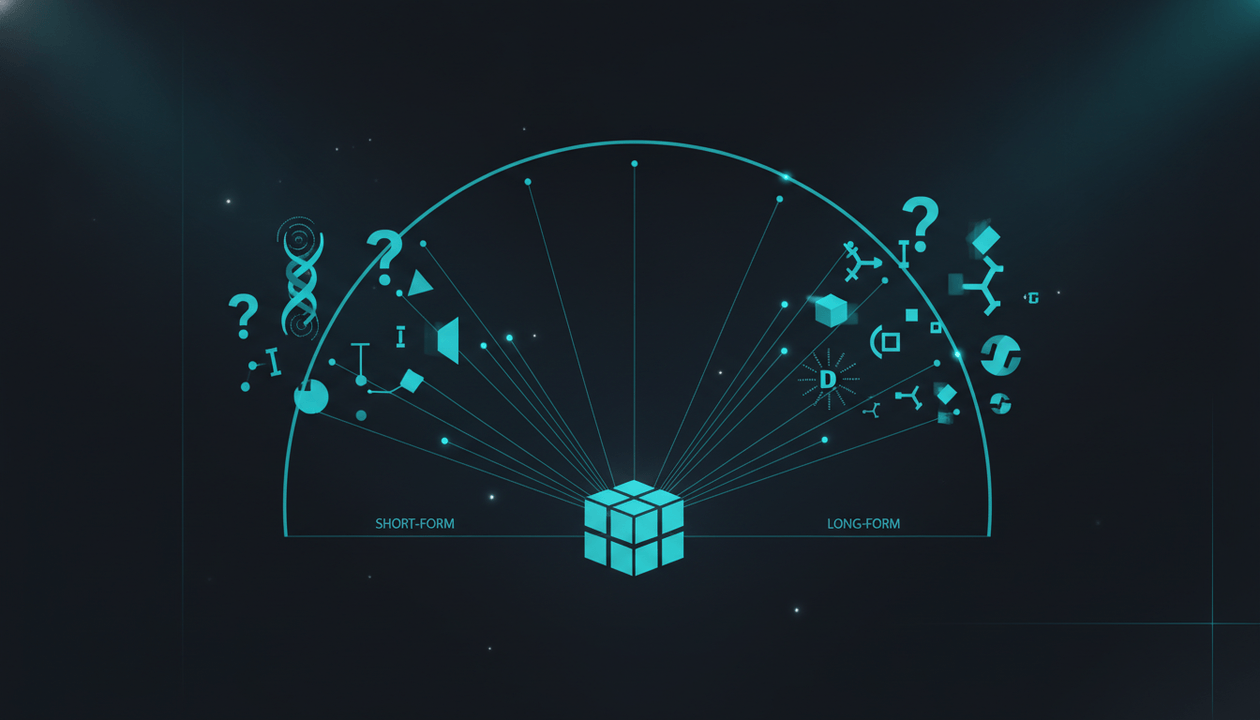

How similar can one YouTube video be to another and still break out? The honest answer is that our data does not support a universal similarity limit. What it does show is a much more useful pattern: million-view videos often revisit proven subjects, but direct reuse of title and hook wording is rare.
OverseerOS analyzed 1,332 English-language long-form YouTube videos from 246 channels. Every video had at least 1 million recorded public views. We compared each video with videos in the successful cohort that were published earlier, then measured similarity across three layers we could evaluate defensibly: title wording, topic entities, and opening-hook wording.
The clearest result was the gap between topic continuity and surface imitation. Among the 1,331 videos with an earlier cross-channel comparison, 39.4% shared at least one specific topic entity with an earlier million-view video from another channel. Yet among those topic-related videos, only 1.5% had high similarity in both the title and hook to the same earlier hit.
Exact title duplication was nearly nonexistent. Just one of 1,324 eligible videos had the same normalized title as an earlier cross-channel hit, and it was the one-word title “Pain.” We found no exact multiword title duplicates.
The practical answer is simple: you do not need a subject nobody has covered. You need a distinct reason to watch your version. Study the demand, format, and promise behind a successful video, then change the angle, evidence, packaging, hook, and execution.
Key Findings
| Finding | OverseerOS result | What it means |
|---|---|---|
| Videos analyzed | 1,332 videos across 246 channels | The study covers successful English-language long-form videos, not all of YouTube |
| Typical scale | Median recorded views of 5.74 million | This was a high-performance cohort |
| Shared topic entity | 525 of 1,331 videos, or 39.4% | Proven subjects regularly reappeared across channels |
| Median nearest-title similarity | 0.143 | The nearest earlier cross-channel title usually shared little wording |
| High title similarity | 55 of 1,324 videos, or 4.2% | Strong title overlap was uncommon |
| Exact title match | 1 of 1,324 videos, or 0.1% rounded | The only exact match was a one-word title |
| Median nearest-hook similarity | 0.125 | Opening wording was usually distinct |
| Exact hook match | 10 of 1,331 videos, or 0.8% | Every exact match involved a familiar nursery rhyme |
| High title and hook similarity within the same related topic | 8 of 525 topic-related videos, or 1.5% | Multi-layer surface imitation was rare |
| Channel-relative breakout result | No meaningful difference after channel matching | Lexical similarity did not provide a clean breakout threshold |
In this OverseerOS sample, successful videos frequently returned to proven topics, but they usually expressed those topics with different title and hook wording.
How We Analyzed the Data
We studied 1,332 long-form videos published between May 2011 and August 17, 2026. The videos came from 246 YouTube channels, were classified as English with high confidence, had usable title, topic, and spoken-hook data, and each had at least 1 million recorded public views.
To keep the comparison chronological, each video was compared only with videos published earlier. Cross-channel comparisons excluded videos from the focal video’s own channel. In total, the analysis evaluated 877,071 chronological cross-channel pairs. We also evaluated 9,375 earlier-hit pairs within the same channel as a separate test of creator self-repetition.
How title and hook similarity were calculated
Titles and hooks were normalized by lowercasing text, removing punctuation, standardizing accents, and excluding common English filler words. We then compared the remaining sets of distinct content words using Jaccard similarity:
Similarity score = shared content words ÷ all distinct content words used by either text
A score of 0 means the two texts share no content words. A score of 1 means they use the same set of content words. A score of 0.4 means 40% of the combined distinct content-word set overlaps.
For every video, we recorded its highest similarity to any earlier qualifying video. This “nearest prior hit” is stricter and more useful than averaging thousands of unrelated comparisons.
How topic relatedness was calculated
We used structured topic signatures derived from each video and counted two videos as topic-related when they shared at least one normalized, specific topic entity. An entity could be a person, place, organization, product, event, franchise, or other concrete subject.
This is deliberately different from title overlap. Two videos can discuss the same subject while making different promises, and two videos can reuse a title formula while discussing unrelated subjects.
For the relative-performance check, we also compared concise normalized topic queries with the same content-word method. That topic-query score is separate from the exact topic-entity overlap rate.
How we checked relative performance
Every video in the main cohort already had at least 1 million views, so raw views could not tell us whether similarity helped a video outperform its own channel.
For the 997 videos with at least four earlier long-form uploads, we compared each video’s recorded views with the median recorded views of those earlier uploads. We labeled a video a channel-relative breakout when it reached at least 2 times that earlier-video median. This produced 461 breakouts and 536 other million-view videos below the 2 times threshold.
Because multiple videos came from the same channels, we also ran a channel-matched descriptive check across 65 channels that contained videos in both groups. We did not treat every pair as an independent experiment, and we do not make a causal claim.
Finding 1: Successful Videos Revisited Topics More Often Than They Reused Wording
Among 1,331 videos with an earlier cross-channel comparator, 525 shared a specific topic entity with an earlier million-view video. That is 39.4% of the cohort.
This was far more common than close title or hook reuse:
| Similarity signal | Videos meeting the condition | Rate |
|---|---|---|
| Shared at least one topic entity with an earlier cross-channel hit | 525 of 1,331 | 39.4% |
| Title similarity of at least 0.4 to any earlier cross-channel hit | 55 of 1,324 | 4.2% |
| Hook similarity of at least 0.4 to any earlier cross-channel hit | 22 of 1,331 | 1.7% |
| Shared topic entity plus title and hook similarity of at least 0.4 to the same earlier hit | 8 of 525 topic-related videos | 1.5% |
The distinction matters. “Use a proven idea” is often interpreted as “make a close version of the winning video.” The data points somewhere else. A creator can enter an established conversation without borrowing the earlier video’s language.
Think of this as separating demand from expression:
- Demand is the audience’s existing interest in a subject, problem, character, event, or transformation.
- Expression is the creator’s thesis, promise, title, hook, evidence, visuals, script, and editing.
The first can be validated through research. The second is where originality must be built.
Finding 2: Exact Title Duplication Was Virtually Absent
Only one of 1,324 eligible videos had an exact normalized title match with an earlier million-view video from another channel. The title was one word: “Pain.” We found zero exact multiword title duplicates.
Even partial title overlap was modest. For each video, we found the most similar earlier title from a different channel:
| Percentile of videos | Nearest earlier title-similarity score |
|---|---|
| 25th percentile | 0.100 |
| Median | 0.143 |
| 75th percentile | 0.200 |
| 90th percentile | 0.286 |
Only 4.2% of eligible videos reached a nearest-title score of 0.4 or higher. Only 1.7% reached 0.5 or higher.
That does not mean every successful title was structurally unique. Some public titles used very similar formulas while swapping the central entity or category. Examples in the sample included:
- “Every Natural Disaster Explained in 12 Minutes” and “Every Government Form Explained in 12 Minutes”
- “What It’s Like to be Every MS-13 Rank” and “What It’s Like to be Every Yakuza Rank”
- “The ENTIRE History of ROME” and “The Entire History of Japan”
These pairs demonstrate format transfer, not proof that one creator copied another. The reusable structure is easy to describe: “Every [category] explained in [time]” or “The entire history of [entity].” The topic, research burden, viewer promise, and finished experience can still differ substantially.
YouTube’s own guidance recommends titles that accurately represent the video and work with the thumbnail to help viewers decide what to watch. It does not publish an acceptable lexical-similarity score. Our 0.4 boundary is an analytical bucket, not a platform rule, copyright test, or monetization threshold. See YouTube’s official title and thumbnail guidance.
Finding 3: Opening Hooks Were Usually More Distinct Than Titles
The median video’s closest earlier cross-channel hook had a similarity score of 0.125. At the 90th percentile, the score was still only 0.222.
| Percentile of videos | Nearest earlier hook-similarity score |
|---|---|
| 25th percentile | 0.100 |
| Median | 0.125 |
| 75th percentile | 0.167 |
| 90th percentile | 0.222 |
Ten of 1,331 videos had an exact normalized hook match. Manual review showed that every exact match came from familiar nursery-rhyme wording, including “Wheels on the Bus,” “Rain Rain Go Away,” “Daddy Finger,” and “Twinkle Twinkle Little Star.”
When we excluded videos with clear nursery-rhyme or children’s-song title markers, only 5 of 1,246 remaining videos, or 0.4%, had a nearest-hook similarity score of at least 0.4.
This sensitivity check changes the interpretation. The apparent hook duplication was not a broad norm among successful videos. It was concentrated in formats built around widely repeated nursery-rhyme and children’s-song language.
For creators outside that category, the lesson is stronger: a familiar topic does not require a familiar opening sentence. A fresh hook can introduce a new conflict, question, proof point, or perspective even when the underlying subject is established.
Finding 4: Creators Reused Their Own Title Structures More Than Their Own Hooks
Cross-channel similarity answers whether creators resemble other successful channels. Same-channel similarity answers a different question: how much do creators repeat what has already worked for themselves?
Among 1,086 videos with an earlier million-view video from the same channel:
| Same-channel nearest prior hit | Title similarity | Hook similarity |
|---|---|---|
| Median | 0.143 | 0.000 |
| 75th percentile | 0.300 | 0.091 |
| 90th percentile | 0.500 | 0.167 |
| Score of at least 0.4 | 17.4% of videos | 3.1% of videos |
High title similarity was more than five times as common as high hook similarity within the same channel. The likely strategic explanation is not that titles matter less. It is that creators can preserve recognizable packaging, series names, or repeatable formats while changing the substance of the opening.
A channel might repeatedly use:
- “I Tried [challenge] for 30 Days”
- “Every [category] Explained”
- “The Truth About [entity]”
- “[Number] Mistakes Ruining Your [result]”
The title architecture can become a navigational promise for returning viewers. But the hook still has to establish why this episode is worth watching now.
Finding 5: Similarity Did Not Separate Channel-Relative Breakouts
The most important negative finding was also the one most likely to prevent bad advice.
In the 997-video performance subset, 461 videos reached at least 2 times the recorded-view median of their channel’s earlier long-form uploads. The other 536 still had at least 1 million views, but did not cross that channel-relative threshold.
The two groups looked almost identical on title and topic-query similarity:
| Nearest earlier cross-channel signal | 2x channel-relative breakouts | Other million-view videos | Median within-channel difference across 65 matched channels |
|---|---|---|---|
| Title similarity | 0.143 | 0.143 | +0.003 |
| Hook similarity | 0.143 | 0.125 | -0.005 |
| Topic-query similarity | 0.143 | 0.143 | 0.000 |
The small pooled hook difference did not survive the more important channel-matched interpretation. Within channels containing both groups, the median differences were effectively zero.
This study therefore does not support claims such as:
- “A 30% similar title is optimal.”
- “More original titles produce more views.”
- “Matching a viral hook makes a breakout more likely.”
- “Staying below a similarity score makes content safe.”
Lexical similarity is only one surface feature. It cannot capture the strength of the idea, thumbnail promise, audience fit, timing, authority, storytelling, production quality, satisfaction, or distribution. Those factors may explain why two videos with similar wording perform very differently.
So, How Original Does a YouTube Video Need to Be?
There is no defensible universal percentage. The strongest answer from this study is qualitative but evidence-backed:
A successful YouTube video can share a proven topic or repeatable format with earlier hits, but it should create a distinct viewer promise and deliver that promise through original evidence, wording, visuals, and execution.
That standard is also more useful than trying to reverse-engineer a loophole. YouTube’s monetization policies assess whether a channel’s content is original and authentic, and explain that borrowed material should be changed meaningfully. Reviewers may consider the channel as a whole, including its main theme, high-view and recent videos, watch-time-heavy content, metadata, and About section.
The policy does not reduce originality to title distance. Neither should a creator.
What to Copy, What to Transform, and What to Create Fresh
“Copy the idea, not the execution” is directionally useful, but still too vague. Use this layer-by-layer rule instead:
| Layer | What research can reveal | Your originality job |
|---|---|---|
| Audience demand | Subjects, questions, fears, ambitions, and curiosities people already watch | Choose a specific audience and reason the topic matters now |
| Format | Explainer, experiment, ranking, documentary, challenge, comparison, investigation | Adapt the format to your voice, access, evidence, and production strengths |
| Title structure | Repeatable promise patterns such as “Every X Explained” | Write new wording around a materially different subject, claim, or outcome |
| Topic angle | The perspective used to narrow a broad subject | Add a distinct thesis, constraint, time frame, test, or point of view |
| Proof | Examples, data, demonstrations, interviews, results, or experience | Gather evidence the source video did not use |
| Opening hook | How the video creates immediate tension or curiosity | Write a fresh opening tied to your specific promise and proof |
| Thumbnail | The visual question and emotional signal | Build a distinct composition and visual promise, not a near-duplicate |
| Full execution | Script, footage, narration, pacing, edit, and sound | Create the experience from your own materials and decisions |
The more layers you leave unchanged, the weaker your reason for existing becomes. Swapping one noun in a title while preserving the same thesis, proof, hook, thumbnail concept, and sequence is not meaningful differentiation.
A Five-Step Workflow for Adapting a Proven YouTube Idea
1. Find repeated demand, not one isolated hit
Start with multiple relevant channels. Look for a subject or format that has produced outlier videos across more than one creator or has worked repeatedly over time.
One hit can reflect timing, audience loyalty, or a creator-specific advantage. Repeated success is stronger evidence that a real viewer demand exists.
You can use the free OverseerOS YouTube Channel Analyzer to inspect a public channel’s top videos, newest uploads, publishing patterns, and public performance signals.
2. Abstract the winning pattern in one sentence
Remove the nouns and write the strategic logic.
For example:
A fast, comprehensive explainer promises to organize a confusing category within a fixed amount of time.
That is more useful than copying “Every Natural Disaster Explained in 12 Minutes.” It reveals the format’s job without locking you into the original wording or subject.
3. Add a different thesis or proof mechanism
Ask what your version can contribute that the existing video cannot:
- newer evidence
- a contrary conclusion
- firsthand access
- a different audience
- a real experiment
- a stronger comparison
- a narrower constraint
- a more useful outcome
If you cannot name the difference in one sentence, the concept is not ready.
4. Write the title and hook from your new promise
Do not edit the source title word by word. Close it, state your new promise from memory, and generate several fresh options.
Then test whether the hook delivers the exact tension the title creates. A title about an experiment should open with the stakes, setup, or surprising early result. A title promising an investigation should open with the contradiction or unanswered question.
OverseerOS Viral X-Ray can break down the public packaging and performance context of a reference video, while OverseerOS 1M+ View Titles helps turn successful title structures into original variations rather than near-copies.
5. Run a multi-layer originality check
Before production, compare your concept with the strongest reference and ask:
- Is the central claim different?
- Is the evidence or demonstration different?
- Is the title written from scratch?
- Does the hook introduce my specific story?
- Is the thumbnail composition visibly distinct?
- Is the sequence of examples and reveals my own?
- Could a viewer explain why both videos deserve to exist?
If the final answer is unclear, keep developing the angle.
The Proven-Demand, Original-Execution Checklist
Use this before approving a video idea:
- I found the pattern across multiple videos or repeated channel performance.
- I can describe the audience demand without repeating a source title.
- My video has a distinct thesis, test, story, or outcome.
- My evidence and examples come from my own research or experience.
- My title is accurate and was written from the new promise.
- My opening hook is specific to my version.
- My thumbnail presents a distinct visual question.
- My script, footage, narration, and edit are original or meaningfully transformed.
- A viewer could immediately explain why my version is worth watching.
- I am not treating any similarity score as a policy or legal safe harbor.
For a separate practical review of YouTube’s channel-level reused-content rules, see the OverseerOS Reused Content Checker guide.
Limitations
This study has important boundaries:
- It is a selected success cohort. Every included video had at least 1 million recorded views and usable English title, topic, and hook data. Research enrichment prioritized eligible high-view videos with available transcripts, rather than randomly sampling every million-view upload. The results do not represent all YouTube uploads.
- It is observational. The analysis describes patterns and does not prove that originality, similarity, or any measured wording caused performance.
- Views are recorded snapshots. Older videos had more time to accumulate views, and the study did not compare every video at an identical age.
- Earlier publication does not prove earlier breakout status. A comparison video was published first and had at least 1 million views when recorded for this analysis. We could not verify that it had already crossed 1 million views when the later video was uploaded.
- Hooks were derived from available transcripts. The analysis used structured opening hooks extracted from the first 150 transcript words. Missing or inaccurate captions can affect the result.
- Lexical methods miss semantic imitation. A paraphrase can express the same idea with different words, while two similar titles can lead to very different videos.
- Topic entities are narrow signals. Shared entities detect concrete subject overlap, not every broader thematic relationship.
- Thumbnails were not scored. We did not have a validated visual-similarity layer for this study, so we make no claim about how close successful thumbnails were.
- Channels contribute multiple videos. We addressed this with video-level nearest-prior measures, within-channel comparisons, and a channel-matched performance check, but the cohort is not a set of fully independent creators.
Final Verdict
The data does not reveal a magic originality percentage. It reveals a more durable strategy.
Across 1,332 million-view videos, topic overlap was common and wording overlap was uncommon. Nearly four in ten videos shared a specific entity with an earlier cross-channel hit, but exact title duplication appeared once, exact hook duplication was confined to nursery-rhyme content, and only 1.5% of topic-related videos had high title and hook similarity to the same earlier hit.
Similarity also failed to meaningfully separate 2x channel-relative breakouts from other million-view videos after channel matching.
So do not begin from a blank page, and do not trace someone else’s finished page. Start with market evidence. Identify the demand and repeatable structure. Then create a different thesis, proof set, title, hook, thumbnail, and viewing experience.
That is the productive middle ground between guessing and imitation, and it is the workflow OverseerOS is built to support.
FAQ
Can I use the same YouTube video idea as another creator?
You can research a proven subject or format, but your version needs a distinct reason to exist. Change the angle, thesis, evidence, title, hook, visuals, script, and execution where appropriate. This study found that topic reuse was common among million-view videos, while close title and hook overlap was rare.
Can two YouTube videos have the same title?
Technically, YouTube titles are not unique identifiers. But exact cross-channel title duplication was almost absent in this study: only 1 of 1,324 eligible videos had the same normalized title as an earlier million-view hit, and that title was one word. An accurate, distinctive title gives viewers a clearer reason to choose your video.
What similarity score is safe for YouTube?
There is no official safe similarity score. YouTube does not publish a Jaccard, wording-overlap, copyright, or monetization threshold. The 0.4 score in this study is only an analytical boundary used to describe the sample.
Does using a similar title hurt views?
This study did not find a meaningful title-similarity difference between 2x channel-relative breakouts and other million-view videos after matching within channels. That does not prove titles are unimportant. It means lexical similarity alone did not explain relative performance in this cohort.
Is it better to copy a viral title formula or invent a new one?
Treat a viral formula as a hypothesis about viewer demand, not a finished template. Keep the useful logic, such as specificity, scope, contrast, or a clear outcome, then write fresh wording around your own subject and promise.
How should I change the opening hook?
Tie the hook to the unique mechanism of your video. Lead with your experiment, contradiction, access, evidence, stakes, or result. Do not merely rewrite the source hook with synonyms.
Did the study compare YouTube thumbnails?
No. The analysis compared title wording, extracted topic signals, and opening-hook wording. We excluded thumbnail similarity because the study did not contain a validated visual-comparison layer.
Does originality make a video go viral?
This analysis cannot establish causation. A video’s performance can also depend on audience fit, topic demand, packaging, timing, satisfaction, distribution, creator credibility, production, and many other factors. Originality is essential to building a defensible body of work, but it is not a standalone view guarantee.