A YouTube sales enablement strategy turns video into a system that helps buyers understand, evaluate, approve, and adopt your offer.
It gives sales representatives the right video for the exact moment a deal becomes uncertain:
- A buyer does not understand the problem
- A champion needs to explain the product internally
- A technical reviewer needs to see the workflow
- An executive needs the business case
- A prospect is comparing alternatives
- A security stakeholder needs reassurance
- A deal stalls after the demonstration
- Procurement questions the cost
- A buyer wants proof from a similar customer
- A new customer needs to reach value quickly
The goal is not to produce more promotional videos.
The goal is to remove specific friction from real buying decisions.
A strong sales enablement video library helps the buyer make progress without forcing a salesperson to repeat the same explanation on every call. It also gives the sales team consistent product truth, stronger proof, clearer follow-up assets, and a measurable way to understand which questions are preventing decisions.
This guide provides a complete YouTube sales enablement strategy for SaaS companies, agencies, professional services firms, creator businesses, marketplaces, ecommerce brands, and complex products.
It includes:
- The eight jobs sales enablement videos must perform
- A buyer-committee content framework
- Videos for every stage of the sales cycle
- Public, unlisted, and private content decisions
- Product demo, comparison, objection, proof, and implementation formats
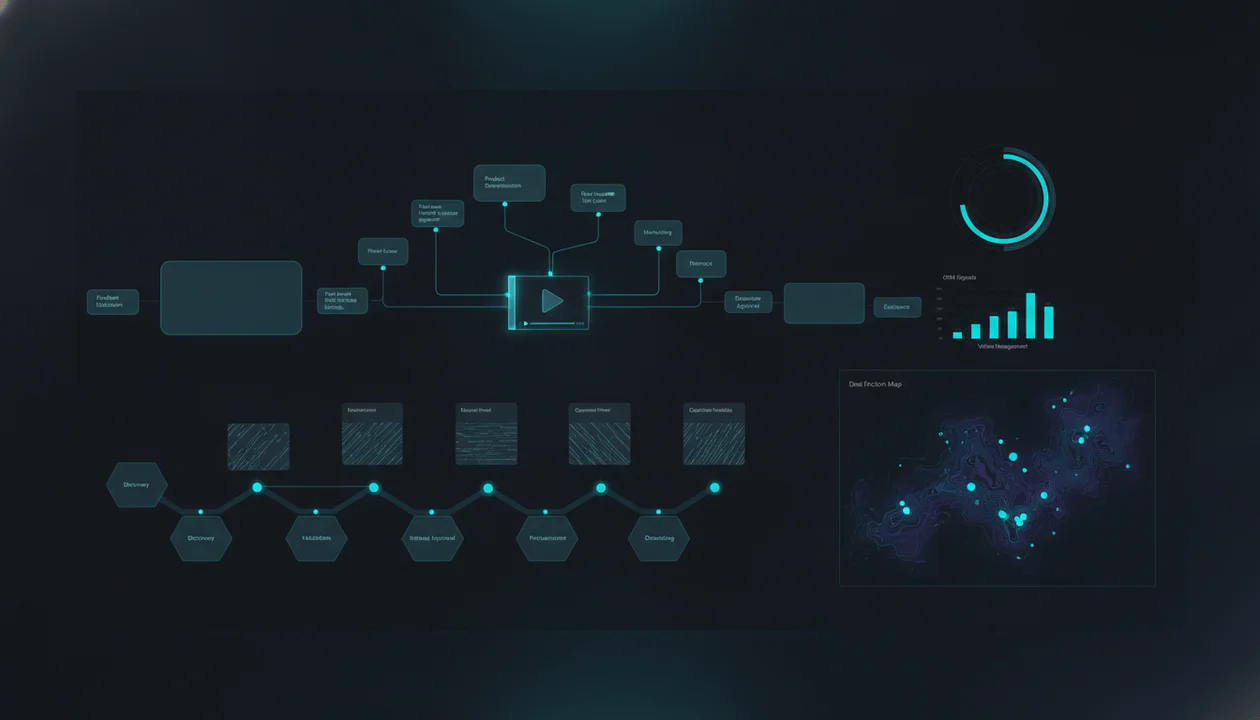
- A Deal Friction Map
- A 100-point video opportunity score
- Sales follow-up sequences
- YouTube playlist and video-journey architecture
- CRM and attribution fields
- Measurement frameworks
- A 90-day implementation plan
- A complete copy-and-paste template
- An OverseerOS workflow for research, planning, scripting, production, distribution, and performance analysis
Key Takeaways
- Sales enablement videos should answer real buyer questions, not merely repeat the company’s marketing message.
- Build videos around deal friction, buyer roles, and decision stages.
- Public videos can attract demand and support active deals at the same time.
- Unlisted videos are useful for focused sharing, but anyone with the link may be able to reshare them.
- Confidential account information, sensitive security details, private pricing, and customer-specific material may require authenticated or controlled delivery outside public YouTube.
- A product overview, product demo, technical walkthrough, customer story, and implementation guide perform different jobs.
- Do not force one video to serve the champion, executive buyer, administrator, technical reviewer, procurement team, and end user.
- Every sales video should have a defined buyer, question, proof requirement, sales stage, CTA, owner, and review date.
- Organize the library according to buyer decisions rather than internal product categories.
- Use playlists, chapters, cards, end screens, descriptions, and pinned comments to create clear content journeys.
- Track sales usage and buyer progression, not only public views.
- Use standardized campaign links and CRM fields to connect video activity with pipeline where the available systems and consent framework allow it.
- Do not claim that a video caused a deal to close when the evidence shows only that it influenced or assisted the process.
- OverseerOS helps teams research market patterns, analyze relevant videos, plan buyer-focused content, write scripts, produce visual assets, distribute each video, and review connected-channel performance.
What Is a YouTube Sales Enablement Strategy?
A YouTube sales enablement strategy is a structured plan for using YouTube videos to help sales teams and buyers move through the buying process.
It defines:
- Which buyer questions deserve videos
- Which stakeholder each video serves
- Which sales stage it supports
- What proof the buyer needs
- Whether the video should be public, unlisted, or privately delivered
- When a representative should send it
- What the buyer should understand afterward
- Which action should happen next
- How the asset will be measured
- How the video will remain accurate as the product changes
Sales enablement generally combines content, training, process, coaching, and technology to help sellers perform more effectively.
Video is one part of that system.
A weak video enablement strategy asks:
Which company videos can sales send?
A stronger strategy asks:
Which recurring buyer questions are currently slowing, weakening, or preventing decisions?
That second question creates videos with a clear commercial job.
Sales Enablement Video vs Video Marketing
Video marketing and video sales enablement overlap, but they are not identical.
| Video Marketing | Video Sales Enablement |
|---|---|
| Attracts audiences | Advances active buying decisions |
| Builds awareness | Removes deal friction |
| Often targets a broad segment | Often targets a specific buyer role |
| Optimized for reach and engagement | Optimized for decision progress |
| Usually distributed by marketing | Frequently used by sales |
| May create demand | Helps evaluate and approve the offer |
| Often measures views and leads | Also measures usage, progression, and deal influence |
A public comparison video can perform both jobs.
It may:
- Rank for a high-intent search
- attract a new prospect
- support a current opportunity
- help a champion share the comparison internally
- reduce repetitive sales explanations
The asset becomes more valuable because it works across discovery and decision-making.
Sales Enablement vs Customer Education
Customer education focuses on helping prospects and customers understand and use a product successfully.
Sales enablement focuses on helping sellers and buyers navigate the buying decision.
| Sales Enablement Question | Customer Education Question |
|---|---|
| Why should we choose this? | How do we succeed with this? |
| How is it different? | How do we complete the workflow? |
| Is the investment justified? | How do we reach value faster? |
| Can it support our requirements? | How do we adopt it across the team? |
| What risk does it reduce? | How do we prevent usage mistakes? |
| What proof supports the decision? | How do we build mastery? |
The same video may support both.
Example:
How a YouTube Agency Uses OverseerOS to Manage Five Client Research Workflows
For a prospect, this is proof and evaluation content.
For a customer, it is implementation education.
Use the complete YouTube customer education strategy to build the post-purchase learning system.
Sales Enablement vs Sales Training
Sales training prepares representatives to perform.
Sales enablement content helps them perform during real opportunities.
Internal sales training videos may teach:
- Positioning
- discovery questions
- product knowledge
- objection handling
- competitive context
- qualification
- demonstration skills
- pricing logic
- process
- CRM usage
Buyer-facing enablement videos may explain:
- The problem
- the product
- the workflow
- the business case
- implementation
- security
- integrations
- comparisons
- customer results
- next steps
A complete strategy may contain both internal and external video libraries.
Keep them separate.
Why YouTube Works for Sales Enablement
1. Buyers Can Learn Before and After the Call
A buyer may not ask every question during a meeting.
A clear video lets the prospect:
- Review the explanation later
- share it with another stakeholder
- revisit a technical step
- compare the product with another option
- prepare for the next call
- validate whether the product fits
This reduces dependence on perfect recall from one conversation.
2. Champions Can Share the Message Internally
Your sales representative does not attend every internal buyer conversation.
The champion may need to explain:
- What the product does
- why the company needs it
- how it differs
- what implementation requires
- why the investment is reasonable
A strong video gives the champion a credible asset to share.
3. Sales Representatives Stop Repeating the Same Explanation
When ten prospects ask the same question, the company can:
- Record a strong answer once.
- Use it before or after calls.
- Improve it from buyer feedback.
- measure where it creates progress.
- update it when the answer changes.
Sales still provides context and judgment.
The video removes avoidable repetition.
4. Public Videos Can Capture Existing Demand
Buyers already search YouTube and Google for:
- Product reviews
- comparisons
- alternatives
- demonstrations
- tutorials
- integrations
- implementation
- pricing explanations
- customer examples
A sales enablement video can become discoverable before the buyer contacts the company.
5. Video Can Demonstrate Complex Workflows
Video is useful when the buyer needs to see:
- An interface
- a process
- a before-and-after
- a technical workflow
- several connected capabilities
- the effort required
- the quality of the result
- how an end user works
6. One Asset Can Support Several Teams
A well-designed video may help:
- Marketing
- sales development
- account executives
- solution consultants
- customer success
- support
- partnerships
- onboarding
- product marketing
- recruitment
The company produces once and uses the explanation repeatedly.
Start With the Deal, Not the Content Calendar
Do not begin by brainstorming video ideas.
Begin by studying where deals slow down.
Ask:
- Which questions appear repeatedly?
- Where do prospects stop responding?
- Which stakeholders join late?
- Which claims require more proof?
- Which parts of the demo confuse buyers?
- Which competitors appear most often?
- Which objections delay approval?
- Which implementation concerns create risk?
- Which questions must sales answer manually every week?
- Which content do top representatives already send?
- Which missing asset would help the buyer make the next decision?
The strategy should respond to the buying process.
Build a Deal Friction Map
A Deal Friction Map documents the questions, doubts, and missing information that prevent buyer progress.
Use this structure:
| Friction | Buyer | Stage | Current Consequence | Video Opportunity |
|---|---|---|---|---|
| Product category is unclear | Champion | Discovery | Weak urgency | Problem and category explainer |
| Workflow feels abstract | End user | Evaluation | Low confidence | Complete product demonstration |
| Executive cannot see ROI | Economic buyer | Approval | Deal stalls | Business-case video |
| Technical team fears migration | Technical reviewer | Validation | Additional meetings | Implementation walkthrough |
| Buyer compares two tools | Champion | Evaluation | Competitor gains control | Fair comparison |
| Security team lacks context | Security reviewer | Risk review | Delayed approval | Security-process overview |
| Procurement challenges cost | Procurement | Negotiation | Discount pressure | Cost-of-current-process video |
| New stakeholder enters late | Executive | Approval | Deal restarts | Two-minute executive summary |
A strong enablement library is the video version of this map.
The B2B Buying Committee Content Framework
Complex purchases rarely depend on one person.
Different stakeholders evaluate different risks.
1. The Champion
The champion wants to solve the problem and persuade others internally.
Questions:
- Can this solve our problem?
- How do I explain it internally?
- What evidence should I share?
- Which next step should I recommend?
- Will adopting it make me look credible?
Useful videos:
- Problem explainer
- product overview
- complete demo
- business case
- customer story
- comparison
- internal-share summary
2. The Economic Buyer
The economic buyer evaluates investment, priority, risk, and expected value.
Questions:
- Why now?
- What does the current problem cost?
- Which strategic result does this support?
- What resources are required?
- What happens if we do nothing?
- Is this the best use of the budget?
Useful videos:
- Executive overview
- cost-of-inaction analysis
- ROI methodology
- strategic case study
- implementation summary
- total-cost comparison
3. The End User
The end user cares about usability and workflow impact.
Questions:
- Will this make my work easier?
- How long will it take to learn?
- Which tasks change?
- Does it fit the existing process?
- What does a normal day look like?
Useful videos:
- Real workflow
- day-in-the-life demonstration
- getting-started preview
- role-based use case
- before-and-after
- interface walkthrough
4. The Technical Reviewer
The technical reviewer evaluates architecture, integrations, permissions, reliability, data flows, and implementation.
Questions:
- How does it integrate?
- Which systems does it touch?
- What access does it require?
- How is data handled?
- Which dependencies exist?
- What happens when something fails?
Useful videos:
- Technical architecture overview
- integration demonstration
- implementation walkthrough
- permission model overview
- reliability or recovery process
- administrator workflow
Sensitive technical or security details may require controlled delivery rather than public YouTube.
5. Security and Legal Reviewers
These stakeholders evaluate organizational risk.
Questions may include:
- Which data is collected?
- How is access controlled?
- Which subprocessors are involved?
- Which contractual terms apply?
- How are incidents handled?
- Which claims require verification?
Useful videos:
- High-level security overview
- permission demonstration
- privacy workflow
- compliance-process summary
- data-control explanation
A video does not replace:
- Security documentation
- data-processing agreements
- legal review
- audit reports
- questionnaires
- contractual terms
Use video to orient the reviewer, not to make unsupported legal or compliance claims.
6. Procurement
Procurement evaluates commercial structure and vendor fit.
Questions:
- What is included?
- Which costs are recurring?
- What will implementation require?
- Are there alternative packages?
- Which terms create risk?
- How does the total cost compare?
Useful videos:
- Package overview
- implementation-cost explanation
- total-cost framework
- scope explanation
- buying-process summary
Do not publish private negotiated pricing publicly unless the company has chosen that strategy.
7. The Executive Sponsor
The executive sponsor needs a concise strategic explanation.
Questions:
- What problem are we solving?
- Why does it matter?
- Why this approach?
- What does success look like?
- What does the organization need to commit?
Useful video:
A two-to-five-minute executive decision brief.
Do not send the executive a 45-minute feature demonstration unless requested.
The Eight Jobs of YouTube Sales Enablement Videos
Every sales enablement video should perform at least one job.
Job 1: Create Problem Clarity
Help the buyer recognize the problem precisely.
Examples:
- Why Your YouTube Team Has More Tools but Fewer Good Decisions
- Why Product Tutorials Are Not a Complete YouTube Strategy
- The Hidden Cost of Producing the Wrong Video
- Why Your Agency Research Workflow Does Not Scale
The video should make the problem easier to explain internally.
Job 2: Build Urgency
Explain why the problem deserves action now.
Possible urgency sources:
- Increasing cost
- competitive movement
- operational bottleneck
- declining performance
- new company priority
- product launch
- team expansion
- changing market behavior
- failed current process
Do not create fake urgency.
Use real consequences.
Job 3: Explain the Category or Method
Some buyers cannot evaluate the product because they do not understand the type of solution.
Teach:
- The old method
- the new method
- the mechanism
- the workflow
- the decision criteria
Example:
What a YouTube Intelligence Platform Does That a Keyword Tool Does Not
Job 4: Demonstrate Product Fit
Show the product solving one realistic problem for one specific audience.
Example:
How a YouTube Agency Builds a Monthly Client Content Plan With OverseerOS
This is stronger than:
Full Platform Tour
Job 5: Provide Proof
Proof can include:
- Customer story
- real workflow
- before-and-after
- transparent experiment
- public methodology
- product output
- third-party evidence
- implementation example
State what the evidence proves and what it does not prove.
Job 6: Address Objections
Turn repeated objections into reusable explanations.
Examples:
- Is OverseerOS Only for Large Channels?
- Can a Generic AI Chatbot Replace a YouTube Intelligence Platform?
- Does AI-Assisted Production Create Repetitive Videos?
- How Much Setup Does a YouTube Research Workflow Require?
- Should You Hire an Agency or Build the Team Internally?
Job 7: Reduce Implementation Risk
Explain:
- Setup
- timeline
- team roles
- migration
- access
- dependencies
- training
- first value
- expected effort
Buyers may believe in the product but fear the change required to adopt it.
Job 8: Enable Internal Approval
Give the champion a concise asset for other stakeholders.
Examples:
- Executive overview
- business-case summary
- technical summary
- team workflow
- implementation plan
- risk and limitation summary
The champion should not need to reconstruct the entire pitch from memory.
The Sales Cycle Video Matrix
| Sales Stage | Buyer Need | Best Video Types | Primary CTA |
|---|---|---|---|
| Problem discovery | Understand the problem | Problem explainer, market analysis | Watch related framework |
| Initial interest | Understand the approach | Category explainer, method video | Explore the workflow |
| Qualification | Confirm relevance | Role-based use case | Book or continue discovery |
| Evaluation | See the product work | Demo, workflow, comparison | Start evaluation |
| Validation | Reduce risk | Proof, implementation, technical overview | Involve stakeholder |
| Internal approval | Build consensus | Executive summary, business case | Approve next step |
| Negotiation | Understand scope and cost | Package, implementation, total-cost video | Finalize terms |
| Closed won | Reach first value | Onboarding preview, getting started | Complete first workflow |
| Expansion | Discover more value | Advanced use case, team workflow | Expand adoption |
The 15 Videos a Sales Enablement Library Needs
1. Problem Explainer
Purpose:
- Build problem awareness
- create urgency
- give the champion language
Example:
Why Your YouTube Content Team Cannot Scale by Adding More Tools
The product does not need to appear immediately.
2. Category Explainer
Purpose:
- Explain the type of solution
- define decision criteria
- make the product easier to evaluate
Example:
What Is a YouTube Intelligence Platform?
Structure:
- Problem
- old approach
- new category
- core capabilities
- best-fit user
- limitations
- evaluation criteria
3. Two-Minute Product Overview
Purpose:
- Give busy stakeholders a concise orientation
Include:
- Who it is for
- problem
- product
- core workflow
- differentiation
- next step
Do not compress every feature into two minutes.
4. Complete Product Demo
Purpose:
- Show a realistic end-to-end workflow
Structure:
- Desired result
- starting input
- core decisions
- product actions
- output
- limitations
- next step
Use the product demo video script guide when building the complete demonstration.
5. Role-Based Use Case
Purpose:
- Help a specific buyer understand relevance
Examples:
- OverseerOS for YouTube Agencies
- OverseerOS for Faceless Channel Teams
- OverseerOS for Scriptwriters
- OverseerOS for SaaS Marketing Teams
Change the workflow, examples, proof, and outcome for each audience.
6. Customer Story
Purpose:
- Prove a relevant implementation
Structure:
- Starting situation
- problem
- previous process
- new approach
- implementation
- result
- limitations
- lesson
Avoid turning every customer story into an unrealistic transformation narrative.
7. Before-and-After Workflow
Purpose:
- Make operational value visible
Show:
- Number of tools
- steps
- handoffs
- decisions
- delays
- quality controls
- final output
Use reliable evidence for time or cost claims.
8. Product Comparison
Purpose:
- Help the buyer compare alternatives fairly
Include:
- Best fit
- main capabilities
- workflow
- limitations
- setup
- cost categories
- data requirements
- final recommendation by use case
Examples:
- OverseerOS vs Generic AI Chatbots for YouTube Strategy
- OverseerOS vs Spreadsheet-Based Channel Research
- YouTube Agency vs In-House Team
- Manual Production vs AI-Assisted Production
9. Objection Video
Purpose:
- Answer one repeated concern completely
One objection per video is often stronger than one long “every objection” recording.
Examples:
- Is This Too Advanced for a Small Channel?
- Will This Replace My Creative Team?
- Does This Work in Non-English Niches?
- How Much Human Review Is Still Required?
10. Implementation Overview
Purpose:
- Reduce fear about adoption
Include:
- Setup steps
- access
- team roles
- timeline
- training
- migration
- first useful result
- support
- known dependencies
11. Technical Overview
Purpose:
- Orient technical stakeholders
Include only approved, accurate information.
Possible topics:
- Integrations
- permissions
- data flow
- architecture
- user roles
- export
- API behavior
- failure handling
Keep sensitive details outside public content where necessary.
12. Executive Business Case
Purpose:
- Help leadership understand the strategic and economic logic
Include:
- Current problem
- cost categories
- strategic effect
- proposed approach
- implementation requirement
- success measures
- main risks
- next decision
Do not promise a universal return.
13. Pricing and Package Explanation
Purpose:
- Clarify the commercial model
Useful when pricing is public or standardized.
Explain:
- Who each package fits
- what changes between packages
- usage or capacity boundaries
- implementation fees
- recurring fees
- optional services
- common cost misunderstandings
Avoid making the viewer calculate the offer from scattered information.
14. Buyer FAQ
Purpose:
- Consolidate common late-stage questions
Organize by:
- Fit
- setup
- workflow
- plans
- access
- support
- limitations
- cancellation
- next steps
Keep the FAQ current.
15. First 30 Days Preview
Purpose:
- Help the buyer visualize what happens after signing
Example:
Your First 30 Days With OverseerOS
Include:
- Kickoff
- first inputs
- first result
- training
- responsibilities
- milestones
- success definition
This reduces uncertainty at the final decision stage.
Build Videos From Real Sales Conversations
The best ideas often exist inside:
- Discovery calls
- demonstration calls
- follow-up emails
- loss notes
- CRM fields
- sales Slack channels
- proposal feedback
- security reviews
- procurement requests
- customer handoffs
Do not publish private call content without appropriate permission and review.
Extract patterns rather than exposing confidential details.
Sales Call Research Questions
Ask sales representatives:
- Which question do you answer every day?
- Which explanation changes the buyer’s attitude?
- Where does the demo usually slow down?
- Which objection appears just before a deal stalls?
- Which stakeholder is hardest to satisfy?
- Which competitor appears most often?
- Which proof do buyers request?
- Which content do you send manually?
- Which content do you wish existed?
- Which questions appear after the call?
- Which late-stage question should have appeared earlier?
- Which deals moved faster because a buyer watched something?
Ask customer success:
- Which expectation is misunderstood during sales?
- Which implementation concern is valid?
- Which promise needs clearer qualification?
- Which customers reach value fastest?
- Which use case creates the strongest adoption?
Ask product:
- Which claims require careful wording?
- Which capabilities are frequently misunderstood?
- Which limitations must be explicit?
- Which releases change existing sales content?
Convert Call Language Into Video Opportunities
Raw Buyer Statement
“I understand the analysis, but I do not know how my writers would actually use it.”
Underlying friction:
The buyer cannot visualize team adoption.
Video:
How a YouTube Writing Team Turns Channel Analysis Into a Monthly Script Pipeline
Raw Buyer Statement
“We already use ChatGPT. Why would we need another AI tool?”
Underlying friction:
The buyer sees the product as interchangeable generation software.
Video:
Generic AI Chatbot vs YouTube Intelligence Platform: What Each One Actually Does
Raw Buyer Statement
“We manage five channels. I am worried this will create more complexity.”
Underlying friction:
The buyer fears operational overhead.
Video:
How a YouTube Agency Organizes Research Across Five Client Channels
Raw Buyer Statement
“Will this give us guaranteed viral ideas?”
Underlying friction:
The buyer misunderstands the role of evidence and uncertainty.
Video:
What YouTube Research Can Predict and What It Cannot
Use the buyer’s language without overstating it.
The 100-Point Sales Enablement Video Opportunity Score
Use this internal score to prioritize production.
| Dimension | Maximum Score |
|---|---|
| Deal impact | 20 |
| Frequency | 15 |
| Buyer importance | 15 |
| Stage criticality | 15 |
| Proof gap | 10 |
| Reusability | 10 |
| Video suitability | 10 |
| Maintenance feasibility | 5 |
| Total | 100 |
1. Deal Impact: 0 to 20
Ask:
- Does this question stop deals?
- Does it create discount pressure?
- Does it delay approval?
- Does it cause poor-fit opportunities?
- Does it weaken confidence?
- Does it restart the sales process?
2. Frequency: 0 to 15
Use evidence from:
- CRM notes
- call reviews
- email threads
- sales interviews
- support questions
- proposal feedback
- search queries
Repeated friction deserves reusable content.
A rare question may still matter when the commercial consequence is high.
3. Buyer Importance: 0 to 15
A concern from the economic buyer, security reviewer, or executive sponsor may deserve more priority than a low-impact preference.
4. Stage Criticality: 0 to 15
Questions that block:
- Qualification
- product validation
- internal approval
- security review
- procurement
- signature
may have greater urgency than general awareness questions.
5. Proof Gap: 0 to 10
Ask:
- Does the current answer rely only on claims?
- Is the product difficult to visualize?
- Is a relevant case study missing?
- Does the buyer need a real example?
- Is the available proof outdated?
6. Reusability: 0 to 10
High-reusability videos can support:
- Many representatives
- many accounts
- several sales stages
- marketing
- onboarding
- customer success
7. Video Suitability: 0 to 10
Video works well for:
- Demonstration
- explanation
- comparison
- process
- storytelling
- proof
- visual workflows
A one-line pricing fact may be better in text.
8. Maintenance Feasibility: 0 to 5
Avoid expensive production for information likely to change every week.
Build modular videos when the product changes frequently.
Score Interpretation
| Score | Action |
|---|---|
| 80 to 100 | Produce immediately |
| 65 to 79 | Add to the next enablement sprint |
| 50 to 64 | Strengthen evidence or combine with another asset |
| 35 to 49 | Consider text, a one-pager, or personalized response |
| Below 35 | Archive unless the friction increases |
This score is an internal prioritization framework, not an official YouTube or sales metric.
Public, Unlisted, or Private?
Choose visibility according to the content’s purpose and sensitivity.
YouTube currently supports Public, Unlisted, and Private video visibility.
Public videos can appear on the channel and in YouTube search, related content, and recommendations.
Unlisted videos generally do not appear in those public discovery areas, but anyone with the link can view and reshare them.
Private videos are limited to the creator and invited viewers under YouTube’s private-sharing rules.
Review the current visibility behavior in YouTube’s privacy settings documentation.
Use Public Videos For
- Problem education
- category education
- product overviews
- public demonstrations
- comparisons
- public case studies
- use cases
- general implementation
- pricing when pricing is public
- buyer FAQs
- tutorials
Benefits:
- Search discovery
- broader reuse
- buyer self-education
- marketing value
- public proof
- long-term demand capture
Use Unlisted Videos For
- Focused deal follow-up
- temporary product previews
- partner enablement
- beta walkthroughs
- account-specific introductions without confidential data
- videos embedded in a sales resource page
- content not intended for public discovery
Do not treat an unlisted link as secure.
Anyone with the link may be able to reshare it.
Use Controlled or Authenticated Delivery For
- Customer-specific data
- private pricing
- confidential roadmap
- unreleased features
- security-sensitive workflows
- legal analysis
- procurement negotiations
- account credentials
- private architecture
- regulated information
- personal data
YouTube may not be the correct delivery system for these materials.
Use an approved secure environment.
Reusable Video vs Personalized Sales Video
These are different assets.
Reusable Sales Enablement Video
Created once and used across many opportunities.
Examples:
- Product demo
- comparison
- customer story
- implementation overview
- FAQ
- executive summary
Strengths:
- Consistent
- scalable
- easier to quality-control
- measurable across deals
- useful for public discovery
Personalized Sales Video
Created for one account or buyer.
Examples:
- Personalized recap
- account-specific workflow
- proposal walkthrough
- tailored demonstration
- follow-up response
- stakeholder summary
Strengths:
- Relevant
- contextual
- personal
- useful for high-value opportunities
Risks:
- Harder to scale
- may expose confidential details
- difficult to maintain
- inconsistent claims
- weak measurement
- seller production burden
Use reusable videos for recurring explanations.
Use personalized videos when account context changes the recommendation meaningfully.
The Hybrid Follow-Up Model
A representative can combine:
- A brief personalized message
- one reusable public or unlisted video
- one account-specific next step
Example:
Hi Maya,

The concern you raised was whether the workflow would create more work for your writing team.

I recorded a short summary of how this applies to your current process.

The reusable walkthrough below shows how an agency moves from channel research to writer-ready briefs:

[Video link]

The most relevant section begins at 04:20.

For your team, the next step would be testing this on one client channel before changing the wider workflow.

Best,
[Name]
The representative provides context.
The reusable asset provides the complete explanation.
Build a Buyer-Assigned Video Sequence
Do not send a random library of links.
Assign a small number of videos according to the next decision.
Before Discovery
Send when the buyer needs basic context.
Possible sequence:
- Problem explainer
- category explainer
- short product overview
Goal:
Improve the quality of the discovery conversation.
After Discovery
Send:
- Role-specific use case
- relevant customer story
- requested workflow
Goal:
Confirm relevance and prepare for evaluation.
Before the Demo
Send:
- Two-minute product overview
- implementation context
- short question form
Goal:
Use the demo for specific decisions rather than basic orientation.
After the Demo
Send:
- Complete workflow
- main objection video
- customer proof
- clear next action
Goal:
Resolve open questions and involve the next stakeholder.
Before Executive Review
Send:
- Executive summary
- business case
- strategic customer story
Goal:
Help the champion gain internal approval.
Before Technical Review
Send:
- Technical overview
- integration video
- implementation plan
- approved security resources
Goal:
Reduce unnecessary uncertainty before the technical meeting.
Before Signature
Send:
- First 30 Days preview
- implementation responsibilities
- final FAQ
Goal:
Make the post-purchase experience concrete.
Do not overwhelm the buyer.
One highly relevant video is often better than ten general links.
Build a Sales Enablement Video Hub
A video hub can live on:
- A public YouTube channel
- a public playlist
- an unlisted playlist
- a website resource center
- a deal room
- a help center
- a sales enablement platform
- an authenticated portal
The hub should be organized by buyer questions.
Recommended Public Library
Understand the Problem
- Problem explainers
- market analysis
- category education
See the Product
- Product overview
- complete demo
- role-based workflows
Compare Your Options
- Product comparisons
- alternative methods
- build-versus-buy content
See the Evidence
- Customer stories
- before-and-after
- experiments
- workflow proof
Plan Implementation
- Setup
- team roles
- migration
- first 30 days
Answer Final Questions
- FAQ
- limitations
- packages
- buyer objections
Recommended Internal Library
Positioning
- ICP
- audience problems
- product promise
- category
Discovery
- Questions
- qualification
- use-case diagnosis
Demonstration
- Demo paths
- role-based demos
- common mistakes
Objections
- Competitors
- pricing
- implementation
- product limitations
Process
- CRM
- proposals
- procurement
- handoff
Use Playlists as Decision Paths
YouTube playlists can group videos around specific decisions.
YouTube also provides playlist-level analytics and aggregated reports for videos within a playlist. Review the current functionality in YouTube’s playlist analytics documentation.
Possible sales enablement playlists:
- Start Here With OverseerOS
- OverseerOS for YouTube Agencies
- OverseerOS Product Demonstrations
- OverseerOS Comparisons and Alternatives
- OverseerOS Customer Workflows
- OverseerOS Implementation
- YouTube Strategy for SaaS Teams
- YouTube Agency Buying Guide
A playlist should answer:
- Who is it for?
- What decision does it support?
- Which video comes first?
- What should the buyer do when finished?
Use Video Chapters for Buyer Navigation
Long demonstrations and webinars should not force buyers to search manually for the relevant section.
YouTube chapters allow creators to divide a video into named sections.
Manual chapters currently require:
- The first timestamp to begin at
00:00 - At least three timestamps
- Timestamps in ascending order
Review the current rules in YouTube’s chapter documentation.
Example:
00:00 Who This Workflow Is For
00:38 The Current Problem
01:42 Starting With a Channel
03:15 Finding Breakout Evidence
05:48 Building the Strategy
08:26 Creating the Content Plan
11:10 Team Workflow
13:32 Limitations
14:24 Plans and Next Steps
Use chapter titles based on buyer questions.
Weak:
- Introduction
- Feature One
- Feature Two
Stronger:
- Find the Relevant Channel
- Validate the Opportunity
- Turn Evidence Into a Plan
- Understand the Limitations
Use Cards and End Screens to Advance the Decision
YouTube end screens can appear during the final 5 to 20 seconds of eligible videos and can direct viewers toward related videos, playlists, subscriptions, and supported external actions.
Review current requirements in YouTube’s end-screen documentation.
Use end screens to move viewers from:
- Problem explainer to product workflow
- demo to customer story
- comparison to implementation
- use case to trial
- FAQ to getting started
YouTube info cards can also connect relevant videos, playlists, channels, and supported links.
Place them when the buyer naturally needs the resource.
Do not add them randomly.
Write Better Sales Enablement Video Titles
The title should match the buyer’s question.
Problem Formula
Why [Current Approach] Is Causing [Negative Outcome]
Examples:
- Why Your YouTube Research Workflow Creates More Ideas but Fewer Decisions
- Why Product Tutorials Are Not Generating Qualified SaaS Demand
- Why Your Agency Cannot Scale Competitor Research Manually
Outcome Formula
How to [Desired Outcome] With [Product or Method]
Examples:
- How to Build a Monthly YouTube Content Plan With OverseerOS
- How to Turn One Channel Analysis Into Writer-Ready Briefs
- How to Validate a YouTube Topic Before Production
Role Formula
[Product] for [Buyer Role]: [Specific Outcome]
Examples:
- OverseerOS for YouTube Agencies: Manage Multi-Client Research
- OverseerOS for Faceless Channel Teams: Research, Script, and Produce
- OverseerOS for SaaS Teams: Build Product-Led YouTube Content
Comparison Formula
[Option A] vs [Option B]: Which Fits [Specific Buyer]?
Examples:
- OverseerOS vs ChatGPT for YouTube Strategy
- In-House YouTube Team vs Agency
- Manual Channel Research vs OverseerOS
Objection Formula
Can [Product or Approach] Really [Question]?
Examples:
- Can AI-Assisted YouTube Production Preserve Originality?
- Can OverseerOS Work for a Small Channel?
- Can a Generic AI Chatbot Replace a YouTube Research Platform?
Implementation Formula
What Your First [Time Period] With [Product] Looks Like
Examples:
- Your First 30 Days With OverseerOS
- Your First Client Research Workflow With OverseerOS
- What Happens After You Hire a YouTube Agency
Design Better Sales Enablement Thumbnails
Sales enablement thumbnails should visualize the decision.
Useful concepts include:
Before and After
Show:
- Fragmented process
- organized process
- old result
- new result
One Input to One Outcome
Examples:
- Channel URL to strategy
- script to video
- video to platform-native assets
- public data to content plan
Competing Options
Show:
- Manual workflow versus platform
- generic AI versus specialist system
- agency versus in-house
- disconnected tools versus unified workflow
Buyer Risk
Show:
- Wasted production budget
- delayed implementation
- missing proof
- overloaded team
- unclear decision
Product Proof
Show:
- One clear interface
- one action
- one output
Avoid:
- A full dashboard reduced to unreadable size
- excessive feature labels
- multiple unrelated screenshots
- repeating the complete title
- generic stock imagery
- unsupported financial claims
The Sales Enablement Video Script Framework
Use this structure for buyer-facing videos.
1. Buyer Situation
Begin with the situation the buyer recognizes.
Your team already has topic ideas, scripts, editors, and publishing capacity. The uncertainty appears earlier: nobody can explain which idea carries enough evidence to deserve production.
2. Decision Question
State what the video will help the buyer decide.
This video will show whether a specialist YouTube intelligence workflow adds value beyond a generic AI chatbot.
3. Current Cost or Risk
Explain the consequence.
Use accurate, supportable information.
4. Better Method
Teach the decision framework before presenting the product.
5. Product or Service Workflow
Demonstrate one realistic path.
6. Proof
Show:
- Evidence
- product output
- customer workflow
- methodology
- limitations
7. Best Fit
State who benefits most.
8. Poor Fit
State when another approach may be better.
This improves qualification and trust.
9. Next Decision
Give one action.
Example:
Test the workflow on one real channel and compare the resulting plan with your current research process.
Example Product Overview Opening
Most YouTube tools begin after you already know what to make. OverseerOS begins earlier. It helps creators and teams study public channel patterns, identify promising opportunities, build an original strategy, and move that strategy into titles, scripts, thumbnails, production, and performance review. This overview shows the complete workflow, who it fits, and where human judgment remains necessary.
Example Objection Video Opening
A generic AI chatbot can generate YouTube ideas, titles, and scripts. The real question is whether generation alone solves your problem. When the difficult decision is choosing which channel, topic, format, and pattern deserves production, the missing layer is usually evidence and workflow, not more text output.
Do Not Hide Limitations
Useful sales enablement content states:
- What the product does
- what it does not do
- which inputs it requires
- which plan is required
- where human judgment remains
- what cannot be guaranteed
- which use cases fit poorly
For OverseerOS, do not claim:
- Guaranteed views
- guaranteed virality
- perfect algorithm prediction
- private competitor analytics
- legal originality verdicts
- a web-wide plagiarism checker
OverseerOS studies public YouTube patterns and creator-provided inputs to support original strategy and production decisions.
Track Video Usage Inside the Sales Process
Public YouTube analytics cannot reveal the complete sales outcome.
Combine several evidence layers.
Layer 1: Content Performance
Track:
- Views
- unique viewers
- watch time
- average view duration
- audience retention
- traffic sources
- playlist progression
- end-screen clicks
- search terms
Layer 2: Sales Usage
Track:
- Representatives using the asset
- opportunities receiving the asset
- stage when sent
- buyer role
- reason sent
- follow-up completed
- representative feedback
- missing content request
Layer 3: Buyer Progression
Track where appropriate:
- Next meeting booked
- stakeholder added
- demo completed
- technical review started
- proposal requested
- procurement started
- opportunity advanced
- deal delayed
- deal lost
Layer 4: Commercial Outcomes
Track:
- Pipeline influenced
- win rate by relevant cohort
- sales-cycle length
- average selling price
- discounting
- expansion
- loss reasons
Do not assume the video caused the outcome.
Use terms such as:
- Viewed
- used
- assisted
- influenced
- associated with
- part of the buyer journey
Reserve causal language for evidence capable of supporting it.
Use Standardized Campaign Links
Google Analytics supports UTM campaign parameters that help identify traffic from tagged links.
Google recommends using consistent parameters such as:
utm_sourceutm_mediumutm_campaign
Additional parameters can distinguish the specific content or asset.
Review the current guidance in Google Analytics’ campaign URL documentation.
Example:
https://example.com/demo
?utm_source=youtube
&utm_medium=organic_video
&utm_campaign=sales_enablement
&utm_content=agency_workflow_demo
Use one naming convention.
Inconsistent capitalization and spelling can fragment reporting.
Recommended CRM Fields
Video Asset Sent

Video Asset ID

Video Title

Video Category

Buyer Role

Sales Stage Sent

Reason Sent

Sent Date

Representative

Opportunity

Buyer Response

Next Action

Opportunity Stage After Send

Sales Feedback

Content Gap Identified
Do not ask representatives to complete 20 fields manually for every link.
Automate where possible and keep the essential inputs short.
The Sales Enablement Video Measurement Table
| Content Job | YouTube Signal | Sales Signal | Business Signal |
|---|---|---|---|
| Problem clarity | Search and watch time | Better discovery conversations | Qualified pipeline |
| Product understanding | Demo retention | Fewer basic questions | Faster evaluation |
| Objection handling | Relevant section views | Objection resolved | Stage progression |
| Internal approval | Executive-video usage | Stakeholder added | Approval |
| Technical validation | Technical-video usage | Review completed | Reduced delay |
| Implementation confidence | Workflow completion | Clearer handoff | Faster onboarding |
| Competitive differentiation | Comparison views | Competitor concern resolved | Win influence |
| Proof | Case-study views | Buyer references evidence | Decision confidence |
Use YouTube Analytics Groups
YouTube Studio’s Advanced Mode supports groups, filters, comparisons, exports, and lifespan-based content analysis.
Current YouTube guidance recommends using groups to compare themes, formats, and performance across equivalent periods such as the first 24 hours, 7 days, or 28 days.
Review the current functionality in YouTube’s Advanced Mode guide.
Create groups such as:
- Product Overviews
- Complete Demos
- Comparisons
- Customer Stories
- Objection Videos
- Executive Content
- Implementation
- Agency Use Cases
- SaaS Use Cases
- Technical Videos
Compare:
- Watch time
- average view duration
- retention
- traffic sources
- subscriber gain
- end-screen behavior
- search performance
Then connect those findings to sales usage outside YouTube.
Analyze Audience Retention as Buyer Feedback
YouTube’s audience-retention report can highlight:
- Intros
- top moments
- spikes
- dips
Review current definitions and requirements in YouTube’s audience-retention documentation.
For a sales demo:
- An early dip may indicate too much company context.
- A spike may indicate buyers revisiting pricing, workflow, or limitations.
- A dip during technical detail may mean the section targets a different stakeholder.
- Strong retention during a customer story may reveal the proof buyers value.
Do not interpret every movement with certainty.
Use the graph to generate questions.
The Sales Enablement Video Dashboard
Review monthly:
Library Health
- Total active videos
- Videos used by sales
- Videos never used
- Outdated videos
- Missing buyer roles
- Missing sales stages
- videos awaiting product review
Sales Adoption
- Active representatives using video
- assets per representative
- most-used assets
- usage by sales stage
- usage by buyer role
- representative satisfaction
Buyer Engagement
- Watch time
- completion
- high-interest sections
- follow-up questions
- shared assets
- stakeholder additions
Commercial Learning
- Opportunities influenced
- progression after send
- win and loss context
- sales-cycle patterns
- repeated objections
- missing assets
The dashboard should produce decisions.
Example: SaaS Sales Enablement Library
Product
A YouTube intelligence and creation platform.
Buyer Roles
- Creator
- agency owner
- content lead
- operations manager
- marketing leader
- finance buyer
Problem Videos
- Why More YouTube Ideas Create More Production Risk
- Why Keyword Research Alone Cannot Build a YouTube Strategy
- Why Multi-Channel Agencies Struggle to Standardize Research
Evaluation Videos
- What OverseerOS Does
- Complete OverseerOS Workflow
- OverseerOS for YouTube Agencies
- OverseerOS for Faceless Channel Teams
- OverseerOS vs ChatGPT for YouTube Strategy
Proof Videos
- Building a 30-Day Content Plan From Public Channel Signals
- Turning One Breakout Video Into an Original Series
- From Finished Script to Structured Faceless Production
Approval Videos
- OverseerOS Executive Overview
- The Cost of a Fragmented YouTube Production Stack
- What Your First 30 Days With OverseerOS Look Like
Post-Purchase Videos
- Analyze Your First Channel
- Build Your First Blueprint
- Save Your First Topic
- Write Your First Script
- Create Your First Video
Example: YouTube Agency Sales Enablement Library
Buyer
A creator or company considering a YouTube agency.
Problem Content
- Why Most YouTube Channels Lack a Repeatable Content System
- What Inconsistent Publishing Actually Costs
- Why Hiring an Editor Does Not Solve Weak Strategy
Evaluation Content
- What a YouTube Strategy Agency Actually Does
- Agency vs In-House YouTube Team
- Our YouTube Strategy and Production Process
- How We Build a 90-Day Content Plan
Proof Content
- Relevant case study
- before-and-after process
- client workflow
- strategy audit example
Approval Content
- How YouTube Agency Pricing Works
- What the Client Must Provide
- Your First 30 Days With the Agency
- How We Measure Progress Without Promising Virality
Use the YouTube agency lead generation framework to find qualified prospects.
Use the YouTube strategy proposal template to convert the opportunity into a clear scope.
Example: Professional Services Firm
Service
Cybersecurity consulting for mid-market companies.
Buyer Roles
- Operations leader
- IT leader
- finance
- executive sponsor
- legal
- security team
Video Library
- How to Recognize the Security Gap
- Internal Team vs External Security Partner
- What a Security Assessment Includes
- What the First 30 Days Look Like
- How Findings Are Prioritized
- Executive Overview
- Technical Methodology
- Customer Case Study
- Common Procurement Questions
Sensitive technical and customer information should remain outside public content.
Example: Ecommerce or Physical Product
Sales enablement is not limited to B2B software.
A high-consideration product may need:
- Product comparison
- sizing
- use-case demonstration
- durability test
- installation
- warranty explanation
- maintenance
- customer story
- total-cost comparison
- buying guide
For a business buyer, the library may also support:
- Distributor sales
- retailer education
- wholesale evaluation
- partner onboarding
The 90-Day YouTube Sales Enablement Plan
Days 1 to 15: Diagnose Deal Friction
Actions
- Interview sales representatives
- review call notes
- inspect lost-deal reasons
- collect repeated objections
- review demo questions
- interview customer success
- audit existing videos
- identify outdated claims
- map buyer roles
- map sales stages
Deliverables
- Deal Friction Map
- buyer committee map
- existing content audit
- content-gap list
- first 20 opportunities
- baseline metrics
Days 16 to 30: Design the System
Actions
- Score opportunities
- select public, unlisted, and controlled assets
- define library architecture
- create video briefs
- define approval workflow
- build title and thumbnail system
- define CRM fields
- create measurement plan
Deliverables
- Priority queue
- playlist structure
- sales usage guide
- script template
- visual template
- governance process
- reporting dashboard
Days 31 to 60: Produce the Core Library
Prioritize:
- Problem explainer
- category explainer
- two-minute overview
- complete demo
- role-based use case
- customer proof
- primary comparison
- primary objection
- implementation overview
- executive summary
Do not produce 50 videos before sales uses the first ten.
Days 61 to 75: Deploy
Actions
- Publish approved public videos
- create unlisted assets
- build playlists
- add chapters
- add cards
- add end screens
- create sales email templates
- add videos to CRM or enablement tools
- train representatives
- assign content owners
Days 76 to 90: Measure and Improve
Review:
- Which representatives used the library?
- Which videos were sent?
- Which buyer roles watched?
- Which opportunities progressed?
- Which objections remained?
- Which videos were ignored?
- Which new questions appeared?
- Which claims need updating?
- Which content should be public?
- Which content should be retired?
Then plan the next production sprint.
The Lean Ten-Video Sales Enablement Library
A small company can begin with ten assets.
- The Problem
- The Better Method
- Two-Minute Product Overview
- Complete Product Demo
- Best-Fit Use Case
- Primary Comparison
- Primary Customer Story
- Main Objection
- First 30 Days
- Executive Summary
This creates a useful decision path without building an oversized library.
Sales Enablement Video Governance
Sales content becomes dangerous when nobody owns accuracy.
Assign clear responsibility.
| Responsibility | Owner |
|---|---|
| Deal friction inventory | Sales enablement |
| Buyer language | Sales and marketing |
| Product truth | Product |
| Competitive claims | Product marketing |
| Customer permissions | Customer success and legal |
| Script | Content team |
| Factual review | Product specialist |
| Legal review | Legal where required |
| Security review | Security where required |
| Recording | Product educator or presenter |
| Publishing | YouTube owner |
| CRM deployment | Revenue operations |
| Performance analysis | Analytics owner |
| Update review | Sales enablement owner |
Add a Review Date to Every Asset
Record:
- Publication date
- product version
- pricing context
- buyer
- stage
- owner
- claim sources
- next review date
- current status
Classify Maintenance Risk
| Video Type | Maintenance Risk |
|---|---|
| Problem explainer | Low |
| Category education | Low |
| Customer story | Low to medium |
| Comparison | Medium to high |
| Product demo | High |
| Pricing explanation | High |
| Technical overview | High |
| Security overview | High |
| Release content | High |
Review After
- Pricing changes
- major product releases
- positioning changes
- new competitor launches
- security changes
- legal changes
- new plans
- changed integrations
- customer feedback
- recurring sales confusion
The Sales Enablement Video Brief
VIDEO TITLE

[Working title]


BUYER ROLE

[Champion, economic buyer, end user, technical reviewer, procurement, executive sponsor]


SALES STAGE

[Discovery, qualification, evaluation, validation, approval, negotiation, onboarding]


DEAL FRICTION

[Which question or concern is preventing progress?]


BUYER QUESTION

[Exact question.]


DESIRED DECISION

[What should the buyer be able to decide after watching?]


CURRENT CONSEQUENCE

[What happens when this question is not answered?]


CONTENT JOB

[Problem clarity, urgency, category, fit, proof, objection, implementation, approval]


VISIBILITY

[Public, unlisted, authenticated]


CORE PROMISE

[What will the video deliver?]


EVIDENCE

[Product demonstration, customer story, public data, workflow, methodology]


LIMITATIONS

[What must be stated clearly?]


VIDEO STRUCTURE

1.
2.
3.
4.
5.


PRIMARY CTA

[Next decision or action.]


NEXT VIDEO

[Related asset.]


SALES USAGE

[When should a representative send this?]


PRIMARY METRIC

[Content, sales, or progression metric.]


PRODUCT VERSION

[Version.]


REVIEW DATE

[Date.]


OWNER

[Name or team.]
Sales Follow-Up Email Templates
After Discovery
Subject: The workflow we discussed

Hi [Name],

The main issue you described was:

[Problem]

The video below shows how [specific buyer or team] handles that workflow:

[Video]

The most relevant section begins at [timestamp].

It covers:

- [Point]
- [Point]
- [Point]

The next decision is whether this approach fits [specific team or use case].

Best,
[Name]
After a Demo
Subject: Demo follow-up and open question

Hi [Name],

Based on the demonstration, the main open question appears to be:

[Question]

This short video answers that directly:

[Video]

It includes:

- [Evidence]
- [Workflow]
- [Limitation]

The logical next step is [action].

Best,
[Name]
For an Executive Stakeholder
Subject: Executive overview for [initiative]

Hi [Name],

This brief video summarizes:

- The problem
- the proposed approach
- the expected operational impact
- the implementation requirement
- the success measures

[Video]

It is designed as a concise overview rather than a full product demonstration.

Best,
[Name]
For a Technical Reviewer
Subject: Technical workflow before our review

Hi [Name],

To make the technical review more focused, this video covers the approved high-level workflow:

[Video]

It explains:

- [Access]
- [Data flow]
- [Integration]
- [Dependency]
- [Known limitation]

Sensitive or account-specific details will remain inside the controlled review process.

Best,
[Name]
AI Prompt for Building a Sales Enablement Video Strategy
Use AI to organize supplied evidence.
Do not ask it to invent buyer truth, product capabilities, or commercial results.
Build a YouTube sales enablement video strategy from the evidence I provide.

Do not invent:

- Buyer quotes
- product capabilities
- private analytics
- customer results
- pricing
- competitor capabilities
- legal claims
- security claims
- conversion rates
- pipeline impact
- win-rate improvement

Separate all conclusions into:

1. Direct evidence
2. Strong inference
3. Weak hypothesis
4. Unknown

For every buyer question or objection, identify:

- Buyer role
- sales stage
- exact question
- underlying concern
- current deal consequence
- proof requirement
- existing sales response
- existing content
- content gap
- best video type
- recommended visibility
- required review
- maintenance risk
- primary next action

Score each opportunity:

- Deal impact: 0 to 20
- Frequency: 0 to 15
- Buyer importance: 0 to 15
- Stage criticality: 0 to 15
- Proof gap: 0 to 10
- Reusability: 0 to 10
- Video suitability: 0 to 10
- Maintenance feasibility: 0 to 5

Then produce:

1. A Deal Friction Map
2. A buyer committee content map
3. A sales-stage video matrix
4. The first 20 videos to produce
5. Three title directions per video
6. One thumbnail direction per video
7. A script outline per video
8. One CTA per video
9. A sales usage instruction per video
10. Public, unlisted, or controlled visibility recommendations
11. A playlist architecture
12. Follow-up email templates
13. CRM fields
14. A measurement framework
15. A 90-day implementation plan
16. A governance and update process
17. Assumptions requiring validation

Important rules:

- Organize content around buyer decisions, not internal features.
- Keep buyer roles separate.
- Do not claim that video caused a sales outcome without evidence.
- Do not present unlisted YouTube videos as secure.
- Flag content requiring product, legal, security, privacy, or compliance review.
- Preserve exact buyer language when provided.
- Explain which evidence supports each recommendation.
- Do not present synthetic examples as customer facts.

SALES ENABLEMENT EVIDENCE:

[Paste call notes, objections, CRM data, loss reasons, buyer questions, product information, customer stories, existing videos, support feedback, and sales interviews.]
How OverseerOS Supports a YouTube Sales Enablement Strategy
A sales enablement library should be based on real buyer friction and public market evidence.
OverseerOS helps teams move from research to original sales content through a connected YouTube workflow.
Step 1: Research the Buyer’s Content Environment With OverseerOS Viral Channel Finder
OverseerOS Viral Channel Finder helps teams discover breakout and fast-growing channels using public YouTube signals.
Use OverseerOS Viral Channel Finder to identify:
- Channels buyers already trust
- recurring buyer problems
- high-intent topics
- product comparisons
- emerging category language
- educational formats
- underserved questions
- breakout use cases
Study:
- Direct competitors
- alternative solutions
- consultants
- educators
- customer communities
- adjacent product categories
This helps the sales enablement team understand the public information shaping the buyer’s expectations.
Step 2: Analyze Relevant Channels With OverseerOS Channel Analyzer
OverseerOS Channel Analyzer helps examine public channel patterns such as:
- Growth patterns
- content strategy
- upload frequency
- engagement signals
- top-performing videos
- recent uploads
Use OverseerOS Channel Analyzer to identify:
- Which buyer questions repeatedly earn attention
- which use cases attract high interest
- which comparison topics remain open
- which formats support complex education
- which competitor messages appear strongest
Public channel analysis cannot reveal private competitor conversion rates, retention, customer data, or pipeline.
Use it to understand visible content strategy.
Step 3: Study Individual Sales Videos With OverseerOS Viral X-Ray
OverseerOS Viral X-Ray helps analyze public video elements such as:
- Titles
- thumbnails
- hooks
- structure
- tone
- apparent audience
- calls to action
Use OverseerOS Viral X-Ray across several:
- Product demos
- comparisons
- customer stories
- objection videos
- implementation guides
Study strategic patterns such as:
- How quickly the buyer problem appears
- when the product enters
- how proof is introduced
- where limitations are stated
- how the CTA connects to the buyer’s next decision
Create original execution for your own product and audience.
Step 4: Extract Transferable Strategy With OverseerOS Channel Blueprint Cloner
OverseerOS Channel Blueprint Cloner helps turn public channel research into a structured strategy blueprint.
Use OverseerOS Channel Blueprint Cloner to examine transferable patterns related to:
- Audience promise
- topic formulas
- tone
- hooks
- pacing
- content structure
- title patterns
- upload cadence
- untapped opportunities
The purpose is to understand public strategic patterns and adapt them into original content.
It is not a tool for reproducing another company’s scripts, thumbnails, branding, or protected creative work.
Step 5: Build the Sales Content Library With OverseerOS Channel Content Planner
OverseerOS Channel Content Planner helps organize a data-backed publishing workflow with:
- Topics
- titles
- briefs
- content ideas
- scripts
- thumbnails
- strategy context
Create planner lanes such as:
- Problem
- Category
- Product
- Use Cases
- Comparisons
- Proof
- Objections
- Implementation
- Executive
- Customer Education
For every video, record:
- Buyer role
- sales stage
- friction
- proof
- visibility
- script status
- title
- thumbnail
- CTA
- sales usage
- review date
- primary metric
Step 6: Develop Scripts With OverseerOS Script Studio
OverseerOS Script Studio provides an AI-assisted YouTube writing environment with autocomplete, a command palette, and real-time writing support.
Use OverseerOS Script Studio to develop:
- Problem explainers
- product overviews
- demonstrations
- use cases
- comparisons
- objection videos
- executive summaries
- implementation content
The company must verify:
- Product behavior
- pricing
- availability
- customer results
- technical claims
- security claims
- legal claims
- limitations
AI can support the writing process.
It cannot approve company truth.
Step 7: Improve Existing Sales Scripts With OverseerOS Script ReSpark
OverseerOS Script ReSpark can strengthen existing drafts by improving:
- Hooks
- pacing
- clarity
- transitions
- emotional delivery
- retention structure
Use OverseerOS Script ReSpark to repair:
- Company-first openings
- long feature lists
- unclear explanations
- weak proof
- repetitive sections
- disconnected CTAs
Do not allow stronger writing to become exaggerated writing.
Step 8: Maintain a Consistent Voice With OverseerOS Creator DNA
OverseerOS Creator DNA helps analyze voice, tone, pacing, phrasing, and emotional delivery patterns.
Use OverseerOS Creator DNA to keep sales videos consistent across:
- Founders
- product marketers
- sales representatives
- scriptwriters
- voiceover artists
- agency partners
The final content should remain original and accurate.
Step 9: Produce Structured Visual Content With OverseerOS Auto Edit Studio
OverseerOS Auto Edit Studio turns finished scripts and voiceovers into a structured faceless YouTube production workflow with scene planning, visual generation, style direction, captions, music, motion, effects, and export controls.
Use OverseerOS Auto Edit Studio for:
- Problem explainers
- market education
- process diagrams
- comparisons
- narrated case studies
- executive summaries
- implementation overviews
Real product demonstrations still require accurate product capture.
Generated visuals should support product proof, not replace it.
Step 10: Create Platform-Native Distribution With OverseerOS Distribution Studio
OverseerOS Distribution Studio can turn a source video, article, or page into native drafts for supported platforms such as X, Reddit, Facebook, LinkedIn, and short-form video.
One sales enablement video can become:
- LinkedIn buyer insight
- X thread
- Reddit discussion
- Facebook explanation
- short-form spoken script
- email summary
- proposal resource
- sales follow-up asset
Adapt the message to each platform.
Do not publish one identical caption everywhere.
Step 11: Review Channel Performance With OverseerOS Channel Pulse
For connected channels, OverseerOS Channel Pulse helps review performance signals such as:
- Traffic sources
- retention
- per-video statistics
Use OverseerOS Channel Pulse to compare:
- Problem explainers
- product demonstrations
- comparisons
- customer stories
- objection videos
- implementation content
Then combine channel observations with:
- CRM usage
- buyer progression
- sales feedback
- pipeline data
- loss reasons
YouTube performance is one layer of sales enablement performance.
Explore the broader OverseerOS YouTube intelligence workflow.
Complete YouTube Sales Enablement Strategy Template
PROGRAM

Company:
[Name]

Product or service:
[Offer]

Sales enablement owner:
[Name]

YouTube owner:
[Name]

Review period:
[Dates]


BUSINESS OBJECTIVE

Primary objective:
[Pipeline progression, sales efficiency, buyer education, win support, shorter evaluation]

Secondary objective:
[Objective]

Success definition:
[Definition]


BUYER COMMITTEE

BUYER ROLE

Role:
[Champion, economic buyer, end user, technical reviewer, security, procurement, executive]

Primary goal:
[Goal]

Primary concern:
[Concern]

Questions:
1.
2.
3.

Proof requirement:
[Proof]

Best video types:
[List]


[Repeat for every role.]


SALES STAGES

DISCOVERY

Buyer decision:
[Decision]

Main friction:
[Friction]

Videos:
1.
2.
3.


QUALIFICATION

Buyer decision:
[Decision]

Main friction:
[Friction]

Videos:
1.
2.
3.


EVALUATION

Buyer decision:
[Decision]

Main friction:
[Friction]

Videos:
1.
2.
3.


VALIDATION

Buyer decision:
[Decision]

Main friction:
[Friction]

Videos:
1.
2.
3.


APPROVAL

Buyer decision:
[Decision]

Main friction:
[Friction]

Videos:
1.
2.
3.


NEGOTIATION

Buyer decision:
[Decision]

Main friction:
[Friction]

Videos:
1.
2.
3.


DEAL FRICTION RECORD

Exact buyer question:
[Question]

Buyer role:
[Role]

Sales stage:
[Stage]

Source:
[Call, email, CRM, proposal, loss review]

Frequency:
[Frequency]

Deal consequence:
[Consequence]

Current answer:
[Answer]

Existing content:
[Content]

Proof gap:
[Gap]

Recommended video:
[Video]

Visibility:
[Public, unlisted, controlled]

Owner:
[Owner]


VIDEO OPPORTUNITY SCORE

Deal impact:
__ / 20

Frequency:
__ / 15

Buyer importance:
__ / 15

Stage criticality:
__ / 15

Proof gap:
__ / 10

Reusability:
__ / 10

Video suitability:
__ / 10

Maintenance feasibility:
__ / 5

TOTAL:
__ / 100


VIDEO BRIEF

Working title:
[Title]

Buyer role:
[Role]

Sales stage:
[Stage]

Deal friction:
[Friction]

Buyer question:
[Question]

Desired decision:
[Decision]

Content job:
[Job]

Visibility:
[Visibility]

Core promise:
[Promise]

Evidence:
[Evidence]

Limitations:
[Limitations]

Structure:
1.
2.
3.
4.
5.

Primary CTA:
[CTA]

Next video:
[Video]

Sales usage:
[When should this be sent?]

Primary metric:
[Metric]

Product version:
[Version]

Review date:
[Date]

Owner:
[Owner]


LIBRARY ARCHITECTURE

UNDERSTAND THE PROBLEM

Videos:
1.
2.
3.


SEE THE PRODUCT

Videos:
1.
2.
3.


COMPARE OPTIONS

Videos:
1.
2.
3.


SEE THE EVIDENCE

Videos:
1.
2.
3.


PLAN IMPLEMENTATION

Videos:
1.
2.
3.


ANSWER FINAL QUESTIONS

Videos:
1.
2.
3.


SALES DEPLOYMENT

CRM location:
[Location]

Enablement platform:
[Platform]

Email templates:
[Location]

Playlists:
[List]

Representative training:
[Plan]

Usage expectations:
[Expectations]


MEASUREMENT

CONTENT PERFORMANCE

- Views
- Watch time
- Average view duration
- Audience retention
- Traffic sources
- Playlist progression
- End-screen clicks


SALES USAGE

- Representatives using assets
- Opportunities receiving assets
- Stage sent
- Buyer role
- Follow-up activity
- Representative feedback


BUYER PROGRESSION

- Stakeholder added
- Next meeting booked
- Demo completed
- Technical review
- Proposal
- Procurement
- Stage progression


COMMERCIAL OUTCOMES

- Pipeline influenced
- Sales-cycle patterns
- Win and loss context
- Discounting
- Expansion


GOVERNANCE

Product review owner:
[Owner]

Legal review owner:
[Owner]

Security review owner:
[Owner]

Publishing owner:
[Owner]

CRM owner:
[Owner]

Analytics owner:
[Owner]

Review cadence:
[Cadence]

Outdated-content process:
[Process]


90-DAY PLAN

DAYS 1 TO 15

- Interview sales
- Review calls
- Review losses
- Map buyers
- Map stages
- Audit videos
- Build Deal Friction Map


DAYS 16 TO 30

- Score opportunities
- Build library architecture
- Create briefs
- Define visibility
- Build governance
- Define measurement


DAYS 31 TO 60

- Produce problem explainer
- Produce category explainer
- Produce product overview
- Produce complete demo
- Produce use case
- Produce customer proof
- Produce comparison
- Produce objection
- Produce implementation video
- Produce executive summary


DAYS 61 TO 75

- Publish videos
- Build playlists
- Add chapters
- Add cards
- Add end screens
- Create email templates
- Add assets to CRM
- Train representatives


DAYS 76 TO 90

- Review sales adoption
- Review buyer progression
- Review content performance
- Collect new friction
- Update weak assets
- Plan next sprint
YouTube Sales Enablement Checklist
Strategy
- The commercial objective is clear.
- Buyer roles are mapped.
- Sales stages are mapped.
- Deal friction is documented.
- Exact buyer language is preserved.
- Existing sales content is audited.
- Public and controlled content are separated.
- The program has an owner.
Content
- A problem explainer exists.
- A category explainer exists.
- A two-minute overview exists.
- A complete demo exists.
- Role-based use cases exist.
- Customer proof exists.
- The primary comparison exists.
- The primary objection is answered.
- Implementation is explained.
- An executive summary exists.
- Post-purchase content connects to customer education.
Accuracy
- Product claims are verified.
- Pricing claims are current.
- Competitor claims are sourced.
- Customer permission is documented.
- Security claims are approved.
- Legal claims are approved.
- Limitations are stated.
- No outcome is guaranteed.
YouTube Structure
- Titles match buyer questions.
- Thumbnails visualize decisions.
- Chapters support navigation.
- Playlists match buyer journeys.
- Cards connect relevant resources.
- End screens advance the decision.
- Descriptions contain the correct CTA.
- Pinned comments contain updates.
Sales Deployment
- Representatives know when to use each asset.
- Email templates exist.
- CRM fields are defined.
- The library is searchable.
- The latest version is obvious.
- Representatives can request missing assets.
- Usage expectations are reasonable.
- Sales feedback is reviewed.
Measurement
- YouTube baselines are recorded.
- Sales usage is tracked.
- Buyer progression is tracked.
- UTM naming is standardized.
- Pipeline influence is interpreted carefully.
- Correlation is not presented automatically as causation.
- Groups are created in YouTube Analytics.
- Reporting produces decisions.
Governance
- Every video has an owner.
- Every video has a review date.
- Product versions are recorded.
- High-risk videos receive frequent review.
- Outdated videos have a retirement process.
- Sensitive content uses approved delivery.
- Product releases trigger content review.
Common YouTube Sales Enablement Mistakes
Building Videos Without Sales Input
Marketing may understand the market.
Sales hears the exact friction inside active deals.
Use both.
Creating One Generic Product Demo
Different buyers need different:
- Workflows
- proof
- depth
- language
- next steps
Build role-based assets.
Organizing Content by Feature
Buyers think in questions and outcomes.
Organize the library around decisions.
Sending Too Many Videos
A library is useful to the seller.
The buyer should receive only the assets needed for the next decision.
Making Every Video Promotional
Useful sales enablement content teaches, demonstrates, compares, and qualifies.
It does not repeat slogans.
Hiding Limitations
Poor-fit buyers waste sales time and create weak customer outcomes.
State where the product does not fit.
Making Unsupported Competitor Claims
Use current, verifiable information.
Acknowledge where an alternative may fit better.
Treating Unlisted Videos as Secure
Anyone with an unlisted link may be able to reshare it.
Use a controlled environment for sensitive content.
Measuring Only Views
A late-stage executive video may receive 30 views and influence a major decision.
Evaluate the video according to its job.
Claiming the Video Closed the Deal
Sales outcomes usually involve:
- Representatives
- product
- price
- timing
- relationships
- implementation
- procurement
- competition
- business priorities
Use assisted or influenced language unless causality is established.
Ignoring Sales Adoption
A strong library has no value when representatives cannot find or trust the content.
Measure usage.
Allowing Videos to Become Outdated
Old pricing, interfaces, claims, and workflows weaken buyer trust.
Assign review dates.
Replacing Human Follow-Up
Video should improve the sales conversation.
It should not become an excuse to avoid buyer questions.
Producing Expensive Videos Before Validating the Need
Begin with the friction.
Test the message.
Then invest in production.
Creating Internal Content With No External Asset
Some internal training topics should also produce a buyer-facing version.
Example:
- Internal: How to Explain Implementation
- External: What Your First 30 Days Look Like
Final Verdict
A YouTube sales enablement strategy is not a folder of product videos.
It is a buyer-decision system.
The strongest systems help buyers:
- Recognize the problem.
- Understand why it matters.
- learn the better method.
- see the product work.
- evaluate fit.
- compare alternatives.
- verify proof.
- reduce implementation risk.
- gain internal approval.
- understand what happens after purchase.
Build the library from real deal friction.
Map every buyer role.
Map every sales stage.
Give each video one commercial job.
Use public YouTube for discoverable, reusable education.
Use unlisted content for focused sharing when the information is suitable for link-based access.
Use controlled systems for confidential or sensitive material.
Connect every video to a next decision.
Track sales usage, buyer progression, and commercial context alongside YouTube performance.
State product limitations.
Avoid unsupported guarantees.
Update the library every time the truth changes.
When this system works, sales representatives spend less time repeating generic explanations and more time helping buyers make specific decisions.
Marketing gains high-intent content.
Buyers gain clarity.
Champions gain internal proof.
Customer success receives better-prepared customers.
The company builds a permanent video asset base that supports discovery, evaluation, approval, onboarding, and expansion.
FAQ
What is a YouTube sales enablement strategy?
A YouTube sales enablement strategy is a structured plan for using videos to help sales representatives and buyers understand problems, evaluate products, compare alternatives, address objections, verify proof, plan implementation, and make purchasing decisions.
What is a sales enablement video?
A sales enablement video is a reusable or personalized video designed to support a specific sales conversation, buyer role, objection, decision, or sales stage.
How is a sales enablement video different from a marketing video?
A marketing video often focuses on awareness and demand. A sales enablement video focuses on helping an active buyer make progress. One video can perform both functions when it is discoverable and useful during active deals.
What sales enablement videos should a SaaS company create?
A SaaS company should consider problem explainers, category education, product overviews, complete demos, role-based use cases, customer stories, comparisons, objection videos, implementation guides, technical overviews, executive summaries, FAQs, and onboarding previews.
Should sales enablement videos be public on YouTube?
Public videos work well for general product education, demonstrations, comparisons, use cases, case studies, and buyer FAQs. Confidential, account-specific, security-sensitive, legal, or negotiated information may require controlled delivery.
Are unlisted YouTube videos secure?
No. Unlisted videos are not broadly discoverable through normal public surfaces, but anyone with the link may be able to view and reshare them. Do not use unlisted visibility as a replacement for secure access control.
What is the difference between a reusable sales video and a personalized sales video?
A reusable video answers a recurring question across many deals. A personalized sales video addresses the context of one buyer or account. Reusable videos scale, while personalized videos provide greater account relevance.
How do I find sales enablement video ideas?
Review discovery calls, demos, follow-up emails, CRM notes, objections, loss reasons, proposals, technical reviews, procurement requests, support feedback, and customer-success handoffs.
What is a Deal Friction Map?
A Deal Friction Map documents the recurring questions, doubts, proof gaps, and stakeholder concerns that delay or prevent buyer progress. It connects each friction point to a buyer role, sales stage, consequence, and possible content asset.
How many sales enablement videos should a company create?
Begin with the highest-impact gaps. A lean library can start with ten videos covering the problem, category, product overview, demo, use case, comparison, proof, objection, implementation, and executive summary.
How long should a sales enablement video be?
The video should be long enough to answer the buyer’s question completely and no longer. An executive overview may require two to five minutes, while a complete technical workflow may need significantly longer.
Should a product demo show every feature?
No. A strong demo shows one realistic workflow and the result it creates. Secondary capabilities can be explained through separate use-case and feature videos.
How do I organize a sales enablement YouTube channel?
Organize it around buyer decisions such as Understand the Problem, See the Product, Compare Options, Review Proof, Plan Implementation, and Answer Final Questions.
Should sales enablement videos use playlists?
Yes. Playlists can organize videos by buyer role, sales stage, use case, product workflow, or decision. YouTube also provides playlist-level analytics.
Should sales enablement videos use chapters?
Yes, particularly for demonstrations, webinars, technical overviews, and long buyer guides. Chapters help stakeholders navigate directly to relevant questions.
How can sales representatives use YouTube videos in follow-up emails?
The representative should explain why the video is relevant, identify the most useful section or timestamp, summarize what it answers, and give one next action.
How do I measure sales enablement video performance?
Measure content performance, sales usage, buyer progression, and commercial context. Useful signals include watch time, retention, representatives using the asset, stage when sent, stakeholder additions, next meetings, opportunity progression, and pipeline influence.
Can a YouTube video be credited with closing a sale?
A video may assist or influence a deal, but sales outcomes usually involve many factors. Avoid claiming direct causation unless the available evidence supports it.
How do UTM parameters help measure sales videos?
UTM parameters can identify campaign traffic from tagged links in analytics systems. Use a consistent naming convention for the source, medium, campaign, and individual content asset.
How often should sales enablement videos be reviewed?
Review the library regularly and after pricing changes, product releases, positioning updates, competitor changes, security updates, new plans, changed integrations, or recurring sales confusion.
Who should own the sales enablement video library?
Sales enablement should usually coordinate the program, with input and approval from sales, product marketing, product, customer success, revenue operations, legal, security, analytics, and the YouTube content team.
Can sales enablement videos improve the sales cycle?
They can help buyers self-educate, share information internally, prepare for meetings, and resolve repeated questions. The impact should be measured against appropriate sales and buyer-progression data rather than assumed.
How does OverseerOS help build a YouTube sales enablement strategy?
OverseerOS Viral Channel Finder helps discover relevant channels and buyer topics. OverseerOS Channel Analyzer adds public market context. OverseerOS Viral X-Ray supports video-level analysis. OverseerOS Channel Blueprint Cloner helps extract transferable strategy patterns. OverseerOS Channel Content Planner organizes the library. OverseerOS Script Studio and OverseerOS Script ReSpark support writing and revision. OverseerOS Creator DNA helps maintain a consistent voice. OverseerOS Auto Edit Studio supports structured visual production. OverseerOS Distribution Studio creates platform-native drafts, while OverseerOS Channel Pulse helps connected channels review performance.