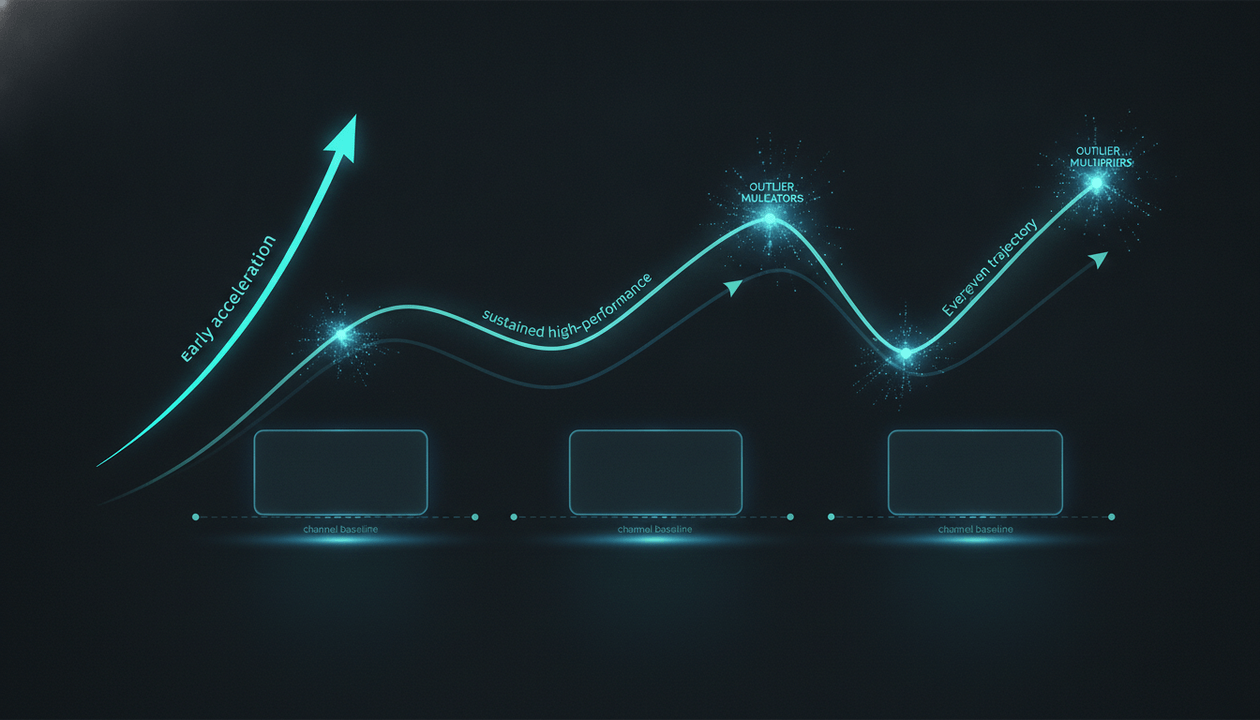
A YouTube outlier finder and a YouTube trend finder can both surface promising video ideas.
They do not measure the same signal.
A YouTube outlier finder identifies videos that performed unusually well compared with a channel’s normal baseline.
A YouTube trend finder identifies topics, searches, stories, formats, or conversations gaining attention over time.
That creates a useful distinction:
- Outlier research asks, “Which videos already beat expectations?”
- Trend research asks, “Which subjects are gaining momentum right now?”
An outlier is performance evidence.
A trend is movement evidence.
One video can be both. A recent upload may outperform its channel while covering a topic that is rising across search, news, social platforms, and multiple YouTube channels.
But the signals frequently separate.
A video can become a major outlier around an evergreen topic with no visible trend spike. A topic can trend aggressively while producing weak videos because creators arrived too late, chose generic angles, or lacked credibility.
This guide explains the difference between a YouTube outlier finder and a trend finder, which one finds better video ideas, the false signals each can produce, and how to combine both without chasing every spike or copying another creator.
Quick Answer
Use a YouTube outlier finder when you want proof that a topic, title, thumbnail, format, or angle performed far above normal expectations.
Use a YouTube trend finder when timing matters and you want to identify topics gaining attention before the market becomes overcrowded.
Use both when you need the strongest signal:
A topic is rising, and videos covering it are already breaking above their channels’ normal baselines.
That combination gives you demand, timing, and YouTube-specific performance evidence.
Key Takeaways
- A YouTube outlier is a video that performs unusually well relative to its own channel’s normal results.
- A trend is a topic, query, format, story, or audience conversation gaining attention over a defined period.
- Outlier finders are strongest for discovering proven topics, packaging patterns, formats, and competitor breakthroughs.
- Trend finders are strongest for current events, rising search interest, seasonal moments, emerging technologies, cultural conversations, and fast-moving niches.
- Raw views do not determine whether a video is an outlier. Relative performance does.
- A trend spike does not guarantee YouTube demand, audience fit, or a strong video opportunity.
- Fresh outliers are often more actionable than old outliers because they combine performance evidence with current timing.
- Repeated outliers across several channels are stronger than one isolated breakout.
- Trend signals become more credible when they appear across several sources, such as YouTube Studio Trends, Google Trends, competitor uploads, news coverage, comments, and search predictions.
- The strongest opportunity usually has four qualities: rising attention, proven video performance, an open angle, and fit with your channel.
- OverseerOS does not require a standalone tool named “Outlier Finder” to support outlier research. OverseerOS Viral Channel Finder, Overseer Feed, OverseerOS AI YouTube Channel Analyzer, and OverseerOS Viral X-Ray form the breakout-discovery and analysis layer.
- OverseerOS Trend to Script handles the next stage by turning fresh stories, topic research, article URLs, and YouTube references into approved research, outlines, and script-ready workflows.
YouTube Outlier Finder vs Trend Finder
| Area | YouTube Outlier Finder | YouTube Trend Finder |
|---|---|---|
| Main question | Which videos beat expectations? | Which topics are gaining attention? |
| Main unit of analysis | Video relative to channel baseline | Topic, query, story, format, or conversation over time |
| Core signal | Relative performance | Momentum |
| Typical metric | Outlier multiple, views per hour, views per day, velocity | Search growth, interest curve, news frequency, upload growth, conversation growth |
| Time orientation | Evidence from videos already published | Current and emerging movement |
| Best for | Proven topics, formats, titles, thumbnails, competitor analysis | News, timing, early opportunities, seasonality, rising markets |
| Main strength | YouTube-specific proof | Early timing advantage |
| Main weakness | Can show success after the opportunity becomes crowded | Can surface attention that never becomes a good YouTube idea |
| Biggest risk | Copying the visible video instead of extracting the pattern | Chasing a spike with no distinctive angle |
| Ideal output | Repeatable content pattern | Timely original video angle |
The simplest distinction is:
Outliers show what broke through. Trends show what is moving.
What Is a YouTube Outlier Finder?
A YouTube outlier finder identifies videos that substantially outperform the normal results of the channels that published them.
The important comparison is not:
How many total views did this video receive?
It is:
How unusual was this result for this specific channel?
Consider two videos.
| Channel Baseline | Video Views | Relative Result |
|---|---|---|
| 2,000,000 views | 1,200,000 views | Below normal |
| 8,000 views | 120,000 views | 15x breakout |
The first video has ten times more absolute views.
The second is the stronger outlier.
It broke far beyond the channel’s expected reach.
Basic Outlier Formula
A simple outlier calculation is:
Outlier multiple = video views ÷ channel baseline views
If a channel normally receives 10,000 views and one video receives 80,000:
80,000 ÷ 10,000 = 8x outlier
That score gives the performance context raw views cannot provide.
Average vs Median Baseline
The baseline matters.
An average can be distorted by one or two enormous videos.
A median is often more stable because it represents the middle result after videos are ordered by performance.
Example:
- Video 1: 5,000 views
- Video 2: 6,000 views
- Video 3: 7,000 views
- Video 4: 8,000 views
- Video 5: 250,000 views
The average is heavily inflated by the breakout.
The median remains 7,000.
A useful outlier workflow may compare videos against:
- Recent median
- Recent average
- Historical median
- Similar-length videos
- Long-form baseline
- Shorts baseline
- Views per day
- Views per hour
- Subscriber-adjusted performance
No single calculation explains everything.
The goal is to determine whether a video genuinely exceeded the channel’s normal performance pattern.
What an Outlier Finder Can Reveal
A strong YouTube outlier finder can help surface:
- Unexpectedly successful topics
- Breakout title structures
- Thumbnail patterns
- Small channels gaining reach
- Formats expanding beyond the normal audience
- Old concepts returning with a new angle
- High-performing video lengths
- Strong emotional frames
- Competitor breakthroughs
- Cross-niche formats
- Recurring audience tensions
- Potential content gaps
- Recent videos gaining unusual velocity
The Main Question an Outlier Finder Answers
A YouTube outlier finder answers:
Which published videos produced a result the channel does not normally achieve?
The next question is more important:
What changed in the topic, package, timing, format, or execution?
Finding the outlier is only discovery.
Explaining it creates strategy.
What Is a YouTube Trend Finder?
A YouTube trend finder helps identify topics, searches, stories, conversations, creators, or content formats gaining momentum.
The trend may appear through:
- YouTube searches
- YouTube Studio Trends
- Search predictions
- Recent competitor uploads
- Breakout videos
- News cycles
- Google Trends
- Reddit discussions
- TikTok formats
- X conversations
- Product launches
- Research announcements
- Entertainment events
- Sports moments
- Seasonal behavior
- Regulatory changes
- Repeated audience questions
A basic trend finder shows what is popular now.
A useful trend finder helps answer:
- When did the movement begin?
- Is attention still rising?
- Is it global or niche-specific?
- Which audience cares?
- Is the topic already saturated?
- Are small channels breaking out?
- Does it fit Search, Browse, Suggested, or Shorts?
- What angle is still open?
- Can the trend become an original video?
- How quickly must the video be published?
The Main Question a Trend Finder Answers
A YouTube trend finder answers:
What is gaining attention quickly enough that timing may create an advantage?
That does not mean every trend deserves a video.
The trend must still pass four tests:
- Relevance
- Remaining opportunity
- Original angle
- Production feasibility
Trend Types
Not all trends behave the same way.
| Trend Type | Example | Typical Window |
|---|---|---|
| Breaking-news trend | Major company announcement | Hours to days |
| Product trend | New AI model or device | Days to weeks |
| Cultural trend | Meme, documentary, public controversy | Days to months |
| Format trend | “I tried X for 30 days” spreading across niches | Weeks to months |
| Seasonal trend | Taxes, exams, holidays, sports events | Predictable recurring window |
| Search trend | Rapidly rising question | Days to months |
| Structural trend | Long-term movement toward faceless video or AI workflows | Months to years |
| Micro-trend | Narrow community topic | Hours to weeks |
| Revival trend | Old topic returning after an event | Days to months |
A trend finder becomes more useful when it helps classify the trend rather than placing every spike into one list.
The Core Difference: Abnormal Performance vs Rising Attention
The difference can be summarized mathematically.
Outlier Signal
An outlier measures:
Performance relative to expectation
The underlying question is:
Did this video outperform what this channel normally achieves?
Trend Signal
A trend measures:
Attention relative to a previous period
The underlying question is:
Is interest increasing compared with its recent or historical baseline?
Both rely on comparison.
The comparison target is different.
| Signal | Compared Against |
|---|---|
| Outlier | Other videos from the same channel or peer group |
| Trend | Previous attention levels over time |
Outlier Does Not Mean Trending
A video can become an outlier without covering a trending topic.
Example:
A small history channel normally receives 4,000 views.
It publishes:
The Forgotten City That Controlled the World’s Salt
The topic is not dominating current news or search.
The video receives 180,000 views.
Possible reasons:
- Exceptional title
- Strong thumbnail
- Undercovered story
- Effective Suggested placement
- Broad human curiosity
- Powerful narrative structure
- Alignment with a larger successful video
- High viewer satisfaction
This is a major outlier.
It may represent evergreen demand rather than a short-lived trend.
Why Evergreen Outliers Matter
Evergreen outliers can be more valuable than trends because they may support:
- Longer traffic life
- Repeatable series
- Stable production
- Less time pressure
- Stronger search accumulation
- More durable audience positioning
Do not reject an outlier because Google Trends shows no spike.
The video itself is evidence.
Trending Does Not Mean Outlier
A topic can trend while individual videos perform normally or poorly.
Imagine a major software company launches a new AI assistant.
Search interest rises immediately.
Hundreds of channels publish:
- News summaries
- Reaction videos
- Feature lists
- Tutorials
- Comparisons
- Predictions
The topic is clearly trending.
Your video can still fail because:
- You published too late
- The angle is generic
- Larger channels already won the news cycle
- The thumbnail looks identical to every competitor
- The script repeats the press release
- Your audience does not care
- The useful information fits a two-minute video, not a 20-minute video
- Search demand is informational but your video is opinion-led
- The trend peaked before production finished
The trend proves movement.
It does not prove your execution deserves attention.
The Four-Signal Opportunity Matrix
The strongest video decisions combine trend momentum and outlier evidence.
| Trend Strength | Outlier Evidence | Opportunity Type | Recommended Action |
|---|---|---|---|
| High | High | Confirmed breakout trend | Prioritize immediately with an original angle |
| High | Low | Early or unproven trend | Run a fast, lower-cost test |
| Low | High | Proven evergreen or latent demand | Build a durable video or series |
| Low | Low | Weak evidence | Reject unless strategic reasons are unusually strong |
High Trend, High Outlier
This is the strongest time-sensitive signal.
You can see:
- Search interest rising
- Multiple creators publishing
- Several videos outperforming channel baselines
- Fresh comments and conversations
- Strong packaging patterns
- Remaining unanswered questions
The opportunity is real.
The biggest danger is saturation.
High Trend, Low Outlier
The topic is moving, but YouTube videos have not broken out yet.
Possible explanations:
- The trend is extremely early
- It is stronger on another platform
- The audience prefers articles or quick updates
- Existing YouTube packages are weak
- The topic does not translate well into video
- The relevant channels have not published yet
This can become a first-mover opportunity.
It can also become a trap.
Use a low-cost production test.
Low Trend, High Outlier
This is an underrated category.
The topic may be:
- Evergreen
- Recommendation-led
- Emotionally universal
- Strong within a small niche
- Missing from search datasets
- Driven by packaging rather than query growth
- Part of a repeatable format
These opportunities can build durable channels.
Low Trend, Low Outlier
There may still be strategic reasons to publish:
- Existing audience request
- Product launch support
- Sponsor requirement
- Channel positioning
- Internal series continuity
- High buyer intent despite limited reach
But the idea lacks strong public evidence.
Treat it as a deliberate strategic bet, not a proven opportunity.
Which Tool Finds Better YouTube Video Ideas?
Neither wins in every situation.
The correct tool depends on the channel, topic, and publishing model.
An Outlier Finder Is Better When:
- You create evergreen videos
- You want competitor-backed ideas
- You need proven title and thumbnail patterns
- Your niche is crowded
- You want to discover small breakout channels
- You publish documentaries
- You build faceless channels
- You need repeatable formats
- You want to validate a niche
- You are studying Suggested and Browse behavior
- You want ideas that already demonstrated unusual performance
- Your production cycle is too slow for breaking news
Examples:
- Business documentaries
- Psychology explainers
- History channels
- Finance case studies
- Faceless list channels
- Educational animation
- Creator education
- Software comparisons
- Long-form storytelling
A Trend Finder Is Better When:
- Timing is part of the value
- You cover news
- Your niche changes quickly
- Product launches create demand
- You publish commentary
- You make sports content
- You cover entertainment
- Search spikes matter
- You can produce quickly
- You need seasonal planning
- You want to identify emerging subjects before mature outliers exist
Examples:
- AI news
- Technology releases
- Sports reactions
- Celebrity commentary
- Financial news
- Political explainers
- Gaming updates
- Science announcements
- Product launches
- Regulatory developments
Use Both When:
- You cover trends but want proof before investing
- You want to detect a topic before it becomes saturated
- You manage several channels
- Your production costs are high
- You want search and Browse potential
- You need an evidence-backed content calendar
- You want to separate real movement from social-media noise
- You want to distinguish a one-video anomaly from a niche-wide shift
Outlier Finder vs Trend Finder by Channel Type
| Channel Type | Better Starting Tool | Why |
|---|---|---|
| Breaking news | Trend finder | Speed and current relevance dominate |
| Evergreen tutorial | Outlier finder | Proven query and format performance matter |
| Business documentary | Outlier finder | Story and packaging patterns are more valuable than daily spikes |
| AI news | Trend finder plus outliers | Topic movement is fast, but breakout evidence improves angle selection |
| Faceless channel | Outlier finder | Repeatable formats and production fit matter |
| Sports commentary | Trend finder | Events create narrow publishing windows |
| Psychology channel | Outlier finder | Universal tensions often outperform without obvious search trends |
| Product review | Both | Launch timing and historical comparison both matter |
| Creator education | Both | Search demand, platform changes, and competitor outliers overlap |
| Entertainment commentary | Trend finder | Cultural timing drives opportunity |
| History | Outlier finder | Evergreen curiosity and storytelling patterns dominate |
| Agency | Both | Different clients require different research systems |
The Five Types of YouTube Outliers
Understanding the type of outlier prevents shallow copying.
1. Topic Outlier
The subject generated unusual interest.
Example:
A general productivity channel normally publishes habit videos. One upload about “revenge bedtime procrastination” receives ten times normal views.
The topic may reveal:
- A specific recognized behavior
- Emotional self-identification
- Strong search language
- A highly shareable concept
2. Packaging Outlier
The topic is familiar, but the title and thumbnail create a stronger click decision.
Normal topic:
Morning routines
Breakout package:
I Woke Up at 5 AM for 30 Days. My Life Got Worse.
The opportunity is not necessarily “make another morning-routine video.”
The pattern may be:
- Familiar advice
- Personal experiment
- Contrarian result
- Clear timeframe
- Emotional reversal
3. Format Outlier
A new presentation style changes the result.
Examples:
- Tutorial becomes experiment
- List becomes documentary
- Talking head becomes animation
- Review becomes blind test
- Advice becomes case study
- Commentary becomes investigation
The subject may not be new.
The format is.
4. Timing Outlier
The video succeeded because it arrived at the correct moment.
Examples:
- Published immediately after an announcement
- Released before a major event
- Connected an old topic to breaking news
- Answered a question before larger channels reacted
Timing outliers overlap heavily with trend research.
5. Authority Outlier
A video performs well because the creator has special access, credibility, identity, or experience.
Examples:
- Former employee explaining the company
- Doctor discussing a medical development
- Athlete reacting to a sports controversy
- Founder revealing revenue data
- Insider documenting an unusual process
This is the hardest outlier to transfer.
You can adapt the topic.
You may not possess the authority that made it work.
The Five Types of YouTube Trends
1. Search Trend
Viewers increasingly search for a topic or question.
Best formats:
- Tutorial
- Comparison
- Explainer
- Review
- Troubleshooting
- FAQ
2. News Trend
A current event creates urgency.
Best formats:
- Breakdown
- Commentary
- Timeline
- Implication analysis
- Reaction
- What-happens-next explanation
3. Format Trend
A presentation structure spreads across creators or niches.
Examples:
- 30-day experiments
- Iceberg videos
- Tier lists
- “Every X explained”
- Blind comparisons
- First-person simulations
- Animated case studies
4. Product Trend
A tool, game, device, platform, or model attracts growing attention.
Best formats:
- Test
- Review
- Comparison
- Workflow
- Failure analysis
- Use case
- Cost breakdown
5. Audience-Problem Trend
More viewers begin discussing the same frustration or desire.
Examples:
- Burnout
- AI replacement anxiety
- Subscription fatigue
- Declining organic reach
- Loneliness
- Cost-of-living pressure
- Information overload
This type can be slower than news but more durable.
How to Find YouTube Outliers Manually
You do not need software to understand the method.
Step 1: Choose a Narrow Channel Set
Build a list of channels that share:
- Audience
- Topic
- Format
- Language
- Video length
- Production model
Avoid comparing unrelated channels.
Step 2: Estimate Normal Performance
Review recent uploads and calculate:
- Median views
- Average views
- Typical range
- Views per day
- Upload frequency
Separate:
- Shorts
- Long-form
- Livestreams
- Clips
- Main-channel uploads
Step 3: Mark Breakouts
A practical starting classification:
| Relative Performance | Classification |
|---|---|
| Below 1x | Underperformed |
| 1x to 2x | Normal to above average |
| 2x to 4x | Strong |
| 4x to 10x | Major outlier |
| Above 10x | Breakout |
These ranges are not universal laws.
A high-volume channel may treat 2x as exceptional. A volatile small channel may need a larger multiple.
Step 4: Record the Variables
For every outlier, capture:
- Topic
- Title
- Thumbnail
- Publish date
- Video age
- Views
- Estimated baseline
- Outlier multiple
- Views per day
- Length
- Format
- Hook
- Emotional frame
- Comments
- Related trend
- Potential reason for success
Step 5: Compare Against Normal Uploads
Ask:
- What changed?
- Which variable is unique?
- Did the channel cover this before?
- Did the title use a new structure?
- Did the thumbnail simplify the promise?
- Was the topic timely?
- Did the format change?
- Did the video attract viewers outside the core audience?
- Can the pattern repeat?
How to Find YouTube Trends Manually
Step 1: Define the Audience
A trend is only useful relative to an audience.
“Trending on the internet” is too broad.
Define:
- Niche
- Country
- Language
- Viewer age or stage
- Channel promise
- Content format
- Publishing speed
Step 2: Collect Signals
Use several sources:
- YouTube Studio Trends
- YouTube search predictions
- Google Trends
- Recent competitor uploads
- Breakout videos
- News feeds
- X
- TikTok
- Industry newsletters
- Product release notes
- Customer questions
- Audience comments
Step 3: Measure Direction
Ask:
- When did attention begin increasing?
- Is it still accelerating?
- Has it flattened?
- Is it declining?
- Is the movement seasonal?
- Is the spike tied to one event?
- Is it happening across several channels?
- Is interest concentrated in one country?
Step 4: Evaluate Saturation
Count:
- Relevant uploads in the last 24 hours
- Relevant uploads in the last seven days
- Major channels already covering it
- Similar title and thumbnail packages
- Unanswered questions
- Missing audience segments
A rising topic can already be overcrowded.
Step 5: Find the Open Angle
Do not publish:
Here is what happened.
Find a more valuable question:
- Why does it matter?
- Who wins or loses?
- What did everyone misunderstand?
- What happens next?
- What does the announcement leave out?
- Can the claim be tested?
- How does this compare with the previous version?
- What does it cost in practice?
- Which audience is being ignored?
- What is the second-order consequence?
The Trend Validation Scorecard
Score each factor from 1 to 5.
| Factor | Question |
|---|---|
| Velocity | Is attention accelerating? |
| Recency | Is the opportunity still fresh? |
| YouTube evidence | Are relevant videos gaining traction? |
| Cross-platform evidence | Does the movement appear elsewhere? |
| Audience fit | Will your viewers care? |
| Saturation | Is meaningful space still open? |
| Angle strength | Do you have a distinct promise? |
| Authority | Can you cover it credibly? |
| Production speed | Can you publish within the window? |
| Longevity | Can the video survive after the spike? |
Scoring Guide
| Total | Decision |
|---|---|
| 43 to 50 | Immediate priority |
| 35 to 42 | Strong opportunity |
| 27 to 34 | Validate or narrow |
| Below 27 | Reject |
The Outlier Validation Scorecard
| Factor | Question |
|---|---|
| Relative performance | How far above baseline did it perform? |
| Freshness | Is the outlier recent enough to matter? |
| Repetition | Does the pattern appear across several videos? |
| Cross-channel evidence | Did other channels break out with similar ideas? |
| Transferability | Can you use the principle without copying? |
| Audience fit | Does it fit your viewers? |
| Format fit | Can your production model execute it? |
| Packaging potential | Can you build a distinct title and thumbnail? |
| Longevity | Is the subject durable? |
| Strategic value | Does it strengthen your channel or business? |
The strongest ideas score well on both tables.
False Positives in Outlier Research
Not every outlier represents a repeatable opportunity.
1. External Traffic
The video may have been embedded, shared by a large account, featured in the news, or promoted outside YouTube.
Public views alone may not reveal the source.
2. Collaboration Effect
A guest with a large audience can create an exceptional result that does not transfer to your channel.
3. Celebrity or Brand Effect
The subject may carry built-in attention unrelated to the creator’s format.
4. One-Time News Event
The video may have benefited from a narrow event that cannot be repeated.
5. Old Accumulated Views
A video can become the channel’s biggest upload after years of search traffic without representing current momentum.
6. Shorts and Long-Form Confusion
A Shorts breakout does not automatically validate a 20-minute video.
The viewers, distribution systems, and consumption behavior differ.
7. Controversy Spike
Negative attention can create views without producing a valuable repeatable audience.
8. Subscriber Mismatch
The channel may have changed niche, making old subscriber counts a poor baseline.
9. Hidden Authority
The creator may have credibility, access, or experience you cannot reproduce.
10. Packaging Without Satisfaction
A strong title and thumbnail may create an initial spike while the video fails to build durable audience value.
Public data cannot reveal every private retention or satisfaction signal.
False Positives in Trend Research
1. Global Trend, Wrong Audience
A subject can dominate globally while remaining irrelevant to your viewers.
2. Google Trend, Weak YouTube Intent
People may want a quick news article, live score, shopping page, or definition rather than a full video.
3. Social Trend, No Search Demand
A discussion may be loud but concentrated among a small group.
4. Trend Already Peaked
The chart may still look impressive because it includes the spike, even though attention is declining.
5. Artificial Noise
Low-volume topics can produce unstable or misleading fluctuations.
6. Seasonal Pattern Mistaken for New Growth
A recurring annual spike is not necessarily a new opportunity.
7. News Without a Video Angle
The event may matter, but your proposed video contributes nothing beyond the headline.
8. High Saturation
Every relevant creator may already be publishing nearly identical videos.
9. Production Delay
The trend may expire before your video is ready.
10. Trend-Chasing Audience Damage
A successful trend video can attract viewers who never care about the rest of your channel.
The Best Combined Workflow
Step 1: Detect the Trend
Find a rising:
- Topic
- Search
- Story
- Product
- Format
- Audience problem
Record the first date you noticed it.
Step 2: Search for Relevant Videos
Find videos published around the topic.
Separate:
- Major channels
- Mid-sized channels
- Small channels
- Shorts
- Long-form
- News
- Evergreen explanation
Step 3: Calculate Outlier Evidence
For each video, compare:
- Views against channel baseline
- Views per day
- Video age
- Engagement
- Similar uploads
Look for several independent breakouts.
Step 4: Determine the Trend Stage
| Stage | Description | Strategy |
|---|---|---|
| Emerging | Few videos, rising attention | Fast original test |
| Confirmed | Multiple fresh outliers | Priority production |
| Crowded | Many similar uploads | Narrow or differentiate |
| Peaked | Interest declining | Publish only with evergreen value |
| Durable | Trend becomes ongoing market | Build a series or channel pillar |
Step 5: Extract the Pattern
Do not copy the videos.
Extract:
- Audience desire
- Topic mechanism
- Emotional frame
- Title structure
- Thumbnail principle
- Format
- Hook
- Proof type
- Story progression
Step 6: Find the Missing Angle
Complete this sentence:
The topic is gaining attention because __________, but current videos mostly fail to __________.
Example:
AI agents are gaining attention because creators want automated workflows, but current videos mostly demonstrate ideal scenarios and ignore what happens when the agent makes an irreversible mistake.
That is a real angle.
Step 7: Design the Original Package
Reference title:
This AI Agent Can Run Your Entire Business
Original title:
I Gave an AI Agent One Irreversible Task. It Failed in 11 Minutes.
The original package keeps:
- AI-agent demand
- High stakes
- Demonstration
- Uncertainty
It changes:
- Thesis
- Experiment
- Evidence
- Outcome
- Script
- Visuals
Step 8: Choose the Production Depth
A trend does not always deserve your most expensive format.
| Confidence | Production Choice |
|---|---|
| Weak trend, no outliers | Short post or low-cost test |
| Strong trend, no outliers | Fast explainer or Short |
| One outlier | Medium-cost test |
| Multiple outliers | Full production |
| Durable repeated pattern | Series or channel pillar |
Step 9: Publish Before the Window Closes
Define a deadline before production.
A breaking story may require publication today.
A format trend may give you several weeks.
An evergreen outlier may not require speed at all.
Step 10: Validate the Result
Use YouTube Studio to review:
- Impressions
- CTR
- Traffic sources
- Audience retention
- New viewers
- Returning viewers
- Subscribers
- Follow-on viewing
- Revenue
- Long-tail performance
The trend and outlier research built the hypothesis.
Your private analytics reveal whether your version worked.
Examples Across Different Niches
AI and Technology
Trend Signal
A new AI video model launches.
Outlier Signal
Several small channels receive 5x to 20x their normal views from practical tests rather than announcement summaries.
Weak Idea
New AI Video Model Explained
Stronger Idea
I Recreated the Same Commercial With Three AI Video Models. One Failed Every Motion Test.
The trend creates timing.
The outliers reveal that practical comparison performs better than generic news.
Finance
Trend Signal
Interest rates become a major news topic.
Outlier Signal
Videos explaining how rate changes affect one realistic household outperform general economic commentary.
Stronger Idea
What One Rate Cut Actually Changes for a Family With a Mortgage, Car Loan, and Credit Card Debt
Psychology
Trend Signal
“Dopamine detox” conversations return.
Outlier Signal
Contrarian videos challenging extreme detox claims outperform basic advice.
Stronger Idea
I Removed Every High-Dopamine Habit for Seven Days. The Wrong Habit Came Back First.
Business Documentaries
Trend Signal
A major company announces bankruptcy.
Outlier Signal
Smaller channels breaking down one hidden operational decision outperform headline recaps.
Stronger Idea
The Spreadsheet Error That Hid This Company’s Collapse for 18 Months
Faceless YouTube
Trend Signal
Creators increasingly discuss AI-powered faceless production.
Outlier Signal
Transparent cost and failure videos outperform “easy passive income” tutorials.
Stronger Idea
I Built a Faceless YouTube Video With AI. The Editing Cost More Than the Script.
Gaming
Trend Signal
A major update changes a popular game.
Outlier Signal
Videos testing one controversial mechanic outperform general patch-note summaries.
Stronger Idea
This Update Quietly Made the Worst Strategy Unbeatable
Creator Education
Trend Signal
YouTube releases or tests a new creator feature.
Outlier Signal
Videos showing real impact on one channel outperform broad feature announcements.
Stronger Idea
I Tested YouTube’s New Feature on a Dead Video. Here’s What Actually Moved.
Current Tool Landscape
Outlier and trend tools often overlap, but their centers of gravity differ.
Outlier-Focused Tools
Current outlier workflows commonly emphasize:
- Relative performance scores
- Views per hour
- Publish-date filters
- Channel-size filters
- Video-length filters
- Shorts and long-form separation
- Thumbnail research
- Competitor tracking
Tools such as vidIQ Outliers, ViewStats, 1of10, TubeLab, and dedicated outlier databases focus heavily on finding videos that overperform expectations.
The strongest choice depends on whether you need:
- Fast discovery
- A browser extension
- Large searchable databases
- Thumbnail research
- Competitor alerts
- Full downstream production
Trend-Focused Tools
Trend workflows commonly rely on:
- YouTube Studio Trends
- Google Trends
- YouTube search predictions
- News feeds
- Category charts
- Social conversations
- Competitor upload monitoring
- Rising-topic databases
YouTube Studio Trends is especially useful because it can connect searches, related videos, breakout videos, and content gaps to the interests of your audience.
Google Trends is valuable for comparing relative search interest over time, geography, related searches, and rising terms.
Neither should be treated as a guaranteed view forecast.
How OverseerOS Combines Outlier and Trend Research
OverseerOS is built around a proof-first content workflow.
The platform does not ask creators to trust a random AI idea simply because it sounds exciting.
It helps creators begin from public evidence, inspect the winning pattern, and turn the result into original content.
Find Breakout Channels With OverseerOS Viral Channel Finder
OverseerOS Viral Channel Finder helps creators discover viral and emerging channels through recent public YouTube signals.
It can filter by:
- Niche
- Subscriber range
- Video count
- Content format
- Language
Results can include:
- Viral score
- Growth signals
- Average views
- Recent uploads
- Viral-hit count
- Actual breakout videos behind the result
The important distinction is the evidence layer.
A channel does not appear only because it matches a keyword.
The creator can inspect the videos that triggered the breakout signal.
OverseerOS Viral Channel Finder combines:
- Absolute viral signals for meaningful raw traction
- Relative breakout signals for videos performing above the channel’s own baseline
That helps prevent two common errors:
- Ignoring small channels because their raw views look modest
- Treating normal performance from a massive channel as a breakout
Monitor Competitors With Overseer Feed
Overseer Feed can help creators monitor competitor uploads and surface videos showing unusual public performance.
This is useful for:
- Discovering fresh outliers
- Tracking velocity
- Building a competitor watchlist
- Saving promising directions
- Moving a breakout into deeper analysis
- Reacting before the pattern becomes obvious
A feed is especially valuable because outlier research becomes weaker when performed only once.
Momentum changes.
New uploads create new evidence.
Analyze the Video With OverseerOS Viral X-Ray
Once a promising video is identified, OverseerOS Viral X-Ray can help analyze the individual video.
The workflow can examine elements such as:
- Public performance
- Title
- Description
- Tags
- Hook
- Storytelling structure
- Target audience
- Dominant emotions
- CTA
- Thumbnail psychology
- Extracted outline
The purpose is not to reproduce the finished video.
It is to separate the transferable principles from the creator-specific execution.
Turn Fresh Topics Into Scripts With OverseerOS Trend to Script
OverseerOS Trend to Script handles a different part of the workflow.
Creators can begin from:
- Live news
- Topic search
- Article URL
- YouTube URL
- Manual notes
- Existing research
The workflow can then help:
- Extract source content
- Pull out useful key points
- Add broader topic research
- Approve, edit, or reject research points
- Add creator notes
- Build an outline
- Continue into OverseerOS Script Studio
This matters because trend-chasing often produces shallow videos.
Creators find one article, summarize it, and publish a version with no distinct thesis.
OverseerOS Trend to Script treats the trend as a research starting point rather than a finished script.
Use the Combined OverseerOS Workflow
- Use OverseerOS Viral Channel Finder or Overseer Feed to detect fresh breakouts.
- Compare the videos against each channel’s normal performance.
- Check whether the topic is also rising through YouTube Studio Trends, Google Trends, news, search predictions, or competitor activity.
- Run the strongest video through OverseerOS Viral X-Ray.
- Extract the topic, title mechanism, thumbnail principle, hook, structure, and emotional frame.
- Define an original angle that the source video did not cover.
- Use OverseerOS Trend to Script to collect and approve fresh research.
- Build the outline.
- Continue into OverseerOS Script Studio.
- Create an original title, thumbnail, script, voiceover, and production.
- Save the idea to OverseerOS Content Planner.
- Publish and validate the result inside YouTube Studio.
The complete loop becomes:
Trend movement → breakout evidence → pattern analysis → original angle → research → script → production → real audience data.
Common Mistakes
Mistake 1: Sorting by Total Views
The biggest video is not always the most useful outlier.
Compare against the channel baseline.
Mistake 2: Chasing Every Trend
Most trends are irrelevant to your channel.
Relevance is more important than speed.
Mistake 3: Copying the Outlier
Do not reproduce:
- Exact title
- Thumbnail
- Script
- Footage
- Research sequence
- Brand identity
Extract the mechanism and build something original.
Mistake 4: Using One Outlier as Proof
One breakout can be noise.
Look for repeated evidence.
Mistake 5: Waiting for Too Much Proof
By the time twenty channels break out, the trend may be saturated.
Fast-moving channels need a lower evidence threshold than expensive documentary channels.
Mistake 6: Ignoring Video Age
A five-year-old video and a five-day-old video require different interpretation.
Mistake 7: Confusing Google Interest With YouTube Demand
Google Trends reflects relative search interest from Google searches.
Use it as one signal, not a direct promise of YouTube views.
Mistake 8: Ignoring the Decline Side of the Curve
A topic can still show large recent interest while already falling.
Direction matters.
Mistake 9: Ignoring Production Time
A perfect trend is useless if your workflow cannot publish before the opportunity closes.
Mistake 10: Choosing a Trend With No Channel Fit
Views from the wrong audience can weaken future performance and confuse your positioning.
Mistake 11: Treating Outlier Score as Causation
The score proves unusual performance.
It does not prove exactly why the video succeeded.
Mistake 12: Ignoring Private Analytics After Publishing
Public research creates the hypothesis.
YouTube Studio reveals whether your title, thumbnail, video, and audience actually responded.
Final Verdict
A YouTube outlier finder and a YouTube trend finder solve different content-research problems.
Use an outlier finder when you want to discover:
- Videos beating channel baselines
- Proven topics
- Breakout titles
- Thumbnail patterns
- Repeatable formats
- Small channels expanding beyond normal reach
- Evergreen opportunities
Use a trend finder when you want to discover:
- Rising searches
- Fresh stories
- Current events
- Product launches
- Seasonal opportunities
- Emerging conversations
- Time-sensitive video ideas
Which one finds better ideas?
An outlier finder gives you stronger evidence that a video concept already worked on YouTube.
A trend finder gives you a better chance of arriving while attention is still moving.
The strongest idea often appears where the signals overlap:
- The topic is gaining attention
- Multiple relevant videos are breaking out
- The market is not yet fully saturated
- Your channel can contribute a distinct angle
- Your production workflow can publish in time
Do not chase trends with no proof.
Do not copy outliers with no understanding.
Use trends to find movement.
Use outliers to find performance evidence.
Then identify what the existing videos missed and build an original version that deserves the next wave of attention.
Read the complete guides to YouTube outlier finder tools and YouTube trend finder workflows, then use OverseerOS to connect breakout discovery, research, analysis, planning, and script production.
FAQ
What is the difference between a YouTube outlier finder and a trend finder?
A YouTube outlier finder identifies videos that performed unusually well compared with their channels’ normal baselines. A trend finder identifies topics, searches, stories, or formats gaining attention over time.
Is an outlier the same as a trending video?
No. An outlier is defined by relative channel performance. A trending video is associated with rising or widespread attention. A video can be one, both, or neither.
Which is better for finding viral YouTube ideas?
Outlier finders are better for identifying proven video-level performance. Trend finders are better for finding timely subjects. Combining both usually produces stronger evidence.
Can a video be an outlier without millions of views?
Yes. A video with 50,000 views can be a major outlier if the channel normally receives 2,000 views.
Can a video have millions of views without being an outlier?
Yes. A video with one million views may be normal or below average for a channel that usually receives several million views.
How is a YouTube outlier score calculated?
A basic outlier score divides a video’s views by the channel’s average or median views. More advanced calculations may account for video age, views per day, views per hour, format, and recent baseline.
Is average or median better for finding outliers?
Median performance is often more resistant to distortion from one enormous hit. A strong analysis may consider both average and median alongside recent performance.
What makes a strong YouTube trend?
A strong trend has accelerating attention, relevance to your audience, YouTube-specific evidence, remaining publishing space, a clear video angle, and enough time for your production workflow.
Is Google Trends a YouTube trend finder?
Google Trends can support YouTube research by showing relative search interest, geography, related searches, and rising terms. It should be combined with YouTube-specific evidence.
Does Google Trends show exact search volume?
Google Trends primarily shows normalized relative interest rather than a straightforward exact monthly search count.
Can YouTube Studio help find trends?
Yes. YouTube Studio Trends can surface audience-related searches, breakout videos, recent videos, audience interest, and content-gap signals, although availability may vary.
What is the best free YouTube trend finder?
YouTube Studio Trends, Google Trends, YouTube search predictions, competitor feeds, comments, and news sources can form an effective free trend-research stack.
What is the best free way to find YouTube outliers?
Choose relevant channels, estimate each channel’s recent median views, and compare individual uploads against that baseline. Record videos performing several times above normal.
How recent should an outlier be?
It depends on the strategy. Time-sensitive channels may focus on the last seven to 30 days. Evergreen creators can study older outliers if the audience need and format remain relevant.
How many outliers should validate an idea?
One outlier creates a clue. Similar outliers across three or more independent channels create stronger market evidence.
Can an outlier finder predict virality?
No. It identifies unusual past or current public performance. It cannot guarantee that your adaptation will perform or predict YouTube’s algorithm.
Can a trend finder predict future views?
No. A trend finder can surface rising attention. It cannot guarantee clicks, retention, distribution, or revenue.
Should a new channel use outliers or trends?
A new channel can use outliers to find proven formats and topics. Trends can add timing advantage, but frequent trend-chasing may make it harder to establish a clear channel identity.
Are outliers useful for faceless YouTube channels?
Yes. Outliers can reveal topics, titles, thumbnails, formats, lengths, and production patterns that performed beyond normal expectations in faceless niches.
Are trend finders useful for evergreen channels?
Yes, but the trend should be converted into durable value. An evergreen creator can use a fresh event to explain a larger lasting question.
What should I analyze after finding an outlier?
Analyze the topic, title, thumbnail, hook, format, audience desire, timing, structure, comments, video age, and whether the pattern appears elsewhere.
What should I analyze after finding a trend?
Analyze its direction, audience relevance, saturation, YouTube-specific evidence, open angles, geographic concentration, expected lifespan, and production deadline.
How does OverseerOS help find outlier videos?
OverseerOS Viral Channel Finder surfaces viral and emerging channels with actual breakout videos behind the result. Overseer Feed can monitor competitor uploads, while OverseerOS Viral X-Ray helps analyze individual videos more deeply.
How does OverseerOS help use trends?
OverseerOS Trend to Script helps creators start from live news, topic research, article URLs, YouTube URLs, and manual notes, then extract key information, approve research points, build an outline, and continue into OverseerOS Script Studio.
Does OverseerOS copy trending or outlier videos?
No. OverseerOS is designed to help creators study public patterns and build original titles, thumbnails, scripts, and videos. Creators remain responsible for originality, verification, and final editorial judgment.
What is the best outlier and trend workflow?
Detect a rising topic, find relevant videos, compare them against channel baselines, confirm whether several are breaking out, identify the missing angle, build an original package, publish within the opportunity window, and validate the result through YouTube Studio.