
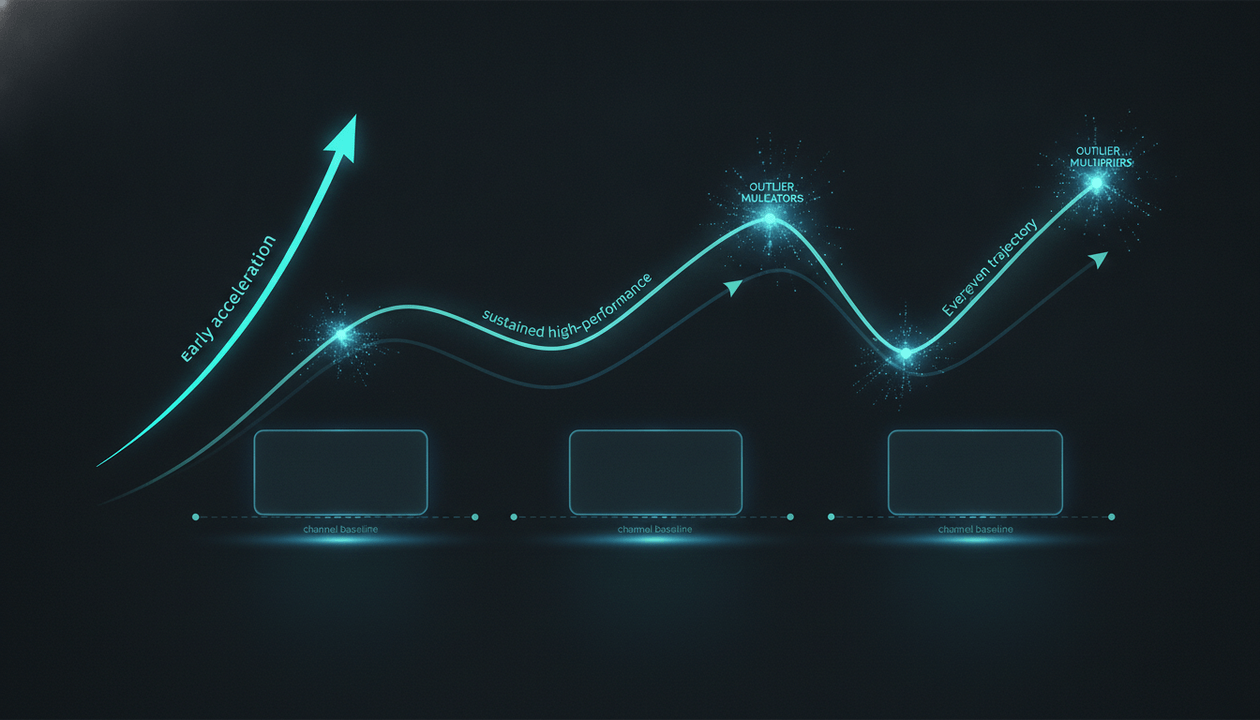
A YouTube breakout video is not one thing.
A video can be breaking out before its total views look impressive, it can keep outperforming months after publication, or it can remain an unusually strong performer long after the initial launch window.
We analyzed 3,844 YouTube breakout videos across 624 channels to see whether those states actually look different in the data.
They do.
The most important finding was also the easiest one to miss:
Among early breakout videos less than 31 days old, the median video was only 8 days old and had 28,378 views, yet it was moving at 15.37 times its channel's normal view velocity.
Even more striking, 63.4% of those early breakout videos still had fewer than 100,000 views.
If you research competitors by sorting for the biggest view counts, you can arrive after the most useful signal has already become obvious to everyone.
The data suggests a better model:
Early breakouts should be judged by velocity. Sustained breakouts should be judged against a channel's recent performance baseline. Evergreen breakouts should be judged by whether the abnormal performance survives with age.
That distinction changes how creators should find video ideas.
Key Findings
- We identified 3,844 strong breakout videos across 624 channels after deduplicating repeated observations and requiring at least a 5x age-appropriate performance signal.
- 889 early breakouts were 0 to 30 days old. Their median age was only 8 days, while their median view velocity was 15.37x the channel baseline.
- 63.4% of early breakout videos had fewer than 100,000 total views, despite already showing a 5x+ velocity breakout.
- 37.2% of early breakouts were still below 2x on a traditional total-view multiplier, meaning a static outlier score could make an emerging winner look much less exceptional than its velocity suggested.
- 1,653 sustained breakouts were 31 to 180 days old. Their median age was 120 days, with a median performance of 13.63x the channel's median view baseline.
- 1,302 evergreen breakouts were 181 to 364 days old. Their median age was 271 days, with a median performance of 19.8x baseline.
- 311 of the 624 channels, 49.8%, had strong breakout videos in at least two different states. Breakout behavior was not confined to one type of channel.
- The 10 channels contributing the most breakout videos accounted for only 5.3% of the dataset, reducing the risk that a handful of prolific channels created the overall pattern.
- We also analyzed 496 near-miss videos sitting close to their channel baseline. Their median relative performance was 1.0x, providing a useful comparison group for what normal performance looks like.
The Breakout State Model
The central mistake in YouTube outlier research is treating every video as though it should be evaluated with the same metric.
A video that is eight days old and a video that is nine months old are answering different questions.
For the fresh video, the question is:
Is attention arriving unusually fast?
For the older video, the question becomes:
Did the video ultimately outperform what this channel normally produces?
We divided the strong outlier sample into three mutually exclusive states.
| Breakout state | Age at observation | Primary signal | Minimum signal | Videos | Median age | Median state score |
|---|---|---|---|---|---|---|
| Early breakout | 0 to 30 days | View velocity vs channel baseline | 5x | 889 | 8 days | 15.37x |
| Sustained breakout | 31 to 180 days | Views vs channel median baseline | 5x | 1,653 | 120 days | 13.63x |
| Evergreen breakout | 181 to 364 days | Views vs channel median baseline | 5x | 1,302 | 271 days | 19.8x |
We used a 5x threshold because OverseerOS's existing outlier benchmark treats roughly 5x to 10x as breakout territory rather than merely above-average performance.
This is deliberately conservative.
We also repeated the analysis with a 3x threshold. That expanded the strong-outlier sample to 4,911 videos, and the same core pattern remained: early breakouts appeared with much lower absolute view counts, while older breakout states showed increasingly established relative performance.
How We Analyzed the Data
The research used public YouTube performance information collected when creators analyzed channels through OverseerOS between July 16 and August 15, 2026.
The original winner dataset contained repeated channel analyses, so we did not blindly count every stored row.
For each YouTube video, we retained its most recent qualifying observation.
We then built age-aware cohorts.
Early breakout
A video qualified as an early breakout when:
- it was 0 to 30 days old
- its views-per-day pace was at least 5x the channel's normal velocity baseline
Velocity matters here because a new video has not had enough time to accumulate the lifetime views of an older winner.
Sustained breakout
A sustained breakout had to:
- be 31 to 180 days old
- have at least 5x the median-relative view performance for its channel comparison baseline
At this stage, total accumulated performance becomes more meaningful than launch velocity alone.
Evergreen breakout
An evergreen breakout had to:
- be 181 to 364 days old
- remain at least 5x above its channel's median-relative view baseline
This is not simply an old popular video. The video still has to look abnormal relative to the channel around it.
Near-miss comparison group
We separately examined 496 videos between 31 and 180 days old whose median-relative performance was between roughly 0.9x and 1.1x.
That created a practical "normal performance" reference point.
Why we used medians
YouTube performance data can be extremely skewed.
A handful of giant videos can make averages misleading, particularly when outliers are the thing being studied.
Where appropriate, we therefore report medians rather than letting extreme performers determine the headline.
We also checked channel concentration.
The primary breakout sample contained 624 channels, with a median of five qualifying breakout videos per channel. The single largest contributor supplied 22 videos, and the top 10 channels combined represented only 5.3% of the breakout sample.
This is still observational research, not a randomized experiment. The methodology can describe associations and useful patterns. It cannot prove what caused any individual video to perform.
Finding 1: Early Breakout Videos Often Do Not Look Viral Yet
This was the strongest finding in the study.
The 889 early breakouts had a median age of only:
8 days.
Their median total view count was:
28,378 views.
Yet their median relative velocity was:
15.37x baseline.
That gap matters.
If you judge a video only by total views, 28,000 views may not look extraordinary.
But if the channel normally accumulates attention far more slowly, the video may already be one of the strongest signals in its market.
The raw-view distribution makes the problem clearer.
Among the 889 early breakout videos:
- 38.8% had fewer than 10,000 views
- 56.1% had fewer than 50,000 views
- 63.4% had fewer than 100,000 views
These videos had already cleared a 5x velocity threshold.
They simply had not had enough time to accumulate large absolute totals.
The practical implication
Do not define "viral competitor video" as:
Videos with at least 500,000 views.
That filter can hide emerging opportunities.
Instead ask:
Which recent videos are accumulating views far faster than this channel normally does?
A 40,000-view video can contain a stronger current market signal than a 2-million-view upload from three years ago.
Finding 2: Traditional Outlier Scores Can Miss Early Winners
We also compared the 889 early breakouts against a more traditional total-view multiplier.
The result was surprisingly messy.
Despite every video qualifying at 5x or higher on velocity:
- 18.6% were still below 1x on their classic total-view multiplier
- 28.8% were below 1.5x
- 37.2% were below 2x
Think about what that means.
More than one-third of the videos that were already moving at breakout velocity would still appear below 2x if you evaluated them primarily by accumulated views.
A static outlier score can therefore lag the market.
That does not make total-view multipliers useless.
It means time changes which metric has information value.
A total-view multiplier is answering:
How far above normal has this video already traveled?
Velocity is answering:
How unusually fast is this video traveling right now?
Those are different questions.
For new uploads, the second question can reveal opportunity sooner.
Finding 3: Sustained Breakouts Are Where the Signal Becomes Hard to Ignore
The sustained group contained 1,653 videos across 337 channels.
Their median age was:
120 days.
Their median accumulated views were:
343,017.
And their median relative performance was:
13.63x the channel's median view baseline.
At this stage, breakout performance is no longer primarily an early acceleration story.
The video has had several months to either fade back toward normal or establish itself as a genuine channel outlier.
That makes sustained breakouts particularly useful for creator research.
An early breakout tells you:
Something may be happening.
A sustained breakout tells you:
Something unusually strong actually happened.
Why this state is valuable for topic research
By four months after publication, a video's performance has more evidence behind it.
That makes sustained outliers useful when asking:
- Did this topic significantly widen the channel's reach?
- Has the idea had enough time to prove itself?
- Does another channel have a similar winner?
- Is this potentially a repeatable content lane?
- Was the opportunity larger than a temporary launch spike?
The goal is not to wait four months before noticing an opportunity.
It is to use sustained winners as confirmation.
Early velocity discovers.
Sustained performance validates.
Finding 4: Evergreen Breakouts Were the Strongest Later-Age Outliers in the Sample
The evergreen cohort contained 1,302 videos across 348 channels.
Their median age was:
271 days.
Median total views had reached:
973,198.
And the median relative performance score was:
19.8x baseline.
That was higher than the sustained group's 13.63x median.
Among the evergreen breakout cohort, many videos were not barely clearing our 5x requirement. They were far beyond it.
But there is a critical statistical warning.
This does not mean videos become more viral as they age
The evergreen sample has a survival effect built into it.
Weak old videos do not qualify as evergreen breakouts.
By definition, the videos surviving into this group are older videos that still look exceptionally strong relative to their channel baseline.
So the correct conclusion is:
The older breakout videos that remained exceptional were very strong outliers.
The incorrect conclusion would be:
Videos get stronger simply because they get older.
Our data does not establish that.
This distinction matters because research becomes misleading when selection effects are turned into causal advice.
Finding 5: Half of Breakout Channels Had Winners in More Than One State
The three breakout states are not three different species of YouTube channel.
Among the 624 channels represented in the strong-outlier sample:
311 channels, 49.8%, had qualifying breakout videos in at least two different states.
A channel could simultaneously contain:
- a fresh upload accelerating unusually fast
- a four-month-old video sitting far above baseline
- an older video that remained a major evergreen outlier
That is strategically important.
Creators often look for one "viral video" and analyze it in isolation.
The stronger research question is:
What does this channel's portfolio of outliers look like?
A channel with only one historic anomaly tells you one thing.
A channel with repeated breakouts across different ages may contain a much more interesting content system.
Finding 6: Near-Misses Show Why "Above Average" Is Not Enough
We also isolated 496 near-miss videos between 31 and 180 days old.
Their median relative performance was:
1.0x baseline.
Median age:
78.5 days.
Median views:
8,905.
This is useful because outlier research becomes meaningless if every slightly above-average video is treated like a breakthrough.
A video near 1x is behaving approximately as expected for the comparison baseline.
That does not mean the video is bad.
It means it provides weak evidence that its topic or packaging unlocked unusual demand.
For competitor research, that distinction is everything.
Imagine a channel publishes:
- Video A: 1.1x baseline
- Video B: 2x baseline
- Video C: 7x baseline
- Video D: 18x baseline
Those four videos should not receive equal research attention.
The biggest strategic mistake is spending the same amount of time reverse-engineering normal uploads as genuine anomalies.
The Real Lesson: A Breakout Score Needs a Clock
The data changes how we think about YouTube outlier scores.
A multiplier without age context is incomplete.
Consider two hypothetical videos.
Video A
- Published 7 days ago
- 42,000 views
- Channel usually moves slowly
- Current velocity: 9x baseline
- Accumulated view multiplier: 1.7x
Video B
- Published 280 days ago
- 600,000 views
- Relative total-view performance: 7x baseline
Which is the stronger breakout?
There is no universal answer.
They are strong in different ways.
Video A may be the better discovery signal.
Video B may be the better validated pattern.
This is why simply sorting competitor videos by views or even by one universal outlier multiplier throws away information.
For a deeper explanation of baseline-relative research, see our guide to YouTube outlier analysis.
What Creators Should Do Differently
The research points toward a simple three-window competitor strategy.
Window 1: Find acceleration
Look at videos published during approximately the last month.
Prioritize:
- abnormal view velocity
- fast acceleration relative to the channel
- topics appearing simultaneously across several channels
- packaging that breaks from the channel's usual pattern
- smaller channels receiving unusually large attention
Do not require huge raw views.
This is your opportunity discovery window.
Window 2: Find confirmation
Look at videos roughly one to six months old.
Prioritize:
- strong relative total-view performance
- repeated topics
- formats that produced more than one winner
- similar outliers across independent channels
- ideas that did not disappear after the launch window
This is your validation window.
Window 3: Find durability
Look at older videos that remain major outliers.
Ask:
- Is the topic evergreen?
- Does the audience problem persist?
- Is the format reusable?
- Has the same idea worked more than once?
- Could a new version answer a newer or narrower question?
This is your durability window.
One channel can give you evidence in all three.
How to Apply This With OverseerOS
The research workflow is more useful when you can move from discovering the signal to understanding the channel behind it.
1. Find breakout channels instead of only famous channels
Use OverseerOS Viral Channel Finder to discover channels showing recent public breakout signals, then filter by niche, subscriber range, format and other relevant criteria.
OverseerOS Viral Channel Finder surfaces the actual breakout videos behind its channel results, rather than returning only a channel score.
Your first question should be:
Which channels are producing unusual performance right now?
Not:
Which channels are already the biggest?
2. Establish the channel baseline
Send an interesting channel into OverseerOS Channel Analysis.
OverseerOS Channel Analysis examines public video performance, recent uploads, top performers, view distributions and channel-level patterns, giving the breakout video the context needed to determine whether its performance is actually unusual.
Without the baseline, an outlier score has no denominator.
3. Separate the breakout state
Ask:
Fresh video? Study velocity.
Several months old? Study sustained relative performance.
Older winner? Study durability and repeatability.
Do not force the same rule onto all three.
4. Reverse-engineer the pattern, not the copy
Once a breakout is worth investigating, use the relevant OverseerOS Reverse Engineer workflow to inspect transferable elements such as the title structure, hook, thumbnail logic, topic framing or storytelling approach.
The purpose of OverseerOS Reverse Engineer is to separate the pattern from the source execution so creators can build an original version with a new angle, wording and creative treatment.
The breakout gives you evidence.
The analysis tells you what may be transferable.
Your job is still to create something original.
The Breakout Research Framework
Use this when studying competitor videos.
| Question | Fresh video | Sustained video | Evergreen video |
|---|---|---|---|
| How old is it? | 0 to 30 days | 31 to 180 days | 181+ days |
| Main signal | Velocity | Relative accumulated views | Persistent relative performance |
| Raw views important? | Less | More | More |
| What are you trying to learn? | What is accelerating? | What proved itself? | What remained durable? |
| Biggest mistake | Waiting for a huge view count | Confusing one spike with repeatability | Assuming age caused success |
| Best use | Early opportunity discovery | Pattern validation | Evergreen strategy |
Breakout Video Research Checklist
Before turning any competitor video into a content idea:
- Compare the video with its own channel, not the whole of YouTube.
- Check how old the video is.
- For recent uploads, prioritize abnormal view velocity.
- For older uploads, use a stable channel-relative view baseline.
- Do not call a 1.1x video a breakout just because it has a lot of absolute views.
- Check whether one unusually weak baseline is exaggerating the multiplier.
- Search for confirmation on other channels.
- Identify whether the opportunity is topic-driven, packaging-driven, format-driven or timing-driven.
- Separate repeatable patterns from one-time events.
- Build a different title, thumbnail, script and execution for your own video.
What This Study Does Not Prove
There are important limitations.
This is not a random sample of YouTube
The dataset consists of public channels encountered through OverseerOS analysis workflows.
It is therefore better described as an OverseerOS research sample, not a statistically random representation of every YouTube channel.
These are cross-sectional observations
We did not watch every individual video progress from early breakout to sustained breakout to evergreen breakout.
The states contain different videos observed at different ages.
So this study can compare breakout states, but it cannot claim that an early breakout has a specific probability of becoming evergreen.
Multiple videos can come from one channel
We accounted for this by deduplicating videos, measuring channel concentration and avoiding pooled significance claims.
The top 10 contributing channels accounted for only 5.3% of the breakout videos, but observations are still clustered within channels.
Public data cannot explain every cause
Public views, publication dates and channel-relative performance can reveal that something unusual happened.
They cannot prove whether the cause was:
- click-through rate
- watch retention
- browse distribution
- external traffic
- audience satisfaction
- seasonality
- creator reputation
- off-platform promotion
Those would require information not available from another creator's public channel data.
The correct claim is that the videos outperformed their public channel baseline, not that any one visible characteristic caused the result.
Final Verdict
The biggest takeaway from 3,844 strong YouTube breakout videos is simple:
A breakout video should not be evaluated without considering its age.
An eight-day-old video does not need a million views to be strategically important.
In our early-breakout cohort, the median video had only 28,378 views, yet it was already moving at 15.37x normal channel velocity.
Nearly two-thirds had fewer than 100,000 views.
By the sustained stage, the signal had shifted. The median winner was 13.63x above its channel's median-relative performance.
By the evergreen stage, the surviving breakout videos had a median relative score of 19.8x.
These are not three interchangeable versions of "viral."
They answer three different creator questions:
What is accelerating?
What has proved itself?
What stayed exceptional?
If you want to find YouTube opportunities before they become painfully obvious, do not only search for the biggest videos.
Search for the videos behaving abnormally for their age and for the channel behind them.
That is where breakout research becomes useful.
FAQ
What is a YouTube breakout video?
A YouTube breakout video is a video performing substantially above the normal level of the channel that published it. In this OverseerOS study, we used a conservative minimum of 5x on the relevant channel-relative performance signal to define the primary breakout cohort.
What is a good YouTube outlier score?
There is no single score that should be interpreted without context. OverseerOS's operational benchmark treats approximately 5x to 10x as breakout territory, but video age, baseline quality and format still matter.
How can you identify a breakout video early?
For very recent videos, view velocity can be more informative than accumulated views. In our sample of 889 early breakouts, the median video was only eight days old but was moving at 15.37x its channel's normal velocity.
How many views does an early breakout video need?
There is no fixed number. In the OverseerOS dataset, 63.4% of 5x+ early breakout videos had fewer than 100,000 views, and 38.8% had fewer than 10,000 views. Relative velocity mattered more than a universal raw-view threshold.
Can a video be an outlier with fewer views than a channel normally gets?
A fresh video can show exceptional velocity before accumulated views catch up. In our early-breakout cohort, 18.6% were still below 1x on the classic total-view multiplier while already clearing a 5x velocity threshold.
What is an evergreen breakout video?
In this study, an evergreen breakout was a video 181 to 364 days old that remained at least 5x above its channel-relative median performance baseline. The 1,302 evergreen breakouts had a median age of 271 days and a median relative score of 19.8x.
Do early breakout videos always become evergreen winners?
No. This study compares different videos observed at different ages. It does not track every early breakout longitudinally, so it cannot establish the probability that an early winner later becomes a sustained or evergreen winner.
Should I copy YouTube breakout videos?
No. Use breakout videos as evidence of audience response, then study transferable elements such as the topic, angle, format, title structure, thumbnail logic and hook. Build an original execution rather than duplicating another creator's work.