Most creators look at the wrong “best videos.”
They sort by total views, study the biggest uploads on a channel, and assume those videos reveal what the audience wants. Sometimes they do. But often, the real opportunity is not the biggest video on the channel. It is the video that performed far above that channel’s normal baseline.
That is what YouTube outlier analysis is for.
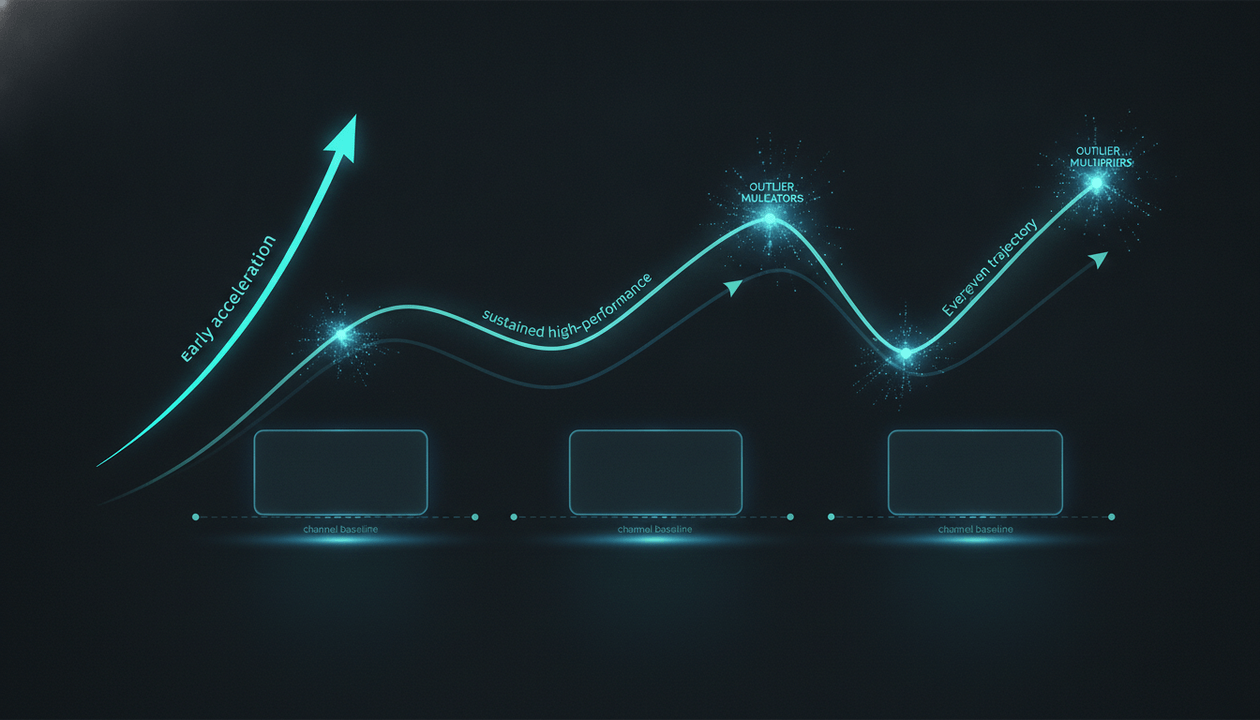
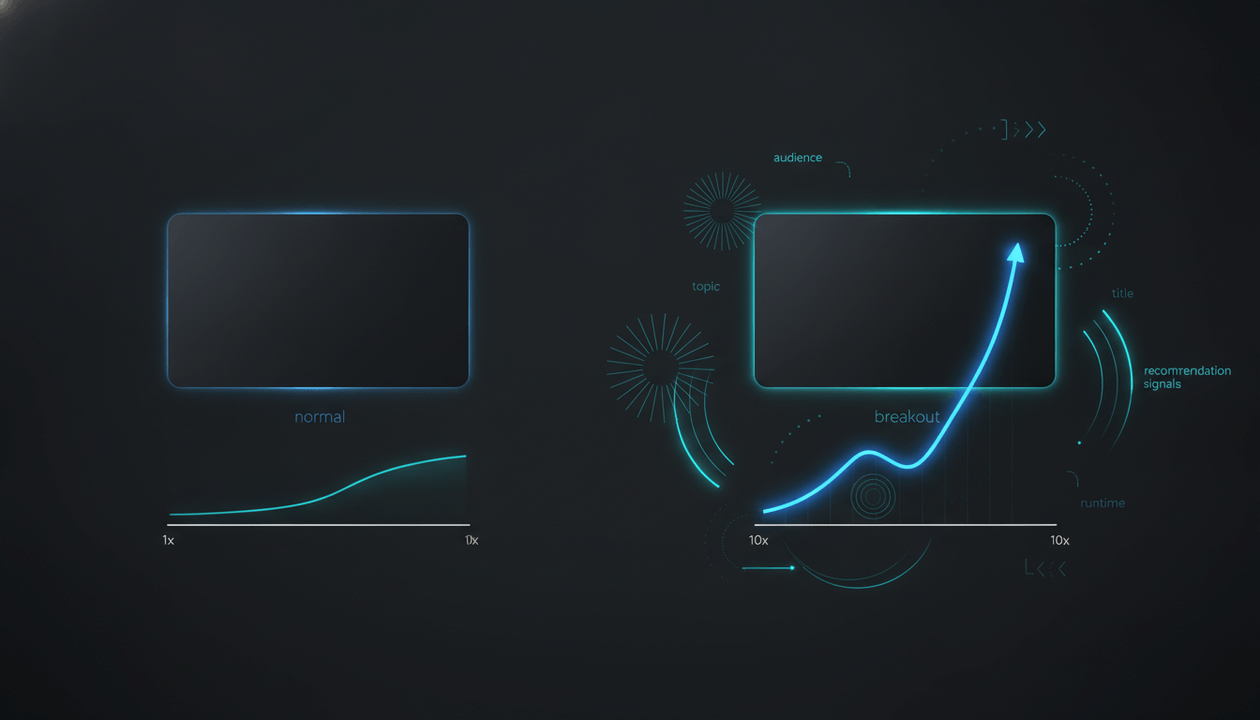
A YouTube outlier is a video that breaks the normal performance pattern of a channel. If a channel usually gets 20,000 views per upload and one video gets 180,000, that is more useful than simply saying “this channel has a popular video.” The important question is: why did this video beat the channel’s usual ceiling?
This guide shows you how to find YouTube outliers, score them correctly, avoid false positives, and turn the best ones into original video ideas without copying another creator.
Key Takeaways
- YouTube outlier analysis means finding videos that outperform a channel’s normal baseline, not just videos with high raw view counts.
- A strong outlier usually combines topic demand, click-worthy packaging, timing, audience fit, and a strong first 30 seconds.
- Total views alone are misleading because a 500,000-view video may be normal for a huge channel, while a 50,000-view video may be a massive breakout for a smaller channel.
- The best outlier metric is a multiplier: video views compared against the channel’s usual average or median performance.
- Outliers are strongest when they appear across multiple channels in the same niche because that signals repeatable market demand.
- YouTube Studio is still the best place to diagnose your own CTR, impressions, watch time, and retention, but public outlier research helps you find winning ideas before you publish.
- Tools like OverseerOS Viral Channel Finder, Channel Analyzer, Viral X-Ray, and Channel Blueprint Cloner help creators move from “this video did well” to “this pattern is worth building around.”
What Is YouTube Outlier Analysis?
YouTube outlier analysis is the process of finding videos that performed unusually well compared with a channel’s normal performance.
Not compared with all of YouTube.
Not compared with MrBeast.
Not compared with your dream channel.
Compared with that specific channel’s own baseline.
That distinction matters.
A video with 1 million views on a channel that usually gets 2 million views is not a breakout. It underperformed.
A video with 80,000 views on a channel that usually gets 8,000 views is a real outlier. It did 10x the channel’s normal result.
That is the kind of signal creators should study.
Simple definition
A YouTube outlier is a video that gets significantly more views, engagement, or velocity than the channel usually gets.
The cleanest version:
Outlier score = video views ÷ channel average views
Example:
| Channel average | Video views | Outlier score | What it means |
|---|---|---|---|
| 10,000 | 12,000 | 1.2x | Slightly above normal |
| 10,000 | 30,000 | 3x | Strong performer |
| 10,000 | 80,000 | 8x | Major outlier |
| 10,000 | 250,000 | 25x | Breakout hit |
This is why outlier analysis is more useful than “top videos” analysis.
Top videos show what was big.
Outliers show what broke the pattern.
Why Outliers Matter More Than Top Videos
A channel’s biggest video is often old, boosted by years of search traffic, or tied to a one-time cultural moment.
Outliers are different. They show where the channel exceeded its expected level.
That makes them more useful for creators because they answer sharper questions:
- What topic pulled in viewers beyond the normal audience?
- What title format created unusual curiosity?
- What thumbnail pattern made people stop?
- What emotional angle widened the audience?
- What timing made the video more relevant?
- What structure kept viewers long enough for YouTube to keep distributing it?
YouTube’s own Help Center explains that CTR can vary based on content type, audience, and where the impression was shown. It also warns that videos with fewer impressions can have higher CTR because they may be viewed by a narrower, more loyal audience. Source: YouTube Help
That is exactly why outlier analysis works best when it is baseline-relative.
You are not asking, “Did this video get a lot of views?”
You are asking, “Did this video perform unusually well for this channel, in this niche, at this time?”
Outlier Analysis vs Normal YouTube Analytics
Normal YouTube analytics tells you what happened on your own channel.
Outlier analysis helps you study what is breaking out across the market.
Both matter, but they solve different problems.
| Method | Best for | Main limitation |
|---|---|---|
| YouTube Studio analytics | Diagnosing your own CTR, impressions, retention, watch time, and traffic sources | Only shows your own channel data |
| Public competitor research | Studying what other channels are doing and finding patterns before you publish | Public data cannot show private retention curves or full traffic-source data |
| Top video analysis | Finding a channel’s biggest historical winners | Can overvalue old evergreen videos or one-time events |
| Outlier analysis | Finding videos that beat a channel’s normal baseline | Needs context to avoid false positives |
| Pattern analysis | Turning multiple outliers into repeatable content strategy | Requires human judgment, not just a score |
The mistake is treating these as the same thing.
Your own YouTube Studio data tells you if your video delivered on the promise.
Competitor outlier analysis tells you which promises the market already rewarded.
The best creators use both.
The 5 Signals of a Real YouTube Outlier
A video should not be treated as a serious outlier just because it has more views than usual. You need to inspect the signal.
1. Relative performance
This is the core outlier score.
Ask:
- How does this video compare with the channel’s average views?
- How does it compare with recent videos, not just the lifetime catalog?
- Is it 2x, 5x, 10x, or 25x above normal?
- Did it beat the channel’s normal ceiling or just slightly outperform?
A 2x performer can be useful.
A 10x performer deserves deep analysis.
A 25x performer can reveal a new content lane.
2. View velocity
Total views can lie.
A video with 500,000 views over four years may be less useful than a video with 60,000 views in six days on a smaller channel.
View velocity asks:
How fast did the video get attention?
Look at:
- Views per day
- Upload date
- Recent upload patterns
- Whether the video is still gaining
- Whether the topic is tied to a current event or evergreen demand
Velocity matters because YouTube opportunities decay. Some ideas are evergreen. Others are only valuable if you move fast.
3. Packaging strength
A real outlier usually has a strong click promise.
Study the title and thumbnail together.
Do not analyze them separately.
A strong outlier package usually has one of these patterns:
| Pattern | Example angle | Why it works |
|---|---|---|
| Hidden truth | “The Business Model No One Noticed” | Creates curiosity around concealed information |
| Before and after | “I Tried This for 30 Days” | Promises transformation |
| Fear gap | “This Is Why Most Channels Stop Growing” | Makes the viewer feel exposed |
| Contrarian claim | “Your Best Videos Are Not Your Best Ideas” | Challenges common belief |
| Proof-first | “0 to 100K Subscribers With One Format” | Gives the viewer evidence before advice |
| Status shift | “Small Channels Are Beating Big Channels With This” | Makes the viewer feel opportunity is still available |
Weak analysis says:
This thumbnail is bright.
Strong analysis says:
The thumbnail reduces the idea to one visual conflict, while the title creates a specific unanswered question. The viewer understands the tension in under one second.
4. Audience expansion
Some videos only perform well because they serve the channel’s existing audience better.
That is useful, but the bigger wins usually come from videos that expand the audience.
Ask:
- Could someone outside the channel’s core audience care about this?
- Does the topic connect to a broader fear, desire, trend, or identity?
- Is the title understandable without knowing the creator?
- Does the thumbnail work for a cold viewer?
- Does the video promise a result, revelation, transformation, or story?
Example:
Weak niche topic:
My Updated Editing Workflow
Better audience-expanding topic:
I Cut My Editing Time in Half With This Workflow
The second version is not just about the creator. It gives the viewer a reason to care.
5. Repeatability
This is where most creators get outlier analysis wrong.
Not every outlier should be copied, modeled, or turned into a new content lane.
Some outliers are one-time spikes.
A good outlier must pass the repeatability test:
- Can this topic format be repeated?
- Can the emotional angle be reused?
- Can the title structure work with another subject?
- Can the thumbnail pattern be adapted without copying?
- Are other channels seeing similar breakouts?
- Is the demand tied to a lasting viewer problem?
One video is a clue.
Three similar outliers across different channels is a pattern.
How to Find YouTube Outliers Manually
You can do basic YouTube outlier analysis manually.
It takes longer, but the process is simple.
Step 1: Pick a channel in your niche
Choose a channel that is relevant to your audience.
Do not only study giants. Big channels are useful, but smaller breakout channels often reveal fresher opportunities.
Good channels to study:
- Similar niche
- Similar audience
- Similar video format
- Similar production style
- Posting actively
- Enough recent videos to compare
Bad channels to study:
- Celebrity-driven channels you cannot replicate
- Channels with one viral short and no consistent format
- Channels that only win because of access, fame, or budget
- Channels outside your realistic audience
Step 2: Estimate the channel baseline
Look at the last 20 to 50 videos.
Ignore extreme old hits at first.
Estimate:
- Average views
- Median views
- Typical low-end result
- Typical high-end result
- Recent upload cadence
- Shorts vs long-form split
Median is often better than average because one huge video can distort the data.
Example:
A channel’s last 12 long-form videos:
| Video | Views |
|---|---|
| 1 | 14,000 |
| 2 | 16,000 |
| 3 | 12,000 |
| 4 | 19,000 |
| 5 | 15,000 |
| 6 | 110,000 |
| 7 | 13,000 |
| 8 | 17,000 |
| 9 | 18,000 |
| 10 | 14,500 |
| 11 | 16,500 |
| 12 | 15,500 |
The average is pulled up by the 110,000-view outlier.
The real baseline is closer to 15,000 to 18,000.
That 110,000-view video is the one to inspect.
Step 3: Calculate the outlier multiplier
Use this:
Video views ÷ channel baseline views = outlier multiplier
If the channel baseline is 16,000 views and one video gets 110,000:
110,000 ÷ 16,000 = 6.9x
That is a strong outlier.
Step 4: Separate recent outliers from legacy outliers
A 4-year-old outlier can still teach evergreen strategy, but it may not show what is working now.
For active strategy, sort outliers into time windows:
| Time window | What it tells you |
|---|---|
| Last 30 days | Fresh demand and current momentum |
| Last 3 months | Strong short-term market signal |
| Last 6 months | Reliable recent content pattern |
| Last 12 months | Broader content strategy direction |
| All time | Evergreen winners and historical ceiling |
For most creators, the best window is the last 3 to 6 months.
That is recent enough to matter, but wide enough to avoid overreacting to one random spike.
Step 5: Decode the pattern
Once you find an outlier, do not stop at the score.
Break it down:
- Topic: What is the video actually about?
- Promise: What does the viewer expect to get?
- Stakes: What happens if the viewer ignores it?
- Title: What curiosity gap does it open?
- Thumbnail: What visual contrast does it create?
- Hook: How does the first 30 seconds continue the click promise?
- Structure: What keeps the video moving?
- Format: Is it a list, story, experiment, documentary, reaction, tutorial, breakdown, or warning?
- Repeatability: Can the format become a series?
The goal is not to steal the video.
The goal is to extract the pattern.
The Outlier Analysis Framework
Use this framework every time you study a breakout video.
| Layer | Question to answer | Example |
|---|---|---|
| Baseline | What does this channel normally get? | “This channel averages 22K views.” |
| Multiplier | How far above normal did this video perform? | “This video did 180K, around 8.2x baseline.” |
| Timing | Was it trend-driven, seasonal, or evergreen? | “Uploaded two days after a major AI release.” |
| Topic | What viewer problem or curiosity did it target? | “People fear being replaced by AI agents.” |
| Packaging | Why did the title and thumbnail earn the click? | “The title created urgency. The thumbnail showed one clear threat.” |
| Hook | Did the intro fulfill the title fast? | “The first line immediately raised stakes.” |
| Structure | What kept people watching? | “It stacked escalating proof, not random examples.” |
| Repeatability | Can this pattern be adapted? | “Yes, the format can work for new AI tools, jobs, and industries.” |
| Original angle | How can we create a unique version? | “Focus on creators, not office workers.” |
This is where creators separate themselves.
Beginners collect titles.
Operators extract systems.
Examples of Outlier Patterns by Niche
AI and technology
Outlier pattern:
“This new tool changes everything” is too generic.
“This tool replaces a specific workflow people already hate” is stronger.
Weak topic:
New AI Agents Explained
Stronger outlier-style angle:
I Let an AI Agent Run My Business Tasks for 7 Days
Why it can break out:
- Specific experiment
- Clear time frame
- Built-in curiosity
- Implied risk
- Easy thumbnail concept
- Strong first-person proof
Finance
Weak topic:
How to Save Money
Stronger outlier-style angle:
I Audited My Spending and Found the $1,200 Leak
Why it can break out:
- Specific number
- Personal discovery
- Viewer self-interest
- Clear payoff
- Strong title-thumbnail alignment
Psychology
Weak topic:
Signs Someone Likes You
Stronger outlier-style angle:
The Subtle Signal People Miss When Someone Is Obsessed With Them
Why it can break out:
- Emotional curiosity
- Identity-based appeal
- Specific but broad
- Feels like hidden knowledge
Faceless business channels
Weak topic:
Best Online Businesses
Stronger outlier-style angle:
The Boring Business Quietly Making $80K/Month
Why it can break out:
- “Boring” creates contrast
- Specific money proof
- Curiosity around hidden opportunity
- Strong visual concept
Education
Weak topic:
How to Learn Faster
Stronger outlier-style angle:
I Studied for 100 Hours and Found the Method That Actually Worked
Why it can break out:
- Experiment format
- Time investment
- Personal proof
- Clear outcome
Common False Positives in YouTube Outlier Analysis
Not every high-performing video is a useful signal.
Here are the traps.
False positive 1: Celebrity or guest leverage
A podcast episode with a famous guest may outperform because of the guest, not the format.
Ask:
Can I recreate this without the same person?
If the answer is no, the outlier is less useful.
False positive 2: News timing
A video may spike because it was first to cover a breaking event.
That can still be valuable, but only if your workflow can move fast.
Ask:
Was this a content strategy win or a speed win?
If it was only speed, do not build a long-term strategy around it.
False positive 3: Controversy without repeatability
Drama can spike views, but it is not always a stable channel strategy.
Ask:
- Did the creator gain repeat viewers?
- Did follow-up videos perform well?
- Did the topic create trust or just attention?
- Would repeating this damage the brand?
False positive 4: Shorts mixed with long-form
Shorts and long-form should not be compared in the same baseline.
A channel may get 800,000 views on Shorts and 30,000 views on long-form. That does not mean the long-form videos are failing. It means the formats distribute differently.
Separate:
- Shorts baseline
- Long-form baseline
- Livestream baseline
- Podcast clip baseline
False positive 5: Old evergreen search traffic
Some old videos look huge because they ranked in search for years.
Useful, yes.
But not the same as a current breakout.
Check:
- Upload date
- Current niche relevance
- Whether newer videos on the same topic still perform
- Whether the topic is evergreen or outdated
How to Turn an Outlier Into an Original Video Idea
This is the part that matters.
Finding outliers is easy.
Turning them into original content without copying is the real skill.
Use this 5-step process.
Step 1: Extract the viewer desire
Do not start with the title.
Start with the desire underneath the title.
Example outlier title:
I Tried Waking Up at 5AM for 30 Days
Surface topic:
Waking up early
Viewer desire:
“I want discipline, control, and a better version of myself.”
Now you can create a unique version:
I Rebuilt My Morning Routine Around Deep Work for 30 Days
Same desire.
Different execution.
Step 2: Identify the content format
Most outliers are not just topics. They are formats.
Common formats:
| Format | What it does |
|---|---|
| Experiment | Shows proof through action |
| Breakdown | Explains why something worked |
| Warning | Helps viewer avoid pain |
| Case study | Uses a real example as evidence |
| Transformation | Shows before and after |
| Tier list | Creates ranking curiosity |
| Mistake audit | Finds hidden problems |
| Documentary | Turns information into a story |
If an outlier was an experiment, do not turn it into a generic tutorial.
If it was a documentary, do not turn it into a basic listicle.
Match the format logic, not the exact content.
Step 3: Change the angle
Your version needs a different angle.
Ways to make it original:
| Original angle | New angle |
|---|---|
| Beginner guide | Advanced mistakes |
| Personal experiment | Expert breakdown |
| General audience | Niche-specific version |
| Positive promise | Warning or risk angle |
| News reaction | Long-term consequence |
| Tool review | Workflow transformation |
| Case study | Step-by-step teardown |
Example:
Original outlier:
I Tried AI Coding for 30 Days
Original but related version:
I Replaced My SaaS Workflow With AI Agents for a Week
Not a copy.
Same market curiosity.
New execution.
Step 4: Build a fresh title-thumbnail promise
Do not reuse the exact packaging.
Model the underlying click mechanism.
Example:
Original:
The AI Tool That Replaced My Editor
Bad copy:
The AI Tool That Replaced My Designer
Better adaptation:
My Editor Finished This Video in 12 Minutes With AI
Why better?
- Same AI replacement curiosity
- Different proof angle
- More specific
- More visual
- Less copycat
Step 5: Make the script prove the promise fast
YouTube’s audience retention documentation explains that the intro shows what percentage of viewers are still watching after the first 30 seconds. It also says a strong intro can mean the first 30 seconds matched the expectation created by the title and thumbnail. Source: YouTube Help
That means your outlier-inspired video must continue the same promise immediately.
If your title creates urgency, the intro cannot start slow.
If your thumbnail shows conflict, the intro must address the conflict.
If your title promises proof, show proof early.
A Practical YouTube Outlier Analysis Template
Use this when studying any breakout video.
Channel:
Niche:
Video title:
Video URL:
Upload date:
Video views:
Channel average views:
Outlier multiplier:
Format:
Topic category:
Audience desire:
Viewer fear:
Title mechanism:
Thumbnail mechanism:
First 30-second promise:
Structure:
Why it likely broke baseline:
Is it trend-driven or evergreen?
Can this be repeated?
What should we avoid copying?
Original video idea based on this pattern:
New title options:
New thumbnail concept:
Script hook:
Here is a filled example.
Channel:
Faceless AI business channel

Niche:
AI automation / online business

Video title:
I Let AI Run My Online Business for 7 Days

Video URL:
Example competitor video URL

Upload date:
Recent upload

Video views:
420,000

Channel average views:
48,000

Outlier multiplier:
8.75x

Format:
Experiment

Topic category:
AI workflow experiment

Audience desire:
Use AI to save time, reduce workload, and create more output without hiring a bigger team.

Viewer fear:
AI is moving fast, competitors are adopting it, and the viewer might fall behind.

Title mechanism:
A time-boxed experiment with a high-stakes result. The title makes the viewer ask, “Did AI actually run the business, and what happened?”

Thumbnail mechanism:
Human vs machine tension. The thumbnail should show one clear conflict, not five random AI logos.

First 30-second promise:
The video needs to show the experiment setup fast: what AI controlled, what the creator was not allowed to do, and what would count as success or failure.

Structure:
1. The challenge
2. The AI setup
3. Day-by-day escalation
4. First failure
5. Unexpected win
6. Final result
7. What the creator would actually keep using

Why it likely broke baseline:
The video turned a broad AI topic into a proof-driven story. It was not “AI tools explained.” It promised evidence.

Is it trend-driven or evergreen?
Both. The specific AI tools may change, but the viewer desire to automate work is evergreen.

Can this be repeated?
Yes. The format can be adapted to different workflows, businesses, creator tasks, research systems, editing systems, and monetization experiments.

What should we avoid copying?
Do not copy the exact title, thumbnail layout, tools used, day-by-day structure, or script. Model the experiment format and viewer desire instead.

Original video idea based on this pattern:
I Gave AI Control of My YouTube Research Workflow for 7 Days

New title options:
1. I Let AI Pick My YouTube Topics for 7 Days
2. I Gave AI My YouTube Strategy and It Found This
3. AI Chose My Next 10 Video Ideas. One Was Terrifying
4. I Replaced My YouTube Research With AI for a Week

New thumbnail concept:
A creator staring at a screen filled with AI-picked video ideas. One idea is highlighted like a warning signal. The visual tension is “human creator vs machine strategist.”

Script hook:
I gave AI one job: find video ideas better than mine. For seven days, I was not allowed to trust my gut. I had to follow the data, the patterns, and the topics it found. By day three, it found an idea I would have completely ignored.
That is how you model an outlier responsibly.
You are not copying the creator’s video.
You are extracting the demand pattern and building a unique execution.
How OverseerOS Helps You Find and Use YouTube Outliers
You can do outlier analysis manually, but it gets slow once you are tracking multiple channels, formats, and niches.
If you are choosing software for this, several Spotter Studio alternatives for outlier research are built around exactly this workflow.
OverseerOS is built around the idea that creators should stop starting from a blank page and start from public patterns that already worked.
Inside OverseerOS, the outlier workflow connects multiple tools.
Channel Analyzer
Use Channel Analyzer to study a channel’s public performance, top videos, upload patterns, engagement signals, and content strategy.
This is where you identify which videos are beating the channel’s normal baseline.
Breakout Videos
OverseerOS surfaces breakout videos by looking at recent videos and comparing them against the channel’s average performance. The workflow supports time windows like 1 month, 3 months, and 6 months, so you can separate fresh breakouts from older historical winners.
The breakout score is designed to answer one simple question:
How many times better did this video perform than the channel’s average?
That is the number creators actually need.
Viral X-Ray
Once you find a breakout, Viral X-Ray helps you inspect why the video worked.
Use it to study:
- Title angle
- Hook
- Structure
- Viewer psychology
- Thumbnail direction
- Engagement pattern
- What can be modeled without copying
Summarize and transcript extraction
For deeper research, you can summarize a breakout video or extract its transcript inside the workflow.
That helps you move from surface-level packaging into structure:
- What happened in the opening?
- How was the payoff delayed?
- Where did the story shift?
- What examples were used?
- How did the creator transition between sections?
Clone thumbnail style responsibly
If the outlier’s thumbnail is part of the win, you can use OverseerOS thumbnail tools to study the style and create a unique version based on the visual pattern.
The point is not to duplicate another thumbnail.
The point is to understand the visual DNA:
- Focal point
- Contrast
- Emotion
- Text hierarchy
- Background simplicity
- Visual tension
- Color separation
For thumbnail workflows, see the AI YouTube thumbnail generator built from proven packaging patterns.
Similar topics and planner handoff
A strong outlier should turn into a content lane, not just one idea.
OverseerOS lets creators generate related topics, save ideas into the planner, and build a repeatable workflow around proven demand.
That is the real advantage.
You go from:
“This video did well.”
To:
“This is a repeatable content pattern we can build around.”
Viral Channel Finder
If you want to find breakout channels before they become obvious, OverseerOS Viral Channel Finder helps discover viral and breakout channels in a niche using public YouTube signals.
It supports filters like niche, subscriber range, video count, content format, and language, then shows ranked channels with viral score, growth signals, and the actual breakout videos behind the result.
This is useful because sometimes the best outlier is not inside a channel you already know.
It is inside a small channel that just started breaking its own ceiling.
Channel Blueprint Cloner
Once you find a channel with repeatable outliers, the Channel Blueprint Cloner can turn that public channel into a strategy blueprint.
That means you can study:
- Tone DNA
- Hook patterns
- Pacing
- Viral topic formulas
- Tags and keywords
- Content structure
- Untapped topic opportunities
- Planner-ready ideas
The important part: strategy cloning is not content copying.
You are not duplicating another creator’s work.
You are turning public signals into original strategy.
The Best Outlier Analysis Workflow for Creators
Use this workflow when researching a niche.
Step 1: Build a competitor list
Pick 10 to 30 channels.
Include:
- 5 large authority channels
- 10 mid-sized active channels
- 10 smaller channels with recent momentum
- 3 to 5 channels outside your niche but with similar formats
The small channels matter most because their breakouts are easier to learn from. A small channel suddenly jumping from 4,000 views to 80,000 views is usually a cleaner signal than a massive channel getting another massive video.
Step 2: Separate formats
Do not mix everything.
Create separate buckets:
- Long-form explainers
- Shorts
- Podcast clips
- Tutorials
- Documentary videos
- News reactions
- Case studies
- List videos
- Experiments
Outlier analysis becomes weak when format baselines are mixed.
A 45-second Short and a 28-minute documentary do not behave the same way.
Step 3: Find 3x to 10x videos
Start with videos that did at least 3x the channel baseline.
Then prioritize:
- Recent 3-month and 6-month outliers
- Videos with clear packaging patterns
- Videos from channels similar to your size or format
- Videos with repeatable topics
- Videos that are not purely celebrity-driven or one-time news
Step 4: Cluster the winners
Do not analyze one outlier in isolation.
Cluster them by pattern.
Example cluster:
| Outlier cluster | What it means |
|---|---|
| “I tried X for 30 days” | Experiment-based proof works in this niche |
| “Why X is failing” | Negative diagnostic angles pull attention |
| “The hidden system behind X” | Viewers want behind-the-scenes breakdowns |
| “Small channel did X” | Aspirational underdog case studies work |
| “X is replacing Y” | Threat-based technology angles work |
The cluster is more valuable than the individual video.
Step 5: Score repeatability
Use this scoring system.
| Score | Meaning |
|---|---|
| 1 | One-time event, not worth modeling |
| 2 | Interesting, but hard to repeat |
| 3 | Repeatable with effort |
| 4 | Strong repeatable format |
| 5 | Clear content lane worth building around |
A 20x outlier with repeatability score 1 is a curiosity.
A 5x outlier with repeatability score 5 is a strategy.
Step 6: Build original ideas
For each strong outlier pattern, create 3 to 5 original ideas.
Use this formula:
Outlier pattern:
Viewer desire:
Original angle:
Unique proof:
New title:
New thumbnail concept:
Hook:
Why this is not a copy:
Example:
Outlier pattern:
AI experiment for 7 days

Viewer desire:
Use AI to save time and make more money

Original angle:
AI for YouTube research instead of generic productivity

Unique proof:
Show the exact workflow before and after

New title:
I Let AI Pick My YouTube Topics for 7 Days

New thumbnail concept:
Human creator staring at a board of AI-picked video ideas, one idea glowing

Hook:
I gave AI one job: find video ideas better than mine. The result was uncomfortable.

Why this is not a copy:
Different workflow, different audience, different proof, different execution
What Makes a YouTube Outlier Worth Copying Strategically?
Do not copy the video.
Copy the logic.
A YouTube outlier is worth modeling when it has at least three of these traits:
- It beat the channel baseline by 3x or more.
- It is recent enough to reflect current demand.
- The topic is understandable to cold viewers.
- The title and thumbnail create a clear click promise.
- The video format can be repeated.
- Other channels have similar winners.
- The angle fits your audience.
- You can add stronger proof, better storytelling, or a more specific niche version.
- The idea does not depend on celebrity access, private data, or a one-time event.
- The content can be made ethically and originally.
The best outliers are not just viral.
They are portable.
Outlier Analysis Checklist
Before you turn an outlier into a video idea, run this checklist.
- The video beat the channel’s normal baseline, not just raw view count.
- The video is in the same format bucket you want to create.
- The upload date is recent enough to matter.
- The video is not only successful because of a famous guest.
- The topic has a clear viewer desire.
- The title creates a specific curiosity gap.
- The thumbnail communicates the idea quickly.
- The first 30 seconds likely continues the click promise.
- The idea can be repeated with a different angle.
- At least one other channel has seen similar demand.
- Your version adds new proof, a new story, or a new audience angle.
- You can explain why your version is original.
If you cannot check most of these boxes, do not build around the outlier.
Mistakes That Ruin YouTube Outlier Research
Mistake 1: Sorting only by most popular
Most popular is not the same as most useful.
Sort by relative performance whenever possible.
Mistake 2: Ignoring channel size
A 100,000-view video means different things on different channels.
Always compare against the channel baseline.
Mistake 3: Copying titles too closely
If your title looks like a slightly edited version of another creator’s title, you are not modeling. You are copying.
Extract the mechanism instead.
Mistake 4: Ignoring the thumbnail
Outliers are usually not topic-only wins.
The click package matters.
Analyze title and thumbnail as one unit.
Mistake 5: Forgetting the first 30 seconds
If the intro does not deliver what the packaging promised, the outlier pattern will not transfer.
YouTube’s own retention guidance points creators back to whether the first 30 seconds matched the expectation created by the title and thumbnail. Source: YouTube Help
Mistake 6: Studying only huge channels
Huge channels can teach you packaging and format, but smaller breakout channels often reveal better opportunity.
Small-channel outliers are where you find market gaps.
Mistake 7: Treating outliers as guarantees
Outlier analysis improves your odds.
It does not guarantee views.
YouTube performance still depends on execution, audience fit, timing, packaging, retention, topic strength, and distribution.
Final Verdict
YouTube outlier analysis is one of the fastest ways to stop guessing.
But only if you do it correctly.
Do not chase the biggest videos.
Find the videos that beat their channel’s normal baseline. Then study why they broke the pattern: topic, packaging, timing, hook, structure, audience desire, and repeatability.
That is where real strategy lives.
The best creators do not start from a blank page. They start from evidence. They study what already worked, extract the pattern, and build an original version that fits their own audience.
If you want to do that faster, use OverseerOS to find breakout videos, analyze winning channels, run Viral X-Ray, and turn proven YouTube patterns into original content strategy.
FAQ
What is YouTube outlier analysis?
YouTube outlier analysis is the process of finding videos that performed much better than a channel’s normal baseline. Instead of only looking at raw views, you compare each video against the channel’s average or median performance to find true breakouts.
What is a good YouTube outlier score?
A 2x outlier is worth noticing. A 3x to 5x outlier is strong. A 10x or higher outlier deserves deep analysis. The score depends on the niche, channel size, video format, and time window.
How do you calculate a YouTube outlier?
Use this formula:
Video views ÷ channel baseline views = outlier score
If a channel averages 20,000 views and one video gets 160,000 views, the video has an 8x outlier score.
Should I use average views or median views?
Median views are often better because one massive video can distort the average. For serious analysis, look at both. If the average is much higher than the median, the channel already has extreme outliers affecting the baseline.
Are YouTube outliers the same as viral videos?
Not always. A viral video usually means high raw reach. An outlier means the video performed unusually well compared with that channel’s normal results. A small channel can have a powerful outlier without reaching millions of views.
Can I find outliers with YouTube Studio?
YouTube Studio is best for analyzing your own channel’s impressions, CTR, watch time, and retention. For competitor outlier analysis, you need to use public signals such as views, upload dates, titles, thumbnails, and channel performance patterns.
What is the difference between a breakout video and an outlier video?
A breakout video usually refers to a video gaining unusual traction, often recently. An outlier is any video that performs far above the channel baseline. A recent outlier with strong velocity is usually a breakout video.
Is it okay to copy outlier videos from competitors?
No. The right move is to model the pattern, not copy the video. Study the topic demand, format, title mechanism, thumbnail structure, and viewer desire. Then create a new version with your own angle, proof, script, and packaging.
How does OverseerOS help with YouTube outlier analysis?
OverseerOS helps creators analyze channels, surface breakout videos, inspect videos with Viral X-Ray, summarize or extract transcripts, clone thumbnail styles responsibly, generate related topics, save ideas into planners, and discover breakout channels with Viral Channel Finder.
What should I do after finding a YouTube outlier?
Do not immediately make the same video. First, decode the viewer desire, title mechanism, thumbnail promise, content format, hook, and repeatability. Then create an original version that serves your audience with a fresh angle.