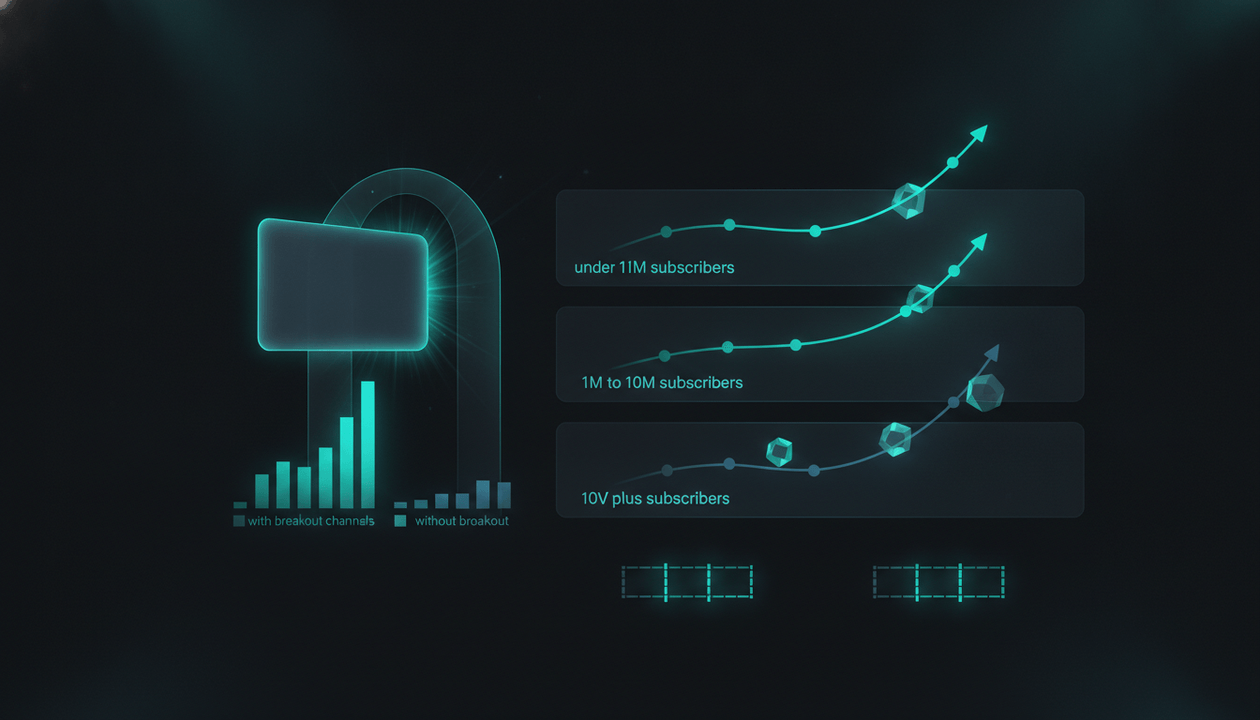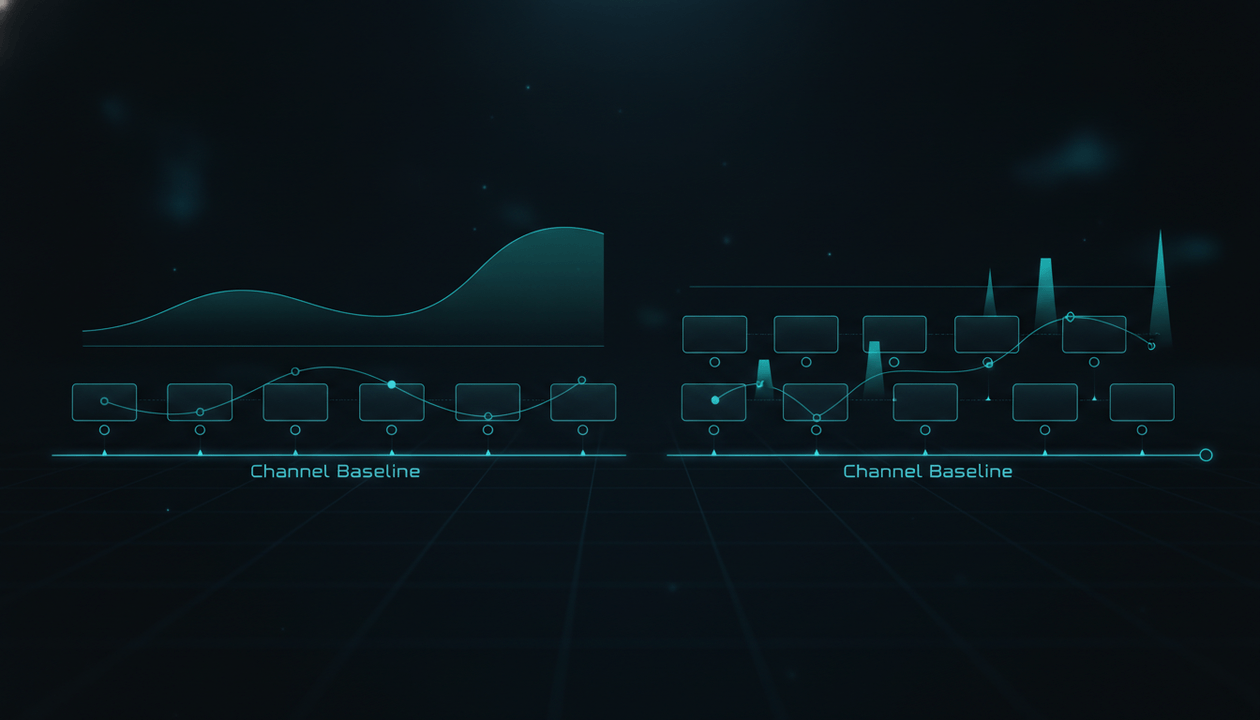
A YouTube channel that is "not growing" does not have one problem.
It has a symptom.
That distinction matters because creators often react to stalled growth by changing everything at once:
- posting more
- switching niches
- redesigning thumbnails
- rewriting titles
- making longer videos
- making shorter videos
- starting Shorts
- stopping Shorts
- changing upload days
- buying new tools
The result is more activity with less clarity.
To understand what creators actually struggle with when growth stalls, OverseerOS analyzed 935 public comments classified around YouTube analytics and growth.
Those comments came from:
- 425 videos
- 40 creator-focused channels
- a larger corpus of 27,555 classified public comments
- 9,677 comments containing an actionable creator signal
The strongest finding was not about thumbnails, retention, or the algorithm.
It was about how creators describe the problem.
Among the 935 analytics-and-growth comments:
- 61.8% contained a pain point
- 33.7% contained a how-to question
- 5.3% contained an objection
- only 2.1% expressed the underlying need explicitly
That means:
97.9% of growth needs were implied.
Creators rarely say:
My channel's specific growth bottleneck is X.
They say things closer to:
My views stopped.
My subscribers are stuck.
Why am I not getting recommended?
Why is this channel growing and mine is not?
Why did everything suddenly slow down?
That is the core insight:
"My YouTube channel is not growing" is usually an outcome description, not a diagnosis. The fastest path forward is to identify which stage of the growth system is constrained before changing your strategy.
Our exploratory analysis reinforces this.
More than half of the growth comments contained language related to:
views, reach, impressions, traffic, or distribution.
Far fewer directly referenced:
- retention
- watch time
- CTR
- titles
- thumbnails
That does not mean packaging and retention are unimportant.
It means creators often notice:
the outcome
before they identify:
the mechanism.
So if your YouTube channel is not growing, do not start by asking:
What should I change?
Start with:
Where exactly is growth breaking?
Key Findings
| Finding | Result |
|---|---|
| Analytics and growth comments analyzed | 935 |
| Source videos | 425 |
| Channels represented | 40 |
| Share of all actionable creator comments | 9.7% |
| English comments | 901, 96.4% |
| Pain-point comments | 578, 61.8% |
| How-to questions | 315, 33.7% |
| Objections | 50, 5.3% |
| Content requests | 43, 4.6% |
| Tool requests | 10, 1.1% |
| Missing-capability signals | 9, 1.0% |
| Comparison requests | 3, 0.3% |
| Pain or objection | 626, 67.0% |
| How-to or content request | 358, 38.3% |
| Explicit needs | 20, 2.1% |
| Implied needs | 915, 97.9% |
| Comments with at least one like | 43.6% |
| Median likes | 0 |
| 75th percentile likes | 1 |
| 90th percentile likes | 4 |
The standout number is:
61.8%.
Across actionable creator comments overall, only:
27.5%
contained a pain point.
Growth comments were therefore about:
2.25 times as likely
to be pain-driven.
That makes sense.
Creators do not usually notice growth as an abstract strategic issue.
They notice it when:
something expected to move stops moving.
The Direct Answer
Why is your YouTube channel not growing?
Usually because one or more stages of the channel's growth system are underperforming.
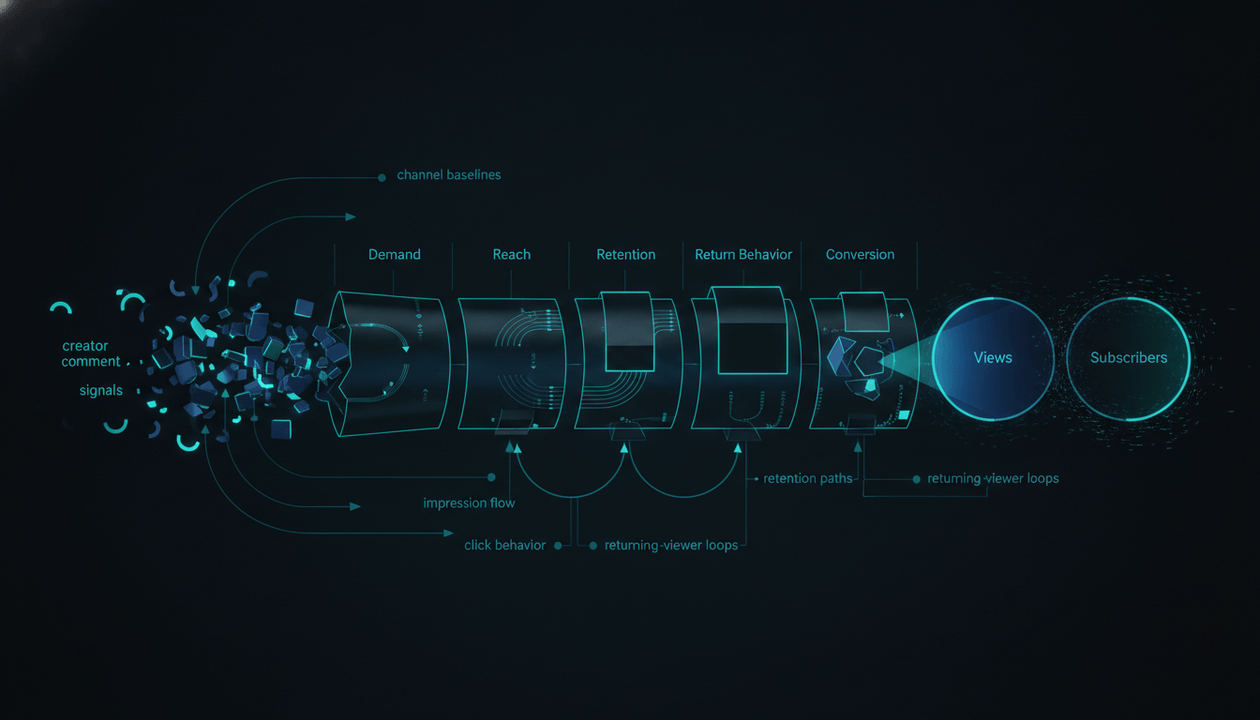
A useful diagnostic chain is:
- Demand: Are you making videos enough people want?
- Reach: Are those videos being shown to potential viewers?
- Click: Are people choosing them when they see them?
- Hold: Are viewers staying after they click?
- Return: Do viewers have a reason to watch another video from you?
- Convert: Is attention turning into subscribers, repeat viewers, or your intended business outcome?
A weakness anywhere in that chain can produce the same visible symptom:
My channel is not growing.
That is why randomly changing your upload frequency, niche, editing style, and thumbnails at the same time is dangerous.
You may be fixing a stage that was never broken.
Finding 1: Growth Comments Were Overwhelmingly Pain-Driven
There were:
578 pain-point comments.
That is:
61.8% of the entire growth cohort.
Compare that with:
27.5%
across actionable creator comments overall.
Growth was one of the most frustration-heavy categories in the dataset.
This matters because pain changes how creators make decisions.
When a channel is growing:
experimentation feels exciting.
When growth stalls:
experimentation can feel like emergency repair.
That creates a risk of overreaction.
What Growth Pain Sounds Like
A creator may see:
- declining views
- subscriber stagnation
- weaker impressions
- inconsistent performance
- one strong video followed by weak uploads
- a competitor suddenly accelerating
All of those can create the same emotional conclusion:
Something is wrong with my channel.
But those observations are not equivalent.
A drop after one viral outlier may be perfectly normal.
Three months of falling matched-age medians is more serious.
One weak topic may be isolated.
Five different topic families weakening together is more concerning.
The sequence matters.
Finding 2: 67% Contained Either Pain or Objection
When we combined:
- pain points
- objections
we found:
626 comments.
That is:
67.0% of the growth cohort.
Two out of every three growth comments therefore contained some form of:
friction or resistance.
That rate was much higher than the:
43.7%
seen across actionable creator comments overall.
This is one reason generic growth advice performs poorly in practice.
The creator does not need another list saying:
- post consistently
- improve thumbnails
- make better videos
- engage with viewers
They need to know:
Which one of those is actually limiting this channel right now?
The Problem With Generic YouTube Growth Advice
Imagine a channel has:
low impressions
but the creator spends two weeks improving:
video editing.
The videos may become prettier.
The distribution problem may remain.
Another channel gets plenty of impressions but weak clicks.
The creator responds by:
uploading more frequently.
Now they publish weak packages faster.
Another gets strong clicks but poor viewer retention.
The creator redesigns the thumbnail.
The click problem was already solved.
The content problem remains.
The correct fix depends on:
where the leak is.
Finding 3: Creators Talk About the Symptom More Than the Cause
We ran a conservative keyword scan across the classifier's normalized growth-need summaries.
These groups overlap and are not an exhaustive taxonomy.
They are directional.
| Language appearing in growth needs | Comments | Share of 935 |
|---|---|---|
| Views, reach, impressions, traffic, distribution | 479 | 51.2% |
| Shorts or long-form format | 133 | 14.2% |
| Subscribers | 117 | 12.5% |
| Algorithm or recommendations | 111 | 11.9% |
| Consistency, posting, upload frequency | 106 | 11.3% |
| Analytics or metrics | 73 | 7.8% |
| Likes, comments, engagement | 56 | 6.0% |
| Niche or topic | 38 | 4.1% |
| Retention or watch time | 25 | 2.7% |
| CTR, titles, thumbnails, clicks | 18 | 1.9% |
Again:
these categories overlap.
They should not be added together.
But the pattern is revealing.
More than half contained language about:
the visible outcome.
Only a small minority directly used language associated with:
packaging or retention.
That does not prove packaging and retention were not the real causes.
It suggests creators often arrive at the problem from the top of the funnel:
My views are low.
rather than:
My packaging is underperforming relative to my historical baseline.
That difference is exactly why diagnosis matters.
Views Are a Symptom Metric
Suppose your views are down.
That can happen because:
Fewer people see the video
Reach problem.
Plenty see it, but fewer click
Packaging problem.
Plenty click, but leave
Content problem.
Individual videos work, but viewers do not return
Channel-positioning problem.
Everything is normal except your comparison point
Benchmarking problem.
One content format is weak
Format problem.
A once-hot topic cooled
Demand problem.
They all end in:
fewer views.
They do not have the same solution.
The YouTube Growth Chain
A useful way to diagnose a stuck channel is to stop treating "growth" as one metric.
Think of it as a chain.
Stage 1: Demand
Question:
Is this an idea enough people actually want?
Before worrying about:
- editing
- tags
- upload times
ask whether the topic has:
audience demand.
A beautifully produced video about something nobody wants can still struggle.
A strong topic does not guarantee a winner.
But weak demand creates a hard ceiling.
Demand Problems Often Look Like Algorithm Problems
A creator publishes a video.
It receives little reach.
Conclusion:
YouTube is not pushing me.
Possible alternative explanation:
The audience opportunity may simply be weak.
The distinction matters.
If demand is weak, changing:
- upload time
- caption style
- camera
- tags
may not meaningfully change the ceiling.
How to Diagnose Topic Demand
For your own channel:
compare the topic with:
- your previous winners
- your previous normal videos
- adjacent audience needs
For competitor research:
look for:
- multiple independent winners
- recent evidence
- channel-relative outliers
- repeatability across creators
One viral video is interesting.
Independent success is stronger evidence.
Stage 2: Reach
Next ask:
Is the video reaching enough potential viewers to create a real test?
For a channel you own, inspect:
- impressions
- traffic sources
- current view velocity
- new viewers
Do not immediately interpret low reach as:
an algorithm penalty.
Low reach can coexist with:
- weak demand
- weak packaging
- narrow audience fit
- an immature channel
- a normal performance range
Treat low reach as:
a diagnostic starting point.
Not a final explanation.
Stage 3: Click
If people are seeing the video, the next question is:
Are they choosing it?
Now packaging matters.
That includes:
- topic framing
- title
- thumbnail
- promise clarity
- differentiation
A creator can solve demand correctly and still package the idea poorly.
The audience may want:
the subject.
They simply do not want:
this version of the promise.
Good Topic, Bad Package
Imagine the underlying topic is:
AI tools for creators.
Package A:
Best AI Tools
Package B:
I Replaced My $2,000 Creator Stack With 5 AI Tools
Same broad market.
Very different promise.
If the market wants the subject but your version earns fewer clicks than your historical norm, the problem may be:
packaging.
Not niche.
Stage 4: Hold
Suppose viewers:
- see the video
- click the video
but then leave.
Now the problem has moved inside the content.
Potential issues include:
- slow opening
- delayed payoff
- weak structure
- repetition
- title-video mismatch
- unclear storytelling
The thumbnail did its job.
The video now has to:
keep the promise.
Packaging Can Hide a Content Problem
A strong thumbnail can increase clicks.
That is useful only if the content satisfies the expectation.
A creator can temporarily improve:
CTR
while worsening:
viewer experience
if the package becomes stronger than the actual delivery.
The goal is not:
maximum clicks.
It is:
qualified clicks from viewers the video can satisfy.
Stage 5: Return
This stage is often ignored.
A video can perform well.
The channel can still struggle.
Why?
Because the viewer may finish and think:
Good video.
instead of:
I want more from this creator.
That is the difference between:
video value
and:
channel value.
A Strong Video Does Not Automatically Create a Strong Channel
Imagine one video gets:
500,000 views.
The next ten get:
15,000 each.
The creator may technically have a breakout.
But the audience discovered:
the video
not necessarily:
the channel.
This is why a viral hit does not automatically create durable growth.
The winning topic may have attracted:
- one-off curiosity
- a different audience
- a broad event
- search demand
without establishing a repeatable channel relationship.
Stage 6: Convert
Finally ask:
Is attention becoming the type of growth you actually want?
Possible goals:
- subscribers
- returning viewers
- revenue
- product customers
- leads
- sponsor value
A video can succeed on one dimension and fail on another.
For example:
High views, low subscribers
Possible issue:
the audience liked the video but did not understand the channel's recurring value.
High views, low revenue
Possible issue:
the audience has low commercial value for your model.
Subscriber growth, weak returning viewership
Possible issue:
subscription is not translating into habitual viewing.
Growth should be defined before it is diagnosed.
The First Question: What Do You Mean by "Not Growing"?
Creators often combine several different problems.
Separate them.
My views are not growing
Traffic problem.
My subscribers are not growing
Conversion or audience problem.
My impressions are not growing
Reach problem.
My average video is getting weaker
Baseline problem.
My revenue is not growing
Business problem.
My channel has subscribers but no views
Active-audience problem.
Those are six different diagnoses.
Finding 4: Subscriber Friction Appeared in 12.5% of Growth Needs
Our exploratory scan found:
117 comments
with language related to:
subscribers.
That equals:
12.5% of the growth cohort.
Subscriber count is one of the easiest numbers to obsess over because:
- it is public
- it moves slowly
- every creator sees it
But subscriber count can be a poor explanation for:
why a specific video performed the way it did.
A subscriber is not a guaranteed viewer.
Stop Using Subscriber Count as Your Only Growth Metric
A channel with:
100,000 subscribers
can be healthier than one with:
500,000
if it has:
- stronger current views
- stronger returning audience
- better repeatability
- better commercial fit
Growth is dynamic.
Subscriber count is cumulative.
Those are different things.
Finding 5: Shorts and Format Questions Appeared Frequently
Our exploratory scan found:
133 comments
with language relating to:
- Shorts
- short-form
- long-form
That is:
14.2%.
This suggests creators often experience growth problems through:
format decisions.
Questions can include:
- Should I make Shorts?
- Are Shorts hurting long-form?
- Should I switch formats?
- Why do Shorts get views but long videos do not?
- Why are subscribers from one format not watching another?
Again, the format itself is not automatically the cause.
The audiences and viewer expectations may differ.
Do Not Treat All Views as Equivalent
Suppose:
Short A
Gets:
200,000 views.
Long-form B
Gets:
20,000.
Which helped the channel more?
You cannot know from raw views.
You need the goal.
Maybe Short A:
- creates awareness
while Long-form B:
- builds trust
- generates revenue
- creates returning viewers
Format selection should follow:
channel strategy.
Not ego around view count.
Finding 6: Algorithm Language Appeared in 11.9%
We found:
111 comments
with language around:
- algorithms
- recommendations
- suggested traffic
- browse
That is:
11.9% of the growth cohort.
This shows how often creators experience distribution as something external.
That perspective is understandable.
You do not directly control:
who gets shown a video.
But an algorithm explanation can become too broad to be useful.
"The Algorithm" Is Not a Diagnosis
Imagine asking a mechanic:
Why is the car not moving?
and getting:
The engine.
Technically relevant.
Operationally weak.
A useful diagnosis needs to become more specific.
Instead of:
The algorithm stopped pushing me.
ask:
- Did impressions change?
- Did topic demand change?
- Did CTR change?
- Did retention change?
- Did traffic sources change?
- Did the audience change?
- Did the channel baseline actually decline?
Now the problem becomes measurable.
Finding 7: Consistency and Uploading Appeared in 11.3%
We found:
106 comments
containing language about:
- consistency
- uploads
- posting
- schedules
- frequency
This is another area where creators can overcorrect.
When growth slows, the instinct is:
I need to upload more.
But more output helps only when:
the production system is pointed at useful demand.
Publishing twice as many weak ideas does not create strategy.
Our prior analysis of whether consistency matters on YouTube found no simple universal rule that exact schedule adherence automatically improves per-video performance.
So consistency should be treated as:
an operating capability.
Not a magic growth lever.
The Difference Between Consistency and Repetition
Good consistency:
I repeatedly deliver value for the same type of viewer.
Bad consistency:
I repeatedly upload because the calendar says Tuesday.
The viewer does not care that you hit your internal schedule.
They care whether the next video is worth choosing.
Finding 8: Analytics Language Appeared in Only 7.8%
Only:
73 comments
in the exploratory scan contained language directly associated with:
- analytics
- metrics
- data
- dashboards
- statistics
That is:
7.8%.
Yet growth problems are exactly where analytics becomes most valuable.
This creates an important gap.
Creators notice:
the problem emotionally
before they frame it:
analytically.
That is why a simple channel dashboard can still feel overwhelming.
It shows:
numbers.
The creator needs:
a diagnosis.
Analytics Should Answer Questions
Do not open YouTube Studio and stare at charts.
Open it with a question.
Example:
Why did this video underperform?
Then inspect:
- reach
- clicks
- retention
- traffic source
- audience behavior
Another question:
Is my channel actually declining?
Now inspect:
- rolling matched-age medians
- multiple recent videos
- topic families
- current view velocity
- returning viewer behavior
Analytics becomes useful when:
the question comes first.
Finding 9: Direct Packaging and Retention Language Was Rare
Our exploratory scan found:
Retention and watch-time language
25 comments, 2.7%.
CTR, thumbnail, title, click language
18 comments, 1.9%.
This is not evidence that those metrics rarely matter.
It is evidence that creators do not always describe their growth problem in those terms.
They describe:
what happened.
Not necessarily:
why it happened.
That gap is where diagnosis creates value.
The Symptom-to-Cause Problem
Creator says:
My video got no views.
Possible cause:
- low reach
- weak topic
- weak package
- weak early response
- narrow demand
Creator says:
My subscribers are stuck.
Possible cause:
- weak viewer conversion
- one-off traffic
- inconsistent channel promise
- low overall reach
Creator says:
YouTube stopped recommending me.
Possible cause:
- actual traffic-source decline
- weaker recent topics
- weaker packaging
- audience saturation
- post-viral normalization
The symptom narrows the search.
It does not finish it.
The 10-Minute YouTube Growth Diagnostic
Use this in order.
Step 1: Define the Metric That Is Actually Stuck
Pick one.
- views
- impressions
- unique viewers
- returning viewers
- subscribers
- revenue
Do not diagnose:
growth
as one number.
Step 2: Build a Comparable Baseline
Use:
10 to 20 comparable videos
when possible.
Match:
- format
- video age
- channel era
Calculate the median.
Do not compare every upload with:
your viral winner.
Our research on why YouTube views are so inconsistent found that video performance can vary dramatically even inside one channel.
A giant outlier can make normal performance look like collapse.
Step 3: Ask Whether the Baseline Is Actually Falling
Example:
Previous 10-video median at day 30:
40K
Current 10-video median:
38K
Maybe normal variation.
Now:
Previous:
40K
Current:
18K
That deserves deeper investigation.
Channel health is better measured as:
a pattern
than:
one upload.
Step 4: Separate One Bad Video From a Channel Problem
Do not call the channel dead because:
one video missed.
Our study on whether one bad YouTube video hurts your channel found that most next uploads improved substantially after a severe underperformer.
The useful question is:
Is this one bad video?
or:
Is this part of a multi-video weak run?
Step 5: Diagnose the Growth Stage
Use this table as a hypothesis framework.
| What you observe | First area to investigate |
|---|---|
| Low views and low reach | Demand, audience fit, distribution |
| Reach exists but clicks are weak | Topic framing, title, thumbnail |
| Clicks are healthy but viewers leave | Hook, structure, delivery |
| Individual videos work but channel does not compound | Audience consistency, repeatability |
| Views grow but subscribers do not | Channel promise, conversion |
| Subscribers grow but views remain weak | Active audience, viewer fit |
| One video drops after a giant winner | Baseline distortion |
| Several comparable videos decline | Broader strategy or market shift |
These are diagnostic directions.
They are not proof.
Step 6: Check the Topic Before Rebuilding the Channel
Ask:
Did the audience stop caring about the entire channel?
or:
Did I simply pick weak ideas?
Those are very different.
If five weak videos all came from:
one topic family
you may have a topic problem.
If:
every topic family
weakens together, the problem deserves broader investigation.
Step 7: Compare Against Competitors Correctly
Do not ask:
Are competitors getting more views?
Ask:
Are comparable competitor videos outperforming their own normal baseline?
That distinction is critical.
A competitor getting:
500K views
may look strong.
But if their normal video gets:
2 million
that result is weak.
A smaller creator getting:
80K
may look irrelevant.
But if their median is:
8K
they have a:
10x breakout.
The OverseerOS YouTube Channel Analyzer can help establish the public channel context before you decide whether a competitor result is actually unusual.
Step 8: Find the Weakest Stage
Do not create a list of ten improvements.
Find:
the dominant constraint.
Examples:
Weak topic demand
Fix:
research.
Weak packaging
Fix:
title and thumbnail.
Weak retention
Fix:
opening and content structure.
Weak repeatability
Fix:
channel promise and topic system.
Production bottleneck
Fix:
workflow.
Measurement problem
Fix:
baseline.
One bottleneck at a time.
Step 9: Change One Major Variable
Suppose you believe:
topic selection is the problem.
Do not simultaneously change:
- topic
- title style
- thumbnail style
- video length
- upload day
- editing
Now you cannot learn what worked.
Instead:
change the suspected variable while holding the rest reasonably stable.
Growth becomes an experiment rather than a panic response.
Step 10: Measure the Next Block, Not the Next Hour
One upload can be noisy.
One day can be noisy.
Look for:
movement across a meaningful block of comparable videos.
The goal is not:
Did this fix produce instant magic?
It is:
Did the distribution improve?
The Five Types of "My Channel Is Not Growing"
This framework makes the problem easier to identify.
Type 1: No Reach
Symptoms:
- few impressions
- few views
- little new audience
Main questions:
- Is the topic strong enough?
- Does the audience fit the channel?
- Are current competitors proving demand?
- Is packaging clear enough to earn a wider test?
Type 2: Reach Without Clicks
Symptoms:
- impressions exist
- views lag
Main questions:
- Is the title compelling?
- Is the thumbnail understandable?
- Does the package create a strong promise?
- Is the angle differentiated?
Type 3: Clicks Without Retention
Symptoms:
- people choose the video
- they leave early
Main questions:
- Does the opening continue the title promise?
- Is setup too long?
- Is the structure clear?
- Does the video answer the right question?
Type 4: Videos Grow, Channel Does Not
Symptoms:
- occasional winners
- poor repeatability
- weak return behavior
Main questions:
- Are winners attracting the same audience?
- Is there a clear recurring channel promise?
- Can one winner lead naturally to another video?
Type 5: The Channel Is Fine, Your Benchmark Is Wrong
Symptoms:
- one viral winner
- normal next video feels terrible
- panic despite healthy historical performance
Main question:
Am I comparing normal with exceptional?
This may be the easiest growth problem to fix because the channel itself may not be broken.
The expectation is.
Why One Viral Video Can Make a Healthy Channel Feel Dead
Suppose your baseline is:
20K views.
Then:
300K.
Then:
25K.
Compared with 300K:
the new upload fell:
91.7%.
Compared with the real baseline:
25K is:
25% above normal.
Those are opposite diagnoses.
This is why creators should track:
median performance
not only:
last-video performance.
Your Best Video Is Not Your Baseline
A winner should answer:
What created unusual upside?
It should not automatically answer:
What should every future upload achieve?
Those are different questions.
A healthy content portfolio often contains:
- misses
- normal videos
- strong performers
- outliers
The objective is to:
raise the baseline and improve the frequency of intelligent outliers.
Not force every video to become your biggest hit.
Why "Post More" Is Often Incomplete Advice
Posting more helps when the bottleneck is:
- not enough testing
- insufficient catalog depth
- a functioning topic and packaging system with low output
It helps much less when:
- topics are weak
- packaging is weak
- retention is weak
- production quality is collapsing
Volume multiplies whatever system already exists.
If the system is weak:
you scale weakness.
Why "Improve Your Thumbnails" Is Also Incomplete
If your real problem is:
retention
better thumbnails can increase:
the number of disappointed viewers.
If your real problem is:
topic demand
packaging may improve the ceiling somewhat without solving the market problem.
Thumbnail work is valuable.
But only when:
packaging is actually the constraint.
Why Switching Niches Can Be the Most Expensive Overreaction
A creator experiences:
three weak uploads.
Conclusion:
My niche is dead.
Then they abandon:
- accumulated audience knowledge
- research
- credibility
- topic history
and begin again.
Sometimes a niche really is weak.
But that conclusion should require more evidence than:
a short bad run.
Before switching, ask:
- Are competitors still finding winners?
- Are any topic families still working?
- Is the audience demand actually declining?
- Did packaging or format change?
- Is the whole channel weak, or only recent topics?
Do not destroy useful assets because the latest video hurt emotionally.
Why Growth Plateaus Can Be Useful
A plateau removes the illusion that:
everything is working.
When views keep rising, weak processes can hide.
A plateau forces the creator to ask:
- Which topics actually work?
- Which viewers return?
- Which packages win?
- Which videos create follow-up opportunities?
- Which production work is unnecessary?
A plateau can be:
diagnostic information.
The Growth Bottleneck Principle
At any moment, your channel probably has:
one bottleneck that matters more than the others.
Examples:
Early channel:
topic selection.
Later:
packaging.
Later:
retention.
Later:
production capacity.
Later:
monetization.
The bottleneck moves.
So yesterday's solution can become tomorrow's distraction.
The Wrong Growth Loop
A weak loop looks like:
low views -> panic -> random change -> upload -> low views -> another random change
Nothing compounds because:
nothing is learned.
The Better Growth Loop
A stronger loop:
observe -> diagnose -> choose hypothesis -> change one major variable -> publish -> measure -> update strategy
That is slower emotionally.
It is much faster strategically.
How OverseerOS Fits Into Channel Growth Diagnosis
Public competitor data cannot replace your private YouTube Analytics.
But it can answer a different question:
Is the problem happening only to me, or is the market itself changing?
Start with the OverseerOS YouTube Channel Analyzer to understand:
- recent competitor videos
- historical winners
- current public performance
- title patterns
- thumbnail patterns
- channel-relative outliers
Then use the YouTube Content Planner to carry the strongest evidence-backed opportunities into production rather than starting every video from a blank page.
The goal is not:
copy the competitor.
It is:
reduce guessing about what the audience is currently responding to.
A Practical Channel Growth Audit
Run this every 10 to 20 meaningful uploads.
Baseline
- What is my median matched-age view count?
- Is the rolling median rising or falling?
- Am I comparing against a viral outlier?
- Are Shorts and long-form separated?
Demand
- Which topics repeatedly outperform?
- Which topics repeatedly underperform?
- Are competitors still winning on the same audience needs?
- Are recent outliers appearing in the niche?
Reach
- Are impressions changing?
- Are traffic sources changing?
- Are new viewers increasing?
Packaging
- Is CTR below my normal range?
- Do winning titles make stronger promises?
- Are thumbnails clear and differentiated?
Content
- Is early retention weaker?
- Does the opening match the click promise?
- Which sections lose viewers?
Channel
- Are viewers returning?
- Do winners attract the same audience?
- Is the channel promise clear?
Conversion
- Are views becoming subscribers?
- Are subscribers becoming repeat viewers?
- Is audience growth helping the business objective?
Decision
- What is the single strongest bottleneck?
- What one variable will I test next?
- What will count as improvement?
That final question matters.
Without a pre-defined success condition, creators can reinterpret every result after the fact.
What Should Count as Improvement?
Do not demand:
viral.
Look for movement in the bottleneck.
If the problem was:
Packaging
Improvement might be:
stronger CTR relative to comparable videos.
Retention
Improvement:
stronger early and overall retention.
Topic selection
Improvement:
higher channel-relative views across several new topics.
Return behavior
Improvement:
more repeat viewing across the channel.
Growth becomes manageable when:
the target metric matches the intervention.
What This Study Does Not Prove
This is important.
Comments reveal perceived problems, not verified causes
A creator can say:
The algorithm killed my channel.
That tells us what they believe.
It does not prove the algorithm was the cause.
The corpus is not a random sample of every YouTube creator
These comments came from creator-focused public videos represented in the OverseerOS audience-intelligence corpus.
The comments came from 40 channels
Some communities contributed more comments than others.
96.4% were classified as English
The findings primarily describe an English-language creator dataset.
Growth and analytics is one classifier category
Some related issues may have been classified elsewhere, such as:
- thumbnails
- niche selection
- consistency
- platform issues
The boundaries are useful but not perfect.
Signal types can overlap
A comment can contain more than one signal.
That is why signal percentages can add above 100%.
The exploratory keyword themes overlap
A comment can mention:
- views
- subscribers
- Shorts
- algorithms
at the same time.
The theme table is descriptive, not mutually exclusive.
Low direct mention of CTR or retention does not mean they rarely cause growth problems
This is one of the most important caveats.
The dataset measures:
how creators describe the problem.
Not:
the verified analytics diagnosis behind every channel.
Comments do not provide private YouTube Studio data
We cannot independently see each commenter's:
- impressions
- CTR
- retention
- returning viewers
- traffic-source mix
This study does not prove one universal growth formula
Different:
- niches
- formats
- audiences
- channel sizes
can behave differently.
Likes are not importance scores
43.6% of growth comments received at least one like.
That does not make the other comments unimportant.
Final Verdict
Why is your YouTube channel not growing?
Because "not growing" is usually the final symptom of a deeper bottleneck.
Our analysis of:
935 analytics-and-growth comments across 425 videos and 40 creator-focused channels
found that:
61.8%
contained a pain point.
That is more than twice the pain-point rate across actionable creator comments overall.
Combined:
67.0%
contained either a pain point or objection.
And:
97.9%
expressed the underlying growth need implicitly.
Creators overwhelmingly notice:
the result first.
Our exploratory language scan showed:
51.2%
of growth comments referenced views, reach, impressions, traffic, or distribution.
Far fewer directly referenced:
retention, CTR, titles, or thumbnails.
That does not tell us the underlying cause.
It tells us something more useful:
Creators usually arrive at a growth problem through the symptom, so the first job is diagnosis.
Use the growth chain:
Demand -> Reach -> Click -> Hold -> Return -> Convert
Find the weakest stage.
Then fix:
that stage.
Do not upload more because you are scared.
Do not change niches because one video failed.
Do not redesign thumbnails when retention is the problem.
Do not blame the algorithm when you have not established a baseline.
And do not compare every normal upload with your biggest outlier.
The most useful question is not:
Why is my channel not growing?
It is:
Where, exactly, does growth stop?
Once you can answer that, the next move becomes much clearer.
Frequently Asked Questions
Why is my YouTube channel not growing?
A channel can stop growing because of weak topic demand, limited reach, weak packaging, poor retention, low repeat viewership, or weak conversion from viewers into a recurring audience. Diagnose the weakest stage before changing strategy.
Why am I getting views but no subscribers?
The video may be useful without giving viewers a strong reason to return to the channel. Check whether the topic fits a clear recurring channel promise and whether related follow-up videos exist.
Why am I getting subscribers but no views?
Subscriber count is cumulative and does not represent guaranteed active viewership. Compare current views, returning viewers, and traffic with your recent channel baseline.
Why are my YouTube videos not getting views?
Low views can result from several different constraints, including weak demand, limited reach, weak title-thumbnail packaging, retention problems, or normal performance variance.
How do I know what is stopping my YouTube growth?
Break growth into demand, reach, click, retention, return behavior, and conversion. Find the first stage that is materially below your normal channel performance.
Is the YouTube algorithm stopping my channel from growing?
Public results alone cannot prove that. Instead of using "the algorithm" as the diagnosis, inspect impressions, traffic sources, CTR, retention, topic demand, and your historical baseline.
Why did my YouTube channel suddenly stop growing?
Check whether the decline is channel-wide or isolated to a few videos. Compare rolling matched-age medians and determine whether one viral outlier distorted your expectations.
Should I change niches if my YouTube channel is not growing?
Not based on a small number of weak uploads alone. First test whether demand is weak across the niche or whether the problem is specific to topics, packaging, format, or execution.
Should I upload more if my channel is not growing?
Only if output is actually the constraint. Publishing more will not automatically solve weak topic demand, packaging, or retention.
Do thumbnails stop YouTube channels from growing?
Weak thumbnails can limit clicks when viewers are seeing your videos, but thumbnails are only one stage of the growth system. Diagnose whether packaging is actually the bottleneck.
Does low retention stop YouTube growth?
Weak retention can limit the performance of content after viewers click, but the importance of retention should be assessed against your own comparable videos rather than a universal benchmark.
Why are my impressions low on YouTube?
Low impressions can occur alongside limited topic demand, narrow audience fit, weaker packaging, or other distribution differences. Low impressions are a symptom to investigate, not a complete diagnosis.
How many videos should I analyze before deciding my channel is failing?
Use a multi-video baseline rather than one upload. Ten to twenty comparable videos can provide a much stronger reference point when your channel has enough history.
Should I compare every video with my best-performing video?
No. Your biggest winner may be an extreme outlier. Use the median of comparable videos as your main definition of normal performance.
Can one bad video stop a YouTube channel from growing?
One weak upload is not enough evidence of a channel-level problem. Look for repeated weakness across several comparable videos before making major strategic changes.
Why did my views collapse after a viral video?
The new video may simply have returned to your normal channel baseline. Compare it with your historical median rather than only with the viral winner.
How do I tell if my YouTube channel is actually declining?
Compare rolling medians for comparable videos at matched ages. A sustained drop across multiple videos and topic families is more meaningful than one weak upload.
Is consistency the reason my channel is not growing?
It can be part of the operating system, but consistency alone cannot create audience demand. Repeatedly publishing weak ideas is still repeated weak strategy.
Should I focus on CTR or retention first?
Focus on the stage that is currently limiting performance. If viewers see the video but do not click, investigate packaging. If they click but leave, investigate the content experience.
Why do Shorts get views but my long videos do not?
Shorts and long-form can reach viewers with different expectations and viewing behavior. Benchmark the formats separately instead of assuming success in one should translate directly to the other.
Why is my subscriber count stuck?
Possible causes include insufficient reach, low viewer-to-subscriber conversion, inconsistent channel positioning, or attracting viewers who enjoyed one video without wanting the broader channel.
What metric should I watch when my YouTube channel is stuck?
There is no single metric that diagnoses every growth problem. Start with the metric that is actually stuck, then inspect the upstream stages that create it.
What is the fastest way to diagnose a stuck YouTube channel?
Define the stalled outcome, build a comparable baseline, check demand, reach, click behavior, retention, return behavior, and conversion, then identify one dominant bottleneck.
How can OverseerOS help diagnose YouTube growth?
The OverseerOS YouTube Channel Analyzer helps compare public recent uploads, winners, titles, thumbnails, and channel-relative performance. The YouTube Content Planner can then carry stronger evidence-backed ideas into production.