Consistency may be the most repeated piece of YouTube advice.
Post every Tuesday.
Never miss a week.
Pick a schedule and stick to it.
Creators often hear this so many times that the calendar starts to feel like part of the algorithm.
Miss your normal upload day and the video feels disadvantaged before it even publishes.
But does a more consistent upload interval actually correspond with better video performance?
We tested it.
OverseerOS analyzed 8,942 mature long-form YouTube uploads across 270 channels.
Every channel had at least:
20 qualifying videos
in the study window.
Every video was already between approximately:
90 and 365 days old
so we were not comparing brand-new uploads with years-old videos.
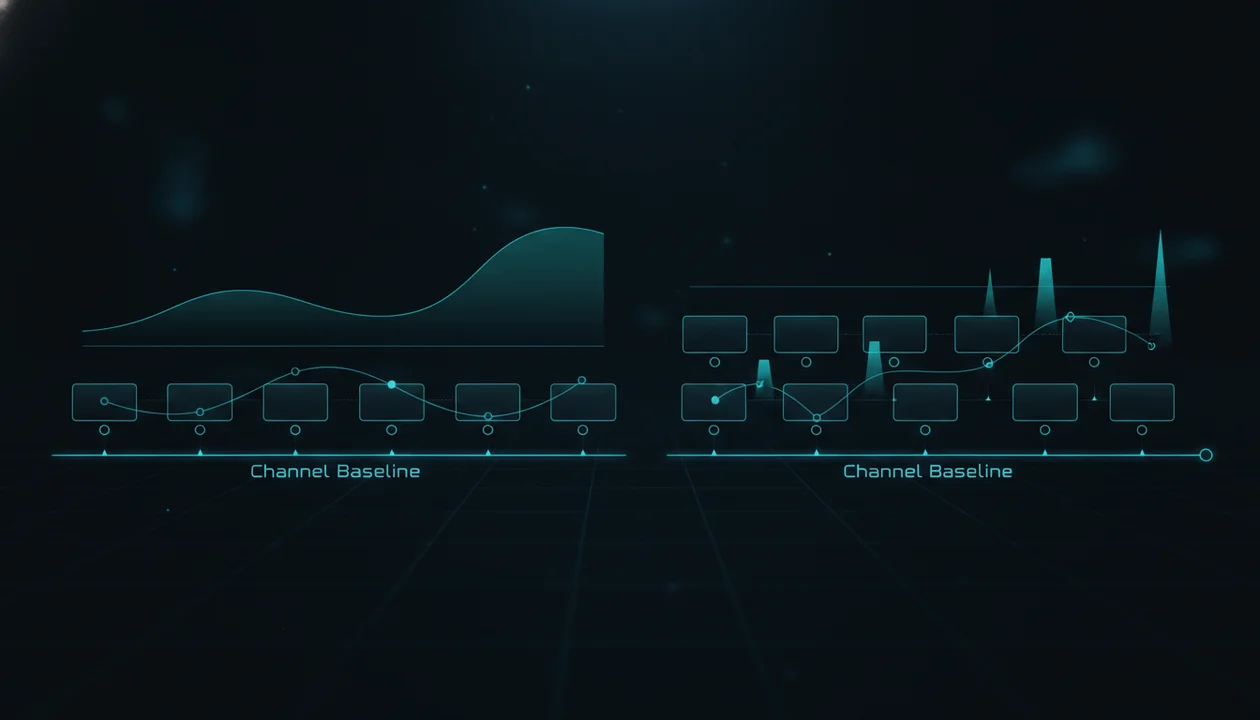
Then, instead of forcing every creator into the same schedule, we calculated each channel's own typical upload gap.
A channel that normally published every four days was judged against four days.
A weekly creator was judged against its own weekly rhythm.
A slower documentary channel was judged against its own cadence.
We then classified each upload based on how far its gap from the previous video deviated from the channel's normal schedule.
The result challenges the simplest version of "consistency wins."
Videos published close to a channel's normal upload interval did not outperform videos published off schedule.
Across the full sample:
- videos published close to schedule had a median age-adjusted performance of 1.00x the channel baseline
- videos published somewhat later reached 1.01x
- videos published after gaps more than twice the channel's normal interval reached 1.17x
- videos published sooner than usual reached 0.96x
Then we compared schedule behavior within the same channels.
Among 108 channels with enough both regular and 2x-plus-gap uploads for a paired comparison:
68.5% of channels had stronger median performance after the longer gaps.
The median long-gap performance was:
1.21x
the channel's regular-schedule performance.
That absolutely does not mean:
Wait twice as long and your views will increase 21%.
Creators probably take longer when:
- the idea is stronger
- production is more ambitious
- research takes longer
- a bigger opportunity appears
- they decide not to rush a weak upload
The data cannot separate those explanations.
But it does allow one important conclusion:
There was no evidence that maintaining an exact upload interval created a meaningful per-video performance advantage in this sample. Breaking the schedule was not automatically harmful.
That is very different from saying consistency has no value.
A sustainable schedule can help:
- production
- planning
- audience expectations
- teams
- creator discipline
But those are different claims from:
"If I miss Tuesday, YouTube will punish the video."
Our data does not support that rule.
Key Findings
- OverseerOS analyzed 8,942 mature long-form YouTube uploads.
- The sample represented 270 channels.
- Every channel contributed at least 20 qualifying mature long-form videos.
- Videos were published from September 13, 2025 through June 13, 2026.
- Every analyzed upload was approximately 90 to 365 days old by the September 12, 2026 research date.
- Median video age was 178.4 days.
- The median upload gap across videos was approximately 4.04 days.
- The median channel's own typical gap was 4.00 days.
- The middle 50% of channel-level typical gaps ranged from approximately 2.75 to 6.97 days.
- 3,794 videos were published within 25% of their channel's normal upload interval.
- Those on-schedule videos reached a median 1.00x age-adjusted channel performance.
- 2,406 videos were published sooner than 75% of the channel's normal interval and reached 0.96x.
- 1,422 videos arrived after gaps between 1.25x and 2x normal and reached 1.01x.
- 1,320 videos arrived after gaps above 2x normal and reached 1.17x.
- 58.3% of those 2x-plus-gap videos finished at or above their channel's median age-adjusted performance.
- 27.3% reached at least 2x their channel's age-adjusted baseline.
- Among 230 channels with enough regular and irregular uploads, irregular uploads had a median 1.04x performance relative to regular uploads.
- Irregular uploads had the higher median performance in 54.3% of those channels.
- Among 108 channels with at least five regular uploads and five 2x-plus-gap uploads, long-gap videos had a median 1.21x advantage over regular-schedule videos.
- The longer-gap side performed better in 68.5% of those paired channels.
- When we narrowed the age range and capped extreme upload gaps, the long-gap association weakened but did not disappear.
- Among weekly-ish channels, publishing roughly every 6 to 8 days showed almost no median performance difference from clearly off-week intervals.
The Direct Answer
Does consistency matter on YouTube?
Yes operationally. Not necessarily because an exact posting interval directly increases views.
This study specifically tested:
upload timing consistency
and found no clear per-video performance advantage for staying close to a channel's normal interval.
That is different from:
content consistency
or:
quality consistency.
Those are completely separate ideas.
You can be:
- inconsistent in your calendar
- highly consistent in your audience promise
Or:
- perfectly consistent every Tuesday
- wildly inconsistent in what viewers get
The second channel may have the cleaner schedule.
The first may have the clearer product for the viewer.
Do not collapse those into the same word.
What "Consistency" Actually Means on YouTube
Creators use one word for several different concepts.
Schedule consistency
Publishing on a predictable interval.
Example:
Every seven days.
This is what this study primarily measures.
Day consistency
Publishing on the same weekday.
Example:
Every Tuesday.
We run a narrower weekly-cadence sensitivity analysis later.
Frequency
How many videos you publish over time.
Example:
Eight videos per month.
Frequency and consistency are not the same thing.
A channel can publish eight videos per month very irregularly.
Another can publish exactly four every month.
Topic consistency
Serving a recognizable audience world.
Example:
Every video explores unsolved engineering disasters.
Format consistency
Giving viewers a familiar experience.
Example:
20-minute narrated documentaries with one central mystery.
Quality consistency
Maintaining a reliable production and editorial standard.
These dimensions can move independently.
This article asks one narrow question:
When a creator publishes close to their normal interval, does that video appear to perform better than uploads that arrive earlier or later?
How We Analyzed 8,942 YouTube Uploads
The study uses public YouTube performance information observed by OverseerOS.
We wanted to avoid several obvious mistakes.
Step 1: Use long-form only
Every qualifying video had to be longer than:
three minutes.
Short-form distribution was excluded.
Step 2: Use mature videos
We did not compare yesterday's upload with a nine-month-old video.
The publication window ran from:
September 13, 2025 through June 13, 2026.
By the research date, every video had roughly:
90 to 365 days
to accumulate public views.
The median age was:
178.4 days.
That still does not equalize maturity perfectly, which is why we also age-adjust the performance metric.
Step 3: Require a meaningful channel history
A channel needed at least:
20 qualifying videos
inside the cohort.
That left:
- 270 channels
- 8,942 usable upload intervals
The first qualifying video from each channel cannot have a previous-gap value and therefore does not enter the interval comparison.
Step 4: Calculate each channel's normal interval
For every channel, we calculated the median number of days between qualifying long-form uploads.
We used the median because upload schedules can contain extreme gaps.
For example:
4, 4, 5, 4, 37, 4, 5
The 37-day interruption should not redefine that channel as a 9-day creator.
The median remains much closer to the normal cadence.
Step 5: Compare each upload with that channel's normal gap
For each video:
gap multiplier = actual gap before video ÷ channel median gap
Example:
Channel normally uploads every:
7 days
Video published after:
7 days
Gap multiplier:
1.0x
Published after:
3.5 days
Gap multiplier:
0.5x
Published after:
14 days
Gap multiplier:
2.0x
Step 6: Define schedule buckets
We grouped videos into four practical buckets.
| Upload timing | Definition |
|---|---|
| Earlier than usual | Below 0.75x normal gap |
| Near schedule | 0.75x to 1.25x |
| Somewhat later | 1.25x to 2x |
| Much later | Above 2x |
This lets us compare:
schedule adherence
with:
schedule deviation
without assuming every creator should publish weekly.
Step 7: Age-adjust public performance
Because a 100-day-old video and a 300-day-old video have had different amounts of time to accumulate views, we calculated:
lifetime public views ÷ video age in days
Then each video's rate was compared with the median rate from its own channel's qualifying videos.
A score of:
1.0x
means the video matches its channel's age-adjusted median.
2.0x
means twice that rate.
0.5x
means half.
This metric is a rough maturity adjustment.
It is not current view velocity.
A video can have a high lifetime average while currently slowing.
For research into current momentum, see our study on YouTube view velocity versus total views.
Finding 1: Being "On Schedule" Did Not Create a Performance Advantage
The largest group contained:
3,794 videos
published within 25% of their channel's typical interval.
Example:
If the channel's median gap was eight days, an interval from roughly:
6 to 10 days
counted as near schedule.
Their median age-adjusted performance was:
1.000x.
Exactly around the channel baseline.
And:
50.2%
finished at or above that baseline.
That sounds perfectly reasonable.
What matters is what happened when creators missed the schedule.
They did not collapse.
Finding 2: Publishing Somewhat Late Performed Almost Identically
The next group contained:
1,422 videos
published after gaps between:
1.25x and 2x
the channel's normal interval.
Their median actual gap was:
6.01 days.
Their median age-adjusted performance was:
1.006x.
Rounded:
1.01x.
Essentially identical to the on-schedule group.
And:
52.3%
finished at or above the channel's normal age-adjusted rate.
At least:
22.2%
reached 2x or higher.
Compare with near-schedule videos:
21.5%
reached 2x.
There is almost nothing here suggesting a modest schedule delay damaged performance.
Finding 3: Videos After Much Longer Gaps Actually Performed Better
Now the interesting group.
1,320 videos
were published after a gap more than:
2x
their channel's normal interval.
The median actual gap in this group was:
12.99 days.
Their median performance was:
1.168x.
Rounded:
1.17x.
And:
58.3%
finished at or above the channel baseline.
Even more:
27.3%
reached at least:
2x
the channel's age-adjusted median.
Here is the full comparison.
| Upload timing | Videos | Median actual gap | Median age-adjusted performance | At/above channel median | 2x+ |
|---|---|---|---|---|---|
| Earlier than usual | 2,406 | 2.00 days | 0.96x | 47.3% | 18.5% |
| Near schedule | 3,794 | 4.89 days | 1.00x | 50.2% | 21.5% |
| 1.25x to 2x later | 1,422 | 6.01 days | 1.01x | 52.3% | 22.2% |
| More than 2x later | 1,320 | 12.99 days | 1.17x | 58.3% | 27.3% |
If you stop here, you could make a terrible conclusion:
Upload less often to get more views.
The data does not prove that.
The better question is:
Why might videos after longer gaps be different?
The Long-Gap Result Is Probably Selection, Not Magic
Imagine a documentary creator normally publishes every five days.
Then one video takes:
14 days.
Why?
Possibilities include:
- harder research
- a stronger topic
- bigger production
- new footage
- a major current event
- more ambitious editing
- a planned flagship upload
- the creator rejected weaker ideas instead of publishing them
- the channel took a break and returned with something important
All of those variables can affect performance.
Our public data cannot observe them.
That means this study does not establish:
waiting longer → more views
It establishes:
Videos that broke the normal schedule did not suffer a visible performance penalty as a group.
That is the part creators can use safely.
Finding 4: Within-Channel Comparisons Tell the Same Story
Pooled video data can be misleading.
A prolific entertainment channel and a slow documentary channel should not carry the same interpretation.
So we repeated the analysis at the channel level.
Early vs regular
We found:
180 channels
with at least five shorter-than-usual uploads and at least five near-schedule uploads.
The median ratio was:
0.94x.
Short-gap videos performed better than regular uploads in:
43.9%
of channels.
This suggests rushing ahead of the normal interval did not create an obvious advantage.
But this finding weakens under a tighter age sensitivity check, so we should not turn it into:
Publishing too soon hurts your channel.
Somewhat late vs regular
There were:
139 paired channels.
The later-video side reached a median:
1.075x
the regular-schedule performance.
Later videos won in:
55.4%
of channels.
A small lean.
Nothing dramatic.
Much later vs regular
There were:
108 channels
with enough examples of both.
Median relative performance:
1.214x.
The long-gap side won in:
68.5%
of channels.
That is the strongest pattern in the study.
Again:
association, not causation.
But it is very difficult to reconcile with the claim that breaking an upload schedule automatically damages reach.
Finding 5: Regular vs Irregular Overall Was Basically a Draw
We also simplified the question.
Instead of separating early and late deviations, we compared:
regular uploads
against:
everything outside the regular interval.
A channel needed at least:
- five regular uploads
- five irregular uploads
That produced:
230 paired channels.
Median regular performance:
0.987x
Median irregular performance:
1.000x
Median irregular/regular ratio:
1.041x
Irregular uploads won:
54.3%
of channel comparisons.
In practical terms:
There was no regular-schedule performance premium.
The result was close enough that treating exact interval adherence as a major view-growth lever would be hard to justify from this dataset.
Finding 6: Weekly Channels Did Not Show a Big "Same Rhythm" Advantage Either
Many creators do not think in gap multipliers.
They think:
Weekly.
So we isolated channels whose median upload interval was approximately:
5 to 9 days.
That produced:
95 weekly-ish channels.
For a stricter paired comparison, we required at least:
- four uploads arriving between 6 and 8 days after the previous video
- four clearly off-week uploads arriving either under 5 days or over 10 days later
That left:
75 channels.
Median age-adjusted performance for the roughly weekly uploads:
1.024x.
For the off-week uploads:
1.020x.
Almost identical.
The roughly weekly side performed better in:
57.3%
of channels.
That is a modest directional lean, not a meaningful universal performance rule.
So even among channels that naturally operate around weekly cadence, our data does not show:
Hitting the exact weekly rhythm dramatically improves views.
Finding 7: Restricting Video Age Did Not Create a Consistency Advantage
Our primary cohort already restricts videos to approximately 90 to 365 days old.
But perhaps the remaining age range still influences the result.
So we tightened it further to:
90 to 270 days.
Now compare much-longer-gap videos against regular-schedule videos.
Across:
61 paired channels
the median long-gap/regular performance ratio was:
1.111x.
Long-gap videos won:
60.7%
of the comparisons.
That is smaller than the primary 1.21x result.
But the direction remains.
More importantly:
regular schedule still does not emerge as the winner.
Finding 8: Removing Extreme Breaks Did Not Reverse the Pattern
Maybe the long-gap group contains huge hiatus returns.
So we removed gaps longer than:
30 days.
Among channels still containing enough regular and 2x-plus-gap examples:
- paired channels: 89
- median long-gap/regular ratio: 1.179x
- long-gap side higher: 66.3%
Then we applied both restrictions:
- video age between 90 and 270 days
- upload gap no longer than 30 days
The result remained:
- paired channels: 52
- median ratio: 1.118x
- long-gap side higher: 59.6%
Again, this is not evidence for deliberately delaying uploads.
It is evidence against fearing schedule deviation.
Why This Does Not Contradict Upload Frequency Research
Frequency and consistency answer different questions.
Imagine two channels.
Channel A
Uploads every:
7 days
without fail.
It publishes:
52 videos per year.
Channel B
Uploads unpredictably:
- 3 days
- 12 days
- 6 days
- 9 days
- 4 days
But also publishes:
52 videos per year.
Frequency is identical.
Consistency is different.
Now imagine Channel C publishes only:
20 videos per year
but each is substantially more ambitious.
You cannot reduce all three channels to:
consistency good / inconsistency bad.
Our earlier YouTube upload-frequency study focuses on how often channels publish.
This study asks whether individual videos perform better when the interval itself is predictable.
They are different questions.
Frequency Can Matter Without an Algorithmic Schedule Bonus
Publishing more videos gives you more attempts.
That matters mathematically.
If each strong video has some probability of becoming an outlier, more high-quality attempts can create more opportunities.
But this does not require YouTube to reward:
calendar obedience.
The mechanism can simply be:
more good videos = more chances for viewers to find something they want.
That is why a sustainable production system still matters.
Just do not confuse:
production consistency
with:
guaranteed distribution advantage.
Why Consistency Is Still Useful
The strongest mistake would be reading this study and deciding:
Schedules are useless.
They are not.
A schedule can solve important operational problems.
It creates production deadlines
Without a target date, creators can endlessly polish.
It helps teams coordinate
Writers, editors, thumbnail designers and voice talent need handoff dates.
It prevents accidental inactivity
A creator can think they posted "recently" and realize three weeks have passed.
It makes planning easier
Knowing roughly how many videos you can produce helps you build a realistic content pipeline.
It can create audience expectation
Some channels benefit from recognizable programming habits.
This study does not measure that private audience effect.
It protects sustainability
The best schedule may simply be the one you can maintain without lowering quality.
These are valid reasons to use a calendar.
None require the claim:
The algorithm rewards me because Tuesday arrived.
The Dangerous Version of Consistency
Consistency becomes harmful when the schedule starts choosing the video.
You planned to upload tomorrow.
The idea is mediocre.
The thumbnail is unclear.
The script is rushed.
But:
"I cannot miss the schedule."
So the video goes live anyway.
That turns consistency from:
production discipline
into:
quality pressure.
Our data provides no evidence that protecting the exact interval is worth publishing a weaker video.
In fact, the strongest performance group appeared after videos took substantially longer than usual.
Again, longer waiting did not necessarily cause better results.
But the finding gives you permission to make the obvious strategic choice:
Do not rush a weak upload solely to preserve cadence.
The Most Useful Schedule Is a Range, Not a Prison
Instead of:
Every Tuesday at exactly 2 PM forever.
Try:
We publish approximately once per week when the video clears our quality bar.
Or:
Two strong videos every 7 to 10 days.
Or:
Four documentary releases per month, with flexibility around research and opportunity.
A cadence range gives you:
- planning
- accountability
- sustainable production
without forcing:
- weak topics
- unfinished packaging
- rushed scripts
- unnecessary uploads
The calendar should support the content system.
The content system should not serve the calendar.
What If You Miss Your Normal Upload Day?
Do not panic.
Ask:
Is the next idea strong?
If yes, finish it properly.
Is the package ready?
Title and thumbnail matter more than satisfying the calendar.
Does the delay have a reason?
Research, production and strategic opportunity are reasonable causes.
Has the gap become operationally unhealthy?
There is a difference between:
two days late
and:
disappearing for three months because there is no process.
This study should not be used to justify chaos.
It should be used to remove false precision.
Should You Upload Early If a Video Is Ready?
Potentially.
Our full-sample shorter-than-usual group reached:
0.96x
channel performance.
Regular uploads reached:
1.00x.
But in the tighter 90 to 270-day sensitivity analysis, the difference essentially disappeared.
Among:
141 paired channels
the short-gap/regular performance ratio was approximately:
1.008x.
That is effectively neutral.
So this study does not support:
Never upload sooner than normal.
If a strong video is ready and the timing matters:
publish it.
Timing Opportunity Can Matter More Than Schedule Consistency
Imagine your normal cadence is every seven days.
You discover a major story on Day 3.
The audience wants the answer now.
Waiting four more days to preserve cadence could destroy the opportunity.
The schedule should lose that argument.
Likewise, imagine Day 7 arrives but the planned topic has weak evidence.
Waiting three extra days for a better idea may be rational.
A content strategy should optimize:
viewer opportunity
not:
calendar aesthetics.
Same Upload Time Is a Different Question
This study looks primarily at:
days between uploads.
It does not test:
- 2 PM vs 8 PM
- morning vs evening
- exact weekday-hour combinations
We analyzed that separately in our study on whether you should post YouTube videos at the same time.
Do not mix:
upload interval
with:
clock time.
A Better YouTube Consistency Framework
Use three layers.
Layer 1: Audience consistency
Ask:
Does the same type of viewer understand why this channel exists?
This matters more than arbitrary calendar perfection.
Layer 2: Quality consistency
Ask:
Does every video meet the minimum standard for idea, packaging and execution?
If not, the schedule should not override the standard.
Layer 3: Production consistency
Ask:
Can we reliably produce enough strong videos to keep learning and growing?
That is where a schedule helps.
Calendar consistency belongs at Layer 3.
Creators often mistakenly put it at Layer 1.
The Consistency Scorecard
Before forcing an upload because the date arrived, score the video.
| Signal | Question |
|---|---|
| Demand | Is there evidence people care? |
| Channel fit | Does it serve our viewer? |
| Original angle | Does this video have a reason to exist? |
| Title | Is the click promise clear? |
| Thumbnail | Is the visual promise clear? |
| Script | Does the opening pay off the click? |
| Timing | Is there a reason to publish now? |
| Production | Is it actually finished? |
If those are strong:
publish.
If they are weak:
the calendar does not rescue the video.
How to Analyze Your Own Upload Consistency
Your private channel analytics can test this better than public competitor data.
Take your last:
30 to 50 long-form uploads.
Record:
- publish date
- days since previous upload
- views after a fixed maturity period
- impressions
- CTR
- average view duration
- watch time
- subscribers gained
Then calculate your typical upload gap.
Example:
Median gap:
7 days
Create groups:
Earlier than usual
Less than:
5 days
Normal
Approximately:
5 to 9 days
Later
More than:
9 days
Then compare performance.
The most important part:
do not compare raw lifetime views if the videos have different ages.
Use equal maturity windows when possible.
For example:
- views after 7 days
- views after 30 days
- views after 90 days
That is better than the public-data age adjustment we must use for competitor channels.
How to Apply This With OverseerOS
Start with the OverseerOS YouTube Channel Analyzer.
Look at:
- upload history
- recent videos
- top performers
- channel patterns
- outliers
The goal is to understand the channel's actual behavior rather than imposing an arbitrary "weekly is best" rule.
Then identify the videos that escaped the normal performance range.
Ask:
Did they happen because the schedule was perfect?
Or:
Was the topic, packaging or audience opportunity unusually strong?
Usually, that second question is more actionable.
Then move validated ideas into the OverseerOS Content Planner.
Use the planner to create a sustainable production cadence around:
- strong topics
- source evidence
- scripts
- thumbnails
- voiceovers
- production readiness
The schedule becomes:
the delivery system.
Not:
the idea-generation system.
The Evidence-First Upload Rule
A useful rule is:
Publish as consistently as your ability to create strong videos allows.
Not:
Publish every Tuesday no matter what.
And not:
Wait indefinitely until every video feels perfect.
You need both:
output
and:
quality.
A schedule is valuable because it forces those two constraints to negotiate.
When a Strict Schedule Makes Sense
There are channels where strict timing can still make strategic sense.
News
The audience expectation may be tied to recurring events.
Sports
Games and seasons create natural release windows.
Market updates
The information itself may expire.
Recurring shows
Viewers may consciously expect an episode on a certain day.
Team production
A predictable release calendar may dramatically improve workflow.
But those are channel-specific advantages.
This study does not show a universal per-video view premium from consistent interval timing.
When Flexibility Makes More Sense
Flexible cadence may be more useful for:
Deep documentaries
Research quality varies.
Investigations
Production time is unpredictable.
High-end visual channels
More complex videos take longer.
Commentary
Opportunity timing can matter more than cadence.
Solo creators
A rigid schedule can create burnout or force weak uploads.
Experimental channels
Learning may require changing production depth from video to video.
Again, the goal is not:
be inconsistent.
It is:
make the schedule serve the strategy.
Why the Longer-Gap Result Should Not Be Used as a Growth Hack
Someone will look at:
1.17x
and conclude:
Waiting longer boosts views.
That is exactly what this article is warning against.
The likely causal diagram is more complicated.
For example:
stronger idea
→ creator spends more time producing
and:
stronger idea
→ more views
The longer gap is correlated with the stronger result.
It may not be causing it.
There are many similar possibilities.
A creator may intentionally break schedule for:
- major interviews
- large collaborations
- important news
- flagship projects
- more expensive videos
The gap itself may have no independent benefit.
So use the long-gap finding only to reject:
missing the normal schedule automatically hurts you.
Do not turn it into:
miss your schedule on purpose.
Limitations
This study has important limitations.
It is observational
Nothing here proves upload timing causes performance.
Creators decide when to publish.
Those decisions are connected to video quality, topic urgency, production complexity and strategy.
Public views do not reveal the recommendation mechanism
We cannot see competitor:
- impressions
- CTR
- watch time
- traffic sources
- returning viewers
- satisfaction signals
The study measures public performance.
Not internal distribution.
Views-per-day is a maturity proxy
We use:
lifetime views ÷ age
to reduce differences between 90-day and 365-day-old videos.
This does not reconstruct how views actually arrived over time.
A video could have exploded early and then flattened.
Another could grow slowly.
Equal lifetime averages do not mean equal trajectories.
Channels had to have at least 20 qualifying videos
That improves schedule estimation.
But it selects for channels with meaningful publishing history.
Do not generalize the exact percentages to brand-new channels.
The cohort is long-form only
Do not apply the exact findings to Shorts or livestreams.
The study covers one maturity window
Videos were approximately 90 to 365 days old.
That helps comparison but excludes both very fresh and very old uploads.
A channel's median interval can hide schedule changes
A creator may have changed from:
weekly
to:
twice weekly
inside the research window.
A single median cannot perfectly represent both eras.
"Consistency" here means upload interval
The study does not directly measure consistency in:
- topic
- format
- personality
- production
- thumbnail style
- audience promise
Those may matter substantially.
Long-gap videos are selected
The strongest association appeared after 2x-plus schedule gaps.
Those videos may systematically differ in quality, importance or production investment.
Do not interpret the 1.17x or 1.21x findings as causal waiting effects.
Niche differences remain
Some categories depend more heavily on timeliness than others.
A breaking-news channel and a historical documentary channel should not use the same scheduling strategy.
Final Verdict
Does posting consistently help on YouTube?
Consistency helps you run a channel. Our data does not show that maintaining an exact upload interval gives individual videos a meaningful performance advantage.
Across:
8,942 mature long-form uploads from 270 channels
videos published near the channel's normal interval reached:
1.00x
age-adjusted channel performance.
Videos published somewhat later reached:
1.01x.
Videos after gaps more than twice normal reached:
1.17x.
Videos published earlier than usual reached:
0.96x.
At the channel level, schedule adherence still did not win.
Across 230 channels with enough regular and irregular uploads:
irregular uploads had the higher median performance in 54.3% of channels.
And among 108 channels with enough regular and much-longer-gap uploads:
68.5% performed better on the long-gap side.
That does not mean waiting creates views.
It means:
Breaking the schedule was not automatically harmful.
So the better rule is not:
Never miss upload day.
It is:
Create a sustainable cadence that helps you produce enough strong videos, then allow the evidence and quality of the next idea to override the calendar when necessary.
Consistency should protect your production system.
It should not pressure you into publishing a video that is not ready.
Your audience does not click a calendar.
They click:
an idea, a title and a thumbnail.
FAQ
Does consistency matter on YouTube?
Yes, but schedule consistency and content quality are different things. In this study, videos published close to a channel's usual upload interval did not show a clear per-video performance advantage over uploads that arrived earlier or later.
Does posting consistently get more views on YouTube?
Not automatically. Among 8,942 mature long-form videos, near-schedule uploads had median age-adjusted performance of 1.00x the channel baseline. Irregular uploads did not perform worse overall.
Does YouTube reward a consistent upload schedule?
This public-data study cannot see YouTube's internal recommendation logic. It found no observable per-video performance premium for closely following a channel's usual upload interval.
Will missing my upload day hurt my YouTube video?
The data does not support that as a general rule. Videos published moderately or substantially later than normal did not perform worse as a group.
Is it bad to upload later than usual on YouTube?
Not necessarily. Videos published after gaps between 1.25x and 2x a channel's normal interval performed almost identically to on-schedule uploads in this study.
Do longer gaps between YouTube videos hurt views?
Not in this sample. Videos after gaps greater than twice the channel's normal interval actually had higher median performance. That association does not prove waiting causes more views.
Should I delay videos to get more views?
No. The long-gap result is observational and likely affected by video quality, topic strength and production effort. Do not deliberately delay a finished strong video because of this study.
Is uploading too frequently bad for YouTube?
The primary sample showed slightly weaker performance among sooner-than-usual uploads, but that difference disappeared in a narrower age sensitivity analysis. The study does not support a universal "posting too often hurts" rule.
Should I upload once a week on YouTube?
Weekly can be a useful sustainable schedule, but it is not a universal performance requirement. Among weekly-ish channels in this study, roughly 6 to 8-day uploads performed almost identically to clearly off-week intervals.
Does posting on the same day every week help?
This study primarily measures days between uploads rather than exact weekday identity. Among channels operating around weekly cadence, staying close to a weekly interval did not produce a large median performance advantage.
Is quality more important than consistency on YouTube?
This study cannot directly measure video quality, but it provides no evidence that preserving an exact upload interval should override a stronger editorial decision. Do not publish a weak video solely to protect the calendar.
Should I skip an upload if the video is not ready?
If the alternative is publishing a clearly weaker or unfinished video simply to maintain cadence, this data provides no evidence that protecting the exact interval is worth that tradeoff.
What is a good YouTube upload schedule?
A good schedule is one that lets you repeatedly produce videos that meet your quality standard without burning out your production system. The exact frequency depends on the channel, niche and resources.
Does YouTube punish inconsistent uploading?
This study found no public-performance evidence of a universal penalty for videos published outside their channel's normal upload interval.
How did OverseerOS measure upload consistency?
For each of 270 channels, OverseerOS calculated the median gap between mature long-form uploads. Each video was then classified based on how far its own gap from the previous upload deviated from that channel's median.
How many YouTube videos were analyzed?
The final interval study analyzed 8,942 mature long-form uploads across 270 channels.
What happened to videos published after long breaks?
Videos published after gaps greater than twice their channel's normal interval reached a median 1.17x age-adjusted channel performance. However, the study cannot determine whether the gap or differences in video quality caused the result.
Is frequency the same as consistency on YouTube?
No. Frequency describes how many videos you publish. Consistency describes how predictable the intervals are. A channel can publish frequently but irregularly, or infrequently but on a very predictable schedule.
What should I prioritize when choosing an upload date?
Prioritize a strong idea, clear packaging, audience relevance, production readiness and strategic timing. Use a schedule to support that process rather than treating the date as the main performance lever.