If your YouTube views dropped, the worst move is guessing.
Most creators jump straight to “the algorithm killed me” or “my channel is dead.” But a view drop usually comes from one of five different problems:
- YouTube adjusted the count.
- Your video got fewer impressions.
- Your thumbnail-title package got fewer clicks.
- The video lost viewers too early.
- A topic, traffic source, or breakout spike cooled off.
Those are not the same problem, so they should not get the same fix.
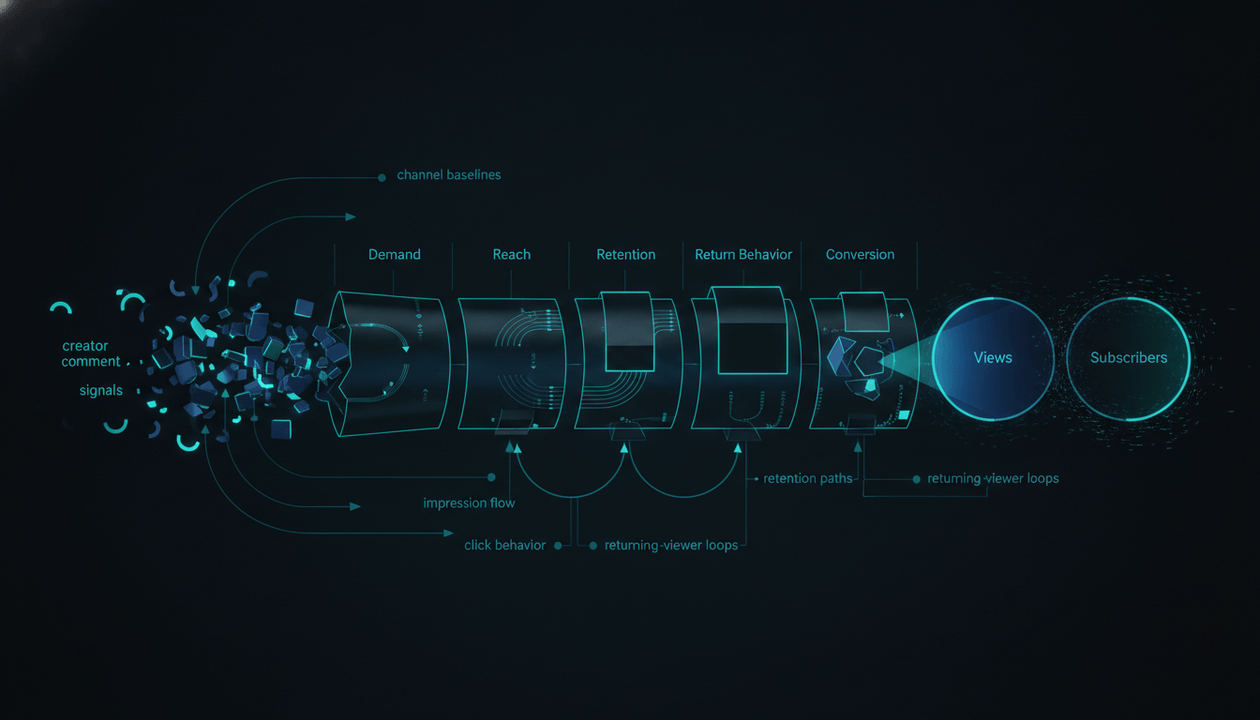
This guide will show you how to diagnose a drop the right way using YouTube Analytics, what the most common causes actually are, and how to tell whether you have a packaging problem, a retention problem, a traffic-source problem, or just a misleading comparison point.
Key takeaways
- A drop in views is not one metric problem. You need to separate impressions, CTR, retention, traffic source, and baseline performance first.
- YouTube itself says traffic from Home and Suggested can fall when audience behavior changes, when a topic cools off, when upload frequency changes, or when a few viral videos stop carrying the channel.
- High CTR with low impressions usually means your core audience likes the video, but YouTube is not expanding distribution yet.
- Falling impressions with stable CTR often points to topic demand, audience saturation, weaker recommendation traffic, or a channel-level distribution issue.
- Falling CTR with normal impressions usually points to a packaging problem: the topic, title, and thumbnail are not winning the click.
- Weak first-30-second retention can quietly kill distribution even if the topic looked good at first. YouTube’s audience retention report is where you confirm that.
- The fastest way to stop repeating the mistake is to study what is working in your niche before the next upload, not after another bad one.
First, separate the type of drop
Do not start with “views.” Start with the layer underneath the drop.
| What you see | What it usually means | First thing to check |
|---|---|---|
| Total views fell overnight on one video | Count adjustment, invalid traffic cleanup, or a reporting delay | Real-time vs published totals, recent traffic source, unusual spikes |
| Impressions fell hard | Recommendation traffic cooled, topic interest dropped, or YouTube stopped expanding the audience | Traffic sources, Home/Suggested share, topic trend, returning viewers |
| Impressions are stable but CTR fell | Packaging problem | Thumbnail, title, topic framing, audience fit |
| CTR is stable but average view duration or retention fell | The video is not keeping the click | First 30 seconds, pacing, payoff timing |
| Channel views fell after one huge hit | You are comparing normal videos to an outlier | 90-day channel baseline, not your best video ever |
| Search is stable but Home/Suggested collapsed | Discovery issue, not necessarily a content-quality collapse | Topic freshness, packaging, audience overlap, competition |
That table alone is better than most articles on this topic because it prevents the biggest mistake:
trying to fix the wrong layer.
The 15-minute diagnostic workflow
Use this before changing titles, thumbnails, upload cadence, or your whole strategy.
1. Check whether the drop is video-level or channel-level
Open YouTube Studio and compare:
- Last 7 days vs previous 7 days
- Last 28 days vs previous 28 days
- Channel-wide traffic vs the specific video that dropped
If one video collapsed but the channel is stable, you probably have a packaging, topic, or retention problem on that upload.
If the whole channel fell, you are more likely looking at:
- weaker recommendation traffic
- lower audience activity
- upload inconsistency
- topic fatigue
- a spike cooling off
- stronger competition in your niche
2. Check impressions before you panic about CTR
YouTube’s own docs on impressions and click-through rate make this easier to read than most creator advice does.
Ask:
- Did impressions fall first?
- Or did CTR fall first?
If impressions dropped first, the issue is usually upstream. The platform is showing the video less.
If CTR dropped first, the issue is usually packaging. The platform showed the video, but fewer people wanted it.
3. Check traffic sources, not just total views
Open traffic sources and look for the real leak:
- Home
- Suggested
- Search
- Shorts feed
- External
- Notifications
- Browse features
YouTube’s performance troubleshooting doc explicitly notes that recommendation traffic can decline when:
- your audience watches more of other videos
- your audience spends less time on YouTube
- a few high-performing videos stop carrying the channel
- you upload less often
- the topic is declining in popularity
That is much more actionable than “the algorithm changed.”
4. Check retention before blaming reach
A weak video can still get tested.
A weak video usually does not keep expanding.
Open the audience retention report and look at:
- the first 30 seconds
- the first big drop
- any flat, slow section in the middle
- whether the title promise gets paid off late
If viewers are bouncing fast, YouTube has less reason to keep showing the video widely.
5. Compare against your baseline, not your best-ever video
A lot of “my views dropped” cases are actually this:
one video massively overperformed, then the next upload went back to normal.
That feels like a collapse, but it is often just the end of a breakout spike.
Compare the video against:
- your median recent views
- your recent CTR range
- your recent retention range
- your normal traffic-source mix
If your normal videos do 2,000 to 5,000 views and one did 80,000, the next 4,000-view upload is not proof your channel died.
It is proof you had an outlier.
The real reasons YouTube views drop
1. YouTube adjusted the count
This is the most literal answer to “why did my YouTube views drop overnight?”
Sometimes the displayed count changes because YouTube is validating traffic or correcting reporting. YouTube also has help documentation on invalid traffic, which explains that non-genuine traffic can lead to adjustments.
This is more likely when:
- the drop is sudden
- the drop is count-based, not distribution-based
- the video had suspicious or low-quality traffic sources
- the change does not match your CTR or retention behavior
What to do:
- wait before overreacting
- check whether the drop affected one video or the whole channel
- review external promotion sources
- avoid cheap traffic, incentivized views, or spammy embeds
What not to do:
- rewrite your whole strategy because one reported count changed
2. Your impressions dropped
This is the most important diagnosis for most creators.
If impressions are down, YouTube is showing your video to fewer people.
That usually means one of these:
- your recent topic has weaker audience demand
- your audience already saw similar videos from you
- your last few uploads trained weaker response signals
- another creator is winning the same audience more convincingly
- your channel had one or two breakout videos that are no longer carrying total traffic
This is where a lot of creators need to stop thinking in terms of “good video” and start thinking in terms of “market fit.”
A technically solid video can still get weak distribution if the topic is stale.
3. Your CTR dropped
If impressions are fine but clicks are down, you have a packaging problem.
That usually means:
- the title is too generic
- the thumbnail does not create a clear visual question
- the thumbnail and title repeat each other instead of completing each other
- the video promise is not strong enough for the audience segment seeing it
- your packaging style is becoming predictable
A useful rule:
- Low impressions + high CTR = your core audience likes it, but reach is narrow.
- High impressions + low CTR = the market is seeing it, but the package is weak.
- Falling CTR after early velocity = the video expanded to a broader audience that found it less compelling.
YouTube’s CTR docs also note that CTR changes with audience and surface context. A broader rollout often lowers CTR naturally, which is why you should read CTR with traffic-source context, not as an isolated number.
4. Your retention is weak
A lot of view drops are really retention drops wearing a views costume.
The title and thumbnail got the click.
The video did not keep the promise fast enough.
Common causes:
- slow intro
- generic setup
- payoff comes too late
- the video answers the question too early and removes tension
- the structure drifts after the first minute
- the title promises one thing and the opening delivers another
If the click promise is “I found the one pattern that killed my channel,” the first 30 seconds should feel like the investigation already started.
It should not feel like:
“Hey guys, welcome back, in today’s video…”
That kind of opening kills momentum.
5. The topic cooled off
Not every drop is a channel problem. Sometimes it is a demand problem.
A topic that worked three months ago may now be:
- saturated
- outdated
- copied by too many channels
- replaced by a sharper angle
- less urgent for the audience
This is why post-mortems should include the niche, not just the video.
Ask:
- Are competitors still getting traction on this topic?
- Are smaller channels still breaking out with this angle?
- Is the topic still emotionally alive for the audience?
- Did the audience move from “what” questions to “how” questions?
6. You changed cadence, format, or audience expectations
If you changed any of these recently, do not ignore it:
- upload frequency
- video length
- topic category
- editing style
- niche focus
- Shorts vs long-form mix
- tone or channel identity
A channel often loses views when the audience no longer knows what to expect.
That does not mean you can never evolve.
It means abrupt shifts usually cost distribution before they pay off.
7. You are reading the channel too emotionally
This sounds soft, but it matters.
A lot of creators interpret any decline as failure because they compare:
- this video to the best outlier
- this month to the highest spike
- this CTR to a different traffic source
- this retention to a totally different video length
Better comparison questions:
- Is this below my normal baseline?
- Which traffic source changed?
- Did impressions fall before CTR?
- Did retention weaken before distribution fell?
- Is this a topic problem, or a channel problem?
The practical diagnosis table
Use this when a drop happens.
| If this metric fell first | Most likely issue | What to inspect next | Best first fix |
|---|---|---|---|
| Impressions | Demand, recommendation traffic, audience saturation | Home, Suggested, topic freshness, recent upload pattern | Sharpen topic selection and study current winners in your niche |
| CTR | Packaging | Thumbnail, title, promise clarity, audience fit | Build 3 stronger package variations before the next upload |
| Retention | Video delivery | First 30 seconds, pacing, structure, payoff timing | Rewrite the hook and re-sequence the early script |
| Returning viewers | Audience relationship or consistency | Topic drift, cadence, format mismatch | Re-anchor to proven channel themes |
| Search traffic | Search intent mismatch | Query fit, title wording, problem specificity | Reframe around a sharper user question |
| Total views only | Misleading top-line comparison | Baseline vs outlier | Stop comparing normal videos to a viral spike |
How to stop the next drop before it happens
This is where most articles stay shallow.
They tell you to “improve thumbnails” or “post consistently.”
That is not enough.
The real move is to improve the decision quality before production.
A stronger workflow looks like this:
- Study which channels in your niche are actually winning right now.
- Identify the topic patterns, title patterns, and packaging patterns getting traction.
- Look for outliers, not just big creators.
- Build the title and thumbnail before the full script.
- Use retention logic in the first 30 seconds.
- Only then produce the full video.
That is exactly where a tool like OverseerOS becomes useful.
If your post-publish view drop exposed a pre-publish weakness, the fix is not just more analytics. It is better research and better planning.
Using the AI YouTube channel analyzer for reverse-engineering any channel, you can break down what a winning channel is actually doing instead of guessing from surface-level views. If the issue is niche movement, the viral YouTube channel finder helps you spot breakout channels and shifting demand before you publish the next video.
For creators diagnosing their own channel after the fact, OverseerOS also supports connected creator workflows that tie analysis, planning, titles, hooks, scripts, and packaging together, so the lesson from one weak upload can improve the next one immediately.
The view-drop recovery checklist
- I checked whether the drop was video-level or channel-level.
- I compared impressions before CTR.
- I checked traffic sources instead of only total views.
- I reviewed first-30-second retention on the affected video.
- I compared performance against my recent baseline, not my biggest outlier.
- I checked whether the topic cooled off in my niche.
- I reviewed whether upload cadence or format changed recently.
- I wrote down one packaging fix and one topic-selection fix for the next upload.
A simple template you can use every week
Copy this into your workflow:
Video / Date:
Main traffic-source drop:
Impressions up or down:
CTR up or down:
Average view duration up or down:
First-30-second retention note:
Was this below channel baseline, or just below an outlier?
Competing videos/channels now winning this audience:
What changed: topic, packaging, retention, cadence, or audience fit?
Next test: one topic change, one title change, one thumbnail change, one hook change.
That template is more useful than another generic “10 reasons your views dropped” list because it forces diagnosis before action.
Common mistakes creators make after a drop
Changing everything at once
If you change the topic, title style, thumbnail style, cadence, and format at the same time, you will not know what actually helped.
Obsessing over one day of data
Do not act on tiny noise. Look for a real pattern.
Treating CTR as the whole answer
A thumbnail can be strong and still fail if the audience was wrong, the topic was weak, or the retention collapsed.
Blaming the algorithm for a market problem
Sometimes the algorithm did not “stop liking” you.
Sometimes the audience stopped caring about that specific idea.
Ignoring the difference between a traffic dip and a strategy dip
A temporary dip in one source is not always a broken channel.
Final verdict
If your YouTube views dropped, the goal is not to panic faster. It is to diagnose faster.
Most drops come down to one of four levers:
- reach
- click
- hold
- demand
Once you know which lever actually failed, the next move gets obvious.
If you want to stop reacting to view drops one upload at a time, start building from proven patterns before production. That is the real advantage of using a platform built to reverse-engineer high-performing YouTube videos with OverseerOS instead of starting every video from a blank page.
FAQ
Why did my YouTube views drop overnight?
Usually because of one of three things: a reporting/count adjustment, a sudden reduction in impressions, or a breakout video cooling off. Check whether total impressions also fell before assuming the content itself failed.
Why are my YouTube impressions dropping but CTR is still okay?
That usually means the people still seeing the video like it, but YouTube is showing it to fewer people. The likely issue is topic demand, recommendation traffic, audience saturation, or weaker expansion beyond your core audience.
Why is my CTR dropping when the video topic is good?
A good topic can still get a weak click package. If CTR dropped first, the thumbnail-title promise is probably not clear or competitive enough for the audience segment seeing it.
How long should I wait before changing a title or thumbnail?
Do not change it instantly after upload unless the packaging is obviously wrong. Let the video collect enough impressions first, then read CTR, traffic source, and retention together before deciding.
Is a sudden drop in YouTube views a shadowban?
Usually no. Most view drops are better explained by traffic-source changes, weaker packaging, lower retention, topic decline, or count adjustments. “Shadowban” is often a vague label for a problem you can diagnose more precisely inside Analytics.