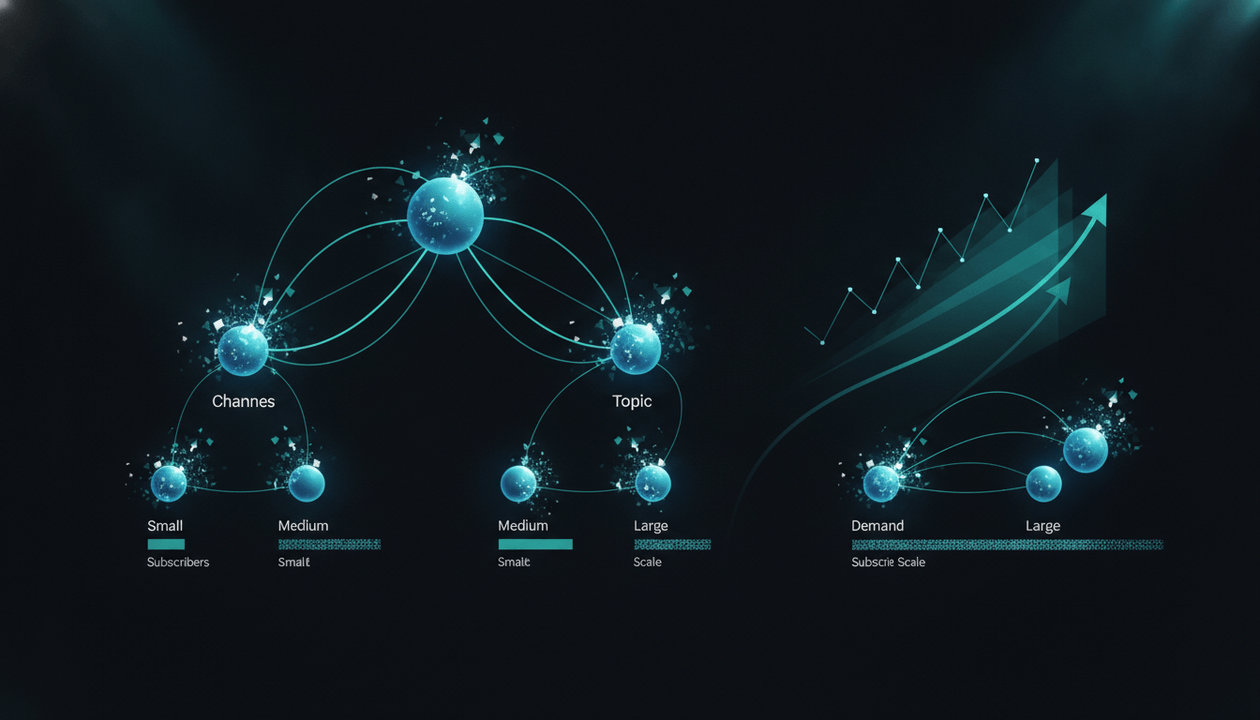
Finding similar YouTube channels sounds simple until you ask what "similar" actually means.
Does similarity mean two channels mention the same people, products, games, companies, or events?
Does it mean their videos are about the same broader ideas?
Or does it mean they compete for the same viewer, even when the literal topics are different?
We started with the most measurable version of the question.
OverseerOS analyzed 3,955 YouTube videos with at least 1 million recorded views across 746 channels. Every channel had at least three qualifying videos with usable topic information.
We then compared every possible channel pair.
That created 277,885 channel-to-channel comparisons.
Our first analysis used exact topic entities extracted from the videos. It produced a striking result:
97.3% of channel pairs shared no exact topic entity at all.
That suggested exact topic matching was far too strict.
So we continued the study.
We built a second channel-level fingerprint from the actual topic summaries of each channel's qualifying videos. Instead of asking whether two channels mentioned the exact same entity, this analysis compared the broader language used to describe what their successful videos were actually about.
That changed the picture.
For 744 of the 746 channels, the summary-based model could identify at least one non-zero semantic-text neighbor.
The median nearest-neighbor similarity score was 0.184.
More importantly, 449 of those 744 channels, 60.3%, had a nearest semantic neighbor that shared zero exact topic entities with them.
That is the central finding of the expanded study:
Exact topic matching dramatically underestimates meaningful YouTube channel similarity.
Channels can discuss different people, companies, events, games, stories, or examples while repeatedly operating in the same broader content territory.
But the second analysis also exposed another problem.
Semantic similarity was not perfect either.
It sometimes connected channels that clearly shared subject matter or storytelling language but differed in format, viewer intent, or production model.
So the final conclusion is stronger, but more precise, than the original one:
Use semantic topic similarity to discover candidate competitors. Do not treat semantic similarity alone as proof that two channels are strategically equivalent.
The data supports the first statement.
The second requires additional validation.
Key Findings
| Finding | OverseerOS analysis |
|---|---|
| Videos analyzed | 3,955 |
| Minimum recorded views per video | 1 million |
| Channels analyzed | 746 |
| Minimum qualifying videos per channel | 3 |
| Possible channel pairs | 277,885 |
| Pairs sharing at least 1 exact topic entity | 7,475, or 2.69% |
| Pairs sharing at least 2 exact entities | 850, or 0.31% |
| Pairs sharing at least 3 exact entities | 171, or 0.06% |
| Pairs sharing at least 5 exact entities | 24, or 0.009% |
| Median closest-neighbor exact entity overlap | 5.9% |
| Channels with no exact-entity neighbor at all | 33 |
| Distinct search-like topic phrases | 3,933 |
| Topic phrases appearing across more than one channel | 12 |
| Channels with no repeated exact entity across their own qualifying videos | 466 of 746, or 62.5% |
| Channels with a measurable summary-based neighbor | 744 of 746 |
| Median nearest summary-fingerprint similarity | 0.184 |
| 75th-percentile nearest similarity | 0.250 |
| 90th-percentile nearest similarity | 0.344 |
| Nearest semantic neighbors sharing zero exact entities | 449 of 744, or 60.3% |
| Channel pairs with semantic score of at least 0.30 | 136 |
| Those high-similarity pairs sharing zero exact entities | 39, or 28.7% |
The semantic scores above belong specifically to the transparent text-fingerprint method used in this study.
A score of 0.30 should not be treated as a universal definition of "30% similar," and it does not represent shared audience percentage.
The useful information is the comparative pattern.
How We Analyzed the Data
The study began with public YouTube videos already represented in the OverseerOS research dataset.
Every video in the final cohort had a recorded public view snapshot of at least 1 million views.
The final cohort contained:
- 3,955 qualifying videos
- 746 channels
- at least three qualifying videos per channel
- 277,885 possible channel pairs
The median channel contributed three qualifying videos.
For each video, OverseerOS had previously derived a structured topic signature from its opening transcript material.
That signature included:
- a concise description of the concrete subject
- a short search-like representation of the topic
- several concrete entities or concepts
Examples of entities might include a person, company, country, technology, game, historical event, platform, product, or named idea.
Phase 1: Exact Topic Similarity
For the first analysis, we combined the distinct topic entities associated with each channel's qualifying videos.
We then measured how many exact entities two channels shared.
We also calculated an overlap ratio:
shared entities ÷ total unique entities across both channels
This provided a deliberately strict definition of topic similarity.
If one channel contained "artificial intelligence" and another contained "machine learning," the pair would not receive credit unless the normalized entities actually matched.
That strictness became one of the most important findings.
Phase 2: Summary-Level Semantic Similarity
Exact entities tell us what concrete nouns overlap.
They do not fully describe what a video is doing with those subjects.
So we built a second channel fingerprint using the topic summaries themselves.
The method was intentionally transparent.
For each channel:
- We collected the topic summaries from its qualifying videos.
- We normalized the text so trivial grammatical differences would not dominate the comparison.
- Very common language appearing across much of the dataset was reduced or removed.
- Terms that appeared repeatedly within one channel but were relatively distinctive across the overall corpus received more weight.
- Each channel was represented by its strongest weighted summary terms.
- Channel fingerprints were compared using cosine similarity.
The primary version used the 20 strongest weighted terms per channel.
This should be understood as a semantic-text fingerprint, not a neural audience model.
It can recognize broader content relationships that exact entity matching misses because summaries contain actions, outcomes, formats, and descriptive context.
It still depends on language overlap and cannot understand everything a modern neural embedding model could understand.
That limitation is important.
We Tested Whether the Result Was Fragile
We did not want the conclusion to exist only because we happened to choose 20 terms.
So we repeated the semantic analysis using different fingerprint sizes and different common-term filters.
Across the main variations we tested:
- median nearest-neighbor similarity stayed between 0.179 and 0.190
- the share of nearest semantic neighbors with zero exact entity overlap stayed between 60.3% and 61.8%
We also repeated the analysis using topic summaries without the auxiliary search-like topic phrase.
The median nearest-neighbor similarity remained 0.184, and 60.3% of nearest semantic neighbors still shared zero exact entities.
The central result survived those sanity checks.
Finding 1: Exact Entity Matching Said 97.3% of Channel Pairs Were Unrelated
Across 277,885 possible channel pairs:
| Exact entity overlap | Channel pairs |
|---|---|
| At least 1 shared entity | 7,475 |
| At least 2 | 850 |
| At least 3 | 171 |
| At least 5 | 24 |
| Total pairs | 277,885 |
Only 2.69% shared even one exact extracted entity.
Only 0.31% shared two or more.
Only 0.06% shared three or more.
Just 24 pairs shared five or more exact entities.
That means 97.31% of all possible channel pairs shared none.
At first, this looks like evidence that the channels were simply very different.
Some certainly were.
A children's music channel should not be expected to overlap heavily with a military-history channel.
But the problem becomes clear when we look only at each channel's closest exact-topic neighbor.
The median channel's closest match still shared only 5.9% of the combined entity set.
Only 112 of 746 channels, 15.0%, had a closest exact-topic neighbor reaching at least 10% overlap.
Only 9 channels, 1.2%, reached 20% with their closest match.
And 33 channels had no exact entity overlap with another eligible channel at all.
If exact entity matching were our only similarity system, many obviously related content markets would look almost empty.
The semantic analysis proved that assumption was too aggressive.
Finding 2: Exact Topic Phrases Were Even More Sparse
We also looked at the short search-like topic descriptions associated with the qualifying videos.
The sample contained 3,933 distinct topic phrases.
Only 12 appeared across more than one channel.
No exact phrase appeared across more than two channels.
That means more than 99.6% of the distinct topic phrases appeared on only one channel within this dataset.
This is not evidence that channels never compete around the same ideas.
It is evidence that the same idea can be expressed through many different concrete topics.
Imagine three hypothetical videos:
- Why Kodak Collapsed
- The Company That Almost Destroyed Netflix
- How Nokia Lost Everything
The literal entities are different.
The exact search phrases are different.
But the videos could still belong to the same strategic territory:
how dominant companies lose their advantage.
A competitor-research system that requires an identical phrase will miss that relationship.
Finding 3: Even the Same Channel Often Wins With Different Exact Subjects
The next test was more revealing.
Instead of comparing one channel with another, we compared qualifying videos inside the same channel.
If exact topic repetition were the defining feature of a channel, high-performing videos from the same creator should repeatedly contain the same concrete entities.
Often, they did not.
Among the 746 channels:
- 280 repeated at least one exact entity across multiple qualifying videos
- 466 did not
- that means 62.5% showed no exact entity recurrence across any pair of their qualifying million-view videos
The median channel only had three qualifying videos, so we ran a deeper check.
There were 230 channels with at least five qualifying videos.
Even there:
91 of 230 channels, or 39.6%, still had no exact extracted entity repeated across any pair of their qualifying videos.
The percentage dropped, as we would expect when more videos are observed.
But the underlying pattern remained.
A successful channel can repeatedly change the literal subject while preserving something broader.
A history creator can move from Rome to Napoleon to the Soviet Union.
A business creator can move from Apple to Kodak to WeWork.
A gaming creator can move between different games.
A psychology creator can move between attachment, attraction, regret, status, and relationships.
The nouns change.
The content territory can remain recognizable.
This was the point where exact entity similarity stopped being sufficient as the main explanation.
Finding 4: Semantic Fingerprints Recovered Relationships That Exact Matching Missed
The second analysis changed the picture substantially.
Using the topic-summary fingerprints, 744 of the 746 channels had at least one measurable semantic-text neighbor.
The distribution of each channel's closest semantic neighbor looked like this:
| Nearest-neighbor semantic score | Result |
|---|---|
| 25th percentile | 0.144 |
| Median | 0.184 |
| 75th percentile | 0.250 |
| 90th percentile | 0.344 |
Again, these scores are useful for ranking channels within this study.
They are not audience-overlap percentages.
The bigger finding was what happened when we compared the semantic neighbor with the exact entities.
Of the 744 channels with a measurable semantic neighbor:
449, or 60.3%, had a nearest semantic neighbor that shared zero exact entities.
That is not a small edge case.
It was the majority.
Among all channel pairs:
- 440 reached a semantic score of at least 0.20
- 136 reached at least 0.30
- 34 reached at least 0.40
Of the 136 pairs at or above 0.30:
39 pairs, or 28.7%, shared zero exact topic entities.
The summary analysis was finding connections the strict entity analysis literally could not see.
Finding 5: Some of the Hidden Semantic Matches Were Clearly Meaningful
Numbers alone do not tell us whether those hidden relationships were useful.
So we inspected high-ranking pairs that:
- had relatively strong summary-based similarity
- shared zero exact extracted topic entities
Several examples made the advantage obvious.
| Channel A | Channel B | Semantic-text score | Exact shared entities | What the summaries had in common |
|---|---|---|---|---|
| SquareWheels TV | Dave and Ava - Nursery Rhymes and Baby Songs | 0.532 | 0 | children's songs, singing, young audiences, animals, engagement |
| THE FIRST TAKE | Elissa | 0.530 | 0 | emotional expression, longing, reflection, poetic music |
| Cocomelon - Nursery Rhymes | LooLoo Kids Français | 0.487 | 0 | children, songs, singing, interactive activities |
| Dave and Ava | LooLoo Kids Français | 0.463 | 0 | children's singing, movement, interaction |
| Trending Beats | Elissa | 0.406 | 0 | emotional lyrics, reflection, heartfelt music |
| Ms Rachel | LooLoo Kids Français | 0.363 | 0 | children's interaction, songs, learning activities |
Exact entity matching treated every one of those pairs as having zero overlap.
The summary fingerprints saw something deeper.
Cocomelon vs LooLoo Kids Français
Their qualifying videos did not need to feature the same exact character, animal, object, or song for the channels to occupy related territory.
The summaries repeatedly described:
- children
- singing
- songs
- engagement
- activities
- movement
That is much closer to how a creator would naturally describe the relationship.
THE FIRST TAKE vs Elissa
The exact entities differed.
The summaries repeatedly converged around:
- emotional expression
- longing
- reflection
- poetic imagery
- personal feeling
- musical performance
A literal noun matcher misses that.
A summary-level analysis can see it.
Ms Rachel vs LooLoo Kids Français
Again, exact entities were zero.
But both channel fingerprints emphasized:
- children
- interaction
- engagement
- songs
- activities
That is useful competitor-discovery information even though the specific video subjects differ.
This is the strongest evidence that the original article thesis needed to change.
It is no longer enough to say:
YouTube channel similarity cannot be found through topic matching.
A better statement is:
YouTube channel similarity cannot be found reliably through exact topic matching. Broader topic meaning recovers relationships that exact matching misses.
That distinction matters.
Finding 6: The Result Still Held When We Required Deeper Channel Profiles
A channel represented by only three videos can produce a noisy fingerprint.
So we repeated the semantic analysis on the 230 channels with at least five qualifying videos.
Among those 230 channels:
- median nearest semantic similarity was 0.168
- the 90th percentile was 0.353
- 90 channels had a nearest semantic neighbor at or above 0.20
- 38 had one at or above 0.30
Most importantly:
113 of the 230 channels, or 49.1%, still had a nearest semantic neighbor sharing zero exact entities.
The share was lower than in the three-video-minimum cohort.
That makes sense.
The more videos a channel contributes, the more opportunities there are for an exact entity to overlap somewhere.
But nearly half of the deeper channel profiles still had their closest semantic-text match outside their exact entity set.
Several of these hidden relationships were intuitive:
- CaseOh and theRadBrad connected through gameplay and viewer-engagement language.
- ChuChu TV and Ms Rachel connected through children's songs and engagement.
- Simple History and The Infographics Show connected through war, history, and evidence-oriented explanatory content.
- The Infographics Show and Serious History connected through military and historical analysis.
The hidden similarity was not simply a side effect of three-video channel profiles.
Finding 7: Semantic Similarity Is Better Than Exact Matching, but It Still Produces False Positives
This was the most important reason not to replace one simplistic similarity score with another.
Some summary-based relationships were clearly useful.
Others were debatable.
For example, our deeper analysis connected Ms Rachel and Vlad and Niki around terms associated with interaction, engagement, play, and participation.
That relationship is not meaningless.
Both operate in children's content.
But a creator trying to reverse-engineer Ms Rachel's learning-driven content would not necessarily treat Vlad and Niki as the closest direct competitor.
The summary fingerprint sees part of the relationship.
It does not know the entire business or viewer experience.
Another example involved channels connected by trading and stock language.
A channel teaching trading strategies can be semantically close to a channel telling dramatic stories about financial markets.
The subjects overlap.
The viewer job may not.
This exposes the boundary of our data.
The study directly measured:
- high-performing video topics
- topic summaries
- concrete topic entities
- semantic-text relationships between those summaries
It did not directly measure:
- shared viewers between channels
- audience demographics
- viewer intent
- production model
- editing style
- presentation format
- private watch behavior
- recommendation overlap
- creator team size
- production cost
So we cannot honestly say the dataset empirically proved that "true channel similarity equals topic + intent + format + production + performance."
That would go beyond what we measured.
The five-layer model from the earlier version of this article was useful as a strategy framework, but it was not a research finding.
The corrected study should keep those concepts separate.
Finding 8: Removing Generic Topics Did Not Explain Away the Exact-Matching Problem
One possible criticism of the entity analysis is that generic concepts such as:
- YouTube
- music
- AI
- money
- social media
might distort the network.
So we ran an additional check that removed entities appearing across more than 10 channels.
The main result barely changed.
The median closest-neighbor entity overlap shifted from 5.9% to 5.6%.
The number of pairs sharing two or more exact entities fell from 850 to 481.
The network became even sparser, not more connected.
That means the low exact-topic similarity was not just the result of a few broad words creating shallow matches.
Exact entity matching genuinely missed much of the broader content relationship.
What the Study Now Supports
After both phases, we can separate three claims.
Claim 1: Exact Keyword or Entity Matching Is Too Strict
Supported strongly by the data.
Across 277,885 pairs, 97.3% shared no exact entity.
Yet the semantic-text analysis repeatedly found intuitive channel relationships inside that zero-overlap group.
Claim 2: Semantic Topic Similarity Is Better for Discovery
Supported by the data.
In the primary semantic analysis, 60.3% of channels had a nearest summary-based neighbor that shared zero exact entities.
Meaning-based topic descriptions recovered relationships that literal matching missed.
Claim 3: Semantic Similarity Alone Defines a Direct Competitor
Not supported by this dataset.
Some high semantic matches were strategically obvious.
Others shared topic language while differing in ways our data did not measure.
That means semantic similarity is best used as a candidate-discovery layer, not a final verdict.
That is the corrected thesis.
What Does "Similar YouTube Channel" Actually Mean?
Based on what this study directly measured, we can defend this definition:
A semantically similar YouTube channel is one whose videos repeatedly occupy related subject and content-meaning territory, even when the exact entities and keywords differ.
That is different from a direct strategic competitor.
A direct competitor may require additional similarities that this dataset does not directly prove.
For practical research, those may include:
- serving a similar viewer need
- using a comparable content format
- operating with a transferable production model
- competing in a similar performance environment
Those are useful validation questions.
They are not findings generated by the semantic score itself.
That distinction makes competitor research much more reliable.
Similar Channel vs Direct Competitor
Creators often use these terms interchangeably.
They should not.
Similar Channel
A channel occupying related content territory.
This can be detected partly through semantic topic analysis.
Useful for:
- discovery
- inspiration
- adjacent ideas
- market mapping
- identifying neighboring content formats
Direct Competitor
A channel close enough that its wins, failures, packaging choices, and topic decisions provide realistic evidence for your own channel.
Semantic similarity can help find it.
Semantic similarity cannot prove it by itself.
Adjacent Channel
A channel that shares meaningful topic or storytelling territory but differs in another important way.
Adjacent channels can be extremely valuable because they expose ideas your direct competitors have not yet copied.
Aspirational Reference
A creator that may not be directly comparable but demonstrates packaging, storytelling, editing, or production principles you want to study.
One channel can belong to more than one category depending on what you are researching.
The important point is to stop calling every vaguely related channel a "competitor."
Why Exact Keywords Fail So Easily
Imagine you run a faceless business-documentary channel.
One competitor publishes:
Why Nokia Lost Everything
Another publishes:
The Company That Almost Killed Netflix
Another publishes:
How Kodak Missed the Future
Exact subjects:
- Nokia
- Netflix
- Kodak
Exact entities:
Different.
Exact search queries:
Different.
Underlying content territory:
Potentially very similar.
All three can deliver:
- corporate rise and fall
- strategic mistakes
- business conflict
- consequences
- hindsight
- dramatic storytelling
This is what the semantic analysis is better positioned to detect.
The relationship lives in what the story means, not just which proper nouns happen to appear.
The Better Way to Find Similar YouTube Channels
The study suggests a two-stage process.
The first stage is directly supported by the research.
The second is a practical validation step.
Stage 1: Find Semantic Neighbors
Start with channels whose successful videos repeatedly operate in related meaning territory.
Look beyond exact keywords.
Ask:
- What kinds of problems are being discussed?
- What kinds of stories are being told?
- What outcomes repeat?
- What emotional or educational territory appears?
- What recurring concepts connect otherwise different subjects?
This dramatically expands the discovery pool.
If you want tools specifically built for discovering neighboring creators, see our guide to the best YouTube similar channel finder tools.
Stage 2: Validate Strategic Relevance
The following checks are not outputs of the semantic study.
They are the creator-research layer required because semantic similarity can produce false positives.
Ask:
Does the viewer come for a similar reason?
A stock-market tutorial channel and a Wall Street scandal documentary may both talk about trading.
The viewer expectation can still be completely different.
Is the format comparable?
A Shorts channel and a 30-minute documentary channel can be semantically close while operating under very different creative constraints.
Can I realistically apply what this channel teaches me?
A solo creator may learn from a large studio, but it may not be the most useful operational benchmark.
Is the channel currently producing useful performance signals?
A close semantic neighbor with no recent momentum may be less actionable than a slightly more distant channel producing repeated breakouts.
Again, these criteria are strategic filters.
The data in this study did not empirically assign scores to them.
A Practical Similar-Channel Research Workflow
Here is how we would use the findings.
1. Start With a Strong Reference Channel
Pick a creator that represents the territory you want to enter.
Do not start with subscriber count alone.
Start with relevance.
2. Find More Channels Than You Think You Need
Use YouTube search, recommendations, creator databases, or a channel discovery tool.
At this stage, include:
- obvious competitors
- semantically related channels
- adjacent formats
- smaller breakout channels
- larger reference channels
The purpose is discovery, not final classification.
The OverseerOS Viral Channel Finder can help surface channels with public traction so you are not limited to the biggest names you already know.
3. Stop Requiring Exact Topic Duplication
If two channels repeatedly tell similar kinds of stories or solve similar audience problems, do not discard the relationship because the nouns differ.
The study shows why.
Most meaningful semantic neighbors would disappear under a strict exact-entity requirement.
4. Inspect the Channel's Actual Winners
Once a candidate looks interesting, stop evaluating the channel only from its homepage.
Look at:
- its biggest historical videos
- recent uploads
- breakout videos
- recurring ideas
- repeated packaging patterns
- changes in topic direction
This is where YouTube outlier analysis becomes useful.
A competitor is most valuable when you can identify what is unusually working inside the channel, not merely that the channel exists.
5. Separate Topic Similarity From Strategic Similarity
Write down why the channel belongs in your research set.
For example:
Semantically similar because both channels tell technology-collapse stories.
Then separately:
Strategically relevant because both are faceless long-form documentaries with comparable production complexity.
Those are two different claims.
Keeping them separate prevents weak competitor lists.
6. Build Different Competitor Buckets
Instead of one giant "competitors" list, use:
Direct competitors
Closest strategic comparisons.
Semantic neighbors
Related meaning territory, possibly different execution.
Format references
Useful production or packaging models.
Breakout channels
Channels producing unusually strong current signals.
This gives each channel a job.
How to Apply This With OverseerOS
The research reinforces a core OverseerOS principle:
Do not begin by guessing what should work. Start from evidence, then understand what the evidence actually means.
Discover Channels
Use OverseerOS Viral Channel Finder to explore channels showing public traction.
The goal is to create a candidate set broader than the obvious market leaders.
Analyze the Channel
Use OverseerOS Channel Analysis to inspect what the channel actually publishes and where its strongest public performance appears.
Look beyond the channel description.
The videos are the evidence.
Find Outliers
Identify videos performing unusually well relative to the channel's normal level.
A semantically related channel becomes more useful when it is also producing breakout content worth investigating.
Reverse-Engineer the Pattern
Ask what the winning videos share beneath the literal topic.
Is the recurring pattern:
- corporate collapse?
- impossible challenges?
- transformation?
- hidden history?
- emotional regret?
- beginner education?
- comparison?
- investigation?
- fear?
- status?
- novelty?
- controversy?
The point is not to duplicate another creator's execution.
It is to identify the transferable pattern and create an original version for your own audience.
One Important Product Note
The semantic fingerprint used in this study is a research analysis.
The scores reported in this article should not be interpreted as a claim that this exact research metric is currently exposed as a live OverseerOS product score.
The practical OverseerOS workflow is to use channel discovery, channel analysis, breakout research, and content intelligence together to make better decisions.
The Similar Channel Validation Checklist
After finding a semantic neighbor, use this checklist before calling it a direct competitor.
- The channels occupy related content territory.
- The relationship goes deeper than one shared keyword.
- I can explain the recurring viewer promise in plain language.
- The content format is relevant to what I actually produce.
- The production requirements are realistic enough to learn from.
- The channel has recent or historical winners worth studying.
- I have identified specific breakout videos rather than judging only from subscriber count.
- The transferable pattern is clear.
- I can adapt that pattern without copying the execution.
- I know whether this channel is a direct competitor, semantic neighbor, format reference, or breakout reference.
The first two checks are closest to what this study measured.
The rest are strategic validation.
Why This Matters for Content Gap Research
The semantic finding has another implication.
If you research competitors using only exact keywords, you may underestimate how crowded an idea really is.
Imagine ten channels all serve the same underlying audience desire but express it through different topics.
A keyword search may show only two.
A semantic view may reveal the larger pattern.
The reverse is also useful.
Several channels can target the same broad keyword while solving different viewer problems.
A literal search can make a market look more competitive than it really is.
This is why YouTube content gap analysis should go beyond keyword gaps.
The strongest gap may not be:
Nobody has used this exact phrase.
It may be:
Several channels have validated this viewer desire, but nobody in my competitive set has packaged it from this angle.
That is a much more useful opportunity.
What We Would Study Next
This research answered one layer of the similarity problem.
It did not answer all of it.
A stronger future similarity model could combine multiple independently measured signals.
For example:
- semantic embeddings of complete topic summaries
- title-pattern similarity
- thumbnail-style similarity
- video-duration distributions
- publishing behavior
- breakout-topic overlap
- channel growth characteristics
- public format classifications
If legitimate audience-overlap information were available, that would add another important layer.
The important rule is the same:
Do not call a dimension "validated" until it has actually been measured.
The current study validates something narrower and valuable:
meaning-based topic analysis finds useful channel relationships that exact keyword and entity matching misses.
Limitations
This research is based on real public YouTube information, but it has important boundaries.
The Videos Were Already High Performing
Every video in the final cohort had at least 1 million recorded views.
This is therefore a study of content relationships among high-performing videos, not a random census of YouTube.
Channels Needed at Least Three Qualifying Videos
Channels without enough qualifying topic signatures were excluded.
The median channel contributed three videos.
We partially addressed this by repeating key analyses on 230 channels with at least five qualifying videos.
The Topic Signature Comes From the Opening Transcript Material
The topic summary is designed to identify the concrete subject and action represented early in the video.
It is not a complete transcript-level representation of every idea discussed later.
Exact Entity Matching Is Deliberately Strict
Synonyms and related concepts can fail to match.
That weakness was one reason we added the second analysis.
The Semantic Fingerprint Is a Transparent Text Model, Not a Neural Embedding Model
It uses the language contained in the topic summaries, weighting distinctive terms more heavily than generic language.
That makes the method auditable.
It also means semantic relationships expressed entirely through different vocabulary may still be missed.
A strong embedding model could potentially recover additional relationships.
Semantic Similarity Does Not Prove Shared Audience
We do not have private viewer-overlap data for unrelated competitor channels.
Two channels can be semantically close while attracting different viewers.
Semantic Similarity Does Not Prove Format Similarity
The model does not inherently know whether one creator uses Shorts and another uses documentaries unless that difference appears strongly in the topic summaries.
Semantic Similarity Does Not Prove Strategic Interchangeability
The false-positive examples matter.
A similarity score should produce research candidates.
It should not replace creator judgment.
Association Is Not Causation
Nothing in this study shows that becoming semantically similar to another channel will increase views.
The research describes relationships in the analyzed dataset.
It does not prescribe imitation.
Final Verdict
We began with a simple question:
What makes two YouTube channels similar?
The first answer was clearly too narrow.
Across 277,885 channel pairs, 97.3% shared no exact topic entity.
Exact search-like topic phrases were even more fragmented, with more than 99.6% appearing on only one channel.
Inside individual channels, 62.5% did not repeat one exact extracted entity across any pair of their qualifying million-view videos.
If we stopped there, the conclusion would be:
Exact topics are poor measures of channel similarity.
That is true, but incomplete.
The semantic analysis revealed the missing layer.
Among channels with a measurable summary-based neighbor, 60.3% had their closest semantic neighbor in a channel with zero exact entity overlap.
We found obvious examples across:
- children's music and learning
- gaming
- history
- music
- emotional storytelling
The relationship existed in the meaning and recurring content territory, not the literal nouns.
But semantic similarity also produced questionable matches.
So the study does not support replacing "same keywords" with one magical semantic score.
The best conclusion is more useful:
Find similar YouTube channels by meaning first, then validate whether the relationship is strategically useful.
Exact keywords are too narrow.
Semantic topic similarity is a much better discovery layer.
Direct competitor status requires another step.
That is how creators should build a competitor set that produces actual intelligence instead of a random list of channels that happen to use the same words.
FAQ
What are similar YouTube channels?
Similar YouTube channels are creators operating in related content territory. They may cover different exact people, products, events, or examples while repeatedly addressing similar subjects, stories, problems, or ideas.
How did OverseerOS measure YouTube channel similarity?
The study used two methods. First, OverseerOS compared exact topic entities across 3,955 million-view videos from 746 channels. Second, we built channel-level semantic-text fingerprints from the topic summaries and compared those fingerprints using cosine similarity.
How many YouTube channel pairs did OverseerOS compare?
The study analyzed all 277,885 possible pairs among the 746 qualifying channels.
How often did two channels share an exact topic entity?
Only 7,475 of 277,885 pairs, or 2.69%, shared at least one exact extracted entity. That means 97.31% shared none.
Does that mean most YouTube channels have nothing in common?
No. The second analysis showed that exact matching substantially underestimates broader content similarity. Many channels had strong summary-level relationships despite sharing zero exact entities.
What did the semantic similarity study find?
Among the 744 channels with at least one measurable semantic-text neighbor, 449, or 60.3%, had a closest semantic neighbor sharing zero exact topic entities.
Can two similar YouTube channels cover completely different topics?
They can cover different exact subjects while operating in closely related content territory. For example, two business-documentary channels may discuss different companies while repeatedly telling the same kind of rise-and-fall story.
Is semantic similarity enough to prove two channels are competitors?
No. Semantic similarity identifies related content meaning. It does not prove the channels share the same viewers, format, production model, or commercial strategy.
What is the difference between a similar channel and a direct competitor?
A similar channel occupies related content territory. A direct competitor should also be useful as a realistic strategic benchmark. Semantic similarity can help discover direct competitors, but additional validation is required.
Why is keyword matching weak for YouTube competitor research?
Keywords capture literal wording. Creators can serve the same audience desire through different people, companies, stories, events, or examples. Exact matching therefore misses relationships that broader topic meaning can reveal.
Did successful channels repeat the same topics?
Not necessarily. In the OverseerOS sample, 466 of 746 channels, or 62.5%, had no exact extracted entity repeated across any pair of their qualifying million-view videos.
Did the result hold for channels with more videos?
Yes. Among 230 channels with at least five qualifying videos, 91, or 39.6%, still had no exact entity recurrence across their own qualifying videos. In the semantic analysis of this deeper cohort, 49.1% still had a nearest semantic neighbor sharing zero exact entities.
Is a high semantic similarity score always a good competitor match?
No. The score measures similarity in topic-summary language under the research method used here. Some high-scoring pairs were clearly related, while others differed in format or likely viewer intent. Treat the score as a discovery signal, not a verdict.
How should I find competitors for my YouTube channel?
Start with channels in related semantic territory, then validate them using their actual videos, format, public performance, breakout content, and strategic relevance to your own channel. Do not rely only on subscriber count or exact keywords.
How can OverseerOS help with competitor research?
OverseerOS combines channel discovery, channel analysis, breakout research, and YouTube content intelligence. The goal is to identify channels worth studying, understand what is unusually working inside them, and adapt the underlying patterns into original content.