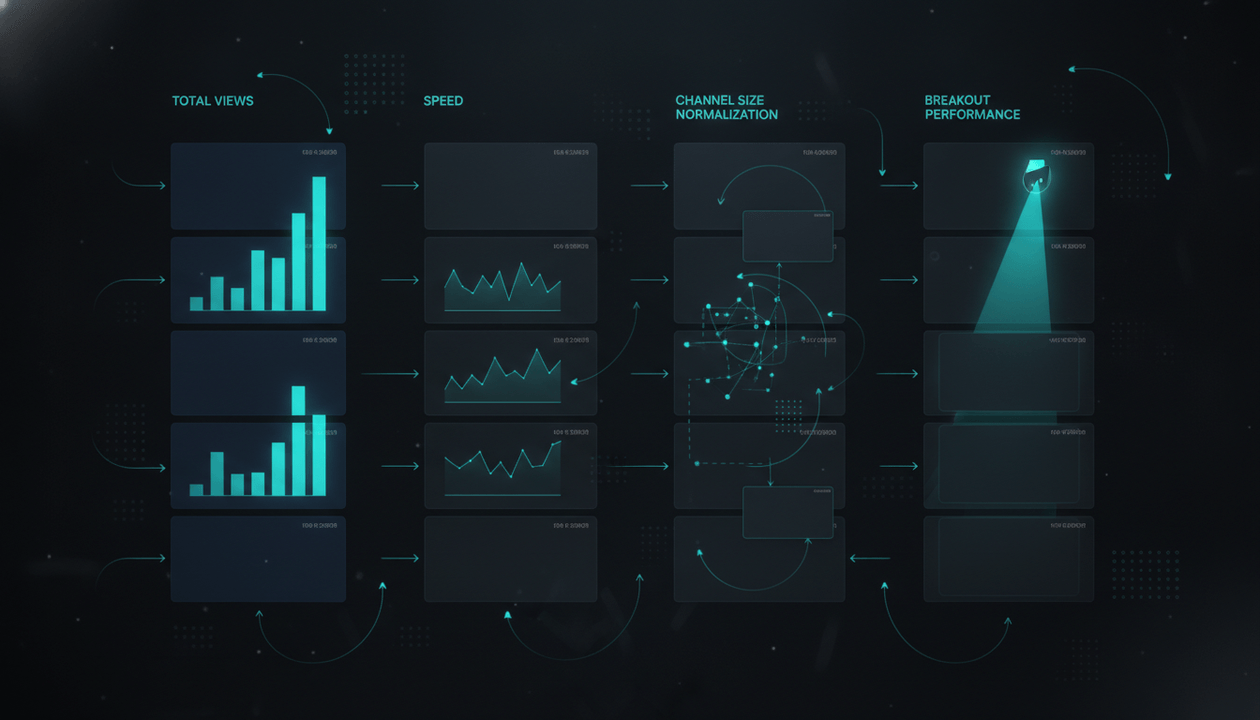
Finding one successful YouTube channel is easy.
Finding the 20 channels that compete for the same viewer, use a comparable format, are active right now, and are actually outperforming their size is much harder.
That is what a useful YouTube similar channel finder should solve.
The best exact-match option is Channels Like, which accepts a YouTube channel URL and returns semantically related creators. The best option for finding performance-qualified channels worth reverse-engineering is OverseerOS Viral Channel Finder. For brands and agencies searching for sponsorship lookalikes, ChannelCrawler is the stronger specialist.
The important distinction is this:
Similarity tells you which channels look alike. Performance data tells you which channels are worth studying.
This guide shows you how to find channels similar to any YouTube creator, compare the best YouTube competitor finder tools, and turn a simple channel list into actionable video ideas, content gaps, collaboration targets, and competitive intelligence.
Key Takeaways
- Channels Like is the best free tool for pasting one channel URL and finding semantically similar creators.
- OverseerOS Viral Channel Finder is best for discovering comparable channels by niche, size, content format, activity, average views, growth, and recent breakout performance.
- ChannelCrawler is strongest for brands and agencies that need sponsorship history, contact data, and creator lookalikes.
- vidIQ Competitors and Viewstats work best after you already know which competitors you want to track.
- Subscriber count alone is a weak way to define a competitor. YouTube itself notes that subscribers do not represent the number of people who watch every upload.
- A useful competitor should overlap across topic, viewer intent, format, performance stage, and production difficulty.
- The smartest workflow is to discover broadly, qualify by performance, inspect breakout videos, and only then choose channels to model.
Quick Verdict: Best YouTube Similar Channel Finder Tools
| Tool | Best For | Starts With a Channel URL | Discovers New Channels | Performance Analysis | Sponsorship Data |
|---|---|---|---|---|---|
| Channels Like | Finding the closest semantic channel matches | Yes | Yes | Basic | No |
| OverseerOS Viral Channel Finder | Finding active, high-performing channels in the same competitive market | Uses niche and channel criteria | Yes | Strong | No |
| ChannelCrawler | Sponsorship prospecting and creator lookalikes | Available through lookalike workflows | Yes | Strong | Strong |
| vidIQ Competitors | Tracking channels you already know | Search or channel ID | Limited | Strong | No |
| Viewstats | Competitor, outlier, and packaging research | Search for channels | Limited | Strong | No |
| YouTube Search | Free manual discovery | No | Yes | Manual | No |
What Is a YouTube Similar Channel Finder?
A YouTube similar channel finder is a tool that identifies creators related to a reference channel based on signals such as:
- Topics covered
- Keywords and search visibility
- Video titles
- Channel descriptions
- Content format
- Audience intent
- Subscriber range
- Upload activity
- View performance
- Growth patterns
- Sponsorship history
Some tools focus on semantic similarity. They answer:
Which channels talk about the same subjects?
Other tools focus on competitive similarity. They answer:
Which channels compete for the same viewer?
A third category focuses on opportunity:
Which comparable channels are growing, producing breakout videos, or attracting sponsors right now?
These questions sound similar, but they produce very different channel lists.
The Best YouTube Similar Channel Finder Depends on Your Goal
| Your Goal | Best Approach |
|---|---|
| Find channels that discuss the same topics | Channels Like |
| Find emerging channels performing above their size | OverseerOS Viral Channel Finder |
| Find competitors for content research | OverseerOS Viral Channel Finder, vidIQ, or Viewstats |
| Find sponsorship lookalikes | ChannelCrawler |
| Find collaboration partners | Similarity search plus channel-size filtering |
| Find faceless channels in a specific niche | OverseerOS Viral Channel Finder |
| Track known competitors over time | vidIQ Competitors or Viewstats |
| Build a complete competitive landscape | Combine discovery, performance qualification, and manual review |
Do not choose a tool until you know which question you need answered.
The 5-Layer YouTube Channel Similarity Model
Most channel finder tools treat similarity as a single score.
That is too simplistic.
Two channels can both publish finance videos while serving completely different audiences, using different production systems, and competing for different viewing occasions.
A more useful comparison uses five layers.
1. Topic Similarity
This measures what the channels discuss.
Examples:
- Artificial intelligence
- Personal finance
- Relationship psychology
- Football documentaries
- Luxury real estate
- Minecraft challenges
Topic similarity is the easiest layer to detect, but it is not enough by itself.
A finance news channel and a beginner budgeting channel both cover money. They are not necessarily direct competitors.
2. Viewer-Intent Similarity
This measures why viewers watch.
Common viewer intents include:
- Learn a skill
- Understand current events
- Feel entertained
- Reduce uncertainty
- Make money
- Improve a relationship
- Validate an opinion
- Escape into a story
- Discover products
- Follow a personality
Consider these two titles:
Why the Federal Reserve Is Trapped
How to Save Your First $10,000
Both belong to finance, but they satisfy different viewer needs.
The first provides analysis and explanation. The second promises personal transformation.
3. Format Similarity
This measures how the content is delivered.
Compare:
- Talking-head commentary
- Faceless documentary
- Animated explainer
- Screen-recorded tutorial
- Podcast interview
- List-based Short
- Investigative video essay
- Challenge video
- News recap
A faceless documentary channel should not automatically model a personality-led podcast simply because both discuss technology.
The research process, script density, thumbnail language, upload frequency, and production economics are different.
4. Performance Similarity
This measures whether the channels operate at a comparable stage.
Useful signals include:
- Typical views per upload
- Recent growth
- Frequency of breakout videos
- Upload activity
- Channel age
- Video library size
- Shorts versus long-form mix
- Subscriber range
A 20-million-subscriber channel can teach you packaging principles, but it may be a poor direct benchmark for a new channel.
Its videos may benefit from brand recognition, returning viewers, celebrity access, and a production budget you cannot reproduce.
5. Production and Business Similarity
This measures whether the operating model is transferable.
Ask:
- Is the channel faceless or personality-led?
- Does it rely on expensive original filming?
- How many people appear to work on each upload?
- Does it publish daily, weekly, or monthly?
- Is the content evergreen or news-driven?
- Does it monetize through ads, sponsors, products, affiliates, or memberships?
- Can your team realistically reproduce the quality and frequency?
A channel is strategically useful when its model can be adapted, not merely admired.
The Three Types of YouTube Competitors
A complete YouTube competitor map should contain three groups.
Direct Competitors
These channels serve a similar viewer with a similar promise and format.
Example for a faceless AI documentary channel:
- Faceless production
- AI and technology topics
- 10 to 20-minute videos
- Cinematic thumbnails
- Explanation-led storytelling
- Similar upload frequency
These channels provide the clearest evidence for:
- Topic demand
- Title patterns
- Thumbnail patterns
- Video length
- Upload cadence
- Story structures
Adjacent Competitors
These channels serve the same viewer but through a different topic or format.
An AI documentary channel might study:
- Business documentary channels
- Science explainers
- Geopolitical technology channels
- Future-focused finance channels
- Cybersecurity storytelling channels
Adjacent competitors are useful because they reveal patterns your direct competitors may not have adopted yet.
That is often where the best original ideas come from.
Aspirational References
These are larger or more sophisticated channels whose creative principles are transferable even if their scale is not.
Study them for:
- Opening tension
- Narrative progression
- Production quality
- Thumbnail simplicity
- Brand consistency
- Series development
Do not use them as your only performance benchmark.
Your competitive research list should ideally include all three groups.
1. Channels Like: Best Exact-Match Similar Channel Finder
Channels Like is the clearest answer for users who want to paste a YouTube channel URL and receive a list of related creators.
Its workflow is simple:
- Paste a channel URL or handle.
- Let the tool analyze the channel’s recent content.
- Review a ranked list of similar channels.
- Inspect relevance, topic alignment, and the queries connecting the channels.
The tool says its similarity model combines:
- Semantic content similarity
- Search-result overlap
- Frequency across relevant searches
That makes it more useful than searching by subscriber count or broad category alone.
Best Use Cases
- Discovering direct topic competitors
- Mapping a creator’s content neighborhood
- Finding small channels around a large reference
- Exploring an unfamiliar niche
- Building an initial competitor list
Main Strength
It begins with the exact input most users expect: a channel URL.
Main Limitation
A close semantic match is not necessarily a strong strategic reference.
A result may discuss the same subject but be:
- Inactive
- Declining
- Poorly packaged
- Dependent on Shorts
- Far larger than your channel
- Too expensive to reproduce
- Serving a different viewer intent
Use Channels Like for discovery, then qualify the results with performance data.
2. OverseerOS Viral Channel Finder: Best for Performance-Qualified Discovery
OverseerOS Viral Channel Finder solves a different and more commercially useful problem:
Which channels in this market are currently producing evidence that their content works?
Instead of beginning with a single URL and returning the nearest semantic neighbors, OverseerOS Viral Channel Finder lets creators define the competitive market they want to investigate.
Search criteria include:
- Niche
- Subscriber range
- Video count
- Content format
- Language
After results are returned, channels can be filtered or sorted using signals such as:
- Average views
- Channel age
- Viral score
- Fastest growth
- Highest average views
- Most viral recently
Each result can include:
- Subscriber count
- Total channel views
- Public video count
- Time since the last upload
- Uploads during the last 30 days
- Average views calculated from recent videos
- Recent viral hits
- Growth indicators
- Breakout videos that triggered the result
This changes the purpose of the search.
You are no longer asking only:
Which channels are similar?
You are asking:
Which comparable channels are active, growing, and repeatedly proving demand?
The Honest Limitation
OverseerOS Viral Channel Finder is not currently a one-field semantic lookalike tool where you paste a seed channel and automatically receive its nearest neighbors.
For an exact channel-to-channel similarity list, Channels Like is the more direct option.
OverseerOS Viral Channel Finder becomes stronger at the next stage: finding and qualifying channels based on the market, format, size, activity, and performance profile you care about.
Best Use Cases
- Finding fast-growing channels in a niche
- Discovering smaller breakout creators
- Locating faceless channel examples
- Comparing Shorts and long-form competitors
- Finding channels within a realistic subscriber range
- Identifying actual breakout videos
- Building a competitor watchlist
- Choosing channels to reverse-engineer
Why This Matters
A creator with 50,000 subscribers does not necessarily need ten more 10-million-subscriber references.
They may learn more from a three-month-old channel with:
- 18,000 subscribers
- Seven recent uploads
- 200,000 average views
- Three breakout videos
- A reproducible faceless format
That channel is close enough to reveal an accessible opportunity.
3. ChannelCrawler: Best for Sponsorship and Creator Lookalikes
ChannelCrawler is designed more for brands, agencies, sponsorship teams, and creator outreach than for pure content strategy.
Its channel database can be filtered using criteria such as:
- Niche
- Subscriber count
- Views
- Engagement
- Geography
- Contact availability
- Sponsorship signals
ChannelCrawler also offers channel-lookalike functionality for discovering creators similar to channels a brand already sponsors.
Best Use Cases
- Finding potential sponsorship partners
- Building outreach lists
- Researching which creators brands repeatedly hire
- Finding verified contact details
- Comparing sponsorship activity
- Locating lookalike creators for an existing campaign
Main Strength
It connects channel discovery to commercial action.
A brand does not only need a similar creator. It needs a creator who:
- Reaches the right market
- Has suitable performance
- Accepts sponsorships
- Can be contacted
- Fits the campaign budget and positioning
Main Limitation
Its strongest workflows are built for influencer marketing and sponsorship intelligence.
A YouTube creator primarily researching titles, thumbnails, hooks, and breakout content may find a creator-growth platform more directly useful.
4. vidIQ Competitors: Best for Tracking Known Competitors
vidIQ Competitors is most useful after you already know which channels belong on your watchlist.
Users can search for channels, add channel IDs, and compare competitors using metrics such as:
- Views
- Subscribers
- Public video count
- Growth over different periods
- Average daily views
- Top-performing videos
- Views per hour
- Titles and thumbnails
- Upload timing
Best Use Cases
- Monitoring an established competitor list
- Tracking recent performance
- Identifying videos gaining views quickly
- Comparing channel growth
- Reviewing competitor keywords
- Watching top uploads
Main Strength
It turns known competitors into an ongoing monitoring system.
Main Limitation
The hardest part is often deciding which competitors deserve to be tracked.
Adding the wrong channels gives you accurate data about irrelevant creators.
Discovery and qualification should come first.
5. Viewstats: Best for Competitor and Outlier Research
Viewstats combines channel analytics with tools for:
- Competitor tracking
- Outlier discovery
- Thumbnail research
- Alerts
- Collections and research boards
It is especially useful for creators who already understand their niche and want to study packaging and performance patterns across selected channels.
Best Use Cases
- Researching high-performing videos
- Monitoring competitors
- Finding outliers
- Studying thumbnails
- Organizing inspiration
- Tracking niche activity
Main Strength
Viewstats is strong at helping creators investigate what performed after the relevant channels have been identified.
Main Limitation
It is not primarily positioned as a direct “paste one channel and discover every similar creator” tool.
6. YouTube Search: Best Free Manual Method
YouTube itself can be used as a basic competitor finder.
The official YouTube Data API search documentation confirms that search results can be queried by term, resource type, language, date, duration, and other filters.
However, YouTube does not provide a documented public “similar channel” search parameter.
Its consumer search results are also influenced by account activity. YouTube states that watch history, search history, likes, feedback, and other Google Account activity can affect recommendations and search results.
For cleaner competitive research:
- Use a dedicated research account
- Pause watch and search history during research
- Search multiple topic phrases
- Record channels that repeatedly appear
- Do not rely on your Home feed alone
The Manual Search Method
Suppose your reference channel publishes faceless psychology videos.
Search several phrases rather than one broad keyword:
- relationship psychology explained
- signs someone is emotionally unavailable
- attachment style animation
- psychology of attraction
- emotional intelligence documentary
- why people pull away
Then record which channels appear repeatedly.
A channel that ranks across five related searches is usually a stronger topical competitor than one that appears once for a broad keyword.
How to Find Channels Similar to Any YouTube Creator
Use this process when you have one seed channel but need a complete market map.
Step 1: Define the Seed Channel Properly
Do not describe the channel using one broad category.
Weak description:
Finance channel
Stronger description:
Faceless long-form finance explainers for young adults, focused on economic systems, business failures, wealth psychology, and current financial events.
Capture:
- Primary niche
- Secondary topics
- Target viewer
- Main viewer outcome
- Content format
- Typical length
- Upload frequency
- Subscriber range
- Average views
- Production style
- Monetization model
Step 2: Extract Five Search Themes
Review the seed channel’s recent uploads and group its recurring topics.
Example:
| Theme | Example Search Queries |
|---|---|
| Economic systems | why economies collapse, financial system explained |
| Company failures | biggest corporate failures, business collapse documentary |
| Wealth psychology | psychology of money, why people stay poor |
| Market events | stock market crisis explained, inflation explained |
| Hidden incentives | how banks make money, financial industry secrets |
These themes become the basis for discovering competitors.
Step 3: Find Direct Semantic Neighbors
Use Channels Like or search YouTube manually.
At this stage, optimize for recall. Collect a broad list.
Do not reject channels yet because they are too large, too small, or slightly different.
Aim for 20 to 50 candidates.
Step 4: Apply Performance Filters
Now remove channels that are not strategically useful.
Useful filters include:
- Uploaded within the last 30 to 60 days
- At least five recent uploads
- Similar content format
- Realistic subscriber range
- Healthy average views
- Evidence of recent breakout performance
- Production quality you can reproduce
This is where OverseerOS Viral Channel Finder adds more value than a basic semantic match.
Step 5: Separate Direct, Adjacent, and Aspirational Channels
Organize the final list.
| Group | Number to Keep | Purpose |
|---|---|---|
| Direct competitors | 5 to 10 | Validate demand and recurring patterns |
| Adjacent competitors | 5 to 10 | Import fresh formats and angles |
| Aspirational references | 3 to 5 | Study world-class execution |
| Emerging channels | 5 to 10 | Detect new opportunities early |
Step 6: Inspect the Breakout Videos
Do not analyze every upload equally.
Start with videos that significantly outperform the channel’s normal baseline.
For each breakout, record:
- Topic
- Title structure
- Thumbnail promise
- Upload date
- Views
- Typical channel baseline
- Video length
- Opening mechanism
- Story structure
- Why the idea may have spread
A channel with one breakout may have found a temporary topic.
A channel with repeated breakouts may have found a system.
Step 7: Add Only Qualified Channels to Your Watchlist
A competitor list should stay useful.
Do not add a channel because it looks impressive.
Add it because it helps answer a strategic question:
- What topics are gaining demand?
- Which packaging patterns keep repeating?
- Which formats are emerging?
- Where is the market overcrowded?
- Which audience problems remain underserved?
- Which smaller channels are growing unusually fast?
The 100-Point YouTube Channel Similarity Score
Use this scorecard to rank potential competitors manually.
| Factor | Maximum Score | What to Measure |
|---|---|---|
| Topic overlap | 25 | How many recurring subjects overlap? |
| Viewer-intent overlap | 20 | Does the viewer want the same outcome? |
| Format overlap | 15 | Is the content delivered similarly? |
| Performance-stage similarity | 15 | Are size, views, and growth comparable? |
| Packaging overlap | 10 | Are titles and thumbnails competing for similar clicks? |
| Production feasibility | 10 | Can you realistically produce this format? |
| Monetization overlap | 5 | Do both channels use similar business models? |
| Total | 100 |
How to Interpret the Score
| Score | Meaning |
|---|---|
| 85 to 100 | Direct strategic competitor |
| 70 to 84 | Strong adjacent competitor |
| 55 to 69 | Useful reference with limited overlap |
| Below 55 | Inspiration source, not a meaningful competitor |
Example: Comparing Three Similar Finance Channels
Assume the seed channel is a faceless finance documentary channel with 80,000 subscribers.
Channel A
- 2.5 million subscribers
- Daily financial news
- Talking-head format
- Heavy focus on current markets
- Strong topic overlap
- Weak format and production overlap
Score: 62
Useful for topic timing, but not a direct operating comparison.
Channel B
- 120,000 subscribers
- Faceless business and finance documentaries
- Weekly uploads
- Similar video length
- Several recent breakout videos
- Comparable visual complexity
Score: 89
This is a direct strategic competitor and should be studied closely.
Channel C
- 300,000 subscribers
- Faceless business case studies
- Less finance-specific
- Similar storytelling and thumbnail style
- Strong sponsor presence
Score: 76
This is an adjacent competitor that can provide transferable formats.
Without a structured score, Channel A may look like the best reference because it is the largest.
Channel B is likely more actionable.
How to Use OverseerOS to Find Channels Worth Studying
A basic YouTube similar channel finder produces names.
OverseerOS helps turn those names into a research and production system.
1. Define the Competitive Market
Start with the seed channel and record:
- Niche
- Subscriber range
- Format
- Language
- Approximate video count
Use those criteria inside OverseerOS Viral Channel Finder.
2. Discover Comparable Channels
Search the niche, then narrow the market using:
- Subscriber range
- Shorts or long-form format
- Channel age
- Average views
- Recent growth
- Viral score
- Recent viral hits
This prevents the results from becoming a list of famous but strategically irrelevant channels.
3. Inspect the Evidence
Open the breakout videos behind each result.
Ask:
- Did one video drive the entire channel?
- Is the channel producing repeated outliers?
- Are the breakouts concentrated around one topic?
- Did the title formula repeat?
- Is the format transferable?
- Is the channel still active?
4. Analyze the Strongest Candidates
Once a channel qualifies, analyze it more deeply.
Study:
- Upload frequency
- Topic clusters
- View distribution
- Titles
- Thumbnails
- Hooks
- Content length
- Audience promise
- Repeatable formats
The goal is not to collect more data. It is to identify a repeatable strategy.
5. Reverse-Engineer the Strategic Blueprint
Use OverseerOS Channel Blueprint Cloner to turn a qualified public channel into a structured strategic reference.
OverseerOS Channel Blueprint Cloner can help organize public patterns such as:
- Tone DNA
- Hook patterns
- Pacing
- Viral topic formulas
- Tags and keywords
- Hidden strategic insights
- Untapped topic opportunities
The result should become an original content system for your channel, not a copy of the source.
6. Find the Missing Opportunities
Compare several qualified channels and look for topics the market repeatedly ignores.
A proper YouTube content gap analysis should ask:
- Which questions appear in comments but not in titles?
- Which successful topics have not been updated recently?
- Which audiences are underserved?
- Which adjacent formats could be adapted?
- Which follow-up questions did breakout videos leave unanswered?
- Which strong ideas were packaged weakly?
That is where competitor research becomes original strategy.
What to Analyze After Finding Similar Channels
Finding the channel is only the beginning.
Topic Portfolio
Classify the last 20 to 30 uploads.
Look for:
- Repeated themes
- New experiments
- Declining subjects
- Evergreen pillars
- News-driven spikes
- Series formats
- High-risk bets
Baseline Versus Breakout Performance
Do not compare every video to the channel’s biggest hit.
Estimate the normal baseline, then identify meaningful outliers.
Example:
- Normal range: 30,000 to 60,000 views
- Strong result: 100,000 views
- Breakout: 300,000 views
- Exceptional outlier: 1 million views
This reveals which ideas genuinely changed the channel’s trajectory.
Packaging Patterns
Record repeated title and thumbnail mechanisms.
Common title mechanisms:
- Hidden cause
- Costly mistake
- Transformation
- Contradiction
- Prediction
- Extreme example
- Unanswered question
- Status threat
- New opportunity
Common thumbnail mechanisms:
- One dominant object
- Before-and-after contrast
- Visible consequence
- Implied danger
- Scale comparison
- Human reaction
- Missing information
- Simple symbolic metaphor
Format Economics
Estimate how difficult the videos are to produce.
Ask:
- How research-heavy is the script?
- Are custom animations required?
- Does the channel rely on original footage?
- Are experts or guests needed?
- How many scenes appear per minute?
- Is the narration personality-dependent?
- Can the format be produced consistently?
A high-performing format that destroys your margins is not automatically a good opportunity.
How Brands and Agencies Should Use Similar Channel Data
The same research can support sponsorships and partnerships.
Start with a creator who has already performed well for the brand.
Then find lookalikes based on:
- Audience subject
- Geography
- Channel size
- Average recent views
- Content format
- Brand safety
- Sponsor frequency
- Engagement
- Production quality
- Contactability
Do not simply choose creators with similar subscriber counts.
A stronger shortlist contains creators who produce content around the same purchasing moment.
Example:
A cybersecurity company may find stronger prospects among:
- AI tool reviewers
- Privacy educators
- Business technology channels
- Remote-work creators
- Scam investigation channels
These channels may outperform a broad “technology” list because the audience problem is more closely aligned with the product.
For sponsor outreach and creator contact data, ChannelCrawler is the more specialized option.
For discovering fast-growing content opportunities and understanding what videos are breaking out, OverseerOS Viral Channel Finder is the stronger creator-strategy layer.
Common Similar-Channel Research Mistakes
Mistake 1: Choosing Competitors by Subscriber Count
Subscriber count measures accumulated subscriptions, not guaranteed current viewership.
YouTube explicitly states that subscribers may not return for every upload and may remain subscribed to channels they no longer watch.
Recent views and repeatable performance matter more.
Mistake 2: Treating Every Channel in the Same Niche as a Competitor
A broad niche label can hide completely different audiences.
“Psychology” could mean:
- Academic lectures
- Relationship advice
- Animated mental-health education
- Criminal psychology
- Self-improvement
- Celebrity behavior analysis
Define the viewer intent and format.
Mistake 3: Copying Only the Largest Channel
Large channels are useful for studying creative excellence.
They are often poor benchmarks for:
- Expected views
- Production costs
- Upload frequency
- Conversion rates
- Early-stage growth
Include emerging and mid-sized competitors.
Mistake 4: Ignoring Content Format
Shorts, podcasts, tutorials, documentaries, and talking-head videos operate differently.
A topic that succeeds in a 30-second Short may not support a 15-minute documentary.
Mistake 5: Studying One Viral Video
One viral video can be an anomaly.
Look for repeated evidence:
- Multiple breakouts
- Recurring topic patterns
- Consistent packaging
- A growing baseline
- Returning series
Mistake 6: Assuming Suggested Videos Are Objective
YouTube recommendations and search results can be influenced by watch history, search history, likes, feedback, and account activity.
Use a controlled research process rather than treating your personal feed as the complete market.
Mistake 7: Confusing Inspiration With Copying
Competitive research should help you identify:
- Audience demand
- Topic patterns
- Viewer problems
- Packaging mechanisms
- Content gaps
It should not lead to:
- Rewritten transcripts
- Copied thumbnails
- Reused footage
- Duplicated visual identities
- Identical title structures across every upload
Model the principle. Change the execution.
YouTube Similar Channel Research Checklist
Seed Channel
- I can describe the channel beyond one broad niche.
- I understand the viewer’s main reason for watching.
- I know whether the channel is Shorts, long-form, or mixed.
- I estimated its normal view baseline.
- I identified its recurring content pillars.
Similarity
- The channels cover overlapping topics.
- They serve a similar viewer intent.
- Their formats are reasonably comparable.
- Their production systems are transferable.
- Their performance stages are relevant.
Performance
- The channel uploaded recently.
- I reviewed more than one video.
- I separated baseline videos from outliers.
- I inspected recent growth rather than lifetime totals alone.
- I identified the breakout videos behind the growth.
Strategic Use
- Each saved competitor answers a specific strategic question.
- I included direct, adjacent, aspirational, and emerging references.
- I recorded repeatable patterns instead of copying individual assets.
- I looked for missing topics and underserved viewers.
- I converted the research into original video ideas.
Final Verdict
The best YouTube similar channel finder depends on what you need the list to do.
Use Channels Like when you want to paste a YouTube URL and quickly find channels discussing similar subjects.
Use ChannelCrawler when your goal is sponsorship prospecting, creator outreach, contact discovery, and campaign lookalikes.
Use vidIQ Competitors or Viewstats when you already know the competitors and want to monitor their videos, growth, outliers, and packaging.
Use OverseerOS Viral Channel Finder when you want to discover comparable channels that are active, growing, producing breakout videos, and worth reverse-engineering.
The strongest workflow combines both types of intelligence:
- Find semantically related channels.
- Filter them by size, format, activity, and performance.
- Inspect the breakout videos.
- Analyze the repeatable patterns.
- Identify what the market still has not done well.
- Turn the evidence into an original content strategy.
A long list of similar channels is not the goal.
The goal is to find the few channels that reveal where viewer attention is moving next.
Frequently Asked Questions
How do I find YouTube channels similar to another channel?
Paste the reference channel into a semantic discovery tool such as Channels Like. Then qualify the results by topic, viewer intent, format, recent activity, average views, growth, and breakout performance.
OverseerOS Viral Channel Finder can help with the qualification and discovery stage by finding comparable channels inside a defined niche and performance range.
What is the best YouTube similar channel finder?
Channels Like is the best direct option for pasting a channel URL and receiving semantic lookalikes.
OverseerOS Viral Channel Finder is better for discovering active, high-performing channels worth studying. ChannelCrawler is better for sponsorship and influencer lookalikes.
Can YouTube show similar channels automatically?
YouTube recommends related videos and channels through Home, Search, and Watch Next, but the results can be personalized by account activity.
The public YouTube Data API supports search queries and channel lookup, but it does not document a direct “find channels similar to this channel” parameter.
How can I find competitors for my YouTube channel?
Define your niche, target viewer, content format, subscriber range, and typical views. Search for channels matching those criteria, then divide the results into direct, adjacent, aspirational, and emerging competitors.
Are channels with similar subscriber counts competitors?
Not necessarily.
Subscriber count does not reveal whether the channels serve the same audience, use the same format, or receive similar current views. Recent performance and viewer intent are more useful.
How many YouTube competitors should I track?
A practical watchlist contains approximately:
- 5 to 10 direct competitors
- 5 to 10 adjacent competitors
- 3 to 5 aspirational references
- 5 to 10 emerging channels
Quality matters more than collecting hundreds of names.
How do I find small YouTube channels in my niche?
Use subscriber-range filters, channel-age filters, recent activity, and minimum average-view criteria.
OverseerOS Viral Channel Finder is designed to surface channels by niche, size, content format, activity, recent growth, and viral performance.
How do I know whether a competitor is growing?
Review:
- Recent views
- Average views per upload
- Subscriber growth
- Upload activity
- Repeated breakout videos
- Views relative to the channel’s baseline
Do not judge growth from one viral upload alone.
What should I copy from successful YouTube competitors?
Do not copy finished creative assets.
Study transferable principles such as:
- Audience problems
- Topic patterns
- Hook mechanisms
- Story structures
- Thumbnail psychology
- Title formulas
- Upload cadence
- Series development
Then rebuild those principles around your own evidence, voice, brand, and audience.
Can I use similar channels to find video ideas?
Yes.
Compare recent uploads across several direct and adjacent competitors. Look for repeated demand, unanswered questions, outdated videos, weak packaging, and topics that succeeded in one format but have not been adapted to yours.
Which similar channel finder is best for brands?
ChannelCrawler is the strongest specialist in this comparison for brands and agencies because it combines creator search with sponsorship intelligence, contact data, and channel-lookalike workflows.
Which similar channel finder is best for faceless YouTube creators?
OverseerOS Viral Channel Finder is the strongest option for faceless creators who need to find active channels by niche, size, format, average views, growth, and recent breakout performance before reverse-engineering their strategies.