Most YouTube videos do not fail because the topic is bad.
They fail because the packaging is broken.
The idea is unclear.
The title says one thing.
The thumbnail says another.
The hook starts somewhere else.
The script delivers a different payoff.
That is not a content problem.
That is a packaging problem.
YouTube video packaging is the system that turns a raw idea into something viewers instantly understand, want, click, and keep watching.
It includes the topic, angle, title, thumbnail, first 30 seconds, format, structure, and payoff.
Most creators treat those pieces separately.
They brainstorm a topic.
Then they write a title.
Then they make a thumbnail.
Then they write the script.
Then they hope the video works.
But strong YouTube videos are packaged as one promise.
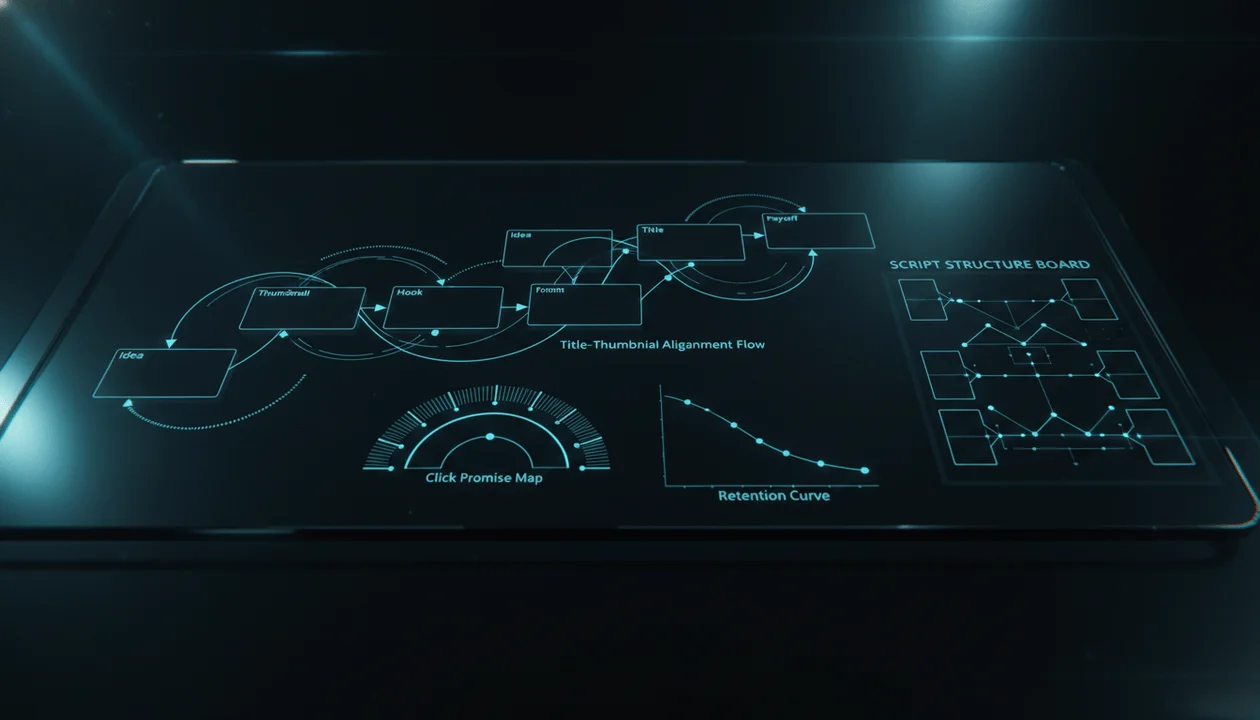
The viewer should feel the same promise from the title, thumbnail, hook, and final payoff.
If the packaging is aligned, the video feels clear.
If the packaging is misaligned, the viewer feels confused, tricked, or bored.
This guide shows you how YouTube video packaging works, how to align the idea, title, thumbnail, hook, and payoff, how to package for Search, Browse, and Suggested traffic, and how to build a repeatable packaging system before scripting.
Key Takeaways
- YouTube video packaging is the strategic alignment of the idea, angle, title, thumbnail, hook, format, structure, and payoff.
- A video is not fully planned until the packaging is clear.
- The title and thumbnail are not decorations. They create the viewer’s expectation before the video starts.
- YouTube’s own thumbnail and title guidance says viewers usually see the thumbnail and title first, and that this helps them decide whether they want to watch. Source: https://support.google.com/youtube/answer/12340300
- YouTube recommends accurate titles because if the title does not represent the video, viewers may stop watching, which can affect discoverability. Source: https://support.google.com/youtube/answer/12340300
- YouTube also explains that a high intro-retention percentage can mean the first 30 seconds matched the viewer’s expectation from the thumbnail and title. Source: https://support.google.com/youtube/answer/9314415
- Strong packaging is not clickbait. Strong packaging makes the right viewer understand the right promise fast.
- The best packaging connects five things: viewer intent, angle, title, thumbnail, and payoff.
- OverseerOS helps creators analyze winning videos, inspect titles and thumbnails, run Viral X-Ray, clone channel blueprints, generate scripts, analyze thumbnails, and turn proven packaging patterns into original content plans.
What Is YouTube Video Packaging?
YouTube video packaging is the way you present a video idea so viewers understand why they should click and what they will get.
It includes:
Topic
Audience
Viewer intent
Angle
Title
Thumbnail
Hook
Format
Script structure
Payoff
A weak creator thinks packaging means:
Make a good thumbnail and title.
A strong creator knows packaging means:
Make the entire video promise clear before the viewer clicks, then prove that promise immediately after the click.
Example:
Topic:
YouTube thumbnails

Weak packaging:
Title: YouTube Thumbnail Tips
Thumbnail: Random thumbnails and a red arrow
Hook: Today we are going to talk about thumbnails

Strong packaging:
Angle: Good-looking thumbnails can still fail
Title: Why Good-Looking Thumbnails Still Get Ignored
Thumbnail: Beautiful thumbnail losing to a simpler, clearer one
Hook: A thumbnail can look clean, professional, and well-designed — and still give viewers no reason to click
Payoff: The viewer learns how to judge thumbnails by click clarity, not design quality
Same topic.
Different packaging.
One feels generic.
The other feels like a real video.
Why YouTube Packaging Matters
YouTube is a decision platform.
Before someone watches, they decide.
They decide whether:
This looks interesting.
This looks useful.
This feels relevant.
This feels trustworthy.
This is worth my time.
This is the video I wanted.
That decision happens fast.
The packaging creates the decision.
If the packaging is weak, the video may never get a real chance.
If the packaging is strong but inaccurate, viewers may click and leave.
If the packaging is strong and aligned, viewers click and feel they made the right choice.
That is the goal.
Not just more clicks.
Better clicks.
Clicks from viewers who actually want the video you made.
Packaging vs Clickbait
Good packaging and clickbait are not the same.
Clickbait creates a promise the video does not satisfy.
Good packaging makes the real promise impossible to miss.
| Bad clickbait | Strong packaging |
|---|---|
| Exaggerates the video | Clarifies the real value |
| Tricks the wrong viewer | Attracts the right viewer |
| Overpromises | Makes a specific promise |
| Creates early drop-off | Improves expectation match |
| Hides the actual topic | Makes the topic more compelling |
| Uses fake urgency | Uses real tension |
Example clickbait:
This One Thumbnail Trick Changed Everything
If the video gives generic advice, it feels cheap.
Example strong packaging:
Why Good-Looking Thumbnails Still Get Ignored
If the video explains the difference between visual polish and click clarity, the promise is real.
Strong packaging is not about lying.
It is about finding the sharpest honest version of the idea.
The YouTube Packaging Formula
Use this formula:
Viewer intent + specific pain + angle + visual promise + first payoff = packaging
Example:
Viewer intent:
Small creators want to know why their videos get impressions but no clicks.

Specific pain:
Their thumbnails look decent but fail to create a click.

Angle:
Good design is not the same as click clarity.

Visual promise:
A good-looking thumbnail losing against a simpler but clearer thumbnail.

First payoff:
The viewer learns the difference between visual polish and viewer decision clarity.

Final packaging:
Why Good-Looking Thumbnails Still Get Ignored
This is packaging.
It is not just a title.
It is the whole idea made clear.
The 7 Parts of YouTube Video Packaging
1. Topic
The topic is the broad subject.
Examples:
YouTube thumbnails
AI tools
audience retention
faceless niches
scriptwriting
content planning
The topic is not enough.
A topic is raw material.
A video needs a packaged promise.
Weak:
YouTube thumbnails
Stronger:
Why good-looking thumbnails still get ignored
The second version turns the topic into a reason to watch.
2. Viewer intent
Viewer intent is what the viewer wants in that moment.
The viewer may want to:
Learn
fix
choose
discover
believe
continue
be entertained
feel understood
Example:
Topic:
AI tools

Learn intent:
How to Use AI Tools to Plan YouTube Videos

Choose intent:
Claude vs ChatGPT for YouTube Scripts

Believe intent:
I Tested 7 AI Tools for YouTube Creators. Only 2 Saved Time.

Discover intent:
The AI Workflow Small Creators Are Missing
Same topic.
Different intent.
Different packaging.
3. Angle
The angle is the specific perspective that makes the topic interesting.
Examples:
The mistake
The hidden mechanism
The proof
The transformation
The comparison
The warning
The experiment
The contrarian truth
Topic:
YouTube hooks
Angles:
Your hook is not the problem. Your promise is.
The first 30 seconds that make viewers leave.
I analyzed 100 viral hooks and found one pattern.
Why dramatic hooks still fail.
The hook mistake that makes viewers feel tricked.
A strong angle makes packaging easier.
A weak angle makes everything harder.
4. Title
The title turns the angle into words.
A good title should:
Create a clear promise
Match the viewer intent
Use important words early
Avoid unnecessary clutter
Be accurate
Create curiosity without confusing the topic
YouTube’s own guidance says titles should accurately represent the video and that creators should keep titles succinct because viewers may only see part of the title. Source: https://support.google.com/youtube/answer/12340300
Weak title:
YouTube Thumbnail Tips
Strong title:
Why Good-Looking Thumbnails Still Get Ignored
The strong title has tension.
It makes the viewer wonder:
If looking good is not enough, what is?
5. Thumbnail
The thumbnail turns the angle into a visual decision.
A strong thumbnail should:
Make the promise easier to understand
Show contrast, emotion, result, or curiosity
Avoid visual clutter
Be readable on small screens
Support the title instead of repeating it
Speak to the target viewer
YouTube’s thumbnail guidance says thumbnails and titles are usually seen first by viewers, and recommends thinking about who may watch the video and where they may find it. Source: https://support.google.com/youtube/answer/12340300
Weak thumbnail:
A random screenshot with “THUMBNAIL TIPS”
Strong thumbnail:
A polished thumbnail losing against a simpler thumbnail with clearer viewer decision
The strong thumbnail adds meaning.
It does not just look nice.
6. Hook
The hook proves the click.
The first 30 seconds should make the viewer think:
Yes, this is the video I clicked for.
If the title says:
Why Good-Looking Thumbnails Still Get Ignored
Do not start with:
Today we are going to talk about thumbnail tips.
Start with:
A thumbnail can look clean, professional, and well-designed — and still give viewers no reason to click.
That hook matches the promise.
YouTube’s retention guidance explains that a high intro percentage can mean the first 30 seconds matched the viewer’s expectation from the thumbnail and title. Source: https://support.google.com/youtube/answer/9314415
That means packaging does not end at the click.
The intro must confirm it.
7. Payoff
The payoff is what the viewer receives by the end.
A strong payoff should answer the promise created by the packaging.
If the title is:
I Tested 7 AI Tools for YouTube Creators. Only 2 Saved Time.
The payoff must reveal:
Which two tools saved time
Why the others failed
What workflow the creator would actually use
If the title is:
Why Your Content Calendar Still Feels Random
The payoff must reveal:
Why the calendar feels random
How to organize topics into content lanes
How to fix the strategy
If the payoff does not match the packaging, the viewer feels cheated.
The Packaging Alignment Test
Before publishing, answer these five questions:
1. What does the title promise?
2. What does the thumbnail promise?
3. What does the first 30 seconds prove?
4. What does the video actually deliver?
5. Would a viewer feel satisfied after watching?
If the answers do not match, the packaging is broken.
Example broken packaging:
Title:
Why Your Thumbnail Gets Impressions But No Clicks

Thumbnail:
A shocked creator looking at a retention graph

Hook:
Today we will talk about YouTube growth tips

Payoff:
General advice about posting consistently
This is misaligned.
Better packaging:
Title:
Why Your Thumbnail Gets Impressions But No Clicks

Thumbnail:
Thumbnail shown to viewers but ignored

Hook:
If YouTube is showing your thumbnail but viewers are not clicking, the problem may not be design quality. It may be decision clarity.

Payoff:
A framework for fixing thumbnail click clarity
Now every piece points to the same promise.
The Big YouTube Packaging Mistake
The biggest mistake is packaging after the script.
Many creators write the script first.
Then they try to invent the title and thumbnail later.
That is backwards.
The title and thumbnail create the viewer expectation.
The script must be built to satisfy that expectation.
If you write the script first, you may end up with a video that has no clear packaging.
Better workflow:
1. Topic
2. Viewer intent
3. Angle
4. Title promise
5. Thumbnail promise
6. Hook
7. Format
8. Script structure
9. Payoff
10. Production
Packaging comes before production.
Not after.
Search Packaging vs Browse Packaging vs Suggested Packaging
Different traffic paths need different packaging.
Search packaging
Search viewers are looking for an answer.
They want clarity.
Example:
How to Make YouTube Thumbnails That Get Clicked
Search packaging should be:
Clear
direct
specific
useful
not overly mysterious
easy to understand
Good Search titles:
How to Write a YouTube Hook That Keeps Viewers Watching
How to Build a YouTube Content Calendar
How to Find Low-Competition YouTube Video Ideas
Best YouTube Video Formats for Small Channels
Search thumbnail style:
Clear outcome
simple visual
checklist
before-after
step-by-step
tool or result
Search hook:
By the end of this video, you will know how to turn one broad YouTube topic into 10 stronger video ideas.
The viewer came for an answer.
Give them the answer.
Browse packaging
Browse viewers did not ask for your video.
They are scrolling.
You need tension.
Example:
Why Good-Looking Thumbnails Still Get Ignored
Browse packaging should be:
Curiosity-driven
emotionally sharp
visual
specific
surprising
easy to understand fast
Good Browse titles:
Small Channels Should Stop Copying Big Creators
Your Hook Is Not the Problem. Your Promise Is.
I Let AI Pick My YouTube Topics for 7 Days
Why Your Channel Feels Random Even When the Videos Are Good
Browse thumbnail style:
contrast
emotion
conflict
before-after
unexpected result
clear visual decision
Browse hook:
A thumbnail can look clean, professional, and well-designed — and still give viewers no reason to click.
Browse packaging must create demand from a cold viewer.
Suggested packaging
Suggested viewers are already watching related content.
They need the next logical step.
Example:
If they watched:
Why Your YouTube Views Dropped
A good Suggested follow-up might be:
The Thumbnail Mistake That Kills Impressions
or:
The First 30 Seconds That Make Viewers Leave
Suggested packaging should be:
Connected
sequential
specific
deepening the same problem
easy to understand as the next step
Suggested hook:
If your views dropped after YouTube gave the video impressions, the next thing to inspect is not the whole video. It is the click promise.
Suggested packaging is about continuity.
The Packaging Matrix
Use this matrix to choose the right packaging.
| Viewer intent | Best title style | Best thumbnail style | Best hook style |
|---|---|---|---|
| Learn | How to / guide / framework | Clear outcome or steps | Direct promise |
| Fix | Why / mistake / problem | Pain visualized | Diagnosis |
| Choose | vs / best / ranking | Split comparison | Criteria |
| Discover | I found / hidden / pattern | Mystery + proof | Reveal |
| Believe | I tested / case study | Experiment/result | Setup + stakes |
| Continue | next problem / deeper layer | Related visual | “If you fixed X, now Y” |
| Return | series / familiar promise | Consistent brand cue | Trust + new value |
| Entertain | challenge / story / conflict | emotion + stakes | story setup |
Good packaging starts with intent.
Not aesthetics.
Examples of Strong YouTube Packaging
Example 1: Thumbnail topic
Weak packaging:
Topic:
Thumbnails

Title:
YouTube Thumbnail Tips

Thumbnail:
A collage of thumbnails

Hook:
Today I will show you some thumbnail tips
Strong packaging:
Topic:
Thumbnails

Angle:
Good-looking thumbnails can still fail

Title:
Why Good-Looking Thumbnails Still Get Ignored

Thumbnail:
Polished thumbnail losing against simpler clearer thumbnail

Hook:
A thumbnail can look clean, professional, and well-designed — and still give viewers no reason to click

Payoff:
The viewer learns how to judge thumbnails by click promise instead of design quality
Example 2: AI tools topic
Weak packaging:
Title:
Best AI Tools for Creators

Thumbnail:
AI logo collage

Hook:
AI tools are changing everything
Strong packaging:
Title:
I Tested 7 AI Tools for YouTube Creators. Only 2 Saved Time.

Thumbnail:
Seven tools shown, five crossed out, two highlighted

Hook:
I tested seven AI tools that promise to help YouTube creators. Five of them made the workflow slower.

Payoff:
The viewer sees which tools actually helped, which wasted time, and what workflow is worth keeping
Example 3: Content planning topic
Weak packaging:
Title:
YouTube Content Planning Tips

Thumbnail:
Calendar screenshot

Hook:
Planning your videos is important
Strong packaging:
Title:
Why Your Content Calendar Still Feels Random

Thumbnail:
Messy calendar compared with clean content lanes

Hook:
A content calendar can be full and still be useless if the videos do not point toward the same viewer promise.

Payoff:
The viewer learns how to turn random topics into connected content lanes
Example 4: Retention topic
Weak packaging:
Title:
Audience Retention Explained

Thumbnail:
Retention graph

Hook:
Audience retention is one of the most important YouTube metrics
Strong packaging:
Title:
The First 30 Seconds That Make Viewers Feel Like They Clicked the Wrong Video

Thumbnail:
Viewer clicking, then leaving as title and intro mismatch

Hook:
A viewer can click because of your title and still leave because your first sentence feels like a different video.

Payoff:
The viewer learns how to match title, thumbnail, and intro promise
The YouTube Packaging Scorecard
Score your video before production.
| Element | Question | Score 1-5 |
|---|---|---|
| Viewer intent | Is the target viewer expectation clear? | |
| Angle | Is the topic framed with tension or value? | |
| Title | Does the title make a specific promise? | |
| Thumbnail | Does the thumbnail make that promise visual? | |
| Title-thumbnail fit | Do title and thumbnail work together instead of repeating each other? | |
| Hook | Does the first 30 seconds prove the click? | |
| Format | Does the video format match the promise? | |
| Structure | Does the script deliver the promised journey? | |
| Payoff | Is the final reward satisfying? | |
| Channel fit | Does this packaging match the channel positioning? |
Total:
| Score | Meaning |
|---|---|
| 10-24 | Weak packaging |
| 25-34 | Usable but unclear |
| 35-44 | Strong packaging |
| 45-50 | Excellent packaging worth producing |
Do not produce the video if the packaging is weak.
Fix the promise first.
The Title-Thumbnail Relationship
A title and thumbnail should work together.
They should not say the exact same thing.
Weak pairing:
Title:
How to Make Better Thumbnails

Thumbnail text:
MAKE BETTER THUMBNAILS
This repeats.
Stronger pairing:
Title:
Why Good-Looking Thumbnails Still Get Ignored

Thumbnail:
Beautiful thumbnail losing to a simple thumbnail with clearer decision
Now the title creates the question.
The thumbnail visualizes the conflict.
The viewer understands the promise faster.
Use this rule:
The title should say the idea.
The thumbnail should show the tension.
Or:
The title creates curiosity.
The thumbnail creates evidence.
Or:
The title names the problem.
The thumbnail shows the consequence.
The Packaging-to-Hook Rule
The first 30 seconds should sound like the title and thumbnail came to life.
Example:
Title:
Why Good-Looking Thumbnails Still Get Ignored

Hook:
A thumbnail can look clean, professional, and well-designed — and still give viewers no reason to click.
Example:
Title:
Small Channels Should Stop Copying Big Creators

Hook:
Big creators can get away with videos that small channels cannot, because their audience already knows why to care.
Example:
Title:
I Tested 7 AI Tools for YouTube Creators. Only 2 Saved Time.

Hook:
I tested seven AI tools that promise to help YouTube creators. Five of them made the workflow slower.
The hook should immediately confirm the packaging.
If the hook feels like a different video, retention suffers.
How to Build YouTube Packaging Before Writing the Script
Use this workflow.
Step 1: Pick the topic
YouTube thumbnails
Step 2: Define the viewer
Small creators whose thumbnails look decent but do not get clicks
Step 3: Define the pain
They think design quality is the problem, but the real problem may be click clarity
Step 4: Choose the angle
Good-looking thumbnails can still fail
Step 5: Write the title promise
Why Good-Looking Thumbnails Still Get Ignored
Step 6: Write the thumbnail promise
A beautiful thumbnail losing against a simpler thumbnail with clearer viewer decision
Step 7: Write the hook
A thumbnail can look clean, professional, and well-designed — and still give viewers no reason to click.
Step 8: Choose the format
Teardown / mistake audit
Step 9: Write the payoff
The viewer learns a practical way to judge thumbnails by click clarity instead of design polish
Step 10: Build the script around that promise
Now write the script.
Not before.
The YouTube Packaging Template
Use this for every video.
Topic:

Target viewer:

Viewer intent:
Learn / Fix / Choose / Discover / Believe / Continue / Return / Entertain

Traffic path:
Search / Browse / Suggested / Shorts / Mixed

Viewer pain:

Core angle:

Title promise:

Thumbnail promise:

Opening hook:

Best format:
Tutorial / teardown / case study / experiment / comparison / documentary / list / audit

Script structure:
1.
2.
3.
4.
5.

Main payoff:

Secondary payoff:

What would make the viewer feel tricked?

What must happen in the first 30 seconds?

What visual proof does the thumbnail need?

What title words must appear early?

How this fits the channel positioning:
Filled Packaging Example
Topic:
YouTube video ideas

Target viewer:
Small creators who do not know what to post next

Viewer intent:
Fix / Learn

Traffic path:
Search and Browse mixed

Viewer pain:
They have ideas but do not know which ones are worth making

Core angle:
Most failed videos were weak before production started

Title promise:
How to Know If a YouTube Video Idea Is Worth Making Before You Record

Thumbnail promise:
Weak idea vs validated idea

Opening hook:
Most failed YouTube videos were not ruined in editing. They were weak before the script was ever written.

Best format:
Diagnostic tutorial

Script structure:
1. Why idea validation matters
2. Topic vs demand
3. Competitor proof
4. Packaging proof
5. Channel fit
6. Scoring system
7. Example workflow

Main payoff:
The viewer can score a video idea before spending time producing it

Secondary payoff:
The viewer understands why some ideas were never worth recording

What would make the viewer feel tricked:
Generic brainstorming tips instead of a real validation system

What must happen in the first 30 seconds:
Show that failure often starts before production

What visual proof does the thumbnail need:
A weak idea being rejected before recording, next to a validated idea

What title words must appear early:
YouTube video idea, worth making, before recording

How this fits the channel positioning:
It helps creators stop guessing and build from proven patterns
Common YouTube Packaging Mistakes
Mistake 1: Making the thumbnail before the promise is clear
A thumbnail cannot save a vague idea.
If the angle is unclear, the thumbnail becomes decoration.
Fix the promise first.
Mistake 2: Repeating the title in the thumbnail
If the title says:
Why Your Thumbnail Gets Ignored
The thumbnail does not need to say:
IGNORED THUMBNAIL
It should show the ignored thumbnail problem visually.
Mistake 3: Using a Search title for a Browse video
Search title:
How to Improve Audience Retention
Browse title:
The First 30 Seconds That Make Viewers Leave
Both can work.
But they serve different viewer contexts.
Mistake 4: Using a Browse title for a Search video
If the viewer searches:
how to make YouTube thumbnails
a title like:
This Thumbnail Mistake Changes Everything
may be too vague.
Search needs clarity.
Mistake 5: Starting the hook too far from the promise
If the title is about thumbnails, do not start with a long history of YouTube.
Start with the thumbnail problem.
Mistake 6: Overpromising the payoff
If the title says:
I Found the Exact Formula
the video must deliver an exact formula.
If it does not, the packaging becomes clickbait.
Mistake 7: Ignoring channel fit
A video can have good packaging and still be wrong for the channel.
If your channel is about proof-based YouTube strategy, a random personal vlog may confuse returning viewers.
Packaging should support channel positioning.
How to Analyze Competitor Packaging
When a competitor video performs well, do not only copy the topic.
Break down the packaging.
Use this:
Competitor video:

Topic:

Viewer intent:

Angle:

Title promise:

Thumbnail promise:

Hook promise:

Format:

Payoff:

Why the title worked:

Why the thumbnail worked:

Why the hook matched:

What made the video feel satisfying:

What can be adapted originally:
Example:
Competitor video:
I Analyzed 100 Viral Thumbnails and Found One Pattern

Topic:
Thumbnails

Viewer intent:
Discover / Believe

Angle:
There is a hidden pattern behind viral thumbnails

Title promise:
A large analysis and one useful discovery

Thumbnail promise:
Many thumbnails reduced to one pattern

Hook promise:
The pattern is surprising but practical

Format:
Proof-based teardown

Payoff:
The viewer understands the pattern and can apply it

Why the title worked:
It combines proof, scale, curiosity, and payoff

Why the thumbnail worked:
It visualizes many examples and one conclusion

Why the hook matched:
It should immediately explain why the pattern matters

What can be adapted originally:
Use the same proof-based packaging structure for hooks, intros, formats, topics, or faceless channels
This is ethical strategy.
You are not stealing.
You are learning packaging patterns.
How OverseerOS Helps With YouTube Video Packaging
OverseerOS is built for creators who want to plan stronger videos before production.
Packaging is exactly where that matters.
Channel Analyzer
Channel Analyzer helps creators study channel performance, growth patterns, upload frequency, engagement signals, and what makes a channel perform.
For packaging, use it to ask:
Which videos got the strongest response?
What title patterns repeat?
What thumbnail patterns repeat?
Which angles keep coming back?
Which topics break baseline?
Which packaging choices seem connected to breakout videos?
Viral X-Ray
Viral X-Ray helps analyze individual videos to understand why they performed well, including titles, thumbnails, hooks, structure, and audience engagement patterns.
For packaging, this is one of the most important tools.
Use it to inspect:
Title promise
Thumbnail promise
Hook
Format
Script structure
Audience emotion
Payoff
Packaging alignment
A viral video is rarely just a good topic.
It is usually a packaged idea.
Thumbnail Analyzer
Thumbnail Analyzer helps analyze thumbnail effectiveness using visual psychology, composition, text placement, emotional triggers, and click-through optimization.
For packaging, this helps answer:
Does the thumbnail show the promise?
Is the visual too complex?
Does it create curiosity or clarity?
Does it support the title?
Does it speak to the right viewer?
A thumbnail should not only look good.
It should make the video easier to choose.
AI YouTube Thumbnail Generator
The AI YouTube Thumbnail Generator helps create thumbnails from scratch, from YouTube URLs, from analyzed channel styles, or from proven high-performing thumbnail styles.
For packaging, this matters because the thumbnail should be designed from the angle.
Not added after the fact.
Channel Blueprint Cloner
The Channel Blueprint Cloner turns a public YouTube channel into a structured strategy blueprint.
For packaging, it helps reveal:
- tone DNA
- hook patterns
- pacing
- viral topic formulas
- title patterns
- content structures
- tags and keywords
- hidden insights
- untapped topic opportunities
This lets creators understand the packaging system behind a channel, not just individual videos.
Viral Channel Finder
The Viral Channel Finder helps discover breakout channels in a niche using public YouTube signals.
This is useful because breakout channels often reveal fresh packaging patterns before the whole niche copies them.
Script Studio and Script Generation
Script Studio and Script Generation help turn the package into the actual script.
This matters because the script must satisfy the promise created by the title and thumbnail.
A strong title with a weak script creates disappointment.
A strong package needs a matching script.
The Best YouTube Packaging Workflow
Use this workflow before recording.
Step 1: Find the winning pattern
Study competitors, outliers, breakout videos, and audience demand.
Step 2: Choose the viewer intent
Decide whether the video is for:
Search
Browse
Suggested
Shorts
Returning viewers
Mixed discovery
Step 3: Choose the angle
Pick the sharpest honest framing.
Step 4: Build 5 title options
Do not stop at one.
Example:
1. Why Good-Looking Thumbnails Still Get Ignored
2. Your Thumbnail Looks Professional But Feels Optional
3. The Thumbnail Mistake That Makes Good Designs Fail
4. Why Pretty Thumbnails Do Not Always Get Clicks
5. The Difference Between a Good Thumbnail and a Clickable Thumbnail
Step 5: Build 3 thumbnail concepts
Example:
1. Pretty thumbnail losing to simple clear thumbnail
2. Viewer ignoring polished design and clicking clearer option
3. Design score high, click clarity score low
Step 6: Match the title and thumbnail
Choose the combination with the clearest promise.
Step 7: Write the first 30 seconds
Make sure the hook proves the click immediately.
Step 8: Build the script structure
Only now should the full script be written.
Step 9: Check the payoff
Make sure the final video delivers exactly what the packaging promised.
Step 10: Publish and study analytics
After publishing, inspect:
CTR
Home and Suggested CTR
Search terms
Audience retention
Intro retention
Dips
Spikes
Returning vs new viewers
Use what you learn to improve the next package.
Final Packaging Checklist
Before producing, check:
- The topic has a clear viewer.
- The angle has tension or value.
- The title creates a specific promise.
- The thumbnail supports the same promise visually.
- The title and thumbnail work together.
- The first sentence matches the click.
- The first 30 seconds proves the title and thumbnail.
- The format fits the promise.
- The script structure delivers the journey.
- The final payoff satisfies the viewer.
- The packaging fits the channel positioning.
- The video can be explained in one sentence.
- The viewer would not feel tricked after watching.
Final Verdict
YouTube video packaging is not just the title and thumbnail.
It is the entire promise system.
The topic creates the subject.
The angle creates the reason to care.
The title names the promise.
The thumbnail makes the promise visual.
The hook proves the click.
The script delivers the journey.
The payoff makes the viewer feel satisfied.
When those pieces align, the video feels clear before the click and satisfying after the click.
When they do not align, the viewer may click once but leave early.
So before writing your next script, ask:
What is the exact promise this video makes, and does every part of the package support it?
That question is where strong videos begin.
If you want to build stronger YouTube packaging faster, use OverseerOS to analyze winning videos, run Viral X-Ray, generate thumbnail concepts, clone channel blueprints, study title and hook patterns, and turn proven packaging signals into original video plans.
FAQ
What is YouTube video packaging?
YouTube video packaging is the strategic alignment of a video’s topic, angle, title, thumbnail, hook, format, script structure, and payoff so viewers understand why they should click and what they will get.
Is YouTube packaging just the title and thumbnail?
No. The title and thumbnail are major parts of packaging, but strong packaging also includes viewer intent, angle, first 30 seconds, video format, script structure, and payoff.
Why does YouTube video packaging matter?
Packaging matters because it creates the viewer’s expectation before the video starts. If the title, thumbnail, hook, and payoff are aligned, viewers are more likely to feel they clicked the right video.
What is the difference between packaging and clickbait?
Clickbait overpromises or misrepresents the video. Strong packaging makes the real promise clearer, more compelling, and easier for the right viewer to understand.
How do I package a YouTube video?
Start with the viewer intent, define the pain, choose the angle, write the title promise, design the thumbnail promise, write the opening hook, choose the format, and make sure the final payoff delivers what was promised.
Should I write the script before the title and thumbnail?
Usually no. The title and thumbnail create the viewer expectation, so the script should be built to satisfy that expectation. Packaging should happen before scripting.
What makes a good YouTube title and thumbnail combination?
A good title and thumbnail combination works together. The title creates the idea or curiosity, while the thumbnail makes the promise visual. They should support each other instead of repeating the same words.
How do I know if my packaging is weak?
Your packaging may be weak if the title is vague, the thumbnail is cluttered, the hook starts too far from the promise, the payoff does not match the title, or viewers leave early because the video feels different from what they clicked.
How does YouTube viewer intent affect packaging?
Search viewers need clear answers. Browse viewers need curiosity or tension. Suggested viewers need the next logical step. Your title, thumbnail, hook, and format should match the traffic path.
How does OverseerOS help with YouTube packaging?
OverseerOS helps creators analyze winning videos, inspect titles and thumbnails with Viral X-Ray, analyze thumbnail effectiveness, clone channel blueprints, generate scripts, and turn proven packaging patterns into original content plans.