Consistency sounds simple.
Pick a schedule.
Make videos.
Keep uploading.
Repeat.
But when creators actually struggle with consistency, the problem is rarely:
I forgot what day to publish.
OverseerOS analyzed 491 public YouTube comments classified around consistency and channel management across:
- 316 videos
- 38 creator-focused channels
Those comments came from the same broader audience-intelligence dataset containing:
27,555 classified public comments
and:
9,677 actionable creator signals.
The strongest finding was that consistency problems split into two very different modes.
46.8% were how-to questions
Creators wanted to know:
How do I actually make this sustainable?
36.5% were pain points
Creators were saying:
I know I should keep going, but the system is breaking down.
Combined:
82.7%
of consistency comments contained either:
- a how-to question
- a pain point
And only:
2.2%
stated the underlying need explicitly.
That means:
97.8% of consistency needs were implied.
Creators rarely write:
My YouTube production system has excessive recurring friction and insufficient capacity planning.
They say:
I can't keep up.
I don't have enough time.
How do you post every week?
Should I upload less?
How do people manage YouTube with a job?
I keep falling behind.
The underlying lesson is:
YouTube consistency is not mainly a motivation problem. It is a capacity-design problem.
The creator is trying to make a publishing commitment fit inside:
- available time
- production complexity
- idea supply
- life constraints
- performance pressure
If those do not fit together, willpower eventually loses.
The answer is not automatically:
post more.
It is:
Build a publishing system you can still operate when the week goes badly.
That is also consistent with a separate OverseerOS study of 8,942 mature long-form uploads across 270 channels.
Videos published close to a channel's usual upload interval did not show a meaningful per-video performance advantage over off-schedule uploads.
In that study:
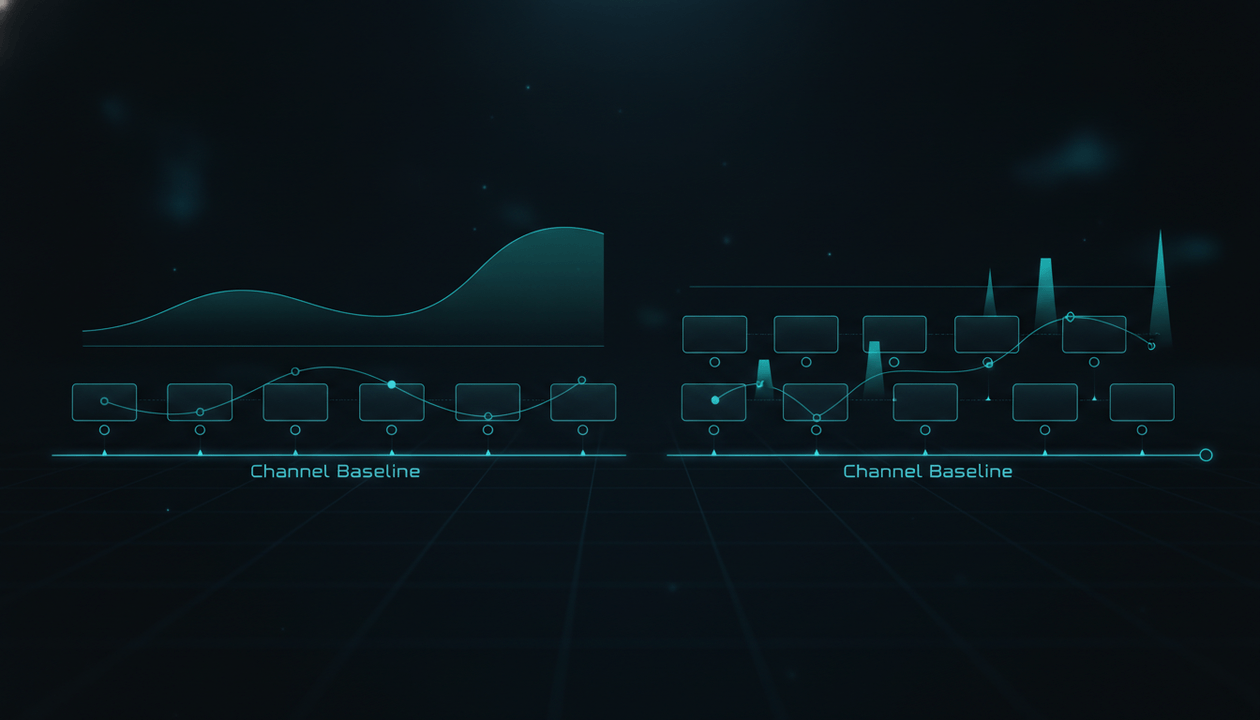
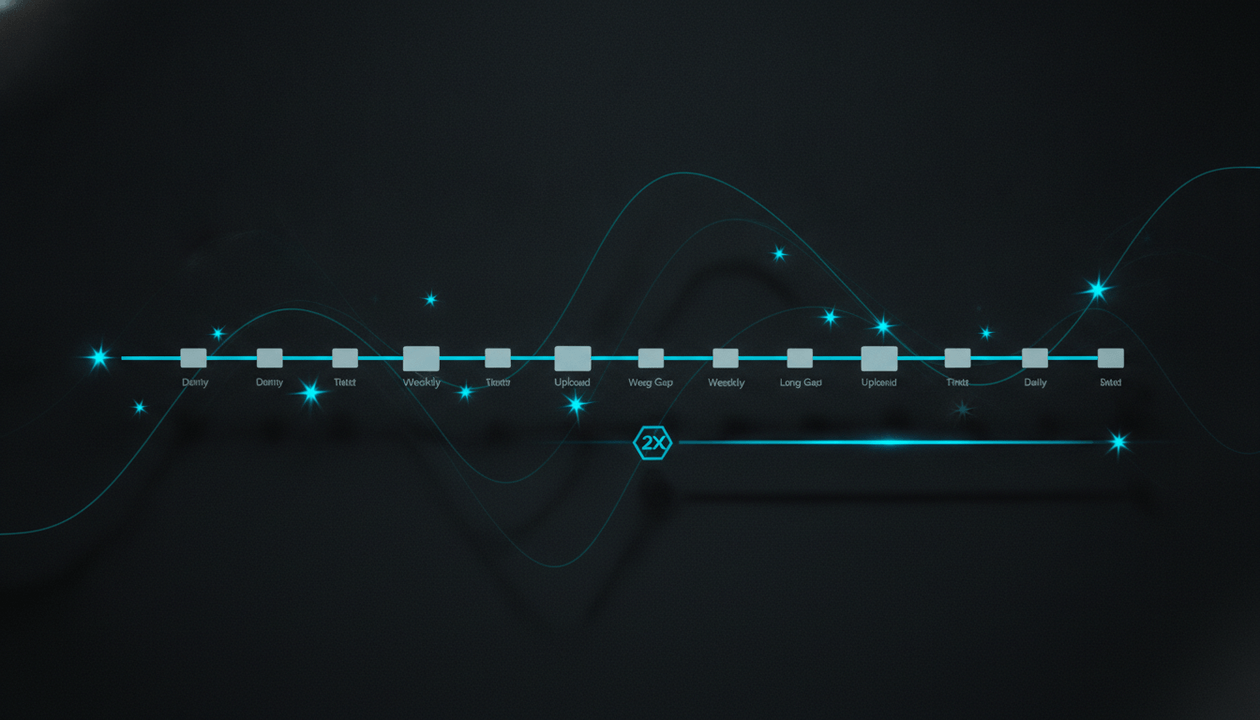
- regular-schedule videos reached 1.00x channel baseline
- videos after moderately longer gaps reached 1.01x
- videos after gaps more than twice normal reached 1.17x
That does not mean longer gaps cause better performance.
It does mean:
missing your usual upload interval was not automatically harmful.
So the real consistency goal should not be:
Never miss Tuesday.
It should be:
Create a repeatable system that keeps producing strong videos without turning every upload into an emergency.
Key Findings
| Finding | Result |
|---|---|
| Consistency and channel-management comments | 491 |
| Source videos | 316 |
| Channels represented | 38 |
| English comments | 481, 98.0% |
| How-to questions | 230, 46.8% |
| Pain points | 179, 36.5% |
| Content requests | 54, 11.0% |
| Objections | 29, 5.9% |
| Tool requests | 6, 1.2% |
| Missing-capability signals | 5, 1.0% |
| Comparison requests | 1, 0.2% |
| How-to or pain-point comments | 406, 82.7% |
| How-to or content-request comments | 281, 57.2% |
| Pain or objection comments | 207, 42.2% |
| Explicitly stated needs | 11, 2.2% |
| Implied needs | 480, 97.8% |
| Comments with at least one like | 36.5% |
| Median likes | 0 |
| 75th percentile likes | 1 |
| 90th percentile likes | 3 |
The most useful number is:
82.7%.
Consistency comments overwhelmingly clustered around:
How do I make this work?
or:
This is becoming difficult to sustain.
That is not the language of a simple calendar problem.
The Direct Answer
How do you stay consistent on YouTube?
Build your schedule around:
sustainable production capacity
rather than:
an ideal posting frequency.
A strong consistency system has six parts:
- a realistic publishing cadence
- a backlog of validated ideas
- clear production stages
- reusable defaults and templates
- a buffer for bad weeks
- a feedback loop that improves the next video
The key rule is:
Choose the fastest cadence you can sustain without regularly sacrificing topic quality, packaging quality, production quality, or your ability to recover when life interrupts the plan.
That may be:
- twice a week
- weekly
- every two weeks
- monthly
The number itself is not the strategy.
The system behind it is.
Finding 1: Nearly Half of Consistency Comments Were How-To Questions
The largest signal was:
how-to questions.
There were:
230
representing:
46.8% of consistency comments.
This matters.
Creators were not primarily rejecting consistency as an idea.
They were asking:
How?
That changes the solution.
The problem is usually not:
lack of awareness.
Most creators already know they are supposed to publish.
The missing knowledge is:
how to turn publishing into an operating system.
Consistency Advice Often Stops Too Early
Generic advice:
Upload every week.
Useful operational advice:
Here is how to make weekly production fit inside your actual available hours.
Those are not the same thing.
If one video requires:
- 3 hours of research
- 4 hours of scripting
- 2 hours of recording
- 8 hours of editing
- 2 hours of packaging
then a weekly schedule needs roughly:
19 production hours
before accounting for:
- revisions
- failed ideas
- administration
- comments
- analytics
- life
If the creator has:
8 available hours
the problem is not:
insufficient discipline.
The schedule and production model are incompatible.
The Capacity Equation
A useful starting formula is:
required production hours <= available sustainable hours
If not:
something has to change.
You can change:
Frequency
Publish less often.
Production complexity
Simplify the format.
Efficiency
Remove repetitive work.
Delegation
Move appropriate tasks to someone else.
Scope
Make videos easier to produce.
Buffer
Produce ahead of schedule.
But you cannot sustainably solve:
19 required hours > 8 available hours
with:
try harder.
Finding 2: Pain Points Were the Second-Largest Signal
There were:
179 pain-point comments.
That is:
36.5%.
Across all actionable creator comments in the broader dataset, pain points represented:
27.5%.
Consistency therefore over-indexed toward:
experienced friction.
Creators were not discussing consistency only as a hypothetical strategy.
They were running into it operationally.
Pain Usually Appears After the Schedule Is Chosen
The schedule often comes first.
The system comes later.
A creator decides:
I will upload every Tuesday.
Then reality arrives.
Research takes longer.
The script needs revision.
Recording fails.
Editing expands.
A thumbnail needs replacing.
The video is not ready Monday night.
Now Tuesday becomes:
a deadline crisis.
Repeat that enough times and the creator begins to experience:
consistency as pressure.
The underlying problem is:
the publishing commitment was defined before production capacity was understood.
Set Capacity Before Cadence
Reverse the sequence.
Do not start with:
How often should I post?
Start with:
How many strong videos can this system reliably produce?
Suppose your real output capacity is:
3 videos per month.
Then forcing:
4
means one of two things happens:
Quality drops
or:
Work expands beyond sustainable capacity
Neither is a real consistency system.
A better cadence may be:
one video every 10 days
with:
- stronger topics
- stronger packaging
- less emergency work
Finding 3: 57.2% Wanted Instructions or More Content
When we combined:
- how-to questions
- content requests
we found:
281 comments
or:
57.2% of the consistency cohort.
That means more than half of consistency-related needs involved creators effectively asking for:
a usable process.
This is one reason motivational consistency advice has limited value.
Creators may not need another reminder to:
stay disciplined.
They need to know:
- how to plan
- how to batch
- how to build a buffer
- how to manage ideas
- how to simplify production
- how to recover after missing uploads
Those are systems questions.
Finding 4: "Consistency" Covered Several Different Problems
We also ran an exploratory keyword scan across the classifier-generated specific_need summaries.
These groups overlap and should not be interpreted as a complete taxonomy.
They are directional.
| Language appearing in consistency needs | Comments |
|---|---|
| Schedule, consistency, uploads, or frequency | 108 |
| Performance pressure, views, growth, or reach | 67 |
| Time, job, family, school, or life constraints | 66 |
| Shorts or long-form format | 59 |
| Production, recording, filming, or editing | 38 |
| Motivation, stress, overwhelm, or burnout language | 24 |
| Delegation, hiring, or team | 17 |
| Planning, workflow, calendar, batching, or buffer | 13 |
| Ideas or topics | 11 |
Again:
these overlap.
A single need can mention both:
- schedule
- job
- performance
The important insight is that consistency was not one issue.
It crossed:
- time
- production
- strategy
- format
- performance expectations
That is why one universal productivity tip cannot solve every consistency problem.
There Are at Least Five Types of YouTube Consistency Problems
Type 1: Time Constraint
The creator knows what to make.
They simply do not have enough hours.
Symptoms:
- full-time job
- school
- family responsibilities
- limited recording windows
Solution direction:
reduce required hours per video or lower frequency.
Type 2: Production Constraint
Ideas exist.
Time exists.
But videos take too long to produce.
Symptoms:
- editing backlog
- slow asset creation
- complex footage requirements
- too many tools
Solution direction:
simplify or systematize production.
Type 3: Idea Constraint
The creator can produce.
They just do not know what to make next.
Symptoms:
- blank-page ideation
- random topics
- last-minute research
Solution direction:
build an evidence-backed idea backlog.
Type 4: Performance Pressure
The creator's schedule changes based on results.
Symptoms:
Last video flopped, so I need to upload again immediately.
or:
That video went viral, so I need to rush a sequel.
Solution direction:
separate analytics decisions from emotional reaction.
Type 5: Motivation and Energy Constraint
The workflow technically fits.
The creator still struggles to keep doing it.
Possible contributors can include:
- low perceived return
- repetitive work
- constant deadlines
- excessive production scope
Solution direction:
redesign the system around lower recurring friction.
This article does not diagnose health conditions.
If creator stress or exhaustion is persistent or affecting health, treat that seriously rather than reducing it to a productivity issue.
The Biggest Consistency Mistake: Choosing a Schedule Based on Ambition
Creators often design around:
best-case capacity.
They imagine the week where:
- motivation is high
- no appointments happen
- no video fails
- the script works immediately
- editing goes perfectly
Then they build a schedule around that week.
That schedule is fragile.
A better system is designed around:
normal capacity.
An even stronger system has room for:
bad weeks.
The Worst-Week Test
Ask:
Could I maintain this system during a difficult but ordinary week?
Not:
- major emergency
- serious illness
- exceptional crisis
Just a normal difficult week where:
- work becomes busy
- recording gets delayed
- one asset fails
- energy is lower
If one ordinary disruption destroys the schedule:
you do not have a system yet.
You have a streak.
A Sustainable Schedule Needs Slack
Suppose a creator has:
12 available YouTube hours per week.
If the production system consumes:
12 hours every week
capacity utilization is:
100%.
That sounds efficient.
It is actually fragile.
One:
- revision
- technical failure
- unexpected call
creates a backlog.
A more resilient system might plan for:
9 hours
and leave:
3 hours of slack.
That slack is not wasted.
It is:
reliability capacity.
Consistency Is Not Maximum Output
Maximum output asks:
How many videos can I force through the system?
Sustainable consistency asks:
How many strong videos can the system repeatedly finish?
Those can be very different numbers.
Finding 5: Exact Schedule Consistency Did Not Show a Universal Performance Advantage
This is where creator psychology and performance data need to meet.
In our separate 8,942-video consistency study:
videos published close to their channel's normal upload interval reached a median:
1.00x
age-adjusted performance.
Videos after gaps between:
1.25x and 2x normal
reached:
1.01x.
Videos after gaps longer than:
2x normal
reached:
1.17x.
And videos published sooner than usual reached:
0.96x.
The study was observational.
It does not prove waiting longer increases views.
But it did not support the idea that:
breaking your exact upload rhythm automatically harms the next video.
That changes how creators should think about consistency.
Schedule Consistency and Audience Consistency Are Different
A creator can publish:
every Tuesday
and still confuse viewers.
Example:
Week 1:
AI tools.
Week 2:
personal vlog.
Week 3:
investing.
Week 4:
gaming.
Perfect calendar.
Inconsistent audience promise.
Another channel publishes:
- after 7 days
- then 10
- then 8
- then 12
but every video serves:
the same viewer need.
The second channel is less calendar-consistent.
It may be far more:
strategically consistent.
The Four Types of Consistency That Matter
1. Audience consistency
Do viewers know who the channel is for?
2. Topic consistency
Do videos exist inside a recognizable world?
3. Quality consistency
Can viewers expect a reliable standard?
4. Production consistency
Can the creator repeatedly finish videos?
Schedule consistency is useful.
But it is only one dimension.
Do Not Protect the Calendar at the Expense of the Video
Imagine your normal upload is tomorrow.
You have two options.
Option A
Publish a weak idea because:
Tuesday is Tuesday.
Option B
Delay the video and finish a stronger topic and package.
Calendar consistency alone cannot tell you which is smarter.
Our 8,942-video study did not find evidence that perfect interval adherence itself created a per-video advantage.
So the calendar should support:
quality production.
It should not become:
the product.
Finding 6: Time and Life Constraints Appeared Frequently
Our exploratory scan found:
66 comments
containing language related to:
- time
- jobs
- work
- school
- family
- life constraints
This is critical.
Many creators are building YouTube around another primary responsibility.
So advice built for a full-time creator can be completely inappropriate.
The Full-Time-Job Creator Needs a Different System
Imagine two creators.
Creator A
40 available hours per week.
Creator B
8 available hours.
Both hear:
Post weekly.
That recommendation means radically different things.
Creator B cannot simply copy Creator A's workflow.
They need:
- lower-complexity videos
- better batching
- stronger prioritization
- less unnecessary editing
- tighter research
The content strategy must fit the life.
The 8-Hour Creator Example
Suppose you have:
8 hours per week.
One possible allocation:
Research
1.5 hours
Outline and script
2 hours
Recording
1 hour
Editing
2 hours
Packaging
1 hour
Analytics and admin
0.5 hours
Total:
8 hours.
Now imagine your actual editing requirement is:
7 hours.
You do not have a motivation problem.
You have:
a format-capacity mismatch.
Options:
- simplify the format
- publish less
- automate mechanical editing
- outsource appropriate work
But the arithmetic must eventually work.
Finding 7: Production Appeared Inside Consistency Problems
We found:
38 consistency comments
containing language associated with:
- production
- recording
- filming
- editing
That matters because consistency is often treated as separate from production.
It is not.
Your publishing cadence is the output of your production system.
If editing is slow:
consistency suffers downstream.
If scripts are slow:
same.
If visual generation is unreliable:
same.
The Bottleneck Determines the Schedule
Think of production as a pipeline:
idea -> research -> script -> recording -> edit -> package -> publish
Suppose:
- idea: 1 hour
- research: 2 hours
- script: 2 hours
- recording: 1 hour
- edit: 10 hours
- package: 1 hour
The bottleneck is obvious.
Editing.
Optimizing idea generation from:
60 minutes
to:
20 minutes
saves:
40 minutes.
Reducing editing from:
10 hours
to:
5
saves:
5 hours.
Consistency improves fastest when you optimize:
the bottleneck.
Do Not Optimize the Easy Step
Creators often optimize:
- captions
- file naming
- upload descriptions
because those are easy to optimize.
Meanwhile:
editing consumes 70% of production time.
Track time.
Find the constraint.
Fix that first.
Finding 8: Performance Pressure Appeared in 67 Comments
Our exploratory scan identified:
67 consistency needs
containing language associated with:
- views
- growth
- reach
- impressions
- subscribers
- algorithms
That suggests some consistency struggles are not purely logistical.
They are:
performance-reactive.
A creator's production behavior changes because the numbers changed.
Do Not Let One Video Rewrite the Schedule
Example:
Normal cadence:
weekly.
A video underperforms.
Creator reaction:
I need to post again in three days.
Why?
If nothing in the diagnosis changed:
the creator may simply be:
accelerating the same weak strategy.
Our research on how long YouTube slumps last found that many underperformance runs were short.
The median slump in that study lasted:
one weak upload.
That is another reason not to treat every miss as a scheduling emergency.
Performance Should Change Strategy, Not Create Panic
A result should update:
- topic confidence
- packaging confidence
- format confidence
It should not automatically update:
upload frequency.
The correct response to a bad video depends on:
why it underperformed.
Finding 9: Shorts and Long-Form Appeared in 59 Consistency Comments
Format language appeared in:
59 of the 491 consistency needs.
That is directionally important.
Creators are not simply deciding:
how often should I post?
They may also be deciding:
what am I supposed to keep posting?
If the channel includes:
- Shorts
- long-form
- livestreams
the production burden multiplies.
Do Not Create Three Content Machines Accidentally
Suppose you commit to:
- 1 long-form video weekly
- 5 Shorts weekly
- 2 community posts
- 1 livestream
That sounds like:
one YouTube schedule.
Operationally it is several production systems.
Each requires:
- ideas
- production
- packaging
- publishing
- measurement
The correct question is not:
Can this generate more reach?
It is:
Can I operate all these formats without weakening the primary content engine?
Use Format Hierarchy
Choose:
Primary format
The format that carries the main channel strategy.
Support format
A format that helps the primary system.
Optional experiments
Everything else.
This prevents:
format sprawl.
Finding 10: Only 2.2% Stated Their Need Explicitly
Only:
11 of 491 consistency comments
were classified as explicit.
That means:
480
were implied.
Or:
97.8%.
This is one of the most important audience-research findings.
Creators may not say:
I need a sustainable content operations system.
They may say:
I keep missing uploads.
Surface problem:
schedule.
Possible deeper need:
capacity planning.
Another says:
How do you upload with a full-time job?
Surface problem:
frequency.
Deeper need:
workflow design.
Good creator education answers:
the underlying job.
Consistency Is a Queueing Problem
Think of each video as work entering a pipeline.
If new work enters faster than finished work exits:
the backlog grows.
Example:
You commit to:
one video every seven days.
Your system actually finishes one every:
nine days.
After the first cycle:
2 days behind.
After five:
10 days behind.
Nothing dramatic happened.
The system simply had:
negative capacity margin.
This is why consistency can collapse gradually.
The Consistency Equation
A simplified version:
publishing demand <= production capacity
Where:
Publishing demand
How much content your schedule requires.
Production capacity
How much quality content your current system can finish.
If demand exceeds capacity:
- backlog grows
- quality falls
- deadlines slip
You must eventually change:
demand or capacity.
Build a Schedule From Throughput
Track your last:
5 to 10 videos.
Record:
- research time
- scripting time
- production time
- editing time
- packaging time
- revision time
Then calculate:
typical production time.
Do not plan from:
your fastest video.
Plan from:
your normal one.
The Sustainable Cadence Formula
A practical starting point:
cadence = typical production time + safety margin
Suppose a normal video takes:
12 hours.
You have:
6 available hours per week.
Your production time is:
2 weeks.
If you want buffer capacity, maybe your real cadence is:
one video every 2.5 weeks.
That may feel slower.
It can produce more actual consistency than:
weekly promises followed by repeated misses.
Why Buffers Matter
A buffer separates:
production date
from:
publication date.
Without a buffer:
one delay becomes:
an audience-facing delay.
With a buffer:
one delay becomes:
an internal production issue.
That is a huge difference.
The One-Video Buffer
Start simple.
Before beginning a regular publishing rhythm:
have:
one finished video ahead.
Now a bad week does not immediately break the schedule.
For higher-frequency channels:
you may need more.
The correct buffer depends on:
- cadence
- production volatility
- time availability
Do Not Build a Huge Buffer of Weak Ideas
A buffer protects operations.
It should not freeze strategy.
Producing:
20 videos ahead
can become dangerous if:
- the niche changes
- audience response changes
- better topics appear
Buffer:
production capacity.
Do not buffer yourself into:
strategic blindness.
The Better Buffer Is a Multi-Stage Pipeline
You do not need 10 fully edited videos.
Instead keep:
Idea backlog
10-30 validated opportunities.
Outline queue
Several ready topics.
Script queue
1-3 ready.
Production queue
Current work.
Published queue
Scheduled videos.
That gives flexibility.
Build an Idea Backlog Before You Need It
Ideation under deadline creates weak decisions.
If the upload is due tomorrow and you have no topic:
the schedule now controls strategy.
That is backwards.
Build the backlog earlier.
Our research on finding YouTube video ideas from comments showed that public audience comments can contain useful signals for:
- pain points
- questions
- content requests
Use:
- competitor outliers
- audience comments
- your own analytics
- repeated topic wins
to maintain a queue of:
validated possibilities.
Backlog Does Not Mean Random Idea List
Weak backlog:
- "AI video"
- "YouTube tips"
- "productivity"
Strong backlog:
- specific audience problem
- evidence of demand
- possible title
- source/reference
- why it fits channel
The goal is to reduce:
topic uncertainty.
The Three-Level Backlog
Classify ideas.
Ready
Enough evidence to produce.
Validate
Promising but needs research.
Parking lot
Interesting, not urgent.
Now you do not treat every idea as equally valuable.
Packaging Before Production
One of the most expensive consistency mistakes is:
finishing the video before discovering the title is weak.
Before full production, define:
- topic
- title direction
- thumbnail concept
You do not need final pixels.
You need confidence that:
the idea can be packaged.
If you cannot create a compelling promise:
the video may not be ready for production.
Batch Decisions, Not Just Recording
Batching is often described as:
Record five videos at once.
That can help.
But batching is more powerful when applied to:
decision types.
Batch:
Topic research
Evaluate multiple ideas together.
Outlining
Stay in structural thinking.
Recording
Keep the setup active.
Visual generation
Keep style context loaded.
Thumbnail ideation
Compare packages side by side.
Batching reduces:
context switching.
Templates Should Remove Repetition, Not Personality
Good templates:
- production checklist
- export settings
- project folder
- caption style
- thumbnail canvas
- research checklist
- brief structure
Bad templates:
- identical hook every time
- identical story
- identical title pattern forever
Standardize:
mechanics.
Preserve:
creative variation.
Create a Minimum Viable Production Standard
Perfection can destroy consistency if every video expands indefinitely.
Define what:
finished
means.
For example:
Story
Clear.
Audio
Clean.
Visuals
Relevant.
Packaging
Strong.
Technical
No obvious errors.
Then stop.
A video can always absorb:
another five hours.
That does not mean those five hours improve the outcome.
The Marginal-Quality Test
Before doing another production task, ask:
How much viewer value will this add?
Examples:
Fix inaudible narration
High value.
Replace factually wrong image
High value.
Rewrite confusing hook
High value.
Add seventh decorative transition
Probably lower.
Consistency improves when creators distinguish:
essential quality
from:
infinite polish.
Automate Repetitive Production Work
Automation is useful when the answer is already known.
Examples:
- transcription
- file organization
- caption timing
- standard formatting
- scene-plan drafting
- repetitive visual setup
But keep strong review around:
- factual accuracy
- visual relevance
- pacing
- narrative emphasis
- final quality
The goal is:
less repetitive labor.
Not:
less thinking.
Use One System of Record
Creators often lose time because information lives in:
- notes
- spreadsheets
- chat messages
- editing software
- browser tabs
- random documents
A content planner should answer:
What is happening with this video?
at a glance.
Useful states:
idea -> validated -> outlined -> scripted -> production -> review -> scheduled -> published
That is where the OverseerOS YouTube Content Planner can help connect research and production rather than treating every video as a separate temporary project.
Create a Weekly Operating Rhythm
Consistency gets easier when the same type of work happens in predictable blocks.
Example:
Monday
Research and topic selection.
Tuesday
Scripts.
Wednesday
Recording.
Thursday
Production.
Friday
Packaging and review.
You do not need these exact days.
The principle is:
reduce daily re-planning.
The Daily Question Should Not Be "What Should I Do?"
Your system should already know.
Every day spent deciding:
What should I work on?
creates friction before the work begins.
A good workflow makes the next action:
obvious.
Design Recovery Before You Need It
Most consistency systems explain:
how to stay on schedule.
Few explain:
what happens after you fall behind.
That matters because eventually:
something will slip.
Create recovery rules in advance.
The Missed-Upload Protocol
If a video misses its date:
Do not
rush a weak replacement.
Do not
double the next workload automatically.
Do not
redesign the entire channel.
Instead:
- identify why it slipped
- decide whether the issue is recurring
- finish the strongest current video
- reset the calendar from reality
- change capacity if necessary
One missed upload should not create:
three emergency uploads.
When Should You Lower Your Upload Frequency?
Consider reducing cadence when:
- quality repeatedly drops near deadlines
- videos constantly miss dates
- production backlog keeps growing
- research becomes rushed
- every week requires emergency work
Reducing frequency is not failure.
It may be:
capacity correction.
When Should You Increase Frequency?
Increase only when:
- idea backlog is strong
- current videos meet quality standards
- production has spare capacity
- the current schedule feels stable
- additional volume serves a strategic purpose
Do not increase frequency because:
another creator uploads more.
Different channels have different:
- teams
- formats
- budgets
- workflows
What If You Miss a Week?
Do not assume the channel is damaged.
Our separate study of 8,942 mature long-form uploads found no clear per-video advantage from exact upload-interval adherence.
A missed week can still matter operationally.
It may:
- reduce output
- disrupt audience expectations
- expose a weak workflow
But that is very different from claiming:
YouTube automatically punishes you because Tuesday passed.
Use the miss as:
system feedback.
Why "Never Miss" Can Be a Dangerous Rule
"Never miss" encourages creators to protect:
the streak.
Sometimes the correct decision is:
delay the weak video.
Consistency should create:
trust and throughput.
Not force:
low-quality output.
What If You Feel Like You Are Always Behind?
That is one of the clearest operational signals.
Usually one of three things is happening.
Your schedule exceeds capacity
Reduce demand.
Your production process is too expensive
Improve capacity.
Your work enters production too late
Build backlog and buffer.
Measure before guessing.
The Weekly Capacity Audit
Track:
Planned hours
How much time did YouTube receive?
Actual hours
What happened?
Videos advanced
How much work moved through the pipeline?
Bottleneck
Where did projects get stuck?
Unplanned work
What created the difference?
After:
four weeks
you will understand your real system far better than from generic productivity advice.
The YouTube Consistency Scorecard
Score each from 1 to 5.
| Area | Question |
|---|---|
| Cadence fit | Can I sustain the schedule during a normal difficult week? |
| Idea backlog | Do I know what the next 5-10 videos could be? |
| Validation | Are ideas researched before deadlines? |
| Script readiness | Do scripts reach production early enough? |
| Production time | Is the format compatible with my available hours? |
| Tool complexity | Am I losing time to unnecessary handoffs? |
| Templates | Are repeated mechanical choices standardized? |
| Buffer | Can one bad week occur without breaking publication? |
| Analytics | Do I know what is working and why? |
| Recovery | Do I have a protocol when the schedule slips? |
The lowest score is probably your next consistency bottleneck.
The Consistency Ladder
Do not try to build everything at once.
Level 1: Finish
Can you consistently finish videos?
Level 2: Repeat
Can you do it again without reinventing the workflow?
Level 3: Buffer
Can you get ahead?
Level 4: Improve
Can you use analytics without destabilizing production?
Level 5: Scale
Can you increase output without lowering quality?
Do not optimize Level 5 while Level 1 is failing.
Why Motivation Should Be the Backup, Not the Engine
Motivation changes.
Systems reduce how much motivation is required.
Compare:
High-motivation workflow
Every week:
- find idea
- rebuild project
- decide style
- organize files
- choose process
System workflow
- next validated idea already exists
- project template exists
- style exists
- production checklist exists
- next action is clear
The second still requires effort.
It requires less:
decision energy.
Consistency Should Feel Boring Operationally
The creative output should be interesting.
The operating system should often be:
predictable.
You want fewer surprises in:
- folders
- deadlines
- task states
- handoffs
Save creativity for:
- ideas
- storytelling
- packaging
Do not spend it deciding where files go.
A Better Definition of YouTube Consistency
The weak definition:
Upload on the same day every week.
A stronger definition:
Reliably deliver valuable content to the same audience through a production system you can actually sustain.
That definition includes:
- audience
- quality
- operations
The calendar becomes a tool.
Not the goal.
How We Analyzed the Data
This study used the current OverseerOS audience-intelligence corpus.
The broader dataset contained:
27,555 classified public YouTube comments
across:
- 1,954 videos
- 44 creator-focused channels
Of those comments:
9,677
contained an actionable creator signal.
The taxonomy classified:
491 comments
as:
consistency_and_channel_management
Those comments came from:
- 316 videos
- 38 channels
The comments were published between approximately:
May 1 and August 13, 2026.
About:
98.0%
were classified as English.
Signal Distribution
The consistency cohort contained:
How-to questions
230, 46.8%
Pain points
179, 36.5%
Content requests
54, 11.0%
Objections
29, 5.9%
Tool requests
6, 1.2%
Missing capabilities
5, 1.0%
Comparison requests
1, 0.2%
Signal types can overlap.
That is why individual percentages can sum above:
100%.
Why We Combined How-To and Pain
We found:
406 unique comments
containing either:
- how-to question
- pain point
That equals:
82.7%.
Only:
3 comments
contained both.
That means the two dominant modes were largely distinct:
Solution-seeking
How do I stay consistent?
Friction-reporting
I am struggling to keep doing this.
A strong consistency system needs to solve both.
Exploratory Theme Analysis
The schedule, time, performance, format, production, motivation, delegation, planning, and ideas counts came from conservative keyword matching against classifier-generated specific_need summaries.
Those categories:
- overlap
- are incomplete
- are not the primary taxonomy
They should be interpreted as:
directional context.
The main findings rely on the fixed taxonomy.
Limitations
The corpus is not a random sample of all YouTube creators
It comes from creator-focused public videos represented in OverseerOS audience research.
Commenters are self-selected
People experiencing difficulty may be more likely to comment.
The study measures expressed needs
It does not independently verify every creator's root cause.
A creator saying:
I need more time
may actually have:
- excessive production scope
- weak planning
- too many formats
The comment captures the expressed problem.
The study does not measure creator working hours
We cannot say:
- how many hours creators should work
- average production time
- ideal weekly workload
from this dataset.
We do not measure burnout clinically
The exploratory theme scan includes burnout-related language.
That is not a medical assessment.
The taxonomy can simplify complex comments
One comment may involve several connected problems.
Likes are not importance scores
Only 36.5% of consistency comments had at least one like.
That does not make unliked concerns unimportant.
The separate 8,942-video consistency study is observational
Its longer-gap associations do not prove that delaying uploads causes better views.
They support the narrower conclusion:
exact interval adherence did not show a universal per-video advantage.
A sustainable cadence is channel-specific
Different creators have different:
- formats
- teams
- budgets
- life constraints
There is no universal ideal schedule.
Final Verdict
How do you stay consistent on YouTube?
Not by forcing yourself to hit the calendar forever.
Build a production system whose:
required workload fits your real capacity.
Our analysis of:
491 consistency and channel-management comments across 316 videos and 38 creator-focused channels
found:
46.8%
were how-to questions.
36.5%
were pain points.
And:
82.7%
contained one or the other.
Only:
2.2%
stated the underlying need explicitly.
Creators were rarely saying:
I need a better content operations system.
They were saying:
I can't keep up.
That is the same problem viewed from the surface.
The solution is not:
maximum frequency.
It is:
repeatable capacity.
Build:
- a cadence based on real production time
- an evidence-backed idea backlog
- clear stages from idea to publish
- templates for repeated decisions
- enough slack for bad weeks
- a small production buffer
- a recovery protocol for missed uploads
- a feedback loop that improves future videos
And remember what our separate 8,942-video consistency study found:
Publishing close to an exact normal interval did not produce a clear per-video performance advantage.
So do not sacrifice:
- a stronger topic
- a better title
- a better thumbnail
- a finished script
just to protect:
Tuesday.
The best consistency system is not the one that produces the most uploads during your best month.
It is the one that still works:
six months later.
Frequently Asked Questions
How do I stay consistent on YouTube?
Choose a publishing cadence that fits your real production capacity, keep a backlog of validated ideas, standardize repeated tasks, create a buffer, and use a defined recovery process when the schedule slips.
How often should I upload on YouTube to stay consistent?
There is no universal ideal frequency. The best cadence is one your production system can sustain without repeatedly sacrificing topic quality, packaging, or production.
Do I need to upload every week on YouTube?
Not necessarily. Different channels have different formats and production requirements. In OverseerOS's separate 8,942-video study, exact upload-interval adherence did not show a clear per-video performance advantage.
Does missing an upload hurt your YouTube channel?
A missed upload does not automatically mean the next video will perform worse. Treat it as operational feedback and investigate why the schedule slipped.
Is posting on the same day every week important?
A predictable schedule can be useful operationally, but our separate consistency study did not find evidence that staying close to an exact interval created a universal per-video view advantage.
Why is it so hard to stay consistent on YouTube?
Consistency combines time management, production capacity, idea supply, performance pressure, and life constraints. In our 491-comment study, 82.7% of consistency comments contained either a how-to question or pain point.
Is YouTube consistency a motivation problem?
Sometimes motivation matters, but repeated inconsistency can also come from a schedule that exceeds production capacity, excessive video complexity, weak planning, or insufficient backlog.
How can I stay consistent on YouTube with a full-time job?
Design the format around the hours you actually have. Reduce production complexity, batch similar tasks, maintain a small idea backlog, and choose a cadence that leaves room for normal life disruptions.
Is one video per week enough for YouTube?
It can be. The useful question is whether weekly publishing allows you to maintain strong topics, packaging, and production quality for your specific channel.
Is uploading every two weeks okay on YouTube?
Yes if that cadence fits the channel's production model and audience strategy. Calendar frequency should support content quality rather than override it.
Should I post less often if editing takes too long?
Consider it if production regularly exceeds your available capacity. You can also simplify the format, automate repetitive work, or delegate suitable tasks.
Should I batch YouTube videos?
Batching can reduce context switching when similar tasks are grouped together, such as research, recording, or packaging. It should not force you to pre-produce so far ahead that the strategy becomes stale.
How many videos should I keep in reserve?
There is no universal number. Even one finished video ahead can provide operational protection. Higher-frequency channels may need more buffer.
How many YouTube video ideas should I keep ready?
Maintain enough validated ideas that the next upload does not depend on last-minute brainstorming. Ten to thirty candidates can be useful for some workflows, but quality and validation matter more than the raw number.
How do I build a YouTube content backlog?
Collect ideas from competitor outliers, audience comments, your own analytics, recurring viewer questions, and proven topic clusters. Separate ready ideas from ideas that still need validation.
What should I automate in my YouTube workflow?
Automate repetitive mechanical work where the correct output is already well defined. Keep stronger human review around topic choice, packaging, storytelling, factual accuracy, pacing, and final quality.
Should I lower quality to post more consistently?
Not automatically. First identify unnecessary production work. Reduce low-value complexity before reducing the parts that materially improve the viewer experience.
What do I do if I miss my YouTube upload schedule?
Identify why the delay occurred, finish the strongest current video, reset the calendar from reality, and adjust capacity if the same issue keeps recurring.
Should I upload twice after missing a week?
Not automatically. Doubling the next workload can create another bottleneck. Recover based on production capacity rather than trying to repair the calendar emotionally.
How do I avoid falling behind on YouTube?
Plan from normal production time rather than your fastest week, leave capacity slack, maintain an idea backlog, and separate production deadlines from publication dates with a buffer.
Does posting more often help YouTube growth?
More output can create more opportunities, but volume alone does not fix weak topics, weak packaging, or poor retention. Publishing frequency should support a working content strategy.
What is more important, consistency or quality?
They should not be treated as opposites. The goal is a quality standard the creator can repeatedly sustain. A schedule that repeatedly destroys quality is not a sustainable consistency system.
What kind of consistency matters most on YouTube?
Audience consistency, topic consistency, quality consistency, and production consistency can be more strategically meaningful than hitting the exact same upload day every week.
How can OverseerOS help with YouTube consistency?
The YouTube Content Planner can keep evidence-backed ideas, scripts, and downstream production context connected so creators do not have to rebuild the planning system for every upload.
How do I know if my YouTube schedule is sustainable?
Track how long your last several videos actually took to produce. If the required workload repeatedly exceeds the hours you can realistically provide, the cadence or production model needs to change.