Most faceless YouTube creators do research the wrong way.
They watch a few successful videos.
They copy titles into a spreadsheet.
They ask AI for 50 ideas.
They pick the one that sounds exciting.
Then they spend money on a script, voiceover, thumbnail, and edit.
Only after publishing do they discover the truth:
The idea was never strong enough.
That is why serious faceless creators need a faceless YouTube research tool.
Not just a keyword tool.
Not just a viral video list.
Not just a random AI idea generator.
A real research tool helps you decide what is worth producing before you spend money.
Because faceless YouTube is not cheap when you do it properly.
Every weak idea costs you research time, writing time, voiceover cost, editing cost, thumbnail cost, upload time, and opportunity cost.
The goal is not to make more videos.
The goal is to make fewer wrong videos.
Quick Answer: What Is a Faceless YouTube Research Tool?
A faceless YouTube research tool helps creators find, validate, and organize video ideas for channels where the creator does not appear on camera.
It should help you research:
- Profitable faceless niches
- Successful competitor channels
- Breakout videos
- Viral topics
- Search demand
- Title patterns
- Thumbnail patterns
- Audience pain points
- Content gaps
- Script angles
- Video formats
- Production difficulty
- Monetization potential
The best faceless YouTube research tool does not just show what is popular.
Ready to match this checklist against real tools? Our comparison of the best NexLev alternatives ranks platforms built for research-led production.
It helps answer the most important question:
Is this video worth producing for my channel?
That question matters more than ever.
Because AI can help you produce faster, but faster production does not fix weak research.
Key Takeaways
- Faceless YouTube creators need stronger research because they cannot rely on personal charisma, lifestyle content, or on-camera trust.
- A faceless YouTube research tool should help creators validate ideas before spending money on scripts, thumbnails, voiceovers, and editing.
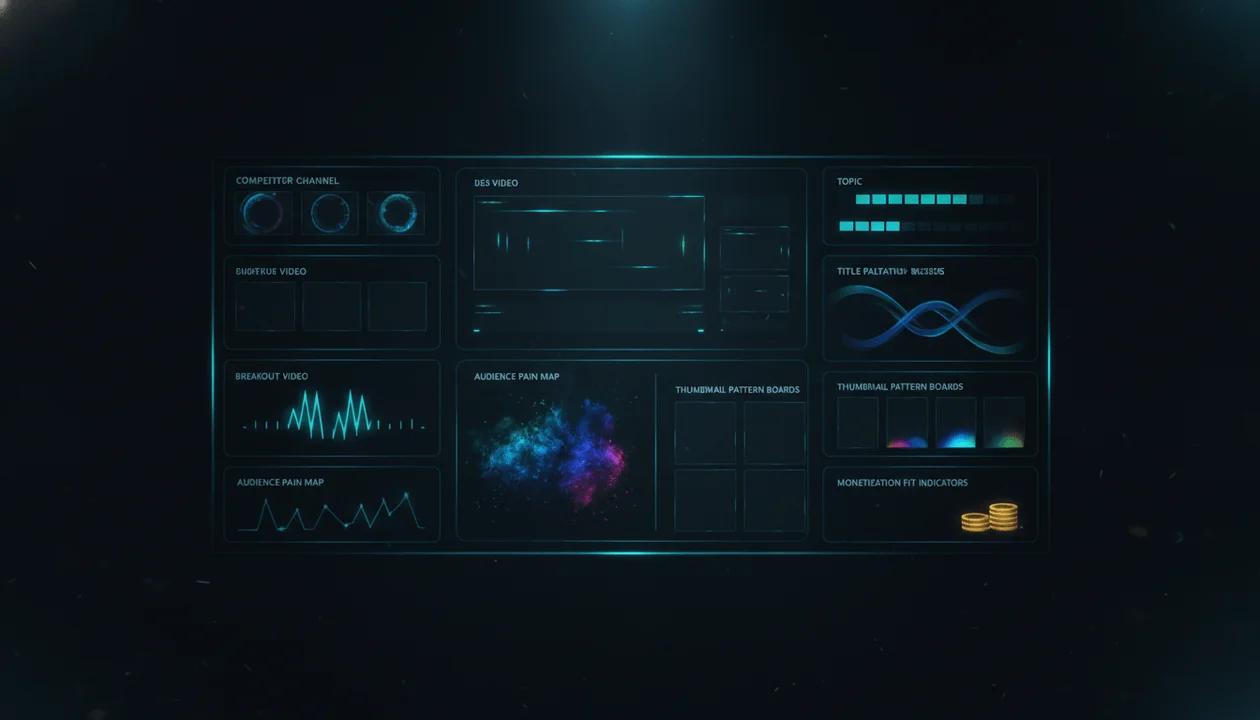
- The best research workflow studies competitors, breakout videos, audience pain, title patterns, thumbnail patterns, search intent, production difficulty, and monetization fit.
- A topic is not enough. A faceless video needs a proven angle, strong package, clear viewer promise, and realistic production plan.
- Random AI idea generators are risky because they can produce polished ideas with no real demand proof.
- The best faceless creators research before they automate.
- OverseerOS fits this workflow because it helps creators analyze channels, find proven topics, track competitors, build content plans, generate scripts, and turn research into production-ready assets.
- The future of faceless YouTube belongs to creators who research like strategists, not creators who mass-produce guesses.
Why Faceless YouTube Research Matters More Than Normal YouTube Research
A personal creator can sometimes publish an average topic and still get views because the audience trusts the person.
A faceless channel has less margin for error.
The viewer is not clicking because they know your face.
They are clicking because the topic, title, thumbnail, and promise are strong.
That means the research has to carry more weight.
For faceless channels, the idea must usually be stronger in at least one of these areas:
- Clear curiosity
- Strong audience pain
- High search intent
- Timely trend
- Strong story
- Useful tutorial
- Emotional tension
- Visual concept
- High monetization value
- Repeatable content pillar
A weak personal video might survive on personality.
A weak faceless video usually disappears.
That is why faceless research is not optional.
It is the foundation.
Faceless YouTube Research Tool vs Keyword Tool
Keyword tools can be useful.
But they are not enough for faceless YouTube.
A keyword tool tells you what people search.
A faceless YouTube research tool should help you understand what people click, watch, and care about.
| Keyword Tool | Faceless YouTube Research Tool |
|---|---|
| Finds search terms | Finds video opportunities |
| Focuses on search volume | Focuses on demand, packaging, and production fit |
| Useful for tutorials | Useful for tutorials, documentaries, commentary, explainers, and trend videos |
| Gives keywords | Gives angles, competitors, patterns, and content gaps |
| Helps with SEO | Helps with the full video decision |
| Can miss Browse and Suggested demand | Studies videos already gaining attention |
Search is only one part of YouTube.
Faceless channels often grow through Browse, Suggested, and emotional click patterns.
That means the research tool has to go beyond keywords.
Faceless YouTube Research Tool vs AI Idea Generator
AI idea generators can help brainstorm.
But brainstorming is not validation.
An AI tool can generate:
10 faceless YouTube video ideas in the finance niche
The list may look clean.
But it may not answer:
- Is there demand?
- Are competitors winning with this topic?
- Is the topic too saturated?
- Is the angle original?
- Can this become a strong thumbnail?
- Can this become a good script?
- Can this attract the right audience?
- Can the channel repeat this topic lane?
- Is this worth production cost?
That is the difference.
An AI idea generator gives possibilities.
A research tool helps choose priorities.
For faceless creators, that distinction matters because every produced video costs money.
The Research-First Faceless YouTube Workflow
The best faceless creators do not start with scripts.
They start with research.
Use this workflow:
1. Pick the content pillar
2. Find competitor signals
3. Identify breakout videos
4. Study audience pain
5. Find search or trend support
6. Extract title and thumbnail patterns
7. Find the content gap
8. Create an original angle
9. Score the idea
10. Move only the strongest ideas into production
This workflow prevents random publishing.
It also helps freelancers work better because the idea has context before production begins.
The 9 Things a Faceless YouTube Research Tool Should Help You Find
1. Proven Competitors
Before building in a niche, find channels already proving demand.
Look for:
- Channels growing quickly
- Channels with repeatable formats
- Channels with recent breakout videos
- Channels with strong packaging
- Channels with clear content pillars
- Channels with videos you can learn from without copying
Do not only study huge channels.
Small and mid-sized channels are often more useful because their breakouts reveal stronger signals.
A video with 200,000 views from a small channel may reveal more opportunity than a video with 2 million views from a giant channel.
2. Breakout Videos
Breakout videos are one of the best faceless research signals.
A breakout video is a video that performs much better than the channel’s normal baseline.
This matters because raw views can lie.
A big channel getting big views may be normal.
A small channel suddenly getting 10x its usual views is a signal.
Study breakout videos to understand:
- What topic created unusual demand?
- What title made the promise clear?
- What thumbnail made the idea visual?
- What audience pain was triggered?
- Was the video timely or evergreen?
- Could this become a pillar or series?
- Is there a better angle still available?
Breakout videos show what the audience rewarded.
3. Content Pillars
A faceless channel should not be built from random ideas.
It needs repeatable pillars.
Example for a faceless AI channel:
1. AI agents
2. AI jobs
3. AI company wars
4. AI safety
5. AI scams
Example for a faceless finance channel:
1. Money traps
2. Wealth psychology
3. Investing mistakes
4. Income systems
5. Market explainers
Example for a faceless creator education channel:
1. Viral topic research
2. Titles and thumbnails
3. Faceless channel strategy
4. Content planning systems
5. Script and retention structure
A good research tool should help you see which pillars have demand and which are too weak.
For a deeper framework, read the YouTube content pillar generator guide.
4. Audience Pain
Faceless videos need strong viewer motivation.
Do not define the audience too broadly.
Weak:
People interested in AI
Better:
Creators and workers who feel AI is moving faster than their ability to understand what matters
Weak:
People interested in money
Better:
People earning more than before but still feeling broke because lifestyle inflation quietly absorbs every raise
Weak:
People interested in YouTube
Better:
Small creators who publish consistently but feel ignored because their videos are not gaining traction
The clearer the pain, the stronger the title, thumbnail, hook, and script.
5. Title Patterns
Faceless creators should study title patterns, not copy exact titles.
Strong title patterns include:
| Pattern | Example |
|---|---|
| Hidden problem | The AI Agent Problem No One Has Solved Yet |
| Survival angle | The Faceless YouTube Channels That Will Survive 2026 |
| Mistake | The Script Mistake Making Your Faceless Videos Feel Cheap |
| Warning | The YouTube Automation Advice That Can Hurt Your Channel |
| Proof | I Studied 100 Faceless Channels. The Winners Had One System |
| Contrarian | Faceless YouTube Is Not Dead. Lazy Automation Is. |
| Before/after | From Random Uploads to a Real Faceless Content System |
| Buyer intent | Best Faceless YouTube Tools for Strategy-Led Channels |
The title pattern tells you what type of promise the audience responds to.
6. Thumbnail Patterns
Faceless thumbnails are different from personality thumbnails.
They need strong objects, contrast, symbols, scenes, or visual metaphors.
Study:
- What object appears repeatedly?
- Is there a face or no face?
- Is the image simple or detailed?
- Is there one clear focal point?
- Does the thumbnail show a problem?
- Does it show contrast?
- Does it create mystery?
- Does it support the title?
- Can the idea be understood on mobile?
A faceless thumbnail has to make the invisible idea visible.
Example:
Topic:
AI agents
Weak thumbnail:
Random robot face with glowing eyes
Stronger thumbnail:
A clean web of AI agent nodes with one poisoned connection spreading through the system
The second thumbnail communicates a problem.
That is stronger.
7. Script Potential
Some topics sound good but produce weak scripts.
Before approving an idea, ask:
- Can this topic hold attention for 8 to 12 minutes?
- Is there a story arc?
- Are there examples?
- Are there visual moments?
- Is there tension?
- Is there a clear payoff?
- Can the viewer learn something specific?
- Does the script avoid generic explanation?
Faceless scripts cannot rely on personality.
The structure has to do the work.
A good research tool should help you judge script potential before production.
8. Production Difficulty
A topic may have demand but still be wrong for your current channel.
Ask:
- Do we have the sources?
- Do we have the visuals?
- Can our editor make it look good?
- Is it too expensive?
- Is it too time-sensitive?
- Does it require expert accuracy?
- Can we produce it before the trend fades?
- Will it need original graphics or screen recordings?
Production difficulty matters.
A strong idea you cannot execute well may perform worse than a simpler idea you can execute perfectly.
9. Monetization Fit
Faceless creators should not chase views only.
They should consider monetization fit.
Ask:
- Does this audience attract advertisers?
- Could this support affiliate links?
- Could this lead to product sales?
- Could this build authority?
- Could this attract sponsors?
- Is this niche advertiser-friendly?
- Does this topic create policy or trust risk?
- Does this channel have long-term brand value?
A video with fewer views can be more valuable if it attracts the right audience.
This is especially true for creator education, finance, software, business, AI tools, productivity, and B2B niches.
The Faceless YouTube Research Scorecard
Use this before moving any idea into production.
| Question | Score 1 to 5 |
|---|---|
| Is there proof of demand? | |
| Are there competitor or breakout signals? | |
| Does the topic fit a clear content pillar? | |
| Is the audience pain specific? | |
| Is the original angle clear? | |
| Can this become a strong title? | |
| Can this become a strong thumbnail? | |
| Can this support a good script? | |
| Can we produce it well with our current resources? | |
| Does it attract the right audience or monetization opportunity? |
Scoring guide:
- 43 to 50: Strong candidate. Move into production.
- 35 to 42: Good candidate. Improve angle or packaging.
- 26 to 34: Needs more proof.
- Below 26: Archive or reject.
This scorecard is simple, but it can save hundreds or thousands of dollars over time.
It stops weak topics before they become expensive videos.
The Faceless Research Matrix
Use this matrix to classify ideas.
| Low Production Difficulty | High Production Difficulty | |
|---|---|---|
| High Demand | Produce first | Produce only if strategic |
| Low Demand | Small experiment | Avoid |
The best ideas are high demand and realistic to produce.
The dangerous ideas are high demand but too hard to execute.
Those can waste money if your team is not ready.
Example:
A faceless AI documentary about “the full history of artificial general intelligence” may sound powerful, but it may require heavy sourcing, graphics, and editing.
A sharper video like “The AI Agent Problem No One Has Solved Yet” may be easier to package and produce while still hitting strong demand.
Research is not just finding topics.
It is choosing battles.
How to Research a Faceless YouTube Niche
A faceless niche should pass five tests.
Test 1: Demand
Are people already watching videos in this niche?
Look for:
- Recent videos with strong views
- Multiple successful channels
- Search demand
- Active comments
- Repeat topics
- New trends
Test 2: Repeatability
Can you produce at least 100 video ideas in this niche?
Weak niches run out quickly.
Strong niches create endless angles.
Test 3: Visual Potential
Can the topic be made visually interesting without showing your face?
Good faceless niches often have:
- Stories
- Diagrams
- Screenshots
- Data
- Objects
- Before/after visuals
- Maps
- Timelines
- Characters
- Tools
- Conflicts
- Case studies
Test 4: Monetization
Can the audience create business value?
Possible monetization includes:
- Ad revenue
- Sponsorships
- Affiliate offers
- Digital products
- Software
- Courses
- Consulting
- Newsletter
- Community
- Lead generation
Test 5: Differentiation
Can you create a unique angle?
Do not enter a niche only to become another generic channel.
Find the difference:
- Better research
- Better storytelling
- Better visuals
- Better speed
- Better taste
- Better frameworks
- Better topic selection
- Better editorial point of view
If you cannot differentiate, the niche is risky.
Faceless Research Examples by Niche
Example 1: Faceless AI Channel
Raw topic:
AI agents
Research signals:
AI agent tools are appearing across creator, business, and tech content.
Many videos explain the hype, but fewer explain the reliability problem.
The topic has strong visual potential: networks, agents, broken workflows, automation loops.
Original angle:
The AI Agent Problem No One Has Solved Yet
Why it works:
- Timely
- Clear tension
- Strong visual metaphor
- Documentary-friendly
- Can become a repeatable pillar
Example 2: Faceless Finance Channel
Raw topic:
Saving money
Research signals:
Viewers often search for saving tips, but many are tired of basic advice.
The deeper pain is feeling broke even after earning more.
Original angle:
The Silent Money Trap Keeping You Broke
Why it works:
- Emotional
- Evergreen
- Broad but specific
- Strong title
- Easy thumbnail metaphor
Example 3: Faceless Creator Education Channel
Raw topic:
YouTube automation
Research signals:
Creators are searching for automation tools, AI video workflows, and faceless channel systems.
But many fear low-quality AI content, policy risk, and wasted production costs.
Original angle:
Faceless YouTube Automation Software: Build a Channel System Without Making AI Slop
Why it works:
- High buyer intent
- Educational
- Timely
- Product-aligned
- Strong pain point
Example 4: Faceless Business Channel
Raw topic:
Startup failure
Research signals:
Business documentaries perform well when they have a clear collapse, villain, mistake, or hidden decision.
The audience wants the cause, not a generic timeline.
Original angle:
The $1 Billion Mistake That Killed This Startup
Why it works:
- Clear stakes
- Story-driven
- Easy to package
- Strong retention potential
The Faceless YouTube Research Template
Use this before approving any idea.
Faceless YouTube Research Template

Channel:
Niche:
Content pillar:
Raw topic:

Target viewer:
Viewer state:
Viewer pain:
Viewer desire:
Viewer fear:

Demand proof:
- Competitor videos:
- Breakout videos:
- Search signals:
- Trend signals:
- Comment signals:

Title patterns:
1.
2.
3.

Thumbnail patterns:
1.
2.
3.

Content gap:
What has not been explained well yet?

Original angle:
What is our unique version?

Script potential:
Can this hold attention? Why?

Visual potential:
What can we show?

Production difficulty:
Low / Medium / High

Monetization fit:
Low / Medium / High

Risk:
Policy, sourcing, copyright, accuracy, brand safety, or production risks.

Score:
1 to 50

Decision:
Produce / Improve / Watch / Reject
This turns research into a production decision.
Not just notes.
The Research-to-Production Handoff
Research should not stay in a document nobody reads.
It should become a production brief.
A good handoff includes:
Topic:
Why this topic matters:
Demand proof:
Target viewer:
Original angle:
Working title:
Thumbnail concept:
Hook direction:
Script structure:
Visual ideas:
Sources needed:
What to avoid:
Priority:
Deadline:
This helps the writer, editor, and thumbnail designer make better decisions.
Without this, the team guesses.
And guessing is expensive.
What a Good Faceless YouTube Research Tool Should Feel Like
A good tool should make you feel less scattered.
You should be able to see:
- Which competitors are worth tracking
- Which videos are breaking out
- Which topics are gaining demand
- Which ideas are saved
- Which ideas are validated
- Which content pillar each idea belongs to
- Which title and thumbnail directions are attached
- Which scripts are ready
- Which topics deserve follow-ups
- Which videos should be rejected
The tool should not just collect data.
It should help you make decisions.
That is the standard.
How OverseerOS Helps With Faceless YouTube Research
OverseerOS is built for creators who want to stop guessing what to upload.
That makes it a strong fit for faceless YouTube research.
Faceless creators need to answer hard questions before production:
- What channel should I study?
- What niche has opportunity?
- What topics already have demand?
- Which competitors are breaking out?
- Which videos are worth learning from?
- Which titles and thumbnails are working?
- Which ideas should enter the planner?
- Which scripts should we create?
- Which thumbnails should we generate?
- Which voiceovers should we produce?
OverseerOS helps connect these steps.
You can use OverseerOS to:
- Analyze successful YouTube channels
- Reverse-engineer channel strategies with the Channel Blueprint Cloner
- Find fast-growing channels with Viral Channel Finder
- Track competitors and breakout videos
- Save validated topics into a content planner
- Generate scripts from proven ideas
- Create title, hook, and thumbnail directions
- Generate voiceovers inside the workflow
- Turn research into a real faceless production system
A normal AI tool asks:
What topic do you want a script about?
OverseerOS helps you answer:
Which topic is actually worth scripting?
That is the difference.
For faceless creators, that difference matters because every video costs time and money.
The 30-Minute Faceless Research Workflow
Use this before approving a video.
Minutes 0 to 5: Define the Pillar
Choose the pillar first.
Example:
Faceless channel strategy
Do not start with random topics.
Minutes 5 to 10: Find Competitor Proof
Look for 3 to 5 videos in the same lane.
Ask:
- Which performed above normal?
- What title patterns appear?
- What thumbnails repeat?
- What comments reveal demand?
Minutes 10 to 15: Find the Audience Pain
Write the viewer state.
Example:
Faceless creators want to use AI but are afraid of building low-quality channels that will not monetize or last.
Minutes 15 to 20: Create the Angle
Turn the topic into a specific promise.
Example:
The Faceless YouTube Channels That Will Survive 2026
Minutes 20 to 25: Check Production Fit
Ask:
- Can we script this well?
- Can we visualize it?
- Can we make a strong thumbnail?
- Can we produce it fast enough?
- Does it require sources?
Minutes 25 to 30: Score the Idea
Use the 50-point scorecard.
Only move the idea forward if it passes.
This simple workflow can prevent bad videos before they happen.
Common Mistakes With Faceless YouTube Research
Mistake 1: Studying Only Viral Videos
Viral videos are useful, but they can mislead you.
Some go viral because of timing, controversy, or creator brand.
Study breakout videos relative to channel size.
Those often reveal cleaner signals.
Mistake 2: Copying Competitors Too Closely
Research is not copying.
The goal is to understand the pattern, then create an original angle.
Copying makes your channel replaceable.
Mistake 3: Ignoring Production Difficulty
Some ideas look great but are too hard to produce well.
A faceless channel should match ideas to its current team, budget, and editing ability.
Mistake 4: Approving Topics Without Thumbnail Potential
If you cannot imagine the thumbnail, the topic may not be ready.
Faceless videos need visual packaging.
Mistake 5: Letting AI Brainstorm Without Proof
AI can create ideas, but it cannot prove demand unless you give it real research context.
Always ground AI in signals.
The Future of Faceless YouTube Research
The next wave of faceless YouTube will be more strategic.
Creators will still use AI.
They will still use voiceovers.
They will still use automation.
But the winners will not be the creators who generate the most videos.
They will be the creators who research better.
They will know:
- Which niches are worth entering
- Which competitors are worth studying
- Which videos are true outliers
- Which topics have repeatable demand
- Which titles create the strongest promise
- Which thumbnails make ideas visual
- Which scripts can hold attention
- Which topics attract valuable audiences
- Which videos deserve production budget
That is the future.
Not blind automation.
Research-led production.
Final Verdict: Research Before You Automate
Faceless YouTube is not dead.
But guessing is getting more expensive.
Every weak idea costs money.
Every generic script costs trust.
Every random thumbnail costs clicks.
Every disconnected edit costs retention.
A faceless YouTube research tool helps you prevent those mistakes before production begins.
The winning workflow is not:
Generate idea → make video → hope
The winning workflow is:
Find signal → validate demand → create angle → package idea → write brief → produce → review
That is how serious faceless creators operate.
If you want to build that workflow, use OverseerOS to analyze channels, track competitors, find proven topics, save ideas, generate scripts, create thumbnails, produce voiceovers, and turn faceless YouTube research into a real content system.
Do not spend money producing guesses.
Research first.
Then scale.
FAQ
What is a faceless YouTube research tool?
A faceless YouTube research tool helps creators find and validate video ideas for channels where the creator does not appear on camera. It can support niche research, competitor analysis, breakout video discovery, topic validation, title research, thumbnail research, and content planning.
Why do faceless YouTube creators need research tools?
Faceless creators need research tools because their videos depend heavily on topic selection, packaging, script structure, and production quality. Without a strong idea, the video has no personality to fall back on.
What should I research before making a faceless YouTube video?
Research competitor videos, breakout topics, search demand, audience pain, comments, title patterns, thumbnail patterns, script potential, production difficulty, and monetization fit before approving a video.
Is a faceless YouTube research tool different from a keyword tool?
Yes. A keyword tool focuses mostly on search terms. A faceless YouTube research tool should also study competitors, breakout videos, title patterns, thumbnail concepts, audience pain, content gaps, and production fit.
Can AI help with faceless YouTube research?
AI can help summarize competitors, organize ideas, generate angles, create briefs, and write scripts. But AI should be grounded in real demand signals, not random brainstorming.
How do I know if a faceless YouTube idea is worth producing?
Score the idea based on demand proof, competitor signals, content pillar fit, audience pain, original angle, title potential, thumbnail potential, script potential, production difficulty, and monetization fit.
What is the biggest mistake in faceless YouTube research?
The biggest mistake is copying viral videos without understanding why they worked. Good research extracts the pattern, identifies the audience desire, and creates a new original angle.
How does OverseerOS help with faceless YouTube research?
OverseerOS helps creators analyze successful channels, find fast-growing channels, track competitors, discover breakout videos, save validated ideas, generate scripts, create title and thumbnail directions, produce voiceovers, and turn research into a connected faceless YouTube workflow.