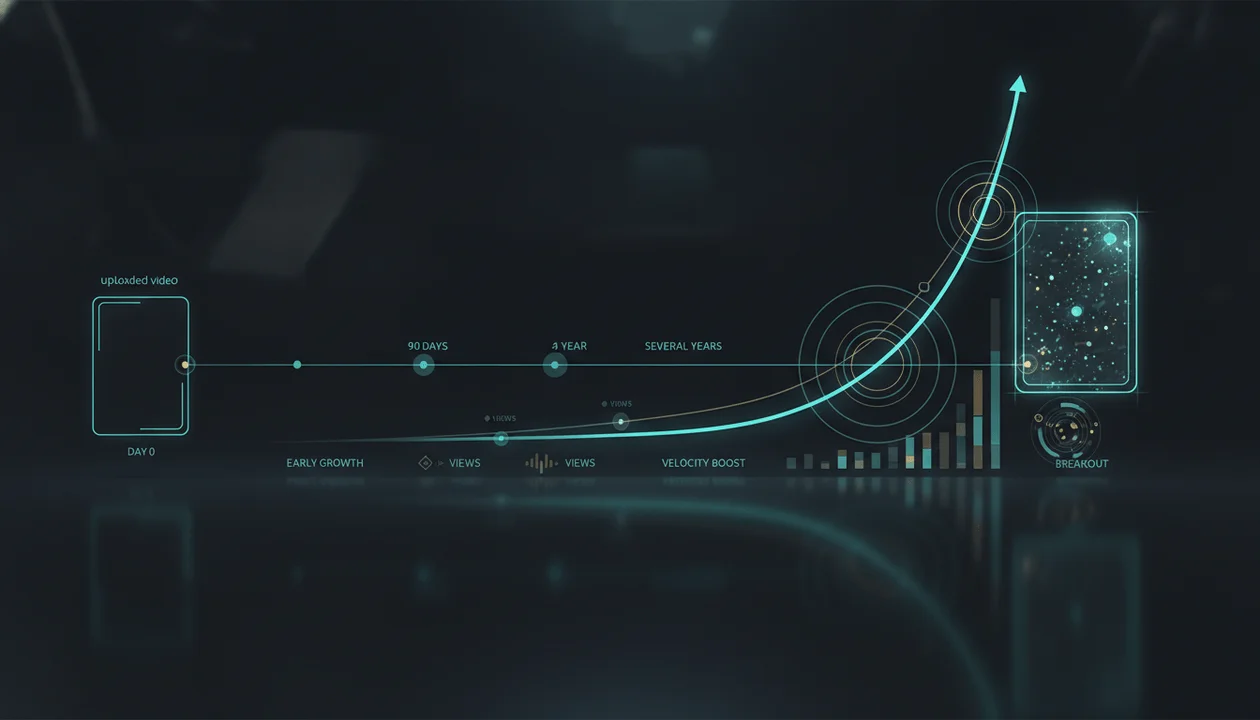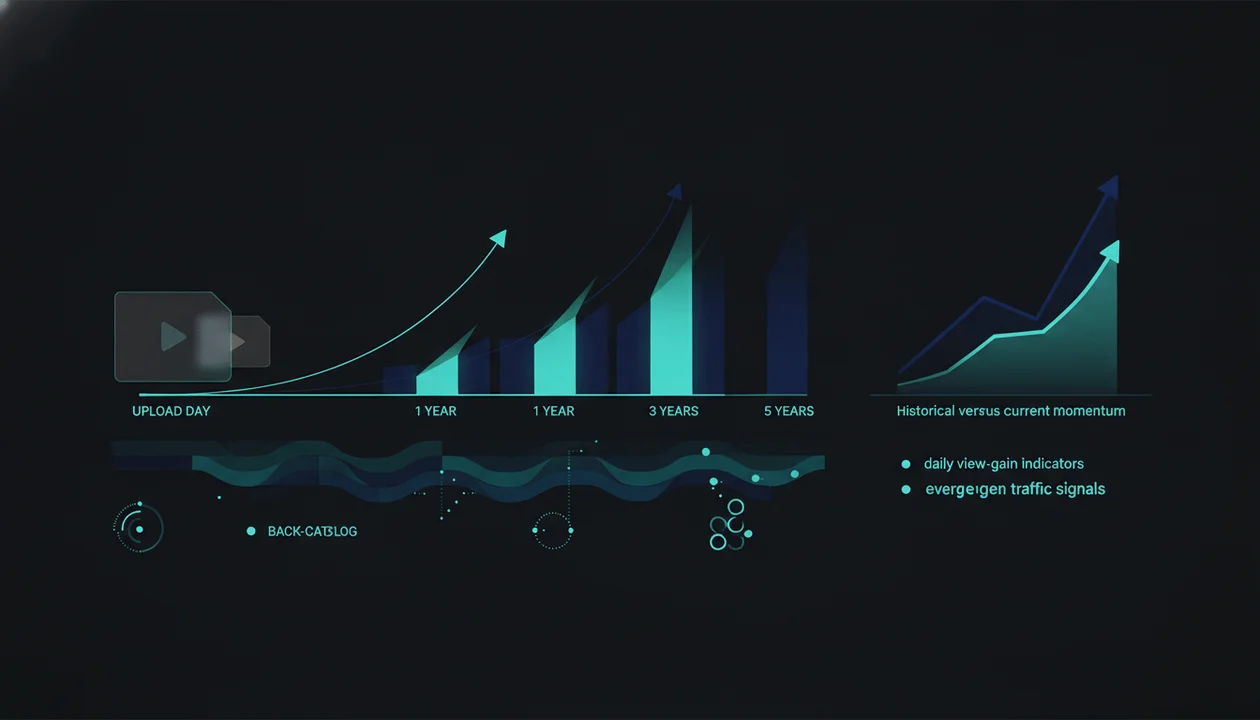
A YouTube video can look dead for months and still be worth watching.
Not by viewers.
By you.
Because one of the easiest mistakes in channel analysis is assuming that an old upload has stopped mattering simply because it disappeared from the recent-video feed.
We wanted to measure what actually happens.
OverseerOS tracked 726 long-form YouTube videos that were already more than one year old across 24 public channels.
These were not random forgotten uploads.
They were older videos already surfaced through OverseerOS channel research, which makes this a winner-heavy cohort. The median video had approximately:
3.33 million recorded views.
Its median age was:
888 days, or about 2.4 years.
We observed public view-count changes for a median of:
26.8 days.
And the result was clear.
Old successful YouTube videos were still gaining meaningful views years after publication.
Across the 726 videos:
- 97.4% gained additional recorded views during the observation window
- 63.4% were adding at least 100 views per day
- 44.8% were adding at least 1,000 views per day
- 16.1% were adding at least 10,000 views per day
- median recent gain was approximately 480 views per day
But there is an equally important second finding.
When we compared old winners against more recent videos from the same channels, old videos generally moved more slowly.
Among channels with enough old and recent observations to establish a current baseline:
- 1 to 2-year-old videos ran at a median 0.54x the channel's newer-video pace
- 2 to 3-year-old videos ran at 0.52x
- 3+ year-old videos ran at 0.27x
So the right conclusion is not:
Old YouTube videos never die.
And it is not:
Fresh videos always replace old ones.
It is:
A strong YouTube back catalog can keep producing meaningful attention for years, but old winners usually become a second traffic layer rather than outperforming the channel's current content as a group.
That changes how creators should think about historical winners.
Key Findings
- OverseerOS tracked 726 long-form videos more than one year old across 24 channels.
- Median video age was 888 days, approximately 2.4 years.
- The middle 50% ranged from approximately 522 to 1,948 days old, or about 1.4 to 5.3 years.
- Median tracking interval was 26.8 days.
- Median recorded views per old video were approximately 3.33 million.
- Median recent public view gain was approximately 480 views per day.
- 97.4% gained additional recorded views during the observation period.
- 92.8% gained at least 1 view per day.
- 86.8% gained at least 10 views per day.
- 63.4% gained at least 100 views per day.
- 44.8% gained at least 1,000 views per day.
- 16.1% gained at least 10,000 views per day.
- The cohort contained 438 videos more than two years old and 311 more than three years old.
- Even among videos more than three years old, substantial recent public view growth remained visible.
- However, old videos usually moved more slowly than newer videos from the same channels.
- Among comparable channels, only 40.4% of 1 to 2-year-old videos matched or exceeded the channel's newer-video median pace.
- That fell to 33.6% for 2 to 3-year-old videos and 30.0% for 3+ year-old videos.
- In 19 channels with enough tracked old and newer videos, old uploads accounted for a median 23.5% of the recent view gain inside the tracked set.
- The central result remained when we required longer 14-day and 21-day observation windows.
The Direct Answer
Do old YouTube videos still get views?
Yes, successful old videos can keep receiving meaningful views for years.
But this study does not mean 97% of every old video on YouTube is still active.
The older videos in this research were already visible in a channel-analysis research corpus, so historically strong videos are deliberately overrepresented.
The useful conclusion is narrower:
If a video was a meaningful historical winner, do not assume its value ended after the launch window.
Some old winners were still adding:
- hundreds of views per day
- thousands per day
- tens of thousands per day
years after publication.
At the same time, newer videos usually had the stronger median pace.
Old content can compound.
Fresh content still matters.
How We Analyzed the Data
This study uses repeated public YouTube view-count observations collected by OverseerOS.
The question was:
Do older successful YouTube videos continue gaining public views long after publication, and how does their recent pace compare with newer videos from the same channels?
Step 1: Keep the format consistent
We included only:
long-form videos longer than three minutes.
Short-form distribution behaves differently and was excluded.
Step 2: Require genuinely old videos
The primary study included videos that were already more than:
365 days old
at the latest observation.
That produced:
- 726 old videos
- 24 channels
The median age was:
888.4 days.
Step 3: Require repeated observations
A static total view count cannot tell you whether a video is still gaining views.
Each video needed:
- an earlier public view observation
- a later public view observation
- at least seven days between observations
- a latest usable observation between September 8 and September 11, 2026
The data used for the study was observed between:
August 12 and September 11, 2026.
The median usable observation interval was:
26.8 days.
Step 4: Calculate recent public view gain
For each video:
recent daily view gain = change in recorded public views ÷ elapsed days
This is observed recent public momentum.
It is not the same as:
total lifetime views ÷ video age
That second number is only a lifetime average.
Step 5: Remove backward-count observations
If a video's later public count was lower than its earlier count, we did not use it in the primary velocity cohort.
Public platform counts can occasionally be corrected.
We did not interpret a negative public change as real negative viewing.
The Most Important Limitation Comes First
This is not a random sample of all old YouTube uploads.
That matters enormously.
The older videos come from OverseerOS channel research, where high-performing historical videos are naturally more likely to appear.
So this article cannot tell you:
97.4% of every video older than one year still gets views.
That would be unsupported.
It can tell you:
Among 726 older long-form videos already important enough to appear in our channel-research cohort, continued public view growth was extremely common.
That is still strategically valuable.
Because when you analyze a competitor's old winner, or one of your own historical hits, the question is not:
What happens to the average forgotten YouTube upload?
It is:
Does proven historical content retain useful demand after freshness disappears?
The data says it often can.
Finding 1: The Median Old Winner Was Still Adding About 480 Views Per Day
Across all 726 videos older than one year:
median recent gain was:
479.8 views per day.
Remember that this is not lifetime views divided by age.
It comes from the actual change between repeated public observations.
That distinction matters.
A video could have 5 million lifetime views but currently gain almost nothing.
Another could have 800,000 lifetime views and suddenly be adding thousands per day.
Repeated observations let us distinguish those situations.
Finding 2: Nearly Half Were Still Adding at Least 1,000 Views Per Day
The distribution was surprisingly active.
| Recent observed view gain | Share of 1+ year-old videos |
|---|---|
| More than 0/day | 97.4% |
| At least 1/day | 92.8% |
| At least 10/day | 86.8% |
| At least 100/day | 63.4% |
| At least 1,000/day | 44.8% |
| At least 10,000/day | 16.1% |
For a historical winner, one year clearly did not represent an automatic expiration point.
But the distribution is also highly skewed.
Some old videos continued at very high rates.
Others were barely moving.
That is why looking only at the average would be misleading.
Finding 3: Multi-Year-Old Videos Could Still Be Highly Active
We then raised the age requirement.
| Minimum video age | Videos | Channels | Median recent views/day | At least 1,000/day |
|---|---|---|---|---|
| 1+ year | 726 | 24 | 480 | 44.8% |
| 2+ years | 438 | 17 | 1,337 | 52.7% |
| 3+ years | 311 | 14 | 1,143 | 51.8% |
| 5+ years | 197 | 8 | 2,033 | 58.9% |
At first glance, this table looks bizarre.
The oldest videos appear stronger.
Do not conclude:
Videos get more views as they age.
That is not what the data says.
The explanation is selection.
The further back we go, the more likely a video had to be an unusually important historical winner to remain inside this research cohort.
A mediocre seven-year-old upload is unlikely to appear.
An enormous seven-year-old hit is much more likely to.
So this table proves:
possibility and persistence.
It does not establish an age-performance curve.
That distinction is essential.
Finding 4: Old Videos Usually Moved Slower Than Newer Videos
The next test is more useful.
Instead of comparing a five-year-old winner from Channel A with a fresh upload from Channel B, we created a newer-video baseline inside the same channel.
For qualifying channels, we calculated the median recent daily gain among videos roughly:
31 to 365 days old.
Then we asked:
How fast is each older video moving relative to the newer-video median on its own channel?
1 to 2 years old
- videos: 228
- channels: 16
- median relative pace: 0.54x newer baseline
- matched or exceeded newer baseline: 40.4%
- reached at least 2x newer baseline: 26.8%
- reached at least 5x newer baseline: 17.1%
2 to 3 years old
- videos: 113
- channels: 11
- median relative pace: 0.52x
- matched or exceeded newer baseline: 33.6%
- reached at least 2x: 18.6%
- reached at least 5x: 8.8%
More than 3 years old
- videos: 240
- channels: 12
- median relative pace: 0.27x
- matched or exceeded newer baseline: 30.0%
- reached at least 2x: 22.9%
- reached at least 5x: 15.8%
Now the picture becomes much more realistic.
Old winners can continue accumulating substantial views.
But their typical current pace is lower than that of newer tracked content.
That is what you would expect from a healthy back catalog:
older videos keep working while newer content carries more of the current momentum.
The Best Mental Model Is a Two-Layer Channel
Think of a strong YouTube channel as having two traffic layers.
Layer 1: The active catalog
These are:
- recent uploads
- current breakouts
- fresh topics
- videos actively matching today's viewer demand
This is where much of the strongest current momentum tends to live.
Layer 2: The back catalog
These are:
- old winners
- evergreen videos
- recurring search answers
- videos resurfacing around renewed interest
- old series episodes
- content viewers discover after finding the channel
These videos may move more slowly individually.
But there can be many of them.
Together, they can remain strategically important.
Finding 5: Old Videos Supplied a Meaningful Share of Current Tracked Views
We isolated channels where we had at least:
- three tracked videos older than one year
- three tracked videos younger than one year
That produced:
19 channels.
Inside each channel, we summed recent observed daily view gain across the tracked old and new videos.
The median share attributable to videos older than one year was:
23.5%.
The middle 50% ranged from:
16.6% to 62.5%.
And in:
36.8% of those channels
the old-video group generated more recent view gain than the newer-video group inside the tracked set.
This is not the share of the channel's total YouTube traffic.
The research system does not contain every upload from every channel in this comparison.
It is the share inside the videos we tracked.
But it demonstrates why a creator's historical library should not automatically be treated as dead inventory.
One Old Winner Can Still Outrun the Current Baseline
The medians tell us old videos generally slow.
The tail tells us something else.
Among videos more than three years old:
30.0%
still matched or exceeded their channel's newer-video median pace.
And:
22.9%
were running at least:
2x
that newer-video baseline.
This is where competitor research becomes interesting.
Imagine you inspect a channel and find:
Video A
Published 30 days ago
Current pace: 2,000 views/day
Video B
Published four years ago
Current pace: 6,000 views/day
The second video's age is not evidence against it.
It is evidence that you need to ask why the underlying demand survived.
Why Old Videos Can Matter More Than Their Current View Rate
Recent views are only one signal.
An old winner can still teach you about:
- durable audience problems
- evergreen questions
- recurring fears or desires
- search demand
- repeatable formats
- historical packaging
- content with unusual shelf life
This is why our research into old viral YouTube topics treated historical winners as evidence rather than expired ideas.
The video itself can continue working.
And even after its own velocity slows, the underlying demand may remain useful for future videos.
Those are separate forms of value.
Finding 6: The Result Survived Longer Tracking Windows
Short observation windows can exaggerate temporary spikes.
So we reran the old-video analysis while requiring progressively longer tracking periods.
| Minimum tracking period | Old videos | Channels | Median recent views/day | Positive growth | At least 100/day | At least 1,000/day |
|---|---|---|---|---|---|---|
| 7+ days | 726 | 24 | 480 | 97.4% | 63.4% | 44.8% |
| 14+ days | 619 | 20 | 229 | 96.9% | 59.6% | 39.6% |
| 21+ days | 546 | 17 | 159 | 96.5% | 55.7% | 33.3% |
The longer-window samples produced lower median velocity.
That is important.
A short burst looks bigger when measured briefly.
But the central finding survived.
Even after requiring at least:
21 days
between observations, more than half of these old winner videos were still adding at least:
100 public views per day.
And one-third were adding at least:
1,000 per day.
Old Videos Are Not Automatically Evergreen
This is where terminology gets sloppy.
An old video is not necessarily evergreen.
A video can remain public for six years and receive almost no attention.
Likewise, a fresh video can be built around evergreen demand even though it is only a week old.
A better definition is behavioral.
Evergreen content demonstrates:
continued usefulness or demand after launch freshness disappears.
Our earlier analysis of evergreen YouTube content looked at mature channel-relative outliers months after publication.
This study adds another layer:
actual recent public view gain from videos that are years old.
The two tests answer different questions.
Age Is Not the Same as Strategic Relevance
A creator researching competitors can easily make this mistake:
This video is from 2021, so I should ignore it.
That throws away information.
Instead, ask:
Is it still gaining views?
If yes, the demand may still be active.
Was it unusually successful for the channel?
If yes, it deserves more weight.
Are newer videos covering the same underlying demand?
If yes, the market may still be validating it.
Have independent channels also succeeded?
If yes, it is less likely to be a one-creator anomaly.
Has the information changed?
If yes, an updated treatment may be more useful than a direct repeat.
That is a much better filter than publication year alone.
Should You Revisit an Old Video That Starts Getting Views Again?
Potentially.
But do not assume the best response is:
remake the same video immediately.
First diagnose what changed.
A renewed old-video signal can mean the audience is interested in:
- the exact subject
- a broader topic
- a person or company mentioned
- a recurring event
- a question the video answers
- a series or format
- a new development related to the old subject
Your next video should respond to the demand, not blindly duplicate the asset.
The Old-Video Opportunity Framework
When an older winner shows life, run these five checks.
1. Current Velocity
Is the video actually gaining views now?
Not:
It has 4 million views.
But:
How many new public views is it adding?
This is why the distinction in our YouTube view velocity study matters.
Total views reveal accumulated success.
Velocity reveals current movement.
2. Historical Outlier Strength
Was the video genuinely exceptional for the channel?
A 2-million-view video on a channel where everything gets 3 million is different from a 2-million-view video on a channel that usually gets 80,000.
3. Topic Durability
Does the audience problem still exist?
Evergreen topics often survive longer than time-sensitive information.
4. Current Cross-Channel Evidence
Are other relevant creators getting unusual results around similar demand?
One resurfacing old video is interesting.
Several independent current winners are stronger.
5. New Information Gain
Can your new video add something?
Possible additions:
- updated evidence
- new consequences
- a modern case
- a stronger explanation
- a different audience
- a new point of view
- a current comparison
The fact that old demand exists does not mean viewers need the same video again.
The Difference Between an Old Winner and a Dead Winner
Use this matrix.
| Historical performance | Recent movement | Interpretation |
|---|---|---|
| Strong | Strong | Active evergreen or revived winner |
| Strong | Moderate | Valuable back-catalog asset |
| Strong | Near zero | Historical evidence, validate current demand |
| Weak | Strong | Possible revival or new external demand |
| Weak | Weak | Low-priority research signal |
The critical mistake is looking at only:
historical performance
or only:
current velocity.
You need both.
What Creators Should Do With Their Own Back Catalog
Your own channel gives you more information than competitor research ever can.
Public research can show:
- title
- thumbnail
- views
- age
- recent public count changes
Your private analytics can show much more.
When reviewing an old winner, ask:
- Is it still getting meaningful views?
- Where are those views coming from?
- Is the viewer intent still relevant?
- Are viewers continuing into other videos?
- Has the topic become newly important?
- Is there a natural follow-up?
- Does the old packaging still represent the video accurately?
The public-data findings tell you old winners deserve inspection.
Your own analytics determine what to do next.
What Competitor Researchers Should Do Differently
The usual workflow is:
- Open competitor.
- Look at recent videos.
- Ignore anything older than a year.
- Pick an idea.
That can miss durable demand.
A stronger workflow is:
Pass 1: Recent winners
Find:
- current outliers
- fresh breakouts
- changing formats
- active momentum
Pass 2: Historical winners
Find:
- giant old hits
- recurring evergreen subjects
- durable formats
- videos that still appear strategically relevant
Pass 3: Current movement on old winners
Ask:
Which historical videos are still gaining meaningful attention now?
That final step separates:
museum pieces
from:
living assets.
A Practical Back-Catalog Audit
Create a sheet with these columns:
| Field | Why it matters |
|---|---|
| Video | Identify the asset |
| Publish date | Establish age |
| Total views | Historical scale |
| Previous observed views | Starting snapshot |
| Current observed views | Latest snapshot |
| Recent views/day | Current movement |
| Channel-relative performance | Historical abnormality |
| Topic | Underlying demand |
| Current confirmation | Is the market still validating it? |
| Action | Keep watching / follow up / update idea / ignore |
Do this for:
- your biggest historical winners
- your strongest evergreen videos
- unexpected old videos showing new movement
You do not need to monitor every upload.
You need to identify the old videos that still contain live information.
How to Apply This With OverseerOS
Start with the OverseerOS YouTube Channel Analyzer.
Separate the channel into:
- recent uploads
- historical winners
- unusual outliers
- recurring topic patterns
The goal is not just to see which video has the largest view count.
You want to understand:
what historically worked and what still appears strategically useful now.
Then widen the research.
Use relevant competitor channels to see whether the same underlying audience demand is appearing elsewhere.
If an old winner is still meaningful and newer channels are also validating the subject, the opportunity becomes much stronger.
When a direction passes that test, move the original angle into the OverseerOS Content Planner with its source evidence attached.
Historical research should survive into production.
Otherwise, by the time you write the script, you are back to guessing.
Do Not Refresh an Old Video Just Because It Is Old
Age is not a strategy.
A four-year-old video that still serves viewers does not automatically need intervention.
And an old video with no current demand does not automatically become valuable because you change:
- the title
- thumbnail
- description
- chapters
Start with evidence.
The question is:
Is this asset still connected to active demand?
If yes, investigate.
If no, your time may be better spent producing something new.
Do Not Judge Your Back Catalog Only by Total Views
Imagine two old videos.
Video A
Age: 4 years
Total views: 5 million
Recent gain: 40 views/day
Video B
Age: 3 years
Total views: 900,000
Recent gain: 4,000 views/day
Which deserves attention today?
Video A is the bigger historical winner.
Video B is the stronger current signal.
That is why a good channel audit needs both:
total views
and:
recent movement.
Why This Matters for YouTube Content Strategy
A channel with a strong back catalog is not starting each upload from zero.
It has:
- historical proof
- old discovery surfaces
- existing viewer entry points
- topics that may continue attracting attention
- a library viewers can explore after discovering one video
That can create compounding behavior.
New videos create new opportunities.
Old winners keep some previous opportunities alive.
The healthiest content strategy understands both.
Limitations
This study has important limitations.
The sample is winner-heavy
This is the biggest limitation.
Older videos stored through the channel-research workflow are disproportionately likely to be historically high-performing videos.
Therefore:
the study does not estimate what percentage of all old YouTube uploads continue getting views.
It measures a selected set of older videos already relevant to channel research.
Only 24 channels were represented in the 1+ year cohort
The study contains 726 videos, but those videos come from 24 channels.
Videos from the same channel are not independent.
The results should not be interpreted as a platform-wide census.
Channel representation differs by age bucket
Only eight channels contributed videos to the 5+ year threshold.
Those extremely old-video statistics are proof that substantial long-tail activity can exist, not a universal five-year benchmark.
The research covers long-form videos
Short-form uploads were excluded.
Do not generalize the exact percentages to Shorts.
Observation windows were not identical
The median tracking period was 26.8 days.
We normalized changes into daily rates and repeated the analysis using 14-day and 21-day minimum observation windows.
But perfectly identical observation windows would still be cleaner.
Public views do not reveal traffic sources
We cannot tell whether an old competitor video is receiving views from:
- search
- Home
- Suggested
- external traffic
- playlists
- a new related upload
Only the channel owner can see that private traffic-source breakdown.
Public velocity does not explain why a video is moving
A video gaining views does not tell us what caused the gain.
Possible explanations include topic demand, packaging, recommendations, external events and channel discovery.
Historical selection makes direct age comparisons inappropriate
The 5+ year cohort looked unusually strong because only exceptional old videos tend to remain visible in a research-selected historical set.
Do not interpret that as evidence that videos improve with age.
Association is not causation
Nothing here shows that being old causes a video to keep getting views.
The study describes continued public view accumulation among selected older successful videos.
Final Verdict
Do old YouTube videos still get views?
Successful ones absolutely can.
OverseerOS tracked 726 long-form videos already more than one year old across 24 channels.
The median video was:
2.4 years old
with approximately:
3.33 million recorded views.
During the observation period, the median old winner was still adding around:
480 views per day.
And:
- 63.4% gained at least 100 views per day
- 44.8% gained at least 1,000 per day
- 16.1% gained at least 10,000 per day
But the same-channel comparison adds the necessary reality check.
Old videos generally moved slower than newer content.
Their median current pace was roughly:
- 0.54x the newer-video baseline at 1 to 2 years old
- 0.52x at 2 to 3 years
- 0.27x after 3 years
So the strongest conclusion is not:
Old content beats new content.
It is:
Strong old content can keep compounding long after launch, while fresh uploads continue carrying more of the typical current momentum.
That makes your back catalog more than an archive.
It is a second layer of the channel.
Do not ignore an old video because of its date.
Check whether it is still moving.
Check whether the topic is still alive.
Check whether other channels confirm the demand.
Then decide whether that old winner is:
history, evergreen traffic, or the beginning of your next video idea.
FAQ
Do old YouTube videos still get views?
Yes. In this winner-heavy OverseerOS research cohort, 726 videos more than one year old were tracked over repeated public view observations. The median was still gaining approximately 480 views per day.
Can YouTube videos still get views after one year?
Yes. Among the selected 1+ year-old videos in this study, 63.4% were gaining at least 100 public views per day during the observation period.
Can a YouTube video still get views after three years?
Yes. The study contained 311 videos more than three years old that were still part of the active tracked research cohort. Some were accumulating substantial new public views.
Can old YouTube videos start getting views again?
They can show renewed public view growth. Public data alone cannot tell whether that growth is a true revival, continuous evergreen traffic or another traffic-source change, so repeated observations and private analytics are needed to diagnose the cause.
Do YouTube videos stop getting views after a certain amount of time?
This study found no fixed age at which a successful video must stop gaining views. Videos several years old were still accumulating public views.
How many views per day can an old YouTube video get?
There is no universal benchmark. In this selected historical-winner cohort, the median 1+ year-old video gained about 480 views per day, while 44.8% gained at least 1,000 per day. These figures should not be generalized to random YouTube uploads.
Are old YouTube videos evergreen?
Not automatically. Age and evergreen performance are different. An evergreen video demonstrates continued demand after launch freshness disappears.
Are newer YouTube videos better than old ones?
For current momentum, newer tracked videos generally had the stronger median pace in this study. Older winners still contributed meaningful traffic but typically ran below the same channel's newer-video median.
What percentage of old YouTube videos still get views?
This study cannot answer that for all YouTube uploads because the old-video cohort is deliberately winner-heavy. It can only describe the selected older videos analyzed by OverseerOS.
Should I ignore competitor videos older than one year?
No. Treat age as context, not a disqualifier. Check the video's historical outperformance, current movement, topic durability and whether newer independent videos confirm the same demand.
Should I remake an old viral YouTube video?
Not automatically. Identify the audience demand behind the old winner, check whether it is still active and create a new reason for viewers to care rather than copying the original execution.
How can I tell if an old YouTube video is still performing?
Compare its public view count at two different times. The difference divided by elapsed days gives you a simple recent public view-gain estimate.
Is total view count enough to evaluate an old video?
No. Total views show historical scale. Recent public view gain tells you whether the video is still moving now.
Why would an old YouTube video still be useful for competitor research?
An old winner can reveal durable audience demand, evergreen subjects, historically strong formats and topics that may still be active today. Its value increases when recent videos or independent channels confirm the same demand.
Should I analyze old and new competitor videos separately?
Yes. Recent videos are better for understanding current strategy. Historical winners are better for understanding proven demand. Comparing both gives you a much clearer view of the channel.
What should I do when an old video suddenly starts gaining views?
Investigate the underlying topic first. Check whether related videos are also gaining attention, whether the subject has become timely again and whether there is a genuinely new follow-up worth making.