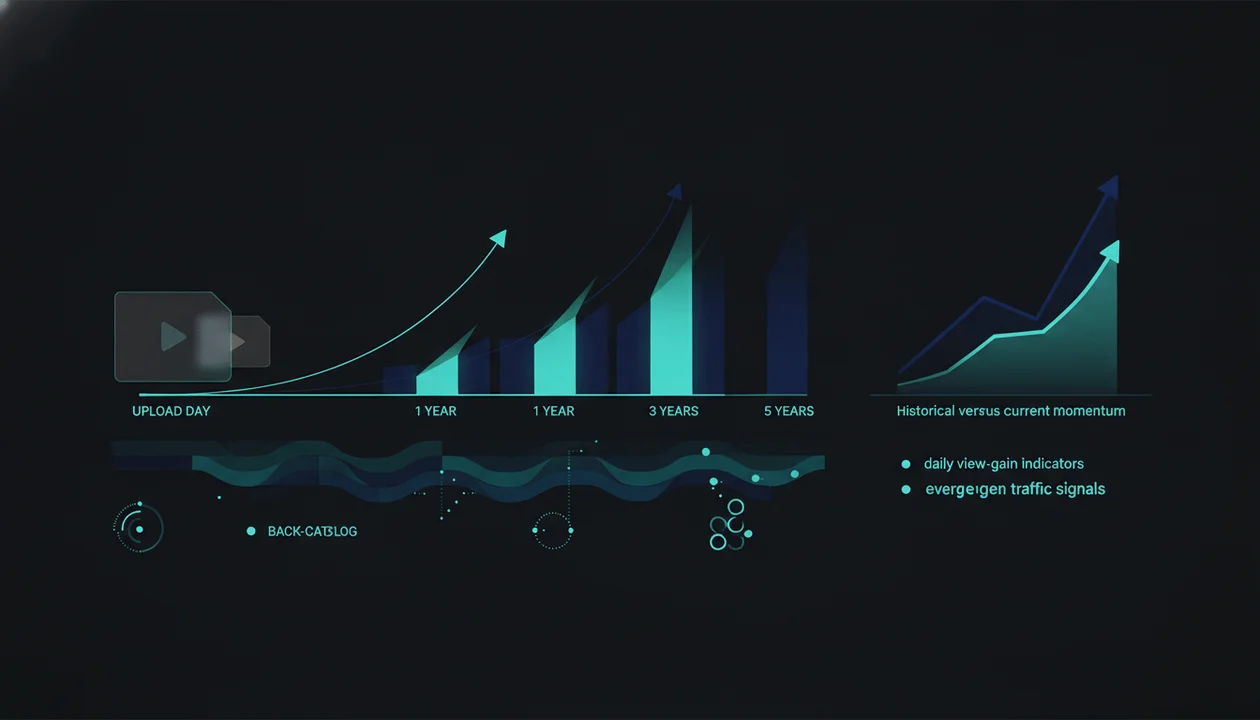
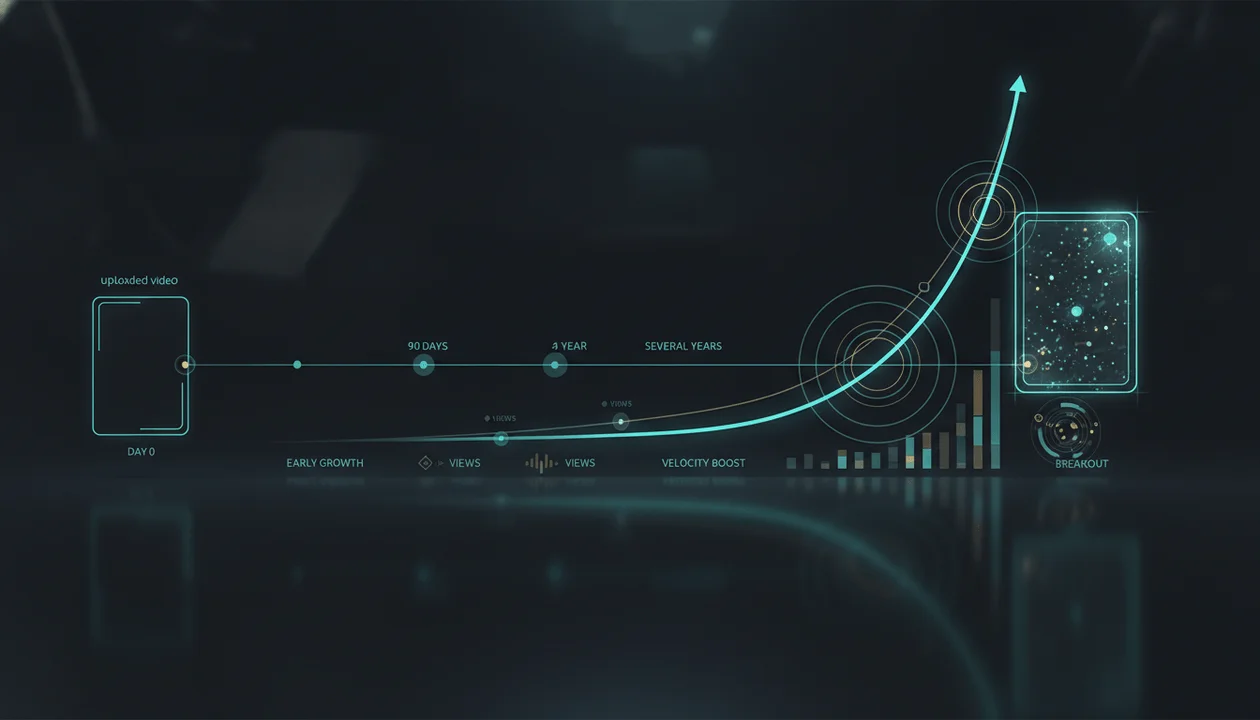
A YouTube video does not always reveal its full potential in the first 24 hours.
Or the first week.
Or even the first few months.
Creators see this happen often enough to ask a surprisingly important question:
Can a YouTube video go viral months later?
Yes, an older YouTube video can accelerate long after publication.
But our data suggests there is an important difference between:
an old video continuing to get views
and:
an old video suddenly taking off.
OverseerOS tracked 367 long-form YouTube videos that were already at least 90 days old across 12 public channels.
Each video had:
- at least four public view-count observations
- at least seven days between its first and last usable observation
- observations collected from August 28 through September 11, 2026
- enough repeated data to compare its earlier view pace with its later view pace
The median video was approximately:
569 days old, or 1.6 years.
The median tracking window was:
13.4 days.
And the median video had:
12 separate public observations.
The first finding was encouraging.
47.7% of the older videos were gaining views faster in the second half of the tracking window than in the first half.
So older videos accelerating was not unusual.
But major acceleration was much rarer.
Only:
9.0%
increased their recent view pace by at least 50% while reaching at least 100 views per day.
Only:
3.8%
at least doubled their pace while reaching 100+ views per day.
And only:
2.2%
at least doubled their pace while reaching 1,000+ views per day.
The strongest group was even more interesting.
7 of 367 videos, or 1.9%, doubled their recent pace and finished the later observation period above 10,000 views per day.
Three of those videos were already more than two years old.
Two were more than three years old.
The oldest was approximately:
10.7 years old.
So yes, late acceleration is real.
But there is another finding creators should pay just as much attention to.
Those seven high-velocity resurgences were not dead videos suddenly jumping from zero.
Their median earlier pace was already approximately:
6,728 views per day.
Their later median pace increased to approximately:
17,608 views per day.
In our short observation window, we found:
- no video under 100 views/day suddenly jumping above 1,000/day
- no video under 500/day suddenly jumping above 5,000/day
- no video under 1,000/day suddenly jumping above 10,000/day
That gives us a much more useful answer than the usual creator folklore.
A YouTube video can take off months or even years later, but measurable late breakouts appear to be uncommon. In this sample, the strongest resurgences usually looked like acceleration of videos that already had active demand, not resurrection from complete inactivity.
Key Findings
- OverseerOS tracked 367 long-form videos at least 90 days old.
- The videos came from 12 public YouTube channels.
- Median video age was 569.3 days, about 1.6 years.
- Median tracking window was 13.4 days.
- Median number of public observations per video was 12.
- 47.7% gained views faster in the second half of the observation period.
- 9.0% accelerated by at least 1.5x and finished at 100+ views/day.
- 3.8% accelerated by at least 2x and finished at 100+ views/day.
- 2.2% accelerated by at least 2x and finished at 1,000+ views/day.
- 7 videos, or 1.9%, doubled their pace and finished above 10,000 views/day.
- Those seven videos came from 3 channels.
- Their median earlier pace was approximately 6,728 views/day.
- Their median later pace was approximately 17,608 views/day.
- Three of the seven were more than two years old.
- Two were more than three years old.
- The oldest was approximately 3,922 days old, about 10.7 years.
- We observed no case where a video moving below 100 views/day suddenly jumped above 1,000/day during this short tracking window.
- The result remained directionally similar when we required longer observation histories.
The Direct Answer
Can a YouTube video go viral later?
Yes.
An older video can gain momentum months or years after publication.
But "viral" has no single universal public threshold.
A video gaining 20,000 views per day may be extraordinary for one channel and ordinary for another.
So instead of pretending there is one viral number, this study measured:
change in recent public view velocity.
The question became:
Is the older video gaining views materially faster now than it was earlier in the tracking period?
That lets us identify late acceleration without inventing a universal definition of virality.
The practical result is:
| Late-video behavior | Share of 367 older videos |
|---|---|
| Any acceleration | 47.7% |
| 1.5x+ acceleration and 100+ views/day | 9.0% |
| 2x+ acceleration and 100+ views/day | 3.8% |
| 2x+ acceleration and 1,000+ views/day | 2.2% |
| 2x+ acceleration and 10,000+ views/day | 1.9% |
Acceleration was common.
Large acceleration was not.
That is the distinction creators need.
How We Measured a Late YouTube Takeoff
This study uses repeated public YouTube view-count observations collected by OverseerOS.
We did not estimate momentum from:
total views ÷ video age
because lifetime average views per day can hide what is happening now.
Instead, we measured actual changes between public snapshots.
Step 1: Require an older video
A video had to be at least:
90 days old
at its latest observation.
That removes the immediate launch period.
Step 2: Keep the format consistent
We included only:
long-form videos longer than three minutes.
Shorts were excluded because their distribution behavior can be very different.
Step 3: Require repeated observations
Each video needed:
- at least four observations
- at least seven days between its earliest and latest usable observation
- public counts collected from August 28 onward
The final videos had a median of:
12 observations each.
Step 4: Split the observation period in half
For each video, we divided its personal tracking window into:
earlier half
and:
later half.
We then calculated a public daily view-gain rate inside each period.
Conceptually:
earlier velocity = views gained in early period ÷ elapsed days
later velocity = views gained in later period ÷ elapsed days
Step 5: Compare the two rates
If later velocity exceeded earlier velocity:
the video was:
accelerating.
We then added stricter thresholds to separate tiny fluctuations from strategically interesting movement.
Why "Any Acceleration" Is Not the Same as Going Viral
Almost half the videos accelerated.
That sounds enormous.
But a change from:
20 views/day
to:
23 views/day
is technically acceleration.
It is not a breakout.
That is why the stronger thresholds matter.
Loose acceleration
Later pace > earlier pace
Result:
47.7%
Meaningful acceleration
Later pace at least 1.5x earlier pace and at least 100 views/day
Result:
9.0%
Strong acceleration
Later pace at least 2x earlier pace and at least 100 views/day
Result:
3.8%
High-velocity resurgence
Later pace at least 2x earlier pace and at least 1,000 views/day
Result:
2.2%
Very high-velocity resurgence
Later pace at least 2x earlier pace and at least 10,000 views/day
Result:
1.9%
The stricter the definition becomes, the rarer the phenomenon becomes.
That is exactly what we should expect.
Finding 1: Nearly Half of Older Videos Changed Direction Upward
Among 367 videos:
175
were gaining views faster in the second half of the observation window.
That is:
47.7%.
This immediately tells us that old-video performance is not always static.
A video's current pace can:
- increase
- decrease
- flatten
- reaccelerate
after the original launch period has passed.
That is why looking only at total lifetime views hides useful information.
A 2-million-view video is not one fixed thing.
It could be:
still accelerating
or:
nearly stopped.
Those are radically different strategic signals.
Finding 2: Strong Late Takeoffs Were Real but Rare
The 2x threshold gives us a better approximation of a meaningful change.
Only:
3.8%
of the older videos doubled their recent pace while also finishing above:
100 views per day.
That is approximately:
1 in 26 videos.
Raise the late pace requirement to:
1,000 views per day
and the rate falls to:
2.2%.
That is closer to:
1 in 46.
So creators should not build a strategy around waiting for every underperforming upload to magically wake up later.
Delayed acceleration exists.
It is not the default outcome.
Finding 3: Seven Older Videos Doubled Into 10,000+ Views Per Day
The strongest subgroup contained:
7 videos.
They simultaneously:
- were at least 90 days old
- at least doubled their earlier observed pace
- reached at least 10,000 recent views per day
That is:
1.9% of the sample.
Their age distribution proves that delayed acceleration is not limited to videos just outside the launch window.
The median was approximately:
316 days old.
Three were more than:
one year old.
All three of those were also more than:
two years old.
Two were more than:
three years old.
And the oldest was approximately:
10.7 years old.
A video can be ancient by internet standards and still experience meaningful new momentum.
Finding 4: The Biggest Resurgences Were Already Alive
This is the most important corrective finding.
The seven strongest accelerations had a median earlier pace of approximately:
6,728 views per day.
Their later median pace reached:
17,608 views per day.
They were not dormant.
They accelerated from:
already active
to:
much more active.
That is different from the story many creators hope for:
"My video got 37 views, died for six months, then suddenly exploded to millions."
That type of event may happen.
But we did not observe that pattern in this short measurement window.
Among the 367 older videos:
zero
went from below 100/day in the earlier half to at least 1,000/day in the later half.
Zero went from:
below 500/day
to:
5,000+/day.
Zero went from:
below 1,000/day
to:
10,000+/day.
That makes the evidence more useful.
The strongest near-term signal of a late breakout may be acceleration in a video that is already moving, not a completely flat video suddenly coming back from zero.
Do Not Confuse "Slow Start" With "Dead Video"
There are at least four different trajectories creators casually call "dead."
1. Slow but steady
The video never spikes.
It gains:
- 50 views today
- 70 tomorrow
- 90 next week
- 120 later
Over months, it becomes meaningful.
2. Initial spike, then long tail
The video gets most of its views early but keeps producing smaller traffic later.
This is classic back-catalog behavior.
3. Active video that reaccelerates
The video is already gaining views.
Then its pace increases sharply.
This is the strongest resurgence pattern we directly observed.
4. True dormant resurrection
The video barely moves for a long period.
Then suddenly explodes.
That is the dramatic scenario creators mean when they say:
"An old video went viral."
Our data does not prove it never happens.
It proves that in this measured cohort, it was much rarer than simple acceleration among already-active videos.
Finding 5: Video Age Did Not Produce a Simple Expiration Rule
We segmented the 367 videos by age.
| Video age | Videos | Channels | Any acceleration | 2x+ and 100+/day |
|---|---|---|---|---|
| 90-180 days | 81 | 9 | 34.6% | 4.9% |
| 180-365 days | 59 | 6 | 59.3% | 10.2% |
| 1-2 years | 67 | 7 | 41.8% | 0.0% |
| 2-3 years | 36 | 5 | 44.4% | 2.8% |
| 3+ years | 124 | 7 | 54.8% | 2.4% |
These groups are small and channel-clustered.
Do not read them as a universal age-performance curve.
The important finding is simpler:
acceleration appeared in every age group.
Even the 3+ year cohort contained strong velocity increases.
So rules such as:
"If it did not work in 30 days, it never will."
are too simplistic.
Finding 6: The Result Survived Stricter Tracking Requirements
Maybe four observations over seven days are not enough.
So we raised the bar.
Primary cohort
Minimum:
- 4 observations
- 7 tracking days
Result:
- 367 videos
- 12 channels
- any acceleration: 47.7%
- 1.5x + 100/day: 9.0%
- 2x + 100/day: 3.8%
- 2x + 1,000/day: 2.2%
Stricter cohort
Minimum:
- 5 observations
- 10 tracking days
Result:
- 287 videos
- 10 channels
- any acceleration: 49.5%
- 1.5x + 100/day: 6.3%
- 2x + 100/day: 2.4%
- 2x + 1,000/day: 2.4%
Strictest sensitivity check
Minimum:
- 6 observations
- 12 tracking days
Result:
- 246 videos
- 7 channels
- any acceleration: 51.2%
- 1.5x + 100/day: 6.9%
- 2x + 100/day: 2.8%
- 2x + 1,000/day: 2.8%
The exact percentages move because the cohorts change.
But the pattern remains:
small accelerations are common. Large delayed accelerations are real but uncommon.
Finding 7: Delayed Acceleration Appeared Across Multiple Channels
The 367-video cohort represented:
12 channels.
At least one video meeting our 1.5x + 100/day acceleration threshold appeared in:
58.3% of those channels.
At least one 2x + 100/day acceleration appeared in:
41.7%.
And at least one video doubling into 1,000+ views/day appeared in:
33.3% of channels.
The number of channels is small.
So these are not platform benchmarks.
But they show that late acceleration was not isolated to one strange creator.
Can a Video That Flopped at First Go Viral Later?
It is possible.
But this study cannot give a clean probability for:
initial flop → months of inactivity → viral breakout.
Why?
Because our observation system begins long after many of these videos were published.
We know:
- their current public counts
- their recent movement
- their age
We do not possess a complete day-by-day public history stretching from publication through the present for every video.
So we cannot reconstruct exactly:
- what happened on day 1
- what happened on day 7
- how long a video was dormant
- when every historical acceleration began
That means the article can answer:
Can older videos accelerate later?
Yes.
It cannot honestly claim:
X% of failed YouTube videos eventually go viral.
We do not have the dataset required for that statement.
Why Would an Old Video Start Growing Again?
Public view data can show that acceleration happened.
It cannot show the cause.
Possible explanations creators should investigate include:
The topic became relevant again
A subject can return because of:
- news
- a product launch
- cultural interest
- a sequel
- a controversy
- a seasonal event
- a new discovery
New viewers found the channel
A recent successful video can send viewers backward into the catalog.
A related video created new demand
A new installment can make an older video newly useful.
The package became more competitive
Creators sometimes update:
- title
- thumbnail
- description
Public data alone cannot prove whether that change caused the acceleration.
Search demand changed
An old answer can become valuable again when more people ask the question.
Recommendation traffic changed
A video may begin reaching a different audience.
Again, competitor-side public data cannot reveal the exact traffic-source mechanism.
Only the channel owner can see that inside private analytics.
The Best Signal Is Not Age. It Is Acceleration.
Suppose two competitor videos are both two years old.
Video A
Total views:
4 million
Earlier observed pace:
80 views/day
Later observed pace:
60 views/day
Video B
Total views:
900,000
Earlier observed pace:
3,000 views/day
Later observed pace:
9,000 views/day
If you sort by total views:
Video A looks more important.
If you are looking for:
what is becoming important now
Video B is far more interesting.
This is why the distinction in our YouTube view velocity study matters.
Historical scale and current movement are different dimensions.
A Better Way to Spot a Late YouTube Breakout
Use four layers.
Layer 1: Video age
Is the video old enough that launch momentum no longer explains everything?
A 90+ day threshold is a useful starting point for research.
It is not a YouTube rule.
Layer 2: Current view velocity
How many public views is it adding now?
You need repeated snapshots to answer this properly.
Layer 3: Acceleration
Is that rate increasing?
A video gaining 5,000/day for months is active.
A video moving from:
5,000/day → 15,000/day
is active and accelerating.
The second deserves more immediate investigation.
Layer 4: Channel-relative context
Is the pace unusual for this particular creator?
That is where acceleration becomes more strategically useful.
The Late Breakout Matrix
Use this simple interpretation framework.
| Earlier pace | Later pace | Meaning |
|---|---|---|
| Low | Low | Dormant or slow long tail |
| High | Similar | Sustained winner |
| High | Lower | Cooling winner |
| Moderate | Higher | Potential resurgence |
| High | Much higher | Strong current acceleration |
| Near zero | Extremely high | True resurrection, verify carefully |
Our strongest observed group was mainly:
high → much higher.
We saw far less evidence of:
near zero → extremely high.
What Should You Do If an Old Video Starts Accelerating?
Do not immediately upload:
the exact same video again.
First understand the signal.
1. Confirm the acceleration
One day can be noise.
Use several observations.
Ask whether the pace is:
- rising
- sustained
- fading
2. Identify the underlying demand
Why would viewers care about this subject now?
Separate:
topic
from:
old execution.
3. Check your other videos
Are related videos also moving?
One accelerating upload is a clue.
A cluster is stronger.
4. Check competitors
Are other channels seeing movement around the same demand?
Independent confirmation can turn:
channel anomaly
into:
market signal.
5. Decide whether a follow-up adds something
Possible follow-ups:
- update
- sequel
- new consequence
- different case
- beginner version
- advanced version
- retrospective
- new evidence
The best next video usually extends the demand.
It does not simply reproduce the old asset.
Should You Change the Thumbnail on an Old Video?
Not automatically.
An accelerating old video is already receiving some form of current attention.
Changing the package during that movement introduces another variable.
If it belongs to your own channel, inspect private data first:
- impressions
- CTR
- traffic sources
- retention
- current daily views
A thumbnail change makes more sense when you have evidence that:
the video is being offered but not being chosen.
Do not treat thumbnail replacement as a ritual for every old upload.
Should You Delete and Reupload a Video That Never Took Off?
Usually, a weak launch alone is not evidence that deletion is necessary.
A video can retain future discovery potential.
And our data shows that older videos can continue changing direction long after publication.
That does not mean:
never delete anything.
There can be valid reasons to remove a video.
But:
"It did not go viral quickly"
is not, by itself, proof that the asset can never matter again.
How Long Should You Wait Before Calling a YouTube Video Dead?
There is no universal day.
This dataset alone disproves the idea that one fixed age determines whether movement is possible.
We observed acceleration among videos that were:
- 3 months old
- 6 months old
- 2 years old
- 3+ years old
- more than 10 years old
But there is an important difference between:
possible
and:
probable.
Only a small minority produced the kind of large acceleration most creators would notice as a genuine resurgence.
So do not wait passively for every weak video to wake up.
Keep publishing.
Keep researching.
Treat old-video revival as upside, not the base strategy.
What Our Previous Old-Video Study Adds
Our broader analysis of whether old YouTube videos still get views found that successful historical videos could keep accumulating meaningful public views years after publication.
That study answered:
Do old winners keep working?
This study asks a different question:
Can their current pace increase later?
The answer is also yes.
But the frequency drops sharply as we demand stronger acceleration.
That is why:
long-tail traffic
and:
late breakout
should not be treated as the same phenomenon.
The Three Types of Old-Video Value
Creators should classify old videos into three groups.
1. Historical proof
The video may no longer move much.
But it proves that a topic or format once generated unusually strong demand.
2. Evergreen traffic
The video keeps accumulating views at a steady rate.
This is a back-catalog asset.
3. Current resurgence
The recent pace is increasing materially.
This is the most urgent research signal.
One video can move between these categories over time.
That is why a channel library should be treated as:
dynamic evidence
rather than an archive.
How to Use This for Competitor Research
Suppose a competitor has:
300 videos.
Do not only sort by:
Most Popular.
That finds historical winners.
And do not only study:
Latest.
That finds current uploads.
Add a third research question:
Which older videos are accelerating right now?
That group can expose:
- returning topics
- evergreen demand
- resurgent stories
- new cultural relevance
- renewed audience interest
It is information neither static list gives you cleanly.
How to Apply This With OverseerOS
Start with the OverseerOS YouTube Channel Analyzer to understand the channel's broader performance context.
Separate:
- historical winners
- recent uploads
- current outliers
- recurring topics
Then monitor important public signals rather than treating one view count as permanent.
Use the OverseerOS Viral Channel Finder to check whether relevant channels are seeing similar breakout behavior.
If an old topic is accelerating on one competitor and related demand is appearing elsewhere, the case becomes much stronger.
Finally, move validated opportunities into the OverseerOS Content Planner with the original evidence attached.
The workflow is:
detect movement → validate demand → create an original angle → produce
not:
find viral video → copy viral video.
The Old-Video Resurgence Checklist
When an old competitor video starts moving, ask:
- Is the video at least 90 days old?
- Do I have more than one view-count observation?
- Is recent velocity actually increasing?
- Is the acceleration large enough to matter?
- Is it unusual relative to the channel?
- Is the topic becoming relevant again?
- Are related competitor videos also moving?
- Does the demand fit my audience?
- Can I create a new angle rather than a remake?
- Can I publish while the opportunity still matters?
If most answers are no:
keep watching.
If most are yes:
you may have found a stronger signal than a static historical hit.
What the SERP Usually Misses About Late Virality
The common answer to:
Can an old YouTube video go viral later?
is simply:
yes.
That is technically useful.
It is strategically incomplete.
The harder questions are:
- How often do older videos actually accelerate?
- How big is the acceleration?
- Were the videos really dead before the increase?
- Does acceleration happen years later?
- How should creators respond?
Our data adds those missing pieces.
And the most important one is:
Late acceleration is much more common than dramatic late breakout.
Almost half moved faster.
Only a few percent doubled meaningfully.
And the largest resurgences were generally already active beforehand.
That is a better expectation to build a strategy around.
Limitations
This study has several important limitations.
Only 12 channels qualified
The primary cohort contains:
367 videos
but only:
12 channels.
Videos from the same creator are related observations.
The video count should not be mistaken for 367 independent channel experiments.
The observation window is short
Median tracking duration was:
13.4 days.
That is sufficient to detect short-term acceleration.
It is not enough to reconstruct a full multi-year performance curve.
We intentionally use one consistent observation period
The study uses observations beginning August 28, 2026.
This keeps the measured acceleration inside one consistent public-count observation period rather than mixing earlier and later measurement windows.
We do not know each video's original launch curve
A video may have:
- gone viral immediately
- grown gradually
- spiked several times
- gone dormant previously
Our observations do not reconstruct all of that.
So we cannot honestly label every acceleration a first-time delayed breakout.
Public view counts do not reveal traffic sources
We cannot see whether competitor acceleration came from:
- Home
- Suggested
- Search
- external traffic
- playlists
- another video
That requires private channel analytics.
"Viral" is not a standardized threshold
The study therefore reports explicit acceleration and views-per-day thresholds instead of declaring every qualifying video viral.
The research cohort is selected
These videos come from the OverseerOS public research universe.
They are not a random sample of every upload on YouTube.
Large thresholds produce small samples
Only seven videos doubled into 10,000+ views per day.
That proves the phenomenon existed in the cohort.
It is not enough to build niche-specific probability estimates.
Association is not causation
We observe acceleration.
We do not know what caused it.
Do not infer that age, metadata, topic reuse or any other single factor created the increase.
Final Verdict
Can a YouTube video go viral months later?
Yes, older videos can accelerate substantially long after publication.
Across 367 long-form videos already at least 90 days old, OverseerOS found:
- 47.7% gained views faster in the second half of the tracking period
- 9.0% accelerated by at least 1.5x while reaching 100+ views/day
- 3.8% at least doubled while reaching 100+ views/day
- 2.2% at least doubled while reaching 1,000+ views/day
- 1.9% at least doubled while reaching 10,000+ views/day
The oldest video in that final high-velocity group was approximately:
10.7 years old.
So age does not create a hard expiration date.
But the other half of the result matters just as much.
The strongest late accelerations were usually not dead videos returning from zero.
They were already active videos that became much more active.
That gives creators a much better rule:
Do not wait for dead videos to save your channel. Watch for old videos whose current velocity starts changing.
A historical winner tells you what worked.
An evergreen winner tells you what keeps working.
An accelerating old winner tells you:
something may be changing right now.
That is the signal worth investigating.
FAQ
Can a YouTube video go viral months later?
Yes. Older videos can accelerate months after publication. In the OverseerOS sample, measurable acceleration occurred across videos from 3 months old to more than 10 years old.
Can a YouTube video go viral after a year?
Yes. The study included videos more than one year old that materially increased their recent public view velocity.
Can a YouTube video go viral years later?
It is possible. Three of the seven videos that doubled into 10,000+ recent views per day were more than two years old, and the oldest was approximately 10.7 years old.
How common is it for an old YouTube video to suddenly take off?
It depends on what counts as "take off." In this sample, 47.7% accelerated at all, but only 3.8% doubled their recent pace while reaching at least 100 views per day.
How many old videos doubled their view velocity?
Fourteen of the 367 older videos, approximately 3.8%, doubled their later pace while reaching at least 100 views per day.
Can a dead YouTube video suddenly come back?
It can happen, but this short study found stronger evidence for acceleration among videos that were already receiving views than for completely dormant videos suddenly exploding.
Did any old videos reach 10,000 views per day?
Yes. Seven videos at least doubled their earlier pace and finished the later observation period above 10,000 views per day.
Should I delete a YouTube video if it does not get views quickly?
A weak early result does not prove a video can never find viewers later. Evaluate the video's accuracy, audience fit and long-term usefulness before deleting it solely because the launch was weak.
How long does YouTube keep recommending videos?
This study cannot observe recommendation duration directly because competitor traffic-source data is private. It does show that videos years old can continue gaining and sometimes accelerating in public views.
Why would an old YouTube video suddenly get views?
Possible reasons include renewed topic interest, new viewers discovering the channel, related uploads, changing search demand or recommendation traffic. Public view counts cannot identify the exact cause.
Should I make a follow-up when an old video starts gaining views?
Potentially. First confirm the increase, identify the underlying audience demand and check whether related videos or competitors show similar evidence. Then create a genuinely new angle.
Is total view count enough to detect an old video going viral again?
No. Total views measure accumulated historical performance. You need repeated observations to determine whether the video's current rate of view growth is increasing.
What is the difference between evergreen traffic and a late breakout?
Evergreen traffic is sustained long-term viewing. A late breakout involves a material increase in the video's current rate of view growth after the original launch period.
How can I find old competitor videos that are taking off?
Track public view counts over time, calculate recent view velocity and compare the later pace with the earlier pace. Then validate whether the acceleration is unusual for that channel and whether similar demand appears elsewhere.
Is a 2x increase in view velocity automatically viral?
No. Doubling from 10 to 20 views per day is not equivalent to doubling from 10,000 to 20,000. Always combine the relative acceleration with an absolute view-rate threshold and channel context.
Should creators stop worrying about the first 24 hours?
The first 24 hours can still provide useful launch information, but they do not determine every video's long-term ceiling. Older videos in this study continued changing direction months and years after publication.