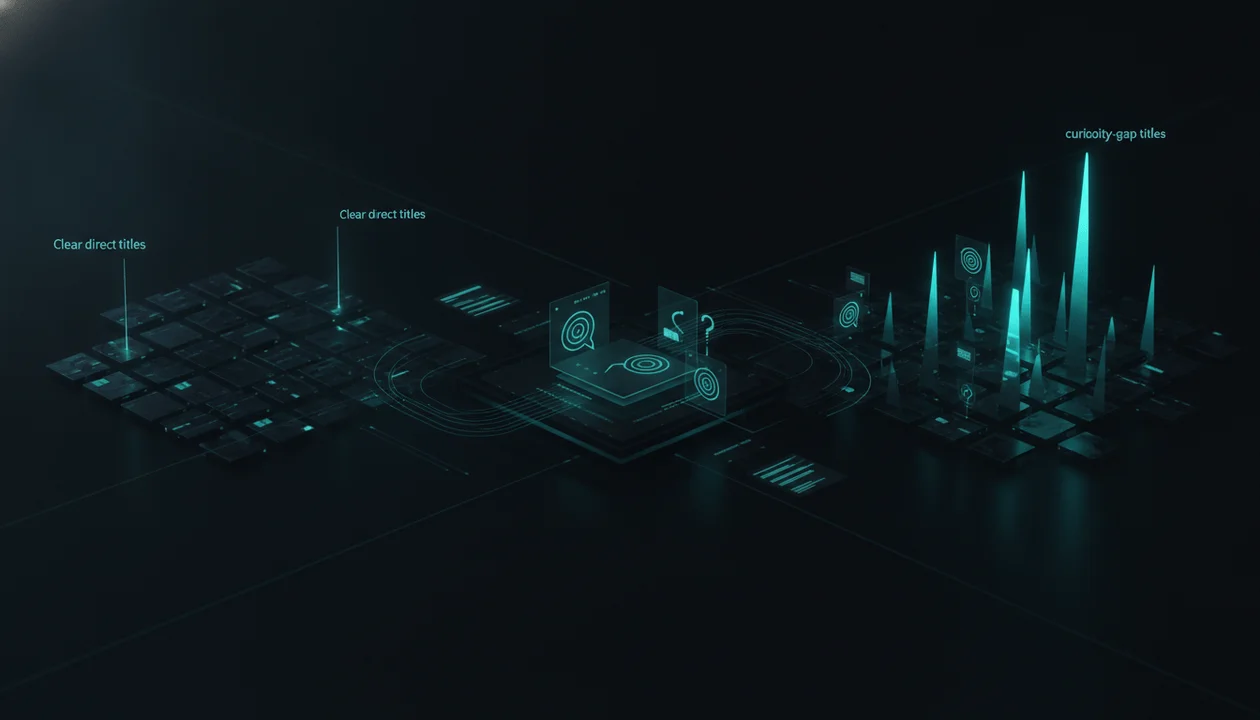
Clickbait has a strange reputation on YouTube.
Creators are warned not to use it.
At the same time, many of the biggest videos on the platform appear to use language built for maximum curiosity:
- shocking
- secret
- insane
- hidden
- exposed
- terrifying
- impossible
- truth
- disaster
So the obvious question is:
Do clickbait-style YouTube titles actually get more views?
We tested it.
OverseerOS analyzed 2,309 mature English-language long-form YouTube videos across 62 channels.
Every channel contributed at least 20 qualifying videos.
Every video had roughly 90 to 365 days to accumulate public views.
We then identified 238 titles containing a transparent set of sensational, secrecy, reveal, shock, danger, or extreme-language markers.
The result was not what the usual "power word" advice would predict.
Clickbait-style language did not produce a clear overall view advantage.
After adjusting performance relative to each channel's own median:
- ordinary titles: 1.00x
- clickbait-style titles: 1.00x
Exactly the same median.
And:
- 50.8% of ordinary titles finished at or above their channel baseline
- 50.8% of clickbait-style titles did too
Then we ran a stronger comparison.
We paired clickbait-style videos with nearby ordinary videos from the same channel, published around the same time.
That produced:
169 unique matched pairs across 45 channels.
The clickbait-style video had a median:
1.06x age-adjusted performance ratio
and won:
52.1%
of comparisons.
That is a very small lean.
At the channel level, the result was similarly modest.
Among 27 channels with enough examples of both styles:
- median clickbait-style advantage: 1.03x
- channels where clickbait-style titles performed better: 55.6%
That is not evidence of a reliable formula.
Different types of sensational language also behaved very differently.
Shock or extreme wording reached:
1.06x
the channel baseline.
Danger or disaster wording reached:
1.04x.
But secrecy and reveal language reached only:
0.87x.
So the stronger conclusion is not:
Clickbait works.
And it is not:
Clickbait never works.
It is:
Adding sensational words to a YouTube title was not a reliable performance advantage. The underlying idea, promise, specificity, audience fit, and execution appear to matter much more than whether the title contains a dramatic word.
Key Findings
- OverseerOS analyzed 2,309 mature English-language long-form videos.
- The study represented 62 channels with at least 20 qualifying videos each.
- The videos were published from September 13, 2025 through June 13, 2026.
- Median video age at observation was approximately 149 to 151 days across the two title groups.
- 238 videos, or 10.3%, contained at least one clickbait-style language marker.
- Those titles appeared across 45 of 62 channels, or 72.6%.
- Ordinary titles had median channel-relative age-adjusted performance of 1.00x.
- Clickbait-style titles also had median performance of 1.00x.
- 50.8% of both groups finished at or above their channel's age-adjusted median.
- 22.3% of clickbait-style videos reached 2x the channel baseline, compared with 20.8% of ordinary videos.
- Clickbait-style titles were slightly longer in the median case: 63.5 characters and 11 words versus 56 characters and 10 words.
- In 169 unique same-channel matched pairs, clickbait-style titles reached a median 1.06x performance ratio.
- Their matched win rate was 52.1%.
- The median publication-date gap inside those matched pairs was only 2.9 days.
- At the channel level, 27 channels with enough examples of both title styles produced a median clickbait-style ratio of only 1.03x.
- 55.6% of those channels favored the clickbait-style side.
- Shock/extreme language reached a median 1.06x channel baseline.
- Danger/disaster language reached 1.04x.
- Secrecy/reveal language reached only 0.87x.
- A broader 9,198-video sensitivity check also failed to reveal a stable universal advantage.
- The study cannot determine whether a title was genuinely misleading. It measures clickbait-style title language, not whether the video failed to deliver on its promise.
The Direct Answer
Do clickbait YouTube titles get more views?
Not reliably.
In this study, videos using sensational title language performed almost identically to other videos from the same channels.
The result becomes more interesting when we separate:
clickable
from:
clickbait.
A clickable title creates a strong reason to watch.
A clickbait title, in the strict sense, creates a promise the video does not adequately deliver.
Those are not the same thing.
And public title text alone cannot prove whether a video delivered its promise.
That is why this study uses the phrase:
clickbait-style language.
We can measure whether a title uses words associated with:
- shock
- secrecy
- revelation
- danger
- extremes
We cannot determine from a competitor title alone whether the actual video satisfied the viewer.
That distinction matters.
What Counts as a Clickbait-Style YouTube Title in This Study?
We did not ask an AI model to subjectively decide:
"Does this feel clickbaity?"
That would make the study difficult to reproduce.
Instead, we used a fixed language proxy.
A title was flagged when it contained one or more words from three broad families.
Shock and extreme language
Examples included:
- shocking
- shocked
- insane
- crazy
- unbelievable
- incredible
- impossible
- terrifying
- horrifying
- scary
- brutal
- mind-blowing
- jaw-dropping
Secrecy and reveal language
Examples included:
- secret
- secrets
- hidden
- exposed
- expose
- revealed
- reveal
- truth
Danger and disaster language
Examples included:
- dangerous
- disaster
- destroyed
- ruined
This is deliberately transparent.
Someone else could run the same classification against the same titles.
But it also creates an important limitation.
A title like:
The Hidden Cost of Cheap Flights
may be completely accurate.
A title like:
This Will SHOCK You
may be misleading.
The presence of a word does not tell us whether the video fulfilled the promise.
So the study tests:
Does sensational title language correspond with higher public video performance?
It does not test:
Does deceiving viewers work?
Those are different questions.
How We Analyzed 2,309 YouTube Videos
The study used public YouTube performance information stored in the OverseerOS research system.
Step 1: Long-form videos only
Every qualifying video had to be longer than three minutes.
Short-form content was excluded so format differences would not dominate the comparison.
Step 2: Mature videos only
The publication window ran from:
September 13, 2025 through June 13, 2026.
This gave each video approximately:
90 to 365 days
to accumulate public views.
The median video was around:
five months old.
That substantially reduces the problem of comparing a two-day-old upload against a six-month-old video.
Step 3: English-language channels only
Our clickbait proxy is based on English-language words.
So the primary study required a current OverseerOS channel-language classification of:
English
with confidence of at least:
0.80.
This is important.
If we included a French, Spanish, Arabic, or Japanese channel in the ordinary-title group simply because its titles did not contain English words like "shocking" or "secret," the comparison would become weaker.
Step 4: Require enough videos per channel
A channel needed at least:
20 qualifying mature long-form videos.
That left:
- 62 channels
- 2,309 videos
This gives each channel enough history to build a more stable internal performance baseline.
Step 5: Adjust for channel scale
Raw views are a poor cross-channel comparison.
A 300,000-view video may be extraordinary for one channel and disappointing for another.
So for every video we calculated an age-adjusted public performance rate:
public views ÷ video age in days
Then we divided that by the median rate for qualifying videos on the same channel.
That produced a channel-relative score.
Example
If a channel's median mature video averaged:
2,000 lifetime views per day
and one video averaged:
4,000
its age-adjusted ratio would be:
2.0x.
If another channel normally averages 100,000 per day, its videos are still evaluated against that channel's own baseline.
This prevents giant channels from automatically dominating the analysis.
Finding 1: Clickbait-Style Language Was Common, but Not Dominant
Among the 2,309 videos:
238
contained at least one sensational-language marker.
That is:
10.3%.
So roughly:
1 in 10
qualifying mature long-form titles used one of the words in our clickbait-style proxy.
But those titles were spread widely.
They appeared across:
45 of 62 channels.
That is:
72.6%.
So sensational title language was not something used only by a tiny cluster of extreme channels.
Most channels in the study used it at least occasionally.
The more interesting question is whether it helped.
Finding 2: The Median Performance Was Exactly the Same
After normalizing each video against its channel:
Ordinary titles
Median performance:
1.000x
Clickbait-style titles
Median performance:
1.000x
There was no median advantage.
The baseline hit rate was also identical.
Ordinary titles at or above channel median
50.8%
Clickbait-style titles at or above channel median
50.8%
At the stronger 2x threshold:
Ordinary titles
20.8%
Clickbait-style titles
22.3%
A small difference.
Not enough to support:
Add dramatic words and your title becomes more likely to win.
The broad distribution looked much closer to:
basically even.
Finding 3: Clickbait-Style Titles Were Slightly Longer
The two groups were not identical structurally.
Median ordinary title:
56 characters
Median clickbait-style title:
63.5 characters
Median ordinary title:
10 words
Median clickbait-style title:
11 words
So sensational titles tended to use a little more language.
That makes intuitive sense.
Compare:
Why the Roman Empire Fell
with:
The Hidden Truth Behind the Roman Empire's Brutal Collapse
The second version needs more space to create:
- secrecy
- drama
- stakes
But the extra intensity did not produce a clear overall performance advantage.
Finding 4: The Same-Channel Matched Test Showed Only a Small Lean
The pooled result could still hide an important problem.
Maybe some channels naturally use clickbait-style titles more often.
Maybe those channels are larger.
Maybe they operate in niches where dramatic language is normal.
So we created a stronger comparison.
For every clickbait-style video, we searched for the closest qualifying ordinary-title video from:
the same channel
published within:
45 days.
We then prevented the same comparison video from being reused repeatedly.
That produced:
169 unique matched pairs across 45 channels.
The median publication gap was only:
2.9 days.
So the comparison looked much more like:
Two videos from the same creator, in roughly the same era, one with sensational wording and one without.
Result
Median clickbait-style / ordinary age-adjusted performance ratio:
1.063x
Clickbait-style win rate:
52.1%
That is a small positive lean.
It is not remotely large enough to justify:
Clickbait words drive views.
The middle 50% of pair ratios was also very wide.
Some sensational titles dramatically won.
Some dramatically lost.
That variation is exactly why one headline trick should not be treated as a universal strategy.
Finding 5: The Channel-Level Result Was Also Close to Even
Videos from one creator are not independent observations.
A prolific channel can contribute many titles.
So we also made the channel the unit of analysis.
We required each channel to have at least:
- 3 clickbait-style videos
- 5 ordinary videos
That produced:
27 channels.
For each channel we compared the median performance of the two title styles.
Median clickbait-style advantage
1.031x
Channels where clickbait-style titles performed better
55.6%
The middle 50% of channel-level ratios ranged from approximately:
0.77x to 1.40x.
That is not a stable universal effect.
It means the tactic was:
- useful for some channels
- neutral for others
- worse for others
Which is exactly what a serious title strategy should expect.
Finding 6: Not All "Clickbait" Language Behaved the Same
This was one of the more useful findings.
Grouping every dramatic word into one giant category hides substantial differences.
Shock and extreme language
Examples:
- terrifying
- shocking
- crazy
- impossible
- brutal
Sample:
77 videos across 26 channels
Median channel-relative performance:
1.06x
At or above channel baseline:
54.5%
2x or higher:
23.4%
A modest positive lean.
Danger and disaster language
Examples:
- disaster
- destroyed
- dangerous
- ruined
Sample:
60 videos across 21 channels
Median performance:
1.04x
At or above baseline:
55.0%
2x or higher:
28.3%
Again, a modest lean.
Secrecy and reveal language
Examples:
- hidden
- secret
- truth
- revealed
- exposed
Sample:
107 videos across 34 channels
Median performance:
0.87x
At or above baseline:
45.8%
2x or higher:
17.8%
This group leaned the other way.
That is a major reason the overall "clickbait works" claim is too crude.
The word:
terrifying
is doing a different job from:
hidden.
One communicates emotional stakes.
The other creates an information gap.
They should not automatically be expected to behave the same.
Finding 7: Individual Power Words Were Far Too Inconsistent for a Formula
Looking at individual words produced even more variation.
Examples from the primary English cohort included:
| Word | Videos | Channels | Median channel-relative performance |
|---|---|---|---|
| disaster | 35 | 5 | 1.05x |
| secret | 35 | 19 | 1.05x |
| hidden | 34 | 15 | 0.64x |
| terrifying | 16 | 8 | 1.20x |
| revealed | 16 | 5 | 0.69x |
| truth | 14 | 10 | 1.23x |
| crazy | 12 | 7 | 1.09x |
| dangerous | 10 | 6 | 0.81x |
| destroyed | 9 | 6 | 0.83x |
| exposed | 9 | 8 | 1.03x |
Do not turn this table into:
Use "truth" because it got 1.23x.
Those individual samples are much too small and channel-clustered for that conclusion.
The table makes a different point.
There was no universal "power word" pattern.
A word could look strong in one subset and weak in another.
That is exactly what you would expect if the underlying:
- topic
- niche
- creator
- promise
- thumbnail
- audience
matter more than the vocabulary alone.
Finding 8: A Broader 9,198-Video Sensitivity Check Did Not Reveal a Hidden Advantage
The primary analysis deliberately restricted itself to channels with confident English classification.
That gives us the cleanest linguistic cohort.
But it reduces the sample substantially.
So we also ran the same broad title proxy across:
9,198 mature long-form videos from 270 channels
without requiring the channel-language classification.
That broader sample included:
642 clickbait-style titles across 155 channels.
The median channel-normalized result was:
Ordinary
1.000x
Sensational language
0.998x
Essentially identical.
Then we created:
491 unique same-channel matched pairs.
The median sensational/ordinary age-adjusted ratio was:
0.93x.
The sensational-title win rate was:
47.0%.
We tightened the comparison again by requiring title length to differ by no more than 10 characters.
That produced:
486 pairs
with a median ratio of:
0.93x
and a win rate of:
45.9%.
Because this broader sample contains channels without a confirmed English classification, it is not our headline cohort.
But it is useful as a robustness check.
It certainly does not reveal a hidden giant clickbait advantage.
Finding 9: Even a Narrower Extreme-Language Test Was Not Convincing
Maybe our broader proxy is unfair.
Perhaps words like:
- hidden
- truth
- secret
are curiosity language rather than true sensationalism.
So we created a narrower intensity test focused on words such as:
- shocking
- insane
- crazy
- unbelievable
- impossible
- terrifying
- scary
- brutal
- dangerous
- disaster
- destroyed
- ruined
In the broader mature-video universe, that produced:
414 videos across 116 channels.
Median normalized performance:
1.01x.
Then we formed:
310 unique matched pairs.
Median intense-title / ordinary-title ratio:
0.95x.
Win rate:
48.4%.
Again:
no reliable universal uplift.
Changing the definition did not suddenly uncover a dramatic performance effect.
The Biggest Mistake: Confusing Clickbait With Curiosity
A strong YouTube title usually leaves something unresolved.
That is not automatically clickbait.
Consider:
Why This Bridge Collapsed Without Warning
There is a curiosity gap.
The viewer wants to know:
why?
Now consider:
Engineers Said This Bridge Was IMPOSSIBLE to Destroy
If engineers never said that, the title has crossed into a different category.
The distinction is:
Curiosity
Creates a question the video genuinely answers.
Clickbait
Creates an expectation the video cannot honestly satisfy.
That is why our study on curiosity-gap YouTube titles should not be interpreted as a study of deception.
Curiosity is a packaging mechanism.
Misleading the viewer is a promise problem.
Why Clickbait-Style Words Sometimes Work
A dramatic word can be useful when it compresses a real idea.
"Disaster"
This can communicate:
- scale
- consequence
- failure
- irreversible damage
If the video genuinely covers a disaster, the word may be the clearest title available.
"Terrifying"
This can communicate:
- emotional experience
- stakes
- danger
In horror, science, crime, history, or survival content, that may accurately represent the material.
"Secret"
This can communicate:
- unknown information
- exclusivity
- hidden mechanism
But it becomes weaker when the "secret" is something obvious.
The word itself is not the strategy.
The underlying information is.
Why Clickbait-Style Words Sometimes Fail
The same language can create several problems.
It makes a generic idea look more generic
Weak:
The SHOCKING Truth About Productivity
The title has intensity.
It has almost no specificity.
It creates an impossible expectation
If everything is:
- insane
- unbelievable
- shocking
- secret
the language stops carrying information.
It hides the actual subject
Compare:
The Hidden Truth Nobody Tells You
with:
Why Most New YouTube Channels Quit Before Video 20
The second title tells the viewer:
- who it is for
- what happens
- what tension exists
without needing a sensational adjective.
It can duplicate the thumbnail's job
If the thumbnail already communicates shock, the title may be stronger when it adds:
new information.
Packaging works as a system.
Not as isolated tricks.
A Better Formula: Specificity Before Intensity
When writing a YouTube title, use this order.
1. Subject
What is actually happening?
2. Promise
What will the viewer understand, see, discover, or experience?
3. Stakes
Why does it matter?
4. Specificity
What detail makes this video different from every generic version?
5. Curiosity
What remains unresolved?
6. Intensity
Only now ask whether a stronger emotional word genuinely improves the promise.
That reverses the way many clickbait-title generators work.
They start with:
shocking, insane, secret, unbelievable
and then attach a topic.
A better title starts with:
the strongest real reason to care.
Example: Weak Clickbait vs Strong Curiosity
Weak
The SHOCKING Truth About AI
Problems:
- enormous topic
- unclear promise
- no audience
- no event
- no consequence
- "shocking" does almost all the work
Better
Why AI Agents Are Replacing Entire Workflows, Not Just Tasks
Now the title contains:
- subject
- change
- consequence
- unresolved explanation
No dramatic adjective required.
Example: Weak Secrecy vs Specific Information
Weak
7 Hidden Secrets of YouTube Growth
What is hidden?
Why seven?
Who is this for?
What type of growth?
Better
Why Small YouTube Channels Keep Missing Their First Breakout
The second title creates a specific problem.
The curiosity comes from wanting the explanation.
Example: When Dramatic Language Is Actually Useful
Suppose the video is about a historical engineering failure that caused catastrophic consequences.
Weak:
This Engineering Project Had Problems
Better:
The Engineering Disaster That Bankrupted an Entire City
"Disaster" is dramatic.
But it also communicates the actual nature and stakes of the story.
That is not intensity replacing specificity.
It is intensity carrying specificity.
The Promise Test
Before using a dramatic title word, ask:
If the viewer watches the full video, will this word feel accurate?
If yes:
keep testing it.
If no:
remove it.
Then ask:
If I delete the dramatic word, is the idea still interesting?
If the answer is no, the real problem may be the video idea.
A strong title should not need:
SHOCKING
to rescue a weak premise.
The Replace-the-Word Test
Take:
The INSANE Reason This Company Collapsed
Remove:
INSANE.
You get:
The Reason This Company Collapsed
Still generic.
Now improve the actual information:
The $2 Billion Bet That Destroyed the Company
That is stronger because the title now contains:
- scale
- mechanism
- consequence
The intensity comes from the facts.
Not the adjective.
The Clickbait-Style Title Scorecard
Before publishing, rate the title on these seven questions.
| Signal | Question |
|---|---|
| Accuracy | Does the video fully deliver this promise? |
| Specificity | Does the title contain a concrete idea? |
| Stakes | Does the viewer understand why it matters? |
| Curiosity | Is one useful question left unanswered? |
| Distinction | Could 50 competing videos use the same title? |
| Compression | Is every word doing useful work? |
| Title-thumbnail fit | Does the thumbnail add rather than simply repeat? |
If your title needs three dramatic words because the first six answers are weak:
rewrite the title.
Clickable Is Better Than Clickbaity
The goal is not to make titles boring.
That would be the wrong lesson.
A title can be:
- emotional
- surprising
- provocative
- urgent
- mysterious
- dramatic
and still be accurate.
The goal is:
maximize honest curiosity.
That is a much more durable strategy than maximizing sensational vocabulary.
What This Means for YouTube Title Generators
A title generator should not simply take:
productivity tips
and return:
10 INSANE Productivity Secrets Nobody Tells You
That is syntactic creativity.
Not strategic packaging.
A stronger title workflow begins with evidence.
Ask:
- What topic is already working?
- What angle is still underused?
- What promise does the viewer care about?
- What type of titles fit this channel?
- What does the thumbnail communicate?
- What can the video genuinely deliver?
That is the logic behind the OverseerOS AI YouTube Title Generator.
The goal is to generate original title directions from proven patterns and channel context rather than bolting random "power words" onto a topic.
How to Apply This With OverseerOS
A practical workflow looks like this.
Step 1: Analyze the channel
Use the OverseerOS YouTube Channel Analyzer.
Identify:
- historical winners
- recent winners
- breakout topics
- repeated title patterns
Do not start with:
What dramatic word should I use?
Start with:
What promises does this audience already respond to?
Step 2: Find the idea before the wording
A great title cannot repair a weak topic indefinitely.
Validate:
- demand
- relevance
- differentiation
- evidence
first.
Step 3: Generate multiple title mechanisms
Instead of:
- normal version
- clickbait version
generate genuinely different frames.
For example:
- result
- warning
- transformation
- question
- contrast
- story
- consequence
- mystery
Step 4: Pair the title with the thumbnail
Do not make both assets say the same thing.
If the title explains the consequence, the thumbnail can show:
- the person
- object
- before/after
- visual contradiction
If the thumbnail already creates shock, the title can provide specificity.
Step 5: Save the winning direction with the production plan
Move the chosen angle into the OverseerOS Content Planner.
Keep:
- source evidence
- topic
- title direction
- thumbnail direction
- script
connected.
That makes the title part of the video promise rather than an afterthought created five minutes before publishing.
What the Data Does Not Say
This article is not proof that emotional titles are bad.
It is not proof that curiosity does not matter.
It is not proof that titles barely matter.
The study shows something narrower:
The presence of sensational words did not create a reliable performance advantage by itself.
That is an important distinction.
A title can be excellent without containing any flagged words.
A title can also be excellent with one of them.
Context decides whether the word strengthens the promise.
Limitations
This study has important limitations.
We cannot detect actual deception from public title text
The biggest limitation.
A real clickbait diagnosis requires comparing the title and thumbnail promise with the video's actual payoff.
This study does not label videos as deceptive.
It measures:
clickbait-style language.
The proxy is deliberately incomplete
No word list can capture every dramatic YouTube title.
A title can be extremely clickbaity without using any of our flagged words.
Likewise, an accurate title can contain:
shocking
because the content genuinely is shocking.
The primary sample contains 62 channels
That is enough for useful within-channel analysis.
It is not a platform-wide census.
Channel behavior is clustered
Multiple videos from the same creator share:
- audience
- niche
- production style
- brand
- topic selection
That is why we included matched and channel-level comparisons.
The study covers long-form only
Do not assume the exact result applies to Shorts.
Performance is based on public views
We do not have competitor:
- impressions
- CTR
- watch time
- retention
- traffic sources
- satisfaction data
A clickbait-style title could theoretically increase CTR while reducing retention, or vice versa, without that mechanism being visible publicly.
Views-per-day is only an age-adjustment proxy
We use lifetime public views divided by video age to reduce maturity differences.
It does not reconstruct the full view curve.
Current titles may differ from publication titles
Creators can change titles after publishing.
The research system stores the latest observed title, not a complete historical title version for every video.
Therefore some titles may not be identical to the wording used at launch.
The sensitivity samples are not identical
The primary English-language cohort and broader 9,198-video sensitivity cohort have different channel inclusion rules.
They should not be compared as if they were one controlled experiment.
Individual word samples are small
Do not interpret "terrifying = 1.20x" or "hidden = 0.64x" as universal word-level causal effects.
Those examples are descriptive only.
Thumbnail packaging is not controlled
A video's thumbnail may strengthen, weaken, repeat, or contradict the title.
We do not have standardized thumbnail-feature controls across this full sample.
Association is not causation
Nothing here proves that adding or removing one word changes a video's views by a fixed amount.
The correct interpretation is:
Sensational title language was not a reliable standalone predictor of higher performance in this dataset.
Final Verdict
Do clickbait-style YouTube titles get more views?
Not reliably.
OverseerOS analyzed:
2,309 mature English-language long-form videos across 62 channels.
Among them:
238 titles
used transparent sensational-language markers.
Their median channel-relative performance was:
1.00x.
Ordinary titles were also:
1.00x.
Both groups finished at or above their channel baseline:
50.8% of the time.
In 169 close same-channel matched pairs, the clickbait-style side reached:
1.06x
and won:
52.1%
of comparisons.
At the channel level, the advantage shrank to:
1.03x.
That is not a dependable growth formula.
And different language families moved in different directions:
- shock/extreme: 1.06x
- danger/disaster: 1.04x
- secrecy/reveal: 0.87x
So the useful lesson is not:
Never use dramatic words.
It is:
Do not mistake dramatic wording for a strong title.
The best title earns curiosity because the underlying video contains something worth being curious about.
Start with:
a strong idea.
Add:
a specific promise.
Make:
the stakes clear.
Leave:
one important thing unresolved.
Then use intensity only when the video genuinely earns it.
A title should not manufacture value.
It should reveal the value already inside the video.
FAQ
Do clickbait YouTube titles get more views?
Not consistently in this study. Across 2,309 mature English-language long-form videos, clickbait-style titles and ordinary titles both had median channel-relative performance of 1.00x.
What percentage of YouTube titles used clickbait-style language?
238 of the 2,309 qualifying titles, or approximately 10.3%, contained at least one word from the study's sensational-language proxy.
How many channels used clickbait-style titles?
45 of the 62 channels, or approximately 72.6%, used at least one qualifying clickbait-style title.
Did clickbait-style titles win in matched comparisons?
Slightly more often than half. In 169 unique same-channel matched pairs, clickbait-style videos won 52.1% of comparisons and had a median 1.06x age-adjusted performance ratio.
Does that prove clickbait works?
No. A 52.1% win rate and 1.06x median ratio are small descriptive differences and do not establish causation.
What clickbait words did the study analyze?
The proxy included words associated with shock, secrecy, revelation, danger, and extremes, including terms such as shocking, insane, crazy, secret, hidden, exposed, truth, terrifying, dangerous, disaster, destroyed, and ruined.
Is "secret" a good word for YouTube titles?
Not universally. In the primary English cohort, titles containing "secret" had a median 1.05x channel-relative performance, but the sample contained only 35 videos and should not be treated as a causal word-level benchmark.
Does "shocking" increase YouTube views?
The primary sample contained only eight titles using "shocking," which is far too small to establish a reliable universal effect.
Do hidden or secret titles work?
The broader secrecy/reveal category underperformed the channel median in this study, with median relative performance of 0.87x. That does not prove secrecy language causes lower views.
What is the difference between clickbait and curiosity?
Curiosity leaves an important question unresolved while still accurately representing the video. Clickbait, in the strict sense, creates an expectation the content does not adequately fulfill.
Are curiosity-gap titles clickbait?
Not automatically. A curiosity gap can be completely accurate. The key question is whether the video delivers the promise created by the title and thumbnail.
Should YouTube titles be emotional?
They can be. Emotional language is useful when it accurately compresses the stakes or viewer experience. The data does not support adding emotional words simply because they sound more clickable.
Should I use power words in YouTube titles?
Only when the word adds real information, stakes, or emotional clarity. This study found no universal performance advantage from sensational words alone.
What makes a YouTube title clickable without clickbait?
A strong title usually combines a clear subject, specific promise, meaningful stakes, honest curiosity, and a reason this version of the topic is different.
Is "The Truth About..." a good YouTube title formula?
Sometimes, but not automatically. The effectiveness depends on whether there is genuinely surprising or misunderstood information behind the promise.
Should I use all caps with clickbait words?
This study did not isolate all-caps styling as part of the clickbait analysis. Capitalization should be evaluated separately from the underlying language.
Can a clickbait title increase CTR but hurt views?
It is possible because CTR and downstream viewing behavior are different metrics. This public-data study cannot see competitor CTR or retention, so it cannot measure that mechanism directly.
Does YouTube punish clickbait titles?
This study does not test platform penalties. It only measures public video performance associated with clickbait-style title language.
Should I remove clickbait words from my title?
Not automatically. Ask whether the word accurately communicates something important. If removing it makes the title more specific and trustworthy, rewrite it. If the word accurately captures the stakes, it may be useful.
What should I prioritize over clickbait words?
Prioritize the video idea, audience fit, specificity, promise, stakes, title-thumbnail relationship, and whether the video fully delivers what the packaging implies.