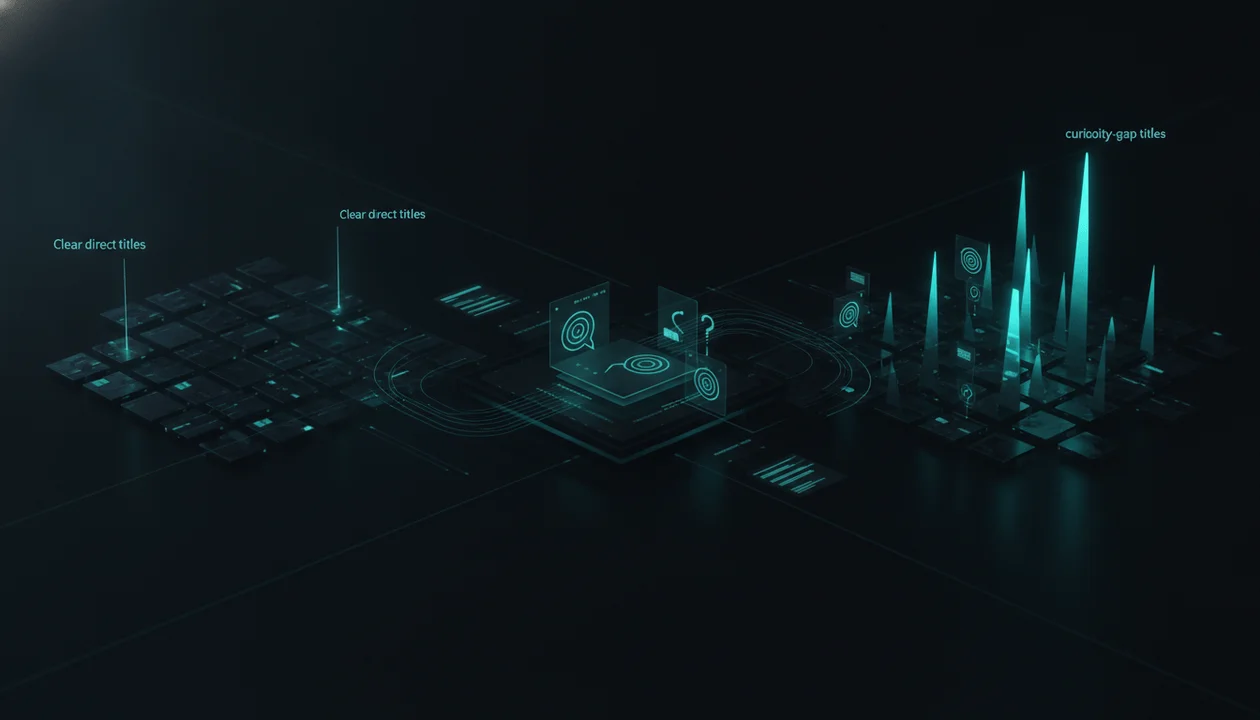
Curiosity-gap YouTube titles do not reliably get more views.
OverseerOS analyzed 3,357 mature long-form videos across 87 public YouTube channels and identified 249 videos across 50 channels using a transparent proxy for curiosity-gap language.
The proxy looked for title signals such as:
- this
- these
- secret
- hidden
- truth
- revealed
- nobody
- no one
- the reason
- one thing
- one reason
- what happened next
- you won't believe
We then compared qualifying curiosity-signaling videos with non-curiosity videos published by the same channel in the same year.
That produced a primary matched sample of:
3,106 videos
including:
232 curiosity-signaling videos across 47 channels.
The result was surprising.
Curiosity-signaling titles
Median relative performance:
0.92x baseline
2x+ outlier rate:
27.6%
5x+ outlier rate:
10.8%
Control titles
Median:
1.00x
2x+:
24.7%
5x+:
10.4%
So curiosity-gap language did not improve the typical video's performance.
But it did create a slightly stronger:
2x-outlier tail.
The distribution was also wider.
Curiosity titles had:
- Lower 25th-percentile performance
- Higher 75th-percentile performance
- More variability between misses and winners
That gives us a much better conclusion than:
Curiosity gets clicks.
The data suggests:
Curiosity-gap framing is a high-variance packaging tool. It can amplify an already compelling information gap, but vague curiosity does not reliably improve a weak video idea.
And one subtype performed very differently from another.
Titles using:
“this” or “these”
had a median performance of only:
0.78x baseline.
Titles using revelation-oriented words such as:
secret, hidden, truth, revealed, nobody
reached:
1.12x median performance
and a:
32.2% 2x-outlier rate.
So the lesson is not:
Hide more information.
It is:
Make the viewer understand exactly what matters while withholding the one piece they genuinely want explained.
Key Findings
| Finding | Curiosity-signaling titles | Control titles |
|---|---|---|
| Full qualified video cohort | 249 | 3,108 |
| Channels using curiosity signals | 50 | 87 |
| Matched videos | 232 | 2,874 |
| Matched channels | 47 | 87 |
| 25th-percentile relative performance | 0.47x | 0.55x |
| Median relative performance | 0.92x | 1.00x |
| 75th-percentile relative performance | 2.25x | 1.96x |
| Above baseline | 47.4% | 48.3% |
| 2x+ rate | 27.6% | 24.7% |
| 5x+ rate | 10.8% | 10.4% |
| Median title length | 61.5 characters | 51 characters |
The central result is:
Curiosity-signaling titles were not better on average. They were more polarized.
That distinction matters.
Do Curiosity Gap YouTube Titles Get More Views?
Not consistently.
The median curiosity-signaling video reached:
0.92x
its same-channel, same-year baseline.
A hypothetical channel with a:
100,000-view baseline
would translate that into roughly:
92,000 views.
That is not evidence of an average boost.
But now look at the upper quartile.
Curiosity titles
75th percentile:
2.25x.
Controls
1.96x.
So the stronger curiosity titles reached further above baseline than the stronger control titles.
At the bottom:
Curiosity titles
25th percentile:
0.47x.
Controls
0.55x.
The weak curiosity videos also fell lower.
That is what a high-variance strategy looks like.
It produces:
more upside
without necessarily improving:
the middle.
What Is a Curiosity Gap on YouTube?
A curiosity gap exists when the viewer understands enough about the subject to care, but lacks one meaningful piece of information they want resolved.
A strong curiosity structure is:
Known:
I understand what the video is about.

Unknown:
I do not know the explanation, result, identity, mechanism, or consequence.

Reason to click:
I care enough about the missing piece to resolve it.
Example:
Why Small YouTube Channels Sometimes Outperform Bigger Ones
The viewer knows:
- Subject: small vs large channels
- Outcome: small channels sometimes win
But not:
- Why
The unknown is clear.
Now compare:
You Won't Believe What Happened
The viewer may not even know:
- To whom?
- About what?
- Why it matters?
That is not necessarily a strong curiosity gap.
It can simply be:
missing context.
The Best Curiosity Gap Hides the Answer, Not the Topic
This is one of the most important rules in YouTube packaging.
Weak:
This Changes Everything
The viewer asks:
What is “this”?
Too much is hidden.
Better:
This New YouTube Feature Changes How Thumbnails Are Tested
Now the viewer understands:
- Topic
- Relevance
- Consequence
The remaining question is:
How does it change thumbnail testing?
Better still, depending on the actual video:
YouTube Changed Thumbnail Testing. Here's What Creators Missed
The subject is clear.
The missing insight remains unresolved.
Finding 1: Curiosity Language Appeared in About 7.4% of Videos
Across the full:
3,357-video
qualified cohort:
249 videos
contained at least one curiosity-signaling pattern.
That is:
7.4%.
The vast majority:
92.6%
did not.
This alone is useful.
Successful YouTube videos do not need:
- vague pronouns
- secrets
- hidden truths
- withheld reveals
to perform.
Curiosity is one packaging architecture.
Not a requirement.
Finding 2: Generic Curiosity Underperformed at the Median
The overall curiosity-signaling median was:
0.92x.
And:
47.4%
of curiosity videos beat baseline.
Controls:
48.3%.
That is essentially no advantage.
If simply creating an information gap increased performance reliably, we would expect a much clearer shift.
We did not see one.
That means:
Curiosity alone is not enough.
A title can create a gap around something nobody cares about.
Example:
You Won't Believe What I Ate This Morning
There is technically withheld information.
But unless the creator, context, or result makes the breakfast important:
the gap has little value.
Curiosity Has Two Parts
A useful model is:
Curiosity value =
Importance of known information
×
Desire for missing information
If either side is near zero:
the title is weak.
High importance + weak mystery
Apple Released a New iPhone
Important subject.
Little mystery.
Strong mystery + low importance
You'll Never Guess What Is Inside This Box
Potential mystery.
No reason yet to care.
Strong subject + strong gap
Apple Removed This Feature From the New iPhone. Here's Why
Now the viewer may care about:
- Apple
- Removed feature
- Consequence
and still lacks:
- Explanation
That is a functioning curiosity gap.
Finding 3: “This” and “These” Titles Performed Poorly at the Median
The largest curiosity subtype contained:
140 matched videos across 36 channels
using:
this
or:
these.
Their results:
Median
0.78x
25th percentile
0.47x
75th percentile
1.99x
2x+
25.0%
5x+
9.3%.
That is weaker than the control median.
This matters because:
This Is Why...
This Changes Everything...
These Are the...
are extremely easy title formulas to generate.
But the word itself provides no value.
It merely points to something.
If the viewer cannot immediately understand what:
“this”
represents, the title may become less clear rather than more intriguing.
“This” Is Not Curiosity by Itself
Compare:
This Is Destroying Your YouTube Channel
with:
Comparing Every Video to Your Biggest Hit Is Destroying Your Expectations
The first withholds the subject.
The second reveals the problem while leaving the explanation open.
Or:
These Are Changing Everything
versus:
These 3 AI Models Are Changing How Faceless Videos Are Made
The second is easier to evaluate.
The viewer can decide:
Do I care?
Clarity happens before curiosity.
The “This” Test
Before using:
this
ask:
Can the viewer understand what “this” refers to before clicking?
If no:
you may be hiding too much.
A strong title should usually let the viewer identify:
- Domain
- Problem
- Stakes
before asking for the click.
Finding 4: Secret, Hidden, and Truth Titles Performed Better
A much stronger subtype contained revelation-oriented language such as:
- secret
- secrets
- hidden
- truth
- revealed
- nobody
- no one
There were:
87 matched videos across 29 channels.
Results:
Median
1.12x
2x+
32.2%.
5x+
12.6%.
For comparison, controls produced:
Median
1.00x
2x+
24.7%.
5x+
10.4%.
This subgroup showed a more interesting positive signal.
But do not immediately conclude:
Add “secret” to your title.
The semantic structure matters.
A title such as:
The Hidden Cost of Cheap AI Video Tools
promises:
information the viewer may not already know.
A title such as:
The SECRET YouTube Algorithm HACK Nobody Tells You!!!
may simply overstate the evidence.
The first creates:
discovery.
The second can create:
distrust.
Revelation Is Different From Vagueness
This is one of the clearest findings in the study.
Vague curiosity
This Is Why Your Videos Fail
The unknown is partly:
what “this” even is.
Revelation curiosity
The Hidden Reason Good YouTube Videos Still Fail
The viewer knows:
- Good videos can fail
- There is an unexplained reason
- The video claims to reveal it
That is much more structured.
The stronger-performing subgroup tended to signal:
There is information here you do not currently have.
rather than:
I am refusing to tell you what the subject is.
Finding 5: The Recent 2024-2026 Cohort Did Not Improve the Median
Maybe modern YouTube rewards curiosity more strongly.
We restricted the matched analysis to videos published from:
2024 through 2026.
That produced:
190 curiosity-signaling videos across 39 channels
and:
2,307 control videos.
Results:
| Metric | Curiosity | Control |
|---|---|---|
| 25th percentile | 0.40x | 0.54x |
| Median | 0.82x | 1.00x |
| 75th percentile | 2.31x | 2.04x |
| Above baseline | 46.3% | 48.4% |
| 2x+ | 28.9% | 25.6% |
| 5x+ | 12.1% | 11.3% |
The exact same pattern became even clearer.
The median curiosity title was weaker.
The upper tail was slightly stronger.
That reinforces our main conclusion:
Curiosity-gap language is not an average-performance hack. It is a high-variance packaging mechanism.
Finding 6: Equal-Channel Weighting Also Showed No Broad Advantage
A few channels may publish many curiosity-driven videos.
That can distort video-level statistics.
So we isolated channels with at least:
two matched curiosity-signaling videos.
That produced:
33 channels
and:
218 curiosity videos.
For each channel, we calculated its median relative curiosity performance.
Then every channel received one vote.
Median channel curiosity performance
0.84x baseline.
Channels where curiosity median beat baseline
42.4%.
So fewer than half of repeatedly using channels had an above-baseline curiosity median.
That strongly rejects:
Curiosity titles work on every channel.
They did not.
Why Can Curiosity Increase the Breakout Tail Without Improving the Median?
Because curiosity is an amplifier.
It can amplify:
a great idea.
It can also amplify:
a weak promise.
Suppose Topic A already has:
- High demand
- Strong stakes
- Novel information
A well-designed curiosity gap can create:
I need to know.
But suppose Topic B has:
- Low relevance
- Weak stakes
- Familiar information
Adding:
secret
does not create demand.
The title may simply look more manipulative.
That can produce a wider distribution:
- Strong ideas become stronger
- Weak ideas become more obviously weak
Which is close to what we observed.
The Curiosity Amplifier Model
Think about packaging like this:
Topic value
×
Curiosity quality
=
Click potential
Not:
Weak topic
+
mystery word
=
viral video
The viewer still asks:
Why should I care?
before:
What is the answer?
The 4 Types of Curiosity Gap
1. Causal Curiosity
Viewer knows:
what happened.
Does not know:
why.
Example:
Why Your YouTube Views Drop After a Viral Video
Strong because the viewer may personally experience the outcome.
2. Reveal Curiosity
Viewer knows:
something important exists.
Does not know:
what it is.
Example:
The Hidden Metric That Makes Average Views Misleading
This requires strong evidence.
3. Outcome Curiosity
Viewer knows:
an experiment occurred.
Does not know:
the result.
Example:
I Posted Every Day for 30 Days. Here's What Happened
The experiment itself creates the question.
4. Contradiction Curiosity
Viewer encounters two facts that should not coexist.
Example:
Why Smaller YouTube Channels Can Have Bigger Relative Breakouts
The viewer thinks:
Bigger channel should have the advantage.
The contradiction demands explanation.
This is often one of the strongest forms because the curiosity is embedded inside the idea itself.
The Weakest Form: Empty Withholding
Examples:
You Need to See This
This Changes Everything
Nobody Expected This
You Won't Believe What Happened
Sometimes these can work because the:
- creator is already famous
- thumbnail supplies the entire context
- story itself is exceptionally visual
But as standalone title architecture:
they place a huge burden on the thumbnail and existing audience familiarity.
For most creators, that is risky.
Curiosity Gap vs Clickbait
They are not the same thing.
Curiosity gap
The title withholds part of the answer.
The video delivers the answer.
Clickbait
The title or thumbnail creates an expectation the content does not satisfy.
A truthful title can be highly curious.
Example:
The Hidden Cost of Posting More YouTube Videos
If the video contains data showing a genuine tradeoff:
the gap is honest.
If the video contains generic upload advice unrelated to a hidden cost:
the packaging becomes misleading.
Curiosity becomes clickbait when:
the promise exceeds the payoff.
Curiosity Must Survive the Click
The title's job is not finished when someone clicks.
A title creates an expectation.
The opening seconds then need to confirm:
Yes, this is the video I thought I clicked.
If your title says:
The Hidden Reason Your Videos Stop Growing
do not open with:
Hey guys, welcome back. Before we begin, make sure you subscribe...
The viewer clicked for:
the hidden reason.
A strong opening might instead establish:
- What appears to happen
- Why the obvious explanation is incomplete
- What the video will resolve
Packaging and retention are one system.
The Curiosity-to-Payoff Chain
A strong video often follows:
Title:
Creates unresolved question

Thumbnail:
Visualizes the tension

Hook:
Sharpens the question

Body:
Provides evidence

Payoff:
Resolves the promise
If one piece breaks:
the system weakens.
Curiosity Gap vs “Why” Titles
Our study of “Why” YouTube titles found a similar pattern:
- Slightly weaker median
- Somewhat stronger 2x tail
- Higher variance
That makes sense.
“Why” is itself a curiosity architecture.
It says:
You know the event.
You do not know the cause.
But not every “Why” title is strong.
Compare:
Why Sleep Matters
with:
Why You Wake Up Tired After Sleeping 8 Hours
Same architecture.
Completely different information gap.
Curiosity Gap vs Negative Titles
Our negative-word YouTube title study found that negative framing showed only a small overall median difference but a somewhat stronger breakout tail.
Again, the mechanics overlap.
A title such as:
The Mistake Killing Your First 30 Seconds
creates:
Negative stake
Something is hurting performance.
Curiosity gap
What is the mistake?
Combining psychological mechanisms can strengthen a title.
But stacking mechanisms cannot rescue an irrelevant idea.
Curiosity Gap vs “How To”
Our “How To” title study showed a stronger median signal than the curiosity-gap cohort.
The viewer promise differs.
How To
I know what I want.
Show me how to get it.
Curiosity gap
I know something is missing.
Tell me what it is.
One emphasizes:
utility.
The other:
information.
Neither should be chosen from a formula sheet.
Choose based on viewer intent.
The Clarity-Curiosity Spectrum
Titles operate on a spectrum.
Maximum clarity
How to Export a 4K Video in Premiere Pro
Viewer knows exactly what they will receive.
Balanced
The Premiere Pro Export Setting Most YouTubers Get Wrong
Viewer understands the topic and problem but lacks the answer.
Maximum withholding
You've Been Doing This Wrong
Almost everything depends on the thumbnail.
The middle is often powerful because it combines:
relevance + information gap.
The 80/20 Rule for Curiosity Titles
A useful creative guideline:
Reveal roughly 80% of the premise and withhold 20% of the answer.
Not mathematically.
Conceptually.
The viewer should understand:
- Subject
- Stakes
- Relevance
but not:
- Resolution
Weak:
You Need to Know This
Too little premise.
Weak:
YouTube CTR Drops Because Browse Expands to Colder Audiences
You may have given away the entire explanation.
Balanced:
Why Your CTR Can Drop When a Video Starts Growing
Now the viewer knows the phenomenon.
They still want the mechanism.
Curiosity Title Formula 1: Known Outcome, Hidden Cause
Why [specific surprising outcome]
Examples:
Why Your Best Video Can Make the Next One Look Like a Flop
Why Small Channels Sometimes Produce Bigger Outliers
Why Posting More Does Not Always Increase Views
This is strong because the unknown is:
causality.
Formula 2: Hidden Mechanism
The Hidden [mechanism/cost/reason] Behind [known thing]
Examples:
The Hidden Cost of Chasing Viral YouTube Topics
The Hidden Reason Average Views Mislead Creators
Avoid turning every topic into:
hidden secret.
You need evidence that something genuinely is overlooked.
Formula 3: Unexpected Result
I [did experiment]. Here's What Happened
Examples:
I Posted 30 Videos in 30 Days. Here's What Happened
I Analyzed 100 Small Channels. Here's What Surprised Me
The experiment creates a naturally unresolved result.
Formula 4: Nobody Tells You X
What Nobody Tells You About [specific experience]
Potentially strong:
What Nobody Tells You About Growing After Your First Viral Video
Weak:
What Nobody Tells You About YouTube
Too broad.
Specificity determines whether the framing feels insightful or generic.
Formula 5: Truth About X
The Truth About [popular belief/system]
Use carefully.
Strong:
The Truth About Average Views on YouTube
if you have data showing the average is systematically distorted.
Weak:
The TRUTH About Success
Too broad and overdramatic.
Formula 6: Counterintuitive Observation
[Thing that should help] is actually [unexpected result]
Examples:
More Subscribers Do Not Always Mean More Views
Your Most-Viewed Video May Be a Terrible Benchmark
The contradiction creates the gap naturally.
No “secret” word required.
Curiosity Does Not Require Curiosity Words
This is critical.
One of the limitations of any lexical study is:
great curiosity titles do not always contain obvious curiosity vocabulary.
Example:
Half of Mars May Still Be Molten
That statement itself creates questions.
It does not need:
- secret
- hidden
- this
- truth
Or:
Google Is Mapping the Human Brain to Robots
Again:
the idea itself is surprising.
The strongest curiosity is often:
topic-level curiosity
rather than:
word-level curiosity.
This Is Why Our Study Uses a Proxy
You cannot reliably detect every psychological information gap from a few words in SQL.
Our study therefore does not claim:
These 249 videos are every curiosity-gap title in the dataset.
Instead, we measured a reproducible set of:
curiosity-signaling linguistic patterns.
That makes the study:
- Transparent
- Repeatable
- Auditable
But not semantically perfect.
The distinction matters.
The Best Curiosity Gap Starts at the Topic Level
Weak workflow:
Topic:
Generic

Title:
Add curiosity
Better workflow:
Topic:
Contains a genuine unanswered question

Title:
Makes the unanswered question visible
Example.
Weak topic:
YouTube Analytics Tips
Then title:
These Analytics Secrets Will Change Everything
Curiosity is being manufactured after the fact.
Better topic:
Why mean views are often nearly twice the median
Now title:
Your Average YouTube Views May Be Lying to You
The curiosity comes from:
real evidence.
That is much more powerful.
How to Find Curiosity-Gap Ideas From Competitors
Do not search only for words like:
secret.
Find unexplained outliers.
Step 1: Establish a channel baseline
Use multiple comparable videos.
Preferably:
20 or more
when available.
Step 2: Find extreme winners
Look for:
- 2x
- 5x
- 10x
channel-relative performance.
Step 3: Ask what question the winner created
Was it:
- Why?
- What happened?
- What is hidden?
- Which one wins?
- How could this happen?
- What did they discover?
Step 4: Look for repetition
One result may be luck.
Several independent creators producing outliers around the same information gap is stronger evidence.
Step 5: Build an original unanswered question
Do not copy:
The Secret Behind X
Extract:
Viewers care about understanding X because Y appears contradictory.
Then create your own premise.
How to Apply This With OverseerOS
Use the free OverseerOS YouTube Channel Analyzer to inspect any public YouTube channel.
Start with:
- Top videos
- Recent uploads
- View distribution
- Titles
- Thumbnails
- Video duration
- Publishing patterns
Then identify curiosity-driven outliers.
Ask:
What was known?
What did the viewer understand before clicking?
What was missing?
What answer did the title withhold?
What were the stakes?
Why was the missing information valuable?
Did the thumbnail add context?
Or did it simply repeat the mystery?
Was the underlying video actually an outlier?
A mysterious title with:
0.5x normal views
is not a title formula worth copying.
The workflow becomes:
Establish baseline
→
Find curiosity-framed videos
→
Measure relative performance
→
Separate winners from misses
→
Identify the missing-information structure
→
Validate demand across channels
→
Create an original gap
→
Design the thumbnail as evidence
→
Make the hook resolve the promise
That is a much stronger system than:
Add "this" to the title.
The Curiosity Gap Scorecard
Score each factor from 0 to 2.
| Signal | 0 | 1 | 2 |
|---|---|---|---|
| Subject clarity | Hidden | Partial | Obvious |
| Viewer relevance | Low | Moderate | Strong |
| Missing information | Trivial | Interesting | Compelling |
| Stakes | None | Some | High |
| Specificity | Generic | Moderate | Precise |
| Evidence | Speculative | Some | Strong |
| Thumbnail synergy | Redundant | Adds context | Visually proves tension |
0-4
Too vague or unimportant.
5-8
Curiosity exists, but the premise needs sharpening.
9-11
Strong candidate.
12-14
Excellent balance of clarity and curiosity.
This is a creative framework.
It is not an algorithm score.
The Five-Second Curiosity Test
Show someone only:
- Title
- Thumbnail
for five seconds.
Then ask:
1. What is the video about?
If they cannot answer:
you may be too vague.
2. What do you want to know?
If they have no unanswered question:
there may be no curiosity gap.
3. Why do you care?
If they cannot answer:
the stakes may be too weak.
Strong packaging should pass all three.
Weak vs Strong Curiosity Examples
Weak
This Changes Everything
Stronger
YouTube Changed How Thumbnail Tests Pick Winners
Weak
You Won't Believe What I Found
Stronger
I Analyzed 3,000 YouTube Videos. One Title Pattern Kept Failing
Weak
The Secret Nobody Knows
Stronger
The Hidden Reason Your Average Views Look Better Than Reality
Weak
These Are Insane
Stronger
These Small Channels Are Getting 10x Their Normal Views
The stronger versions reveal:
the subject.
They withhold:
the explanation or identity.
The Biggest Curiosity-Gap Mistakes
Mistake 1: Hiding the Topic
The viewer cannot care about something they cannot identify.
Mistake 2: Withholding Something Trivial
Mystery around low-value information does not create a strong click.
Mistake 3: Giving Away the Entire Answer
No unresolved question remains.
Mistake 4: Using Generic Revelation Words
“Secret” is not automatically valuable.
Mistake 5: Overpromising the Payoff
If the content cannot deliver:
the packaging becomes clickbait.
Mistake 6: Repeating the Same Gap in the Thumbnail
Title:
The Hidden Reason Your Videos Stop Growing
Thumbnail:
HIDDEN REASON
No additional information.
Use the thumbnail to show:
the strange pattern.
Mistake 7: Copying a Competitor's Mystery
Their unknown may not matter to your audience.
Mistake 8: Confusing Confusion With Curiosity
Confusion asks:
What is this?
Curiosity asks:
I understand this. What explains it?
That difference is enormous.
How We Analyzed the Data
This study used public YouTube video and channel information captured through OverseerOS research and channel-analysis workflows.
The analysis was frozen on:
September 4, 2026.
Channel Qualification
A channel needed:
- At least 20 mature qualifying long-form videos
- Strong public-catalog coverage
- Captured public-video count between approximately 80% and 120% of its latest reported public video count
Video Qualification
Videos needed:
- Duration greater than three minutes
- Age of at least approximately 90 days
- Valid positive public view count
- Valid public title
The final full cohort contained:
3,357 mature long-form videos across 87 channels.
Curiosity-Signal Definition
Because curiosity is a psychological concept rather than a clean metadata field, we used a predefined lexical proxy.
Titles qualified when they contained one of several patterns associated with information withholding or revelation.
Deictic language
this
these
Revelation language
secret
secrets
hidden
truth
revealed
nobody
no one
Explicit withheld-answer phrases
you won't believe
what happened next
the reason
one thing
one reason
The full qualified cohort contained:
249 curiosity-signaling videos across 50 channels.
Primary Same-Channel, Same-Year Matching
For each video, we created a baseline from control videos published by:
- The same channel
- In the same calendar year
We required at least:
five non-curiosity control videos.
The matched analysis contained:
3,106 videos
including:
232 curiosity-signaling videos across 47 channels.
Relative Performance
Relative performance =
Video views
÷
Median views of same-channel, same-year control videos
This reduces distortion from:
- Channel size
- Channel growth
- Video age
- Different creator baselines
It does not eliminate every confounder.
Subtype Analysis
We separately examined:
“This / These”
140 matched videos across 36 channels
“Secret / Hidden / Truth” family
87 matched videos across 29 channels
Explicit withheld-answer phrases
Only:
5 matched videos
The final group was too small for meaningful generalization.
Recent-Era Sensitivity Test
We repeated the analysis using only videos published from:
2024 through 2026.
The central pattern remained:
- Curiosity median below control
- Slightly higher 2x rate
- Slightly higher 5x rate
- Wider distribution
Equal-Channel Sensitivity Test
We also isolated channels with at least:
two matched curiosity-signaling videos
and gave each channel equal weight.
That produced:
33 channels.
Median channel curiosity performance:
0.84x.
Only:
42.4%
had an above-baseline curiosity median.
Limitations
Curiosity cannot be perfectly identified from words alone
This is the largest limitation.
A title can create intense curiosity without using any of our keywords.
A title can also contain:
this
without functioning as a curiosity gap.
The study therefore measures:
curiosity-signaling language
not every human-perceived curiosity gap.
The study is observational
We did not publish identical videos under:
- Clear title
- Curiosity title
and randomly assign viewers.
Therefore the study cannot establish causation.
Topic selection is a major confounder
Creators choose curiosity wording for specific types of content.
Those topics may already be:
- More surprising
- More narrative
- More speculative
- More entertainment-oriented
Public views are cumulative
Same-channel, same-year matching reduces age distortion but does not eliminate it.
Current titles can change
Creators can edit titles after publication.
The research layer uses the latest captured public title.
We cannot see competitor CTR
Public competitor data cannot reveal:
- Impressions
- Click-through rate
- Retention
- Traffic sources
- Viewer satisfaction
- Title-test results
This study therefore measures:
public performance
not the isolated click effect of curiosity language.
Subtype samples vary
The revelation-language group was large enough to describe.
The explicit withheld-answer phrase group was not.
What the Data Actually Says
The strongest defensible conclusion is:
Across 3,357 mature long-form videos, curiosity-signaling titles did not show a reliable median performance advantage. In the primary matched sample, they reached 0.92x median performance versus 1.00x for controls, while producing a slightly higher 2x-outlier rate of 27.6% versus 24.7%. The result varied strongly by framing: generic “this/these” titles had a 0.78x median, while secret/hidden/truth-style revelation titles reached 1.12x.
That is much more useful than:
Curiosity titles work.
Final Verdict
Do curiosity-gap YouTube titles get more views?
Not reliably.
OverseerOS analyzed:
3,357 mature long-form videos across 87 public channels.
Curiosity-signaling titles represented:
249 videos.
In the primary matched analysis:
Median
Curiosity:
0.92x
Control:
1.00x.
2x outliers
Curiosity:
27.6%.
Control:
24.7%.
5x outliers
Curiosity:
10.8%.
Control:
10.4%.
So there was no typical performance advantage.
There was:
slightly more upside
and:
slightly more downside.
The subtype results make the lesson even clearer.
“This / These”
Median:
0.78x.
Secret / hidden / truth framing
Median:
1.12x.
The winning lesson is not:
Be more mysterious.
It is:
Be clear about the problem, subject, and stakes, then leave one valuable piece unresolved.
Do not hide:
what the video is about.
Hide:
the answer.
Do not manufacture:
confusion.
Create:
a meaningful information gap.
And most importantly:
start with an idea that naturally makes the viewer ask a question.
Because the strongest curiosity does not come from adding:
secret
this
hidden
to an ordinary topic.
It comes from discovering something the audience genuinely wants to understand.
Analyze any public YouTube channel with OverseerOS, find the videos performing far beyond that creator's baseline, and study which unanswered questions actually generated unusual demand.
Frequently Asked Questions
Do curiosity-gap YouTube titles get more views?
Not reliably. In the OverseerOS matched sample, curiosity-signaling titles had a 0.92x median relative performance versus 1.00x for controls.
What is a curiosity gap in a YouTube title?
A curiosity gap occurs when the viewer understands enough about the subject to care but is missing a specific answer, explanation, result, or mechanism they want resolved.
Do curiosity titles increase YouTube CTR?
This study cannot directly measure competitor CTR. It analyzes public view performance rather than private impressions and click-through rate.
Are curiosity-gap titles clickbait?
Not inherently. A curiosity gap becomes misleading when the video fails to deliver the implied answer or payoff.
How common are curiosity titles on YouTube?
Using the conservative lexical proxy in this study, 249 of 3,357 mature long-form videos qualified, or about 7.4%.
Do “This” titles work on YouTube?
The 140 matched “this/these” videos in this study had a 0.78x median relative performance, below the control baseline.
Is “This Changes Everything” a good YouTube title?
Not automatically. It hides so much context that the viewer may not know what the video is about unless the thumbnail supplies strong context.
Do “secret” titles get more views?
The broader secret/hidden/truth subgroup had a 1.12x median and a 32.2% 2x-outlier rate. The result does not prove the word “secret” itself causes more views.
Do “hidden” YouTube titles work?
They can when the video genuinely reveals something overlooked and relevant. Generic hidden-secret framing can easily become clickbait.
Does “The Truth About” work in YouTube titles?
It can create revelation curiosity when the video genuinely corrects a misconception or provides evidence the audience lacks. The phrase alone is not a performance guarantee.
Should I hide the answer in my YouTube title?
Often yes, but do not hide the topic or the stakes. The viewer should understand what they are clicking to learn.
How much information should a YouTube title reveal?
Reveal enough for the viewer to understand the subject, relevance, and stakes. Withhold the specific resolution, mechanism, or result.
What is the difference between curiosity and confusion?
Curiosity means the viewer understands the subject but wants the missing answer. Confusion means the viewer does not understand the premise at all.
What makes a strong curiosity-gap title?
A clear subject, meaningful stakes, a specific unanswered question, and a credible payoff.
What makes a weak curiosity-gap title?
Vague wording, trivial mysteries, hidden context, generic revelation phrases, or a payoff the video cannot deliver.
Is “You Won't Believe” a good YouTube title phrase?
This study's explicit withheld-answer phrase sample was too small for a reliable conclusion. The phrase also carries a high risk of sounding generic unless the underlying result is genuinely extraordinary.
Is “Nobody Tells You” good for YouTube titles?
It can work when the video truly contains overlooked information. It becomes weak when used as a generic way to exaggerate ordinary advice.
Is curiosity better than clarity in a YouTube title?
Usually they should work together. Clarity tells the viewer why the video matters. Curiosity gives them a reason to resolve the remaining gap.
Should my thumbnail create the curiosity gap instead?
Title and thumbnail can divide the work. One can establish the subject while the other visualizes the contradiction, unknown result, or evidence.
Should the title and thumbnail reveal different information?
Usually yes. Strong packaging often uses the title to establish the verbal promise and the thumbnail to add visual context, proof, or tension.
Are “Why” titles curiosity-gap titles?
Many are. “Why” titles naturally withhold a cause or explanation while revealing the outcome or subject.
Are “How To” titles curiosity-gap titles?
Usually they are more utility-driven than mystery-driven. The viewer knows the desired outcome and wants the process.
Are negative YouTube titles also curiosity titles?
They can overlap. A title such as “The Mistake Killing Your Retention” combines negative stakes with an unanswered question about the mistake.
Does curiosity work better on YouTube Browse than Search?
Curiosity can be especially useful when a viewer did not arrive with a fully formed query, but this study did not observe private traffic-source performance and cannot establish a Browse-versus-Search causal effect.
Should every YouTube video use a curiosity gap?
No. Tutorials, direct answers, reviews, utilities, and highly specific search content may benefit more from clarity.
Can a direct title outperform a curiosity title?
Absolutely. The study found no overall median advantage for curiosity-signaling titles.
Why did curiosity titles have a higher 2x rate but a lower median?
The distribution was wider. Some curiosity titles became strong outliers while many others underperformed, creating more variance without lifting typical performance.
What type of curiosity title performed best in the study?
The secret/hidden/truth revelation-language group had the strongest descriptive result among the meaningful subgroups, with a 1.12x median and 32.2% 2x-outlier rate.
What type performed worst?
The large “this/these” subgroup had a 0.78x median.
How should small YouTube channels use curiosity?
Start with a proven audience problem or surprising observation. Use curiosity to sharpen an existing information gap rather than to hide a weak topic.
Should I copy a viral competitor's curiosity title?
No. Measure the video's performance against the creator's normal baseline, identify the underlying unanswered question, then create an original angle.
How can I find strong curiosity-gap ideas?
Study channel-relative outliers, recurring audience questions, contradictions, unexpected results, overlooked mechanisms, and topics where several independent videos outperform their channels.
Can OverseerOS help research curiosity titles?
Yes. OverseerOS Channel Analysis lets you inspect public titles, thumbnails, top videos, recent uploads, views, durations, and publishing patterns so curiosity-driven videos can be evaluated against the channel's normal performance.