Starting a YouTube title with “Why” does not reliably increase views.
OverseerOS analyzed 3,155 mature long-form videos across 83 public YouTube channels and found 169 videos across 26 channels whose titles began with “Why.”
That is:
5.4% of the sample.
We then compared “Why” videos with non-“Why” videos from the same channel and publication year so giant channels, older videos, and changing channel eras would not dominate the result.
Among the 99 “Why” videos across 24 channels with a strong matched baseline:
- Median relative performance: 0.90x
- Videos beating baseline: 44.4%
- Videos reaching 2x+ baseline: 28.3%
- Videos reaching 5x+ baseline: 9.1%
For matched non-“Why” videos:
- Median: 1.00x
- Above baseline: 48.2%
- 2x+: 24.2%
- 5x+: 10.4%
So the surprising result is not simply:
“Why” titles perform worse.
It is more interesting:
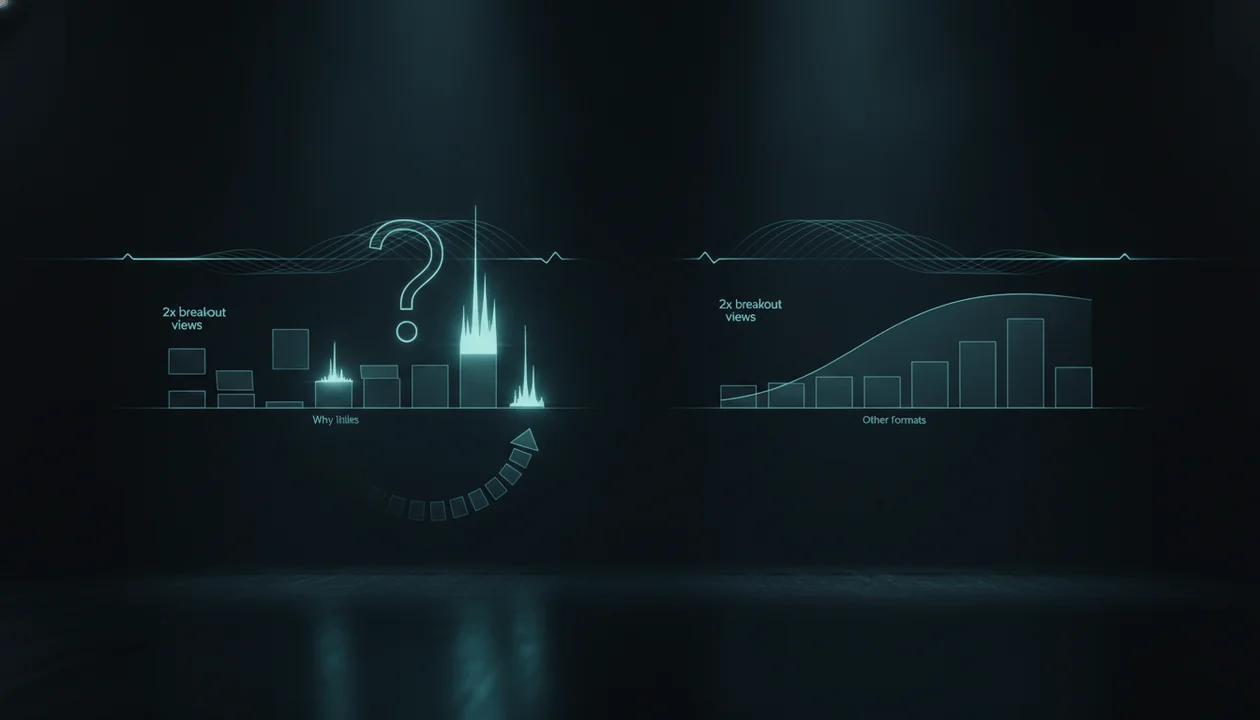
“Why” titles had a slightly weaker median but a somewhat higher 2x-outlier rate. They appeared more polarized, producing both weak videos and meaningful winners.
At the 25th percentile, “Why” videos sat at:
0.44x baseline.
At the 75th percentile:
2.28x.
That creates a roughly:
5.2x spread
between the lower and upper quartiles.
For non-“Why” videos, the equivalent spread was approximately:
3.6x.
So “Why” appears to be less like a guaranteed title upgrade and more like a high-variance framing device.
When the underlying question is compelling, it can produce a breakout.
When the question is weak, vague, or obvious, “Why” does not rescue it.
Key Findings
| Finding | “Why” titles | Other titles |
|---|---|---|
| Full mature-video cohort | 169 | 2,986 |
| Channels using “Why” | 26 | 83 |
| Share of all videos | 5.4% | 94.6% |
| Matched videos used for primary comparison | 99 | 2,753 |
| Matched channels | 24 | 82 |
| 25th-percentile relative performance | 0.44x | 0.54x |
| Median relative performance | 0.90x | 1.00x |
| 75th-percentile relative performance | 2.28x | 1.93x |
| Above channel-year baseline | 44.4% | 48.2% |
| 2x+ rate | 28.3% | 24.2% |
| 5x+ rate | 9.1% | 10.4% |
| Median title length | 50 characters | 51 characters |
| Median title word count | 9 words | 9 words |
The most useful answer is:
Do not start a YouTube title with “Why” because you think the word itself earns clicks. Use “Why” when the unexplained cause, contradiction, mystery, or consequence is genuinely the strongest part of the idea.
Do “Why” YouTube Titles Get More Views?
Not consistently.
The median “Why” video in our same-channel, same-year comparison performed at:
0.90x baseline.
That means the typical matched “Why” video actually finished about:
10% below
its channel-year comparison median.
But the upper tail tells another story.
“Why” videos crossed:
2x baseline
in:
28.3%
of cases.
Other titles:
24.2%.
So “Why” generated more 2x winners even while producing a weaker median.
That is exactly why simple title-formula advice is dangerous.
You could look only at the breakout rate and conclude:
Start more titles with “Why.”
Or look only at the median and conclude:
Never use “Why.”
Neither conclusion captures the distribution.
Finding 1: “Why” Titles Were Relatively Uncommon
Only:
169 of 3,155 videos
started with “Why.”
That is approximately:
1 in 19 videos.
And only:
26 of 83 channels
used the structure at least once in the qualifying mature catalog.
So “Why” was clearly not a universal title architecture.
Most successful long-form videos in the dataset used something else.
That matters because title formulas are often taught as if every video can be translated into:
Why X Happens
But some ideas are naturally:
- Stories
- Tutorials
- Experiments
- Lists
- Challenges
- Comparisons
- Reveals
- Investigations
- Transformations
A “Why” title is only one possible framing.
Finding 2: The Typical “Why” Video Underperformed Slightly
The primary matched median was:
0.90x.
Suppose a channel’s same-year non-“Why” median was:
100,000 views.
A 0.90x result would correspond to:
90,000 views.
That is not catastrophic.
But it certainly does not support the idea that the word:
Why
creates an automatic performance boost.
The title still needs a strong underlying question.
Finding 3: “Why” Titles Produced More 2x Winners
Here is where the story becomes interesting.
“Why” titles
2x+ rate:
28.3%.
Other titles
24.2%.
Difference:
4.1 percentage points.
So although the median was weaker, the “Why” group produced a somewhat larger share of meaningful 2x outliers.
That suggests the structure can work extremely well when the premise is right.
But it does not make mediocre “Why” ideas stronger.
Finding 4: “Why” Did Not Produce More 5x Breakouts
Raise the standard from:
2x
to:
5x.
The advantage disappears.
“Why”
9.1%
Other titles
10.4%.
So there was no evidence that beginning with “Why” made extreme 5x winners more common.
This is another reason to resist simplistic formulas.
A pattern can look positive at one threshold and disappear at another.
Finding 5: The “Why” Distribution Was More Polarized
The 25th percentile for “Why” titles was:
0.44x.
The 75th percentile:
2.28x.
That gives an approximate middle-50% spread of:
2.28 ÷ 0.44
=
5.18x
For other titles:
1.93 ÷ 0.54
=
3.57x
So the central distribution of “Why” videos was wider.
This is one of the most strategically useful findings.
“Why” did not create predictable improvement.
It created a group where outcomes were more spread out.
A compelling explanatory premise could win.
A weak one could fail badly.
What Makes a Strong “Why” Title?
A strong “Why” title usually contains an unresolved causal question.
The viewer sees something surprising and wants an explanation.
For example:
Why Your YouTube Videos Stop Growing After 48 Hours
The tension is:
I observe something happening
+
I do not know the cause
=
I want the explanation
That is a natural information gap.
Now compare:
Why YouTube Is Important
The question is broad.
There is little mystery.
The viewer probably already has an answer.
“Why” does not automatically create curiosity.
The unknown cause creates curiosity.
The Best “Why” Titles Usually Contain a Contradiction
Consider:
Why Expensive Restaurants Serve Smaller Portions
The viewer sees:
Higher price
should mean
more value
but observes:
Higher price
sometimes means
less food
That contradiction creates tension.
Another example:
Why Smart People Make Terrible Financial Decisions
Again:
Smart
+
terrible decisions
seems contradictory.
The viewer wants the missing explanation.
That is a much stronger “Why” premise than:
Why Financial Decisions Matter
Formula 1: Why + Unexpected Outcome
Why [unexpected thing happens]
Examples:
Why Good YouTube Videos Still Get No Views
Why Some Expensive Products Feel Cheap
Why Your Best Employees Leave First
The outcome is surprising.
The title promises causality.
Formula 2: Why + Accepted Belief Is Wrong
Why [common belief] is wrong
Examples:
Why Posting Every Day Can Slow Your YouTube Growth
Why More Features Can Make Software Harder to Sell
Why Being Busy Makes You Less Productive
This works when you have evidence strong enough to challenge the default belief.
Do not manufacture contrarianism just for clicks.
Formula 3: Why + Successful Thing Works
Why [successful thing] works
Examples:
Why Simple Thumbnails Keep Winning
Why Some Small YouTube Channels Grow So Fast
Why Costco Keeps the $1.50 Hot Dog
The viewer already observes the outcome.
The video explains the mechanism.
Formula 4: Why + Failure Happens
Why [desired outcome fails]
Examples:
Why Your YouTube Titles Get Impressions but No Clicks
Why Most New Habits Fail After Two Weeks
Why Good Products Still Fail to Sell
This is especially strong when the viewer personally experiences the problem.
Formula 5: Why + Person/Group Behaves Unexpectedly
Why [group] does [unexpected behavior]
Examples:
Why Billionaires Borrow Money Instead of Spending Cash
Why Professional Editors Cut Scenes Earlier Than Beginners
Why Experienced Creators Kill Good Video Ideas
Again, the behavior itself must create a question worth answering.
The Weakest “Why” Formula
The weakest version is usually:
Why [obvious thing] matters
Examples:
Why Sleep Is Important
Why Exercise Is Good for You
Why You Need Better Thumbnails
The viewer already knows the conclusion.
The title promises very little new information.
Better:
Why You Still Feel Tired After 8 Hours of Sleep
Now there is:
- Specificity
- Contradiction
- Personal relevance
- Mystery
The problem was not the word “Why.”
The problem was the question.
Finding 6: Recent Videos Told the Same Story
Maybe older YouTube title behavior makes the overall result irrelevant to 2026.
So we restricted the matched analysis to videos published from:
2024 through 2026.
That left:
84 matched “Why” videos across 22 channels.
Results:
Median
0.91x
2x+
29.8%
5x+
10.7%.
That is remarkably similar to the full matched sample.
The median remained slightly below baseline.
The 2x tail remained relatively healthy.
The result therefore did not appear to be driven entirely by old YouTube eras.
Finding 7: Channel-Level Weighting Made “Why” Look Weaker
Video-level studies can be distorted when a few creators publish a lot of one format.
So we performed another check.
We isolated channels with at least:
two matched “Why” videos.
That produced:
13 channels
and:
88 “Why” videos.
For each channel, we calculated its median “Why” relative performance.
Then each channel received one vote.
The result:
Median channel “Why” performance
0.85x baseline.
Channels where the “Why” median exceeded baseline:
23.1%.
Channels where the “Why” median reached at least 1.5x:
23.1%.
Channels at 2x+:
15.4%.
That is much less flattering than the video-level 2x rate.
This suggests a limited number of channels or individual videos may be responsible for a meaningful portion of the stronger “Why” outlier tail.
The safest conclusion remains:
“Why” can work very well, but it was not a broadly reliable channel-level advantage.
Finding 8: Title Length Was Almost Identical
Maybe “Why” titles were simply shorter.
They were not.
“Why”
Median:
50 characters
and:
9 words.
Other titles
51 characters
and:
9 words.
Practically identical.
So title length does not explain the observed difference.
For a deeper analysis of length itself, see the OverseerOS YouTube title-length study.
Most “Why” Titles Did Not Use a Question Mark
This is surprisingly useful.
Among all:
169 “Why” titles
only:
14
contained a question mark.
That is:
8.3%.
So:
Why This Happens
was much more common than:
Why Does This Happen?
with explicit ? punctuation in the observed titles.
That distinction matters because:
question framing
and:
question punctuation
are not the same thing.
A title can create an unanswered question without ending in ?.
Did the Question Mark Help?
In the primary matched sample:
“Why” without a question mark
87 videos
Median:
0.85x.
2x+:
28.7%.
5x+:
10.3%.
“Why” with a question mark
Only:
12 videos
Median:
1.02x.
2x+:
25.0%.
5x+:
0%.
The question-mark sample is far too small to declare a winner.
The useful conclusion is simply:
There is no evidence here that punctuation is the important part of the “Why” structure.
Our separate study on whether YouTube titles should be questions reaches the same broader strategic lesson: punctuation alone is not a meaningful content strategy.
“Why” vs “How To”
These two title structures look similar because both promise information.
But the viewer intention is different.
“How To”
Promises:
action.
How to Fix a Slow Laptop
Viewer wants:
a process.
“Why”
Promises:
explanation.
Why Your Laptop Gets Slower Over Time
Viewer wants:
understanding.
That difference matters.
In our recent study of “How To” YouTube titles, explicit instructional titles showed a much stronger positive channel-relative pattern than the “Why” titles in this study.
That does not mean “How To” is universally better.
The two structures solve different jobs.
If the viewer wants to:
do something
use an action-oriented frame.
If the viewer wants to:
understand something surprising
a “Why” frame may be stronger.
“Why” Is Often Better for Browse Than Search
Imagine a viewer searches:
fix low youtube ctr
A title like:
How to Fix a Low YouTube CTR
maps directly to the desired action.
Now imagine the viewer is scrolling Home and sees:
Why Your YouTube CTR Drops After a Video Starts Growing
They may never have searched for that question.
But the title creates:
an unresolved mechanism.
That can make “Why” particularly useful for explanatory Browse-native content.
This does not mean all “Why” titles belong in Browse.
It means the structure naturally creates curiosity when the audience did not arrive with a fully formed query.
The “Why” Test
Before using “Why,” ask:
1. Is there a real mystery?
If the answer is obvious, skip it.
2. Is the outcome surprising?
Stronger:
Why Your Best Video Can Hurt Your Expectations
Weaker:
Why Good Videos Get Views
3. Does the viewer care about the cause?
Something can be mysterious without being important.
4. Can you actually explain the mechanism?
Do not package speculation as explanation.
5. Does knowing “why” change what the viewer does?
The best explanatory videos often lead to action even though the title itself promises understanding.
A 12-Point “Why” Title Scorecard
Score each dimension from 0 to 2.
| Signal | 0 | 1 | 2 |
|---|---|---|---|
| Mystery | Obvious | Some gap | Strong unexplained cause |
| Contradiction | None | Mild | Immediate tension |
| Viewer relevance | Low | Moderate | Personal/high stakes |
| Specificity | Generic | Partial | Precise |
| Explanation value | Trivial | Useful | Changes understanding |
| Evidence | Speculative | Some support | Strong proof |
0–3
Do not use “Why.”
4–6
The premise needs sharpening.
7–9
Solid explanatory title.
10–12
Strong “Why” candidate.
This is a creative planning framework.
It is not an algorithm score.
Example: Weak vs Strong “Why” Titles
Weak
Why YouTube Thumbnails Matter
The audience already knows thumbnails matter.
Stronger
Why Great YouTube Thumbnails Still Get Ignored
Now the expected relationship breaks.
Weak
Why Saving Money Is Important
Obvious.
Stronger
Why Saving More Money Can Still Make You Feel Poor
Unexpected.
Weak
Why AI Is Changing Business
Broad and predictable.
Stronger
Why Companies Are Replacing AI Tools They Bought Last Year
Specific and unresolved.
The structure becomes powerful when:
the answer is not obvious from the title.
The Curiosity-Gap Trap
A “Why” title can easily become cheap clickbait.
Example:
Why Everything You Know Is WRONG
Wrong about what?
Why should the viewer care?
The title hides too much.
Useful curiosity says:
I understand the problem
but
I do not know the explanation
Bad curiosity says:
I do not understand what this video is about
Those are not the same thing.
Specific Mystery Beats Generic Mystery
Weak:
Why This Changes Everything
Stronger:
Why Google's New Search Feature Could Kill Comparison Sites
The second title gives the viewer enough information to evaluate whether the mystery matters.
A good “Why” title does not hide the subject.
It hides the explanation.
The Title Should Hide the Answer, Not the Topic
This is a useful rule.
Bad:
Why This One Thing Is Destroying Your Channel
The subject is hidden.
Better:
Why Uploading More Videos Can Lower Your Channel Average
The topic is clear.
The causal explanation remains open.
That is a much cleaner curiosity gap.
Pairing a “Why” Title With a Thumbnail
The thumbnail should usually visualize:
the contradiction
rather than repeat the question.
Title:
Why Your Most-Viewed Video Can Mislead You
Weak thumbnail:
WHY?
That adds almost nothing.
Better thumbnail:
A channel graph showing one enormous spike followed by normal videos appearing tiny.
Now:
- Title asks for explanation
- Thumbnail shows the strange evidence
The two assets create one promise together.
Another Example
Title:
Why Small YouTube Channels Produce Bigger Relative Breakouts
Thumbnail:
A tiny channel with one giant spike beside a huge channel with a flat high baseline.
No need to write:
SMALL CHANNELS WIN
The visual can communicate the anomaly.
When NOT to Use “Why”
1. The Viewer Wants Instructions
If the user needs:
steps
give them steps.
Instead of:
Why Your Microphone Has Background Noise
someone searching for a fix may prefer:
How to Remove Background Noise From Any Microphone
2. The Outcome Is Obvious
Avoid:
Why Exercise Is Healthy
unless your actual angle challenges or deepens the obvious conclusion.
3. The Video Is Primarily a Story
If the value is:
what happened
not:
why it happened
a story title may be stronger.
4. You Cannot Prove the Cause
A title beginning with “Why” implies explanatory authority.
If the real content is:
Here are five guesses
the packaging overpromises.
5. The Mystery Is Manufactured
Do not turn every idea into a fake causal puzzle.
The viewer can feel it.
When “Why” Is Excellent
Use it when the video genuinely answers:
- A contradiction
- A counterintuitive outcome
- A hidden mechanism
- A common failure
- An unexpected behavior
- A misunderstood trend
- A surprising historical event
- A persistent audience problem
The word should feel inevitable.
Not inserted.
Why One “Why” Winner Can Mislead Your Strategy
Suppose a channel normally receives:
50,000 views.
One “Why” video gets:
400,000.
That is:
8x baseline.
The creator may conclude:
My audience loves “Why” titles.
Then publishes:
Why X...
Why Y...
Why Z...
Why A...
and they all return to normal.
The better conclusion from the 8x winner is:
My audience cared deeply about that particular unexplained problem.
Study:
- Topic
- Stakes
- Contradiction
- Timing
- Thumbnail
- Audience relevance
before assuming the first word caused the breakout.
Analyze the Problem, Not the Formula
Suppose the winner is:
Why Everyone Is Leaving California
Do not extract:
Winning pattern =
Why Everyone Is...
Extract the deeper structure:
Large visible behavior
+
high-interest subject
+
unexplained cause
+
personal consequences
Now original angles become possible.
That is strategic pattern research.
Not title cloning.
How to Research “Why” Titles on Competitor Channels
Step 1: Establish the channel baseline
Use at least:
10 comparable videos
and preferably:
20 or more
when the channel history supports it.
Step 2: Find explanatory titles
Search for titles beginning with or structurally resembling:
- Why
- The Reason
- What Caused
- What Really Happened
- The Truth About
Step 3: Calculate relative performance
Video views
÷
Comparable-channel median
Step 4: Ignore one-off winners
Look for multiple explanatory videos.
Step 5: Identify the repeated mystery
Maybe the winning structure is not:
Why.
Maybe it is:
- Failed expectations
- Hidden business models
- Counterintuitive science
- Social behavior
- Historical mysteries
That is the more valuable pattern.
How to Apply This With OverseerOS
Use the free OverseerOS YouTube Channel Analyzer to inspect any public channel.
Start with:
- Top videos
- Recent uploads
- Public view distribution
- Titles
- Thumbnails
- Video duration
- Publishing patterns
Then ask:
Which explanatory videos actually outperform normal?
Separate:
“Why” winners
These contain potential demand signals.
“Why” normal videos
These prove the structure itself is not enough.
“Why” failures
These can reveal weak or obvious questions.
Then compare:
- Topic
- Specificity
- Contradiction
- Stakes
- Thumbnail
- Recency
- Audience fit
The workflow becomes:
Establish baseline
→
Find “Why” videos
→
Measure relative performance
→
Separate winners from failures
→
Extract the underlying mystery
→
Validate the demand elsewhere
→
Create an original explanatory angle
That is stronger than copying a title formula.
How We Analyzed the Data
This study used public YouTube channel and video information captured through OverseerOS research and channel-analysis workflows.
The analysis was frozen on:
September 3, 2026 at 07:00 UTC.
Channel Qualification
A channel needed:
- Strong public-catalog coverage
- Captured video count between approximately 80% and 120% of its latest reported public video count
- At least 20 qualifying mature long-form videos
Video Qualification
Videos needed:
- Duration greater than three minutes
- Age of at least 90 days
- Valid positive public view count
- Valid public title
The final cohort contained:
3,155 mature long-form videos
across:
83 public channels.
“Why” Definition
A video qualified only when the current captured title began with the word:
Why
ignoring capitalization and leading whitespace.
Examples of the structural classification:
Why X Happens
WHY X Is Changing
Why You Should...
A title containing “why” later in the sentence did not qualify.
Primary Same-Channel, Same-Year Comparison
For every qualifying “Why” video, we calculated the median views of non-“Why” videos published by:
- The same channel
- During the same calendar year
We required at least:
five control videos
for that channel-year baseline.
That produced:
99 matched “Why” videos across 24 channels.
The formula:
Relative performance =
“Why” video views
÷
Median views of same-channel, same-year non-“Why” videos
Why We Matched by Year
Lifetime public views grow over time.
A video from 2019 has had much longer to accumulate views than one from 2026.
Matching by publication year reduces that lifecycle distortion.
It also controls partially for changes in:
- Channel audience size
- Content quality
- Creator strategy
- Production resources
over long periods.
Channel-Wide Sensitivity Test
We repeated the comparison using each channel's broader non-“Why” mature-video median.
That produced:
112 “Why” videos across 25 channels.
Results:
- Median “Why” performance: 0.84x
- Above baseline: 37.5%
- 2x+: 21.4%
- 5x+: 8.0%
Controls:
- Median: 1.00x
- Above baseline: 49.2%
- 2x+: 26.4%
- 5x+: 11.5%
This stricter alternative did not reveal a hidden “Why” advantage.
Recent-Era Sensitivity Test
Using only:
2024–2026
matched videos, “Why” titles produced:
- 84 videos
- 22 channels
- Median: 0.91x
- 2x+: 29.8%
- 5x+: 10.7%
The central conclusion remained.
Equal-Channel Check
Channels can contribute different numbers of videos.
So we separately examined channels with at least:
two matched “Why” videos
and gave every channel one equal vote.
That produced:
13 channels.
Median channel-level “Why” performance:
0.85x.
Only:
23.1%
of those channels had an above-baseline median “Why” result.
Limitations
This is observational research
We did not randomly assign identical videos to:
Why X Happens
versus another title.
Therefore we cannot prove the word “Why” caused any result.
Topic selection is a major confounder
Creators use “Why” for explanatory content.
Explanatory topics may systematically differ from:
- Tutorials
- Stories
- Challenges
- Lists
- Reviews
The result measures the complete real-world package, not the isolated first word.
Only 169 videos began with “Why”
That is a meaningful sample for descriptive analysis, but far smaller than the full 3,155-video cohort.
Usage was clustered
Only 26 channels used at least one qualifying “Why” title.
Public views are not CTR
We cannot see competitor:
- Impressions
- Click-through rate
- Audience retention
- Traffic sources
- Search terms
- Returning viewers
- Title A/B test results
A title could affect clicks without producing an equivalent lifetime-view effect.
Current titles may differ from original titles
The research layer uses the latest captured public title.
Creators can edit titles after publication.
Same-year matching reduces but does not eliminate age differences
Two videos published in January and December of the same year still have different accumulation periods.
That is why we also ran broader sensitivity checks rather than relying on one method.
What the Data Actually Says
The strongest defensible conclusion is:
Across 3,155 mature long-form videos, titles beginning with “Why” did not show a reliable median performance advantage. In the primary same-channel, same-year analysis, the median “Why” video reached 0.90x baseline, although its 2x-outlier rate was slightly higher at 28.3% versus 24.2% for other titles. The distribution was wider, suggesting that “Why” can produce strong winners when the underlying explanatory premise is compelling, but the word itself is not a reliable growth shortcut.
That is much more useful than:
“Why” titles work.
or:
“Why” titles fail.
Final Verdict
Do “Why” YouTube titles get more views?
Not reliably.
OverseerOS analyzed:
3,155 mature long-form videos across 83 public channels.
There were:
169 titles beginning with “Why.”
In the primary matched analysis:
Median performance
“Why”:
0.90x
Other titles:
1.00x.
2x breakout rate
“Why”:
28.3%.
Other:
24.2%.
5x breakout rate
“Why”:
9.1%.
Other:
10.4%.
So “Why” produced a strange profile:
weaker typical performance
but:
a somewhat stronger 2x tail.
And its middle-50% performance range was substantially wider.
The practical lesson is not:
Avoid “Why.”
It is:
Earn the word “Why.”
Use it when the video contains a genuinely unresolved cause.
A strong “Why” title says:
Something surprising is happening, and I can explain it.
A weak one says:
I added “Why” because title formulas told me curiosity gets clicks.
Viewers can tell the difference.
So before using the structure, ask:
- Is the outcome surprising?
- Is the cause genuinely unclear?
- Does the viewer care about the explanation?
- Can I prove the explanation?
- Can the thumbnail visualize the contradiction?
If those answers are strong, “Why” can be an excellent title architecture.
If they are weak, use a different frame.
Analyze any public YouTube channel with OverseerOS and find which title structures actually outperform that creator's normal baseline instead of trusting universal title formulas.
Frequently Asked Questions
Do “Why” YouTube titles get more views?
Not consistently. In the OverseerOS matched analysis, the median “Why” video reached 0.90x its same-channel, same-year baseline.
Are “Why” titles good on YouTube?
They can be very strong when the video explains a surprising outcome, contradiction, or hidden mechanism. The title structure itself did not produce a reliable average advantage.
How common are “Why” YouTube titles?
169 of 3,155 mature long-form videos in the qualified OverseerOS sample began with “Why,” or 5.4%.
Are “Why” titles more likely to go viral?
They had a slightly higher 2x-outlier rate in this dataset, 28.3% versus 24.2%, but a slightly lower 5x rate, 9.1% versus 10.4%.
Do “Why” titles outperform normal videos?
The median matched “Why” video performed at 0.90x baseline, so the typical result did not outperform.
Why can a “Why” title still produce a breakout?
A strong explanatory title can create an information gap around a surprising cause. The underlying topic, stakes, contradiction, thumbnail, and audience relevance likely matter more than the first word itself.
Should I start my YouTube title with “Why”?
Use “Why” when understanding the cause is genuinely the viewer's main reason to watch. Do not add it solely as a click tactic.
What makes a good “Why” YouTube title?
A strong one usually contains a specific, relevant, non-obvious outcome whose cause the viewer genuinely wants explained.
What makes a bad “Why” title?
Generic or obvious questions such as “Why Exercise Is Important” provide little unresolved information and weak curiosity.
Is “Why” good for YouTube SEO?
It can naturally match explanatory queries, but this study found no universal view advantage from beginning the title with “Why.”
Is “Why” better for Browse or Search?
It can work in either, but explanatory curiosity can be particularly natural for Browse when the viewer was not already searching for a step-by-step solution.
Is “Why” better than “How To”?
Neither is universally better. “How To” promises a process, while “Why” promises an explanation. Use the one that matches the viewer's actual intent.
Do “How To” titles perform better than “Why” titles?
In the separate OverseerOS “How To” study, instructional titles showed a stronger positive relative-performance pattern. The studies should not be interpreted as a controlled head-to-head experiment because the content types differ.
Should a “Why” title end with a question mark?
Not necessarily. Only 8.3% of the “Why” titles in the full cohort contained a question mark. The question framing matters more than punctuation alone.
Do question marks make “Why” titles perform better?
The matched question-mark subset was too small to establish a reliable conclusion.
How long should a “Why” YouTube title be?
There was almost no length difference in this study. “Why” titles had a median length of 50 characters versus 51 for other titles.
How many words should a “Why” title have?
Both “Why” and non-“Why” titles had a median of nine words in the matched sample.
What are good “Why” title formulas?
Useful structures include “Why [unexpected outcome happens],” “Why [common belief] is wrong,” “Why [successful thing] works,” and “Why [desired outcome] fails.”
Should I use “Why” for tutorial videos?
Use it if the viewer wants an explanation. If the viewer primarily wants actionable steps, a “How To” or direct instructional frame may be clearer.
Should I use “Why” for documentaries?
It can be an excellent documentary frame when the story centers on explaining a mystery, failure, behavior, historical event, or counterintuitive outcome.
Should the thumbnail say “Why?” too?
Usually not. Let the title ask for the explanation and use the thumbnail to visualize the contradiction, consequence, or evidence.
How do I know whether a competitor's “Why” title actually worked?
Compare the video's views with a multi-video baseline from the same channel instead of judging the raw view count alone.
How many competitor videos should I analyze?
Use at least 10 comparable videos when possible and preferably 20 or more for a more defensible channel baseline.
Should I copy a successful competitor's “Why” title?
No. Treat the breakout as evidence that viewers cared about the underlying unexplained problem. Create an original angle around the transferable audience insight.
Can OverseerOS identify successful title patterns?
OverseerOS Channel Analysis lets you inspect public titles, thumbnails, top videos, recent uploads, views, duration, and publishing patterns so a title structure can be evaluated relative to the channel's normal performance.