Most AI-written YouTube videos fail before the script begins.
The creator enters a topic into a chatbot, asks for “deep research,” receives a confident summary, and starts writing.
The output may look professional.
It may also contain:
- Outdated facts
- Circular citations
- Weak sources
- Invented statistics
- Missing counterarguments
- Competitor angles everyone already copied
- Claims pulled from articles that copied one another
- A video idea with no evidence of YouTube demand
An AI research agent for YouTube should do more than summarize search results.
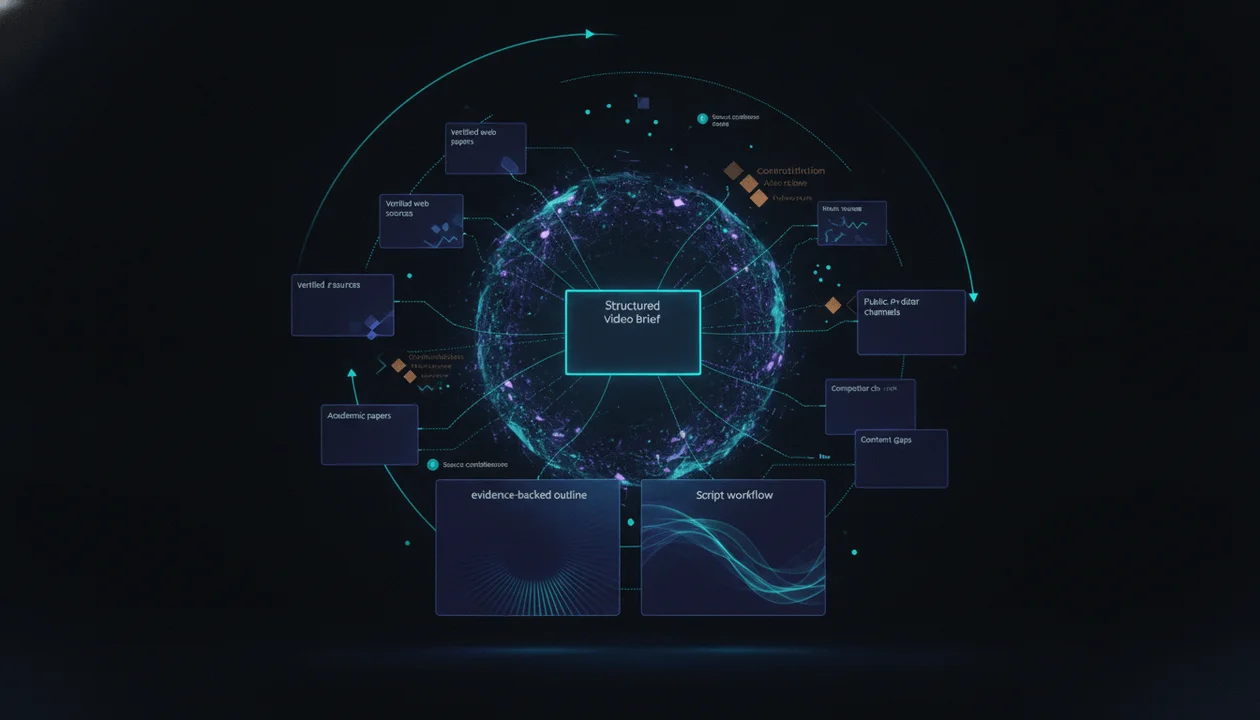
It should break a video question into research tasks, gather current evidence, inspect the YouTube market, compare sources, expose contradictions, identify unanswered audience needs, and turn the findings into a source-backed creative brief.
The final output should not be:
Here is everything the internet says about this topic.
It should be:
Here is the strongest original YouTube angle, the evidence supporting it, the claims that still need verification, the videos already competing for attention, and the structure most likely to turn the research into a useful video.
That is the difference between AI-assisted research and AI-generated filler.
Key Takeaways
- An AI research agent plans and completes a multi-step investigation instead of answering one prompt from memory.
- A YouTube research agent should combine web sources with public YouTube evidence such as channels, titles, videos, transcripts, comments, upload timing, and breakout performance.
- A general deep research tool is useful for source discovery and synthesis, but it does not automatically understand YouTube packaging, channel fit, outliers, or content gaps.
- Citations do not guarantee accuracy. The creator still needs to open the source and verify that it supports the exact claim.
- The strongest research brief separates confirmed facts, interpretations, unresolved questions, and creative hypotheses.
- Research agents should search for contradictory evidence rather than only confirming the original idea.
- One source repeated across ten articles is still one source.
- YouTube research should validate both the subject and the proposed video angle.
- AI agents can reinforce existing patterns, so human judgment is still needed to produce genuinely original questions.
- OverseerOS connects YouTube market research, video analysis, web research, mind mapping, outlines, scripts, and planning inside one creator workflow.
- The final script should remain grounded in approved evidence rather than unrestricted AI improvisation.
Quick Answer
An AI research agent for YouTube is a system that autonomously plans, searches, evaluates, and synthesizes information for a video topic.
A strong YouTube research agent should:
- Clarify the video question
- Break it into research subtopics
- Search current web and primary sources
- Inspect relevant YouTube videos and channels
- Analyze competing angles
- Extract factual claims and evidence
- Find contradictions and unanswered questions
- Identify an original viewer promise
- Produce a structured video brief
- Flag every claim requiring human verification
It should not independently decide that a claim is true simply because several webpages repeat it.
What Is an AI Research Agent?
An AI research agent is an AI system that performs a sequence of research actions toward a defined outcome.
Instead of producing one immediate response, the agent may:
- Create a research plan
- Generate subquestions
- Select search tools
- Browse sources
- Read documents
- Compare evidence
- Refine its searches
- Follow new leads
- Abandon weak directions
- Organize findings
- Produce a cited report
The important word is agent.
A standard chatbot responds.
A research agent investigates.
Chatbot vs Search Engine vs Research Agent
| Tool | Main Behavior | Typical Output |
|---|---|---|
| Standard chatbot | Generates an answer from supplied context and model knowledge | Explanation or draft |
| Search engine | Retrieves pages matching a query | Ranked links |
| AI answer engine | Searches and summarizes current sources | Cited answer |
| Deep research tool | Plans and completes a multi-source investigation | Documented report |
| YouTube research agent | Combines topic research with public YouTube market evidence | Video opportunity brief |
A search engine gives you sources.
A chatbot gives you prose.
A research agent should give you a defensible decision.
What Makes a YouTube Research Agent Different?
A general research agent can tell you what happened.
A YouTube research agent must also determine whether the subject can become a strong video.
That requires additional questions:
- Has this topic already been covered heavily?
- Which videos broke out?
- Which channels normally cover it?
- Is the opportunity Search-led, Browse-led, or Suggested-led?
- Which title promises already dominate?
- What does the audience still misunderstand?
- Which visual proof can the video show?
- Is the angle strong enough to sustain a full script?
- Does the topic fit the channel?
- Can the creator contribute something original?
- Is the opportunity still timely?
- What would make the viewer choose this video over the existing options?
This creates two separate research layers.
Layer 1: Subject Research
This validates:
- Facts
- Timeline
- Mechanisms
- People
- Companies
- Statistics
- Causes
- Consequences
- Expert positions
- Counterarguments
- Primary sources
Layer 2: YouTube Opportunity Research
This validates:
- Audience demand
- Existing coverage
- Competitor performance
- Breakout videos
- Title patterns
- Thumbnail patterns
- Content gaps
- Format fit
- Packaging potential
- Channel relevance
A video can pass one layer and fail the other.
A fascinating subject may have weak YouTube packaging.
A highly clickable subject may lack enough reliable evidence for a trustworthy video.
What an AI YouTube Research Agent Should Produce
The ideal output is not one long essay.
It is a structured research packet.
1. Research Question
The agent should restate the precise question.
Weak:
Research AI agents.
Strong:
Determine whether AI browser agents can reliably manage customer support workflows for small SaaS companies without creating unacceptable privacy, accuracy, or approval risks.
The second question defines:
- Technology
- Use case
- Audience
- Evaluation criteria
- Risk
- Decision
2. Current-State Summary
A concise explanation of what is known now.
This section should contain only well-supported findings.
3. Evidence Table
| Claim | Supporting Source | Source Type | Confidence | Verification Status |
|---|---|---|---|---|
| Company released the product on a specific date | Official announcement | Primary | High | Verified |
| Users report repeated failures | Community reports | Secondary | Medium | Needs broader validation |
| Tool reduced workflow time by 40 percent | Vendor case study | Interested primary source | Medium | Independent proof needed |
This prevents citations from becoming decoration.
4. Contradiction Table
| Question | Source A | Source B | Why They Differ |
|---|---|---|---|
| Is the workflow fully autonomous? | Vendor says yes | Documentation requires approval | Marketing uses a broader definition |
| Is the product cheaper? | Monthly plan appears lower | Usage charges increase total cost | Different assumptions |
Contradictions often create the strongest video angle.
5. YouTube Market Map
The agent should summarize:
- Leading videos
- Leading channels
- Recent uploads
- Outliers
- Common titles
- Common thumbnails
- Dominant formats
- Repeated claims
- Missing questions
- Saturation level
6. Audience Question Map
Sources may include:
- YouTube comments
- Search predictions
- Forums
- Product communities
- Support questions
- Customer interviews
- Creator comments
Questions should be grouped into:
- Confusion
- Fear
- Desire
- Objection
- Comparison
- Cost
- Implementation
- Trust
7. Original Angle
The agent should complete this sentence:
Existing videos explain __________, but viewers still need __________.
Example:
Existing videos demonstrate AI browser agents completing ideal tasks, but viewers still need a realistic test of what happens when the agent encounters ambiguous instructions, sensitive customer data, and irreversible actions.
8. Claim Ledger
Every script-worthy claim should be classified.
| Classification | Meaning |
|---|---|
| Confirmed fact | Supported by a reliable source |
| Supported interpretation | Reasonable conclusion based on cited evidence |
| Disputed claim | Reliable sources disagree |
| Vendor claim | Stated by a company with an interest in the outcome |
| Anecdotal report | Based on individual experience |
| Creative hypothesis | Useful angle that still requires testing |
| Unverified | Must not enter the final script as fact |
9. Recommended Video Brief
The brief should contain:
- Target viewer
- Core promise
- Original thesis
- Strongest evidence
- Counterargument
- Proposed title directions
- Thumbnail direction
- Hook
- Main sections
- Required visuals
- Claims to verify
- Sources to preserve
- Final viewer takeaway
The 10-Stage YouTube Research Agent Workflow
Stage 1: Define the Decision
Do not ask the agent to “research a topic.”
Define what the video must help the viewer understand or decide.
Examples:
- Should a solo creator use AI video editing?
- Why did a dominant company collapse?
- Which AI script tools produce the most original output?
- Can a faceless channel still enter this niche?
- Is the new product genuinely better or mostly marketing?
A strong decision gives the research direction.
Stage 2: Build the Question Tree
Break the main question into subquestions.
For a software comparison:
- What does each product claim?
- What does each product actually include?
- What does it cost under realistic usage?
- Which limitations appear in documentation?
- What do independent users report?
- Which audience is each product built for?
- What information is missing?
- What can be tested directly?
For a documentary:
- What happened?
- What happened first?
- Who made the decisions?
- What evidence exists?
- Which explanations are disputed?
- What changed after the event?
- Which popular version of the story is misleading?
- What remains unknown?
Stage 3: Establish the Source Hierarchy
Not all sources deserve equal weight.
Tier 1: Primary Sources
- Official documents
- Regulatory filings
- Court records
- Academic papers
- Original datasets
- Product documentation
- Direct interviews
- Company announcements
- Government publications
Tier 2: High-Quality Secondary Sources
- Established journalism
- Expert analysis
- Reputable industry research
- Systematic reviews
- Professional publications
Tier 3: Community Evidence
- YouTube comments
- Reddit discussions
- Product reviews
- Social posts
- Forums
- User anecdotes
Community evidence is useful for discovering problems.
It is weaker for proving universal facts.
Stage 4: Search Broadly, Then Narrow
The first pass maps the topic.
The second pass investigates the strongest claims.
The third pass searches for disagreement.
A useful sequence is:
- Broad orientation
- Primary-source discovery
- Date and timeline verification
- Contradictory evidence
- Audience questions
- YouTube market analysis
- Final claim validation
Stage 5: Inspect the YouTube Market
Analyze relevant channels and videos.
Record:
- Title
- Thumbnail concept
- Publish date
- Views
- Video age
- Channel baseline
- Outlier multiple
- Format
- Length
- Hook
- Main promise
- Comments
- Missing coverage
The goal is not to find a video to copy.
It is to understand what the audience has already been offered.
Stage 6: Read the Actual Sources
Do not trust a search snippet.
Do not trust the AI’s paraphrase without opening the source.
Check:
- Does the source make the claimed statement?
- Is the statistic current?
- Is the quote complete?
- Is the study being interpreted correctly?
- Is the number global or regional?
- Is the source discussing correlation or causation?
- Is the date relevant to the final script?
- Is the source independent?
Stage 7: Search Against the Thesis
Once the agent forms a likely conclusion, force it to challenge that conclusion.
Prompt:
Find the strongest credible evidence that contradicts the current thesis. Explain whether that evidence changes, narrows, or invalidates the proposed argument.
This reduces confirmation bias.
Stage 8: Separate Evidence From Story
The video still needs a narrative.
But the narrative cannot distort the evidence.
Separate:
- What is known
- What is inferred
- What is disputed
- What is unknown
- What the creator personally believes
This creates honest tension without fake certainty.
Stage 9: Build the Creative Brief
Only after the evidence is organized should the agent propose:
- Titles
- Hooks
- Sections
- Story structure
- Visuals
- Payoff
Packaging should emerge from the research.
The research should not be bent to justify a prewritten title.
Stage 10: Require Human Approval
The creator should approve:
- Central thesis
- Key claims
- Sources
- Counterarguments
- Title promise
- Risky statements
- Final outline
The agent can accelerate research.
It should not silently become the editor-in-chief.
The Research Integrity Framework
Use five tests before allowing information into the script.
1. Source Test
Who originally published the information?
A hundred articles may trace back to one company press release.
That is not a hundred independent confirmations.
2. Support Test
Does the source support the exact wording?
Source:
Early users reported faster completion in one internal test.
Invalid script:
The tool makes every user twice as productive.
3. Freshness Test
Is the evidence current enough for the claim?
Fast-moving topics may require sources from:
- Today
- This week
- The current product version
- The current policy
- The current market
4. Independence Test
Does the source benefit from the conclusion?
Vendor evidence can still be useful.
It should be labeled as vendor evidence.
5. Scope Test
Does the evidence apply to the audience in the video?
A study involving enterprise developers may not prove the same result for beginner creators.
General Deep Research Tools vs YouTube Research Agents
| Capability | General Deep Research Tool | YouTube Research Agent |
|---|---|---|
| Search the live web | Strong | Strong when connected |
| Read documents | Strong | Useful |
| Produce cited reports | Strong | Expected |
| Compare public YouTube channels | Limited unless specifically connected | Core capability |
| Calculate channel-relative outliers | Usually absent | Core capability |
| Analyze title and thumbnail patterns | Limited | Core capability |
| Detect content gaps | General topic gaps | YouTube-specific gaps |
| Understand channel fit | Requires detailed context | Should be built in |
| Turn evidence into video brief | Requires prompting | Core output |
| Connect into script workflow | Usually separate | Ideally connected |
| Access private competitor analytics | No | No |
Generic research agents are excellent for subject depth.
YouTube-specific systems are better for content opportunity and production context.
The strongest workflow combines both.
Current AI Research Tool Categories
ChatGPT Deep Research
Best for:
- Multi-step web investigations
- Structured reports
- Source-controlled research
- Uploaded files
- Connected internal sources
- Broad synthesis
Useful strengths include:
- Editable research plan
- Specific-site controls
- Progress tracking
- Web, file, and connected-app research
- Documented reports
Main limitation for creators:
It needs explicit YouTube market context. It does not automatically know your channel, competitors, previous topics, public outliers, or packaging strategy.
Gemini Deep Research
Best for:
- Long-horizon web research
- Google ecosystem workflows
- Data analysis
- Visual research outputs
- Custom source connections
Main limitation:
A detailed research report is not automatically a YouTube opportunity brief.
Perplexity Advanced Deep Research
Best for:
- Fast source discovery
- Current web research
- Cross-referencing
- Professional reports
- Uploaded-document analysis
Main limitation:
Fast synthesis can still hide weak source selection unless the creator checks the underlying evidence.
Claude Research
Best for:
- Long-form synthesis
- Internal and web context
- Nuanced written analysis
- Cited reports
- Research-to-writing workflows
Main limitation:
Strong prose can make uncertain conclusions sound more settled than the evidence deserves.
Gemini Notebook
Formerly known as NotebookLM, Gemini Notebook is especially useful when the creator already has a controlled source collection.
Best for:
- Research packets
- PDFs
- Reports
- Interviews
- YouTube source URLs
- Source-grounded questioning
- Citation-linked notes
Main limitation:
It is strongest inside the selected source set. Weak source selection still produces weak research.
Consensus Research Agent
Best for:
- Peer-reviewed evidence
- Study comparisons
- Citation discovery
- Academic filtering
- Scientific questions
Main limitation:
Academic evidence does not replace competitor, audience, packaging, or trend research.
The Best Research Stack by Video Type
| Video Type | Recommended Research Stack |
|---|---|
| Breaking news | Current web research, primary announcement, competitor monitoring, rapid fact verification |
| Software comparison | Official documentation, pricing pages, test accounts, community reports, YouTube comparison gap |
| Documentary | Primary records, journalism, papers, interviews, timeline mapping, YouTube format research |
| Science explainer | Academic research agent, systematic reviews, expert sources, visual explanation planning |
| Product review | Direct testing, documentation, user reports, pricing calculations, competing videos |
| Faceless educational video | Public research, source ledger, original script, custom visual plan, repetition audit |
| Trend commentary | Trend data, news sources, competitor velocity, audience comments, counterargument search |
| Historical video | Archival sources, chronology, disputed interpretations, map or timeline planning |
A Practical YouTube Research Agent Prompt
Use this as a starting template:
Act as an evidence-first YouTube research agent.
Topic: [TOPIC]
Target viewer: [VIEWER]
Channel positioning: [POSITIONING]
Proposed video decision: [WHAT THE VIEWER SHOULD UNDERSTAND OR DECIDE]
Complete the following process:
- Clarify the central research question.
- Break it into factual, historical, technical, market, audience, and counterargument subquestions.
- Prioritize primary and authoritative sources.
- Gather current evidence and preserve source links.
- Identify the original source behind repeated claims.
- Separate confirmed facts, vendor claims, interpretations, disputed claims, anecdotes, and unverified statements.
- Search for credible evidence against the emerging thesis.
- Analyze the current YouTube market, including common angles, recent videos, breakout examples, titles, formats, and unanswered viewer questions.
- Identify three original video angles.
- Score each angle for evidence strength, audience demand, originality, packaging potential, channel fit, visual potential, and production difficulty.
- Recommend one angle and explain why.
- Build a source-backed video brief with hook, sections, evidence, counterargument, visuals, payoff, and claims requiring human verification.
Do not invent statistics, quotes, sources, private analytics, or performance guarantees.
State uncertainty clearly.
Example Research Brief
Topic:
Why AI-generated YouTube scripts sound the same
Weak AI Output
AI scripts sound similar because AI uses predictable patterns. Creators should add more personality and improve their prompts.
This is generic.
Strong Research-Agent Output
Research question
Which parts of AI-assisted script production cause different creators to converge on similar hooks, transitions, structures, and conclusions?
Possible mechanisms
- Similar training patterns
- Repeated viral-script prompts
- Shared creator templates
- Preference for statistically familiar language
- Low source diversity
- One-pass generation
- Lack of lived experience
- Automatic phrase selection
- Editing toward the same retention formulas
YouTube market finding
Many videos discuss “humanizing AI writing,” but fewer test several generators against the same brief or compare the resulting structures line by line.
Original angle
Give five leading AI systems the same YouTube brief, remove branding, and test whether professional writers can identify the model or detect repeated structural patterns.
Evidence required
- Five controlled outputs
- Defined prompt
- Similar model settings
- Blind evaluator
- Phrase-overlap analysis
- Structural comparison
- Human rewrite comparison
Title direction
I Gave Five AI Models the Same YouTube Script. They Made the Same Mistake.
Now the research creates a real video.
How to Score an AI Research Agent
Score each category from 1 to 5.
| Category | Question |
|---|---|
| Planning | Does it create a useful research plan? |
| Source quality | Does it prioritize primary and credible sources? |
| Traceability | Can every major claim be traced? |
| Contradiction search | Does it actively challenge the thesis? |
| Freshness | Does it use current information when required? |
| YouTube evidence | Does it inspect relevant videos and channels? |
| Audience understanding | Does it identify viewer questions and objections? |
| Originality | Does it reveal an open angle rather than summarize competitors? |
| Uncertainty | Does it label weak or disputed evidence? |
| Workflow value | Does the result move cleanly into an outline and script? |
Score Interpretation
| Score | Verdict |
|---|---|
| 43 to 50 | Strong research workflow |
| 35 to 42 | Useful with human verification |
| 27 to 34 | Shallow or incomplete |
| Below 27 | High hallucination or decision risk |
Why AI Research Agents Still Produce Generic Ideas
A research agent may search more sources and still produce conventional output.
Research published in 2026 found that AI-generated scientific ideas tended to remain more concentrated around existing literature than human follow-on research.
The YouTube implication is important:
An agent may become excellent at recombining what already exists without asking the genuinely new question.
That creates research convergence.
Every creator receives:
- Similar facts
- Similar angles
- Similar titles
- Similar examples
- Similar conclusions
Human judgment is needed to ask:
- What does everyone assume?
- What has not been tested?
- Which audience is ignored?
- What contradiction is unresolved?
- What can we prove ourselves?
- Which format from another niche could reveal this differently?
- What does our channel know that a generic agent does not?
How OverseerOS Supports a Research-Agent Workflow
OverseerOS does not position one unrestricted chatbot as the answer to every research problem.
It connects specialized YouTube research and production stages.
Find Public Market Evidence
Use:
- OverseerOS Viral Channel Finder
- Overseer Feed
- OverseerOS AI YouTube Channel Analyzer
- OverseerOS YouTube Competitor Analysis Tool
These workflows help creators inspect public signals such as:
- Channels
- Recent uploads
- Views
- Velocity
- Breakout status
- Titles
- Thumbnails
- Upload timing
- Public engagement
- Historical performance patterns
The purpose is to identify which directions deserve deeper investigation.
Analyze the Individual Video
OverseerOS Viral X-Ray helps creators examine a relevant public video more deeply.
The workflow can support analysis of:
- Public performance
- Title
- Thumbnail psychology
- Hook
- Target audience
- Emotional framing
- Structure
- Extracted outline
This helps separate the transferable principle from the finished video.
Research Fresh Topics With OverseerOS Trend to Script
OverseerOS Trend to Script supports research-first workflows beginning from:
- Live news
- Topic search
- Article URL
- YouTube URL
- Manual notes
- Extracted key points
Creators can review, edit, approve, or reject research points before moving into the outline.
That approval layer matters.
Research does not enter the script simply because the AI retrieved it.
Map Complex Research With MindOS
OverseerOS MindOS gives creators a visual research and brainstorming canvas.
It can support:
- Topic mapping
- AI-expanded nodes
- Web research
- Historical timelines
- Key points
- Connected ideas
- Script-outline conversion
This is especially useful when the subject has:
- Several causes
- Competing explanations
- Historical phases
- Multiple people
- Technical dependencies
- A complex timeline
Turn Approved Evidence Into the Script
OverseerOS Script Studio can receive the title, outline, selected research, reference context, and creator tone.
The connected workflow becomes:
Public YouTube evidence → source research → approved findings → mind map or outline → original script → title and thumbnail → production plan.
That is more reliable than asking one blank chatbot prompt to invent the entire video.
The OverseerOS Research Workflow
- Define the audience and decision.
- Use OverseerOS Viral Channel Finder or Overseer Feed to find relevant breakout evidence.
- Analyze channels through OverseerOS AI YouTube Channel Analyzer.
- Inspect important videos with OverseerOS Viral X-Ray.
- Use OverseerOS Trend to Script for current web, article, and video-source research.
- Approve only the strongest research points.
- Organize complex ideas inside MindOS.
- Convert the approved structure into an outline.
- Continue into OverseerOS Script Studio.
- Verify every factual claim before recording.
- Preserve source and production evidence.
- Publish and compare the hypothesis with real YouTube analytics.
Common Mistakes
Mistake 1: Asking for “Deep Research” Without Defining the Decision
A broad prompt creates a broad report.
Define what the viewer needs to understand.
Mistake 2: Trusting the Citation Count
Twenty citations do not equal twenty independent sources.
Trace repeated claims to the original evidence.
Mistake 3: Using Search Snippets as Sources
Open and read the source.
Snippets remove context.
Mistake 4: Letting the Agent Choose the Thesis Too Early
Premature conclusions create confirmation bias.
Map the evidence first.
Mistake 5: Ignoring the YouTube Market
A deeply researched subject can still become a redundant video.
Inspect existing coverage.
Mistake 6: Researching Only Successful Videos
Study weak and average videos too.
They reveal which variables did not transfer.
Mistake 7: Treating Comments as Facts
Comments reveal questions, beliefs, and frustrations.
They do not automatically prove claims.
Mistake 8: Using One Research Agent for Every Source Type
Academic, news, product, competitor, and historical research require different tools.
Mistake 9: Allowing AI to Invent Missing Bridges
When evidence is incomplete, the agent may create a smooth causal story.
Label the gap instead.
Mistake 10: Writing Before the Claim Ledger Is Approved
Do not let uncertain claims become emotionally persuasive narration.
Mistake 11: Copying the Competitor’s Research Sequence
Use public videos as evidence of audience demand, not as scripts to paraphrase.
Mistake 12: Confusing Synthesis With Originality
A clean summary is not automatically a new idea.
Final Verdict
An AI research agent for YouTube should not be judged by how many pages it reads.
It should be judged by the quality of the decision it enables.
A strong system helps the creator answer:
- Is the topic true?
- Is the information current?
- Which sources deserve trust?
- Where do credible sources disagree?
- What has YouTube already covered?
- Which videos actually broke out?
- What does the audience still need?
- What can this creator contribute?
- Which claims remain unsafe?
- What original video should be made?
Generic deep research tools are powerful for gathering and synthesizing evidence.
YouTube-specific research workflows are stronger for evaluating channels, videos, packaging, outliers, and content opportunities.
The best approach combines them.
Use agents to expand the search.
Use evidence to narrow the claim.
Use YouTube research to validate the opportunity.
Use human judgment to create the original angle.
Then move only approved research into the script.
The future of YouTube research is not a chatbot that confidently writes everything for you.
It is an evidence system that makes it harder to publish something false, generic, copied, outdated, or strategically unnecessary.
FAQ
What is an AI research agent for YouTube?
An AI research agent for YouTube is a system that plans and completes multi-step research for a video topic. It can gather sources, inspect public YouTube evidence, analyze competitors, identify content gaps, organize claims, and produce a source-backed video brief.
How is a research agent different from ChatGPT?
A standard chatbot usually responds directly to a prompt. A research agent creates a plan, searches external information, uses tools, refines queries, compares sources, and produces a documented result.
Can AI research agents access current information?
Research agents with live web access can retrieve current information. The creator still needs to check source dates, product versions, policies, and original documents.
Can an AI research agent hallucinate?
Yes. Research agents can misread sources, combine unrelated facts, cite weak evidence, omit contradictions, or create unsupported conclusions. Citations reduce opacity but do not eliminate error.
Does a citation prove the claim is true?
No. A citation proves that a source was referenced. You still need to confirm that the source is reliable and supports the exact claim.
Can AI research YouTube videos?
Yes, when the system has access to public video metadata, available transcripts, titles, thumbnails, channels, comments, or specialized YouTube tools. It cannot access another creator’s private YouTube Studio analytics.
Can an AI research agent see competitor retention?
No public research agent can access a competitor’s private audience-retention graph, CTR, revenue, or internal YouTube Studio data without authorized access.
What should a YouTube research brief include?
It should include the research question, confirmed facts, source table, contradictions, competitor coverage, audience questions, original angle, claim ledger, title direction, outline, required visuals, and verification tasks.
What sources should a YouTube research agent prioritize?
It should prioritize primary sources such as official documents, academic papers, datasets, filings, direct interviews, product documentation, and government publications. High-quality secondary and community sources can add context.
Can an AI research agent find viral video ideas?
It can identify possible opportunities by combining trend, competitor, outlier, search, and audience evidence. It cannot guarantee views or virality.
Should AI write the script immediately after research?
Not automatically. The creator should first approve the thesis, evidence, claims, counterarguments, and outline.
What is the best AI research tool for YouTube creators?
The best choice depends on the task. General deep research tools are useful for web evidence. Academic agents are useful for papers. OverseerOS is useful for connecting public YouTube research, video analysis, trends, mind mapping, outlines, scripts, and planning.
Is ChatGPT Deep Research useful for YouTube?
Yes. It is useful for complex source discovery, web research, files, connected data, and documented reports. It still needs YouTube-specific channel, competitor, packaging, and audience context.
Is Perplexity useful for YouTube research?
Yes. Perplexity is useful for current source discovery, cited answers, and deeper web research. Creators should still verify the underlying sources and add YouTube-specific market analysis.
Is Gemini Notebook useful for video research?
Yes. Gemini Notebook is useful for organizing controlled source collections, asking grounded questions, reviewing citations, and working with reports, documents, interviews, and YouTube source URLs.
Can AI research agents replace a human researcher?
They can reduce browsing, extraction, comparison, and organization time. Human judgment is still required for source quality, originality, ethics, uncertainty, and final editorial decisions.
How does OverseerOS support YouTube research?
OverseerOS connects viral-channel discovery, competitor monitoring, channel analysis, video analysis, live trend research, source approval, visual mind mapping, outline creation, Script Studio, and Content Planner.
Does OverseerOS guarantee that research is accurate?
No. AI-assisted research and analysis still require source verification and human review. OverseerOS helps structure the workflow but does not replace editorial responsibility.
What is the safest AI research workflow?
Define the question, prioritize primary sources, search for contradictions, inspect YouTube market evidence, maintain a claim ledger, approve the evidence, build the outline, verify every claim, and only then write the final script.