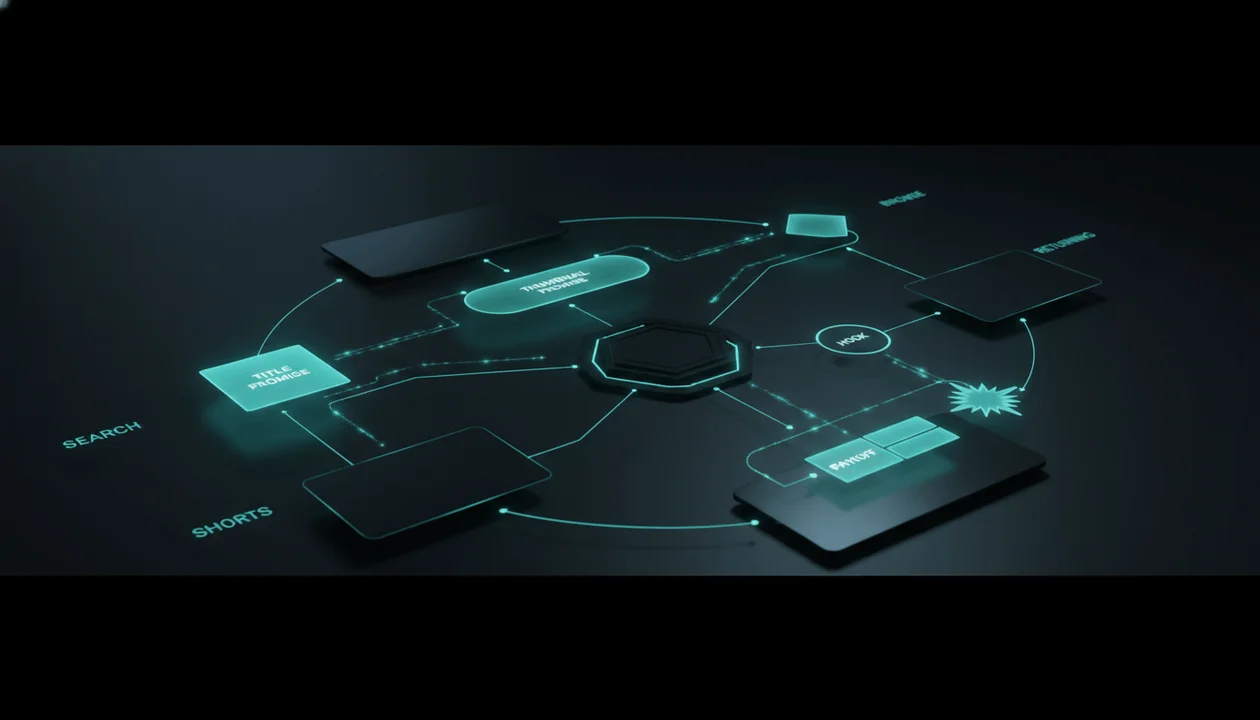
Most creators make one video for every viewer.
That is a mistake.
A viewer who searches for a video is not thinking the same way as a viewer scrolling the homepage.
A viewer clicking from Suggested is not thinking the same way as a loyal subscriber.
A viewer watching Shorts is not thinking the same way as someone choosing a 22-minute documentary.
Same topic.
Different intent.
Different expectation.
Different title.
Different thumbnail.
Different hook.
Different script structure.
That is why one creator can make a video called:
How to Improve YouTube Thumbnails
and another can make:
Why Good-Looking Thumbnails Still Get Ignored
Both are about thumbnails.
But they are built for different viewer intents.
The first is clear for Search.
The second is stronger for Browse.
This guide shows you how YouTube viewer intent works, how to match Search, Browse, Suggested, Shorts, and returning-viewer expectations, and how to build videos that feel like the exact thing the viewer clicked for.
Key Takeaways
- YouTube viewer intent is the reason a viewer is willing to click and watch a video in a specific context.
- Search viewers usually want a clear answer. Browse viewers need curiosity, emotion, or tension. Suggested viewers want the next natural question.
- The same topic should be packaged differently depending on the viewer intent.
- YouTube Analytics shows traffic sources such as YouTube Search, Browse features, Suggested videos, Shorts, playlists, channel pages, and external sources.
- YouTube’s audience retention report shows whether the first 30 seconds matched the viewer’s expectation from the title and thumbnail.
- Viewer intent should shape the topic, angle, title, thumbnail, hook, format, script structure, and payoff.
- Most videos fail because the creator matches the topic but misses the intent.
- OverseerOS helps creators study competitor videos, analyze titles and thumbnails, inspect hooks, clone channel blueprints, find breakout channels, and turn viewer-intent signals into stronger video ideas.
What Is YouTube Viewer Intent?
YouTube viewer intent is the reason a viewer wants to watch a video.
It answers:
What does the viewer want right now?
What problem are they trying to solve?
What feeling made them click?
What expectation did the title and thumbnail create?
What kind of payoff are they expecting?
A viewer might want:
A quick answer
A tutorial
A warning
A comparison
A story
A proof-based breakdown
A reaction to something current
A next step after another video
A deeper explanation
A satisfying transformation
The topic alone does not reveal this.
Example topic:
YouTube hooks
Possible viewer intents:
I need a simple hook formula.
I want to know why my viewers leave early.
I want examples of viral hooks.
I want to compare my hook against a better one.
I want to understand the psychology behind hooks.
I want to fix a script before recording.
Each intent needs a different video.
Why Viewer Intent Matters on YouTube
YouTube is not one discovery system.
A video can be found through:
- YouTube Search
- Browse features
- Suggested videos
- Shorts
- playlists
- channel pages
- end screens
- external websites
- notifications
- direct links
Each path creates a different viewer mindset.
A Search viewer often has an active question.
A Browse viewer is casually choosing what feels interesting.
A Suggested viewer is already watching something related.
A returning viewer has previous trust.
A new viewer needs faster proof.
A Shorts viewer expects faster movement.
If you package every video the same way, you ignore the context that created the click.
That is where many creators lose.
The Core Viewer Intent Formula
Use this formula before making any video:
Viewer context + viewer problem + viewer expectation + payoff = viewer intent
Example:
Viewer context:
They are searching.

Viewer problem:
They do not know how to make thumbnails.

Viewer expectation:
They want a clear tutorial.

Payoff:
A practical step-by-step process.

Best video:
How to Make a YouTube Thumbnail That Gets Clicked
Another example:
Viewer context:
They are scrolling the homepage.

Viewer problem:
Their thumbnails look good but do not get clicks.

Viewer expectation:
They want a surprising explanation.

Payoff:
A new way to judge thumbnails.

Best video:
Why Good-Looking Thumbnails Still Get Ignored
Same topic.
Different intent.
Different video.
Search Intent vs Browse Intent vs Suggested Intent
Search intent
Search intent means the viewer is actively looking for something.
They may type:
how to make YouTube thumbnails
best YouTube title generator
how to write a YouTube hook
YouTube audience retention tips
best faceless YouTube niches
The viewer wants clarity.
They are already interested.
You do not need to create as much mystery.
You need to answer the question better than everyone else.
Search-friendly titles:
How to Write a YouTube Hook That Keeps Viewers Watching
How to Make Better YouTube Thumbnails
Best YouTube Video Formats for Small Channels
How to Find Low-Competition YouTube Video Ideas
How to Build a YouTube Content Calendar
Search-friendly formats:
Tutorial
Step-by-step guide
Checklist
Comparison
Template
Beginner guide
Explainer
Tool walkthrough
Search-friendly hooks:
In the next few minutes, you will learn how to turn one broad topic into 10 stronger YouTube video ideas.
Bad Search hook:
You will not believe what I discovered...
That may feel too vague.
Search viewers want the answer.
Give them clarity fast.
Browse intent
Browse intent means the viewer did not search for the video.
They saw it while scrolling the homepage, subscriptions, Explore, or other browsing surfaces.
They were not asking for your video.
You need to interrupt them.
Browse-friendly titles:
Why Good-Looking Thumbnails Still Get Ignored
Small Channels Should Stop Copying Big Creators
I Let AI Pick My YouTube Topics for 7 Days
The YouTube Strategy That Looks Smart but Kills Small Channels
I Analyzed 100 Viral Hooks and Found One Pattern
Browse-friendly formats:
Experiment
Case study
Mistake audit
Teardown
Contrarian breakdown
Documentary
Reaction
Ranking
Challenge
Browse-friendly hooks:
A thumbnail can look clean, professional, and well-designed — and still give viewers no reason to click.
Browse viewers need a reason to care before they know they care.
That is why Browse packaging needs more tension.
Suggested intent
Suggested intent means the viewer is coming from another video.
They are already inside a topic path.
The best Suggested videos answer the next natural question.
Example:
Viewer just watched:
Why Your YouTube Views Dropped
Good Suggested follow-ups:
The Thumbnail Mistake That Kills Impressions
The First 30 Seconds That Make Viewers Leave
Why Your Topic Has No Demand
How to Audit Your Channel Before Posting Again
Bad Suggested follow-up:
Best AI Tools for Productivity
That may be interesting, but it breaks the viewer journey.
Suggested-friendly formats:
Follow-up breakdown
Mistake audit
Deep dive
Part two
Comparison
Teardown
Related case study
Suggested intent is about continuity.
The viewer thinks:
I just watched this. What should I watch next?
Your video should feel like the answer.
The 5 Main YouTube Viewer Intent Types
1. Learn intent
The viewer wants to learn how to do something.
Examples:
How to write a YouTube hook
How to make a YouTube thumbnail
How to find video ideas
How to improve retention
Best formats:
Tutorial
Framework
Checklist
Step-by-step guide
Template
Best title style:
How to [achieve result] without [pain]
Example:
How to Find YouTube Video Ideas Without Guessing
Best hook:
By the end of this video, you will know how to validate a YouTube idea before writing the script.
Learn intent needs clarity.
Do not overcomplicate the packaging.
2. Fix intent
The viewer has a problem and wants a diagnosis.
Examples:
Why did my views drop?
Why is my CTR low?
Why do viewers leave early?
Why is my channel not growing?
Best formats:
Mistake audit
Diagnostic framework
Teardown
Before-after fix
Checklist
Best title style:
Why [problem happens] and how to fix it
Example:
Why Your Viewers Leave in the First 30 Seconds
Best hook:
If viewers leave early, the problem may not be your whole video. It may be the first promise they feel in the intro.
Fix intent needs pain and relief.
The viewer should feel:
This video understands my exact problem.
3. Choose intent
The viewer is comparing options.
Examples:
Claude vs ChatGPT for scripts
Shorts vs long-form
best thumbnail tool
best faceless niche
which content format should I use?
Best formats:
Comparison
Ranking
Tier list
Decision framework
Test
Review
Best title style:
[Option A] vs [Option B]: Which Is Better for [specific use case]?
Example:
Tutorials vs Case Studies: Which YouTube Format Should Small Channels Use?
Best hook:
Both formats can work, but they solve different viewer problems. Pick the wrong one, and the same topic can become much harder to click.
Choose intent needs criteria.
Do not just give opinions.
Give a decision system.
4. Discover intent
The viewer wants something new, interesting, surprising, or useful they did not know before.
Examples:
viral channel examples
new AI tools
breakout niches
hidden patterns
new trend
small channels growing fast
Best formats:
Research breakdown
Trend analysis
Case study
List
Ranking
Discovery video
Best title style:
I found [number] [things] that reveal [surprising pattern]
Example:
I Found 10 Small Faceless Channels Quietly Breaking Out
Best hook:
These channels are not famous yet, but their recent videos show a pattern that most beginners are missing.
Discover intent needs novelty and proof.
The viewer wants to feel early.
5. Believe intent
The viewer is skeptical.
They need proof before they accept the claim.
Examples:
Does this strategy actually work?
Is this tool worth it?
Can small channels still grow?
Are AI scripts good enough?
Do faceless channels still make money?
Best formats:
Experiment
Case study
Proof breakdown
Before-after
Data analysis
Real test
Best title style:
I tested [thing] to see if [claim] is true
Example:
I Let AI Plan My YouTube Videos for 7 Days
Best hook:
I wanted to know if AI could actually find better video ideas than me, so I gave it my niche, competitors, and channel goal. The first results were terrible.
Believe intent needs evidence.
Do not only tell.
Show.
The Viewer Intent Matrix
Use this matrix before choosing a title.
| Viewer intent | Viewer thought | Best format | Best packaging |
|---|---|---|---|
| Learn | “Show me how” | Tutorial | Clear, direct, useful |
| Fix | “What is wrong?” | Mistake audit | Pain, diagnosis, solution |
| Choose | “Which option should I pick?” | Comparison | Criteria, winner, tradeoff |
| Discover | “Show me something new” | Research/list/case study | Novelty, proof, curiosity |
| Believe | “Prove it” | Experiment/case study | Evidence, test, result |
| Continue | “What should I watch next?” | Follow-up | Next logical problem |
| Return | “I trust this channel” | Series | Consistent promise |
| Escape | “Entertain me” | Story/challenge | Emotion, stakes, movement |
A strong video knows which intent it serves.
A weak video tries to serve all of them at once.
How Viewer Intent Changes the Same Topic
Let’s use one topic:
YouTube thumbnails
Learn intent
How to Make YouTube Thumbnails That Get Clicked
The viewer wants instruction.
Fix intent
Why Your Thumbnail Gets Impressions but No Clicks
The viewer wants diagnosis.
Choose intent
Face vs No Face Thumbnails: Which Should Small Channels Use?
The viewer wants a decision.
Discover intent
I Analyzed 100 Viral Thumbnails and Found One Pattern
The viewer wants a surprising finding.
Believe intent
I Tested 5 Thumbnail Styles on the Same Video Idea
The viewer wants proof.
Browse intent
Why Good-Looking Thumbnails Still Get Ignored
The viewer needs curiosity.
Suggested intent
The Title Mistake That Makes Good Thumbnails Fail
The viewer just watched something related and wants the next layer.
Same topic.
Seven different videos.
That is why viewer intent matters.
The Search/Browse/Suggested Packaging Difference
Search packaging
Search packaging should feel like an answer.
Example:
How to Improve YouTube Audience Retention
Thumbnail:
Retention curve + clear checklist visual
Hook:
Here is a simple way to find where viewers are leaving and what to fix first.
Browse packaging
Browse packaging should feel like a problem the viewer did not know they had.
Example:
Your Hook Is Not the Problem. Your Promise Is.
Thumbnail:
Hook crossed out, promise highlighted as the real issue
Hook:
A strong first sentence cannot save a video if the viewer feels the intro is not the video they clicked for.
Suggested packaging
Suggested packaging should feel like the next step.
Example:
The Retention Mistake That Starts Before the Video
Thumbnail:
Title and thumbnail leading into a retention drop
Hook:
Your retention problem may start before the viewer presses play, because the title and thumbnail already created an expectation the intro has to prove.
This is why copying one title style everywhere is weak.
Different traffic paths need different packaging.
How Viewer Intent Shapes the Hook
A hook should confirm the viewer made the right click.
That means different intents need different openings.
Learn hook
By the end of this video, you will know how to turn one broad topic into 10 stronger YouTube video ideas.
Fix hook
If your videos get impressions but no clicks, your thumbnail may not be ugly. It may be unclear.
Choose hook
Both Claude and ChatGPT can write YouTube scripts, but they fail in different places.
Discover hook
I studied 50 small channels that suddenly broke out, and the strange part is that most of them were not chasing trending topics.
Believe hook
I let AI choose my next 10 video ideas. The first five were useless, but one competitor pattern changed the whole plan.
Suggested hook
If you already fixed your thumbnail but the video still underperforms, the next problem is probably the title promise.
The hook is not just a catchy line.
It is the first proof that the video understands the viewer’s intent.
How Viewer Intent Shapes the Script
Different intents need different structures.
Learn script structure
1. Define the problem
2. Explain the framework
3. Show the steps
4. Give examples
5. Provide checklist
6. Summarize the method
Fix script structure
1. Name the symptom
2. Explain the hidden cause
3. Show common mistakes
4. Diagnose examples
5. Give the fix
6. Provide prevention checklist
Choose script structure
1. Define the options
2. Set decision criteria
3. Compare strengths
4. Compare weaknesses
5. Explain best use cases
6. Give final recommendation
Discover script structure
1. Open with the finding
2. Show why it matters
3. Reveal examples
4. Group patterns
5. Explain the opportunity
6. Show how to apply it
Believe script structure
1. State the test
2. Set rules
3. Show process
4. Reveal failures
5. Reveal what worked
6. Share result and verdict
Do not use one script template for every video.
Viewer intent decides the structure.
How Viewer Intent Shapes the Payoff
Every intent expects a different payoff.
| Intent | Payoff the viewer expects |
|---|---|
| Learn | A clear method |
| Fix | A diagnosis and solution |
| Choose | A decision |
| Discover | A new opportunity or pattern |
| Believe | Proof |
| Continue | A deeper next step |
| Return | Consistent value |
| Escape | Emotional satisfaction |
If your payoff does not match the intent, viewers feel unsatisfied.
Example:
A video titled:
Claude vs ChatGPT for YouTube Scripts
must give a decision.
If it only explains both tools without a clear recommendation, it fails the intent.
A video titled:
I Tested 5 Thumbnail Styles on the Same Topic
must show a real test.
If it becomes generic advice, it fails the intent.
A video titled:
Why Your Thumbnail Gets Impressions but No Clicks
must diagnose the real reason.
If it only gives broad tips, it fails the intent.
The Viewer Intent Scorecard
Score your video idea before writing.
| Element | Question | Score 1-5 |
|---|---|---|
| Intent clarity | Is the viewer intent obvious? | |
| Traffic path | Is this built for Search, Browse, Suggested, Shorts, or returning viewers? | |
| Viewer problem | Is the viewer pain specific? | |
| Title match | Does the title match the intent? | |
| Thumbnail match | Does the thumbnail support the same expectation? | |
| Hook match | Does the first 30 seconds prove the click? | |
| Format fit | Does the format match the intent? | |
| Script fit | Does the structure deliver what the viewer expects? | |
| Payoff fit | Does the ending satisfy the intent? | |
| Channel fit | Does this intent match your channel positioning? |
Total:
| Score | Meaning |
|---|---|
| 10-24 | Intent mismatch |
| 25-34 | Usable but unclear |
| 35-44 | Strong intent alignment |
| 45-50 | Excellent video idea |
If the score is low, do not fix the script first.
Fix the intent.
Common Viewer Intent Mistakes
Mistake 1: Writing a Browse title for a Search viewer
Bad:
The Truth About YouTube Hooks
when the viewer searches:
how to write a YouTube hook
Better:
How to Write a YouTube Hook That Keeps Viewers Watching
Search viewers need clarity.
Mistake 2: Writing a Search title for a Browse viewer
Bad:
How to Improve YouTube Thumbnail CTR
for a homepage video.
Better:
Why Good-Looking Thumbnails Still Get Ignored
Browse viewers need curiosity.
Mistake 3: Making Suggested videos that do not continue the journey
If someone watches:
Why Your Views Dropped
do not send them to:
Best AI Tools for Productivity
Send them to:
The CTR Mistake That Makes YouTube Stop Testing Your Video
Suggested videos should feel connected.
Mistake 4: Using a tutorial when the viewer wants proof
Topic:
AI tools for YouTube
Weak format:
How to Use AI Tools
Stronger format for skeptical viewers:
I Tested 7 AI Tools for YouTube Creators. Only 2 Saved Time.
Believe intent needs proof.
Mistake 5: Promising a comparison without a verdict
If the title says:
Shorts vs Long-Form
the video must help the viewer decide.
Do not end with:
Both are good.
Give criteria.
Give tradeoffs.
Give a recommendation by use case.
Mistake 6: Ignoring returning viewer intent
Returning viewers do not only want random good videos.
They want the kind of value they subscribed for.
If your channel promise is:
Proof-based YouTube strategy for small creators
then a random lifestyle video may break returning viewer intent.
Even if it is well made.
How to Read Viewer Intent From Competitors
When a competitor video performs well, do not only ask:
What was the topic?
Ask:
What intent did this video satisfy?
Use this template:
Competitor title:

Traffic path guess:
Search / Browse / Suggested / Mixed

Viewer intent:
Learn / Fix / Choose / Discover / Believe / Continue / Return

Viewer pain:

Title promise:

Thumbnail promise:

Hook promise:

Format:

Payoff:

Why it worked:

How to adapt the intent originally:
Example:
Competitor title:
I Analyzed 100 Viral Thumbnails and Found One Pattern

Traffic path guess:
Browse / Suggested

Viewer intent:
Discover and believe

Viewer pain:
Creators do not know why some thumbnails win

Title promise:
Large sample size and one hidden pattern

Thumbnail promise:
Many examples reduced to one visual insight

Hook promise:
The pattern is not what most creators think

Format:
Proof-based teardown

Payoff:
A repeatable thumbnail principle

Why it worked:
It combined proof, curiosity, and practical application

How to adapt it originally:
Use the same proof-based intent for hooks, intros, formats, topic clusters, or faceless niches
That is strategic competitor research.
You are not copying the video.
You are learning the viewer intent it served.
How OverseerOS Helps With Viewer Intent
OverseerOS is built around planning better videos before production.
Viewer intent is exactly the kind of decision creators should make before scripting.
Channel Analyzer
Channel Analyzer helps creators study public channel performance, top videos, growth patterns, engagement signals, upload strategy, and what makes a channel perform.
For viewer intent, use it to ask:
Which videos are Search-driven?
Which videos are Browse-driven?
Which videos likely work as Suggested follow-ups?
Which topics repeatedly serve the same viewer pain?
Which videos create returning-viewer expectations?
Viral X-Ray
Viral X-Ray helps analyze individual videos to understand why they performed well, including titles, thumbnails, hooks, structure, and audience engagement patterns.
For viewer intent, use it to inspect:
What promise did the title create?
What expectation did the thumbnail create?
What did the first 30 seconds prove?
What viewer pain did the video target?
What payoff did the video deliver?
Channel Blueprint Cloner
The Channel Blueprint Cloner turns a public YouTube channel into a structured strategy blueprint.
For viewer intent, this helps reveal:
- tone DNA
- hook patterns
- pacing
- viral topic formulas
- content structure
- title patterns
- keywords
- hidden insights
- untapped topic opportunities
That matters because winning channels often repeat the same viewer-intent patterns.
They know what their audience comes for.
Viral Channel Finder
The Viral Channel Finder helps creators discover breakout channels in a niche using public YouTube signals.
This is useful because breakout channels often reveal fresh viewer intent before the niche becomes crowded.
A small channel might break out because it serves an underserved intent:
More practical
More proof-based
More beginner-friendly
More contrarian
More entertaining
More specific
More urgent
Smart Content Planner
Smart Content Planner helps turn research into planned videos.
For viewer intent, the planner should not only store the topic.
It should store:
Traffic path
Viewer intent
Angle
Format
Title promise
Thumbnail promise
Hook direction
Payoff
That is how ideas become stronger before writing.
MindOS
MindOS helps creators brainstorm video angles, hooks, and creative direction.
For viewer intent, it can help answer:
Should this topic be a tutorial, teardown, comparison, experiment, or warning?
What does the viewer want right now?
What hook proves the click fastest?
What angle fits Search vs Browse?
The Viewer Intent Planning Template
Use this before writing every video.
Topic:

Target viewer:

Viewer intent:
Learn / Fix / Choose / Discover / Believe / Continue / Return / Escape

Main traffic path:
Search / Browse / Suggested / Shorts / Returning viewer / Mixed

Viewer problem:

Viewer expectation:

Best angle:

Best format:

Title promise:

Thumbnail promise:

Opening hook:

Script structure:

Payoff:

What would break the promise?

Suggested follow-up video:

Internal playlist or cluster:

Why this fits the channel positioning:
Filled Example
Topic:
YouTube video ideas

Target viewer:
Small creators who do not know what to post next

Viewer intent:
Fix / Learn

Main traffic path:
Search and Browse mixed

Viewer problem:
They have ideas but do not know which ones are worth making

Viewer expectation:
They want a clear way to choose stronger ideas

Best angle:
Most failed videos were weak before production started

Best format:
Diagnostic tutorial

Title promise:
How to Know If a YouTube Video Idea Is Worth Making Before You Record

Thumbnail promise:
Weak idea vs validated idea

Opening hook:
Most failed YouTube videos were not ruined in editing. They were weak before the script was ever written.

Script structure:
1. Why idea validation matters
2. The difference between topic and demand
3. Competitor proof
4. Packaging proof
5. Channel fit
6. Scoring system
7. Example workflow

Payoff:
The viewer can score a video idea before spending time producing it

What would break the promise:
Giving generic idea tips instead of a real validation process

Suggested follow-up video:
How to Turn One Validated Topic Into 10 Video Angles

Internal playlist or cluster:
YouTube research and pre-production

Why this fits the channel positioning:
It helps creators stop guessing and build from proven patterns.
The Best Workflow for Matching Viewer Intent
Step 1: Pick the topic
Example:
YouTube thumbnails
Step 2: Pick the traffic path
Search
Browse
Suggested
Mixed
Step 3: Pick the intent
Learn
Fix
Choose
Discover
Believe
Continue
Return
Step 4: Choose the angle
Search angle:
How to Make YouTube Thumbnails That Get Clicked
Browse angle:
Why Good-Looking Thumbnails Still Get Ignored
Suggested angle:
The Title Mistake That Makes Good Thumbnails Fail
Step 5: Choose the format
Tutorial
Mistake audit
Teardown
Comparison
Experiment
Case study
Step 6: Build the promise
By the end, the viewer will understand why their thumbnail can look good but still fail to create a click.
Step 7: Write the hook
A thumbnail can look clean, professional, and well-designed — and still give viewers no reason to click.
Step 8: Check alignment
Ask:
Does the title match the thumbnail?
Does the hook match the title?
Does the script match the hook?
Does the payoff match the promise?
That is viewer intent alignment.
How to Use Viewer Intent in a Content Calendar
A strong content calendar should not only list topics.
It should balance intents.
Example weekly plan:
| Day | Intent | Video |
|---|---|---|
| Monday | Learn | How to Find YouTube Video Ideas Before Recording |
| Wednesday | Fix | Why Your Content Calendar Still Feels Random |
| Friday | Discover | I Found 10 Small Channels Breaking Out With Simple Topics |
| Sunday | Believe | I Tested 5 Thumbnail Styles on the Same Video Idea |
This creates variety without randomness.
All videos can still support the same channel positioning.
The intent changes.
The promise stays consistent.
Final Verdict
YouTube viewer intent is the reason behind the click.
If you ignore it, you can choose the right topic and still make the wrong video.
A Search viewer wants clarity.
A Browse viewer needs curiosity.
A Suggested viewer wants the next step.
A skeptical viewer wants proof.
A returning viewer wants the promise they subscribed for.
So before writing your next script, do not only ask:
What is the topic?
Ask:
What does this viewer want in this exact moment?
That question shapes the angle, title, thumbnail, hook, format, script, and payoff.
If you want to match viewer intent faster, use OverseerOS to analyze winning channels, run Viral X-Ray, clone channel blueprints, discover breakout channels, brainstorm angles, and turn proven viewer-intent signals into original content plans.
FAQ
What is YouTube viewer intent?
YouTube viewer intent is the reason a viewer wants to click and watch a video. It includes the viewer’s problem, expectation, context, and desired payoff.
Why does viewer intent matter on YouTube?
Viewer intent matters because the same topic needs different packaging depending on whether the viewer comes from Search, Browse, Suggested videos, Shorts, or returning-viewer behavior.
What is the difference between Search intent and Browse intent on YouTube?
Search intent is active. The viewer is looking for an answer. Browse intent is passive. The viewer is scrolling and needs curiosity, emotion, or tension before they care.
What is Suggested video intent?
Suggested video intent happens when a viewer comes from another related video. The best Suggested videos answer the next natural question in the viewer’s journey.
How do I match a YouTube video to viewer intent?
Start by identifying the traffic path, viewer problem, expected payoff, best angle, best format, title promise, thumbnail promise, hook, and script structure.
Can the same topic have different viewer intents?
Yes. “YouTube thumbnails” can become a tutorial, mistake audit, comparison, experiment, teardown, or proof-based breakdown depending on the viewer intent.
How does viewer intent affect YouTube titles?
Search titles should be clear and direct. Browse titles should create curiosity or tension. Suggested titles should feel like the next logical step after a related video.
How does viewer intent affect retention?
When the title, thumbnail, intro, script, and payoff match the viewer’s expectation, the viewer is more likely to feel they clicked the right video and keep watching.
What are the main YouTube viewer intents?
The main viewer intents are learn, fix, choose, discover, believe, continue, return, and escape. Each one needs a different title, format, hook, and payoff.
How does OverseerOS help with viewer intent?
OverseerOS helps creators analyze winning videos, study titles and thumbnails, inspect hooks, clone channel blueprints, discover breakout channels, brainstorm angles, and plan videos around proven viewer-intent signals.