
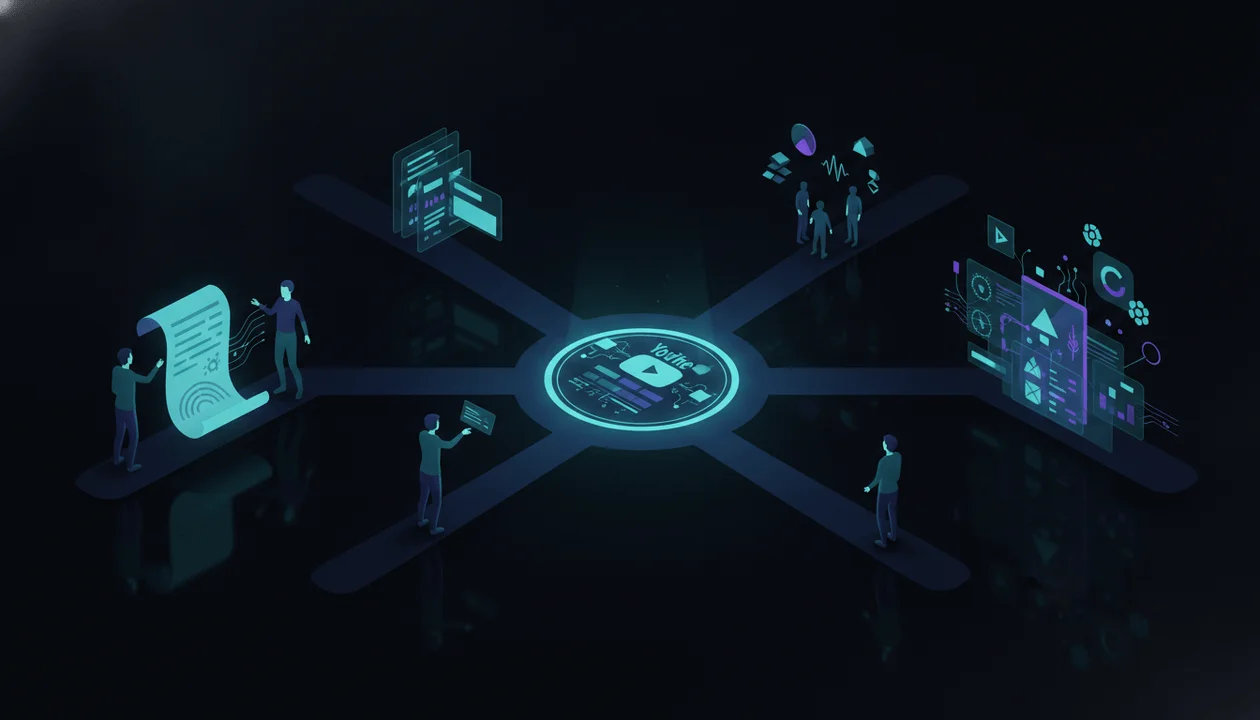
A creator says they need help with YouTube.
One person recommends hiring a strategist.
Another says to book a consultant.
An agency offers to handle everything.
A software platform promises to turn channel data into better topics, titles, scripts, thumbnails, and production decisions.
All four options sound similar because they use the same language:
- Strategy
- Growth
- Optimisation
- Research
- Content planning
- Analytics
- Audience development
They are not the same purchase.
A YouTube strategist helps decide what the channel should do repeatedly.
A YouTube consultant diagnoses a defined problem and advises you on how to fix it.
A YouTube agency supplies a team that can own strategy, production, publishing, or all three.
YouTube software gives the creator or team the data, research, workflows, and automation needed to make stronger decisions internally.
Choosing the wrong model creates an expensive mismatch.
You can pay an agency when the real problem is weak positioning.
You can hire a consultant when nobody on your team has time to execute the recommendations.
You can buy software when what you actually need is an experienced person willing to make difficult editorial decisions.
You can hire a full-time strategist before the channel has enough publishing volume to justify the role.
This guide explains the difference between a YouTube strategist, consultant, agency, and software platform, what each should own, what each normally cannot replace, and which option fits your channel in 2026.
Key Takeaways
- A YouTube strategist provides ongoing direction and helps decide what the channel should publish, how it should be positioned, and how performance should influence future videos.
- A YouTube consultant usually solves a defined problem through an audit, strategy engagement, workshop, or advisory retainer.
- A YouTube agency provides people and execution capacity across strategy, production, packaging, publishing, analytics, or paid promotion.
- YouTube software helps an internal creator or team research channels, analyse videos, identify patterns, plan topics, create assets, and monitor performance more efficiently.
- Choose software when you can execute but need better intelligence and workflow.
- Choose a consultant when you need an expert diagnosis or strategic reset.
- Choose a strategist when you need someone continuously responsible for channel direction.
- Choose an agency when you need a team to perform work that your organisation cannot or does not want to perform internally.
- The strongest solution is often a hybrid: software for continuous intelligence, a strategist for judgment, and specialists or an agency for execution.
- Do not give an outside partner your Google password. YouTube Studio supports role-based channel permissions for owners, managers, editors, and viewers.
- The person or company you hire should be accountable to viewer behaviour and business outcomes, not only uploads, subscribers, or production quality.
YouTube Strategist vs Consultant vs Agency vs Software: Quick Answer
| Option | Primary Job | Best When | Usually Owns | Usually Does Not Own |
|---|---|---|---|---|
| YouTube strategist | Continuous channel direction | You publish consistently and need someone accountable for what happens next | Positioning, content strategy, formats, topics, packaging direction, analytics, editorial priorities | Full production unless separately included |
| YouTube consultant | Diagnosis and expert advice | You have a specific problem, transition, launch, or plateau | Audit, recommendations, roadmap, workshops, specialised guidance | Daily execution and long-term management |
| YouTube agency | Strategy plus execution capacity | You need a team to produce or manage the channel | Production, scripting, editing, thumbnails, publishing, analytics, sometimes ads | Deep internal knowledge unless deliberately developed |
| YouTube software | Intelligence and workflow leverage | You or your team can act but need better research, systems, and speed | Data analysis, research, planning, generation, workflow support, monitoring | Final judgment, leadership, accountability, human taste |
| In-house YouTube team | Internal ownership and execution | YouTube is a core long-term business function | Strategy, production, institutional learning, cross-functional alignment | External perspective unless brought in separately |
The simplest decision rule is:
Buy software when you need leverage. Hire a consultant when you need an answer. Hire a strategist when you need ongoing decisions. Hire an agency when you need people to perform the work.
What Is a YouTube Strategist?
A YouTube strategist is responsible for the direction of a channel.
The role should answer questions such as:
- Who is this channel for?
- Why should that audience return?
- Which content promise can the channel own?
- What topics should be prioritised?
- Which formats should be repeated?
- What should the channel stop producing?
- How should titles and thumbnails frame each idea?
- Which audience signals matter?
- Why did a video outperform or underperform?
- What should the team learn from the result?
- What should be tested next?
- How does YouTube support the wider business?
A strategist may be:
- A full-time employee
- A fractional team member
- A freelancer
- A senior agency lead
- A creator acting as their own strategist
- A consultant retained for ongoing direction
The title does not determine the value.
The operating responsibility does.
What a Good YouTube Strategist Produces
A serious strategist should create decisions, not vague inspiration.
Useful outputs may include:
- Channel positioning
- Audience definition
- Content pillars
- Repeatable video formats
- Topic selection criteria
- Packaging direction
- Title and thumbnail briefs
- Competitive research
- Publishing priorities
- Format experiments
- Performance reviews
- Post-publication learning
- Editorial calendars
- Team briefs
- Strategic recommendations tied to evidence
The strategist should be able to explain:
We should make this video, for this audience, using this format, with this promise, because these signals suggest it has a stronger opportunity than the alternatives.
That is strategy.
Saying “post consistently” is not strategy.
When to Hire a YouTube Strategist
A strategist becomes valuable when:
- The channel publishes regularly.
- Several people contribute to production.
- Topic decisions consume significant time.
- The team has plenty of ideas but no prioritisation system.
- Videos look professional but results remain inconsistent.
- The channel has reached a plateau.
- The business needs YouTube connected to revenue, leads, authority, or customer education.
- Different departments want different things from the channel.
- The creator cannot remain the only person making every editorial decision.
- The production team needs a clear strategic owner.
When a Strategist Is Premature
Do not rush into a major strategist engagement when:
- You have not published enough to create meaningful feedback.
- You are unwilling to produce consistently.
- You have no production capacity.
- Every video changes niche, audience, and format.
- You expect the strategist to guarantee views.
- The budget would prevent you from actually producing the videos.
- The channel has no clear reason to exist beyond “we should be on YouTube.”
An early-stage channel often needs to publish, learn, and build evidence before creating a large strategic structure.
What Is a YouTube Consultant?
A YouTube consultant is an external expert hired to solve a specific problem, provide an independent perspective, or improve the decisions of an existing team.
The relationship is often narrower and more time-bound than a strategist’s role.
Common consulting engagements include:
- Channel audits
- Launch strategy
- Repositioning
- Content strategy development
- Analytics diagnosis
- Audience analysis
- Packaging reviews
- Format development
- Workflow design
- Team training
- Executive workshops
- Monetisation strategy
- Conversion strategy
- Creator coaching
- Hiring support
- Agency or vendor evaluation
A consultant should not merely describe what happened.
The consultant should diagnose why it happened and recommend what changes next.
What a Good YouTube Audit Should Include
A meaningful channel audit may review:
- Channel positioning
- Audience fit
- Topic selection
- Content pillars
- Format consistency
- Titles
- Thumbnails
- Openings
- Average view duration
- Audience retention
- Traffic sources
- Returning-viewer behaviour
- Subscriber conversion
- Publishing cadence
- Competitive differentiation
- Content gaps
- Production constraints
- Revenue or funnel alignment
The output should prioritise actions.
A weak audit lists 40 observations.
A useful audit identifies the three to five changes most likely to improve the channel.
Consultant vs Strategist
The difference is not always the person.
It is the scope of responsibility.
| Question | Consultant | Strategist |
|---|---|---|
| Is the engagement usually time-limited? | Often | Not necessarily |
| Does the person diagnose a defined problem? | Yes | Yes |
| Do they remain responsible for future decisions? | Sometimes | Usually |
| Do they attend recurring editorial meetings? | Sometimes | Often |
| Do they review every new topic or package? | Rarely unless retained | Often |
| Do they build internal capability? | Frequently | Frequently |
| Are they embedded in the workflow? | Usually lightly | Often deeply |
| Are they accountable for implementation? | Limited | Greater, but depends on authority |
The same expert may begin as a consultant and later become a fractional strategist.
When to Hire a YouTube Consultant
A consultant is the best fit when:
- You need an objective diagnosis.
- The channel has plateaued and the reason is unclear.
- You are entering YouTube for the first time.
- You are changing niches or audiences.
- Your existing team needs training.
- You need a second opinion before making a major investment.
- You want to evaluate an agency proposal.
- You need a three-to-six-month strategy but can execute internally.
- You need specialised expertise for one challenge.
- You want senior guidance without a long-term hire.
When a Consultant Will Not Solve the Problem
Consulting will underperform when:
- Nobody has time to execute the recommendations.
- The internal team rejects outside input.
- The creator expects the consultant to replace production.
- The engagement ends with a presentation that nobody translates into tasks.
- The consultant has no access to the relevant analytics.
- The recommendations are too broad for the available budget.
- There is no owner responsible for implementation.
A strategy document has no value until somebody turns it into published videos.
What Is a YouTube Agency?
A YouTube agency is a service company that provides a team rather than one individual.
The agency may own one part of the channel or the entire operation.
Possible services include:
- Channel strategy
- Audience research
- Competitive research
- Topic development
- Scripting
- Filming
- Voiceover production
- Editing
- Animation
- Thumbnail design
- Title development
- Uploading
- Metadata
- Publishing
- Community management
- Analytics
- Reporting
- Shorts repurposing
- Sponsorship support
- Paid YouTube advertising
The phrase “YouTube agency” is broad.
One agency may specialise in organic creator growth.
Another may primarily buy YouTube ads.
Another may be a video production company that understands cameras but provides little channel strategy.
Another may operate faceless channels using writers, voice actors, editors, and thumbnail designers.
Before comparing agencies, define what you expect the agency to own.
The Four Main Types of YouTube Agencies
1. YouTube Strategy Agency
Focuses on:
- Positioning
- Research
- Content planning
- Formats
- Packaging
- Analytics
- Editorial direction
The client may keep production in-house.
2. YouTube Production Agency
Focuses on:
- Filming
- Editing
- Animation
- Sound
- Motion graphics
- Post-production
The client may supply the strategy, script, and on-camera talent.
3. Full-Service YouTube Agency
May own:
- Strategy
- Ideas
- Scripts
- Production
- Packaging
- Publishing
- Reporting
This is the broadest and normally most expensive model.
4. YouTube Advertising Agency
Focuses on paid distribution through Google Ads and YouTube advertising.
This is not the same as building an organic channel.
An advertising agency may be excellent at:
- Media buying
- Targeting
- Conversion tracking
- Creative testing
- Cost-per-view optimisation
- Lead generation
It may have limited experience developing an organic audience that voluntarily returns for videos.
When to Hire a YouTube Agency
An agency makes sense when:
- You lack internal production capacity.
- You need several specialists immediately.
- Hiring each role separately would take too long.
- The channel supports a sufficiently valuable business goal.
- You need reliable publishing volume.
- Your internal team can approve work but not create it.
- The agency has relevant experience with your content type.
- You want one accountable partner instead of managing several freelancers.
- You are prepared to invest long enough for the system to improve.
- You have an internal owner who can provide access, expertise, feedback, and decisions.
When an Agency Is the Wrong Purchase
An agency is risky when:
- You still do not know who the channel is for.
- You expect production quality alone to create demand.
- You cannot provide subject-matter expertise.
- Nobody internally can approve topics or factual claims.
- You need results immediately from organic publishing.
- The retainer consumes the budget needed for distribution or internal support.
- The agency has no relevant channel examples.
- The agency reports output instead of learning.
- You are hiring prestige rather than solving a bottleneck.
- You want to outsource accountability for whether the business has something valuable to say.
An agency can manufacture content.
It cannot manufacture a defensible point of view without input.
What Is YouTube Strategy Software?
YouTube strategy software helps creators and teams make channel decisions with better data, research, systems, and automation.
Depending on the product, it may help with:
- Channel analysis
- Competitor research
- Outlier discovery
- Topic research
- Trend analysis
- Search demand
- Content-gap discovery
- Audience intelligence
- Title development
- Thumbnail analysis
- Hook analysis
- Script planning
- Script generation
- Voice analysis
- Content calendars
- Performance monitoring
- Production workflows
- Team collaboration
Software does not need to replace the creator or strategist to create value.
Its role is to make stronger work possible with less manual effort.
Four Categories of YouTube Software
1. First-Party YouTube Software
YouTube Studio provides the platform’s own data and publishing tools.
It includes:
- Channel analytics
- Video analytics
- Audience reports
- Engagement reports
- Content performance
- Traffic sources
- Audience-retention data
- Trends and content-gap signals
- Inspiration features
- Publishing controls
- Comments
- Channel permissions
- Title and thumbnail testing
YouTube now allows eligible creators to test up to three title and thumbnail combinations, with the winning result selected using watch-time performance rather than click-through rate alone.
YouTube Studio should remain the source of truth for what happened on your channel.
Third-party software should help explain, organise, compare, generate, or act on that information.
2. Optimisation Tools
These products may focus on:
- Keywords
- Metadata
- Search optimisation
- Checklists
- Channel management
- Publishing support
- Competitive metrics
Examples include vidIQ and TubeBuddy.
3. Research and Outlier Tools
These products may focus on:
- Breakout videos
- Competitive channels
- Outlier performance
- Topic patterns
- Viral formats
- Thumbnail and title research
Examples include 1of10, Viewstats, and specialised channel-discovery platforms.
4. YouTube Strategy Intelligence Platforms
These systems connect research to planning and creation.
OverseerOS is built for this broader workflow.
OverseerOS can help creators:
- Analyse public YouTube channels
- Reverse-engineer successful channel strategies
- Identify high-performing videos and patterns
- Find breakout channels
- Study titles, thumbnails, hooks, pacing, topics, and formats
- Generate channel blueprints
- Build original topic recommendations
- Analyse creator tone through OverseerOS Creator DNA
- Plan videos inside OverseerOS Channel Content Planner
- Write scripts inside OverseerOS Script Studio
- Improve existing scripts with OverseerOS Script ReSpark
- Turn finished scripts and voiceovers into scene-based faceless-video workflows with OverseerOS Auto Edit Studio
The principle is strategy extraction, not content duplication.
The creator studies public patterns and adapts the learning into an original channel, topic, script, title, thumbnail, and production system.
When YouTube Software Is Enough
Software may be the right first purchase when:
- You are the main decision-maker.
- You understand your audience.
- You can produce videos consistently.
- You need faster research.
- You want evidence behind topic selection.
- You need better organisation.
- You want to compare competitors efficiently.
- You need help turning strategy into briefs, titles, scripts, or production plans.
- Your budget does not justify a senior external hire.
- You are willing to make the final decisions yourself.
When Software Is Not Enough
Software cannot fully replace:
- Taste
- Leadership
- Accountability
- Political alignment inside a company
- Difficult editorial judgment
- Original expertise
- Creator charisma
- Stakeholder management
- Team coaching
- Performance conversations
- Negotiation
- Organisational change
A platform can show that one format consistently outperforms another.
A human still needs to decide whether the business should commit to that format.
The Real Question: What Problem Are You Solving?
Do not begin with:
Should we hire a strategist, consultant, agency, or buy software?
Begin with:
Where does our YouTube system currently fail?
Most problems fall into five categories.
1. Intelligence Problem
Symptoms:
- You do not know what competitors are doing.
- Topic selection is based on instinct alone.
- The team cannot identify repeatable patterns.
- Research takes too long.
- You cannot explain why videos outperform.
- Ideas come from generic brainstorming.
Best initial solution:
- YouTube software
- Focused consultant
- Strategist using strong research systems
2. Decision Problem
Symptoms:
- The team has too many ideas.
- Nobody has final editorial authority.
- Stakeholders disagree about the audience.
- Priorities change every week.
- Strategy documents exist but are not followed.
- Data is available but does not change behaviour.
Best initial solution:
- Embedded strategist
- Senior consultant with an implementation owner
- Internal channel lead
3. Capability Problem
Symptoms:
- The team does not know how to develop YouTube-native topics.
- Titles sound like blog headlines.
- Thumbnails are designed too late.
- Scripts do not retain attention.
- Editors understand production but not YouTube pacing.
- Nobody knows how to interpret retention data.
Best initial solution:
- Specialist consultant
- Training engagement
- Experienced strategist
- Agency with proven capability
4. Capacity Problem
Symptoms:
- The strategy is clear but videos are not being produced.
- Publishing is repeatedly delayed.
- One person performs five roles.
- Editors or designers are overloaded.
- The creator cannot scale output.
- The company has expertise but no production team.
Best initial solution:
- Agency
- Freelance production team
- Internal hiring
- Production software plus specialists
5. Accountability Problem
Symptoms:
- Everyone contributes but nobody owns results.
- Reports describe metrics without creating decisions.
- Underperforming formats continue for months.
- The same errors repeat.
- Meetings end without assigned actions.
- External partners blame the algorithm.
Best initial solution:
- Named strategist or internal channel owner
- Agency contract with clear strategic accountability
- Operating cadence with defined decisions and owners
Software can improve an intelligence problem.
It cannot independently solve an accountability problem.
Side-by-Side Comparison
| Factor | Strategist | Consultant | Agency | Software |
|---|---|---|---|---|
| Strategic depth | High | High within scope | Varies | Depends on user |
| Ongoing involvement | High | Low to medium | High | Continuous |
| Execution capacity | Low to medium | Low | High | Automation only |
| Internal learning | High when embedded | High when knowledge is transferred | Varies | High when actively used |
| Speed to start | Medium | Fast | Medium | Fast |
| Commitment | Medium to high | Low to medium | High | Low |
| Personalised judgment | High | High | Medium to high | Limited |
| Research scale | Depends on tools | Depends on tools | Depends on tools | High |
| Team management | Sometimes | Rarely | Yes | No |
| Production ownership | Sometimes | Rarely | Often | Partial workflow support |
| Best for one defined problem | Medium | High | Low | Medium |
| Best for repeatable workflow | High | Medium | High | High |
| Risk of dependency | Medium | Low | High | Low to medium |
| Requires internal operator | Usually | Yes | Yes, even if lighter | Yes |
| Typical budget level | Medium to high | Low to medium | High | Low |
Cost: What Should You Expect?
Pricing varies heavily by:
- Experience
- Geography
- Channel size
- Business complexity
- Publishing volume
- Production quality
- Number of services
- Access to senior talent
- On-camera or faceless format
- Research requirements
- Reporting requirements
- Paid advertising
- Rights and licensing
- Turnaround expectations
A published UK YouTube consulting guide for 2026 lists broad ranges of:
- £75 to £200 per hour
- £300 to £1,500 for a channel audit
- £500 to £3,000 per month for ongoing consulting
These are one specialist’s published market ranges, not an industry tariff.
Agency pricing is wider because “agency” can describe anything from strategic support to full production.
Public agency guides in 2026 commonly place full-service retainers in the mid-four-figure to five-figure monthly range, with larger engagements going higher.
Budget Comparison
| Option | Relative Cost | What You Are Primarily Buying |
|---|---|---|
| Software | Lowest | Research scale, data, automation, repeatable workflows |
| One-time consultant | Low to medium | Diagnosis, expertise, recommendations |
| Ongoing consultant | Medium | Recurring advice and review |
| Fractional strategist | Medium to high | Senior ongoing direction without a full-time hire |
| Full-time strategist | High | Dedicated internal strategic ownership |
| Specialist agency | High | A defined execution capability |
| Full-service agency | Highest | A coordinated external team and production capacity |
The cheapest option can become expensive when it does not address the real constraint.
A £1,000 audit is wasted if nobody implements it.
A £10,000 monthly agency is wasted if it produces the wrong videos faster.
A software subscription is wasted if nobody changes decisions based on the information.
Time to Value
| Option | Earliest Useful Value | Time to Build Full Value |
|---|---|---|
| Software | Same day | Several publishing cycles |
| Consultant audit | Days to weeks | Depends on implementation |
| Strategy engagement | Weeks | One to three months |
| Fractional strategist | First month | Three to six months |
| Agency | First production cycle | Three to twelve months |
| Full-time internal hire | After onboarding | Six to twelve months |
Organic YouTube strategy should be evaluated over repeated publishing cycles.
One video may overperform because of:
- A breaking topic
- External traffic
- An unusual guest
- Timing
- Search demand
- Existing audience interest
- A strong title and thumbnail
- Random variance
A partner should not claim to have proven a strategy from one result.
What Each Option Should Deliver in the First 90 Days
YouTube Strategist: First 90 Days
Days 1 to 30
- Review channel data
- Interview stakeholders
- Clarify business goals
- Define audience
- Analyse current formats
- Review competitors
- Identify strategic constraints
- Create an initial channel thesis
Days 31 to 60
- Define content pillars
- Build topic criteria
- Develop repeatable formats
- Improve packaging workflow
- Create editorial priorities
- Establish performance review cadence
- Launch controlled experiments
Days 61 to 90
- Review early results
- Refine formats
- Stop weak patterns
- Expand promising patterns
- Improve team briefs
- Establish a rolling roadmap
- Connect learning to future production
YouTube Consultant: First 90 Days
Depending on scope:
- Complete channel audit
- Present prioritised findings
- Define positioning
- Build strategic roadmap
- Train the internal team
- Review initial implementation
- Conduct one or two follow-up sessions
- Transfer frameworks and documentation
The consultant’s success depends on whether the organisation can continue without permanent dependence.
YouTube Agency: First 90 Days
- Discovery and access setup
- Audience and competitor research
- Production workflow design
- Editorial calendar
- Topic and packaging development
- Initial scripts or production
- Publishing
- Reporting
- Revision system
- Early performance review
A strong agency should improve its understanding after every published video.
The work should become more channel-specific over time, not remain generic.
YouTube Software: First 90 Days
Month 1
- Connect or analyse the channel
- Define competitors
- Build research lists
- Identify proven topics and formats
- Create baseline performance benchmarks
- Document the current strategy
Month 2
- Create topic recommendations
- Build titles and thumbnail directions
- Develop content briefs
- Save planning workflows
- Compare published results with predictions
Month 3
- Identify repeatable winners
- Remove weak assumptions
- Build a recurring research process
- Integrate planning with scripts and production
- Create a channel-specific operating system
Software creates the most value when it becomes part of the weekly workflow rather than an occasional idea generator.
Which Option Should You Choose?
Choose YouTube Software When
- You are a solo creator or small team.
- You already publish.
- You need better ideas, research, or organisation.
- You can interpret recommendations.
- You want to understand competitors.
- You need to improve titles, scripts, hooks, thumbnails, or planning.
- You want a repeatable system before adding headcount.
- You prefer to keep strategic control.
- Your budget should remain focused on production.
- You need intelligence every week, not one presentation.
Best Example
A faceless-channel operator has writers, editors, voice actors, and thumbnail designers but still chooses topics manually.
The team does not need another production company.
It needs:
- Better channel research
- Better topic prioritisation
- Better format analysis
- Better briefs
- A clearer connection between research and scripts
Software is the logical first layer.
Choose a YouTube Consultant When
- You are unsure why the channel is underperforming.
- You need a launch or repositioning plan.
- You want a senior outside perspective.
- Your internal team can execute.
- You need specialised knowledge.
- You want to validate a major decision.
- You need training.
- You want help evaluating hires or agencies.
- You are not ready for a long retainer.
- You need clarity before spending more.
Best Example
A B2B company publishes polished interviews that receive little discovery traffic.
The internal video team is capable.
The company may need a consultant to diagnose:
- Whether the format is too company-centred
- Whether topics match viewer demand
- Whether packaging is weak
- Whether the audience promise is unclear
- Whether interviews should become more editorial
The company does not necessarily need another production team.
Choose a YouTube Strategist When
- The channel publishes consistently.
- You need recurring editorial leadership.
- Several people depend on topic and packaging decisions.
- The creator is becoming a bottleneck.
- The business wants YouTube tied to measurable goals.
- You need continuous learning between uploads.
- The channel is large enough for small improvements to create meaningful value.
- Internal teams need alignment.
- You want someone accountable for the roadmap.
- You can give the strategist enough authority to make decisions.
Best Example
A creator publishes twice a week with a writer, editor, and thumbnail designer.
Production is stable, but the creator still approves every idea, title, outline, and post-publication decision.
A fractional strategist can reduce that bottleneck and create a stronger editorial system.
Choose a YouTube Agency When
- You need strategy and execution.
- You cannot hire a complete team internally.
- Speed matters.
- You need reliable production volume.
- You have a valuable business case for the investment.
- You can supply subject-matter expertise.
- You want one partner managing several specialists.
- The agency has relevant proof.
- You have an internal owner.
- You are prepared for an iterative relationship.
Best Example
A software company wants to publish weekly documentary-style educational videos but has no scriptwriters, editors, motion designers, or thumbnail designers.
An agency can provide the missing capacity faster than building the team one role at a time.
The Best Hybrid Models
The four options are not mutually exclusive.
The strongest YouTube operations often combine them.
Hybrid 1: Creator + Software
Best for:
- Solo creators
- Early channels
- Faceless operators
- Small internal teams
Structure:
- Creator owns judgment
- Software provides research and workflows
- Freelancers execute specialised tasks
This is the lowest-cost scalable model.
Hybrid 2: Consultant + Software + Internal Team
Best for:
- Channel reset
- B2B companies
- Experienced production teams
- Organisations entering YouTube
Structure:
- Consultant diagnoses and designs the plan
- Software supports ongoing research
- Internal team executes
- Consultant returns for scheduled reviews
This reduces permanent external dependency.
Hybrid 3: Fractional Strategist + Software + Freelancers
Best for:
- Growing creators
- Multi-channel operators
- Lean media businesses
- Channels with stable production
Structure:
- Strategist owns direction
- Software scales research and planning
- Freelancers handle writing, editing, thumbnails, and voiceover
- Creator provides final taste and authority
This can provide senior guidance without the cost of a full-service agency.
Hybrid 4: Internal Strategist + Specialist Agency
Best for:
- Established brands
- Large creator businesses
- Complex production formats
Structure:
- Internal strategist owns the channel
- Agency supplies production capacity
- Business retains strategic knowledge
- Agency is evaluated against clear briefs and outcomes
This is often stronger than asking an external agency to discover the business and run the entire channel alone.
Hybrid 5: Agency + Strategy Software
Best for:
- Agencies managing several channels
- Clients that want research transparency
- High-volume production systems
Structure:
- Software finds patterns and opportunities
- Agency applies human judgment
- Client approves strategic direction
- Production specialists execute
An agency using software is not automatically less valuable.
It may be more efficient.
The question is whether the agency adds judgment beyond what the client could generate alone.
How OverseerOS Fits Into the Decision
OverseerOS is not positioned as a replacement for every consultant, strategist, or agency.
It replaces a large amount of manual research and disconnected workflow.
A strategist may spend hours:
- Collecting competitor videos
- Comparing titles
- Identifying outliers
- Reviewing hooks
- Documenting formats
- Studying upload patterns
- Building topic lists
- Translating research into briefs
OverseerOS helps compress those tasks into a connected YouTube strategy workflow.
OverseerOS Channel Analyzer
Use OverseerOS Channel Analyzer to study:
- Channel performance
- Upload behaviour
- Engagement signals
- Content patterns
- Individual videos
- Strategic direction
OverseerOS Channel Blueprint Cloner
OverseerOS Channel Blueprint Cloner turns a public channel into a structured strategy blueprint.
The analysis can cover:
- Tone DNA
- Hook patterns
- Pacing
- Topic formulas
- Tags
- Keywords
- Hidden patterns
- Untapped opportunities
The purpose is to study strategy and create original content, not duplicate another channel.
OverseerOS Viral Channel Finder
OverseerOS Viral Channel Finder helps find breakout and fast-growing channels using public YouTube signals.
This is useful when:
- Entering a niche
- Researching emerging formats
- Looking for smaller breakout channels
- Studying what is gaining momentum before it becomes obvious
OverseerOS Viral X-Ray
OverseerOS Viral X-Ray helps analyse why an individual video performed.
The creator can study:
- Topic
- Title
- Thumbnail
- Hook
- Structure
- Audience engagement
- Strategic pattern
OverseerOS Creator DNA
OverseerOS Creator DNA analyses the communication patterns of selected videos.
It can help identify:
- Tone
- Pacing
- Sentence structure
- Vocabulary
- Openings
- Storytelling
- Hooks
- Emotional signature
- Transition behaviour
- Calls to action
The resulting profile can guide original scripts inside supported OverseerOS writing workflows.
For a detailed explanation, read YouTube Brand Voice Generator: Build a Repeatable Channel Voice.
OverseerOS Channel Content Planner
OverseerOS Channel Content Planner turns strategy into an actionable publishing plan.
It can connect:
- Topics
- Titles
- Briefs
- Scripts
- Content pillars
- Readiness
- Saved channel strategy
OverseerOS Script Studio
OverseerOS Script Studio helps transform approved ideas and outlines into complete YouTube scripts.
The workflow can use:
- Channel strategy
- Creator DNA
- Research
- Hooks
- Outlines
- Writing assistance
- Section-level editing
OverseerOS Auto Edit Studio
OverseerOS Auto Edit Studio turns a finished script and voiceover into a scene-based faceless-video workflow.
It supports areas such as:
- Scene structure
- Visual prompts
- Generated visuals
- Style direction
- Captions
- Background music
- Motion
- FX
- Export controls
Read the comparison of the best AI B-roll generators for YouTube for a deeper look at the production category.
Who Still Makes the Decision?
The creator, strategist, consultant, or agency.
OverseerOS provides evidence and workflow.
A human remains responsible for:
- Choosing the opportunity
- Rejecting weak recommendations
- Creating an original angle
- Checking facts
- Protecting the brand
- Approving the title and thumbnail
- Deciding whether the video deserves to exist
How to Evaluate a YouTube Strategist
Ask candidates to explain their process using a real example.
Questions should include:
- How do you decide which topics a channel should pursue?
- How do you separate topic failure from packaging failure?
- Which metrics matter at the channel, video, and section level?
- How do you analyse a video that received strong clicks but weak watch time?
- How do you judge whether a format should be repeated?
- How do you work with writers, editors, and thumbnail designers?
- What decisions would you expect to own?
- What access do you need?
- How do you document learning?
- How do you avoid chasing short-term trends that damage the channel?
- Which channels have you worked on directly?
- What did you change, and what happened next?
- Which recommendations failed?
- How would you approach our channel differently from a generic creator?
- What would success after 90 days look like?
Strong Strategist Signals
- Explains trade-offs clearly
- Distinguishes evidence from opinion
- Understands viewer behaviour
- Can discuss failed tests
- Connects topics, packaging, hooks, and retention
- Prioritises decisions
- Creates repeatable systems
- Understands production constraints
- Does not guarantee outcomes
- Adapts the strategy to the channel
Weak Strategist Signals
- Talks mainly about the algorithm
- Gives the same advice to every channel
- Obsessively focuses on tags
- Cannot explain specific work
- Promises viral videos
- Treats subscribers as the only goal
- Does not ask about the business or audience
- Avoids analytics
- Recommends increasing volume without diagnosing quality
- Has no process for learning after publication
How to Evaluate a YouTube Consultant
Before hiring, define the exact decision the consultant should improve.
Weak scope:
Help us grow on YouTube.
Strong scope:
Diagnose why our interview videos receive strong impressions but low clicks, determine whether the problem is topic selection, title and thumbnail packaging, or audience positioning, and deliver a prioritised 90-day testing plan.
Ask:
- What information is required?
- Which analytics will be reviewed?
- Which deliverables are included?
- How are recommendations prioritised?
- Will the consultant train the team?
- Is a follow-up review included?
- How much implementation support is available?
- Can the consultant show comparable engagements?
- What will not be included?
- Who owns the documents and frameworks?
A good consultant should narrow the problem before expanding the engagement.
How to Evaluate a YouTube Agency
Do not choose an agency based only on its showreel.
A showreel proves that the agency can produce attractive images.
It does not prove that it can build a YouTube channel.
Ask:
- Which services are performed internally?
- Which services are outsourced?
- Who will work on our account?
- How senior is the strategist?
- How many clients does that strategist manage?
- Who selects topics?
- Who owns final editorial approval?
- How are titles and thumbnails developed?
- Are packaging decisions made before production?
- How are scripts reviewed for accuracy?
- What happens when a video underperforms?
- How does the agency use retention data?
- Which metrics appear in reports?
- Can we speak with a current or former client?
- Who owns raw files, scripts, thumbnails, and project files?
- What is the cancellation process?
- What access does the agency require?
- Will our team retain the learning?
- How does the agency avoid generic AI content?
- How does it protect confidential business information?
Organic Agency vs Advertising Agency
Ask directly:
Is this engagement designed to build an organic audience, run paid YouTube advertising, or both?
Paid views can increase traffic.
They do not prove that the organic content strategy works.
The reporting should keep:
- Organic performance
- Paid performance
- Subscriber acquisition
- Watch behaviour
- Conversion outcomes
clearly separated.
Channel Access and Security
Never share your Google password with a strategist, consultant, freelancer, or agency.
YouTube Studio supports role-based channel permissions.
Depending on the role, outside collaborators may receive access as:
- Manager
- Editor
- Editor with limited revenue visibility
- Viewer
- Viewer with limited revenue visibility
- Subtitle editor
Use the lowest level of access required for the work.
For example:
- A consultant conducting an audit may only need viewer access.
- An editor uploading drafts may need editor access.
- A channel lead managing publishing may need manager access.
- A subtitle specialist should not receive full channel control.
YouTube states that channel permissions are safer than sharing sign-in details and allow owners to control which data and actions each person can access.
Review access when:
- A project ends
- A contractor leaves
- An agency relationship changes
- Responsibilities change
- An account appears unfamiliar
- A team member no longer needs the channel
What Metrics Should the Partner Report?
The correct metrics depend on the channel’s purpose.
Audience-Growth Metrics
- Unique viewers
- Monthly audience
- New viewers
- Casual viewers
- Regular viewers
- Returning viewers
- Subscribers gained
- Subscriber conversion by video
Discovery Metrics
- Impressions
- Click-through rate
- Traffic sources
- Browse traffic
- Suggested traffic
- Search traffic
- External traffic
- Topic reach
Engagement Metrics
- Watch time
- Average view duration
- Average percentage viewed
- Key moments for audience retention
- Intro retention
- Rewatch behaviour
- Likes
- Comments
- Shares
Publishing Metrics
- Videos published
- Production cycle time
- Approval delays
- Revision rounds
- Cost per video
- On-time delivery
Business Metrics
- Qualified leads
- Product sign-ups
- Trial activations
- Sales
- Newsletter subscribers
- Course purchases
- Sponsorship revenue
- Affiliate revenue
- Customer education
- Reduced support demand
- Brand-search growth
No partner should claim success using subscriber growth alone when the channel exists to drive qualified business results.
The Packaging Test
A strategist, consultant, or agency should understand that a video’s result is influenced by at least three connected systems:
- Idea: Does the audience care about the subject and angle?
- Packaging: Does the title and thumbnail create an accurate, compelling promise?
- Delivery: Does the video fulfil that promise and maintain attention?
A high click-through rate with weak retention may indicate that the packaging created a stronger promise than the video delivered.
Strong retention with weak clicks may indicate that the content satisfies viewers after they enter, but the idea or package is not creating enough interest.
Weak clicks and weak retention may indicate a deeper topic, audience, or format problem.
YouTube’s native title and thumbnail testing can compare up to three variations and uses watch time to determine the winning combination.
That matters because the highest-clicked option is not always the option that creates the strongest overall viewing session.
Define Accountability Before Signing
Every engagement should define:
- What the partner controls
- What the client controls
- Which decisions require approval
- Who owns the final decision
- Which deliverables are guaranteed
- Which outcomes are not guaranteed
- How performance is reviewed
- How disagreements are resolved
- What happens when the strategy changes
- How data is stored
- Who owns created assets
- What happens after termination
Example Responsibility Matrix
| Work | Client | Strategist | Agency | Software |
|---|---|---|---|---|
| Business goals | Owns | Advises | Advises | Informs |
| Audience definition | Approves | Leads | Contributes | Supports research |
| Topic selection | Approves | Leads | May lead | Recommends |
| Title direction | Approves | Leads | Creates | Generates and analyses |
| Thumbnail direction | Approves | Leads | Creates | Analyses and generates concepts |
| Script | Supplies expertise | Reviews | Creates | Assists |
| Production | Reviews | Guides | Executes | Supports workflow |
| Publishing | Approves | May coordinate | May execute | Supports |
| Analytics | Reviews | Interprets | Reports | Organises and analyses |
| Final accountability | Owns | Shares within authority | Shares within contract | Cannot own |
The channel owner always retains ultimate accountability.
YouTube Strategy Brief Template
Use this brief before approaching a strategist, consultant, or agency.
Company or Creator
Name:
Website:
Channel:
Primary contact:
Channel Purpose
The channel exists to:
- Build audience
- Generate advertising revenue
- Generate leads
- Build authority
- Educate customers
- Support product adoption
- Attract sponsors
- Sell products
- Support recruitment
- Other:
Current Position
- Subscribers:
- Monthly views:
- Monthly publishing volume:
- Primary formats:
- Current team:
- Current production cost:
- Main traffic sources:
- Best-performing videos:
- Weakest-performing videos:
Audience
- Primary viewer:
- Viewer problem:
- Viewer aspiration:
- Current audience evidence:
- Desired audience:
Core Problem
Describe the exact problem the engagement should solve.
Existing Capabilities
We can already perform:
- Research
- Topic development
- Scripting
- Filming
- Voiceover
- Editing
- Animation
- Thumbnail design
- Publishing
- Analytics
- Community management
Required Support
We need support with:
- Audit
- Strategy
- Topics
- Titles
- Thumbnails
- Scripts
- Production
- Publishing
- Analytics
- Training
- Paid promotion
Success Definition
After 90 days, success would mean:
Define the decisions, systems, outputs, and early performance indicators expected.
Constraints
- Budget:
- Publishing frequency:
- Approval process:
- Legal or compliance requirements:
- Brand restrictions:
- Subject-matter experts:
- Deadlines:
- Access limitations:
Questions for the Provider
- What do you recommend?
- What should we not buy?
- Which parts should remain internal?
- What assumptions must be tested?
- What would you change first?
- What could prevent success?
Red Flags
Avoid providers who:
Guarantee Views or Virality
No strategist, consultant, agency, or software platform can guarantee that a video will receive a specific number of views.
Blame Every Failure on the Algorithm
The recommendation system matters.
So do:
- Audience fit
- Topic
- Timing
- Packaging
- Retention
- Satisfaction
- Competition
- Channel history
- Execution
“The algorithm did not push it” is not a complete analysis.
Focus on Tags as the Main Growth Strategy
Metadata can support clarity and search.
Tags are not a substitute for a compelling idea, strong packaging, or satisfying content.
Report Activity Instead of Learning
Publishing eight videos is an output.
Explaining what those eight videos taught the channel is strategic value.
Present Generic AI Output as Strategy
A list of broad topics generated from one prompt is not a channel strategy.
Strategy requires:
- Audience evidence
- Competitive context
- Prioritisation
- Differentiation
- Production reality
- Feedback from published content
Hide Who Performs the Work
You should know whether the promised senior strategist is involved after the sales call.
Require Password Sharing
Use YouTube Studio permissions.
Cannot Explain a Failed Recommendation
Real strategists make incorrect predictions.
The important question is whether they recognise the error and update the system.
Recommend More Volume Without Diagnosing the Current Videos
Publishing more weak videos scales the weakness.
Optimise for Vanity Metrics
Subscribers and views matter differently depending on the channel’s goal.
The provider should understand what creates business or creator value.
Common Hiring Mistakes
Mistake 1: Hiring an Agency to Fix a Strategy Problem
A production team may deliver better-looking versions of the same weak concept.
Diagnose the direction before scaling the execution.
Mistake 2: Hiring a Consultant Without an Implementation Owner
Recommendations disappear when nobody is responsible for turning them into work.
Name the internal owner before the engagement begins.
Mistake 3: Hiring a Strategist Without Giving Them Authority
A strategist who cannot reject topics, influence packaging, or change the roadmap becomes an analyst with no power.
Responsibility and authority must match.
Mistake 4: Buying Software and Expecting Automatic Growth
Software improves the inputs to decisions.
It cannot force the team to act.
Mistake 5: Outsourcing the Channel’s Point of View
An agency can research, write, and produce.
The organisation still needs original expertise and convictions.
Mistake 6: Choosing Based on Follower Count
A consultant’s personal audience may prove communication ability.
It does not automatically prove that they can solve your channel’s problem.
Mistake 7: Confusing Production Quality With YouTube Performance
A video can look like television and still fail because nobody wanted the topic.
Mistake 8: Changing Everything at Once
When the topic, format, title, thumbnail, opening, length, host, and publishing day all change, the team cannot identify what caused the result.
Use controlled tests.
Mistake 9: Ending the Relationship With No Internal Learning
Your organisation should become more intelligent after working with an expert.
Mistake 10: Expecting Organic Results on a Paid-Media Timeline
An organic channel develops through repeated publication, feedback, and audience learning.
Decision Framework
Score each statement from 0 to 2.
0= false1= partly true2= completely true
Internal Intelligence
- We know which competitors and formats matter.
- We can identify patterns in successful videos.
- We use channel data when choosing future topics.
- We can explain why recent videos performed differently.
Low score: Start with software or a consultant.
Strategic Leadership
- One person owns the channel roadmap.
- The team agrees on the audience.
- Topic decisions follow clear criteria.
- Performance reviews create decisions.
Low score: Hire or assign a strategist.
Execution Capacity
- We can produce at the required frequency.
- Roles and deadlines are clear.
- Scripting, editing, and thumbnails are reliable.
- Production does not depend on one overloaded person.
Low score: Build an internal team, use freelancers, or hire an agency.
Specialist Capability
- Titles and thumbnails are developed strategically.
- Scripts are written for spoken retention.
- Editors understand the intended format.
- Analytics are interpreted correctly.
Low score: Use a specialist consultant, strategist, or agency.
Organisational Readiness
- Stakeholders can approve work quickly.
- Subject-matter experts are available.
- We can commit for several publishing cycles.
- The budget supports both strategy and execution.
Low score: Fix the internal operating system before buying a larger external solution.
Recommendations by Channel Stage
| Channel Stage | Best Starting Model |
|---|---|
| No channel and no production capability | Consultant or strategist to define the plan, then production support |
| New solo creator | Software plus selective freelancers |
| Early channel with fewer than 20 videos | Software, publishing discipline, and a focused audit if needed |
| Growing creator with a stable team | Fractional strategist plus software |
| Plateaued established channel | Consultant diagnosis followed by strategist-led implementation |
| Brand with internal video team | Consultant or strategist plus software |
| Brand without a video team | Agency with an internal channel owner |
| Faceless multi-channel operator | Software, central strategist, and specialised production team |
| Large creator business | Internal strategist, software, and specialist agencies |
| Agency managing client channels | Strategy software plus channel-specific human leads |
Final Verdict
A YouTube strategist, consultant, agency, and software platform solve different problems.
Choose a YouTube strategist when you need ongoing editorial direction and someone accountable for what the channel does next.
Choose a YouTube consultant when you need a diagnosis, reset, specialist answer, or outside perspective.
Choose a YouTube agency when the strategy cannot move forward because you lack the people or production capacity to execute it.
Choose YouTube software when you or your team can perform the work but need stronger research, faster analysis, better workflows, and more evidence behind every decision.
For many creators and teams, software is the most logical starting point.
It exposes whether the real constraint is:
- Intelligence
- Judgment
- Capability
- Capacity
- Accountability
Once that constraint is visible, the hiring decision becomes easier.
OverseerOS gives creators, strategists, consultants, agencies, and internal teams a connected environment for analysing channels, identifying patterns, finding opportunities, planning videos, developing packaging, cloning communication DNA responsibly, writing original scripts, and moving approved content toward production.
It does not remove the need for human judgment.
It gives that judgment better evidence.
The winning model is not software instead of people or people instead of software.
It is the smallest combination that can repeatedly make the right video, package it well, deliver the promise, learn from the audience, and improve the next decision.
Frequently Asked Questions
What is the difference between a YouTube strategist and a YouTube consultant?
A YouTube consultant normally diagnoses a defined problem and delivers recommendations through an audit, project, workshop, or advisory engagement.
A YouTube strategist is more likely to remain involved continuously and help make recurring decisions about positioning, formats, topics, packaging, publishing priorities, and performance.
The same person can perform both roles under different scopes.
What does a YouTube strategist do?
A YouTube strategist helps determine:
- Who the channel serves
- What promise it makes
- Which topics to publish
- Which formats to repeat
- How titles and thumbnails should frame videos
- What channel data means
- Which experiments to run
- What the team should do next
A strategist may also coordinate writers, editors, designers, and producers, but production is not automatically part of the role.
What does a YouTube consultant do?
A YouTube consultant provides specialist external guidance.
Typical work includes:
- Channel audits
- Launch plans
- Repositioning
- Analytics reviews
- Content strategy
- Packaging analysis
- Team training
- Workflow design
- Advisory calls
The consultant may not execute the recommendations unless implementation support is included.
What does a YouTube agency do?
A YouTube agency provides a team that may handle:
- Strategy
- Research
- Topic development
- Scripts
- Filming
- Editing
- Animation
- Titles
- Thumbnails
- Publishing
- Analytics
- Advertising
Services vary widely, so buyers should define exactly what the agency owns.
What is YouTube strategy software?
YouTube strategy software helps creators and teams research channels, analyse videos, find content opportunities, develop topics, improve packaging, create scripts, plan publishing, and review performance.
It supports the decision-maker rather than independently owning the channel.
Is a YouTube strategist worth it?
A YouTube strategist can be worth the cost when the channel publishes consistently, has production capacity, and needs continuous senior direction.
The role is less useful when the channel rarely publishes or has no ability to implement strategic decisions.
Is a YouTube consultant worth it?
A consultant is valuable when the problem is defined and the internal team can act on the answer.
A consultant is less useful when nobody owns implementation.
Is a YouTube agency worth it?
A YouTube agency can be worth the investment when the channel supports a valuable business goal and the organisation lacks the required production team.
The agency should be evaluated on YouTube-specific strategy and learning, not production quality alone.
Should a small creator hire a YouTube agency?
Most small creators should first determine whether the real constraint is research, strategy, scripting, editing, packaging, or time.
Software and specialised freelancers may provide a more flexible starting point than a full-service agency.
Should I hire a consultant or buy YouTube software?
Choose a consultant when you need expert diagnosis and personalised judgment.
Choose software when you need continuous research, analysis, planning, or creation support and can make the final decisions internally.
The two can work together.
Can YouTube software replace a strategist?
YouTube software can replace significant manual research and workflow work.
It cannot fully replace:
- Human taste
- Leadership
- Accountability
- Stakeholder alignment
- Original expertise
- Difficult editorial judgment
A strong operator may use software to perform many strategic tasks without hiring a separate strategist.
Can AI replace a YouTube consultant?
AI can analyse information, generate options, summarise patterns, and support planning.
A consultant adds:
- Context
- Experience
- Prioritisation
- Organisational judgment
- Communication
- Accountability
- Adaptation to constraints
AI may reduce the amount of manual consulting work, but it does not automatically replace the complete role.
How much does a YouTube consultant cost?
Pricing varies by geography, experience, channel size, and scope.
One published UK guide for 2026 lists approximately:
- £75 to £200 per hour
- £300 to £1,500 for an audit
- £500 to £3,000 per month for ongoing consulting
Treat public ranges as planning references rather than fixed market prices.
How much does a YouTube agency cost?
Agency pricing depends on how much work is included.
A strategic advisory agency may cost far less than a team handling scripting, filming, editing, thumbnails, publishing, and analytics.
Full-service engagements commonly begin in the mid-four-figure monthly range and can reach five figures or more.
Should I hire an in-house YouTube strategist?
An in-house strategist makes sense when:
- YouTube is a core long-term channel.
- The publishing volume justifies a dedicated role.
- The company wants to retain strategic learning.
- Several internal teams need alignment.
- There is enough production capacity to act on the strategist’s decisions.
A fractional strategist may be a better first step when the workload does not justify a full-time hire.
What is a fractional YouTube strategist?
A fractional YouTube strategist works with a channel on an ongoing but part-time basis.
The strategist may attend editorial meetings, review analytics, approve topics, direct packaging, and manage experiments without becoming a full-time employee.
What should a YouTube channel audit include?
A complete audit should review:
- Positioning
- Audience
- Topics
- Formats
- Titles
- Thumbnails
- Openings
- Retention
- Traffic sources
- Returning viewers
- Publishing patterns
- Competitive differentiation
- Production constraints
- Business alignment
The recommendations should be prioritised.
What should I ask a YouTube agency before hiring it?
Ask:
- Who performs the work?
- Who owns strategy?
- Which services are outsourced?
- How are topics selected?
- How are titles and thumbnails developed?
- How is performance reviewed?
- Which metrics are reported?
- Who owns created assets?
- What access is required?
- What happens when videos underperform?
- How is organic performance separated from paid traffic?
- What is the cancellation process?
Should a YouTube agency have access to my account?
An agency may need role-based access to YouTube Studio.
Do not share your Google password.
Use YouTube channel permissions and grant the lowest role required for the work.
What metrics should a YouTube strategist track?
Depending on the goal:
- Impressions
- Click-through rate
- Watch time
- Average view duration
- Average percentage viewed
- Audience retention
- Traffic sources
- Unique viewers
- New, casual, and regular viewers
- Returning viewers
- Subscriber conversion
- Leads
- Sales
- Product sign-ups
- Sponsorship revenue
The strategist should connect metrics to decisions.
What is the best option for a faceless YouTube channel?
A strong faceless-channel model often combines:
- YouTube strategy software
- One central strategist or operator
- Scriptwriters
- Voiceover talent
- Editors
- Thumbnail designers
A full agency is useful when the operator does not want to manage those specialists directly.
What is the best option for a B2B YouTube channel?
A B2B company with an existing production team may need a consultant or strategist more than another production company.
A B2B company with expertise but no production capability may benefit from an agency.
Software can support both models with research, planning, packaging, scripting, and performance analysis.
What is the best option for a solo creator?
A solo creator should usually begin with software and targeted specialist support.
Hire for the clearest bottleneck rather than outsourcing the whole channel immediately.
How does OverseerOS help YouTube strategists?
OverseerOS helps strategists:
- Analyse channels
- Find breakout competitors
- Study viral videos
- Extract strategy blueprints
- Identify topic opportunities
- Analyse creator voice
- Build publishing plans
- Generate titles and scripts
- Connect research to production
This reduces manual work and gives the strategist more time for judgment.
How does OverseerOS help YouTube agencies?
OverseerOS can help agencies standardise:
- Research
- Competitor analysis
- Channel audits
- Topic development
- Strategy documentation
- Client blueprints
- Creator voice profiles
- Content planning
- Script workflows
- Production handoffs
The agency should still adapt every output to the client.
How does OverseerOS help solo creators?
OverseerOS gives solo creators access to workflows that might otherwise require several separate research, planning, writing, thumbnail, and production tools.
The creator keeps final control while reducing repetitive manual work.
Can OverseerOS replace a YouTube agency?
OverseerOS can reduce the need to outsource research, planning, scripting, and some production workflows.
It does not provide an external human team to film, edit, approve, manage stakeholders, or accept accountability for the channel.
Creators who can execute internally may not need a full agency.
Creators who lack capacity may still need people.
Which should I choose: strategist, consultant, agency, or software?
Use this final rule:
- Need better tools and evidence: choose software.
- Need an expert answer: choose a consultant.
- Need recurring direction: choose a strategist.
- Need a team to execute: choose an agency.
- Need all four: build a hybrid system with clear ownership.


