Most creators think YouTube packaging means “make a better thumbnail.”
That is too small.
Packaging is not just the thumbnail. It is the full promise system that gets a viewer to click, proves the click was worth it, and gives them a reason to keep watching.
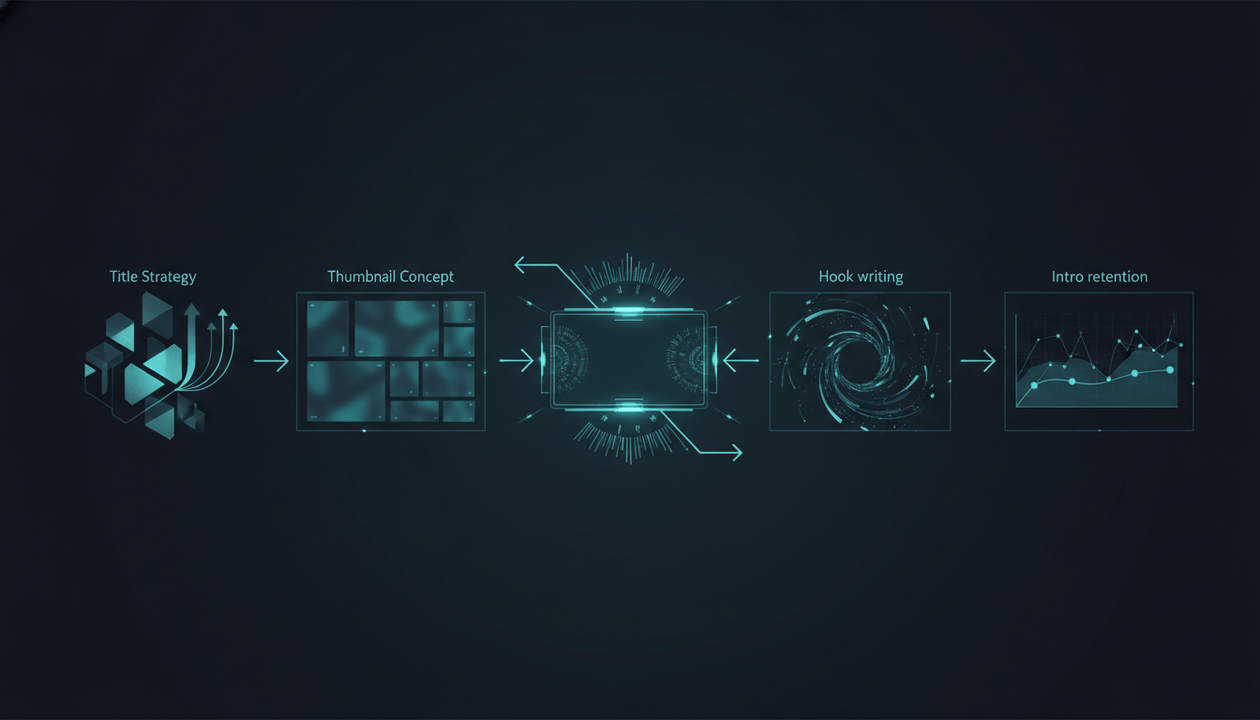
A strong YouTube packaging system connects four things:
- Title
- Thumbnail
- Hook
- Intro
If one of those breaks, the video leaks attention.
A great thumbnail with a weak title gets ignored.
A strong title with a confusing thumbnail creates hesitation.
A clickable title and thumbnail with a slow hook creates an early retention drop.
A strong hook with an intro that explains too much kills momentum.
In 2026, packaging matters more because YouTube is more competitive, viewers are more skeptical, AI content has raised the volume of generic videos, and creators now have more ways to test titles and thumbnails. YouTube’s own guidance says viewers usually see the thumbnail and title first, and that these help viewers decide whether they want to watch. Source: YouTube Help
But the best creators do not treat packaging as decoration.
They treat it as strategy.
This guide breaks down the full YouTube packaging system serious creators should use: how to build titles, thumbnails, hooks, and intros that work together, how to avoid misleading clickbait, how to analyze packaging after publishing, and how to use OverseerOS to reverse-engineer packaging patterns that already work.
Key Takeaways
- YouTube packaging is not just the title and thumbnail. It also includes the hook and intro because the viewer judges the promise after clicking.
- The strongest packaging creates one clear question in the viewer’s mind, then answers it through the video.
- Clickbait is not the same as curiosity. Curiosity creates interest. Clickbait creates a promise the video cannot deliver.
- YouTube packaging should be built before the full script because packaging forces the idea to become clear.
- Search videos, suggested videos, browse videos, Shorts, and subscriber-first videos need different packaging styles.
- YouTube Analytics can show whether the packaging earned attention, but creators need strong pre-publish research before testing.
- OverseerOS helps creators study proven title, thumbnail, and hook patterns with OverseerOS Viral X-Ray, OverseerOS Viral Title Architect, OverseerOS Thumbnail Analyzer, and the OverseerOS AI YouTube Thumbnail Generator.
What Is YouTube Packaging?
YouTube packaging is the way a video is presented before and immediately after the click.
It is the viewer’s first contract with the video.
| Packaging Element | What It Does |
|---|---|
| Title | Creates the verbal promise |
| Thumbnail | Creates the visual question |
| Hook | Confirms the click was worth it |
| Intro | Opens the story, argument, or payoff loop |
Most creators only focus on the first two.
That is a mistake.
A viewer does not stop judging the packaging after clicking. The first 5 to 30 seconds decide whether the viewer feels rewarded, tricked, bored, or curious enough to stay.
That means packaging is not only about earning the click.
It is about earning the next minute.
A strong packaging system answers four questions:
- Why should someone stop scrolling?
- Why should they click this video instead of another one?
- Why should they trust the promise after the first few seconds?
- Why should they keep watching until the payoff?
If the title and thumbnail earn the click but the hook does not continue the same promise, the video creates friction.
That friction often becomes a retention problem.
The Packaging Promise: One Video, One Core Question
Every strong YouTube video has a core question.
Not always a literal question. Sometimes it is a tension, mystery, fear, challenge, transformation, or contradiction.
Weak packaging tries to communicate everything.
Strong packaging makes the viewer care about one thing.
Examples:
| Weak Packaging Idea | Strong Core Question |
|---|---|
| “AI tools for creators” | “Are AI tools helping creators or making their content generic?” |
| “How to grow on YouTube” | “Why are some creators growing faster with fewer uploads?” |
| “Faceless YouTube strategy” | “Why do some faceless channels feel premium while others feel cheap?” |
| “Thumbnail tips” | “What makes someone click before they even read the full title?” |
| “Productivity advice” | “Why does your system fail the moment motivation disappears?” |
The core question becomes the spine of the packaging.
Title:
What is the clearest verbal version of the question?
Thumbnail:
What is the strongest visual version of the question?
Hook:
What is the fastest way to prove this question matters?
Intro:
What deeper loop keeps the viewer watching?
This is why great packaging feels simple from the outside and strategic underneath.
The 4-Part YouTube Packaging System
1. The Title: The Verbal Promise
The title tells the viewer why the video matters.
A strong title usually does one of five things:
| Title Job | What It Creates | Example |
|---|---|---|
| Explain | Clear search intent | “How to Build a YouTube Content Strategy in 2026” |
| Challenge | Contradiction | “Posting More Is Not a YouTube Strategy” |
| Warn | Risk or consequence | “Why Most Faceless Channels Fail After 30 Videos” |
| Reveal | Hidden insight | “The Packaging Mistake Killing Your YouTube Retention” |
| Compare | Decision help | “AI Video Generators vs Auto Edit: What Creators Actually Need” |
YouTube’s guidance says titles should accurately represent the video and be succinct, with important words near the beginning because viewers may only see part of the title. Source: YouTube Help
That matters more than most creators think.
A title has to work in small spaces:
- Home page.
- Suggested videos.
- Search results.
- Mobile.
- TV.
- Notifications.
- Embedded previews.
- Shared links.
If the title needs the full sentence to make sense, it is probably too fragile.
Strong Title Formula
Use this simple structure:
Specific subject + tension + payoff
Examples:
| Subject | Tension | Payoff Title |
|---|---|---|
| AI tools | They do not fix weak strategy | “AI Tools Won’t Save Your YouTube Channel. This Workflow Might.” |
| Faceless channels | Trust is harder without a face | “Why Faceless YouTube Channels Feel Cheap and How to Fix It” |
| Thumbnails | Pretty design is not enough | “The Thumbnail Mistake That Makes Good Videos Invisible” |
| Content planning | Random ideas waste production time | “How to Build a YouTube Content System Instead of Chasing Ideas” |
| Competitor research | Copying is not strategy | “How to Reverse-Engineer YouTube Competitors Without Copying Them” |
The best title is not always the most dramatic.
It is the clearest clickable promise the video can honestly deliver.
2. The Thumbnail: The Visual Question
The thumbnail does not need to explain the video.
It needs to create the right question.
That is why many weak thumbnails fail.
They try to summarize everything.
They include:
- Too many objects.
- Too many words.
- Too many faces.
- Too many arrows.
- Too many colors.
- Too many logos.
- Too many ideas.
A strong thumbnail usually has one dominant job:
Make the viewer pause long enough to read or feel the title.
YouTube’s own thumbnail guidance recommends avoiding designs that are too complex because too much can overwhelm the viewer. Source: YouTube Help
That is the core rule.
A thumbnail should be understandable in one second.
The 5 Thumbnail Tension Types
Most strong thumbnails use one of these tension types.
| Thumbnail Type | What It Shows | Best For |
|---|---|---|
| Contrast | Before vs after, old vs new, winner vs loser | Transformation, comparisons |
| Mystery | Hidden object, blurred result, unknown cause | Investigation, drama |
| Emotion | Shock, fear, greed, confidence, confusion | Personality, commentary, drama |
| Status | Money, power, ranking, authority, scale | Business, finance, AI, luxury |
| Consequence | Collapse, warning, mistake, danger | Education, risk, analysis |
Examples:
| Niche | Weak Thumbnail Text | Better Visual Question |
|---|---|---|
| AI | “AI Automation” | One person replaced by a clean system dashboard |
| Finance | “Market Update” | Calm investor vs collapsing chart |
| Psychology | “Manipulation Signs” | Smiling person holding invisible strings |
| History | “Roman Empire” | Emperor above a cracked map |
| YouTube growth | “Thumbnail Tips” | Great video buried under ignored thumbnails |
A thumbnail should not ask the viewer to decode a design.
It should make them feel the question instantly.
3. The Hook: The Click Confirmation
The hook is where many videos die.
The viewer clicked because the title and thumbnail promised something. The hook must prove that promise immediately.
A weak hook starts like this:
“Hey everyone, welcome back to the channel. In today’s video we’re going to talk about...”
That is dead time.
A strong hook starts with tension, stakes, contradiction, or a specific promise.
Weak:
“Today we are going to discuss YouTube thumbnails.”
Better:
“Most creators think their thumbnail problem is design. It is usually a promise problem.”
Weak:
“AI is changing YouTube.”
Better:
“AI is not making YouTube easier. It is making average content cheaper, which means trust is becoming the real advantage.”
Weak:
“Here are some tips to grow your channel.”
Better:
“If your videos get decent retention but nobody clicks, you do not have a content problem. You have a packaging problem.”
The hook should make the viewer think:
“Good. This is the video I clicked for.”
The 3-Part Hook Formula
Use this:
- Name the mistake or tension.
- Reframe the problem.
- Promise the payoff.
Example:
“Most creators think YouTube packaging means title and thumbnail. That is why their retention drops after the click. In this guide, you will learn how to connect the title, thumbnail, hook, and intro into one system.”
That hook works because it continues the same promise as the title.
No warm-up.
No filler.
No generic welcome.
4. The Intro: The Retention Bridge
The hook earns the next few seconds.
The intro earns the next few minutes.
A good intro does not explain everything. It sets up the reason to keep watching.
A strong intro usually includes:
- Why this matters now.
- What most people misunderstand.
- What the viewer will learn.
- What payoff is coming later.
- Why the video is worth finishing.
A weak intro gives background too early.
Example:
“YouTube was founded in 2005 and has become one of the largest platforms...”
That may be accurate, but it is rarely the right opening.
A stronger intro moves from tension to context.
Example:
“YouTube has never had more tools for creators. But most creators are still losing before the video starts, because they treat the title, thumbnail, hook, and intro as separate jobs. They are not separate. They are one promise system.”
That tells the viewer the video has a thesis.
That is what creates confidence.
The Packaging Alignment Test
Before publishing, ask one question:
Does the viewer get the same promise from the title, thumbnail, hook, and intro?
Use this table.
| Element | Example |
|---|---|
| Title | “Why Most Faceless YouTube Channels Feel Cheap” |
| Thumbnail | Split-screen: polished faceless video vs generic AI content |
| Hook | “The problem with most faceless channels is not that they are faceless. It is that they have no trust system.” |
| Intro | Explains visual consistency, script quality, narration, research, and packaging as the trust system |
That is aligned.
Now compare a weak version.
| Element | Weak Version |
|---|---|
| Title | “Why Most Faceless YouTube Channels Feel Cheap” |
| Thumbnail | Random robot face with “AI???” text |
| Hook | “Today I’ll show you five faceless channel ideas.” |
| Intro | Generic list of niches |
That is broken.
The viewer clicked for an analysis of why faceless channels feel cheap. The hook gives them a listicle. The promise changed.
When the promise changes, trust drops.
Search Packaging vs Suggested Packaging
Not every video should be packaged the same way.
Search videos and suggested videos behave differently.
A search viewer already knows what they want.
A suggested viewer may not know they care yet.
That means the packaging style changes.
| Video Type | Viewer Mindset | Packaging Style |
|---|---|---|
| Search | “I need an answer.” | Clear, direct, keyword-led |
| Suggested | “This looks interesting.” | Curiosity, tension, emotion |
| Browse/Home | “Show me something worth watching.” | Broad relevance, identity, strong promise |
| Subscriber feed | “I know this channel.” | Familiar voice, trust, continuation |
| Shorts | “Entertain me fast.” | Instant visual or verbal hook |
Search Packaging Example
Topic:
YouTube competitor analysis
Search title:
“How to Do YouTube Competitor Analysis in 2026”
Thumbnail:
Clean dashboard, competitor videos, arrows to patterns.
Hook:
“If you study competitors by copying their topics, you are doing it wrong. The goal is to find patterns viewers already reward.”
This works because search viewers want clarity.
Suggested Packaging Example
Same topic, different packaging:
Title:
“The Competitor Research Trick Small Channels Ignore”
Thumbnail:
Small channel looking at a competitor’s breakout video pattern.
Hook:
“Small creators usually study the wrong competitor videos. They look at the biggest videos, not the biggest breakouts.”
This works because suggested viewers need curiosity.
The content may cover similar ideas, but the packaging changes based on traffic intent.
The Clickbait Problem: Curiosity vs Deception
Creators often confuse curiosity with clickbait.
They are not the same.
Curiosity is when the title and thumbnail create a question the video answers.
Clickbait is when the title and thumbnail create a promise the video cannot deliver.
| Packaging Type | Example | Result |
|---|---|---|
| Clear curiosity | “The Thumbnail Mistake Killing Your Clicks” | Viewer expects a specific mistake |
| Useful tension | “Why Good Videos Still Get Ignored” | Viewer expects a packaging explanation |
| Misleading clickbait | “YouTube Is Deleting Small Channels” | Viewer expects a platform crisis |
| Fake urgency | “Do This Today or Your Channel Dies” | Viewer expects fear, often loses trust |
| Broken promise | Thumbnail shows MrBeast, video barely mentions him | Viewer feels tricked |
Clickbait may earn the click.
But it can destroy the next click.
That matters.
YouTube packaging is not only about one video. It trains the viewer how to feel about your channel.
If the viewer clicks and feels rewarded, the brand gets stronger.
If the viewer clicks and feels tricked, the brand gets weaker.
The long-term goal is not maximum curiosity.
It is maximum trust with enough curiosity to earn attention.
The YouTube Packaging Matrix
Use this matrix to decide your title and thumbnail direction.
| Packaging Angle | Best When | Example Title |
|---|---|---|
| Beginner clarity | Search demand is high | “How to Make Better YouTube Thumbnails in 2026” |
| Mistake angle | Audience has pain but does not know cause | “The Thumbnail Mistake That Makes Good Videos Invisible” |
| Contrarian angle | The niche has lazy common advice | “Your Thumbnail Is Not the Problem. Your Promise Is.” |
| Comparison angle | Viewer is deciding between options | “AI Thumbnails vs Human Designers: What Actually Works?” |
| Warning angle | There is real risk | “Why Clickbait Packaging Kills Channel Trust” |
| System angle | Serious creators want process | “The YouTube Packaging System: Titles, Thumbnails, Hooks, and Intros” |
| Case-study angle | You can show real examples | “Why This Small Channel’s Packaging Beat Bigger Competitors” |
| Future angle | Platform behavior is changing | “How YouTube Packaging Changes When Title Testing Becomes Normal” |
The best angle depends on the viewer’s awareness level.
| Awareness Level | Best Packaging Style |
|---|---|
| Unaware | Big curiosity or tension |
| Problem-aware | Mistake, warning, pain |
| Solution-aware | Framework, system, tutorial |
| Tool-aware | Comparison, workflow, use case |
| Buyer-aware | Best tool, feature, decision guide |
For OverseerOS content, the strongest articles often sit between solution-aware and tool-aware.
The reader already knows they need better YouTube strategy. The article teaches the framework, then makes OverseerOS feel like the obvious way to execute it.
How to Build a Title That Works With the Thumbnail
The title and thumbnail should not repeat each other.
They should complete each other.
Weak pairing:
Title:
“How to Get More Views on YouTube”
Thumbnail text:
“GET MORE VIEWS”
Problem:
Same message twice. No extra tension.
Better pairing:
Title:
“Why Good Videos Still Get Ignored”
Thumbnail text:
“NO CLICKS?”
Now the title creates the idea and the thumbnail creates the emotional pain.
Title and Thumbnail Pairing Rules
- The title should explain the promise.
- The thumbnail should dramatize the question.
- The title can be specific while the thumbnail is emotional.
- The thumbnail can be simple while the title adds meaning.
- Do not make both too complex.
- Do not make both too vague.
- Do not make them say the exact same thing.
Examples:
| Title | Thumbnail Text | Why It Works |
|---|---|---|
| “AI Tools Won’t Save Your YouTube Channel” | “STILL STUCK?” | Title creates argument, thumbnail shows pain |
| “Why Most Faceless Channels Feel Cheap” | “FAKE?” | Title explains topic, thumbnail creates trust question |
| “The YouTube Packaging System” | “CLICK → WATCH” | Title names framework, thumbnail shows outcome |
| “How to Reverse-Engineer Competitors Without Copying” | “COPY OR MODEL?” | Title promises method, thumbnail creates ethical tension |
| “Why Good Scripts Still Lose Viewers” | “BORING?” | Title gives contradiction, thumbnail gives emotion |
The best packaging feels like one idea split across two surfaces.
The Hook Must Continue the Thumbnail
This is the part creators miss.
The hook should not only continue the title. It should also continue the thumbnail.
If the thumbnail shows a creator staring at a video with zero clicks, the hook should immediately speak to that pain.
Example:
Thumbnail:
“NO CLICKS?”
Title:
“Why Good Videos Still Get Ignored”
Weak hook:
“Welcome back. In this video, we’ll talk about YouTube growth.”
Strong hook:
“If your retention is decent but your views are low, the problem may not be the video. It may be that your packaging never gave viewers a reason to click.”
That confirms the click.
Now the viewer feels understood.
This is why packaging should be built before scripting. The hook is not separate from the title and thumbnail. It is the next sentence in the same conversation.
The 5 Best YouTube Hook Types for Packaging
1. The Mistake Hook
“Most creators think their thumbnail problem is design. It is usually strategy.”
Best for educational videos.
2. The Contradiction Hook
“Posting more videos can make your channel grow slower if your packaging is weak.”
Best for strategy and opinion videos.
3. The Stakes Hook
“A weak title does not just lower clicks. It can stop YouTube from learning who your video is for.”
Best for serious creator topics.
4. The Story Hook
“This channel changed one thing about its thumbnails, and its old videos started getting discovered again.”
Best for case studies.
5. The Identity Hook
“If you are building a faceless channel in 2026, your packaging has to do the trust-building that your face cannot.”
Best for faceless creators, personal brands, and niche-specific content.
The hook should fit the packaging angle.
A warning title needs a stakes hook.
A system title needs a framework hook.
A case-study title needs a story hook.
A contrarian title needs a contradiction hook.
The Packaging Workflow Serious Creators Should Use
Most creators package too late.
They write the video, produce it, then ask:
“What should the title and thumbnail be?”
That is backwards.
Packaging should happen before the full script.
Use this workflow.
Step 1: Choose the Viewer Desire
What does the viewer want?
| Desire | Packaging Direction |
|---|---|
| Clarity | “How to...” or “What is...” |
| Fear | Warning, mistake, consequence |
| Status | Become smarter, understand what others miss |
| Curiosity | Mystery, hidden reason, surprising truth |
| Transformation | Before/after, system, process |
| Belonging | “Why creators like you...” |
Example:
Topic:
YouTube thumbnails
Viewer desire:
“I want to know why my videos are not getting clicks.”
Packaging direction:
Mistake + pain.
Title:
“The Thumbnail Mistake That Makes Good Videos Invisible”
Step 2: Find Proven Pattern Signals
Look at videos in your niche and ask:
- Which titles overperformed?
- Which thumbnail styles repeat across winners?
- Which emotions show up often?
- Which topics break the channel’s average?
- Which title structures appear across multiple channels?
- Which thumbnails are simple enough to understand fast?
- Which hook styles match the packaging?
This is exactly where OverseerOS Viral X-Ray and OverseerOS Channel Analyzer become useful. You do not want to guess what packaging works. You want to study real videos and extract the patterns that viewers already reward.
Step 3: Write 10 Title Angles
Do not write one title.
Write angle families.
For example, topic:
AI-assisted YouTube
Title angles:
| Angle Type | Title |
|---|---|
| Warning | “Why AI YouTube Content Feels Cheap” |
| Contrarian | “AI Is Not the Problem on YouTube. Lazy AI Is.” |
| System | “The AI-Assisted YouTube Workflow Serious Creators Should Use” |
| Mistake | “The AI Mistake Turning Creator Channels Into Content Farms” |
| Future | “How to Use AI on YouTube Without Losing Trust in 2026” |
Now choose the title that best matches the video’s strongest promise.
OverseerOS Viral Title Architect can help creators generate stronger title directions from proven YouTube patterns, but the creator still needs to choose the title that the video can actually deliver.
Step 4: Build 3 Thumbnail Concepts
Do not make one thumbnail.
Make three concepts:
- Literal concept
- Emotional concept
- Metaphor concept
Example topic:
YouTube packaging system
| Concept Type | Thumbnail Idea |
|---|---|
| Literal | Title, thumbnail, hook, intro connected as a chain |
| Emotional | Creator shocked at high retention drop after click |
| Metaphor | A broken promise contract between viewer and video |
This helps avoid generic design.
Step 5: Write the Hook Before the Script
Before scripting, write the first 20 seconds.
If the hook does not work, the video is not ready.
Hook test:
- Does it match the title?
- Does it match the thumbnail?
- Does it create a reason to keep watching?
- Does it avoid generic setup?
- Does it establish the problem fast?
- Does it make a clear promise?
If the hook feels weak, fix the angle first.
Step 6: Build the Intro Loop
The intro should tell the viewer:
- Why this matters.
- What most people get wrong.
- What they will learn.
- Why it is worth staying.
Example:
“Most creators try to fix low views by changing thumbnails. But the thumbnail is only one part of the promise. If the title creates one expectation, the thumbnail creates another, and the hook starts somewhere else, viewers feel friction. This guide shows you how to build packaging as one connected system.”
That intro creates a clear learning loop.
Packaging Diagnostics: What Your Analytics Are Really Telling You
YouTube Analytics can help diagnose packaging problems.
YouTube explains that impressions show how many times thumbnails were shown to viewers through registered impressions, and impressions click-through rate shows how often viewers watched after seeing a thumbnail. Source: YouTube Help
But CTR alone is not enough.
A high CTR with poor retention may mean the packaging overpromised.
A low CTR with strong retention may mean the video was good but the packaging failed.
A high CTR and high retention means the packaging and content aligned.
Use this diagnostic table.
| Data Pattern | Likely Meaning | What To Fix |
|---|---|---|
| Low CTR, high retention | Good video, weak packaging | Improve title and thumbnail |
| High CTR, low retention | Packaging worked, video disappointed | Fix hook, intro, or promise accuracy |
| Low impressions, strong watch time | YouTube may not know audience yet | Clarify topic, metadata, and adjacent videos |
| High impressions, low CTR | YouTube tested it but viewers ignored it | Rework title and thumbnail tension |
| Good CTR, drop in first 30 seconds | Hook does not match packaging | Rewrite opening |
| Good first minute, later drop | Structure problem, not packaging | Improve pacing and reveals |
| Strong search traffic, weak suggested | Clear topic but low curiosity | Add tension and emotional framing |
| Strong suggested, weak subscriber response | Broad curiosity but weak channel fit | Reconnect to core audience promise |
YouTube’s Reach tab shows traffic source reports, including YouTube Search, Suggested Videos, Browse features, external sources, playlists, Shorts, and more. Source: YouTube Help
That matters because CTR should be judged by traffic source.
Search CTR and Browse CTR are not the same game.
A search title may look boring but perform well because it answers clear intent.
A browse title may need more curiosity because the viewer was not searching for it.
The 2026 Packaging Shift: Testing Makes Strategy More Important, Not Less
YouTube has expanded title and thumbnail testing for creators with access to advanced features, allowing creators to test up to three title and thumbnail combinations on eligible videos. A report from The Verge explains that YouTube can run these tests across audiences for up to two weeks and apply the winning combination based on watch time. Source: The Verge
This is useful.
But it creates a new problem.
If everyone can test packaging, the advantage moves earlier.
The winners will not be the creators who test three random thumbnails.
The winners will be the creators who create three strategically different packaging angles before the test starts.
Bad test:
| Version | Problem |
|---|---|
| Title A | “How to Grow on YouTube” |
| Title B | “YouTube Growth Tips” |
| Title C | “Grow Your Channel Fast” |
Those are not meaningfully different. They are the same idea with different wording.
Better test:
| Version | Angle |
|---|---|
| “Why Good Videos Still Get Ignored” | Pain and curiosity |
| “The YouTube Packaging System Serious Creators Use” | Framework and authority |
| “Your Thumbnail Is Not the Problem. Your Promise Is.” | Contrarian insight |
Now the test is useful because each version tests a different viewer trigger.
Testing does not replace strategy.
Testing rewards better strategy.
The Packaging Scorecard
Use this before publishing.
Score each category from 1 to 5.
| Category | 1 Point | 3 Points | 5 Points |
|---|---|---|---|
| Title clarity | Vague | Understandable | Sharp and specific |
| Thumbnail clarity | Cluttered | Decent | Instantly readable |
| Title-thumbnail relationship | Repetitive or disconnected | Some alignment | Completes one strong idea |
| Hook alignment | Generic intro | Related | Directly continues the promise |
| Intro loop | Slow background | Some stakes | Clear reason to keep watching |
| Viewer desire | Unclear | Moderate | Strong emotional or practical pull |
| Traffic fit | Wrong style | Mixed | Perfect for search, browse, suggested, or subscribers |
| Promise honesty | Overhyped | Mostly accurate | Strong and fully deliverable |
| Pattern proof | Guessing | Some inspiration | Built from proven niche patterns |
| Differentiation | Generic | Some angle | Clearly unique |
Score:
| Score | Meaning |
|---|---|
| 10 to 25 | Packaging is weak. Do not publish yet. |
| 26 to 35 | Usable, but needs sharper alignment. |
| 36 to 44 | Strong enough to test. |
| 45 to 50 | Excellent packaging system. |
The goal is not perfection.
The goal is to stop publishing videos with broken promises.
How OverseerOS Helps You Build Better YouTube Packaging
The best packaging does not come from random brainstorming.
It comes from pattern recognition.
That is why OverseerOS is useful for serious creators.
OverseerOS helps creators reverse-engineer what already works on YouTube and turn those patterns into better titles, thumbnails, hooks, scripts, and video workflows.
Here is how the packaging workflow connects inside OverseerOS:
| Packaging Need | OverseerOS Workflow |
|---|---|
| Find what is already working | OverseerOS Channel Analyzer and OverseerOS Viral X-Ray |
| Study breakout videos | OverseerOS Viral X-Ray |
| Extract channel style and patterns | OverseerOS Channel Blueprint Cloner |
| Plan better video ideas | OverseerOS Smart Content Planner |
| Create stronger titles | OverseerOS Viral Title Architect |
| Build thumbnail concepts | OverseerOS Thumbnail Analyzer and OverseerOS AI YouTube Thumbnail Generator |
| Turn packaging into a script | OverseerOS Script ReSpark and OverseerOS Quality Script Generation |
| Produce faceless videos from the plan | OverseerOS Auto Edit |
For thumbnails specifically, OverseerOS AI YouTube Thumbnail Generator can help creators create thumbnails from scratch, clone visual style from a YouTube URL, use style patterns from analyzed channels, or explore high-performing thumbnail style inspiration.
For full faceless video production, OverseerOS Auto Edit Studio helps creators move from script and voiceover into scene-based video production with visual direction, captions, music, motion, FX, and export workflows.
The point is not to copy another creator’s thumbnail or title.
The point is to understand what viewers respond to, then build your own unique version from evidence.
That is the difference between guessing and strategy.
Practical Template: Build Your Packaging Before the Script
Use this template for every serious video.
Video Idea
What is the raw topic?
Example:
Faceless YouTube channels feel cheap.
Viewer Desire
What does the viewer want to understand, avoid, achieve, or feel?
Example:
They want to know how to make faceless videos feel premium and trustworthy.
Core Question
What question should the title and thumbnail create?
Example:
Why do some faceless channels feel fake while others feel professional?
Title Options
Write at least 10.
Examples:
- “Why Most Faceless YouTube Channels Feel Cheap”
- “The Trust Problem Killing Faceless YouTube Channels”
- “How to Make Faceless Videos Feel Premium, Not Generic”
- “Faceless YouTube Is Not the Problem. Low-Trust Content Is.”
- “Why Viewers Instantly Know Your Faceless Video Is Cheap”
Thumbnail Concepts
Create three directions.
| Concept | Visual Direction |
|---|---|
| Trust contrast | Cheap AI video vs premium documentary frame |
| Viewer reaction | Viewer sees video and thinks “fake?” |
| Production system | Random scenes vs consistent visual style |
Hook
Write the first 20 seconds.
Example:
“The problem with most faceless channels is not that they are faceless. It is that viewers can feel when nobody made real creative decisions. The voice sounds generic, the visuals do not match, the script says nothing new, and the thumbnail promises more than the video delivers.”
Intro Loop
Explain why they should stay.
Example:
“In this guide, you will learn the trust system behind premium faceless channels: better research, stronger packaging, cleaner scripts, consistent visuals, and a production workflow that feels intentional instead of generated.”
Payoff
What will the viewer get by the end?
Example:
A practical checklist for making faceless videos look and feel premium.
If you cannot fill this template, the video idea is not ready.
Common YouTube Packaging Mistakes
Mistake 1: Making the Thumbnail Before the Promise Is Clear
Design cannot fix unclear strategy.
Before opening a thumbnail editor, define:
- Who is the viewer?
- What is the emotion?
- What is the question?
- What is the title promise?
- What is the visual tension?
A thumbnail without a clear promise becomes decoration.
Mistake 2: Repeating the Title in the Thumbnail
If the title says:
“How to Grow on YouTube in 2026”
The thumbnail should not say:
“GROW ON YouTube”
That wastes space.
Instead, the thumbnail can show the pain:
“STUCK?”
Or the outcome:
“0 → 100K”
Or the tension:
“POSTING MORE?”
The title and thumbnail should work together, not duplicate each other.
Mistake 3: Overloading the Thumbnail
Most thumbnails are too busy.
Remove anything that does not help the viewer understand the question.
Ask:
- Can this be understood on mobile?
- Is there one focal point?
- Is the text readable?
- Is the emotion clear?
- Is the background too loud?
- Does this look premium or desperate?
Simple usually beats crowded.
Mistake 4: Using Curiosity Without Payoff
Curiosity is only powerful if the video pays it off.
Bad:
“You Won’t Believe What Happened”
Better:
“The YouTube Mistake That Kills Good Videos Before Anyone Clicks”
The second title still creates curiosity, but it tells the viewer what kind of value to expect.
Mistake 5: Starting the Video Like the Packaging Never Happened
The hook must continue the click.
Do not reset the video after the viewer clicks.
The first sentence should feel like the natural next step after the title and thumbnail.
Mistake 6: Judging Packaging by Overall CTR Only
Overall CTR can mislead you.
Always check traffic source.
A video may have:
- Strong Search CTR.
- Weak Browse CTR.
- Strong subscriber CTR.
- Weak Suggested CTR.
Those mean different things.
YouTube packaging should be diagnosed by audience and source, not one blended number.
Mistake 7: Copying a Competitor’s Thumbnail Style Too Closely
Modeling is smart.
Copying is weak.
The ethical workflow is:
- Study what worked.
- Extract the pattern.
- Change the topic, angle, composition, examples, and visual identity.
- Make it fit your channel.
- Deliver the promise honestly.
The goal is not to look like another creator.
The goal is to understand why viewers clicked.
Final Verdict: Packaging Is the Video Before the Video
YouTube packaging is not a final step.
It is the first test of your strategy.
If you cannot package the idea clearly, the idea is not ready.
If the thumbnail creates one promise and the title creates another, viewers hesitate.
If the hook does not continue the click, viewers leave.
If the intro explains too much before creating stakes, attention drops.
The strongest creators in 2026 will not just make better thumbnails.
They will build better packaging systems.
They will understand how titles, thumbnails, hooks, and intros work together.
They will use analytics to diagnose the promise.
They will study what already works without copying it.
They will test smarter variations.
And they will build every video from the same principle:
One clear viewer desire. One strong promise. One aligned click-to-watch experience.
If you want to build that kind of workflow, OverseerOS helps creators reverse-engineer high-performing YouTube videos, create stronger titles, analyze thumbnail patterns, plan better hooks, and turn proven packaging signals into repeatable content workflows.
FAQ
What is YouTube packaging?
YouTube packaging is the way a video is presented before and immediately after the click. It includes the title, thumbnail, hook, and intro. Strong packaging creates a clear promise, earns the click, confirms the viewer made the right choice, and gives them a reason to keep watching.
Why are titles and thumbnails important on YouTube?
Titles and thumbnails are important because they are usually the first things viewers see before deciding whether to watch. YouTube’s own guidance says thumbnails and titles give viewers a glimpse of what a video is about and help them decide if they want to watch. Source: YouTube Help
What makes a good YouTube title?
A good YouTube title is clear, specific, accurate, and emotionally relevant. It should create a strong reason to watch without misleading the viewer. The best titles usually combine subject, tension, and payoff.
What makes a good YouTube thumbnail?
A good YouTube thumbnail creates one clear visual question. It should be simple, readable, emotionally clear, and aligned with the title. A thumbnail does not need to explain the whole video. It needs to stop the viewer and support the title promise.
Should my thumbnail repeat my title?
Usually, no. The thumbnail and title should complete each other, not repeat the same words. If the title explains the promise, the thumbnail should add emotion, contrast, curiosity, or visual tension.
What is the difference between curiosity and clickbait?
Curiosity creates a question the video actually answers. Clickbait creates a promise the video cannot deliver. Curiosity builds trust when the payoff is real. Clickbait may earn one click but can damage retention and long-term channel trust.
Should I create the title before writing the script?
For serious YouTube videos, yes. You should create the title, thumbnail concept, and hook before writing the full script. Packaging forces clarity. If you cannot package the idea clearly, the video angle probably needs more work.
How do I know if my YouTube packaging is working?
Look at impressions, CTR, average view duration, first 30-second retention, traffic sources, and watch time from impressions. Low CTR with strong retention usually means the video is good but packaging is weak. High CTR with poor retention may mean the packaging overpromised.
How does OverseerOS help with YouTube packaging?
OverseerOS helps creators study proven packaging patterns with OverseerOS Channel Analyzer, OverseerOS Viral X-Ray, OverseerOS Viral Title Architect, OverseerOS Thumbnail Analyzer, and the OverseerOS AI YouTube Thumbnail Generator. It helps creators build titles, thumbnail directions, hooks, and content plans from evidence instead of guessing.
What is the best YouTube packaging strategy in 2026?
The best YouTube packaging strategy in 2026 is to build the title, thumbnail, hook, and intro as one connected promise system. Study what already works in your niche, create a unique angle, make the thumbnail visually simple, make the title accurate and clickable, continue the promise in the hook, and use analytics to improve future packaging.