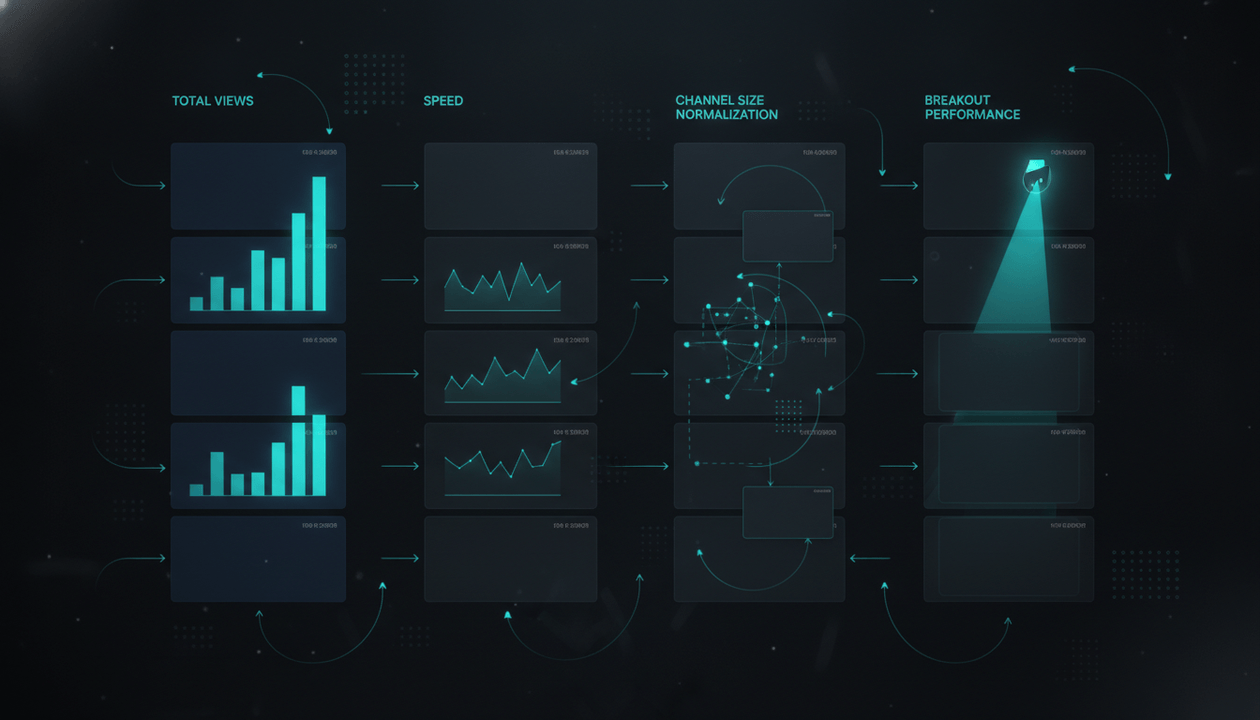
Most creators use YouTube channel finder, YouTube niche finder, and YouTube outlier finder as if they describe the same tool.
They do not.
Each one answers a different strategic question:
- A channel finder tells you which creators are gaining traction.
- A niche finder tells you which market or channel position may be worth entering.
- An outlier finder tells you which individual videos performed far above expectations.
Choose the wrong tool and you can collect useful data that does not solve your actual problem.
You might find a viral video without knowing whether the niche is sustainable. You might find a profitable niche without knowing which channels prove the opportunity. Or you might discover a fast-growing channel without understanding which specific videos caused its growth.
The strongest YouTube research workflow connects all three.
You use niche research to choose the market, channel discovery to find the right creators, and outlier analysis to identify the topics, formats, titles, and packaging patterns that broke through.
Key Takeaways
- A YouTube channel finder discovers whole channels worth studying, usually based on niche, channel size, format, activity, and recent performance.
- A YouTube niche finder evaluates where to build, whether that means validating an existing niche or turning a proven format into a new channel opportunity.
- A YouTube outlier finder identifies individual videos that performed significantly better than a channel’s normal baseline.
- High views do not automatically make a video an outlier. Performance must be judged relative to the channel that published it.
- One outlier video does not prove an entire niche is worth entering. Look for repeated signals across several videos and channels.
- For a new channel, the best order is usually: niche finder, channel finder, then outlier finder.
- For an existing channel, the best order is usually: channel finder, outlier finder, then niche research only when considering a pivot or expansion.
- OverseerOS Viral Channel Finder connects channel discovery with the actual breakout videos behind each result.
- OverseerOS Niche Bender goes beyond generic niche lists by turning proven channel formats into researched new-channel opportunities.
YouTube Channel Finder vs Niche Finder vs Outlier Finder: The Core Difference
| Tool Type | Main Question | What It Analyzes | Best Used For | Typical Output |
|---|---|---|---|---|
| YouTube channel finder | Which channels are gaining traction? | Whole channels and their recent public performance | Competitor discovery, channel research, market mapping | Ranked channels, growth signals, filters, recent winners |
| YouTube niche finder | Which market or position should I enter? | Niches, audiences, competition, demand, formats, monetization and production fit | Starting a channel, expanding into a new market, validating an idea | Niche opportunities, viability scores, competition signals, channel concepts |
| YouTube outlier finder | Which videos beat expectations? | Individual videos compared with the publishing channel’s normal performance | Finding proven topics, title patterns, thumbnail patterns and emerging formats | Outlier scores, breakout videos, view velocity, titles, thumbnails |
The cleanest way to remember the difference is:
A niche finder chooses the market. A channel finder identifies who is winning inside it. An outlier finder reveals what caused the market to react.
These tools overlap, but they should not be treated as substitutes.
A channel finder may display breakout videos.
An outlier finder may reveal promising channels.
A niche finder may use channels and outliers as evidence.
The difference is the decision each tool is designed to help you make.
What Is a YouTube Channel Finder?
A YouTube channel finder helps you discover creators that match specific research criteria.
A basic channel finder may let you search by:
- Keyword
- Category
- Country
- Language
- Subscriber count
- Total videos
- Channel age
A more useful YouTube channel finder also looks at recent performance:
- Average views per video
- Recent uploads
- Breakout videos
- Growth rate
- View velocity
- Upload frequency
- Shorts versus long-form
- Performance relative to channel size
This matters because a large channel is not automatically a useful research target.
A channel with five million subscribers may have a huge archive but weak current momentum. Meanwhile, a channel with 30,000 subscribers may have published three consecutive videos that each crossed 300,000 views.
The second channel may reveal a more actionable opportunity.
The Main Job of a Channel Finder
A channel finder should help you answer:
- Which channels are growing inside this niche?
- Are smaller channels breaking out?
- Which content formats are gaining traction?
- Who should I add to my competitor watchlist?
- Which channels deserve deeper analysis?
- Which channels have recent evidence rather than only historical success?
- Are there emerging creators that YouTube search is not making obvious?
The output is not supposed to be a random directory of YouTube channels.
It should be a shortlist of channels with a clear reason to investigate them.
When You Should Use a YouTube Channel Finder
Use a channel finder when you already know the broad market but do not know who to study.
Examples:
- You know you want to build an AI education channel, but you need to find smaller AI channels gaining traction.
- You operate a finance channel and want to identify new competitors entering your sub-niche.
- You manage YouTube for clients and need to build a competitor set for each account.
- You want to find faceless long-form channels rather than Shorts-heavy channels.
- You are researching acquisition, sponsorship or partnership opportunities.
- You need proof that new channels can still grow in a market.
What a Channel Finder Cannot Decide for You
A channel finder can reveal promising channels, but it cannot automatically tell you whether their entire strategy fits your situation.
A channel may be growing because of:
- A highly skilled host
- Celebrity access
- Expensive production
- Exclusive industry knowledge
- A temporary news cycle
- An existing audience from another platform
- A single unsustainable breakout
- A format your team cannot reproduce consistently
Finding the channel is the start of the analysis.
You still need to determine whether the underlying pattern is transferable.
What Is a YouTube Niche Finder?
A YouTube niche finder helps you identify or validate a market that could support a repeatable channel.
Weak niche finders produce generic lists:
- Finance
- Technology
- Fitness
- Psychology
- History
- Gaming
- Travel
Those are broad categories, not strong channel positions.
A serious niche finder should help you move from a broad subject to a specific, differentiated opportunity.
For example:
| Broad Category | More Specific Niche | Stronger Channel Position |
|---|---|---|
| Finance | Personal finance | Visual case studies explaining how ordinary people recovered from major financial mistakes |
| Technology | Artificial intelligence | Real-world tests of whether AI agents can replace specific business workflows |
| Psychology | Social psychology | Animated breakdowns of the hidden power dynamics inside everyday conversations |
| History | Military history | Decision-by-decision reconstructions of battles that were lost before fighting began |
| Business | Company analysis | Documentary investigations into the single strategic mistake that destroyed dominant companies |
The final column is where a real YouTube channel begins.
It defines:
- The audience
- The promise
- The repeatable format
- The emotional angle
- The production model
- The reason to watch this channel instead of another one
The Main Job of a Niche Finder
A niche finder should help you answer:
- Is there active demand?
- Are new or smaller channels succeeding?
- Is the market still open to new entrants?
- Can the channel produce hundreds of potential topics?
- Are the titles and thumbnails naturally clickable?
- Can the format be produced consistently?
- Does the audience have monetization value?
- Are there sponsor, affiliate, product or service opportunities?
- What will make this channel different?
- Is the opportunity based on evidence or a convincing-sounding AI guess?
A strong niche is not simply popular.
It sits at the intersection of:
- Viewer demand
- Competitive opportunity
- Repeatable content
- Strong packaging
- Sustainable production
- Monetization fit
- A defensible angle
Three Types of YouTube Niche Finder
Not every niche finder works the same way.
1. List-Based Niche Finder
This gives you lists of popular or profitable niches.
It is useful for initial inspiration, but weak for serious decisions because the recommendations are usually broad and disconnected from live channel evidence.
2. Market-Signal Niche Finder
This evaluates factors such as:
- Search demand
- Competition
- Channel growth
- Outlier videos
- Saturation
- Estimated monetization
- Trend direction
This is more useful because it gives the niche a supporting evidence layer.
3. Format-Transfer Niche Finder
This starts with a successful channel, extracts the repeatable format behind it, then searches for other markets where that format could work.
This is the approach used by OverseerOS Niche Bender.
Instead of asking:
What are some profitable YouTube niches?
It asks:
What made this channel format work, which parts are transferable, and where could that system become an original new channel?
That distinction matters.
A generic niche idea may tell you to start a history channel.
A format-transfer analysis may produce:
A cinematic channel reconstructing the final 72 hours before famous corporate collapses, using the pacing and escalating-reveal structure of successful historical disaster documentaries.
That is far closer to something you could actually launch.
For a deeper breakdown of this approach, read the YouTube niche bending guide.
What Is a YouTube Outlier Finder?
A YouTube outlier finder identifies videos that perform unusually well compared with a channel’s normal baseline.
Imagine two videos:
- Video A has 500,000 views on a channel that normally gets 2 million views.
- Video B has 120,000 views on a channel that normally gets 8,000 views.
Video A has more total views.
Video B is the stronger outlier.
It performed 15 times above the channel’s normal result, while Video A underperformed its usual baseline.
That is why raw view counts can be misleading.
The Main Job of an Outlier Finder
An outlier finder helps you answer:
- Which topics produced unexpected demand?
- Which videos dramatically beat their channel’s normal performance?
- Which titles created unusual curiosity?
- Which thumbnail structures are appearing across several breakouts?
- Which formats are accelerating now?
- Are smaller channels proving an idea can work?
- Is the same pattern repeating across multiple competitors?
- Which ideas may deserve a deeper content brief?
A strong outlier finder may use signals such as:
- Performance relative to the channel median
- Performance relative to recent channel averages
- Views per hour
- Views per day
- Upload date
- Channel size
- Video length
- Shorts versus long-form
- Current momentum
- Similar breakout videos
When You Should Use a YouTube Outlier Finder
Use an outlier finder when you already understand the niche and need stronger video ideas.
Examples:
- You know your competitors but do not know what topic to publish next.
- Your AI-generated ideas feel generic and lack market evidence.
- You want to find topics that worked on smaller channels.
- You need title and thumbnail patterns based on real performance.
- You are building a content calendar and want each idea backed by proof.
- You want to distinguish a genuinely surprising winner from a normal video on a giant channel.
For a dedicated comparison of discovery platforms, read the best YouTube outlier finder tools.
What an Outlier Finder Cannot Prove
One viral video does not prove:
- The niche is sustainable
- The topic can be repeated
- The channel is healthy
- The format will work for your audience
- The video is still gaining momentum
- The result was caused by the title or thumbnail
- Your version will perform similarly
- The audience has commercial value
An outlier is evidence of an unusual audience reaction.
It is not a guarantee.
You need to investigate what created the reaction and whether the underlying opportunity repeats.
Which Tool Do You Actually Need?
Use this decision table.
| Your Current Problem | Start With | Why |
|---|---|---|
| I have no idea what kind of channel to start | Niche finder | You need to choose and validate a market before studying individual videos |
| I know the niche but cannot find good competitors | Channel finder | You need a stronger research set |
| I know the competitors but need better video ideas | Outlier finder | You need to isolate the videos that beat expectations |
| I want to launch a faceless channel | Niche finder, then channel finder | Validate the opportunity and find proof that accessible channels can grow |
| I want to pivot an existing channel | Niche finder | You need to evaluate adjacent positions without abandoning your transferable strengths |
| I manage multiple client channels | Channel finder | You need repeatable competitor discovery and monitoring |
| I need a topic for next week | Outlier finder | You need video-level evidence, not an entirely new market |
| I want to find emerging creators | Channel finder | The unit of discovery is the channel |
| I want to know whether a niche is saturated | Niche finder plus channel finder | Market-level conclusions require evidence from multiple channels |
| I found a viral channel and want to adapt its model elsewhere | Format-transfer niche finder | You need to separate transferable Format DNA from creator-specific advantages |
The Fast Decision Rule
Use a niche finder when the uncertainty is:
Where should I build?
Use a channel finder when the uncertainty is:
Who should I study?
Use an outlier finder when the uncertainty is:
What should I make?
The Best Order for Starting a New YouTube Channel
For most new channels, use the tools in this order.
Step 1: Use a Niche Finder to Define the Opportunity
Do not begin by collecting random viral videos.
First determine:
- Who the channel is for
- What promise it will make
- What format it will repeat
- Why the market may support it
- How the content will be packaged
- Whether the production model is realistic
- How the channel could eventually make money
Your output should be a specific channel thesis.
Example:
A faceless business documentary channel explaining how one hidden operational decision caused famous companies to collapse.
That is more useful than:
Business documentaries.
Step 2: Use a Channel Finder to Find Market Proof
Search for channels occupying the same market or using adjacent formats.
Look for:
- Small and mid-sized channels
- Recent growth
- Repeated strong performance
- Active upload schedules
- Several breakout videos
- Different execution styles
- Channels that succeeded without celebrity advantages
You are trying to answer:
Is there evidence that viewers respond to this type of content from channels that are not already enormous?
Step 3: Use an Outlier Finder to Extract Proven Video Patterns
Once you have the right channels, inspect their outliers.
Record:
- Topic
- Title
- Thumbnail
- Video length
- Upload date
- View count
- Channel baseline
- Outlier multiple
- Opening promise
- Emotional driver
- Content structure
- Comments and audience questions
Do not copy one video.
Look for patterns across several outliers.
Step 4: Build a Ten-Video Test
Turn the evidence into a controlled first batch.
Your first ten videos should test:
- Two or three content pillars
- Multiple title structures
- Multiple thumbnail directions
- Different emotional promises
- A consistent production format
- A clear audience promise
The purpose is not to prove that every video will work.
The purpose is to learn which part of the channel thesis the market responds to.
The Best Order for Growing an Existing Channel
An established channel already has a niche and audience data.
The best research order is usually different.
Step 1: Use a Channel Finder
Find current competitors and emerging channels.
Your old competitor list may no longer reflect the real market.
Look for:
- New creators
- Format shifts
- Smaller channels gaining traction
- Channels entering from adjacent niches
- Competitors publishing more aggressively
- New title and thumbnail conventions
Step 2: Use an Outlier Finder
Identify what is currently beating expectations across those channels.
Group the outliers by:
- Topic
- Viewer problem
- Format
- Emotional angle
- Title structure
- Thumbnail pattern
- Video length
- Publishing timing
Step 3: Use Niche Research Only When Necessary
Return to niche-level analysis when:
- Your audience is shrinking
- Your format has become saturated
- Your monetization model is weak
- You want to start a second channel
- You are considering an adjacent audience
- A stronger format appears transferable to another market
Do not reinvent the entire channel every time one video underperforms.
Use niche research for strategic changes, not weekly panic.
Three Examples of the Tools Working Together
Example 1: AI and Technology Channel
A niche finder may reveal a more specific opportunity:
Real-world AI workflow tests for small businesses.
A channel finder may uncover smaller channels succeeding with:
- AI agent experiments
- Software comparisons
- Workflow automation challenges
- “I replaced X with AI” formats
An outlier finder may show repeated breakout patterns such as:
- A concrete job being replaced
- A time-limited experiment
- A surprising failure
- A measurable before-and-after result
The final video idea should not be a copy of the outlier.
It could become:
I Gave an AI Agent Our Entire Customer Support Queue for 7 Days
The market came from niche research.
The credible creators came from channel discovery.
The video structure came from outlier analysis.
Example 2: Faceless Psychology Channel
A niche finder may identify:
Animated social psychology breakdowns for people navigating difficult relationships.
A channel finder may reveal several small channels gaining traction with:
- Manipulation breakdowns
- Conversation analysis
- Attachment-style stories
- Workplace psychology
- Relationship power dynamics
An outlier finder may show that videos perform best when the packaging focuses on a moment viewers recognize:
The Moment a Manipulator Realizes You See Through Them
The final channel is not “psychology.”
It has a specific audience, promise and repeatable packaging system.
Example 3: Finance Channel
A generic niche finder might recommend personal finance.
A stronger analysis may identify:
Financial mistake autopsies for professionals earning good salaries but building no wealth.
A channel finder could locate creators using:
- Anonymous case studies
- Budget breakdowns
- Lifestyle inflation stories
- Financial recovery timelines
An outlier finder may reveal that high-performing videos frequently contain:
- A precise salary
- A surprising negative outcome
- A visible contradiction
- A recovery or transformation arc
That could lead to an original angle:
He Earned $180,000 a Year and Still Had Nothing at 40
Again, the goal is not to duplicate another creator’s video.
The goal is to understand which human tension the market repeatedly rewards.
How OverseerOS Connects Channel, Niche and Outlier Research
Most tools stop at one layer.
They may show a list of niches, a database of channels or a grid of viral videos.
The harder part is connecting those signals into a decision.
OverseerOS is built around the idea that creators should not start from a blank page. They should begin with public patterns that already earned attention, then adapt those patterns into original work.
Find Breakout Channels With OverseerOS Viral Channel Finder
OverseerOS Viral Channel Finder uses recent public YouTube signals to discover channels behind high-performing videos.
You can narrow the search using criteria such as:
- More than 40 niche presets or a custom niche
- Subscriber range
- Total video count
- Short Form, Long Form or Mixed content
- English-focused or all-language results
- Average views
- Recent uploads
- Viral score
- Growth
- Recent viral hits
Each result is designed to show more than a channel name.
OverseerOS Viral Channel Finder can surface:
- Channel statistics
- Average views
- Recent upload activity
- Viral-hit counts
- Growth signals
- The actual breakout videos behind the result
That last part closes an important gap.
You are not only told:
This channel may be interesting.
You can inspect the public video evidence that caused it to appear.
From there, you can save the channel, send it into OverseerOS Channel Analyzer or study it through OverseerOS Channel Blueprint Cloner.
Turn a Proven Format Into New Markets With OverseerOS Niche Bender
OverseerOS Niche Bender solves a different problem.
You begin with a proven public YouTube channel and choose how far the format should move:
- Best Opportunities
- Related
- Cross-Niche
- Completely Different
OverseerOS Niche Bender analyzes the source channel’s transferable Format DNA, then researches where that system could create a differentiated new channel.
The goal is not to duplicate the original channel.
It is to separate:
- Creator-specific advantages
- Repeatable storytelling patterns
- Audience promise
- Hook structure
- Packaging logic
- Production model
- Content pillars
- Transferable format mechanics
The strongest opportunities can include:
- A proposed channel concept
- Opportunity score
- Evidence quality
- Format-transfer reasoning
- Market evidence
- Content pillars
- Launch video ideas
- Packaging direction
- Main risks
- Supporting sources
- Premium concept key art
When a concept is worth pursuing, the Build This Channel action can move it into OverseerOS Content Planner as a new blueprint with the available launch ideas.
This turns niche discovery into execution rather than leaving you with another saved list.
Use the Breakout-Video Layer as Your Outlier Research
OverseerOS does not need to pretend that every high-view video is a useful signal.
The breakout-video layer inside OverseerOS Viral Channel Finder helps connect channel-level momentum with the individual videos driving it.
The research sequence becomes:
- Discover a promising channel.
- Inspect its breakout videos.
- Compare those videos with the channel’s normal performance.
- Identify repeated topic, title and thumbnail patterns.
- Analyze the full channel through OverseerOS Channel Analyzer.
- Extract the broader strategy through OverseerOS Channel Blueprint Cloner.
- Turn the opportunity into an original content plan.
That is stronger than collecting disconnected viral videos.
It keeps each outlier attached to its channel context.
The Three-Layer YouTube Opportunity Scorecard
Before committing to an idea, score all three layers.
| Layer | Question | Score 1-5 |
|---|---|---|
| Niche demand | Is there evidence that viewers care about this market? | |
| Niche repeatability | Can this support at least 50 to 100 credible video ideas? | |
| Niche monetization | Are there realistic revenue paths beyond one viral video? | |
| Channel proof | Are multiple relevant channels succeeding? | |
| Small-channel access | Are smaller or newer channels breaking out? | |
| Format transferability | Can you reproduce the format without copying the creator? | |
| Outlier strength | Did the reference videos significantly beat their channel baseline? | |
| Pattern repetition | Does the same idea or packaging pattern work across several videos? | |
| Freshness | Is the evidence recent enough to remain useful? | |
| Production fit | Can you produce this format consistently at the required quality? | |
| Original angle | Can you add a distinct promise, audience or perspective? | |
| Packaging potential | Can the niche repeatedly produce strong titles and thumbnails? |
Scoring Guide
| Total Score | Decision |
|---|---|
| 50-60 | Strong opportunity worth testing |
| 40-49 | Promising, but validate the weak dimensions |
| 30-39 | High risk unless you have a major strategic advantage |
| Below 30 | Do not commit yet |
The scorecard is not a prediction engine.
Its purpose is to stop one exciting metric from overpowering the full decision.
A 20x outlier does not matter if the channel format is impossible for you to produce.
A high-RPM niche does not matter if smaller channels cannot break through.
A fast-growing channel does not matter if all its success came from one temporary event.
Common Mistakes When Using These Tools
Mistake 1: Using an Outlier as Proof of an Entire Niche
One breakout video proves that viewers reacted strongly to one package at one moment.
It does not prove the market can sustain a channel.
Look for:
- Several outliers
- Multiple channels
- Repeatable topics
- Consistent audience problems
- Ongoing packaging potential
Mistake 2: Treating a Large Channel as a Good Model
Large channels often benefit from:
- Brand recognition
- Returning audiences
- Established authority
- Better collaborators
- Bigger production budgets
- Existing distribution
A smaller channel beating its baseline may provide more transferable evidence.
Mistake 3: Confusing High Views With Outlier Performance
Always compare the result with the publishing channel’s normal performance.
Ask:
Was this result surprising for this channel?
That is more useful than:
Did this video get a lot of views?
Mistake 4: Choosing a Niche From a Generic List
A broad niche list cannot tell you:
- What format to use
- Who the audience is
- Why they should care
- How to package the videos
- Whether smaller channels can enter
- Whether your team can execute
- What makes the concept different
Use lists for inspiration, not commitment.
Mistake 5: Copying the Creative Artifact Instead of Modeling the Pattern
Do not duplicate:
- The exact title
- The thumbnail composition
- The script
- The examples
- The branding
- The narrative sequence
- The creator’s identity
Extract the deeper principle.
Example:
Reference title:
I Let AI Run My Business for 30 Days
Do not produce:
I Let AI Run My Business for 31 Days
Extract the pattern:
- High-stakes delegation
- Defined time period
- Clear experiment
- Uncertain outcome
- Personal consequences
Original application:
I Gave an AI Agent Full Control of Our Ad Budget for One Week
The structure is modeled.
The content is original.
Mistake 6: Ignoring Production Economics
A niche may look attractive but require:
- Expensive custom animation
- Daily news research
- Legal review
- Expert interviews
- Original filming
- High-end motion graphics
- Specialized knowledge
- Long editing cycles
A channel opportunity is only real when you can produce it repeatedly.
Mistake 7: Collecting Research Without Making a Decision
Saving 500 channels and 2,000 viral videos does not create a strategy.
Every research session should end with one of four decisions:
- Reject the opportunity
- Validate it further
- Add it to the test queue
- Move it into production
Research becomes valuable when it changes what you create.
The Practical Weekly Research Workflow
Use this system once per week.
Monday: Map the Market
Use a channel finder to identify:
- New competitors
- Fast-growing channels
- Small-channel breakouts
- Format changes
- Adjacent creators
Save only channels with a clear research reason.
Tuesday: Study Breakout Videos
For each promising channel, record:
- Top recent outliers
- Outlier multiple
- Topic
- Title structure
- Thumbnail structure
- Video length
- Upload timing
- Emotional promise
Wednesday: Cluster the Patterns
Group the breakouts into repeated patterns.
Examples:
- “I tried X” experiments
- Hidden-cost investigations
- Before-and-after transformations
- Contrarian explanations
- Failure autopsies
- Ranked comparisons
- Timeline documentaries
- Expert reaction formats
Thursday: Find the Open Angle
Ask:
- Which audience has not been served?
- Which explanation is still weak?
- Which version is outdated?
- Which production style is missing?
- Which competitor promise can be made more specific?
- Which format could transfer into an adjacent niche?
- What can we contribute that requires our own judgment or expertise?
Friday: Build the Brief
The final brief should include:
- Target viewer
- Core problem or desire
- Evidence behind the idea
- Reference channels
- Reference outliers
- Original angle
- Working title options
- Thumbnail directions
- Hook
- Structure
- Production requirements
- Main risk
- Success metric
That is how research becomes a video.
Final Verdict
A YouTube channel finder, niche finder and outlier finder are not competing labels for the same thing.
They operate at different levels:
- The niche finder identifies where an opportunity may exist.
- The channel finder identifies which creators provide market evidence.
- The outlier finder identifies which individual videos beat expectations.
For a new channel, use them in this order:
- Niche finder
- Channel finder
- Outlier finder
For an existing channel, use them in this order:
- Channel finder
- Outlier finder
- Niche finder when considering expansion or repositioning
The biggest mistake is expecting one signal to make the entire decision.
A niche can look attractive but have no accessible competitors.
A channel can look successful but depend on an unrepeatable advantage.
A video can look viral but be ordinary for the channel that published it.
The strongest decisions come from combining all three levels.
Start with the market.
Find the channels proving it.
Study the videos that broke through.
Then turn those patterns into something the audience has not already seen.
Use OverseerOS Viral Channel Finder to discover breakout channels and inspect the videos driving their momentum, or use OverseerOS Niche Bender to transform a proven channel format into researched new-channel opportunities.
FAQ
What is the difference between a YouTube channel finder and a niche finder?
A YouTube channel finder discovers individual channels that match filters or show relevant performance signals. A YouTube niche finder evaluates broader markets, audiences and channel positions to help determine where a creator should build.
What is the difference between a channel finder and an outlier finder?
A channel finder analyzes and ranks whole channels. An outlier finder identifies individual videos that performed significantly above the publishing channel’s normal baseline. Channel discovery tells you who to study. Outlier discovery tells you which of their videos deserve attention.
Should I use a niche finder or an outlier finder first?
Use a niche finder first when starting a new channel or considering a major pivot. Use an outlier finder first when you already know the niche and need stronger video ideas.
Can an outlier finder help me find YouTube niches?
Yes, but indirectly. Repeated outliers across several channels can reveal demand inside a niche. One outlier alone is not enough to validate the entire market.
Can a channel finder show breakout videos?
Some channel finders can. OverseerOS Viral Channel Finder connects channel discovery with the actual breakout videos behind its channel-level signals, allowing creators to inspect why a channel appeared in the results.
Is a viral video always an outlier?
No. A viral-looking video may be normal or even weak for a very large channel. An outlier must be evaluated relative to the channel’s typical performance.
What makes a good YouTube niche finder?
A strong YouTube niche finder should evaluate demand, competition, channel accessibility, repeatable topics, packaging potential, production difficulty, monetization and differentiation. It should provide more than a generic list of popular categories.
What makes a good YouTube channel finder?
A good YouTube channel finder should support relevant filters and surface recent performance context such as average views, activity, growth, viral hits, content format and breakout videos. It should explain why each channel is worth studying.
What makes a good YouTube outlier finder?
A good outlier finder should compare videos with their channel baseline, account for freshness, show momentum signals and help creators inspect the topic, title, thumbnail and format behind each breakout.
What is OverseerOS Viral Channel Finder?
OverseerOS Viral Channel Finder is a channel discovery workflow that searches recent public YouTube traction, identifies the channels behind high-performing videos and ranks them using public channel and breakout signals. It supports niche, subscriber, video-count, format and language filters.
What is OverseerOS Niche Bender?
OverseerOS Niche Bender is a format-transfer YouTube niche research tool. It analyzes a proven public channel’s transferable Format DNA, researches markets where that system could work and returns ranked new-channel opportunities with positioning, evidence, content pillars, launch ideas, packaging direction and risks.
Does OverseerOS predict which YouTube videos will go viral?
No. OverseerOS uses public YouTube evidence to support research and decision-making. It does not access YouTube’s private recommendation system, predict guaranteed virality or guarantee channel growth.
How many channels should I analyze before choosing a niche?
Study enough channels to determine whether the opportunity repeats. A practical starting point is five to ten relevant channels, including smaller and emerging creators. Do not base the decision on one giant channel or one breakout video.
How many outlier videos should I study before using a pattern?
Look for the pattern across at least three credible examples when possible. A pattern that appears across multiple channels is usually stronger than one isolated winner.
Is it ethical to use channel finders and outlier finders?
Yes, when they are used for research, pattern recognition and original strategy. Study public performance signals, extract general principles and create a distinct version. Do not duplicate another creator’s scripts, thumbnails, branding or videos.