YouTube niche bending is a format-first method for finding new channel opportunities. Instead of starting with a generic list of niches, you begin with a proven YouTube channel, identify the transferable system behind its success, and research where that same format could work for a different audience or subject.**
That is exactly what OverseerOS Niche Bender is built to do.
Paste a successful YouTube channel URL, choose how far you want to bend the concept, and OverseerOS Niche Bender will:
- Analyze the source channel’s winning Format DNA
- Separate transferable patterns from creator-specific advantages
- Research current demand and competition
- Reject weak, saturated, generic, and unsupported ideas
- Return up to five validated new-channel opportunities
- Score every opportunity using format fit, demand, and supply gap
- Show the market evidence and real sources behind each recommendation
- Generate content pillars, launch-video ideas, packaging direction, and risk analysis
- Create premium concept art for each accepted opportunity
- Turn a selected opportunity into a ready-to-work Channel Content Planner with one click
The result is not another list of broad suggestions such as “finance,” “psychology,” or “true crime.”
It is a set of buildable channel positions based on a format that already has evidence behind it.
Key Takeaways
- OverseerOS Niche Bender is now live for Pro and Elite users.
- It turns one proven YouTube channel into up to five validated new-channel opportunities.
- It analyzes format, hooks, storytelling, packaging, production, audience promise, and topic patterns.
- It separates elements that can transfer from advantages tied specifically to the original creator.
- Users can choose Best Opportunities, Related, Cross-Niche, or Completely Different.
- Each opportunity receives a score based on 40% format fit, 35% demand, and 25% supply gap.
- Every accepted opportunity must have real market evidence and at least one credible research source.
- Weak, vague, duplicate, unsupported, and internally contradictory opportunities are rejected.
- The tool may return fewer than five results rather than filling the page with generic ideas.
- Each profile includes a channel concept, content pillars, launch-video ideas, packaging direction, risks, sources, and premium key art.
- The Build This Channel button creates a new planner and adds the opportunity’s launch topics automatically.
- OverseerOS Niche Bender transfers strategy, not scripts, thumbnails, branding, or another creator’s content.
- It does not predict guaranteed success or reveal another channel’s private YouTube Analytics.
- Pro users receive three fresh runs per day, while Elite users receive ten.
- A deep channel and market analysis usually takes approximately one minute.
OverseerOS Niche Bender at a Glance
| Question | Answer |
|---|---|
| What does it do? | Turns a proven YouTube format into validated new-channel opportunities |
| What do you enter? | A YouTube channel URL or @handle |
| How many opportunities can it return? | Up to five |
| What bend modes are available? | Best Opportunities, Related, Cross-Niche, Completely Different |
| What does it analyze? | Public channel performance, representative videos, titles, thumbnails, hooks, storytelling, production, and live market evidence |
| How are opportunities scored? | Format fit, demand, and supply gap |
| Are sources included? | Yes |
| Does it guarantee success? | No |
| Does it copy the source channel? | No, it identifies transferable strategy and excludes creator-specific advantages |
| Can it create a planner? | Yes, through Build This Channel |
| Who can access it? | OverseerOS Pro and Elite users |
| Daily Pro limit | Three fresh research runs |
| Daily Elite limit | Ten fresh research runs |
| Where can users open it? | Open OverseerOS Niche Bender |
What Is YouTube Niche Bending?
YouTube niche bending is the process of transferring a proven content format into a different, validated market without copying the original creator’s content.
The process begins with a source channel.
That source channel may have a repeatable system built around:
- A recognizable audience promise
- A recurring title mechanism
- A distinctive thumbnail language
- A repeatable hook
- A storytelling structure
- A consistent production model
- A formula for selecting topics
- A predictable viewer experience
Traditional niche research asks:
Which YouTube niches are popular?
Niche bending asks a more useful question:
Where else could this proven format create value?
That shift matters.
A niche alone does not explain how a channel should compete.
“Business” is a niche.
“Three-minute narrated investigations into business decisions that destroyed once-dominant companies” is a channel position.
“Psychology” is a niche.
“Animated relationship stories that reveal one hidden behavioral pattern and end with a practical boundary” is a channel position.
“History” is a niche.
“Cinematic timelines explaining the single decision that changed an empire” is a channel position.
YouTube niche bending combines the market with the format.
What Is OverseerOS Niche Bender?
OverseerOS Niche Bender is a YouTube channel opportunity research tool that reverse-engineers a successful channel’s Format DNA, validates where that format could work again, and produces up to five buildable channel concepts.
Each result is designed to answer six questions:
- What should the new channel be?
- Why should the source format transfer?
- Is there current evidence of demand?
- How should the channel package its videos?
- What should its first videos cover?
- What is the main risk?
The tool does not stop after naming a niche.
It produces an opportunity dossier containing:
- Proposed channel name
- Specific channel concept
- Bend category
- Opportunity score
- Evidence classification
- Why the format transfers
- Market evidence
- Content pillars
- Launch-video ideas
- Packaging direction
- Main risk
- Supporting sources
- Premium concept art
A selected opportunity can then be sent directly into an OverseerOS Channel Content Planner.
Why Generic YouTube Niche Generators Are Not Enough
Most AI niche generators begin with a prompt such as:
Give me 20 profitable faceless YouTube niches.
The output usually contains broad categories:
- Personal finance
- Productivity
- Psychology
- Technology
- Luxury
- History
- True crime
- Motivation
- Health
- Celebrity news
These lists create the appearance of progress.
They do not answer the difficult strategic questions.
A Generic Niche List Does Not Tell You
- Which audience segment the channel should serve
- Which format should carry the subject
- Why viewers would choose this channel
- Whether smaller creators can compete
- Whether demand is current
- Whether the market is saturated
- Which elements of a proven format are transferable
- Which advantages depend on the original creator
- How the title and thumbnail system should work
- What the first five videos should be
- What could cause the concept to fail
- Whether the production model is realistic
OverseerOS Niche Bender is designed around those missing decisions.
Generic Niche Generator vs OverseerOS Niche Bender
| Generic Niche Generator | OverseerOS Niche Bender |
|---|---|
| Starts with a blank prompt | Starts with a proven public YouTube channel |
| Produces broad niche labels | Produces specific, buildable channel positions |
| Relies primarily on model knowledge | Conducts live market research |
| May produce unsupported claims | Requires valid sources for accepted opportunities |
| Treats every idea as equally useful | Scores and ranks opportunities |
| Does not understand the source format | Extracts detailed Format DNA |
| Ignores creator-specific advantages | Separates transferable and non-transferable elements |
| Often fills a fixed list | Returns fewer results when weaker ideas fail validation |
| Usually stops at ideation | Creates pillars, launch ideas, packaging, risk analysis, and a planner |
| Can encourage imitation | Focuses on original strategy transfer |
Niche Bending vs Niche Finding
A YouTube niche finder helps you discover markets, categories, or channels.
OverseerOS Niche Bender begins one level later.
It assumes you have found a channel with a format worth studying and asks:
Where else can the underlying system create a strong channel?
Niche Finding
Best for:
- Exploring broad markets
- Discovering competitors
- Finding active categories
- Identifying emerging channels
- Comparing niche demand
Niche Bending
Best for:
- Generating differentiated channel positions
- Moving proven formats into new markets
- Finding cross-niche opportunities
- Developing faceless channel concepts
- Escaping generic niche lists
- Building a launch-ready strategy
The two workflows can be used together.
Use OverseerOS Viral Channel Finder to discover breakout channels.
Then use OverseerOS Niche Bender to explore where one of those channels’ winning formats could travel next.
Niche Bending vs Switching an Existing Channel’s Niche
Niche bending does not mean taking an established YouTube channel and suddenly publishing unrelated content to its current subscribers.
That is a niche switch.
A niche switch can create audience confusion because the existing subscribers may not want the new subject.
YouTube niche bending is different.
It uses a source channel as strategic research for a new opportunity.
| Niche Switching | Niche Bending |
|---|---|
| Changes the subject of an existing channel | Researches an opportunity for a new channel or planner |
| Risks confusing an established audience | Starts with a fresh audience promise |
| May discard existing positioning | Preserves the transferable format logic |
| Often reacts to declining views | Proactively searches for format-market fit |
| Usually focuses on subject change | Focuses on format transfer and market validation |
OverseerOS Niche Bender does not modify the source YouTube channel.
It creates a new strategy inside OverseerOS.
Niche Bending vs Copying a YouTube Channel
YouTube niche bending is not channel duplication.
It does not mean:
- Reusing another creator’s scripts
- Copying their thumbnails
- Recreating their branding
- Republishing their videos
- Impersonating the creator
- Duplicating a unique series
- Replacing nouns inside an existing title
- Reproducing the same visual sequence
- Pretending their private performance data is available
The transferable layer is more abstract.
It may include:
- The type of audience promise
- The way tension is introduced
- The narrative progression
- The level of production complexity
- The relationship between title and thumbnail
- The way topics are framed
- The role of lists, comparisons, stories, or experiments
- The emotional outcome delivered to viewers
OverseerOS Niche Bender explicitly distinguishes between:
Transferable Elements
Patterns that can reasonably travel into another market.
Examples:
- Numbered case-study structure
- Curiosity-first opening
- Transformation storytelling
- Minimalist visual packaging
- Narrated documentary production
- Repeatable comparison format
Creator-Specific Advantages
Elements that may not transfer.
Examples:
- Celebrity status
- Personal authority
- A recognizable face
- Exclusive access
- A large production budget
- An existing audience
- Proprietary data
- Personal history
- A unique comedic personality
- Established brand recognition
This separation protects creators from one of the biggest research mistakes:
Assuming every visible part of a successful channel caused its success and can be reproduced.
How OverseerOS Niche Bender Works
The workflow has five major stages.
Stage 1: Analyze the Source Channel
The user pastes a YouTube channel URL or @handle.
OverseerOS Niche Bender studies public channel and video information to build a compact source-channel research packet.
The analysis can include:
- Channel context
- Recent videos
- Viral or outlier videos
- Public performance signals
- Top titles
- Video formats
- Representative thumbnails
- Selected transcript openings
- Existing structured channel analysis
The system does not treat every upload equally.
It selects representative videos using factors such as:
- Age-normalized outlier performance
- Recency
- Repeated format patterns
- Topic diversity
- Shorts and long-form representation when both exist
This helps the analysis focus on content that is more likely to reveal the channel’s actual winning system.
Stage 2: Extract the Winning Format DNA
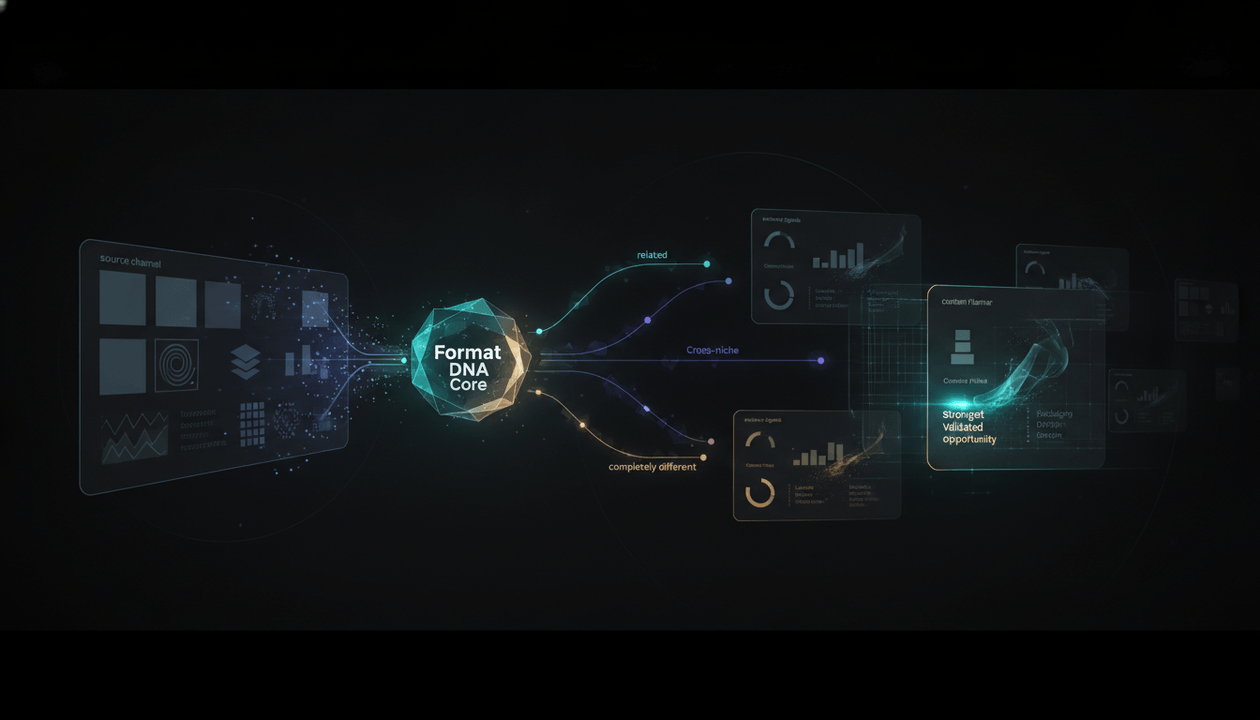
OverseerOS Niche Bender turns the source evidence into a structured Format DNA.
Format DNA Fields
| Field | What It Explains |
|---|---|
| Winning format | The repeatable viewing experience |
| Audience promise | What viewers expect to receive |
| Topic formula | How the channel repeatedly chooses or frames subjects |
| Storytelling structure | How videos progress |
| Hook pattern | How attention is captured at the beginning |
| Title pattern | How the promise is expressed verbally |
| Thumbnail style | How the promise is expressed visually |
| Production model | How the content is made |
| Strongest proof | The public evidence supporting the analysis |
| Transferable elements | Patterns that may work elsewhere |
| Creator-specific elements | Advantages that should not be assumed to transfer |
The Format DNA is more useful than simply describing the channel as “faceless,” “educational,” or “documentary.”
Those labels are too broad.
A useful Format DNA explains how the parts work together.
Stage 3: Bend the Format
The user chooses one of four research directions.
Best Opportunities
Searches for the strongest mix across every bend distance.
The tool aims for diversity, potentially including:
- Two related opportunities
- Two cross-niche opportunities
- One completely different opportunity
That mix is not padded.
A category is included only when a strong enough opportunity survives validation.
Related
Finds neighboring niches closest to the source channel.
This is useful when you want:
- Lower conceptual distance
- A familiar audience problem
- Similar production requirements
- Easier adaptation of the format
- A narrower strategic shift
Cross-Niche
Moves the proven format into a meaningfully different subject area.
This is useful when:
- The format is stronger than the original topic
- You want more differentiation
- A different market has a similar viewer need
- The storytelling mechanism can travel
- The original niche is crowded
Completely Different
Searches for far or contrarian applications of the format.
This is useful when:
- You want ideas ordinary niche tools would not generate
- The format appears highly transferable
- You are building a portfolio of distinct channels
- You want maximum creative distance
- You are willing to accept greater execution uncertainty
Stage 4: Validate the Strongest Opportunities
OverseerOS Niche Bender does not research every brainstormed idea equally.
It first generates a wider private candidate set.
Then it rejects weak candidates before conducting deeper research.
Candidates may be rejected for being:
- Too broad
- Too vague
- Semantically duplicated
- Forced
- Saturated
- Unsupported
- Based only on weak listicle-style evidence
- Internally inconsistent
The strongest finalists are then researched against current demand and competition.
Each accepted opportunity must include at least one valid research source.
An opportunity supported only by weak sources does not qualify.
Stage 5: Build the Channel
Once a user selects a profile, the Build This Channel button creates a new OverseerOS Channel Content Planner.
The planner receives context such as:
- Proposed channel name
- Specific niche concept
- Audience promise
- Content pillars
- Format direction
- Packaging direction
- Launch-video ideas
- Source channel
- Source Format DNA
The launch ideas are also added as planned topics.
Instead of ending with an inspirational card, the workflow ends with a channel workspace ready for execution.
What Is Inside a Niche Bending Profile?
Every accepted result is presented as an opportunity dossier.
1. Channel Name
A concise name for the proposed position.
The system rejects bare generic labels and attempts to return a channel identity rather than a category.
2. Channel Concept
A specific description of:
- Target audience
- Transferred format
- Differentiated angle
- Audience promise
Weak concept:
Productivity
Buildable concept:
Short narrated breakdowns of the hidden systems causing remote teams to lose time, designed for early-stage founders and managers.
3. Bend Category
Every final result is classified as:
- Related
- Cross-Niche
- Completely Different
“Best Opportunities” is a search mode, not a result category.
4. Opportunity Score
Each profile receives a score out of 100.
The score is a comparative research score.
It is not a predicted probability of success.
5. Evidence Quality
Profiles can show evidence classifications such as:
- Strong evidence
- Credible evidence
- Limited evidence
The result also exposes the supporting sources so users can inspect the evidence directly.
6. Why the Format Transfers
This explains which source-channel mechanisms apply to the new market.
It should connect the original format to the new audience rather than relying on surface-level similarity.
7. Market Evidence
This summarizes the current evidence around:
- Audience demand
- Existing channels
- Competitor activity
- Content performance
- Supply conditions
- Format saturation
Unsupported precise claims are removed rather than presented as fact.
8. Content Pillars
Each opportunity can include up to three foundational content pillars.
These help define the recurring categories the channel could own.
9. Launch-Video Ideas
Each profile can include up to five launch ideas.
These are not meant to be random topics.
They should demonstrate how the channel position becomes actual videos.
10. Packaging Direction
This explains how titles and thumbnails should express the channel’s promise.
It may describe:
- Title tension
- Visual hierarchy
- Repeated thumbnail language
- Emotional contrast
- Curiosity mechanism
- What should remain consistent
11. Main Risk
Every opportunity includes a reason it could fail.
Possible risks include:
- Crowded competition
- Weak differentiation
- High production cost
- Limited topic depth
- Trust requirements
- Dependence on expert sourcing
- Packaging difficulty
- A narrow target audience
- Format-audience mismatch
A serious opportunity report should show both the upside and the risk.
12. Supporting Sources
Users can open the research sources behind the recommendation.
This allows the creator to inspect the evidence before committing resources.
13. Premium Key Art
Each accepted profile can receive original cinematic editorial artwork.
The image is designed to help the concept feel tangible and distinct.
The key art is not part of the opportunity score.
When image generation is unavailable, the result remains usable and the interface displays designed fallback artwork.
How the Opportunity Score Is Calculated
The OverseerOS Niche Bender opportunity score is calculated from three components:
Opportunity Score =
(Format Fit × 0.40)
+ (Demand × 0.35)
+ (Supply Gap × 0.25)
Format Fit: 40%
Format fit receives the highest weight.
It asks:
How naturally can the source channel’s winning format serve this new market?
A strong format fit may include:
- Similar viewer psychology
- A compatible storytelling mechanism
- A clear recurring promise
- Sufficient topic depth
- A production model that still makes sense
- Packaging that can translate without becoming derivative
A market can have enormous demand and still receive a weak opportunity score when the source format does not belong there.
Demand: 35%
Demand evaluates whether enough credible evidence suggests that viewers care about the proposed subject and promise.
Evidence may include:
- Active channels
- Relevant videos
- Current interest
- Repeated audience behavior
- Credible market or platform sources
- Multiple independent signals
Demand does not mean guaranteed views.
It means the opportunity is supported by more than imagination.
Supply Gap: 25%
Supply gap evaluates whether space appears to exist for the proposed position.
It considers questions such as:
- Is the market dominated by established channels?
- Are existing channels serving the audience well?
- Is the proposed angle missing?
- Is the format uncommon in the market?
- Do current results look generic or outdated?
- Could a new channel offer a clear alternative?
The system checks whether the written market evidence agrees with the score.
When the evidence describes a saturated or heavily dominated market, the supply-gap score cannot remain unrealistically high.
What the Score Does Not Mean
An opportunity score does not mean:
- A percentage chance of success
- Guaranteed views
- Guaranteed subscribers
- Guaranteed monetization
- Predicted revenue
- Private algorithm access
- A replacement for testing
- Permission to ignore production quality
- Proof that the user can execute the concept
The score helps compare the returned opportunities against each other.
It does not eliminate uncertainty.
Why Format Fit Receives the Highest Weight
Many niche tools prioritize demand alone.
That creates a predictable problem.
They recommend markets that are popular but poorly suited to the creator’s format, resources, or skills.
Consider a proven channel built around:
- Calm long-form narration
- Archival visuals
- Slow-burn mysteries
- Evidence-heavy storytelling
A large market built around daily personality-driven reactions may have strong demand.
It could still be a poor format transfer.
Format fit forces the opportunity to answer:
Can this channel system create value in the proposed niche without becoming unnatural?
That is why it carries 40% of the score.
Why OverseerOS Niche Bender May Return Fewer Than Five Results
The product promises up to five opportunities.
It does not promise exactly five.
A profile can be removed when it is:
- A generic niche label
- Too vague to build
- Missing valid sources
- Supported only by weak evidence
- Semantically similar to another profile
- Contradicted by its own market analysis
- Too saturated for the claimed supply gap
- Forced or strategically weak
This is intentional.
Five generic ideas are not more valuable than three strong ones.
The interface explains when weaker combinations were rejected instead of used to fill the list.
Hypothetical Example of YouTube Niche Bending
Imagine the source is a successful faceless channel about failed companies.
Its Format DNA might look like this:
Winning Format
Cinematic narrated case studies explaining how one hidden decision caused a famous organization to collapse.
Audience Promise
Understand the strategic mistake behind a story the viewer thought they already knew.
Hook Pattern
Open at the peak of success, reveal that disaster is already unavoidable, then ask what went wrong.
Storytelling Structure
Peak success
→ hidden vulnerability
→ triggering decision
→ escalating consequences
→ collapse
→ strategic lesson
Packaging Style
Titles focus on one irreversible mistake.
Thumbnails show a recognizable symbol of success being damaged, erased, divided, or abandoned.
Production Model
Faceless narration, archival imagery, timelines, maps, financial graphics, and restrained sound design.
Transferable Elements
- Rise-and-fall narrative
- Hidden-cause curiosity
- Recognizable subject
- Escalating consequences
- Documentary pacing
- Clear final lesson
Creator-Specific Elements
- Exclusive interviews
- An existing business audience
- Proprietary financial research
- A large archival licensing budget
OverseerOS Niche Bender could then explore different distances.
Related Bend
Creator Economy Collapse Files
A documentary channel examining the strategic decisions behind failed creator businesses, media brands, courses, agencies, and online communities.
Cross-Niche Bend
Megaprojects That Went Wrong
Cinematic investigations into airports, stadiums, railways, cities, ships, and infrastructure projects undermined by one critical decision.
Completely Different Bend
The Decisions That Broke Famous Expeditions
Narrated historical stories showing how planning errors, leadership failures, and hidden environmental risks destroyed ambitious expeditions.
The topics are different.
The underlying format remains recognizable:
A system reaches a moment of apparent success, one hidden decision changes the trajectory, consequences escalate, and the viewer discovers the real cause.
That is niche bending.
How to Choose the Right Source Channel
The quality of the source channel affects the quality of the bend.
The best source is not necessarily the largest channel.
Look for a channel with a clearly repeatable system.
Strong Source-Channel Signals
A Clear Audience Promise
Viewers understand why they should return.
Multiple Strong Videos
The channel is not dependent on one isolated viral event.
A Recognizable Format
The experience repeats without every upload feeling identical.
Transferable Storytelling
The structure could work with different subjects.
Distinct Packaging
Titles and thumbnails follow understandable principles.
Realistic Production
The required quality is within your team’s reach.
Sufficient Public Evidence
The channel has enough analyzable videos, titles, thumbnails, and performance history.
Recent Relevance
The format still appears active rather than belonging to an abandoned period of the channel.
Weak Source-Channel Signals
Be careful with channels that depend heavily on:
- Celebrity status
- Personal relationships
- Exclusive access
- A famous face
- Expensive stunts
- A giant existing audience
- One viral controversy
- Copyrighted clips
- News access
- Large-scale giveaways
- Proprietary datasets
- An unusually charismatic personality
- Production budgets you cannot approach
OverseerOS Niche Bender will identify creator-specific advantages, but selecting a strong source still improves the exercise.
A Manual Source Channel Scorecard
Score a possible source channel before bending it.
| Factor | Weight | Question |
|---|---|---|
| Format clarity | 25 | Can you describe the repeatable experience in one sentence? |
| Repeatability | 25 | Has the system worked across several videos? |
| Transferability | 20 | Can the mechanism serve different subjects? |
| Production feasibility | 15 | Could your team execute the model? |
| Evidence quality | 15 | Is enough public evidence available? |
| Total | 100 |
Interpretation
| Score | Recommendation |
|---|---|
| 85 to 100 | Excellent source channel |
| 70 to 84 | Strong source with some constraints |
| 55 to 69 | Usable, but inspect creator-specific advantages carefully |
| 40 to 54 | Weak transfer candidate |
| Below 40 | Choose another source |
This is a manual editorial framework, separate from the OverseerOS Niche Bender opportunity score.
Which Bend Direction Should You Choose?
Choose Best Opportunities When
- It is your first run on the source channel.
- You do not know how far the format can travel.
- You want a varied opportunity set.
- You are open to both safe and contrarian ideas.
- You want the strongest overall scoring profiles.
This is the recommended starting mode for most users.
Choose Related When
- You already understand the source niche.
- You want lower strategic distance.
- You want to preserve more of the original audience psychology.
- You are testing an adjacent submarket.
- You need a concept your existing team can understand quickly.
- You want fewer production changes.
Choose Cross-Niche When
- The format appears stronger than the original subject.
- You want more differentiation.
- You operate several channels.
- You are entering a market where the format is uncommon.
- You want to combine proven execution with a less obvious subject.
Choose Completely Different When
- You want maximum creative distance.
- You are looking for portfolio expansion.
- You want ideas generic niche generators are unlikely to produce.
- You are comfortable conducting deeper validation.
- You can adapt the format without copying its identity.
- You accept that execution risk may be higher.
How to Use OverseerOS Niche Bender Step by Step
Step 1: Find a Proven Source Channel
Look for a channel with:
- Several strong recent videos
- A visible content system
- A recognizable viewer promise
- A format you understand
- A production model you could realistically adapt
You can begin with a channel you already know or use OverseerOS Viral Channel Finder to discover emerging channels.
Step 2: Copy the Channel URL
OverseerOS Niche Bender accepts a YouTube channel link or @handle.
Example:
https://youtube.com/@channel
Step 3: Choose the Bend Direction
Select:
- Best Opportunities
- Related
- Cross-Niche
- Completely Different
Begin with Best Opportunities when you are unsure.
Step 4: Click Bend This Channel
OverseerOS Niche Bender begins the research process.
The workflow includes:
- Understanding the source formula
- Mapping transferable formats
- Researching demand and competition
- Validating opportunities
- Preparing opportunity visuals
Deep channel and market research usually takes approximately one minute.
Step 5: Review the Winning Format DNA
Before choosing an opportunity, study:
- Winning format
- Hook
- Storytelling
- Production
- Audience promise
- Title pattern
- Thumbnail style
- Topic formula
- Transferable elements
- Creator-specific elements
The Format DNA explains what the tool is attempting to move.
Step 6: Compare the Opportunity Profiles
Do not choose only by score.
Compare:
- Concept clarity
- Bend distance
- Format fit
- Market evidence
- Supply gap
- Content pillars
- Launch ideas
- Packaging
- Risk
- Source quality
- Production difficulty
Step 7: Open the Full Breakdown
Inspect the evidence behind the card.
Ask:
- Does the market evidence support the recommendation?
- Are the sources relevant?
- Is the format genuinely transferable?
- Are the launch ideas distinct?
- Can the packaging become recognizable?
- Is the risk manageable?
Step 8: Choose Build This Channel
The selected profile becomes a new OverseerOS Channel Content Planner.
The planner is seeded with:
- Channel positioning
- Format direction
- Audience promise
- Content pillars
- Packaging direction
- Launch topics
- Source-channel context
Step 9: Validate the Launch Topics
The generated launch ideas are a starting strategy.
Before production:
- Confirm freshness
- Check factual sourcing
- Develop title-thumbnail packages
- Estimate production cost
- Prioritize the strongest cluster
- Remove ideas that do not fit the final positioning
Use the YouTube video idea validation framework before committing significant production resources.
Step 10: Launch a Controlled Test
Do not judge the channel after one upload.
Publish a coherent group of videos that tests:
- The audience promise
- The format
- The topic pillars
- The title system
- The thumbnail language
- The production model
Then use first-party YouTube Analytics to evaluate actual viewer behavior.
How to Choose Between the Returned Profiles
A higher score does not automatically make an opportunity the best choice for you.
The product score evaluates the opportunity.
It does not know every detail about your personal advantage.
Add five operator-level questions.
1. Do You Understand the Audience?
A market may look attractive, but weak audience understanding can produce generic content.
2. Can You Produce the Format Consistently?
A strong concept that takes three months per video may not fit your operating model.
3. Do You Have a Credibility Advantage?
Relevant experience, access, research ability, or distribution can improve execution.
4. Can You Make the Packaging Distinctive?
The channel needs a recognizable promise, not just a valid niche.
5. Does the Channel Support Your Business?
Consider:
- Advertising potential
- Sponsors
- Affiliate products
- Owned products
- Services
- Authority
- Portfolio value
- Strategic relationships
The Operator Fit Adjustment
Use this manual calculation after receiving the product score:
Final Operator Priority =
Opportunity Score
+ Personal Advantage
+ Production Fit
+ Business Alignment
- Execution Risk
Rate each adjustment conservatively.
This is not a replacement for the product score.
It helps you decide which validated opportunity fits your specific resources.
How to Turn One Profile Into a 10-Video Launch Plan
OverseerOS Niche Bender provides up to five launch-video ideas.
Use those ideas as the foundation of a broader controlled test.
Videos 1 to 3: Prove the Core Promise
Choose three topics that clearly demonstrate what the channel does.
Avoid unrelated experiments.
Videos 4 and 5: Test the Strongest Content Pillar
Create two related videos around the pillar with the most evidence.
Videos 6 and 7: Test Packaging Variations
Keep the audience promise stable while varying:
- Curiosity
- Comparison
- Contradiction
- Consequence
- Transformation
Video 8: Test an Adjacent Topic
Explore whether the audience follows the format into a neighboring subject.
Video 9: Create a Follow-Up
Build directly on the video receiving the strongest qualified response.
Video 10: Consolidate the Learning
Create the clearest expression of the channel’s emerging identity.
After ten videos, review:
- Impressions
- Click-through rate
- Retention
- Returning viewers
- Subscriber conversion
- Topic performance
- Production cost
- Business outcomes
Who Should Use OverseerOS Niche Bender?
Faceless YouTube Channel Operators
The tool is particularly useful when the channel identity depends on:
- Format
- Narration
- Research
- Story structure
- Visual language
- Repeatable topic formulas
Faceless operators can study what travels without depending on a host’s personality.
Multi-Channel Media Operators
Teams managing several channels can use it to:
- Expand proven production systems
- Explore portfolio opportunities
- Reuse operational strengths
- Find concepts for existing editors and writers
- Compare related and distant markets
Creators Launching a Second Channel
A creator may have developed a strong format but want a new subject or audience.
OverseerOS Niche Bender can explore where the format fits without forcing the current audience through a niche switch.
YouTube Agencies
Agencies can use it to develop:
- Client channel concepts
- New media properties
- Strategic proposals
- Market expansion ideas
- Format-based research
- Content pillars and launch plans
Scriptwriters and Strategists
The tool can turn a channel reference into:
- Audience promise
- Story architecture
- Topic formula
- Packaging principles
- Launch ideas
- Risks
That creates a better strategic brief before scriptwriting begins.
SaaS and Product-Led Companies
Businesses can explore channel concepts built around:
- Customer problems
- Industry case studies
- Product-adjacent education
- Buyer questions
- Research
- Expert-led formats
Creators Entering an Unfamiliar Market
Instead of beginning with a blank page, the creator can begin with a format they understand and investigate where it might fit.
The market evidence still needs human review, especially in regulated or expertise-heavy categories.
When You Should Not Use OverseerOS Niche Bender
The tool may not solve the primary problem when:
- You have not identified any strong source channel.
- You want guaranteed views.
- You plan to copy another channel directly.
- You cannot commit to testing several videos.
- You do not have the resources required by the format.
- You want to change an existing channel overnight without considering its audience.
- You are looking only for private competitor analytics.
- Your biggest bottleneck is publishing, not opportunity discovery.
- You are unwilling to inspect the evidence.
- You expect software to replace creative judgment.
OverseerOS Niche Bender vs OverseerOS Viral Channel Finder
These features solve different stages of research.
| OverseerOS Viral Channel Finder | OverseerOS Niche Bender |
|---|---|
| Finds breakout channels in a niche | Starts from one proven channel |
| Filters by niche, size, format, and language | Filters opportunities by bend distance |
| Helps discover competitors and references | Transfers Format DNA into new markets |
| Shows public performance and breakout videos | Produces channel concepts and opportunity dossiers |
| Answers “Which channels are winning?” | Answers “Where else could this format win?” |
Recommended workflow:
- Use OverseerOS Viral Channel Finder to discover an interesting breakout channel.
- Send the channel into OverseerOS Niche Bender.
- Compare the returned opportunities.
- Build the strongest profile into a planner.
OverseerOS Niche Bender vs OverseerOS Channel Blueprint Cloner
| OverseerOS Channel Blueprint Cloner | OverseerOS Niche Bender |
|---|---|
| Analyzes a channel’s existing strategy | Analyzes where the strategy could travel |
| Builds a blueprint from the source channel | Builds new channel opportunities |
| Focuses on adapting patterns to original content | Focuses on new markets and channel positions |
| Extracts tone, hooks, pacing, topics, and packaging | Adds live demand, competition, supply-gap research, and bend categories |
| Supports strategy replication at the principle level | Supports format-market expansion |
Use OverseerOS Channel Blueprint Cloner when you want to understand and adapt a channel within a closer strategic context.
Use OverseerOS Niche Bender when you want to explore new channel opportunities around the transferable format.
OverseerOS Niche Bender vs a YouTube Niche Saturation Checker
A YouTube niche saturation checker evaluates whether a selected market appears accessible.
OverseerOS Niche Bender goes further by generating a specific position before evaluating the opportunity.
Saturation Checker
Starts with:
Is this niche too crowded?
OverseerOS Niche Bender
Starts with:
Where could this format create a differentiated channel, and what does the evidence say about demand and supply?
The two concepts remain complementary.
A market can be competitive while a specific format-market combination remains underserved.
Why Live Sources Matter
AI-generated niche ideas can sound convincing without being current.
Markets change.
A concept may be weakened by:
- A sudden wave of competitors
- A trend that already peaked
- A platform-policy change
- New dominant channels
- A disappearing audience need
- Outdated products
- Shifting viewer language
- A format becoming overused
OverseerOS Niche Bender uses live research to validate the strongest finalists.
It also classifies source quality and removes invented links.
The presence of a source does not make every conclusion automatically correct.
Users should still inspect:
- Relevance
- Date
- Authority
- Directness
- Whether the source supports the written claim
Why the Main Risk Matters
Weak opportunity tools sell only the upside.
That encourages creators to fall in love with ideas before understanding the constraints.
OverseerOS Niche Bender includes a main risk because a channel opportunity can be strong and difficult at the same time.
Examples:
Strong Demand, Weak Differentiation
The market exists, but the concept could disappear among similar channels.
Strong Format Fit, High Production Cost
The transfer makes sense, but the production model may be unsustainable.
Strong Supply Gap, Limited Topic Depth
Few channels serve the position, but the reason may be a limited long-term topic universe.
Strong Concept, High Trust Requirement
The channel may require professional expertise or rigorous sourcing.
Strong Audience, Weak Packaging
The viewer problem is real, but the concept is difficult to communicate in one title and thumbnail.
Risk should affect the launch plan.
It should not automatically kill the opportunity.
Common Niche Bending Mistakes
Mistake 1: Choosing the Largest Source Channel
Size does not prove transferability.
A smaller channel with a clearer format can be a better source.
Mistake 2: Confusing Topic With Format
“Finance” is a topic category.
“Animated case studies explaining one money mistake through a recurring character” is a format-market position.
Mistake 3: Ignoring Creator-Specific Advantages
The source may succeed partly because of:
- Fame
- Expertise
- Access
- Personality
- Budget
- Brand equity
Do not assume those advantages belong to the format.
Mistake 4: Choosing Only by Opportunity Score
The highest-scoring market may not fit your:
- Skills
- Team
- credibility
- Budget
- Business
- Interest
- Distribution
Mistake 5: Copying the Launch Ideas Literally
Treat them as strategic starting points.
Research and develop each video into original work.
Mistake 6: Ignoring the Main Risk
A risk included in the dossier should influence:
- Budget
- Test size
- Topic selection
- Publishing cadence
- Sourcing
- Packaging
- Kill criteria
Mistake 7: Expecting Exactly Five Results
Fewer strong profiles are better than padded output.
Mistake 8: Choosing a Source With One Viral Video
One outlier may not represent a repeatable format.
Look for several examples.
Mistake 9: Bending Only the Subject
Changing “business” to “history” is not enough.
The audience promise, story structure, packaging, and production must transfer coherently.
Mistake 10: Using a Format You Cannot Produce
A valid opportunity can still be operationally wrong.
Mistake 11: Treating Public Data as Private Analytics
The tool cannot see a competitor’s private:
- CTR
- Retention
- Traffic sources
- Revenue
- Returning viewers
- Internal experiments
Mistake 12: Launching Without a Controlled Test
One video cannot validate a complete channel thesis.
Mistake 13: Ignoring Originality
Strategy research should produce a distinct channel, not a lower-quality imitation.
Mistake 14: Entering Expertise-Heavy Niches Without Review
Health, finance, law, science, and other high-stakes categories require qualified sourcing and careful review.
Mistake 15: Building Several Channels at Once
A tool can surface several good opportunities.
That does not mean the team should launch all of them.
Choose based on strategic priority and execution capacity.
A Complete Niche Bending Decision Framework
Before building an opportunity, evaluate four layers.
Layer 1: Market
- Is demand credible?
- Is the opportunity current?
- Are smaller channels succeeding?
- Is there a meaningful supply gap?
- Is the market deep enough?
Layer 2: Format
- Does the source format transfer naturally?
- Can the hook work?
- Can the storytelling structure repeat?
- Can the packaging become distinct?
- Is the viewing experience coherent?
Layer 3: Operator
- Does the team understand the audience?
- Can the production model be sustained?
- Is relevant expertise available?
- Does the concept fit the business?
- Can the channel publish consistently?
Layer 4: Experiment
- What are the first five videos?
- What assumption does each test?
- What metrics determine continuation?
- What would make the team stop?
- How quickly can the strategy improve?
A strong opportunity needs all four layers.
Copy-and-Paste Niche Bending Evaluation Template
NICHE BENDING EVALUATION

SOURCE CHANNEL
Name:
URL:
Why this channel is worth studying:

SOURCE FORMAT DNA
Winning format:
Audience promise:
Topic formula:
Storytelling structure:
Hook pattern:
Title pattern:
Thumbnail style:
Production model:

TRANSFERABLE ELEMENTS
1.
2.
3.
4.
5.

CREATOR-SPECIFIC ELEMENTS
1.
2.
3.
4.
5.

PROPOSED BEND
Opportunity name:
Bend category:
Target audience:
Channel concept:
Audience promise:

MARKET EVIDENCE
Demand:
Existing channels:
Recent videos:
Supply gap:
Source quality:

FORMAT FIT
Why the format belongs in this market:

CONTENT PILLARS
1.
2.
3.

LAUNCH VIDEOS
1.
2.
3.
4.
5.

PACKAGING
Title mechanism:
Thumbnail language:
Visual identity:
Repeated promise:

MAIN RISK
Primary risk:
How we will reduce it:

OPERATOR FIT
Audience understanding:
Production ability:
Credibility:
Business alignment:
Personal advantage:

TEST PLAN
Videos in first test:
Budget:
Timeline:
Primary metrics:
Kill criteria:
Double-down criteria:

FINAL DECISION
Build / research further / test smaller / reject
Access and Daily Limits
OverseerOS Niche Bender is available on:
- OverseerOS Pro: three fresh research runs per day
- OverseerOS Elite: ten fresh research runs per day
Free and Creator users can view the feature’s locked experience and upgrade to an eligible plan.
A fresh run includes deep source-channel analysis, opportunity generation, live research, validation, scoring, and visual enrichment.
Final Verdict
OverseerOS Niche Bender solves a problem that generic YouTube niche tools usually ignore.
The difficult part of launching a new channel is not naming a popular subject.
It is finding a combination of:
- Proven format
- Relevant audience
- Current demand
- Defensible positioning
- Repeatable topics
- Strong packaging
- Realistic production
- Manageable risk
OverseerOS Niche Bender begins with evidence from a working channel, identifies the transferable Format DNA, and searches for new markets where that system could create value.
It then turns the strongest results into complete opportunity dossiers containing:
- Specific channel concepts
- Opportunity scores
- Market evidence
- Sources
- Content pillars
- Launch ideas
- Packaging direction
- Main risks
- Premium key art
The strongest opportunity can be converted into an OverseerOS Channel Content Planner with the launch topics already added.
No blank page.
No generic list of niches.
No assumption that every part of a successful creator can be copied.
Just a clearer path from:
This channel has a powerful format
to:
Here are the strongest validated places that format could go next.
Frequently Asked Questions
What is YouTube niche bending?
YouTube niche bending is the process of identifying the transferable format behind a successful channel and researching where that format could work for a different audience, market, or subject.
It transfers strategic principles rather than copying the creator’s content.
What is OverseerOS Niche Bender?
OverseerOS Niche Bender is a YouTube channel opportunity research tool.
Users paste a YouTube channel URL, choose a bend direction, and receive up to five validated new-channel opportunities based on the source channel’s winning Format DNA.
How many channel opportunities does OverseerOS Niche Bender generate?
It generates up to five.
It may return fewer when weaker opportunities fail validation.
What are the OverseerOS Niche Bender modes?
The four modes are:
- Best Opportunities
- Related
- Cross-Niche
- Completely Different
What does Best Opportunities mean?
Best Opportunities searches across every bend distance and returns the highest-scoring valid mix.
It aims for a diverse set but does not include weak profiles merely to represent every category.
What is a related niche bend?
A related bend applies the source format to a neighboring audience or subject close to the original channel.
What is a cross-niche bend?
A cross-niche bend moves the same content mechanism into a meaningfully different market where the format still appears relevant.
What is a completely different bend?
A completely different bend explores far or contrarian applications of the format.
It creates greater creative distance from the source niche.
What is Format DNA?
Format DNA is the structured system behind a channel’s content.
OverseerOS Niche Bender can describe:
- Winning format
- Audience promise
- Topic formula
- Storytelling structure
- Hook pattern
- Title pattern
- Thumbnail style
- Production model
- Strongest proof
- Transferable elements
- Creator-specific elements
How is the opportunity score calculated?
The score uses:
- 40% format fit
- 35% demand
- 25% supply gap
The server recomputes the final score from those components.
Is the opportunity score a success prediction?
No.
It is a comparative research score, not a probability of success or guaranteed performance.
Does OverseerOS Niche Bender use live research?
Yes.
The strongest candidates are validated using current web research and real sources.
Are sources included in the result?
Yes.
Each accepted profile must include at least one valid source, and users can inspect the supporting links.
Can weak sources support a profile?
A profile supported only by weak evidence is rejected.
The tool prefers direct YouTube evidence, official sources, reputable analytics platforms, and credible research or press.
Does OverseerOS Niche Bender guarantee a profitable niche?
No.
It evaluates opportunity evidence, not guaranteed profit.
Profitability depends on execution, audience, production cost, monetization, geography, and many other factors.
Does OverseerOS Niche Bender copy another channel?
No.
It extracts strategic patterns from public content and uses them to create original channel opportunities.
It also separates creator-specific advantages that should not be treated as transferable.
Can I use a competitor’s YouTube channel?
You can use a public channel as a strategic research reference.
The resulting channel should have its own positioning, content, scripts, titles, thumbnails, branding, and creative identity.
Can I paste a YouTube @handle?
Yes.
OverseerOS Niche Bender accepts supported YouTube channel URLs and @handles.
How long does a run take?
The interface explains that deep channel and market research usually takes approximately one minute.
Actual timing may vary.
What happens when fewer than five opportunities qualify?
OverseerOS Niche Bender returns the accepted profiles and rejects weaker combinations rather than padding the list with generic ideas.
What is Build This Channel?
Build This Channel converts a selected profile into an OverseerOS Channel Content Planner.
The planner receives the channel concept, audience promise, pillars, format direction, packaging direction, source context, and launch topics.
Does Build This Channel create a real YouTube account?
No.
It creates a strategy and production planner inside OverseerOS.
The user still creates and manages the YouTube channel through YouTube.
Are the launch ideas added to the planner?
Yes.
The accepted profile’s launch-video ideas are added as planned topics.
Does every profile receive an image?
OverseerOS Niche Bender attempts to create premium editorial key art for every accepted profile.
When image generation is unavailable, the opportunity remains available with designed fallback artwork.
Does the image affect the opportunity score?
No.
The key art is visual concept support and does not influence research validation or scoring.
Who can access OverseerOS Niche Bender?
OverseerOS Niche Bender is available to Pro and Elite users.
What is the Pro daily limit?
OverseerOS Pro users receive three fresh Niche Bender runs per day.
What is the Elite daily limit?
OverseerOS Elite users receive ten fresh Niche Bender runs per day.
Is OverseerOS Niche Bender useful for faceless YouTube channels?
Yes.
It is especially relevant to faceless channels because it studies transferable format, storytelling, hooks, production, packaging, and topic systems independently from a creator’s on-camera identity.
Should I use the largest channel in my niche as the source?
Not necessarily.
A smaller channel with a clearer, more repeatable, and more transferable format may provide a better source.
Can one viral video make a channel a good source?
Not by itself.
A stronger source usually demonstrates the format across several videos.
How is OverseerOS Niche Bender different from OverseerOS Viral Channel Finder?
OverseerOS Viral Channel Finder discovers breakout channels inside a market.
OverseerOS Niche Bender starts from one channel and investigates where its Format DNA could create new channel opportunities.
How is OverseerOS Niche Bender different from OverseerOS Channel Blueprint Cloner?
OverseerOS Channel Blueprint Cloner explains and adapts the strategy of an existing channel.
OverseerOS Niche Bender uses the transferable format to research different channel positions and markets.
Can I run the same source through different bend modes?
Yes.
Related, Cross-Niche, and Completely Different explore different levels of distance from the source channel.
Should I automatically build the highest-scoring opportunity?
Not always.
Consider your experience, production capacity, business model, audience knowledge, and execution advantage before choosing.
Can OverseerOS Niche Bender reveal competitor retention or revenue?
No.
It does not reveal another channel’s private click-through rate, audience retention, traffic sources, returning viewers, or exact revenue.
Can OverseerOS Niche Bender replace human judgment?
No.
It improves the research and strategic starting point.
The creator still decides which opportunity fits their resources, expertise, values, and business goals.
What should I do after building a channel profile?
Review the evidence, validate the launch-video packages, estimate production requirements, publish a controlled group of videos, and measure real behavior inside YouTube Analytics.
Where can I try OverseerOS Niche Bender?
Eligible users can open OverseerOS Niche Bender here.