Most advice about YouTube creator problems starts with the obvious answers:
- getting views
- understanding the algorithm
- making better thumbnails
- finding video ideas
- staying consistent
Those problems are real.
But when creators actually write about what is blocking them, the picture looks different.
OverseerOS analyzed 27,555 public YouTube comments across 1,954 videos and 44 creator-focused channels to identify the problems, questions, objections, requests, and missing capabilities creators reveal in their own words.
We found:
9,677 comments, or 35.1%, contained at least one actionable audience signal.
Then we grouped those signals by the underlying creator problem.
The biggest category was not:
getting more views.
It was:
editing and production.
The top four challenge areas were:
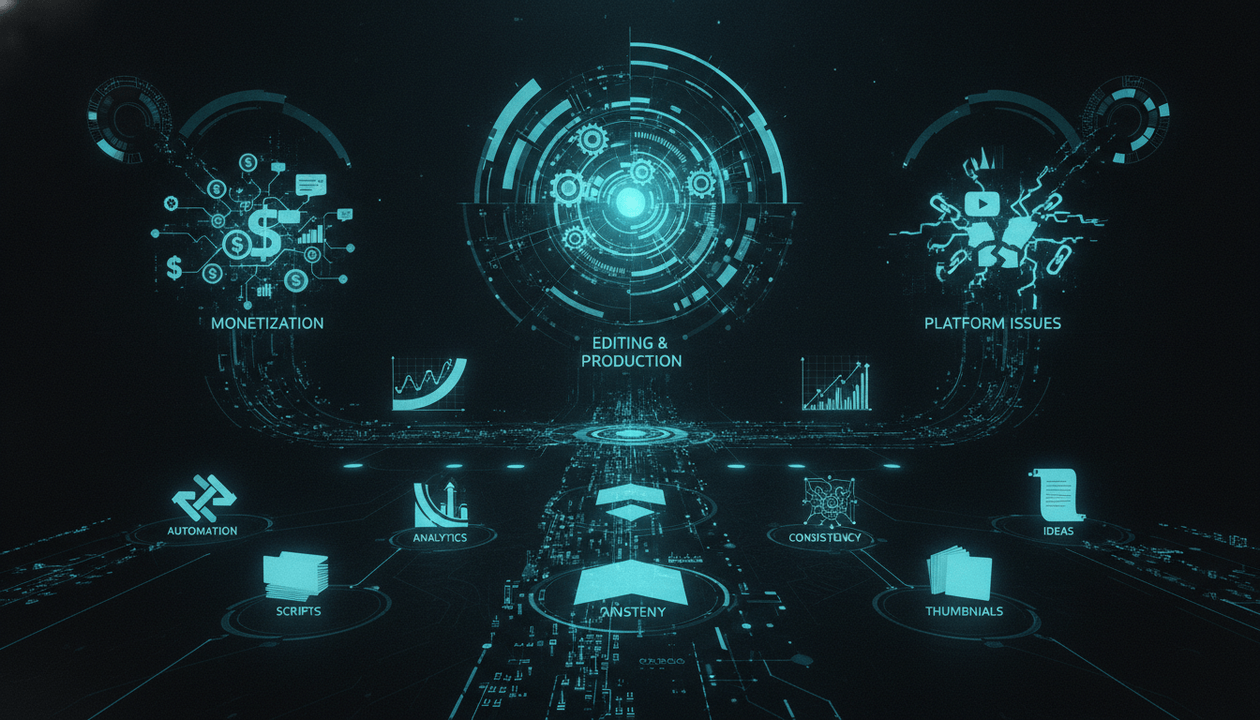
- Editing and production: 21.4%
- Monetization: 15.6%
- Platform and account issues: 15.6%
- Faceless content and automation: 12.1%
Together, those four categories accounted for:
64.8% of all signal-bearing comments.
Analytics and growth, the category most YouTube advice tends to revolve around, represented:
9.7%.
Ideas and topic research represented:
4.4%.
Scripts, hooks, and retention represented:
1.8%.
Thumbnails, titles, and CTR represented:
1.1%.
That does not mean thumbnails, hooks, or ideas are unimportant.
It means something more useful:
A large share of creator friction happens after someone already knows they need to make good videos. The hard part is repeatedly executing, monetizing, navigating the platform, and turning the strategy into a working production system.
There was another important finding.
Creators rarely announced their problem directly.
Among the 9,677 comments containing an actionable signal:
- 90.3% expressed the need implicitly
- only 9.7% expressed it explicitly
So if you ask:
What do YouTube creators struggle with most?
the answer is not found only in comments saying:
"My biggest problem is..."
It appears in statements such as:
How do I actually do this?
This does not work for me because...
I cannot figure out...
What tool are you using?
What if I do not have...
Can you show how to...
The struggle is usually embedded inside the question.
Key Findings
| Finding | OverseerOS analysis |
|---|---|
| Public comments analyzed | 27,555 |
| Source videos | 1,954 |
| Channels represented | 44 |
| English comments | 26,336 |
| Share classified as English | 95.6% |
| Comments with an actionable audience signal | 9,677 |
| Share of all comments with a signal | 35.1% |
| Implied signals | 90.3% |
| Explicit signals | 9.7% |
| Editing and production | 2,073 comments, 21.4% |
| Monetization | 1,514, 15.6% |
| Platform and account issues | 1,510, 15.6% |
| Faceless content and automation | 1,171, 12.1% |
| Analytics and growth | 935, 9.7% |
| Consistency and channel management | 491, 5.1% |
| Ideas and topic research | 427, 4.4% |
| Niche selection | 296, 3.1% |
| Scripts, hooks, and retention | 177, 1.8% |
| Thumbnails, titles, and CTR | 110, 1.1% |
| Competitor research | 10, 0.1% |
| Top four categories combined | 64.8% |
| Top six categories combined | 84.4% |
The largest lesson is that "YouTube growth" is not one problem.
It is a stack of problems.
A creator can understand:
- titles
- thumbnails
- hooks
- niches
- analytics
and still be blocked by:
- editing time
- production complexity
- monetization uncertainty
- platform limitations
- account problems
- tools
- automation
- execution consistency
That is why generic advice such as:
Make better videos.
often feels useless.
The creator may already know that.
Their actual problem is:
How do I reliably produce the better video?
The Direct Answer
What do YouTube creators struggle with most?
In this creator-focused comment dataset, the biggest challenge was editing and production, representing 21.4% of actionable comments.
The next largest categories were:
- monetization: 15.6%
- platform and account issues: 15.6%
- faceless content and automation: 12.1%
- analytics and growth: 9.7%
- consistency and channel management: 5.1%
The data suggests creator problems can be grouped into three broader layers.
Layer 1: Strategy
Questions such as:
- What niche should I choose?
- What topic should I make?
- What is working?
- Why are my views low?
- What should I improve?
Layer 2: Execution
Questions such as:
- How do I edit this?
- How do I produce faster?
- Which tool should I use?
- How do I automate this?
- How do I make this without showing my face?
- How do I maintain output?
Layer 3: Economics and Platform Constraints
Questions such as:
- How do I monetize?
- Why am I not earning?
- Is this eligible?
- Why is this feature unavailable?
- Why did my account behave this way?
- Can I do this under YouTube's rules?
The largest concentration of comments sat in Layers 2 and 3.
That means one of the biggest mistakes in creator education is treating every problem as:
a strategy problem.
Sometimes the strategy is fine.
The system around the strategy is broken.
What We Actually Analyzed
This research uses public YouTube comments collected through OverseerOS audience-intelligence workflows.
The final versioned cohort contained exactly:
- 27,555 classified comments
- 1,954 source videos
- 44 channels
The comments were published between:
May and August 2026.
The underlying source videos extended further back.
The language distribution was heavily English:
26,336 comments, or 95.6%.
That matters because both the taxonomy and the practical conclusions in this article are most relevant to an English-language creator audience.
What Counts as a Creator Challenge?
We did not simply search comments for words such as:
- struggle
- difficult
- problem
- help
That would miss most of the useful signal.
Instead, comments were classified using a fixed audience-intelligence taxonomy.
A comment could express one or more of seven types of need.
| Signal type | Meaning |
|---|---|
| How-to question | Viewer wants to know how to accomplish something |
| Pain point | Viewer describes something that is failing or difficult |
| Objection | Viewer explains why an approach may not work in their situation |
| Content request | Viewer asks for more explanation or a follow-up |
| Missing capability | Viewer cannot currently accomplish a desired task |
| Tool request | Viewer wants software, a workflow, or a recommendation |
| Comparison request | Viewer wants help deciding between alternatives |
Then the comment was assigned to a broader topic area such as:
- editing
- monetization
- analytics
- automation
- ideas
- thumbnails
This produces a much richer picture than simply asking:
What topics are creators talking about?
We can ask:
What kind of problem are they experiencing inside each topic?
That turns out to matter a lot.
Finding 1: Editing and Production Was the Largest Creator Challenge
The largest category contained:
2,073 comments.
That represents:
21.4% of all actionable creator signals.
The biggest signal inside editing and production was:
how-to questions.
There were:
822
editing-related how-to signals.
That means roughly:
39.7% of editing and production comments included a how-to need.
The next largest signal was:
content requests: 435
followed by:
- pain points: 300
- tool requests: 206
- missing capabilities: 153
- objections: 139
- comparison requests: 117
This is revealing.
Editing and production was not dominated by people merely saying:
Editing is hard.
A large amount of the demand was procedural:
How do I actually make this?
That distinction matters.
Strategy problems need better decisions
Example:
Which topic should I choose?
Production problems need better execution systems
Example:
How do I make this style without spending six hours editing?
Those are different problems.
Giving a creator another list of video ideas does not solve a production bottleneck.
Why Production Becomes the Hidden Growth Constraint
Imagine two creators.
Creator A
Has:
- 50 strong ideas
- clear niche
- good titles
- good thumbnails
But every video takes:
25 hours to produce.
Creator B
Has the same strategic quality.
But their production system can create the video in:
8 hours.
Over enough uploads, the second creator gets:
- more experiments
- more feedback
- more topic tests
- more chances at a breakout
- faster learning
The bottleneck was never:
ideas.
It was:
throughput without destroying quality.
This is why production efficiency should be treated as a growth variable.
Not merely an operational convenience.
The Production Bottleneck Test
Ask yourself:
If I gave myself 20 strong video ideas today, could my channel actually produce them?
If the answer is:
No, because editing takes too long.
your bottleneck is not ideation.
If the answer is:
No, because scripting is inconsistent.
your bottleneck is not thumbnails.
If the answer is:
No, because every video requires a custom workflow.
your bottleneck is system design.
Creators often solve the wrong layer because the more visible problem feels strategic.
Finding 2: Monetization Was the Second-Largest Challenge
Monetization produced:
1,514 signal-bearing comments.
That equals:
15.6%
of the actionable dataset.
But monetization looked very different from editing.
The largest monetization signal was:
pain points: 529
or approximately:
34.9% of monetization comments.
Then:
objections: 484
or:
32.0%.
How-to questions accounted for:
428 comments
or:
28.3%.
This pattern matters.
Monetization demand was not simply:
How do I make money?
A substantial amount of it reflected:
- frustration
- limitations
- skepticism
- eligibility problems
- practical constraints
- uncertainty about whether a strategy works
That makes monetization fundamentally different from a clean tutorial problem.
Monetization Has Three Different Problems
Problem 1: Access
How do I become eligible?
Problem 2: Optimization
How do I earn more from the audience I have?
Problem 3: Viability
Is this even worth doing?
That third problem is easy to underestimate.
An objection often contains a deeper strategic question.
For example:
That only works if you already have a huge audience.
The visible comment is an objection.
The hidden content opportunity is:
How does this strategy work for smaller channels?
Or perhaps:
At what audience size does this strategy become viable?
Objections often reveal the conditions under which generic advice breaks.
Those can be more valuable than direct requests.
Finding 3: Platform and Account Issues Were Almost as Large as Monetization
Platform and account issues accounted for:
1,510 comments
or:
15.6%
of all actionable signals.
That makes the category nearly identical in size to monetization.
The largest signals were:
- pain points: 585
- how-to questions: 441
- missing capabilities: 261
- objections: 229
Approximately:
38.7%
of the category included a pain point.
Another:
29.2%
included a how-to question.
And:
17.3%
included a missing-capability signal.
This is a very different type of creator frustration.
The user may understand what they want to do.
They may even know the correct workflow.
But the platform does not behave as expected.
Examples of this class of problem include:
- feature availability
- account restrictions
- settings
- permissions
- eligibility
- publishing behavior
- platform rules
- channel access
- technical limitations
These are not creativity problems.
They are platform-friction problems.
Why Platform Friction Is So Expensive
A creator can spend hours solving a problem that has almost nothing to do with making content.
That time is invisible in the finished video.
But it still consumes:
- attention
- production capacity
- energy
- upload time
This creates a useful distinction.
Creative work
Improves the video.
Administrative work
Keeps the channel functioning.
Platform troubleshooting
Removes blockers.
All three consume time.
Only one directly improves the content.
A professional creator system should therefore reduce the other two wherever possible.
Finding 4: Faceless Content and Automation Was a Major Challenge Category
Faceless and automation comments accounted for:
1,171 signals
or:
12.1%
of all actionable comments.
The dominant signal was:
how-to questions: 429
or:
36.6%
of the category.
But this category had a more diverse signal mix than many others.
It also contained:
- objections: 231
- content requests: 207
- pain points: 163
- tool requests: 118
- comparison requests: 47
- missing capabilities: 44
That diversity tells us the creator is not asking one question.
They are asking an entire workflow of questions.
For example:
How do I make a faceless video?
quickly becomes:
Which voice should I use?
then:
How do I make visuals?
then:
Which editor?
then:
Can this be monetized?
then:
How do I make it look original?
then:
How do I produce enough of them?
"Faceless YouTube" is not one feature request.
It is a production system.
Automation Creates a Quality Tradeoff
Automation promises:
less work.
Creators actually want:
less unnecessary work without worse content.
Those are not the same goal.
A useful automation removes:
- repetitive editing
- mechanical formatting
- file movement
- transcription
- drafting overhead
- repetitive generation
A harmful automation removes:
- judgment
- originality
- audience understanding
- creative decisions
That difference explains why faceless and automation discussions generate both:
how-to demand
and:
objections.
Creators want leverage.
They do not want the leverage to make the final content worse.
Finding 5: Analytics and Growth Was Extremely Pain-Heavy
Analytics and growth accounted for:
935 comments
or:
9.7%
of actionable signals.
That places it fifth if we exclude the uncategorized "other" bucket.
But the internal signal mix was unusual.
There were:
578 pain-point signals.
That means:
61.8% of analytics and growth comments contained a pain point.
How-to questions appeared in:
315 comments
or:
33.7%.
No other major category in this dataset was as dominated by pain.
This suggests creators often arrive at analytics after something has already gone wrong.
They are not always asking:
What metric should I track?
They are asking:
Why did this video fail?
Why are my views dropping?
Why did this stop working?
Why is my channel not growing?
Analytics frequently begins as diagnosis.
Growth Is Often a Diagnosis Problem
That means the most useful analytics workflow is not:
Show me more numbers.
It is:
Help me understand what changed and what decision follows from it.
A dashboard can display:
- views
- likes
- subscribers
- CTR
- watch time
and still leave the creator confused.
Data becomes useful when it answers:
- What changed?
- Is the change meaningful?
- Why might it have happened?
- What should I investigate?
- What should I do next?
This is why good channel analysis requires context.
A 50,000-view video can be:
- a breakout
- normal
- a failure
depending on the channel.
Finding 6: Consistency Was More About "How" Than Motivation
Consistency and channel management represented:
491 comments
or:
5.1%
of actionable signals.
The two largest signal types were:
- how-to questions: 230
- pain points: 179
That means:
46.8%
of consistency comments included a how-to need.
Another:
36.5%
included pain.
This suggests consistency is not merely:
I need more discipline.
The actual problem may be:
- workflow design
- planning
- production capacity
- scheduling
- batching
- prioritization
- maintaining quality
- balancing formats
The word "consistency" often hides an operational problem.
The Wrong Way to Solve Consistency
A weak answer is:
Just post every week.
That tells the creator:
what outcome to produce.
It does not tell them:
how to make the system capable of producing it.
A better consistency diagnosis asks:
Is ideation too slow?
Fix research.
Is scripting too slow?
Fix the writing workflow.
Is editing too slow?
Fix production.
Are ideas weak?
Fix validation.
Is every video structurally different?
Standardize repeatable parts.
Is the schedule too ambitious?
Reduce frequency.
Consistency is usually downstream of something else.
Finding 7: Idea Research Was Smaller Than You Might Expect
Ideas and topic research represented:
427 comments
or:
4.4%
of the actionable dataset.
Within that category:
- how-to questions: 173
- content requests: 140
- pain points: 62
- objections: 41
How-to questions appeared in:
40.5%
of the category.
Content requests appeared in:
32.8%.
So idea-related demand was strongly action-oriented.
Creators wanted:
- methods
- examples
- inspiration
- validation
- specific topics
But the overall category was much smaller than:
- editing
- monetization
- platform problems
- automation
This is useful because idea generation receives disproportionate attention in AI creator tools.
Generating more ideas is easy.
Producing, validating, and executing the right idea is much harder.
More Ideas Are Not Always the Answer
Imagine a creator already has:
100 unused video ideas.
An AI tool gives them:
100 more.
Did the problem improve?
Probably not.
The actual bottleneck might be:
- selecting the right one
- proving demand
- packaging it
- scripting it
- editing it
- publishing it consistently
The useful workflow is therefore not:
idea generation
alone.
It is:
idea discovery -> validation -> packaging -> script -> production -> measurement
The quality of the transitions matters more than the size of the idea list.
Finding 8: Niche Selection Was a Concentrated Decision Problem
Niche selection represented:
296 comments
or:
3.1%
of actionable signals.
How-to questions were dominant:
153
or:
51.7%.
Pain points accounted for:
71
or:
24.0%.
Content requests contributed:
48
or:
16.2%.
This category behaved differently from analytics.
Analytics was dominated by frustration.
Niche selection was dominated by decision-making.
The creator wants to know:
What should I choose?
That can include:
- niche size
- competition
- monetization
- interest
- sustainability
- faceless viability
- production difficulty
The mistake is treating niche selection as a list problem.
A niche should be evaluated as a market.
A Better Niche Question
Instead of:
What are the best YouTube niches?
ask:
Where do audience demand, creator fit, production capability, monetization, and repeatable topic depth overlap?
That requires evidence.
Not a random top-ten list.
Finding 9: Scripts, Hooks, Titles, and Thumbnails Were a Small Share of Expressed Friction
Scripts, hooks, and retention represented:
1.8%
of actionable comments.
Thumbnails, titles, and CTR represented:
1.1%.
Combined:
2.9%.
This does not mean those things are unimportant to YouTube performance.
They are extremely important.
It means creators in this particular comment corpus were much more likely to publicly express friction around:
- producing content
- making money
- platform issues
- automation
- growth problems
than around the packaging vocabulary that dominates creator advice.
There are several possible reasons.
Reason 1: Packaging problems are harder to self-diagnose
Creators know when editing takes eight hours.
They may not know that the thumbnail is the problem.
Reason 2: Packaging failure appears as a growth problem
The creator says:
My views are terrible.
They may not say:
My click-through rate is weak because the thumbnail promise is unclear.
Reason 3: Packaging is upstream of a visible symptom
A bad title can surface as:
low views.
A weak hook can surface as:
poor performance.
So the category should not be interpreted as importance.
It should be interpreted as:
how creators naturally describe their problem.
That distinction is valuable.
The Problem Creators Report Is Not Always the Problem They Have
This may be one of the most important practical lessons.
A creator says:
I need more views.
That is a symptom.
Possible causes:
- weak topic
- weak title
- weak thumbnail
- poor audience fit
- poor retention
- inconsistent publishing
- saturated angle
- wrong competitor benchmark
A creator says:
I cannot stay consistent.
Possible causes:
- editing bottleneck
- unrealistic schedule
- weak planning
- too many formats
- no reusable production system
A creator says:
I need more ideas.
Possible cause:
- ideas are not being validated
- current ideas take too long to produce
- the creator does not know which competitor evidence matters
Good creator tools and good creator education should diagnose:
the underlying constraint.
Not merely echo the user's first sentence.
Finding 10: 90% of Creator Needs Were Implied Rather Than Explicit
Among the:
9,677 signal-bearing comments
we found:
- 8,743 implied signals
- 934 explicit signals
That means:
90.3% were implied.
Only:
9.7%
were explicit.
This is why simple keyword research of comment sections can miss most of the valuable information.
A creator does not usually write:
My current pain point is editing efficiency.
They write:
How do you get this edit done so fast?
They do not write:
My objection to this monetization method is capital requirements.
They write:
This only works if you already have money.
They do not write:
I have a missing capability involving thumbnail ideation.
They write:
I wish there was a way to make three versions without starting over.
The need is inside the language.
You have to infer the job.
Why This Matters for Audience Research
Traditional audience research often asks:
What do you want?
Behavioral research asks:
What are you already trying to solve?
The second question can reveal better opportunities.
People are often excellent at describing:
- what hurts
- what they tried
- what failed
- what they cannot do
- what they are confused about
They are not always good at designing:
the product, workflow, or video that should solve it.
That is the creator's job.
The Creator Challenge Stack
The data suggests a useful five-layer model.
Layer 1: Market
Questions about:
- niche
- audience
- topic demand
- competition
Layer 2: Packaging
Questions about:
- title
- thumbnail
- hook
- retention
Layer 3: Production
Questions about:
- scripts
- editing
- visuals
- voice
- automation
- tools
Layer 4: Distribution and Growth
Questions about:
- analytics
- views
- consistency
- channel management
Layer 5: Economics and Platform
Questions about:
- monetization
- policies
- account issues
- capabilities
The mistake is assuming the creator's current bottleneck is always Layer 1 or Layer 2.
For many commenters in this dataset, the friction had already moved further down the stack.
How to Identify Your Real YouTube Bottleneck
Use one question:
If the problem above this one disappeared tomorrow, would I still be stuck?
Example:
You think your problem is:
not enough video ideas.
Imagine someone gives you 50 excellent validated ideas.
Can you publish them?
If no:
the real bottleneck is production.
Another example:
You think your problem is:
slow editing.
Imagine editing becomes instant.
Would your videos perform?
If the topics are weak:
the real bottleneck may be research.
Work backward until removing the problem actually changes the outcome.
The YouTube Bottleneck Scorecard
Score yourself from 1 to 5.
| Area | Question |
|---|---|
| Niche | Do I know exactly who the channel is for? |
| Topic research | Can I repeatedly find evidence-backed ideas? |
| Packaging | Can I turn those ideas into strong titles and thumbnails? |
| Script | Can I consistently deliver the click promise? |
| Production | Can I finish videos at the required quality and speed? |
| Consistency | Can the workflow operate repeatedly without breaking? |
| Analytics | Can I diagnose why videos overperform or underperform? |
| Monetization | Do I have a clear economic model? |
| Platform | Are technical or policy issues blocking execution? |
Do not improve the highest-scoring area.
Improve the lowest.
That is where leverage usually lives.
What Creator Educators Should Learn From This
If you teach creators, stop assuming:
They need more tips.
They may need:
a complete workflow.
For example, a video about thumbnails is useful.
But if the audience's real problem is:
I do not know which video idea deserves a thumbnail.
the thumbnail lesson is downstream of the real issue.
Likewise, a video about posting consistency may be useless if:
editing is the reason they cannot post consistently.
Good education should connect:
symptom -> cause -> action.
What Creator Tools Should Learn From This
The same principle applies to software.
A title generator solves:
one moment.
A creator system needs to solve the handoff between moments.
For example:
- Discover an opportunity
- Validate it
- Package it
- Write it
- Produce it
- Publish it
- Learn from the result
Every broken handoff creates friction.
That is why disconnected AI generators can feel impressive while failing to improve output.
The creator does not need:
50 isolated generations.
They need:
one finished video workflow.
What These Findings Mean for OverseerOS
The data does not suggest that one tool can or should solve every creator problem.
For example:
- account restrictions are platform issues
- monetization economics can depend on business model
- creator burnout cannot be solved by a button
But several large challenge categories directly intersect with the OverseerOS workflow.
Analytics and growth
The YouTube Channel Analyzer helps turn public channel performance into comparative context rather than showing isolated numbers.
Idea and competitor research
The strongest research question is not:
Give me ideas.
It is:
Which ideas have evidence behind them?
That is why competitor outliers, topic patterns, recent momentum, and source evidence matter.
Scripts and production
Once the topic is selected, the workflow has to continue into:
- script
- voice
- visuals
- editing
rather than forcing the creator to restart context in a separate tool.
Planning
The YouTube Content Planner keeps topic evidence, scripts, thumbnails, and downstream production assets connected to the same content object.
Production
Auto Edit addresses the production layer by reducing repetitive editing work while still leaving the creator responsible for the final creative decision.
The important principle is not:
automate everything.
It is:
remove friction without removing judgment.
The Research-to-Production Loop
A more complete YouTube workflow looks like this.
Research
Find:
- proven demand
- breakouts
- competitor patterns
- audience questions
Validate
Ask:
- Is the signal repeated?
- Is it current?
- Is it relevant?
- Is it transferable?
Package
Create:
- angle
- title
- thumbnail promise
Write
Build:
- hook
- structure
- evidence
- payoff
Produce
Create:
- voice
- visuals
- edit
Publish
Release when the video clears the quality bar.
Measure
Track:
- performance
- velocity
- audience response
- repeatability
Then the loop begins again.
Most creator pain exists because one of those transitions breaks.
Why "More AI" Is Not Automatically the Answer
AI can reduce several types of friction in this dataset.
It can help with:
- ideas
- scripts
- editing
- analysis
- automation
- comparisons
- research organization
But AI can also create new problems.
More output, less judgment
Generating 100 ideas is useless if you cannot rank them.
Faster editing, weaker identity
Automation can increase throughput while making every channel look the same.
More data, less understanding
An AI dashboard can generate 40 observations without identifying the one that matters.
The useful standard is:
Does the AI reduce the user's bottleneck while preserving or improving quality?
If not, it is just faster activity.
The Difference Between a Tool Request and a Workflow Problem
We found:
437 tool requests
across the broader signal corpus.
Tool requests are useful.
But a creator saying:
What editor do you use?
may not actually need:
an editor recommendation.
They may need:
a faster method for producing this type of video.
The requested object is:
software.
The underlying job is:
production efficiency.
Always identify the job before designing the solution.
The Difference Between Pain and Objection
This distinction also matters.
Pain
I cannot make this work.
Objection
This method will not work under my conditions.
Pain suggests:
execution failure.
Objection suggests:
strategy-context mismatch.
The correct response differs.
If 100 people say:
I cannot edit fast enough.
build a better workflow.
If 100 people say:
This workflow only works for people with a team.
you may need a different workflow entirely.
The Difference Between a Question and a Request
A question:
How do I make these visuals?
reveals:
a job.
A request:
Can you make a video about creating visuals?
reveals:
a content format for answering the job.
The first is more fundamental.
That is why, across the full signal dataset, how-to questions were so important.
There were:
3,333 how-to signals
compared with:
1,302 direct content requests.
Creators tell you what they need more often than they tell you what content to produce.
What the Lowest-Frequency Categories Really Mean
Competitor research represented only:
10 comments
inside this taxonomy.
That does not mean competitor research is useless.
It likely means the audience does not naturally describe its problem as:
I need competitor research.
They say:
How do I know what video to make?
Why did that channel grow?
How do I find what is working?
The solution category and the user-language category are not necessarily the same.
This is a critical product lesson.
Users describe:
the problem.
Experts name:
the method.
How to Use This Data as a YouTube Creator
Do not read the ranking and decide:
Editing is universally the most important thing on YouTube.
That would be wrong.
Instead, use the ranking as a diagnostic map.
Ask:
Am I blocked before production?
Focus on:
- niche
- topic
- packaging
Am I blocked during production?
Focus on:
- scripting
- editing
- workflow
- tools
- automation
Am I blocked after publishing?
Focus on:
- analytics
- channel management
- audience feedback
Am I blocked economically?
Focus on:
- monetization
- business model
- production cost
Am I blocked technically?
Focus on:
- platform
- account
- capability constraints
The correct advice depends on where the blockage occurs.
How to Use This Data for YouTube Content Ideas
If your audience consists of creators, the challenge map can also become a content-research framework.
The highest-volume demand areas in this corpus were:
- editing and production
- monetization
- platform problems
- faceless workflows and automation
- analytics and growth
But do not simply make generic videos called:
YouTube Editing Tips
or:
How to Make Money on YouTube
Go one level deeper.
Ask:
What is the exact unresolved job?
For editing:
How do I reduce production time without making the video look automated?
For monetization:
When does a sponsorship actually make sense for a small channel?
For growth:
How do I know whether the problem is the topic or the thumbnail?
The category finds the market.
The specific friction creates the video.
For a deeper comment-to-topic workflow, see our study on finding YouTube video ideas from comments.
Why This Study Is Different From a Creator Survey
A survey asks creators to summarize their struggles.
Comment analysis captures creators while they are encountering them.
Those are different contexts.
In a survey, someone may answer:
Growth.
In a comment, they might write:
Why does this keep happening even when my CTR is higher?
The second response contains more operational detail.
But comments also have more bias.
That is why this dataset should be interpreted as:
observed public audience friction
rather than:
a representative census of every YouTube creator.
Limitations
The sample contains only 44 channels
The comment count is large:
27,555
but the channel count is much smaller.
Some communities contribute many more comments than others.
The findings should not be treated as a random global sample of every YouTube creator.
The corpus is creator-focused
The source videos heavily involve creator topics.
This is useful for answering:
What do people interested in YouTube creation struggle with?
It should not be generalized to:
- gamers
- music audiences
- sports fans
- general entertainment viewers
95.6% of the comments were English
The conclusions are therefore primarily about an English-language corpus.
Creator problems may be expressed differently across languages and markets.
The classification system can make mistakes
The comments were categorized using a fixed versioned taxonomy and classification workflow.
Some comments are ambiguous.
A comment could reasonably fit:
- analytics
- consistency
- ideas
at the same time.
Taxonomies simplify reality.
Some comments had more than one signal
Most signal comments had one dominant signal, but a minority received two.
That means signal-type counts inside a topic can overlap slightly.
Do not add every signal-type count inside a category and assume the sum equals unique comments.
The topic labels describe expressed needs
A creator saying:
My views are down.
may be classified under analytics and growth even if the real cause is:
- title
- thumbnail
- topic
- seasonality
The taxonomy describes the expressed problem.
Not necessarily the final root cause.
Comment volume does not equal economic importance
A rare problem can still be extremely expensive.
For example, an account restriction may affect fewer people than editing friction but completely stop one creator's business.
Frequency should not be the only prioritization signal.
Commenters are self-selected
People who comment may be:
- more engaged
- more frustrated
- more confused
- more opinionated
than silent viewers.
This is qualitative demand evidence, not a population survey.
"Other" represented 10.0%
Not every creator problem fit cleanly into the main taxonomy.
That is expected.
Any fixed classification system leaves edge cases.
Final Verdict
What do YouTube creators struggle with most?
In this analysis of:
27,555 public comments across 1,954 videos and 44 creator-focused channels
we identified:
9,677 actionable creator signals.
The largest challenge was:
editing and production at 21.4%.
Next came:
- monetization: 15.6%
- platform and account issues: 15.6%
- faceless content and automation: 12.1%
- analytics and growth: 9.7%
- consistency and channel management: 5.1%
- ideas and topic research: 4.4%
- niche selection: 3.1%
- scripts, hooks, and retention: 1.8%
- thumbnails, titles, and CTR: 1.1%
The top four categories alone accounted for:
64.8%
of all actionable comments.
And:
90.3% of the needs were implied rather than explicitly stated.
That changes the way creator problems should be understood.
The typical creator does not simply need:
more tips.
They need the current bottleneck removed.
Sometimes that bottleneck is:
- the idea
Sometimes:
- the thumbnail
But often it is:
- production
- monetization
- automation
- platform friction
- consistency
- execution
So instead of asking:
What is the most important YouTube skill?
ask:
What is currently preventing this creator from turning a good idea into a finished, repeatable, economically sustainable video?
Fix that.
Then find the next bottleneck.
That is how creator growth becomes a system instead of an endless collection of tips.
Frequently Asked Questions
What are the biggest challenges YouTube creators face?
In this OverseerOS analysis, the largest creator challenge categories were editing and production at 21.4%, monetization at 15.6%, platform and account issues at 15.6%, faceless content and automation at 12.1%, and analytics and growth at 9.7%.
What do YouTube creators struggle with most?
Editing and production was the largest challenge in this creator-focused comment dataset, representing 2,073 of 9,677 actionable comments.
Is getting views the biggest problem for YouTube creators?
Not in this dataset. Analytics and growth represented 9.7% of actionable comments, while editing and production represented 21.4%.
Why is editing such a big problem for YouTube creators?
Editing combines technical skill, time, software, creative judgment, and repeated production work. In the dataset, 39.7% of editing and production comments included a how-to question, indicating that much of the friction was procedural rather than merely emotional.
Is monetization one of the biggest YouTube creator challenges?
Yes. Monetization represented 15.6% of actionable comments, making it the second-largest named category alongside platform and account issues.
What do creators struggle with when monetizing YouTube?
The monetization category was dominated by pain points, objections, and how-to questions. This suggests creators struggle not only with earning more but also with eligibility, viability, limitations, and whether certain monetization methods work in their situation.
Are YouTube algorithm problems the biggest creator challenge?
Growth and analytics were significant, but they were not the largest category. They represented 9.7% of actionable comments in this dataset.
Do creators struggle to find YouTube video ideas?
Yes, but ideas and topic research represented 4.4% of the actionable comments, much less than production, monetization, platform issues, or automation.
Why are idea-generation tools not enough for YouTube creators?
A creator can have many ideas and still be blocked by validation, packaging, scripting, editing, consistency, or production time. More ideas do not solve a downstream bottleneck.
Is consistency a major YouTube creator problem?
Consistency and channel management represented 5.1% of actionable comments. Nearly half of those comments included a how-to question, suggesting consistency is often an operational workflow problem rather than simply a motivation problem.
What do faceless YouTube creators struggle with?
Faceless content and automation represented 12.1% of actionable comments. Common needs included how-to questions, objections, content requests, pain points, and tool requests.
Is YouTube automation a common creator challenge?
Yes. Faceless and automation topics represented the fourth-largest category in the dataset. The variety of signal types suggests creators are trying to solve an entire production workflow rather than one isolated task.
Are titles and thumbnails a major creator challenge?
Titles, thumbnails, and CTR represented only 1.1% of expressed actionable comments in this corpus. That does not mean packaging is unimportant. Creators may describe packaging failures indirectly as low views or growth problems.
Are scripts and hooks a major creator challenge?
Scripts, hooks, and retention represented 1.8% of actionable comments. As with packaging, the underlying problem may sometimes be expressed indirectly through performance or production complaints.
Why do creator comments reveal different problems than generic YouTube advice?
Creators often comment while encountering a specific operational problem. That can reveal implementation friction such as editing, monetization, platform limitations, or workflow issues that broad growth advice may not capture.
Do creators clearly state what their problem is?
Usually not. In this study, 90.3% of actionable comments expressed the need implicitly, while only 9.7% were classified as explicit.
What is an implied creator problem?
An implied problem occurs when the creator reveals the need without directly naming it. For example, "How do you edit these videos so fast?" implies a production-efficiency problem.
How can I identify my biggest YouTube bottleneck?
Work through your workflow from niche and topic selection through packaging, scripting, production, publishing, analytics, and monetization. Identify the stage that prevents the next stage from happening reliably.
Should I focus on strategy or production first?
Focus on whichever is the current constraint. Better production cannot rescue weak ideas, but perfect ideas are useless if you cannot produce them consistently.
What is the best way to solve YouTube consistency problems?
Diagnose why consistency is failing. The issue may be ideation, scripting, editing time, workflow complexity, unrealistic frequency, or lack of planning. Fix the underlying constraint rather than forcing an arbitrary schedule.
Can AI solve the biggest YouTube creator challenges?
AI can reduce friction in research, scripting, analysis, editing, and automation, but it should not replace strategic judgment. The useful test is whether AI removes a bottleneck without lowering content quality or originality.
How can YouTube creators use comments for audience research?
Look for recurring how-to questions, pain points, objections, content requests, tool requests, missing capabilities, and comparison requests. Group repeated needs and validate the strongest opportunities against real market evidence.
What is the biggest mistake creators make when solving growth problems?
Treating every symptom as the root cause. Low views may result from topic, packaging, retention, audience fit, or execution. Diagnose the bottleneck before applying a solution.