
If you are trying to write a viral YouTube title, one piece of advice appears everywhere:
Be original.
Another camp says almost the opposite:
Find proven titles, copy the pattern, and stop reinventing the wheel.
So which is actually closer to what winning videos do?
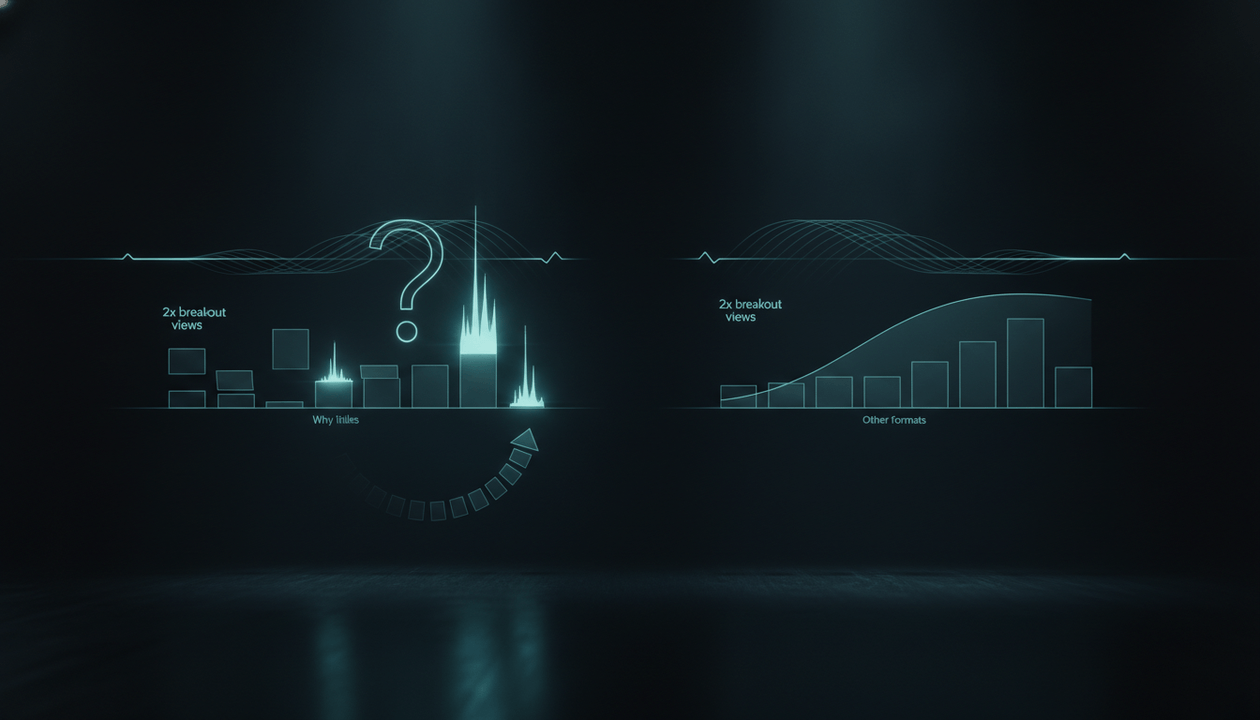
OverseerOS analyzed 2,442 YouTube videos across 64 competitor channels, comparing the titles of breakout videos with the titles of videos that did not break out.
The result was surprisingly clear:
Breakout titles were not more lexically original.
Their closest-match similarity to the channel's previous 20 titles was:
- 23.8% for breakout videos
- 23.1% for non-breakout videos
Almost identical.
When we gave channels equal weight, the result moved even further away from the "original titles win" theory.
Among 48 channels that produced both qualifying breakout and non-breakout videos, 31 channels, or 64.6%, had breakout titles that were more similar to their own existing title language than their non-breakout titles were.
Yet exact copying was rare.
Only:
2.5% of breakout titles exactly repeated one of the channel's previous 20 normalized titles.
So the real pattern was not:
Invent a completely new title structure every time.
And it was not:
Copy a winner word for word.
It was closer to:
Reuse proven title language and structures while changing the actual idea, promise, angle, and reason to click.
That distinction matters because most creators confuse title originality with idea originality.
They are not the same thing.
Key Findings
| Finding | Breakout videos | Non-breakout videos |
|---|---|---|
| Primary titles analyzed | 241 | 2,201 |
| Channels represented | 49 | 63 |
| Median closest-title similarity | 23.8% | 23.1% |
| Middle 50% similarity range | 15.8% to 37.5% | 15.4% to 36.4% |
| Shared 2-word phrase with prior 20 titles | 79.3% | 74.4% |
| Shared 3-word phrase | 43.6% | 40.5% |
| Shared 4-word phrase | 23.7% | 23.2% |
| Shared 5-word phrase | 11.2% | 13.1% |
| Exact normalized title repeat | 2.5% | 1.4% |
Additional checks:
- 64.6% of paired channels had breakout titles that were more similar to their own title history than their non-breakouts
- 5x+ outliers had a median closest-title similarity of 25.5%
- The least-similar title group had a 9.0% breakout rate
- The most-similar group had an 11.0% breakout rate
- Breakouts and non-breakouts both had a median title length of 58 characters
- Both groups also had a median of 10 words
- Exact four-word phrase reuse from earlier titles on other channels was nearly identical: 12.9% vs 12.6%
The evidence does not support the idea that viral YouTube titles must look linguistically unlike everything that came before them.
The Direct Answer: Do Viral YouTube Titles Need to Be Original?
No, not in the sense of using completely original wording or title structure.
In this OverseerOS sample, breakout titles were approximately as similar to their channel's previous titles as non-breakout titles were.
The stronger distinction was this:
Breakout titles frequently reused pieces of existing title language without simply repeating the entire title.
For example, a creator might repeatedly use structures such as:
- I Tried [X] for [Time]
- Why [X] Is Actually [Y]
- The Truth About [X]
- I Tested [X] So You Don't Have To
- [Number] Mistakes That [Outcome]
- How I [Result] Without [Obstacle]
The variables change.
The idea changes.
The promise changes.
But the underlying language can remain familiar.
That is fundamentally different from copying another video's full title.
What We Mean by "Title Originality"
Originality is difficult to measure because a title can be original in several different ways.
Consider:
I Tried Running Every Day for 30 Days
and:
I Tried Cold Showers Every Day for 30 Days
The wording is extremely similar.
The subject is different.
Now consider:
30 Days of Cold Showers Changed How I Sleep
The subject is almost identical, but the wording is less similar.
Which title is more original?
There is no perfect mathematical answer.
So this study measures a narrower concept:
lexical title similarity.
In simple terms:
How much wording does a title share with titles that the same channel published before it?
That allows us to test an important creator question without pretending we can mathematically measure creativity itself.
How We Analyzed 2,442 YouTube Titles
The source dataset contained recent public competitor-video observations collected through OverseerOS.
Videos had public metrics including:
- title
- publication time
- public views
- observed velocity
- channel baseline velocity
- relative performance score
The broader valid velocity dataset contained:
2,826 videos across 83 channels.
We then applied an additional title-history requirement.
Each video needed at least:
5 earlier observed videos from the same channel
so there was enough previous title language to compare against.
That produced the primary novelty cohort:
2,442 videos across 64 channels
including:
- 241 breakout videos
- 2,201 non-breakout videos
How a breakout was defined
For this analysis, a breakout was an operational OverseerOS classification where the video's observed velocity exceeded:
2x the channel's velocity baseline
This is not an official YouTube definition of "viral."
It is a channel-relative method for identifying videos moving unusually fast compared with the creator's normal performance.
That distinction is important.
A 300-VPH video can be an extraordinary breakout for a channel that normally gets 80 VPH.
A 1,000-VPH video can be ordinary for a channel that normally gets 1,200.
We explored that problem in detail in our YouTube VPH study.
How title similarity was calculated
For each qualifying video, we took up to:
20 earlier titles from the same channel.
Titles were normalized by:
- converting text to lowercase
- removing punctuation
- splitting the title into words
We then compared the set of words in the current title with the words in each previous title.
The similarity metric was Jaccard similarity:
shared unique words ÷ all unique words across both titles
A score of:
0
means the two titles share no normalized words.
A score of:
1
would mean they contain exactly the same set of words.
For every video we retained its highest similarity score against the previous 20 titles.
That answers:
How similar is this title to the most similar recent title the channel already used?
We also tested exact phrase reuse
Word-set similarity ignores word order.
So we separately checked whether titles repeated exact contiguous phrases of:
- 2 words
- 3 words
- 4 words
- 5 words
We also checked exact normalized full-title repetition.
That gives us a second way to distinguish:
familiar title language
from:
literal copying.
We ran a stopword sensitivity test
Words such as "the," "and," "to," and "I" can artificially increase similarity.
So we reran the word-overlap analysis after removing a broad set of common function words.
The conclusion barely changed.
Median closest-title similarity after that filtering:
Breakouts: 22.2%
Non-breakouts: 21.4%
So the result was not being created simply by titles sharing words like "the" or "you."
Finding 1: Breakout Titles Were Not More Original
This is the central result.
| Similarity to closest previous title | Breakouts | Non-breakouts |
|---|---|---|
| 25th percentile | 15.8% | 15.4% |
| Median | 23.8% | 23.1% |
| 75th percentile | 37.5% | 36.4% |
| Mean | 30.5% | 28.6% |
If linguistic originality were a strong requirement for breakout performance, we would expect breakout titles to sit noticeably farther from the channel's previous title language.
They did not.
The distributions were extremely similar.
If anything, breakout titles showed slightly more overlap at the mean.
The difference is too small to treat as proof that similarity helps performance.
But it is enough to reject a much stronger claim:
Breakout titles clearly need to be more original than ordinary titles.
That pattern simply was not present.
Finding 2: 65% of Paired Channels Had More Familiar Breakout Titles
Pooled data can hide channel differences.
One creator may use extremely repetitive titles.
Another may constantly experiment.
If the first creator contributes more videos, it could distort the overall comparison.
So we changed the unit of analysis.
We isolated channels that had:
- qualifying breakout videos
- qualifying non-breakout videos
There were:
48 paired channels.
For each channel, we calculated the median closest-title similarity separately for its breakouts and non-breakouts.
The result:
- 31 channels: breakouts were more similar to prior title language
- 15 channels: breakouts were less similar
- 2 channels: tied
That means:
64.6% of paired channels had the more familiar title language on their breakout videos.
Median channel-level similarity:
Breakouts: 26.0%
Non-breakouts: 22.2%
Again, this does not prove that repeating title language causes views.
Many variables change at the same time.
But it does make one thing difficult to argue:
Winners only emerge when creators abandon their existing title style and invent something completely new.
Most paired channels did not behave that way.
Finding 3: Winning Titles Often Reused Phrases, but Rarely the Whole Title
This is where the result becomes much more practical.
We looked for exact phrases that also appeared in at least one of the channel's previous 20 titles.
Two-word phrase reuse
Breakouts:
79.3%
Non-breakouts:
74.4%
Two words is a low bar.
Phrases like:
- how to
- I tried
- the best
- what happens
can appear naturally.
So we raised the threshold.
Three-word phrase reuse
Breakouts:
43.6%
Non-breakouts:
40.5%
Now almost half of breakout titles contained an exact three-word sequence that the channel had recently used before.
Four-word phrase reuse
Breakouts:
23.7%
Non-breakouts:
23.2%
Nearly one in four breakout titles still reused an exact four-word sequence.
Five-word phrase reuse
Breakouts:
11.2%
Non-breakouts:
13.1%
At five consecutive words, repetition becomes much more specific.
The rate falls quickly.
Full-title repetition
Only:
2.5% of breakout titles
exactly matched a normalized full title among the previous 20.
For non-breakouts:
1.4%
There were too few complete repetitions to treat that difference as a meaningful performance result.
The broader pattern is more useful:
Phrase reuse was common. Full-title reuse was not.
That is almost exactly the distinction creators should make between:
copying a title
and:
using a title formula.
Finding 4: Even 5x+ Outliers Were Not More Original
Maybe 2x breakouts are not extreme enough.
Perhaps the truly exceptional videos use radically different titles.
So we separated videos by relative velocity strength.
| Relative performance | Videos | Median closest-title similarity |
|---|---|---|
| Under 1x baseline | 1,778 | 23.1% |
| 1x to 2x | 423 | 23.1% |
| 2x to 3x | 118 | 25.0% |
| 3x to 5x | 75 | 22.7% |
| 5x+ | 48 | 25.5% |
There is no progression toward originality.
The 5x+ group actually had the highest median similarity in the table.
Again, do not read that backward and conclude:
Repetitive titles create 5x videos.
The sample is observational and the 5x+ group contains only 48 videos.
The defensible conclusion is:
Increasing breakout strength did not coincide with increasingly novel title wording.
That is much more interesting than another arbitrary list of "viral power words."
Finding 5: Strong Breakouts Still Reused Familiar Title Language
The phrase analysis told a similar story.
Among videos below their channel baseline:
39.7%
shared a three-word phrase with a recent prior title.
Among 5x+ outliers:
47.9%
did.
Median word-set similarity:
Under 1x: 23.1%
5x+: 25.5%
So even the strongest observed breakouts were not linguistic rebels.
Many remained visibly connected to the title language around them.
That suggests a different model for what happens when a title works.
The creator may not be inventing a completely new packaging language.
They may be inserting a much stronger idea into a packaging language the audience already understands.
Finding 6: Copying Other Channels' Wording Was Not the Breakout Signal
There is another version of the originality question.
Maybe creators do not reuse their own titles.
Maybe they copy title phrases from competitors.
We tested that separately.
For every primary-cohort video with enough earlier market examples, we checked whether an exact phrase had appeared previously on another observed channel.
Exact four-word sequence used by another channel
Breakouts:
12.9%
Non-breakouts:
12.6%
Almost identical.
Exact five-word sequence used by another channel
Breakouts:
2.9%
Non-breakouts:
4.4%
Breakout titles were not more likely to contain long copied phrases from other channels.
That is an important distinction.
The data supports the idea that title structures and language patterns can repeat.
It does not show that winners systematically copy long competitor phrases verbatim.
Finding 7: Greater Similarity Did Not Reduce Breakout Rate
We can reverse the analysis.
Instead of asking:
Are breakout titles original?
Ask:
What percentage of videos broke out at different levels of title similarity?
We grouped titles by similarity to their closest recent same-channel title.
| Closest-title similarity | Videos | Breakouts | Breakout rate |
|---|---|---|---|
| Under 15% | 565 | 51 | 9.0% |
| 15% to 25% | 737 | 71 | 9.6% |
| 25% to 40% | 613 | 61 | 10.0% |
| 40%+ | 527 | 58 | 11.0% |
If familiar wording were inherently harmful, we would expect breakout rate to collapse as similarity increased.
It did not.
The most similar group actually had the highest descriptive breakout rate.
The difference from 9.0% to 11.0% is not large enough, nor is this design causal enough, to recommend intentionally maximizing title similarity.
But there is no evidence here for an "originality penalty."
Familiar language was clearly compatible with breakout performance.
Finding 8: This Was Not Just a Title-Length Effect
Longer titles naturally have more opportunities to share words.
So perhaps breakouts looked slightly more similar because they were simply longer.
They were not.
Across the broader valid 2,826-video dataset:
Breakout titles
Median characters:
58
Median words:
10
Non-breakout titles
Median characters:
58
Median words:
10
Even their character distributions were almost identical.
Breakout middle 50%:
45 to 75 characters
Non-breakout middle 50%:
46 to 73 characters
So the similarity result cannot simply be dismissed as:
Breakout titles were longer and therefore shared more words.
They were effectively the same length.
For a deeper analysis of title length specifically, see our study of 942 breakout YouTube titles.
The Real Lesson: Original Idea, Familiar Grammar
The most useful mental model is to separate a YouTube title into layers.
A title can be familiar in one layer and original in another.
Layer 1: The topic
What is the video actually about?
Examples:
- AI agents
- weight loss
- Minecraft
- ancient Rome
- credit cards
- celebrity scandals
Layer 2: The angle
What makes this version of the topic different?
Examples:
- a test
- a failure
- a comparison
- a hidden cause
- a challenge
- a prediction
- an investigation
Layer 3: The promise
Why should the viewer care?
Examples:
- save time
- make money
- avoid a mistake
- learn something surprising
- see an extreme result
- resolve uncertainty
Layer 4: The title grammar
How is that promise expressed?
Examples:
- I Tried [X] for [Y]
- Why [X] Is Failing
- [Number] Mistakes That [Outcome]
- I Tested Every [X]
- The Truth About [X]
- How [X] Actually Works
Creators often assume Layer 4 needs to be original.
Our data suggests that assumption is weak.
The winning differentiation can come from Layers 1 through 3 while Layer 4 remains familiar.
Why Proven YouTube Title Formulas Keep Working
A formula does not necessarily work because the algorithm recognizes the sentence pattern.
That is the wrong way to think about it.
A useful title formula solves a communication problem.
For example:
I Tried [X] for 30 Days
immediately tells the viewer:
- there was an experiment
- it lasted long enough to produce evidence
- something probably changed
- the video contains a result
Or:
Why [Common Thing] Is Actually [Unexpected Claim]
creates:
- an existing belief
- a contradiction
- an information gap
- a reason to resolve it
You can reuse that communication structure without reusing the underlying idea.
That is why "formula" and "copy" should not be treated as synonyms.
The Wrong Way to Copy a Viral YouTube Title
Suppose a competitor publishes:
I Tried Waking Up at 5AM for 30 Days
The wrong process is:
That title got views. I will make "I Tried Waking Up at 5AM for 30 Days."
You have copied both:
- the packaging
- the idea
There is almost no strategic transformation.
A slightly less obvious version is:
I Tried Waking Up at 4AM for 30 Days
Technically different.
Strategically almost identical.
Changing one variable does not automatically create originality.
The Better Way to Reverse-Engineer a Viral Title
Instead, abstract the mechanism.
Original structure:
I Tried [Behavior] for [Time Period]
Psychology:
personal experiment + commitment + outcome curiosity
Now adapt that mechanism to a genuinely different idea.
Examples:
I Let AI Plan Every Meal for 30 Days
I Uploaded at the Same Time Every Day for a Month
I Replaced Search With AI for One Week
I Used Only Free Editing Tools for 30 Days
Same broad grammar.
Different experiment.
Different audience promise.
Different video.
That is the distinction the data supports.
Copy the Structure, Not the Sentence
Here is a practical transformation framework.
| Viral title pattern | What to extract | What not to copy |
|---|---|---|
| I Tried [X] for 30 Days | Experiment + time commitment | The exact experiment |
| Why [X] Is Dying | Contrarian diagnosis | The same subject and claim |
| I Tested Every [X] | Exhaustive comparison | The exact product set |
| [Number] Mistakes Killing Your [Y] | Specific count + loss aversion | Exact wording and examples |
| How I Got [Result] Without [Obstacle] | Outcome + objection removal | Another creator's result |
| The Truth About [X] | Hidden-information frame | The competitor's evidence |
| I Spent [Amount] on [X] | Cost + experiment + stakes | Identical purchase concept |
| [X] Is About to Change Forever | Future stakes | Unsupported prediction |
This is how a swipe file becomes useful.
You are not collecting sentences.
You are collecting mechanisms.
Your Own Channel Should Be the First Title Swipe File
One of the most interesting findings from this research was not competitor copying.
It was internal consistency.
Breakout videos frequently resembled title language the same channel had already used.
That means creators may be overlooking one of their best research assets:
their own history.
Before searching 1,000 competitors, identify:
- your highest relative performers
- your strongest title structures
- recurring promises
- recurring emotional frames
- recurring topic angles
- title-thumbnail relationships that repeatedly work
Then ask:
What can I repeat without repeating the actual video?
That is very different from posting sequels forever.
You are preserving the pieces of your packaging system that audiences already understand.
How to Build a Viral YouTube Title Swipe File
A good swipe file should not be a folder of titles you intend to copy.
It should be a database of evidence.
Step 1: Find outliers, not just popular videos
A title on a 20-million-subscriber channel with 500,000 views may not be an exceptional title.
A title on a 30,000-subscriber channel with 800,000 views is a much more interesting research target.
Raw views are not enough.
Look for videos outperforming the channel around them.
Step 2: Save the title and the performance context
Record:
- title
- video views
- channel baseline
- relative outlier score
- video age
- topic
- format
- thumbnail concept
Without the context, you are just collecting pretty sentences.
Step 3: Decompose the title
Ask:
What is fixed?
Example:
I Tried [X] for 30 Days
Fixed:
- first-person test
- duration
- unresolved result
Variable:
- X
Step 4: Name the psychological mechanism
Possible mechanisms include:
- curiosity
- proof
- authority
- fear
- contradiction
- transformation
- compression
- exclusivity
- comparison
- identity
- urgency
- specificity
Step 5: Generate multiple original applications
Do not immediately use the first adaptation.
Write several different ideas using the same mechanism.
Step 6: Reconnect the title to the thumbnail
A title should not be optimized in isolation.
If the title already tells the entire story, the thumbnail may need to create the unanswered question.
If the thumbnail shows the result, the title may need to explain why it matters.
Packaging is a system.
Similar Is Not the Same as Derivative
Creators sometimes overcorrect.
They discover a title looks similar to another title and immediately abandon it.
That can be a mistake.
Many strong titles naturally share language because language itself has constraints.
There are only so many concise ways to express:
- a comparison
- an experiment
- a warning
- a mistake
- a transformation
- a tutorial
- a surprising discovery
The question should not be:
Has anyone ever used these words?
The better questions are:
Am I promising the same video?
Am I using the same evidence?
Am I presenting the same central idea?
Would a viewer reasonably feel that I copied the competitor rather than adapted a communication pattern?
Those are much more meaningful originality tests.
When Similar Titles Become a Problem
The data should not be interpreted as permission to clone titles blindly.
Similarity becomes strategically weak when you copy too many layers at once.
Same title structure + same topic
Risk rises.
Same title structure + same topic + same thumbnail concept
Higher risk.
Same title structure + same topic + same claim + same thumbnail
You are approaching imitation rather than research.
The safe strategic goal is:
borrow the evidence-backed mechanism while creating a distinct piece of content.
What to Change When You Borrow a Title Formula
If you model a proven title, change at least the substantive layer.
Good dimensions to transform include:
- target viewer
- topic
- experiment
- timeframe
- scale
- evidence
- result
- objection
- stakes
- comparison
- perspective
- data source
- narrative conflict
- question being answered
Do not simply replace one adjective.
What Not to Change Just for the Sake of Originality
Creators sometimes destroy clear titles because they are trying too hard to sound unique.
Suppose the clean title is:
How to Find Profitable YouTube Niches
Then the creator rewrites it into:
The Digital Goldmine Discovery Method Nobody Understands
It may be more original.
It is also much harder to understand.
Originality that removes clarity is not an upgrade.
The title exists to communicate.
Not to win a creative-writing award.
Familiarity Can Be a Feature
Humans understand patterns.
When viewers repeatedly encounter structures like:
I Tested Every...
they immediately understand the kind of experience being offered.
That lowers interpretation cost.
The viewer does not need to decode the title format.
They can focus on the variable:
Every what?
Likewise:
The Biggest Mistake...
immediately communicates:
- something is going wrong
- there is a dominant error
- the video will identify it
The structure is familiar.
The specific answer can still be completely new.
That is why novelty should often live in the content promise, not in making the sentence impossible to categorize.
What This Means for Small YouTube Channels
Small creators should be especially careful with abstract originality.
A giant creator can sometimes publish:
I Was Wrong
and rely on:
- audience familiarity
- an ongoing story
- personality
- thumbnail recognition
- existing curiosity
An unknown creator may need:
I Was Wrong About Starting a Faceless YouTube Channel
Less mysterious.
More context.
A small creator generally cannot assume the viewer already knows why their personal revelation matters.
That means competitor title research should focus less on copying famous creators word for word and more on identifying structures that communicate value to a cold viewer.
A Better Framework for Writing Viral YouTube Titles
Instead of asking:
Is this title original enough?
Score it across five dimensions.
1. Idea strength
Would the viewer care about the underlying subject even before seeing the title?
2. Promise clarity
Can a cold viewer understand what they gain by clicking?
3. Tension
Is there:
- uncertainty
- stakes
- contrast
- conflict
- curiosity
that needs resolution?
4. Evidence
Does the title imply something concrete?
Examples:
- 100 channels analyzed
- 30-day experiment
- $10,000 spent
- every major tool tested
- five years of data
5. Packaging familiarity
Can you express the idea using a title structure viewers already understand?
This fifth dimension is where creators often waste energy trying to be unnecessarily novel.
How to Research Viral Titles With OverseerOS
The data in this study points toward a simple workflow.
1. Find actual breakout channels
Use the OverseerOS Viral Channel Finder to find channels showing unusual recent public performance.
Do not begin with the biggest creator.
Begin with the strongest evidence.
2. Find the videos beating their own channel
A video's raw view count is not enough.
Use relative performance to identify videos that are behaving unusually compared with that creator's normal baseline.
3. Analyze the title system around the breakout
Open the channel in the OverseerOS AI YouTube Channel Analyzer.
Look beyond one title.
Compare:
- recent titles
- top-performing titles
- repeated structures
- recurring topics
- title length
- view distribution
- breakout videos
The goal is to identify what the winner changed and what it did not change.
4. Add the strongest channels as competitors
Use the OverseerOS YouTube Competitor Analysis Tool to keep tracking the competitors most relevant to your channel.
That lets you study new outliers as they appear rather than discovering a trend six months later.
5. Save formulas, not sentences
If several outliers share a pattern, record the structure.
For example:
[Unexpected person] Tried [Thing] for [Time]
not:
the exact title text.
6. Build original ideas inside proven structures
Now combine:
- a validated audience desire
- a breakout topic
- a familiar packaging mechanism
- your own evidence or perspective
That is much closer to strategic reverse-engineering.
A Practical Example
Imagine you discover three breakout titles with these abstract structures:
I Tested Every [Tool] So You Don't Have To
I Tried [Method] for 30 Days
Why [Popular Strategy] Doesn't Work Anymore
Do not ask:
Which sentence should I copy?
Ask:
Which communication mechanism fits the strongest original video idea I have?
Suppose your topic is AI video editing.
Possible adaptations:
I Tested 12 AI Video Editors So You Don't Have To
Mechanism:
exhaustive test + effort saved
I Let AI Edit Every Video for 30 Days
Mechanism:
long experiment + outcome curiosity
Why Fully Automated AI Editing Still Falls Apart
Mechanism:
contrarian diagnosis
Three familiar structures.
Three potentially original videos.
That is the correct level of copying.
The Viral Title Research Checklist
Before publishing a competitor-inspired title, check:
- Did I find the source title because it was a true outlier, not just because the channel is famous?
- Do I understand the performance baseline around that video?
- Can I describe the title formula without repeating the original sentence?
- Is my underlying video idea meaningfully different?
- Is my central promise different?
- Am I adding my own evidence, experiment, result, or perspective?
- Does the title accurately represent my actual video?
- Does a cold viewer understand why the video matters?
- Is the thumbnail adding information rather than repeating the title?
- Could I generate at least three genuinely different packaging concepts before deciding?
If you pass those checks, similarity is not automatically a problem.
What This Study Does Not Prove
There are important limitations.
Lexical similarity is not idea similarity
Two titles can use completely different words to describe almost identical videos.
They can also use similar words while covering different ideas.
Our metric studies language overlap, not philosophical originality.
We cannot see competitor CTR
Public YouTube data does not expose another creator's:
- impressions
- click-through rate
- Home CTR
- Suggested CTR
- search CTR
- retention
- viewer satisfaction
- title experiment results
A breakout title is associated with a breakout video.
That does not prove the title caused the breakout.
This is not a random sample of YouTube
The videos came from channels tracked through OverseerOS competitor workflows.
Those channels may differ from YouTube as a whole.
Multiple videos came from the same channel
That is why we included the 48-channel paired analysis rather than relying only on pooled videos.
The breakout definition is operational
A video was classified as breakout when its observed velocity exceeded 2x the available channel baseline.
That identifies unusual relative momentum.
It is not YouTube's definition of viral content.
Previous-title availability differed by video
We required at least five prior same-channel titles and compared against no more than the previous 20.
Median available prior-title counts were very similar:
Breakouts: 34
Non-breakouts: 33
so the main result was not created by one group simply having dramatically more title history.
Titles may have been edited
The public title stored in the competitor dataset reflects the title available when the video was fetched or refreshed.
If a creator changed the title after publication, the dataset does not provide a complete historical version log of every title variation.
Exact phrase reuse does not prove intentional copying
Two creators can independently write the same four-word phrase.
This becomes especially likely with common title structures.
Our cross-channel phrase analysis measures overlap.
It cannot identify intent.
This is observational research
The study does not show that increasing similarity causes breakout performance.
It shows that linguistic similarity and breakout performance clearly coexist, and that breakout titles were not systematically more novel than non-breakout titles.
Final Verdict
Do viral YouTube titles need to be original?
Not in their basic wording or structural formula.
In our primary analysis of 2,442 videos:
- breakout closest-title similarity: 23.8%
- non-breakout similarity: 23.1%
- 43.6% of breakouts reused a three-word phrase from one of their previous 20 titles
- 23.7% reused a four-word phrase
- only 2.5% exactly repeated a full normalized title
- 64.6% of paired channels had breakout titles that were more similar to their own previous title language
- 5x+ breakouts were not more lexically original
- long phrase reuse from other channels was not higher among breakouts
The data does not support:
Every viral title needs a completely original formula.
It also does not support:
Copy competitor titles word for word.
The strongest strategy sits between those extremes.
Find proven title structures. Understand why they communicate. Keep the mechanism. Change the idea, promise, evidence, and execution.
Your title does not need to sound like nothing YouTube has ever seen.
Your video needs a reason to exist.
That is the difference.
FAQ
Do viral YouTube titles need to be unique?
Not completely. In our analysis, breakout titles were almost exactly as similar to their channel's previous titles as non-breakouts were. The median closest-title similarity was 23.8% for breakouts versus 23.1% for non-breakouts.
Can I copy a viral YouTube title?
You can study and adapt the structure, but copying the full title and underlying video idea is a weak strategy. Extract the formula or psychological mechanism, then apply it to an original topic, experiment, claim, or piece of evidence.
Is it okay to reuse a YouTube title formula?
Yes. Reusing a title structure is different from copying a title word for word. In our sample, exact phrase reuse was common while complete title repetition was rare.
How often did breakout titles repeat previous title phrases?
Among the 241 qualifying breakout titles, 43.6% shared an exact three-word phrase with one of the channel's previous 20 titles, 23.7% shared a four-word phrase, and 11.2% shared a five-word phrase.
How often were viral titles exact copies?
Exact same-channel normalized title repetition was rare. Only 2.5% of qualifying breakout titles exactly matched one of the previous 20 titles.
Were stronger YouTube outliers more original?
No clear pattern showed that. Videos exceeding 5x their channel baseline had a median closest-title similarity of 25.5%, compared with 23.1% among videos below 1x baseline.
Should my YouTube titles all follow the same style?
Not necessarily. Consistency can help create a recognizable packaging language, but repeating one formula indefinitely can become predictable. Use your strongest historical structures as evidence, then continue testing new angles and packaging concepts.
What is a viral YouTube title formula?
A title formula is the reusable structure beneath a title. For example, "I Tried [X] for [Y]" is a formula. The specific experiment, evidence, stakes, and result are variables that can make each video original.
How do I find viral YouTube title ideas?
Find videos dramatically outperforming their own channels, not just videos with high raw view counts. Analyze the title, identify the underlying structure and psychological mechanism, then adapt that mechanism to a different original idea.
Is copying titles from competitors bad?
Copying an exact competitor title and producing essentially the same video is very different from studying proven packaging. A stronger approach is to extract the structure, understand why it communicates effectively, and create a distinct video around it.
What matters more than title originality?
The strength of the underlying idea, clarity of the promise, audience relevance, curiosity, stakes, evidence, thumbnail relationship, and whether the actual video delivers on what the title promises.
Should small YouTube channels copy big creators' titles?
Not blindly. Large creators can rely on audience familiarity and context that smaller channels do not have. Research channels with comparable audiences and especially channels producing strong relative outliers, then adapt the underlying title patterns rather than copying celebrity-style ambiguity.
What is the best way to reverse-engineer a YouTube title?
Identify a real outlier, separate the title into its fixed structure and variable idea, name the psychological mechanism, generate several original applications, and evaluate the title together with the thumbnail and actual video promise.