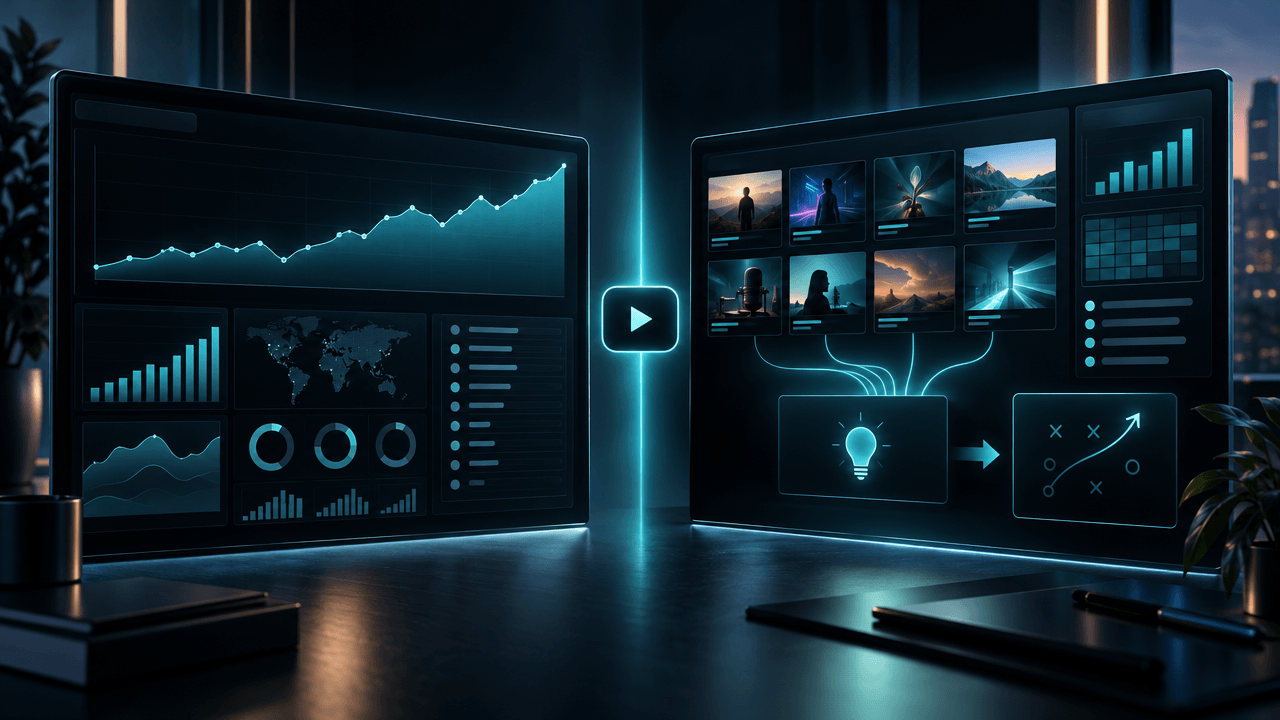
Most creators think YouTube audience research means checking age, gender, and geography inside YouTube Studio.
That is only one layer.
A complete audience-research system should answer five questions:
- Who is watching your channel?
- What else do those viewers watch and search for?
- Which topics repeatedly earn attention in your market?
- What problems, objections, and desires appear in audience language?
- Which opportunities can your channel realistically win?
No single tool answers all five.
The best first-party YouTube audience research tool is YouTube Studio, because it shows private information about your real viewers. The best tool for studying public market demand, breakout channels, and competitor content patterns is OverseerOS. SparkToro is strongest for understanding what a broader audience visits, follows, watches, and searches for outside your own channel.
The strongest research workflow combines these tools instead of forcing one platform to answer every question.
This guide compares the best YouTube audience research tools in 2026 and gives you a complete framework for turning audience data into better topics, titles, thumbnails, scripts, collaborations, products, and channel positioning.
Key Takeaways
- YouTube Studio is the best source of private first-party information about viewers who already watch your channel.
- OverseerOS is best for public, competitor-backed YouTube opportunity research, including breakout channels, viral videos, content patterns, and untapped topic opportunities.
- SparkToro is best for discovering the websites, YouTube channels, social platforms, search terms, podcasts, and interests associated with a broader online audience.
- vidIQ is useful for tracking known competitors, growth patterns, top-performing videos, and search opportunities.
- Viewstats is strongest for outlier research, competitor tracking, thumbnail patterns, and niche-level content discovery.
- TubeBuddy is useful when audience demand is primarily expressed through YouTube and Google search.
- Brand24 is designed for social listening, sentiment, topic analysis, audience discussion, and brand monitoring across multiple sources.
- Google Trends is the best free tool for comparing the direction and seasonality of broader demand.
- Public competitor tools cannot reveal another channel’s private demographics, retention curves, traffic sources, or returning-viewer data.
- A useful audience persona should be built from observed behavior and language, not invented demographic stereotypes.
- The best video opportunity appears when first-party audience interest, public performance evidence, and an unresolved audience problem overlap.
Quick Verdict: Best YouTube Audience Research Tools
| Tool | Best For | First-Party Audience Data | Competitor Research | Audience Interests | Search Demand |
|---|---|---|---|---|---|
| OverseerOS | Public YouTube demand, breakout channels, and content opportunities | No private competitor data | Strong | Inferred from public content behavior | Indirect |
| YouTube Studio | Understanding your existing viewers | Strong | Limited | Strong for your own audience | Strong for your audience |
| SparkToro | Off-platform affinities and broader audience behavior | No YouTube channel analytics | Indirect | Strong | Strong |
| vidIQ | Competitor tracking and YouTube opportunity research | Connected-channel data | Strong | Inferred from content performance | Strong |
| Viewstats | Outliers, packaging, competitors, and niche trends | Limited | Strong | Inferred from performance | Indirect |
| TubeBuddy | Search-led audience demand and keyword research | Connected-channel workflows | Moderate | Search behavior | Strong |
| Brand24 | Social listening, sentiment, and audience discussion | No private YouTube analytics | Strong for mentions | Strong through public conversations | Indirect |
| Google Trends | Free trend direction and seasonality research | No | Indirect | Broad interest patterns | Strong directional data |
What Is a YouTube Audience Research Tool?
A YouTube audience research tool helps creators understand the people most likely to watch, engage with, return to, share, or buy through a YouTube channel.
Depending on the tool, it may help reveal:
- Age ranges
- Gender distribution
- Geography
- Languages
- Device types
- Returning viewers
- New, casual, and regular viewers
- When viewers are active
- Other channels viewers watch
- Other videos and formats viewers consume
- Search terms and questions
- Competitor channels
- Breakout videos
- Topic demand
- Content gaps
- Viewer complaints
- Purchase intent
- Brand sentiment
- Off-platform interests
- Websites, podcasts, and communities the audience follows
The phrase “audience research” is often used too broadly.
A creator researching an existing channel needs different information from a creator launching a new channel.
The Three Types of YouTube Audience Research
1. First-Party Audience Research
This uses private data from your own channel.
Examples:
- Returning viewers
- Unique viewers
- Watch time
- Age
- Gender
- Geography
- Device type
- Traffic sources
- Subscriber status
- What your audience watches
- When viewers are active
The strongest source is YouTube Studio.
2. Public Market Research
This uses public channels, videos, titles, thumbnails, upload activity, views, comments, and other observable signals.
It helps answer:
- Which channels compete for this audience?
- Which topics repeatedly work?
- Are smaller channels breaking out?
- What formats attract attention?
- Which titles and thumbnails dominate the market?
- Where are competitors leaving gaps?
OverseerOS, vidIQ, and Viewstats are strong options for this layer.
3. Off-Platform Audience Research
This studies what the audience does beyond YouTube.
It may include:
- Websites visited
- Search behavior
- Social networks
- Podcasts
- Subreddits
- Influencers
- Publications
- Product categories
- Professional interests
- Demographics
- Brand conversations
SparkToro, Brand24, and Google Trends are useful here.
A complete audience strategy combines all three.
The YouTube Audience Evidence Stack
Do not build an audience persona from one dashboard.
Use five evidence layers.
| Evidence Layer | Core Question | Best Sources |
|---|---|---|
| First-party behavior | Who actually watches and returns? | YouTube Studio |
| Public performance | What earns attention in the market? | OverseerOS, Viewstats, vidIQ |
| Audience language | How do viewers describe their problems? | Comments, reviews, communities |
| Search demand | What are viewers actively trying to find? | YouTube Studio, TubeBuddy, Google Trends |
| Off-platform affinity | What else does this audience follow and trust? | SparkToro, Brand24 |
When several layers support the same conclusion, confidence increases.
Example
Suppose you believe faceless YouTube creators want faster video production.
One signal is not enough.
A stronger case contains:
- First-party evidence: Your editing tutorials attract high watch time.
- Public performance evidence: Videos about automated production repeatedly outperform competitor baselines.
- Audience language: Comments complain that editing takes too long.
- Search demand: Queries around AI video editing and script-to-video tools are rising.
- Off-platform behavior: The same audience follows automation tools, creator software, and productivity communities.
Now the opportunity is supported by multiple independent signals.
1. OverseerOS: Best for Public YouTube Audience Opportunity Research
OverseerOS is the best option in this comparison for creators who need to understand what a target YouTube audience responds to before publishing.
It does not claim to reveal another channel’s private viewer demographics.
Instead, OverseerOS analyzes public evidence from channels and videos to help creators understand:
- Which channels are gaining traction
- Which videos are outperforming
- What topics repeatedly attract attention
- Which formats work in a niche
- What title and thumbnail patterns appear
- How successful channels structure their content
- Which audience needs remain underserved
- Which ideas fit a proven content system
That distinction is important.
A creator entering a new niche usually does not have enough first-party audience data to study inside YouTube Studio.
They need market evidence.
OverseerOS Viral Channel Finder
OverseerOS Viral Channel Finder helps creators discover viral, emerging, and breakout channels using recent public YouTube signals.
Research filters include:
- Niche
- Subscriber range
- Video count
- Content format
- Language
Results can include:
- Subscriber count
- Total channel views
- Recent upload activity
- Average views
- Growth signals
- Viral score
- Recent viral hits
- Actual breakout videos behind the result
This helps answer:
Which creators are currently proving that this audience exists?
OverseerOS Channel Blueprint Cloner
OverseerOS Channel Blueprint Cloner turns a public YouTube channel into a structured strategy blueprint.
The resulting research can include:
- Tone DNA
- Primary emotion
- Pacing
- Hook patterns
- Signature phrases
- Viral topic formulas
- Content structure
- Upload cadence
- Title patterns
- Keywords
- Tags
- Untapped topic opportunities
This helps answer:
What repeatable system does this audience already respond to?
OverseerOS Viral X-Ray
OverseerOS Viral X-Ray helps analyze individual public videos to understand the strategic patterns behind their performance.
A useful analysis can examine:
- Topic selection
- Title
- Thumbnail promise
- Hook
- Structure
- Viewer psychology
- Audience engagement patterns
This helps answer:
Why did this specific idea attract attention?
Best For
- Creators entering a new niche
- Faceless channel operators
- YouTube agencies
- Multi-channel operators
- Scriptwriters
- Content strategists
- Competitor research
- Finding breakout channels
- Developing original content systems
Main Strength
OverseerOS connects research to execution.
A creator can move from:
Find a breakout channel
to:
Analyze its public strategy
to:
Find original topic opportunities
to:
Plan the content
to:
Write the script
without rebuilding the context across disconnected tools.
Main Limitation
OverseerOS uses public YouTube information for competitor research.
It does not access another creator’s:
- Private demographics
- Audience-retention graph
- Traffic sources
- Revenue
- Returning-viewer data
- Watch time
- YouTube Studio
Use YouTube Studio for private data on your own channel.
Use OverseerOS to understand public market behavior and competitive opportunity.
2. YouTube Studio: Best for Understanding Your Existing Audience
YouTube Studio is the most authoritative source of information about viewers who already watch your channel.
Its Audience analytics can help creators understand:
- Monthly audience
- Unique viewers
- New viewers
- Casual viewers
- Regular viewers
- Returning viewers
- Subscribers
- Age and gender
- Top geographies
- Subtitle languages
- Device types
- Watch time from subscribers and non-subscribers
- When viewers are active on YouTube
- Channels viewers also watch
- Videos, Shorts, live streams, and podcasts viewers watch
- Formats viewers consume
Why YouTube Studio Is Essential
Third-party platforms can estimate public channel performance.
They cannot replicate private behavior from your real viewers.
YouTube Studio can tell you whether:
- New viewers are becoming regular viewers
- Subscribers account for most watch time
- Your audience prefers Shorts, long-form, or live content
- Your viewers are active at specific times
- Viewers also watch particular channels
- Certain countries or language groups are becoming more important
- Your content is attracting the audience you intended to reach
Best For
- Existing channels
- First-party audience analysis
- Content-format decisions
- Collaboration research
- Scheduling live streams and Premieres
- Audience-loyalty analysis
- Geographic and language strategy
- Returning-viewer growth
Main Strength
The data comes from actual viewing behavior on your channel.
Main Limitation
YouTube Studio primarily explains your current audience.
It is less useful when:
- The channel is new
- The audience is still small
- You are researching a completely different niche
- You want to analyze competitor viewers
- You need broader off-platform interests
- You want a complete market map
Some reports also require enough audience data before they appear.
The YouTube Studio Reports Creators Commonly Misread
Subscribers Are Not the Same as Active Audience
A channel may have 500,000 subscribers but a much smaller current monthly audience.
Subscribers may:
- No longer watch
- Watch only one format
- Have joined years ago
- Be inactive
- Prefer an older channel direction
Use monthly audience, unique viewers, and returning behavior alongside subscriber count.
New Viewers Are Not Automatically Better
A high number of new viewers may indicate strong discovery.
It may also indicate that people watch one isolated video and never return.
The goal is not merely to acquire new viewers.
It is to convert relevant new viewers into casual and regular viewers.
Regular Viewers May Be Small but Valuable
Regular viewers often represent the strongest core audience.
They can influence:
- Early velocity
- Comments
- Community strength
- Memberships
- Product sales
- Returning watch time
- Brand trust
Demographics Do Not Explain Motivation
Knowing that your largest age group is 25 to 34 does not tell you:
- Why they clicked
- What problem they want solved
- What they fear
- What they are trying to buy
- Which alternatives they considered
- What would make them return
Combine demographics with behavior and audience language.
3. SparkToro: Best for Off-Platform Audience Affinities
SparkToro is an audience-research platform designed to show what a particular online audience:
- Visits
- Reads
- Watches
- Listens to
- Follows
- Searches for
- Talks about
Research outputs can include:
- Websites
- YouTube channels
- Podcasts
- Subreddits
- Social platforms
- Search keywords
- Trending questions
- Demographic characteristics
- Professional interests
- Public profile language
Why This Matters for YouTube Creators
Your viewers do not exist only on YouTube.
A cybersecurity audience may also follow:
- Privacy newsletters
- Technology podcasts
- Security researchers
- Relevant Subreddits
- Software-review sites
- Professional communities
- Specific conferences
- SaaS products
These affinities can improve:
- Video topics
- Guest selection
- Collaboration outreach
- Sponsorship targeting
- Examples used in scripts
- Distribution strategy
- Brand positioning
- Product development
Best For
- Audience personas
- B2B channels
- Sponsorship research
- Collaboration discovery
- Marketing teams
- Agencies
- Product-led channels
- Off-platform distribution
- Finding trusted publications and creators
Main Strength
SparkToro expands audience research beyond YouTube performance metrics.
Main Limitation
SparkToro does not replace YouTube Studio.
It is not designed to show the private watch behavior, retention, or revenue of your channel.
Its audience data should also be treated as directional aggregate research, not a precise list of every viewer.
4. vidIQ: Best for Tracking Known Competitors and Search Opportunities
vidIQ combines YouTube analytics, competitive research, search tools, idea generation, and optimization workflows.
Its competitor tools can help track:
- Views
- Subscribers
- Public video count
- Growth over different time periods
- Average daily views
- Views per hour
- Top-performing videos
- Titles
- Thumbnails
- Upload timing
- Competitor keywords
How This Supports Audience Research
You cannot see a competitor’s private audience profile.
You can observe what their audience repeatedly rewards.
For example:
- Which topics produce the highest views?
- Which videos gain traction quickly?
- Which themes work across several competitors?
- Which packaging patterns keep recurring?
- Which competitors are growing?
- Which formats are losing momentum?
- Which keywords reveal audience intent?
Best For
- Tracking known competitors
- Keyword research
- Monitoring top-performing videos
- Identifying search opportunities
- Trend alerts
- Existing creators who need ongoing monitoring
Main Strength
vidIQ places competitor and keyword research close to the YouTube publishing workflow.
Main Limitation
The quality of the insight depends on the quality of the competitor list.
Tracking ten irrelevant channels gives you accurate data about the wrong audience.
Use a discovery tool first, then add qualified competitors.
5. Viewstats: Best for Outlier and Packaging Research
Viewstats focuses on public YouTube performance, competitor tracking, trends, outliers, thumbnails, and content inspiration.
Its creator-research features include:
- Outlier-video discovery
- Channel and video analytics
- Competitor tracking
- Thumbnail research
- Trend alerts
- Research collections
- Niche-level discovery
What Is an Outlier?
An outlier is a video that performs significantly above the channel’s normal baseline.
This matters because raw views can mislead.
A video with 300,000 views may be average for a massive channel.
A video with 100,000 views may be transformative for a channel that usually receives 5,000.
The second video may reveal a more accessible audience opportunity.
How Viewstats Supports Audience Research
Viewstats can help identify:
- Subjects attracting disproportionate attention
- Packaging that earns clicks
- Smaller creators producing breakout videos
- Repeated outliers across a topic
- Thumbnail styles common in a niche
- New trends emerging among competitors
Best For
- Outlier research
- Competitor monitoring
- Thumbnail research
- Content inspiration
- Packaging analysis
- Niche trend alerts
Main Strength
It helps creators analyze what the market is rewarding through public performance.
Main Limitation
Public performance does not explain the complete audience.
A high-performing video does not reveal:
- Private demographics
- Exact traffic sources
- Retention
- Viewer satisfaction
- Revenue
- Whether viewers returned
Use outliers to form hypotheses, then validate them with additional evidence.
6. TubeBuddy: Best for Search-Led Audience Demand
TubeBuddy Keyword Explorer is useful when viewers express demand through YouTube and Google searches.
It can help creators investigate:
- Search volume
- Competition
- Keyword strength
- Long-tail keywords
- Related searches
- Keyword trends
- Competitor terms
- Topic opportunities
Best Use Cases
TubeBuddy is particularly relevant for channels built around:
- Tutorials
- Reviews
- Comparisons
- How-to content
- Troubleshooting
- Software education
- Product buying guides
- Fitness routines
- Personal finance questions
- Career advice
- Educational content
Main Strength
It helps translate broad audience problems into searchable phrases.
Broad audience need:
Creators struggle to make thumbnails.
Search-led opportunities:
- How to make a YouTube thumbnail
- Best YouTube thumbnail maker
- YouTube thumbnail size
- How to improve thumbnail click-through rate
- AI YouTube thumbnail generator
- YouTube thumbnail design mistakes
Main Limitation
Search behavior represents only one part of YouTube demand.
Many entertainment, documentary, commentary, and personality-driven channels grow primarily through:
- Browse features
- Suggested videos
- Returning viewers
- Community
- Trends
- Strong packaging
A low search volume does not automatically mean a topic has weak browse potential.
7. Brand24: Best for Audience Sentiment and Social Listening
Brand24 is a media-monitoring and social-listening platform.
It can help analyze public conversations around:
- Brands
- Products
- Competitors
- Topics
- Campaigns
- Industries
- Creators
Its research capabilities can include:
- Sentiment analysis
- Topic analysis
- Mention volume
- Reach
- Share of voice
- Discussion context
- Demographics
- Language
- Geography
- Anomaly detection
- Alerts
- Competitive reporting
Why This Matters for YouTube
YouTube audience demand is often visible outside individual video analytics.
A software launch may generate discussion across:
- YouTube reviews
- Comments
- Social posts
- Blogs
- Forums
- News sites
- Podcasts
Brand24 can help answer:
- What does the market like?
- What are people criticizing?
- Which product problems keep recurring?
- Is negative sentiment increasing?
- Which competitor receives more discussion?
- Which themes are spreading?
- What happened after a launch or controversy?
Best For
- Brands
- SaaS companies
- Agencies
- Reputation management
- Product launches
- Competitor monitoring
- Sponsorship analysis
- Market research
Main Strength
It captures broader public conversation instead of limiting analysis to one YouTube channel.
Main Limitation
It is broader than most individual creators need.
A creator researching five potential videos may receive faster value from comments, YouTube Studio, and public performance tools.
8. Google Trends: Best Free Tool for Demand Direction
Google Trends helps compare the relative direction of search interest across topics and time periods.
It is useful for studying:
- Long-term demand direction
- Seasonal patterns
- Geographic differences
- Rising related topics
- Sudden spikes
- Topic comparisons
- Search behavior changes
Example
A creator considering content about:
- AI video editing
- AI image generation
- AI voiceovers
- AI presentations
- AI website builders
can compare how interest changes over time.
The research may show:
- One topic is steadily growing.
- One depends on product launches.
- One has strong seasonal demand.
- One peaked and declined.
- One is popular only in selected regions.
Best For
- Early niche validation
- Seasonal planning
- Geographic research
- Comparing broad topics
- Free directional analysis
- Trend monitoring
Main Strength
It provides a fast, free way to compare demand direction.
Main Limitation
Google Trends does not directly measure:
- YouTube views
- Video competition
- Click-through rate
- Subscriber conversion
- Viewer retention
- Buyer intent
- Whether a smaller channel can win
Use it as a demand-direction layer, not a complete YouTube strategy.
Best YouTube Audience Research Tool by Goal
| Goal | Best Tool |
|---|---|
| Understand who already watches your channel | YouTube Studio |
| Discover breakout channels in a niche | OverseerOS Viral Channel Finder |
| Reverse-engineer a public channel’s strategy | OverseerOS Channel Blueprint Cloner |
| Find what your broader audience follows online | SparkToro |
| Track known competitors | vidIQ |
| Find public outlier videos | Viewstats or OverseerOS |
| Research YouTube search demand | TubeBuddy |
| Monitor audience sentiment around a brand | Brand24 |
| Compare long-term topic direction | Google Trends |
| Find future topics from audience questions | Comments plus public-performance validation |
| Build an entire channel strategy | OverseerOS plus YouTube Studio |
The 100-Point YouTube Audience Opportunity Score
Use this framework to rank potential audiences, sub-niches, or content directions.
Score each factor from 0 to 5.
Then calculate:
Factor score = rating ÷ 5 × factor weight
| Factor | Weight | What to Measure |
|---|---|---|
| Proven demand | 20 | Do recent videos across multiple channels earn meaningful views? |
| Audience urgency | 15 | How strongly does the audience want the outcome? |
| Newcomer accessibility | 15 | Are smaller or newer channels breaking out? |
| Topic depth | 15 | Can the audience support a large, repeatable content library? |
| Language clarity | 10 | Does the audience clearly describe its problems and desired outcomes? |
| Commercial intent | 10 | Do viewers compare tools, products, services, or costly decisions? |
| Channel fit | 10 | Does the audience match your expertise and production strengths? |
| Distribution potential | 5 | Can the content spread through search, suggested, communities, or other platforms? |
| Total | 100 |
How to Interpret the Score
| Score | Meaning | Recommended Action |
|---|---|---|
| 80 to 100 | Exceptional audience opportunity | Prioritize and build a full content system |
| 65 to 79 | Strong opportunity | Enter with clear positioning |
| 50 to 64 | Promising but uncertain | Run a controlled content test |
| 35 to 49 | Weak or difficult | Narrow the audience or improve the format |
| Below 35 | Poor opportunity | Choose another audience or problem |
Factor 1: Proven Demand
Strong evidence includes:
- Multiple recent high-performing videos
- More than one successful channel
- Repeated outliers
- Stable or growing view baselines
- Continued interest after trends fade
- Demand across multiple topic clusters
Weak evidence includes:
- One old viral video
- One dominant personality
- Declining recent views
- A large number of videos with little engagement
- Interest driven by a temporary controversy
Factor 2: Audience Urgency
High-urgency audience problems include:
- Losing money
- Saving time
- Reducing risk
- Fixing a painful failure
- Reaching an important goal
- Making a buying decision
- Responding to a major change
- Protecting status, health, or security
Low-urgency topics can still succeed through entertainment, identity, curiosity, or emotion.
The important question is:
Why does this audience need to watch now?
Factor 3: Newcomer Accessibility
Look for smaller channels producing videos that significantly outperform their normal baseline.
Ask:
- Are new channels gaining traction?
- Do viewers click unfamiliar creators?
- Does one format dominate?
- Are established brands controlling the market?
- How long does it take for new channels to break through?
- Can your production quality compete?
A market with demand but no newcomer success may be difficult to enter.
Factor 4: Topic Depth
A valuable audience should support more than ten videos.
Test whether you can create content around:
- Beginner questions
- Advanced problems
- Mistakes
- Comparisons
- Case studies
- News
- Experiments
- Tutorials
- Stories
- Products
- Myths
- Frameworks
- Predictions
- Updates
- Recurring series
A useful goal is at least 100 credible ideas across several content pillars.
Factor 5: Language Clarity
Strong markets have audiences that describe their problems clearly.
Examples:
I get impressions but nobody clicks.
My editing workflow takes too long.
I cannot tell which competitor videos are real outliers.
Every AI script sounds the same.
Clear language improves:
- Titles
- Hooks
- Landing pages
- Product positioning
- Search optimization
- FAQs
- Email copy
Use the audience’s natural language without copying personal comments excessively or presenting unverified opinions as facts.
Factor 6: Commercial Intent
Commercial signals include questions about:
- Price
- Cost
- Plans
- Alternatives
- Features
- Results
- Compatibility
- Setup
- Recommendations
- Hiring
- Software
- Services
- Products
An audience can be commercially valuable even when its total view potential is smaller.
A focused audience comparing expensive business software may generate more revenue than a broad entertainment audience with weak buyer intent.
Factor 7: Channel Fit
A profitable audience can still be wrong for you.
Ask:
- Do you understand the audience?
- Do you have credibility?
- Can you create better content than existing options?
- Can you sustain the production cost?
- Does the audience fit your brand?
- Can you publish consistently?
- Does the monetization model fit your business?
Factor 8: Distribution Potential
Consider whether the audience can be reached through:
- YouTube Search
- Browse features
- Suggested videos
- Shorts
- Communities
- Newsletters
- Google Search
- Social platforms
- Collaborations
- Sponsorships
A topic with several distribution paths is usually more resilient than one dependent on a single keyword.
The Audience Research Matrix
Use two axes:
- Audience demand
- Ability to win
| Audience Demand | Ability to Win | Verdict |
|---|---|---|
| High | High | Build aggressively |
| High | Medium | Enter with sharper positioning |
| High | Low | Narrow the audience or change format |
| Medium | High | Run a low-cost test |
| Medium | Medium | Proceed only with strategic advantage |
| Low | High | Small passion project or lead-generation niche |
| Low | Low | Avoid |
The biggest audience is not always the best audience.
The best audience is one you can serve more effectively than the alternatives.
How to Research a YouTube Audience Step by Step
Step 1: Define the Audience by Situation, Not Demographics
Weak definition:
Men aged 25 to 34 interested in finance.
Stronger definition:
Early-career professionals earning good salaries but struggling to build wealth because housing costs, lifestyle inflation, and financial uncertainty consume their income.
The second definition gives you:
- Problems
- Desired outcomes
- Emotional context
- Video ideas
- Product opportunities
- Useful language
Use this template:
[Specific people] who are trying to [desired outcome] but struggle with [main obstacle], and currently rely on [existing alternatives].
Step 2: Identify Five Core Audience Problems
Example for faceless YouTube creators:
- They cannot find proven topics.
- They struggle to differentiate from competitors.
- Script production takes too long.
- Editing is expensive or inconsistent.
- They do not know why videos fail.
Each problem becomes a research track.
Step 3: Study First-Party Data
Inside YouTube Studio, review:
- Monthly audience
- New viewers
- Casual viewers
- Regular viewers
- Returning viewers
- Top geographies
- Age and gender
- Device type
- Watch time from subscribers
- Other channels watched
- Other content watched
- Preferred formats
Record what the data directly proves.
Avoid adding assumptions.
Step 4: Find the Public Market
Use OverseerOS Viral Channel Finder to identify:
- Direct competitors
- Emerging channels
- Small breakout channels
- Relevant formats
- Recent viral videos
Search several channel-size ranges.
A new creator often learns more from a fast-growing 30,000-subscriber channel than a global celebrity channel.
Step 5: Analyze Winning Channels
Use OverseerOS Channel Blueprint Cloner to study qualified public channels.
Look for:
- Repeated audience promise
- Tone
- Emotional positioning
- Hook style
- Pacing
- Topic formulas
- Upload cadence
- Video length
- Title patterns
- Content structure
- Untapped opportunities
Do not copy the content.
Extract transferable principles.
Step 6: Analyze Outlier Videos
For each strong channel, find videos that outperform its normal baseline.
Record:
- Topic
- Title
- Thumbnail
- Publish date
- Views
- Channel baseline
- Video length
- Format
- Hook
- Audience promise
- Follow-up performance
Then ask:
- Did the topic create the outlier?
- Did the packaging create the outlier?
- Was the timing unusual?
- Was the video part of a repeatable pattern?
- Did later videos confirm the demand?
Step 7: Mine Audience Language
Analyze:
- YouTube comments
- Product reviews
- Reddit discussions
- Community posts
- Search suggestions
- Customer-support tickets
- Sales calls
- Surveys
- Emails
Classify useful language into:
- Questions
- Frustrations
- Desired outcomes
- Objections
- Comparisons
- Purchase signals
- Identity statements
- Failed alternatives
Step 8: Research Off-Platform Affinities
Use SparkToro or manual research to identify:
- Websites
- Podcasts
- Creators
- Publications
- Communities
- Social platforms
- Products
- Search terms
This reveals:
- Where the audience learns
- Who it trusts
- What examples it recognizes
- Where content can be distributed
- Which brands may sponsor the channel
Step 9: Validate Trend Direction
Use Google Trends and recent YouTube activity.
Ask:
- Is demand stable, growing, declining, or seasonal?
- Is the trend global or regional?
- Is it tied to one product or event?
- Does interest persist after news spikes?
- Are related topics also growing?
Step 10: Build an Evidence-Based Audience Brief
Your final audience brief should include:
- Audience situation
- Desired transformation
- Main frustrations
- Current alternatives
- Trusted creators and sources
- Search behavior
- Winning topics
- Winning formats
- Objections
- Commercial intent
- Content gaps
- Channel positioning
- Evidence and confidence level
Copy-and-Paste YouTube Audience Research Brief
YOUTUBE AUDIENCE RESEARCH BRIEF

Audience:
[Describe the audience by situation, problem, and desired outcome]

Primary transformation:
[What the audience wants to achieve]

Top problems:
1.
2.
3.
4.
5.

Current alternatives:
[What viewers currently use, watch, buy, or believe]

First-party evidence:
[Relevant YouTube Studio findings]

Public-performance evidence:
[Channels, videos, outliers, and recurring patterns]

Audience language:
[Questions, frustrations, objections, and desired outcomes]

Search behavior:
[Queries, comparisons, and trend direction]

Off-platform affinities:
[Websites, podcasts, communities, channels, and brands]

Winning content formats:
[Documentaries, tutorials, Shorts, reviews, interviews, etc.]

Commercial signals:
[Products, services, pricing questions, comparisons, or purchase intent]

Underserved needs:
[Questions or audience segments competitors serve poorly]

Channel positioning:
[Why this audience should choose this channel]

Top content pillars:
1.
2.
3.
4.
5.

Top 10 validated video opportunities:
1.
2.
3.
4.
5.
6.
7.
8.
9.
10.

Research limitations:
[What the data does not prove]

Confidence level:
[Low, medium, or high, with explanation]
The 45-Minute YouTube Audience Research Workflow
Minutes 0 to 5: Define the Audience
Write:
- Who they are
- What they want
- What blocks them
- What they currently use
- Why they would watch
Minutes 5 to 15: Study Your Audience Data
Review YouTube Studio for:
- Returning behavior
- Audience segments
- Other content watched
- Channels watched
- Format preferences
- Geography
- Device use
Minutes 15 to 25: Find Public Winners
Use OverseerOS Viral Channel Finder to identify:
- Direct competitors
- Emerging channels
- Breakout videos
- Repeatable formats
Minutes 25 to 32: Analyze the Audience Promise
Choose three qualified channels and record:
- Repeated topic
- Core emotion
- Title promise
- Thumbnail promise
- Hook pattern
- Viewer outcome
Minutes 32 to 38: Mine Audience Language
Read relevant comments and record:
- Questions
- Frustrations
- Objections
- Comparisons
- Requests
- Specific praise
Minutes 38 to 42: Check Search and Trend Direction
Use:
- YouTube search suggestions
- YouTube Studio
- TubeBuddy
- Google Trends
Minutes 42 to 45: Score the Opportunity
Complete the 100-point Audience Opportunity Score.
Choose one action:
- Enter the audience aggressively.
- Narrow the positioning.
- Test ten videos.
- Reject the audience and research another market.
Example: Researching an AI Tool Review Audience
Suppose you want to build a channel reviewing AI software.
Weak audience definition:
People interested in AI.
This is too broad.
A stronger audience definition:
Solo creators and small content teams trying to use AI tools to increase production output without sacrificing originality, quality, or control.
Core Problems
- Too many tools make similar promises.
- Reviews rarely test complete workflows.
- Pricing becomes difficult to compare.
- AI output often looks generic.
- Creators do not know which tools save meaningful time.
- Product updates make reviews outdated quickly.
Public Performance Evidence
Research may reveal that videos perform well when they:
- Compare two products
- Test one tool on a real project
- Reveal hidden costs
- Show failures honestly
- Compare AI with human production
- Measure time saved
- Publish immediately after major launches
Audience Language
Common questions may include:
- Does this work for long-form videos?
- How much does one finished video cost?
- Can I use my own voice?
- Does it support commercial use?
- Is it better than hiring an editor?
- Can it maintain one visual style?
- Which plan is actually enough?
Off-Platform Affinities
The audience may also follow:
- AI newsletters
- Product Hunt
- Creator-economy podcasts
- Automation communities
- Software-review sites
- YouTube growth channels
- No-code tools
Stronger Positioning
We test AI creator tools inside real production workflows and measure the cost, time, quality, and limitations before recommending anything.
That positioning is specific, credible, and commercially valuable.
How to Turn Audience Research Into Video Ideas
Do not ask only:
What topics does this audience like?
Ask:
What decision, tension, fear, curiosity, or desired transformation makes this audience click?
Problem to Video
Audience problem:
Editing takes too long.
Weak idea:
Video Editing Tips
Stronger ideas:
- I Timed Every Step of My YouTube Editing Workflow
- AI Editor vs Human Editor: Which Is Actually Faster?
- Why Your Editing Workflow Still Takes All Weekend
- I Cut My Editing Time in Half Without Lowering Quality
Objection to Video
Audience objection:
AI scripts always sound robotic.
Potential videos:
- Why AI Scripts Sound Robotic and the Exact Fix
- I Compared Five AI Scriptwriters on the Same Topic
- Can AI Actually Clone a Creator’s Writing Tone?
- The Prompt Is Not the Real Reason Your Script Sounds Fake
Comparison to Video
Audience comparison:
Is OverseerOS better than using ChatGPT alone?
Potential videos:
- ChatGPT vs YouTube Intelligence Software
- Why Generic AI Misses the Context Behind Viral Videos
- Can ChatGPT Analyze a YouTube Channel Properly?
- YouTube Research Tool vs General AI Assistant
Identity to Video
Audience statement:
I manage several faceless channels.
Potential videos:
- The Multi-Channel YouTube Research System
- How to Manage Five Faceless Channels Without Losing Quality
- The Dashboard Every YouTube Automation Team Needs
- How Agencies Standardize Research, Scripts, and Thumbnails
How Audience Research Improves Titles
Audience research helps titles become more specific.
Generic title:
How to Grow on YouTube
Audience-aware title:
Why Small Faceless Channels Get Impressions but No Clicks
Generic title:
Best AI Video Tools
Audience-aware title:
7 AI Video Tools That Can Actually Produce Long-Form YouTube Videos
Generic title:
YouTube Competitor Research
Audience-aware title:
How to Find Small Channels Breaking Out in Your Niche
The strongest titles connect:
- A recognizable audience
- A meaningful problem
- A specific outcome
- A credible mechanism
- Curiosity or tension
How Audience Research Improves Thumbnails
Audience research should influence the promise, not merely the visual style.
A thumbnail for experienced software buyers may use:
- Direct comparison
- Price contrast
- Visible result
- Product-interface evidence
- Clear winner and loser
A thumbnail for beginner creators may use:
- One simple problem
- Clear transformation
- Fewer elements
- Strong emotional contrast
- Familiar language
Ask:
What must this audience understand in one second to believe the video is relevant?
How Audience Research Improves Scripts
A strong script should reflect:
- What the audience already knows
- What it misunderstands
- What it fears
- What it has already tried
- What objection appears next
- What evidence it needs
- What outcome it wants
Beginner Audience
Needs:
- Definitions
- Context
- Step-by-step explanations
- Fewer assumptions
- Simple examples
Expert Audience
Needs:
- New evidence
- Nuance
- Edge cases
- Better frameworks
- Deeper comparisons
- Fewer generic explanations
The same topic requires a different script for each audience.
How Audience Research Improves Monetization
Audience research can reveal:
- Products viewers already use
- Tools they compare
- Problems they will pay to solve
- Sponsors that fit naturally
- Services they need
- Templates they request
- Education they value
- Objections preventing purchase
Low Commercial Intent
Examples:
- General entertainment
- Passive curiosity
- Broad inspiration
- Meme-driven attention
Medium Commercial Intent
Examples:
- Skill development
- Career improvement
- Productivity
- Hobby equipment
- Educational products
High Commercial Intent
Examples:
- Software comparisons
- Business services
- Financial products
- Professional equipment
- Hiring decisions
- Expensive purchases
- Urgent operational problems
Commercial intent should not control every content decision.
It should inform the business model.
Common YouTube Audience Research Mistakes
Mistake 1: Inventing a Persona
Statements such as:
Sarah is 29, drinks coffee, loves travel, and wants financial freedom.
are useless unless supported by evidence.
Build personas from:
- Behavior
- Problems
- language
- Decisions
- Consumption
- Desired outcomes
Mistake 2: Treating Demographics as Motivation
Two viewers of the same age and gender may click for completely different reasons.
Study the situation and desired transformation.
Mistake 3: Assuming Subscribers Equal Audience
Subscribers measure subscriptions.
They do not measure the complete active audience.
Use monthly audience, unique viewers, and returning behavior.
Mistake 4: Studying Only Your Existing Viewers
Your current audience may reflect your past content rather than your future strategy.
Use public market and off-platform research to identify expansion opportunities.
Mistake 5: Studying Only Massive Competitors
Large creators prove that demand exists.
Smaller breakout channels reveal whether the opportunity remains accessible.
Mistake 6: Confusing Views With Satisfaction
A click can be caused by excellent packaging.
It does not prove viewers were satisfied.
Review retention, comments, returning behavior, follow-up performance, and audience response.
Mistake 7: Overvaluing Search Volume
YouTube growth can come from browse, suggested videos, Shorts, returning viewers, and community.
Search is one acquisition path.
Mistake 8: Copying Competitor Content
Audience research should reveal:
- Viewer needs
- Strategic patterns
- Content gaps
- Packaging principles
It should not lead to copied scripts, titles, thumbnails, footage, or channel identities.
Mistake 9: Treating Public Data as Private Analytics
Third-party tools cannot reveal a competitor’s full:
- Demographics
- Traffic sources
- Retention
- Revenue
- Watch time
- Returning-viewer behavior
Avoid tools that imply otherwise without credible access.
Mistake 10: Trusting One Viral Video
One outlier can result from:
- Timing
- News
- Controversy
- External traffic
- Collaboration
- Celebrity involvement
- Random distribution
Look for repeated performance.
Mistake 11: Ignoring Audience Language
Metrics tell you what happened.
Audience language can reveal why.
Use comments, reviews, and questions to understand motivation.
Mistake 12: Treating Negative Feedback as Failure
Criticism can reveal:
- Missing information
- Product gaps
- Trust barriers
- Future topics
- Strong objections
Separate useful criticism from spam or abuse.
Mistake 13: Researching Forever
Audience research should produce decisions.
Set a deadline, choose a hypothesis, and test it through content.
The 10-Video Audience Validation Test
Before committing to a full channel direction, publish ten controlled videos.
Keep Consistent
- Target audience
- Core promise
- Production quality
- Upload frequency
- General format
- Brand identity
Vary
- Topic cluster
- Title mechanism
- Thumbnail concept
- Hook
- Emotional angle
- Search-led versus browse-led subject
Measure
- Impressions
- Click-through rate
- Average view duration
- Percentage viewed
- Returning viewers
- Subscriber conversion
- Comments
- Traffic sources
- Follow-up demand
Positive Signals
- Several videos receive expanding impressions.
- One topic cluster consistently beats baseline.
- Viewers request related content.
- Returning viewers increase.
- Suggested traffic begins appearing.
- The audience describes a clear next problem.
- Subscriber conversion improves.
Negative Signals
- The positioning remains unclear.
- Strong packaging receives little response.
- Viewers arrive for unrelated topics.
- No content pillar shows repeatable demand.
- Production cost is unsustainable.
- Comments reveal a different audience than intended.
Use the results to refine the audience, not merely judge the channel.
YouTube Audience Research Checklist
Audience Definition
- The audience is defined by situation and desired outcome.
- The main problem is clear.
- Existing alternatives are known.
- The reason to watch now is credible.
- The audience fits the channel’s expertise and production model.
First-Party Data
- Monthly audience was reviewed.
- New, casual, and regular viewers were compared.
- Returning viewers were examined.
- Other channels and videos watched were reviewed.
- Format, geography, language, and device data were considered.
Public Market Data
- Direct competitors were identified.
- Smaller breakout channels were included.
- Outlier videos were separated from normal performance.
- Repeated topic and packaging patterns were recorded.
- Competitor private data was not assumed.
Audience Language
- Questions were collected.
- Frustrations were collected.
- Objections were collected.
- Comparisons and purchase signals were identified.
- Generic comments were separated from useful evidence.
Demand Validation
- Search behavior was reviewed.
- Trend direction was checked.
- More than one channel proves the demand.
- The audience supports repeatable content.
- Newcomer accessibility was evaluated.
Execution
- A distinct channel promise was written.
- Content pillars were selected.
- At least ten validated ideas were created.
- The production model is sustainable.
- A measurement plan exists.
Final Verdict
The best YouTube audience research tool depends on the evidence you need.
Use YouTube Studio to understand the people already watching your channel through private first-party data.
Use OverseerOS to study public market demand, breakout channels, competitor content systems, viral videos, and untapped opportunities.
Use SparkToro to understand what the broader audience watches, visits, follows, reads, searches for, and trusts beyond your channel.
Use vidIQ to track known competitors and investigate YouTube search opportunities.
Use Viewstats to find public outliers, analyze packaging, and monitor niche activity.
Use TubeBuddy when the audience expresses demand through searchable questions.
Use Brand24 when you need social listening, sentiment, audience discussion, and brand intelligence across multiple platforms.
Use Google Trends for free directional validation and seasonality research.
The strongest research process combines the tools:
- Study your real viewers.
- Find the channels currently winning their attention.
- Identify the videos outperforming normal baselines.
- Learn the language viewers use to describe their needs.
- Research what else the audience follows and searches for.
- Score the opportunity.
- Publish controlled tests.
- Let real viewer behavior refine the strategy.
Audience research should not produce a fictional persona in a presentation.
It should produce better decisions about what to create, how to position it, and why the viewer should care.
Frequently Asked Questions
What is the best YouTube audience research tool?
YouTube Studio is the best tool for private first-party information about viewers who already watch your channel.
OverseerOS is the best option for public competitor-backed research, breakout-channel discovery, content patterns, and untapped YouTube opportunities.
SparkToro is strongest for broader off-platform affinities and audience behavior.
How do I research my YouTube audience?
Start with YouTube Studio to review monthly audience, returning viewers, demographics, geography, other channels watched, content watched, and preferred formats.
Then study public competitors, outlier videos, audience comments, search behavior, and off-platform interests.
Can I see another YouTube channel’s audience demographics?
Not through ordinary public YouTube data.
Another channel’s private age, gender, geography, watch time, retention, traffic sources, and returning-viewer information are generally unavailable unless the owner shares or authorizes access.
Third-party tools can analyze public performance and content patterns, but they should not be treated as sources of private competitor analytics.
What is the difference between YouTube Analytics and audience research?
YouTube Analytics explains viewer behavior on your own channel.
Audience research is broader. It may include competitors, search demand, audience language, off-platform interests, products, communities, and market opportunities.
How can I research a YouTube audience before launching a channel?
Study:
- Breakout channels
- Recent outlier videos
- Search trends
- Comments
- Product reviews
- Communities
- Off-platform affinities
- Newcomer success
- Topic depth
- Monetization potential
OverseerOS Viral Channel Finder can help discover active and breakout channels before you have first-party data.
What should a YouTube audience persona include?
A useful persona should include:
- Situation
- Desired outcome
- Main problems
- Current alternatives
- Trusted sources
- Questions
- Objections
- Search behavior
- Preferred formats
- Purchase signals
Avoid unsupported lifestyle details and stereotypes.
How do I find what my YouTube audience watches?
Inside YouTube Studio, open Analytics and select Audience.
When enough data is available, reports may show other channels and content your viewers watch, along with their preferred formats.
How do I find a competitor’s target audience?
You can infer a competitor’s target audience by analyzing:
- Channel promise
- Topics
- Titles
- Thumbnails
- Tone
- Comments
- Sponsors
- Products
- Video structure
- Repeated audience problems
Treat the result as an evidence-based inference, not private demographic data.
Can YouTube comments be used for audience research?
Yes.
Comments can reveal:
- Questions
- Confusion
- Frustrations
- Objections
- Comparisons
- Audience identities
- Purchase intent
- Follow-up requests
Comments represent active commenters, not every viewer, so combine them with behavioral data.
How many competitors should I research?
A useful starting set includes:
- 5 to 10 direct competitors
- 5 adjacent channels
- 3 to 5 aspirational references
- 5 emerging or smaller breakout channels
Quality matters more than collecting hundreds of channels.
How do I know whether an audience is commercially valuable?
Look for viewers discussing:
- Products
- Software
- Services
- Pricing
- Alternatives
- Features
- Hiring
- Expensive decisions
- Urgent problems
Also assess sponsor activity, affiliate opportunities, products, memberships, and services.
What is the difference between audience demand and search volume?
Search volume measures how often people search for a phrase.
Audience demand also includes attention from browse, suggested videos, returning viewers, communities, trends, emotional curiosity, and entertainment.
A topic can have low search volume and strong browse demand.
Can AI perform YouTube audience research?
AI can help:
- Summarize data
- Classify comments
- Cluster questions
- Build draft personas
- Identify themes
- Generate hypotheses
It should not invent audience facts or replace first-party analytics, public-performance evidence, and human verification.
How often should I research my YouTube audience?
Review first-party analytics monthly and after major content or positioning changes.
Monitor competitors and audience language continuously.
Run a deeper audience review every three to six months or whenever growth patterns materially change.
How does OverseerOS support YouTube audience research?
OverseerOS supports public market and competitor research rather than private competitor demographics.
OverseerOS Viral Channel Finder discovers viral and breakout channels using public signals. OverseerOS Channel Blueprint Cloner analyzes tone, hooks, pacing, topic formulas, keywords, content structure, and untapped opportunities. OverseerOS Viral X-Ray helps study individual videos, while OverseerOS Script Studio and the content-planning workflow turn validated audience opportunities into original content.