A finished YouTube script is not yet a production plan.
It tells the narrator what to say.
It does not automatically tell the editor:
- What should appear on screen
- When the visual should change
- Which lines need proof
- Which scenes require custom graphics
- Where a character must remain consistent
- Which moments should be animated
- How long each shot should last
- What footage needs to be licensed
- Where captions, transitions, sound effects, or camera movement belong
Without a storyboard, the editor has to invent the visual language after production has already started.
That creates expensive problems:
- Random B-roll
- Repetitive AI images
- Visuals that merely repeat the narration
- Inconsistent characters
- Abrupt pacing
- Weak opening scenes
- Missing proof
- Too many costly generations
- Scenes that cannot be produced
- Endless revision notes
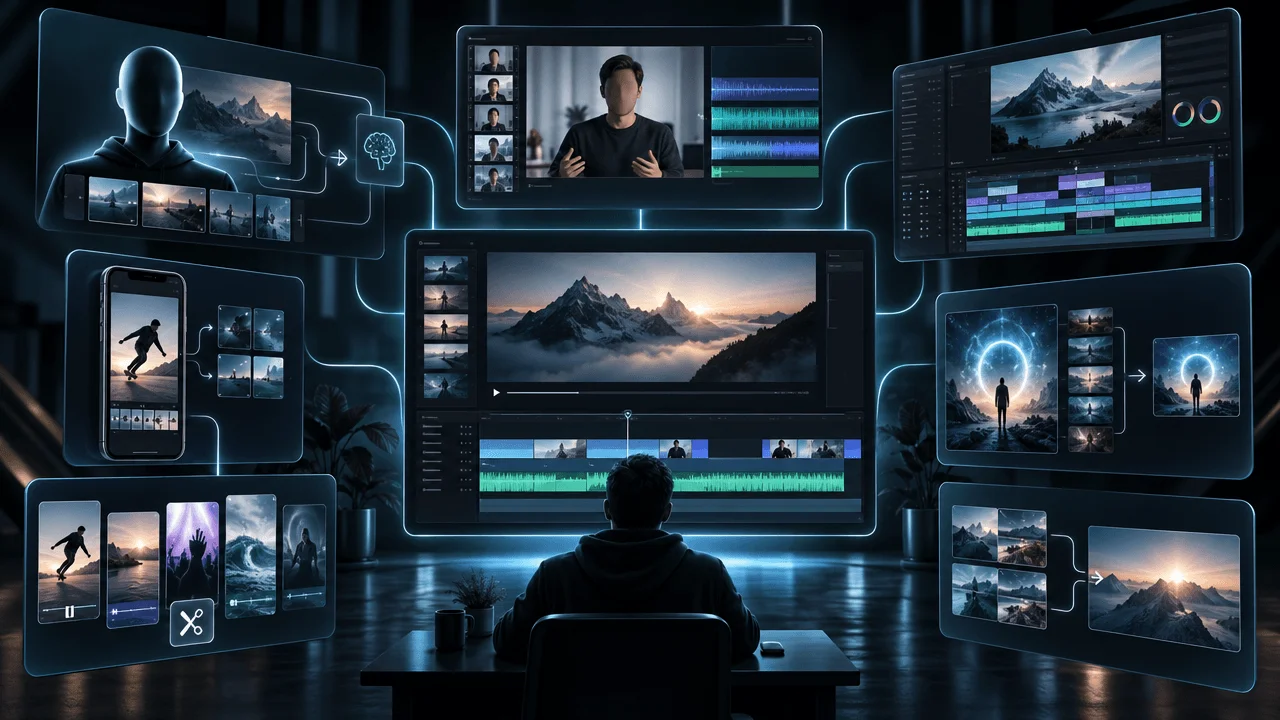
An AI storyboard generator for YouTube turns a finished script, outline, or video idea into a scene-by-scene visual plan before the final editing work begins.
For traditional productions, that plan may contain illustrated panels and camera instructions.
For faceless YouTube videos, it may be a structured timeline containing:
- Narration segment
- Visual concept
- Scene image
- Shot type
- On-screen text
- Motion direction
- Duration
- Transition
- Asset source
- Production status
The goal is not to create beautiful concept art for its own sake.
The goal is to answer one practical question:
What should the viewer see during every important moment of the video?
Quick Answer
An AI storyboard generator converts a script or video idea into a sequence of visual scenes or shots.
For YouTube creators, the strongest storyboard should connect:
- The title and thumbnail promise
- The spoken narration
- The visual shown during each line
- Scene timing
- Camera or motion direction
- Supporting proof
- Asset requirements
- Editing notes
- Production cost
- The final viewer payoff
Use a dedicated storyboard tool when you need visual planning, team approval, client review, camera direction, or illustrated frames.
Use a YouTube script-to-scene workflow when you already have a finished script and need to move directly into faceless video production.
Key Takeaways
- A YouTube storyboard is a visual production plan, not merely a collection of AI images.
- A script explains what will be said. A storyboard explains what will be shown.
- A storyboard frame represents a planned moment. A scene may contain several shots, movements, or visual changes.
- AI storyboard tools can split scripts into scenes, generate frames, suggest camera angles, and create shot lists.
- AI-generated storyboard images are planning references, not guaranteed final production assets.
- Visual consistency remains a major challenge, especially across recurring characters, locations, clothing, objects, and lighting.
- A useful storyboard should include purpose, timing, narration, visual direction, motion, source, and production status.
- Storyboarding before generation helps creators identify expensive or impossible scenes before spending credits.
- A visual change should support attention, clarity, proof, emotion, or progression. Constant change without purpose creates noise.
- Long-form videos, Shorts, documentaries, tutorials, reviews, and talking-head videos need different storyboard systems.
- OverseerOS Auto Edit provides a script-to-scene production workflow rather than a traditional client-presentation storyboard board.
- OverseerOS can segment narration into scenes, prepare visual prompts, generate scene visuals, support scene review, and continue into captions, music, motion, FX, and export.
- No storyboard generator can guarantee retention, viewer satisfaction, or YouTube performance.
What Is an AI Storyboard Generator?
An AI storyboard generator is software that converts a concept, brief, outline, screenplay, or script into a visual sequence.
Depending on the tool, it may produce:
- Scene breakdowns
- Storyboard panels
- AI-generated images
- Camera angles
- Shot descriptions
- Dialogue or narration
- Character references
- Location references
- Motion notes
- Transitions
- Timing
- Shot lists
- Animatics
- Client review links
- Production exports
A traditional storyboard artist interprets the script manually.
An AI storyboard generator automates part of that interpretation.
The tool may identify:
- Where the location changes
- Where a new subject enters
- Which action deserves its own shot
- When the emotional tone changes
- Which lines require visual proof
- When a close-up, wide shot, insert, or over-the-shoulder view may help
- Which scenes reuse the same character or environment
The creator then reviews and corrects the plan.
What Is a YouTube Storyboard?
A YouTube storyboard is a scene-by-scene or shot-by-shot plan showing how the video’s narration, visuals, timing, editing, and audience journey work together.
It can be created as:
- Illustrated panels
- A spreadsheet
- A card-based board
- An editing timeline
- A slide deck
- A production document
- An infinite canvas
- A script with visual notes
- A scene-management interface
A YouTube storyboard does not need to look like a film-school storyboard.
For a faceless educational channel, this may be enough:
| Time | Narration | Visual | Motion | Source |
|---|---|---|---|---|
| 0:00 to 0:03 | Eight of the twelve tools made the workflow slower | Twelve tool icons, eight immediately crossed out | Rapid sequential strikes | Custom graphic |
| 0:03 to 0:07 | The most expensive one caused the biggest delay | Pricing page beside a large timer | Slow push toward timer | Screen capture and graphic |
| 0:07 to 0:12 | Only four tools survived the final test | Four tools remain highlighted | Background dims, winners stay bright | Custom graphic |
That table is already a functional storyboard.
It tells production what to show, when to show it, and why the scene exists.
Script vs Outline vs Storyboard vs Shot List
These documents are related, but they are not interchangeable.
| Document | Main Question |
|---|---|
| Video brief | What are we making and why? |
| Outline | What information or story beats appear, and in what order? |
| Script | What exactly will the narrator or creator say? |
| Storyboard | What will the viewer see during each important moment? |
| Shot list | Which specific shots must be captured or generated? |
| Edit plan | How will the assets be assembled, timed, transitioned, and mixed? |
Outline
An outline establishes the content architecture.
Example:
- Hook
- Test criteria
- Biggest failure
- Four surviving tools
- Final workflow
Script
The script writes the narration.
Example:
The most surprising result was not that eight tools failed. It was that the most expensive tool created the longest delay.
Storyboard
The storyboard visualizes the narration.
Example:
- Start on a clean cost comparison
- Reveal the expensive tool
- Cut to a timer rapidly increasing
- Show an editor undoing several generated mistakes
- End on the final extra time added
Shot List
The shot list defines the assets needed.
Example:
- Screen recording of pricing page
- Close-up timer animation
- Editing timeline with revisions
- Product logo card
- Reaction insert
- Result chart
Scene vs Shot vs Frame vs Beat
Understanding these units prevents bloated storyboards.
Beat
A beat is a meaningful information, emotion, or story change.
Example:
The experiment appears successful, then the cost calculation reverses the conclusion.
A beat may happen inside one shot or across several scenes.
Scene
A scene is a continuous visual unit with one main location, subject, graphic setup, or visual purpose.
Example:
A comparison dashboard showing all twelve tools.
Shot
A shot is one uninterrupted camera view or generated clip.
One scene may contain:
- Wide shot
- Close-up
- Insert
- Screen recording
- Reaction shot
- Detail shot
Frame
A storyboard frame is a still image representing one planned shot or key visual moment.
One frame does not necessarily represent the entire scene.
The Core Difference: Writing Logic vs Visual Logic
A script follows language.
A storyboard follows attention.
These do not always change at the same moment.
One sentence may require three visuals:
The company grew faster than anyone expected, burned through its cash, and collapsed within eighteen months.
Possible storyboard:
- Revenue chart rising
- Cash balance falling
- Empty headquarters
- Eighteen-month timeline closing
Another paragraph may need only one visual:
The entire strategy depended on one assumption.
The camera may hold on a single document while one sentence is highlighted.
That stillness can create more tension than five random scene changes.
The correct storyboard does not ask:
How often can we change the image?
It asks:
What visual best supports this exact viewer moment?
What a Strong YouTube Storyboard Should Include
A professional storyboard can contain many fields.
Not every video needs all of them.
1. Scene Number
Give every scene a stable number or identifier.
This makes revision notes precise.
Weak feedback:
Change the image in the middle.
Strong feedback:
Replace scene 14 with a closer product comparison.
2. Time Range
Include:
- Start time
- End time
- Estimated duration
This helps production assess pacing and asset cost.
3. Narration Segment
Attach the exact script lines to the scene.
The editor should never have to guess which narration the visual supports.
4. Scene Purpose
Explain why the scene exists.
Possible purposes:
- Establish context
- Provide proof
- Create tension
- Explain a mechanism
- Introduce a character
- Show transformation
- Reset attention
- Deliver payoff
- Demonstrate a step
- Support a claim
A scene without a purpose is likely decoration.
5. Visual Concept
Describe what the viewer sees.
Weak:
AI image of technology.
Stronger:
Top-down desk containing twelve AI tool cards arranged like candidates in an elimination test, with eight cards fading into red failure states.
6. Shot Type
Useful shot types include:
- Extreme wide
- Wide
- Medium
- Close-up
- Extreme close-up
- Over-the-shoulder
- Point of view
- Top-down
- Insert
- Screen recording
- Split screen
- Diagram
- Timeline
- Data visualization
- Text-led scene
7. Composition
Define where important elements appear.
Examples:
- Character on right, negative space on left for text
- Product interface centered
- Subject in foreground, consequence visible in background
- Timeline moving left to right
- Vertical mobile-first composition
- Large readable object with minimal background detail
8. Character and Continuity Notes
Track:
- Face
- Age
- Clothing
- Hairstyle
- Accessories
- Body type
- Location
- Time of day
- Lighting
- Color palette
- Important objects
Without a continuity record, AI-generated storyboards can turn one character into several different people.
9. Camera Direction
Examples:
- Slow push in
- Static locked shot
- Pan left
- Tilt down
- Handheld movement
- Orbit around subject
- Rack focus
- Zoom out
- Tracking shot
- No camera movement
Motion should support the idea.
“Cinematic camera movement” is too vague.
10. Subject Motion
Camera motion and subject motion are different.
Examples:
- Character turns toward monitor
- Documents blow across desk
- Number counter rapidly falls
- Product cards disappear
- Door closes
- Map routes illuminate
- Graph line breaks downward
11. On-Screen Text
Specify:
- Exact words
- Position
- Timing
- Importance
- Whether narration also says them
Do not place entire paragraphs on screen.
Use text to emphasize:
- Number
- Date
- Name
- Result
- Contrast
- Question
- Warning
12. Asset Source
Mark each scene as:
- Original footage
- Screen recording
- Licensed stock
- Archive material
- Product screenshot
- Custom graphic
- AI image
- AI video
- Animation
- Uploaded reference
- Public-domain asset
This improves rights management and budgeting.
13. Sound Direction
Include:
- Music change
- Sound effect
- Silence
- Impact
- Interface click
- Environmental sound
- Whoosh
- Tension rise
- Voiceover pause
Audio can create a pattern break without changing the visual.
14. Transition
Examples:
- Hard cut
- Match cut
- Dissolve
- Whip transition
- Zoom transition
- Graphic wipe
- Object transition
- No visible transition
Transitions should not be randomly assigned to every scene.
15. Production Status
Possible labels:
- Planned
- Research needed
- Source missing
- Prompt ready
- Generated
- Approved
- Needs revision
- Animated
- Licensed
- Final
The Ideal YouTube Storyboard Template
| Field | What to Enter |
|---|---|
| Scene | Stable scene number |
| Time | Start, end, and duration |
| Narration | Exact script segment |
| Purpose | Why the scene exists |
| Visual | What the viewer sees |
| Shot | Framing and camera setup |
| Subject action | What moves inside the scene |
| Camera motion | How the camera moves |
| Text | On-screen words |
| Audio | Music, effects, silence |
| Transition | How the next scene begins |
| Source | Original, licensed, AI, stock, archive |
| Continuity | Character, location, clothing, objects |
| Status | Production progress |
How an AI Storyboard Generator Works
Most AI storyboard workflows use several stages.
Stage 1: Script Parsing
The system analyzes the script for:
- Paragraphs
- Sentences
- Dialogue
- Actions
- Locations
- Characters
- Emotional changes
- Topic changes
- Visual nouns
- Time references
Stage 2: Scene Segmentation
The tool decides where one scene should end and another should begin.
Possible boundaries include:
- New location
- New character
- New concept
- New example
- Major emotional turn
- Visual proof
- Comparison
- Transition
- Payoff
Poor segmentation creates two common problems:
Too Few Scenes
The video becomes visually static.
Too Many Scenes
Production becomes expensive, chaotic, and difficult to follow.
Stage 3: Visual Interpretation
The system converts narration into a scene concept.
Narration:
The company did not run out of customers. It ran out of time.
Literal weak visual:
Clock beside a company building.
Stronger visual:
A crowded checkout line outside a startup office while a large countdown reaches zero behind the founder.
The stronger image expresses the contradiction.
Stage 4: Shot Planning
The system may propose:
- Framing
- Camera angle
- Composition
- Character placement
- Focus
- Movement
- Lighting
Stage 5: Frame Generation
AI image models generate planning frames.
These may be:
- Sketches
- Illustrations
- Photorealistic frames
- 3D renders
- Anime scenes
- Product mockups
- Cinematic concept art
Stage 6: Continuity Management
More advanced tools may use:
- Character references
- Style references
- Location references
- Seed controls
- Project memory
- Reusable casts
- Fixed wardrobe
- Image-to-image generation
Continuity should still be reviewed manually.
Stage 7: Review and Revision
The creator or client can:
- Replace frames
- Change angles
- Rewrite prompts
- Move scenes
- Add notes
- Approve scenes
- Request revisions
- Compare versions
Stage 8: Production Handoff
The storyboard may become:
- Shot list
- Animatic
- Presentation
- Editing plan
- Image-generation queue
- Video-generation queue
- Production timeline
AI Storyboard Generator vs Script-to-Scene Generator
These workflows overlap, but their goals differ.
| Area | AI Storyboard Generator | Script-to-Scene Generator |
|---|---|---|
| Primary goal | Visualize and approve the planned production | Turn narration into production-ready scenes |
| Typical user | Filmmaker, agency, brand team, director | YouTube creator, faceless channel, editor |
| Main output | Panels, frames, camera notes, shot list | Timed scenes connected to script and voiceover |
| Client approval | Often central | Usually secondary |
| Image quality | Can range from sketch to polished concept art | Often closer to usable scene assets |
| Voiceover synchronization | Sometimes | Usually more important |
| Editing integration | May require export | Ideally connected to production |
| Captions and music | Usually outside the tool | May be inside the workflow |
| Final video export | Not always | Often part of the same system |
| Best for | Previsualization and alignment | Script-first faceless production |
A storyboard generator helps the team agree on the vision.
A script-to-scene generator helps the team produce the video.
AI Storyboard Generator vs AI Video Generator
An AI storyboard is not the finished video.
| Storyboard Generator | Video Generator |
|---|---|
| Plans the sequence | Produces moving footage |
| Uses representative frames | Generates complete clips |
| Cheap to revise | More expensive to regenerate |
| Helps catch problems early | Reveals final motion problems |
| Supports approval | Supports final production |
| Focuses on intention | Focuses on output |
Generating final clips before approving the storyboard is like filming before reading the shot list.
The result can look impressive while failing to tell the intended story.
Why YouTube Creators Need Storyboards
1. The Hook Becomes Visual
Creators often write strong opening narration and pair it with generic footage.
Title:
I Tested 12 AI YouTube Tools. Only Four Saved Time.
Hook narration:
Eight of the twelve tools made my workflow slower.
Weak opening visual:
Person typing on a futuristic laptop.
Stronger opening:
- Twelve tool cards appear
- Eight immediately fail
- A timer increases instead of decreasing
- Four tools remain hidden
- The question becomes visual
2. Visual Repetition Appears Early
A script may contain ten sections that all produce similar scene prompts.
Example:
- Person looking worried at computer
- Person looking confused at computer
- Person looking frustrated at computer
- Person looking shocked at computer
The storyboard reveals that repetition before generation begins.
3. Expensive Scenes Can Be Replaced
A line may require:
- Several consistent characters
- Complex crowd motion
- Accurate historical location
- Product interface
- Detailed machinery
- Multi-step transformation
The storyboard lets the creator redesign the scene before paying for multiple failed generations.
4. Proof Becomes Part of the Production
Statements such as these need visual evidence:
- Revenue increased
- Prices changed
- The feature disappeared
- The company made a claim
- The experiment took 14 hours
- The channel outperformed its baseline
A storyboard can mark the required:
- Chart
- Screenshot
- Document
- Screen recording
- Before-and-after result
- Citation card
5. Editors Receive Better Instructions
Weak editor note:
Make this section engaging.
Strong editor note:
During the 11-second explanation, begin with the pricing page, highlight the hidden usage charge, cut to the final invoice, then animate the total increasing from $20 to $143.
6. AI Generation Costs Become Predictable
Count the scenes requiring:
- New image generation
- Premium model
- Character reference
- Animation
- Regeneration
- Licensed asset
- Manual design
The storyboard becomes a production budget.
7. Rights Risks Become Visible
A plan that depends on:
- Movie clips
- News footage
- Sports broadcasts
- Social media reposts
- Copyrighted music
- Competitor thumbnails
should be reconsidered before editing begins.
How to Turn a YouTube Script Into a Storyboard
Step 1: Approve the Script Structure
Do not storyboard a script that is still fundamentally changing.
Confirm:
- Title promise
- Hook
- Section order
- Evidence
- Payoff
- Target duration
Small wording edits can happen later.
Large structural changes should happen first.
Step 2: Read the Script for Visual Beats
Highlight every moment where the viewer’s understanding changes.
Mark:
- New claim
- New location
- New example
- Important number
- Character introduction
- Emotional turn
- Proof
- Contrast
- Reversal
- Final answer
These become potential scene boundaries.
Step 3: Mark Must-Show Moments
Some information should not rely on narration alone.
Examples:
- Product interface
- Data
- Comparison
- Quoted claim
- Historical event
- Physical process
- Before and after
- Map
- Timeline
- Tutorial step
Label these before generating decorative visuals.
Step 4: Define the Function of Each Visual
Choose one primary function:
| Function | Visual Job |
|---|---|
| Clarify | Make a complex idea easier to understand |
| Prove | Show evidence supporting the narration |
| Demonstrate | Show how something works |
| Emotionalize | Make the consequence feel real |
| Orient | Establish time, place, or subject |
| Compare | Show a difference |
| Escalate | Increase stakes |
| Reset | Renew attention |
| Pay off | Deliver the promised result |
Step 5: Choose the Scene Boundary
Create a new scene when:
- The viewer needs a different mental picture
- The subject changes
- The location changes
- The proof changes
- The emotional state changes
- The current visual has completed its purpose
Do not create a new scene only because a sentence ended.
Step 6: Estimate Timing
A planning estimate can begin from narration speed.
At 150 words per minute:
150 words per minute ÷ 60 seconds = 2.5 words per second
A 25-word narration segment would take roughly 10 seconds.
That does not mean one static image should remain for 10 seconds.
The scene could contain:
- One image with controlled motion
- Three related shots
- One diagram building in stages
- Screen recording
- Text appearing progressively
Step 7: Choose the Visual Type
Possible choices:
- Original footage
- Talking head
- Screen recording
- Product demo
- Stock footage
- Archive
- AI image
- AI animation
- Motion graphic
- Diagram
- Data chart
- Text-led scene
- Screenshot
- Map
- Timeline
Use the lowest-cost format that communicates the idea well.
Step 8: Write the Scene Concept
Use this formula:
Show [subject] doing [specific action] in [environment], framed as [shot type], while [visual contrast or consequence] communicates [scene purpose].
Example:
Show a solo creator surrounded by twelve browser windows while a timer climbs upward, framed as a wide top-down workstation shot, communicating that the tools are increasing workload instead of removing it.
Step 9: Add Continuity Rules
Create a project bible containing:
Character
- Name
- Age
- Face
- Hair
- Clothing
- Accessories
- Body type
- Expression range
Environment
- Location
- Architecture
- Furniture
- Time of day
- Lighting
- Color palette
Style
- Photorealistic
- Documentary
- Illustration
- 3D
- Anime
- Graphic novel
- Minimal vector
Camera
- Lens feel
- Framing
- Depth
- Motion
- Aspect ratio
Step 10: Add Motion Intentionally
For each scene, decide:
- Static
- Camera motion
- Subject motion
- Graphic motion
- Transition only
- Full AI animation
Not every scene needs full animation.
A static close-up with deliberate sound can create more impact than uncontrolled AI motion.
Step 11: Add Production Source and Rights
Record:
- Asset owner
- License
- Generation source
- Screenshot source
- Permission
- Public-domain evidence
- Required attribution
Step 12: Review the Storyboard Without Audio
Look only at the frames.
Ask:
- Can I understand the progression?
- Does the video look repetitive?
- Are important facts visually supported?
- Does the opening create a question?
- Does the middle escalate?
- Is the final result visible?
Step 13: Review the Storyboard With Narration
Play the voiceover against the sequence.
Check:
- Visual timing
- Scene length
- Repeated images
- Delayed proof
- Abrupt cuts
- Missing moments
- Overloaded frames
- Narration and visual contradiction
Step 14: Approve Before Final Generation
Mark each scene:
- Approved concept
- Approved frame
- Approved motion
- Ready for production
Do not spend final-video credits on scenes that still have unresolved direction.
YouTube Storyboard Example
Working title:
I Tested 12 AI YouTube Tools. Only Four Saved Time.
| Scene | Narration | Visual Plan | Motion | Purpose |
|---|---|---|---|---|
| 1 | Eight of the twelve tools made the workflow slower | Twelve cards on a dark desk, eight fail instantly | Rapid elimination | Hook |
| 2 | The most expensive tool created the longest delay | High-price card beside growing timer | Slow push in | Contradiction |
| 3 | I tested every tool on the same video | One script moves through twelve identical test lanes | Horizontal tracking | Explain method |
| 4 | Research tools looked fast until fact checking began | AI report opens, unsupported claims highlight red | Text highlights | Reveal hidden cost |
| 5 | Script tools produced the same opening | Four scripts stack with identical phrases | Overlay alignment | Show repetition |
| 6 | Thumbnail tools generated polish, not strategy | Attractive thumbnails appear beside weak concepts | Split screen | Explain failure |
| 7 | Only four tools removed real work | Four cards finally illuminate | Background falls dark | Partial payoff |
| 8 | This was the final workflow | Four-stage pipeline assembles | Sequential build | Final answer |
| 9 | Automation worked only where judgment was preserved | Creator approves key decisions between stages | Controlled camera move | Thesis |
| 10 | The cheapest winning stack saved nine hours | Cost and time result lock on screen | Number count-up | Final payoff |
Storyboarding Different YouTube Formats
Faceless Documentary
Priorities:
- Historical accuracy
- Visual continuity
- Archive rights
- Maps
- Timelines
- Character identity
- Emotional progression
- Evidence
- Scene variety
Useful storyboard fields:
- Date
- Location
- Character
- Source
- Historical confidence
- Visual metaphor
- Archive alternative
Tutorial
Priorities:
- Exact interface state
- Cursor movement
- Zoom target
- Step order
- Error prevention
- Verification result
Useful storyboard fields:
- Screen
- Action
- Expected result
- Callout
- Zoom
- Common mistake
Product Review
Priorities:
- Test criteria
- Product close-ups
- Screen demonstrations
- Results
- Comparisons
- Limitations
- Verdict
Useful storyboard fields:
- Claim
- Test
- Evidence
- Product state
- Result
- Winner
Talking-Head Video
Priorities:
- Camera framing
- B-roll timing
- Text emphasis
- Pattern breaks
- Demonstrations
- Emotional changes
The storyboard may not require a generated image for every scene.
It may simply mark:
- Stay on speaker
- Cut to evidence
- Show diagram
- Return tighter
- Add text
- Hold silence
YouTube Short
Priorities:
- First frame
- Immediate movement
- One central idea
- Fast proof
- Mobile readability
- Clear payoff
- Loop or next action
A Shorts storyboard may use five to twelve beats rather than dozens of film-style shots.
Interview
Priorities:
- Question sequence
- Camera setup
- Guest reaction
- Cutaway assets
- Proof
- Follow-up prompts
- Promotional clips
Storyboard Quality Scorecard
Score each category from 1 to 5.
| Category | Question |
|---|---|
| Promise match | Does the visual sequence fulfill the title and thumbnail? |
| Hook visualization | Does the opening show the central tension immediately? |
| Clarity | Does every scene communicate one understandable idea? |
| Proof | Are important claims visually supported? |
| Progression | Does the sequence move forward rather than repeat? |
| Visual variety | Are scenes different without becoming random? |
| Continuity | Do characters, locations, and style remain coherent? |
| Production feasibility | Can every scene be created within budget and time? |
| Rights readiness | Are asset sources and permissions clear? |
| Payoff | Is the final answer visible and satisfying? |
Score Interpretation
| Total | Verdict |
|---|---|
| 43 to 50 | Ready for production |
| 35 to 42 | Strong, revise the weakest areas |
| 27 to 34 | Visually incomplete or repetitive |
| Below 27 | Rebuild before generating final assets |
This is a planning score.
It does not predict YouTube retention.
How to Prompt an AI Storyboard Generator
Weak prompt:
Make a storyboard for my YouTube video.
Stronger prompt:
Convert the following YouTube script into a scene-by-scene storyboard for a 16:9 faceless documentary.
For every scene, provide:
- Scene number
- Narration segment
- Estimated duration
- Scene purpose
- Visual concept
- Shot type
- Character and location continuity
- Subject motion
- Camera motion
- On-screen text
- Sound direction
- Transition
- Suggested asset source
Visual rules:
- Use one clear idea per scene
- Show proof for factual claims
- Avoid generic people looking at laptops
- Avoid repeating the same composition
- Maintain consistent characters and environments
- Use readable framing for 16:9 YouTube
- Mark scenes that require custom graphics, screen recordings, or licensed footage
- Prefer production-feasible visuals
- Do not invent brands, quotes, documents, or historical details
End with a continuity bible and a complete asset list.
AI Storyboard Generator Prompt for Shorts
Turn this script into a 9:16 YouTube Shorts storyboard.
Create one visual beat for every meaningful change in attention.
For each beat, include:
- Time range
- Narration
- First-frame composition
- Subject
- Action
- Camera movement
- Caption emphasis
- Sound effect
- Transition
Keep every important subject inside mobile-safe framing.
The first frame must communicate the topic without sound.
Avoid tiny interface screenshots, wide compositions, and long text.
Current AI Storyboard Tool Landscape
Boords
Best for:
- Agencies
- Brand teams
- Client approvals
- Script import
- Camera directions
- Shot lists
- Animatics
- Frame-level review
Boords can convert scripts and briefs into structured storyboard frames, support camera-angle exploration, maintain reusable cast references, collect feedback, and produce animatics and production exports.
Main limitation for YouTube creators:
It is designed broadly for professional pre-production and approval. A creator may still need a separate YouTube script, voiceover, editing, captions, music, and publishing workflow.
LTX Studio
Best for:
- AI filmmaking
- Narrative projects
- Script visualization
- Frame-level creative control
- Storyboard-to-video workflows
LTX Studio can transform concepts or scripts into visual boards and provides control at project, board, and frame levels.
Main limitation:
Its filmmaking-oriented workflow may be more extensive than a creator needs for a simple educational or talking-head YouTube video.
Katalist
Best for:
- Script-to-storyboard conversion
- Character-driven narratives
- AI visual storytelling
- Storyboard-to-video workflows
- Creators who need recurring characters
Katalist can analyze scripts, identify scenes and characters, generate storyboard visuals, and continue into supported AI video workflows.
Main limitation:
Creators still need to verify whether generated characters, scenes, pacing, and camera decisions accurately support the specific YouTube script.
StoryboardHero
Best for:
- Agencies
- Advertising concepts
- Voiceover-led boards
- Camera and transition notes
- PDF presentation
- Human-assisted sketch options
StoryboardHero connects concept creation, structured scripts, AI images, voiceover, camera angles, transitions, and shareable storyboard output.
Main limitation:
It is optimized heavily around concept presentation and production planning rather than YouTube channel research and publishing strategy.
Adobe Firefly Boards
Best for:
- Visual ideation
- Moodboards
- Creative exploration
- Image remixing
- Collaborative concept development
- Adobe-centered teams
Firefly Boards can organize text, references, and generated images into visual concepts and storyboards.
Main limitation:
A flexible visual board does not automatically create a complete YouTube-specific narration-to-scene production plan.
Canva Storyboard Creator
Best for:
- Beginners
- Templates
- Manual storyboarding
- Drag-and-drop planning
- Team collaboration
- Simple client presentations
Canva provides storyboard templates, stock assets, collaboration, and AI-assisted media creation.
Main limitation:
It is closer to a flexible design and storyboard workspace than a specialized automatic script-to-shot production engine.
OverseerOS Auto Edit
Best for:
- Faceless YouTube videos
- Script-first production
- Voiceover-based scene timing
- AI scene generation
- Shorts and long-form
- Creators moving from planning into final production
OverseerOS Auto Edit Studio is not positioned as a traditional illustrated storyboard presentation tool.
It provides a production-oriented storyboard-like workflow.
The process can include:
- Start from a finished script and voiceover.
- Choose Shorts or long-form.
- Define visual style direction.
- Segment narration into scenes.
- Prepare AI visual direction for each scene.
- Generate scene visuals.
- Review scenes in a timeline.
- Inspect and refine individual scenes.
- Regenerate or replace supported scene visuals.
- Add captions, music, motion, FX, and transitions.
- Export a supported final video.
This is closer to:
Script → scene plan → scene assets → final video
than:
Script → illustrated PDF storyboard
How OverseerOS Connects Script, Storyboard, and Production
Start With an Approved Script
Use OverseerOS Script Studio to develop:
- Title
- Hook
- Outline
- Section structure
- Full narration
- Creator tone
- Retention improvements
- Voiceover-ready script
Convert the Script Into Scenes
OverseerOS Script to Scene Generator helps turn the finished narration into scene-by-scene production structure.
Each scene can remain connected to:
- Narration
- Visual concept
- Timing
- Project style
- Generated asset
- Production status
Review the Scene Timeline
Inside OverseerOS Auto Edit, creators can inspect the scene sequence rather than treating the finished video as one black-box generation.
This helps identify:
- Weak images
- Repeated concepts
- Incorrect scene direction
- Inconsistent visuals
- Timing problems
- Missing production assets
Refine Individual Scenes
Supported workflows can allow creators to:
- Edit a scene concept
- Regenerate a scene image
- Replace a scene visual
- Upload a supported image
- Preview the selected scene
- Animate supported scenes
- Remove weak motion clips
Add Visual Consistency
OverseerOS Consistent Character Generator can help supported scenes follow a recurring reference character.
This is useful for:
- Recurring hosts
- Story characters
- Historical reconstructions
- Branded mascots
- Consistent visual identities
The creator should still review every result for:
- Face drift
- Clothing changes
- Age changes
- Object changes
- Style drift
- Incorrect anatomy
Add Motion
OverseerOS AI Video Animation Generator can animate supported scene visuals inside the same Auto Edit project.
Motion remains connected to:
- Scene intent
- Script
- Voiceover
- Visual direction
- Project format
Continue Into Final Production
The scene workflow can continue into:
- Captions
- Music
- FX
- Transitions
- Motion
- Logo controls
- Preview
- Export
The complete workflow becomes:
Evidence-backed idea → title → outline → script → voiceover → storyboard-like scene plan → generated visuals → scene review → motion → final video.
The Best YouTube Storyboard Workflow
- Validate the video idea.
- Define the title and thumbnail promise.
- Approve the outline.
- Finish the script.
- Generate or record the voiceover.
- Mark visual beats.
- Identify must-show evidence.
- Build scene concepts.
- Add timing.
- Create the continuity bible.
- Assign asset sources.
- Generate rough storyboard frames.
- Review visual progression.
- Replace repetitive or expensive scenes.
- Approve the storyboard.
- Generate or capture final assets.
- Add motion selectively.
- Build captions and sound.
- Export the video.
- Review YouTube retention and use the results to improve the next storyboard.
Common Mistakes
Mistake 1: Treating AI Images as the Storyboard
A folder containing 40 images is not automatically a storyboard.
The sequence still needs timing, narration, purpose, and production direction.
Mistake 2: Generating Final Assets Too Early
Rough frames are cheaper to revise than final animated scenes.
Approve the concept first.
Mistake 3: Visualizing Every Sentence Literally
Narration:
The business was running out of runway.
Literal visual:
Airplane runway.
The intended meaning is financial survival.
Visualize the idea, not only the words.
Mistake 4: Using Generic Filler
Common filler includes:
- Person typing
- Glowing AI brain
- Futuristic city
- Random charts
- Generic handshake
- Worried face
- Rocket launch
Use visuals connected to the actual claim.
Mistake 5: Changing the Visual Constantly
Fast changes can create motion without comprehension.
Hold the shot when the viewer needs time to:
- Read
- Understand
- Compare
- Feel tension
- Observe proof
Mistake 6: Keeping One Image Too Long
A long static image may work when it contains meaningful progression, zoom, annotation, or sound design.
A static decorative image usually becomes invisible to the viewer.
Mistake 7: Ignoring Continuity
Do not regenerate recurring characters from scratch in every scene.
Use references and continuity notes.
Mistake 8: Storyboarding Before the Script Is Stable
Major script changes can invalidate the entire visual plan.
Approve structure first.
Mistake 9: Ignoring the Voiceover Timing
A scene plan based only on text length may drift once the final voice includes pauses, emphasis, and changes in speed.
Use the real narration when available.
Mistake 10: Using the Same Shot Type Repeatedly
Ten consecutive centered medium shots feel mechanical.
Vary framing based on purpose.
Mistake 11: Adding Camera Motion Everywhere
Camera motion should communicate:
- Discovery
- Tension
- Scale
- Attention
- Movement
- Transition
Random motion makes the video feel artificial.
Mistake 12: Forgetting Rights and Sources
A perfect storyboard is unusable when half the assets cannot legally appear in the final video.
Mistake 13: Creating Scenes That Cannot Be Generated
AI still struggles with many complex interactions, precise text, continuity, crowded scenes, and detailed physical processes.
Redesign difficult scenes as:
- Diagrams
- Split screens
- Screen recordings
- Custom graphics
- Simpler compositions
- Several short shots
Mistake 14: Copying Another Creator’s Visual Sequence
Studying pacing or shot principles can be useful.
Do not reproduce another video’s exact:
- Scene order
- Visual concepts
- Graphics
- Footage
- Characters
- Transitions
- Protected assets
Mistake 15: Letting the Tool Direct the Entire Video
AI can propose frames.
The creator must still decide:
- What matters
- What is accurate
- What is ethical
- What is visually clear
- What is original
- What the channel should look like
Pre-Production Storyboard Checklist
Script
- The title promise is clear.
- The hook is approved.
- The section order is stable.
- Major claims are verified.
- The ending delivers a real payoff.
Visual Strategy
- Every scene has one primary purpose.
- Important claims have visual proof.
- The hook is understandable without sound.
- Visuals progress rather than repeat.
- Abstract ideas have clear visual solutions.
Continuity
- Recurring characters have references.
- Clothing and appearance are documented.
- Locations and lighting are consistent.
- Important objects remain recognizable.
- The project has one visual style direction.
Production
- Each asset source is identified.
- Expensive scenes are approved.
- Difficult scenes have fallback plans.
- Scene timing matches the voiceover.
- Generation and animation costs are estimated.
Rights
- Stock licenses are documented.
- Archive footage is cleared.
- Music rights are confirmed.
- Screenshots are used responsibly.
- AI-generated assets meet the tool’s commercial-use terms.
Final Review
- The storyboard fulfills the title.
- The first 30 seconds contain visual proof.
- The middle escalates.
- The final result is visible.
- The editor can produce the video without guessing.
Final Verdict
An AI storyboard generator for YouTube should not be judged by how beautiful its images look.
It should be judged by whether it creates a clearer, cheaper, more controllable production.
A strong storyboard tells the team:
- What the viewer sees
- Why the scene exists
- Which narration it supports
- How long it lasts
- What moves
- What evidence appears
- Which asset is required
- What must remain consistent
- What can be generated
- What is ready for approval
Dedicated storyboard platforms are strongest when creators need:
- Illustrated panels
- Camera planning
- Animatics
- Team comments
- Client approval
- Shot lists
- Presentation exports
YouTube script-to-scene systems are stronger when creators need:
- Narration segmentation
- Voiceover timing
- Faceless scene generation
- Scene review
- Visual replacement
- Captions
- Motion
- Music
- FX
- Final export
For serious YouTube production, the storyboard should sit between the script and the expensive work.
The complete sequence is:
Idea → title → outline → script → storyboard → assets → edit → publish → audience data.
Do not ask the editor to discover the video after the script is finished.
Do not ask a video generator to invent the visual story one prompt at a time.
Plan what the viewer should see before production becomes expensive.
Then use AI to execute a direction that has already been chosen.
Read the best AI scene generators for YouTube, then use OverseerOS Script to Scene Generator when the finished storyboard needs to move into actual faceless video production.
FAQ
What is an AI storyboard generator for YouTube?
An AI storyboard generator for YouTube turns a video idea, outline, or script into a visual sequence containing scenes, frames, shot directions, timing, narration, and production notes.
Can AI automatically storyboard a YouTube script?
Yes. AI can split a script into scenes, propose visual concepts, generate representative frames, and suggest camera directions. The creator should review the segmentation, accuracy, continuity, and production feasibility.
What is the difference between a storyboard and a script?
A script contains the words that will be spoken. A storyboard shows what the viewer should see while those words are delivered.
What is the difference between a storyboard and an outline?
An outline organizes the video’s information or story beats. A storyboard converts the approved structure and script into visual scenes or shots.
What is the difference between a storyboard and a shot list?
A storyboard visualizes the planned sequence. A shot list is an operational list of the specific shots that must be filmed, captured, designed, or generated.
Do YouTube creators need a storyboard?
Not every simple video needs a formal storyboard. Storyboards become especially valuable for faceless videos, documentaries, animation, tutorials, client work, team production, AI-generated video, and visually complex scripts.
Do talking-head YouTube videos need storyboards?
A talking-head video may use a lightweight storyboard marking camera changes, B-roll, graphics, demonstrations, on-screen text, and pattern breaks.
Do YouTube Shorts need storyboards?
Shorts benefit from beat-level storyboards that define the first frame, hook, motion, captions, proof, payoff, and mobile-safe composition.
Can I create a storyboard without drawing?
Yes. A storyboard can use written scene cards, stock images, screenshots, diagrams, rough AI frames, or simple sketches.
Can ChatGPT generate a YouTube storyboard?
A language model can create a written scene breakdown and visual prompts. A dedicated storyboard or video-production tool is usually better for frame generation, sequencing, visual review, continuity, and production handoff.
Can an AI storyboard generator create consistent characters?
Some tools support character references or reusable casts. Consistency still requires review because faces, clothing, age, objects, and locations can drift across generated frames.
How many storyboard frames does a YouTube video need?
There is no universal number. The correct number depends on duration, format, visual complexity, narration speed, production style, and how much changes inside each scene.
How long should each storyboard scene last?
Scene duration should match the viewer’s need to understand the visual and the pace of the narration. Some shots may last less than a second, while diagrams, demonstrations, and emotional moments may need significantly longer.
Should every sentence have a new scene?
No. Create a new scene when the visual idea, subject, proof, location, emotion, or purpose changes.
What should a YouTube storyboard include?
Include scene number, timing, narration, scene purpose, visual concept, shot type, subject action, camera motion, on-screen text, sound, transition, asset source, continuity notes, and production status.
Can a storyboard improve YouTube retention?
A storyboard can reduce visual repetition, delayed proof, confusing scenes, weak hooks, and pacing problems. It cannot guarantee retention because performance also depends on the idea, script, voice, edit, packaging, and audience fit.
Should I storyboard before recording the voiceover?
A rough storyboard can be created from the script. Final timing is easier to approve after the real voiceover is available.
Should I generate final AI images during storyboarding?
Use rough or lower-cost frames first when possible. Approve the concept and sequence before paying for final assets or animation.
What is an animatic?
An animatic is a timed video preview created from storyboard frames, often with temporary narration, music, or sound. It helps test pacing before final production.
What is the best AI storyboard generator?
The best tool depends on the workflow. Boords is strong for agencies and approvals, LTX Studio for AI filmmaking, Katalist for character-driven storyboard-to-video work, Adobe Firefly Boards for ideation, Canva for simple manual boards, and OverseerOS Auto Edit for YouTube script-to-scene production.
Is Canva an AI storyboard generator?
Canva provides storyboard templates, stock media, collaboration, drag-and-drop design, and AI-assisted media tools. It is useful for manual and semi-assisted storyboarding rather than specialized automatic script-to-shot production.
Can AI turn a storyboard into a finished video?
Some platforms can generate video clips or complete projects from storyboard scenes. The quality still depends on motion, continuity, prompt accuracy, sound, editing, and human review.
What is OverseerOS Script to Scene Generator?
OverseerOS Script to Scene Generator is a workflow inside Auto Edit that turns a finished YouTube script into scene-by-scene production structure connected to visual direction, AI scenes, captions, motion, music, FX, and export controls.
Is OverseerOS a traditional storyboard tool?
Not exactly. OverseerOS focuses on moving a finished script and voiceover into a scene-based faceless YouTube production workflow. It is closer to an executable production storyboard than a static illustrated presentation board.
Can OverseerOS regenerate individual scenes?
Supported Auto Edit workflows allow creators to inspect scenes and regenerate or replace supported visual assets without rebuilding the complete video.
Can OverseerOS use uploaded images for scenes?
Supported workflows can allow a creator to replace a scene visual with an uploaded image, subject to available controls, formats, account access, and current rollout.
Can OverseerOS animate storyboard scenes?
Supported scene visuals can move into the OverseerOS animation workflow, where motion is connected to the script, voiceover, scene intent, and project direction.
Can OverseerOS keep characters consistent?
OverseerOS includes a supported reference-based Consistent Character workflow designed to help recurring characters remain visually aligned across scenes. Results still require creator review.
Does an AI storyboard guarantee better YouTube performance?
No. A storyboard improves production planning. Views and retention still depend on topic demand, title, thumbnail, script, delivery, editing, audience fit, and viewer satisfaction.
What is the best YouTube storyboard workflow?
Approve the title and script, mark visual beats, identify proof, build scene concepts, add timing and continuity, generate rough frames, review the full sequence, approve production, generate final assets, edit, publish, and learn from YouTube Analytics.