Most YouTube videos do not fail on upload day.
They fail much earlier.
They fail when the idea is approved.
Before the script.
Before the thumbnail.
Before the voiceover.
Before the editor spends hours building the video.
Before the creator realizes the topic never had enough demand, the angle was weak, the thumbnail was unclear, or the viewer did not care.
That is the hidden cost of YouTube.
Not editing.
Not voiceover.
Not thumbnails.
Bad approvals.
A YouTube video idea scoring system helps creators stop producing videos that were already weak before production started.
Because if the idea is wrong, every step after that becomes damage control.
A better script cannot fully save a weak topic.
A better thumbnail cannot fully save a boring promise.
A better edit cannot fully save a video nobody wanted.
The goal is simple:
Stop guessing what to produce.
Score the idea first.
Quick Answer: What Is a YouTube Video Idea Scoring System?
A YouTube video idea scoring system is a decision framework that helps creators judge whether a video idea is worth producing before spending time, money, or team effort on it.
It scores an idea based on signals like:
- Viewer demand
- Topic fit
- Audience pain
- Original angle
- Title strength
- Thumbnail clarity
- Retention potential
- Production difficulty
- Monetization value
- Channel strategy fit
- Competitor proof
- Risk of generic content
A weak creator asks:
Can we make this video?
A serious creator asks:
Should we make this video?
That one question can save thousands of dollars and months of wasted production.
Key Takeaways
- Most YouTube production waste starts before the script, thumbnail, or edit.
- A video idea should be scored before it enters production.
- The best YouTube creators do not only create more ideas. They reject more weak ideas.
- A strong idea should have demand, a clear viewer, a strong angle, a clickable title path, a visual thumbnail path, and a realistic production path.
- A weak idea can still look exciting if the niche is hot, but the video may fail if the viewer promise is unclear.
- A scoring system helps teams make better decisions without relying only on gut feeling.
- The goal is not to remove creativity. The goal is to protect creativity from waste.
- OverseerOS fits this workflow because it helps creators research channels, find proven topics, track competitors, plan content, generate scripts, and connect decisions before production starts.
Why YouTube Creators Need a Scoring System
Most creators have too many ideas.
That sounds like a good problem.
But it creates chaos.
Ideas come from everywhere:
- Competitors
- Trends
- Comments
- Search results
- AI tools
- Team members
- Sponsors
- Personal inspiration
- News
- Old videos
- Random shower thoughts
The issue is not idea supply.
The issue is idea selection.
A creator who approves everything becomes busy.
A creator who scores ideas becomes strategic.
The difference is massive.
Without a scoring system, the team may produce videos because:
- The topic sounds interesting
- A competitor made something similar
- The idea came from AI
- The title sounds clickable
- The niche has high RPM
- The team needs to upload something
- The creator feels pressure to stay consistent
But none of that proves the video is worth making.
A scoring system forces the idea to earn production.
The Most Expensive Sentence in YouTube
The most expensive sentence is:
Let’s just make it.
That sentence sounds harmless.
But it can trigger:
- Writer cost
- Research cost
- Voiceover cost
- Thumbnail cost
- Editing cost
- Review time
- Upload time
- Opportunity cost
- Team coordination
- Brand risk
- Audience fatigue
If the video fails, the cost is not only money.
The bigger cost is the better video you did not make.
Every weak idea takes space from a stronger one.
That is why serious creators need kill criteria.
What Are Kill Criteria?
Kill criteria are the rules that stop a video idea before production.
They protect the channel from weak decisions.
Examples:
Kill the idea if there is no clear viewer pain.
Kill the idea if the thumbnail cannot be made clear in one second.
Kill the idea if the title needs too much explanation.
Kill the idea if it does not fit a content pillar.
Kill the idea if competitors have covered it better and we have no new angle.
Kill the idea if production cost is high but upside is unclear.
Kill the idea if the video only exists because we need to upload.
Kill criteria are not negative.
They are strategic.
They create focus.
The YouTube Video Idea Scorecard
Score every idea from 1 to 5 in each category.
| Category | Question | Score |
|---|---|---|
| Demand Proof | Is there evidence viewers want this? | 1-5 |
| Viewer Pain | Does this solve or reveal a real viewer problem? | 1-5 |
| Channel Fit | Does it fit our channel promise and pillars? | 1-5 |
| Original Angle | Do we have a fresh angle, not just the same topic? | 1-5 |
| Title Potential | Can this become a strong clickable title? | 1-5 |
| Thumbnail Potential | Can this become a clear visual promise? | 1-5 |
| Retention Potential | Can the video hold attention beyond the hook? | 1-5 |
| Production Reality | Can we produce this well with our resources? | 1-5 |
| Monetization Value | Does it attract a valuable viewer or sponsor fit? | 1-5 |
| Strategic Upside | Can this become a series, pillar, or long-term asset? | 1-5 |
Total score:
45-50 = Strong idea. Prioritize.
38-44 = Good idea. Improve title, angle, or thumbnail before production.
30-37 = Risky idea. Needs stronger proof or sharper packaging.
Below 30 = Kill or park.
The score does not replace judgment.
It improves judgment.
The 10 Scoring Categories Explained
1. Demand Proof
Do not approve an idea only because it sounds good.
Ask:
Where is the proof that viewers care?
Demand proof can come from:
- Competitor breakout videos
- Search demand
- Repeated audience comments
- Recent news
- Fast-growing channels
- Forum discussions
- Community pain points
- Old videos on your channel
- Trends in your niche
- High-performing adjacent topics
Weak demand proof:
I think this is interesting.
Strong demand proof:
Three small channels in this niche got breakout views on this topic in the last 60 days, and the comments show viewers still have unanswered questions.
Demand proof does not guarantee success.
But no proof makes the idea dangerous.
2. Viewer Pain
A strong video usually connects to a viewer pain, fear, desire, curiosity, or decision.
Ask:
What does the viewer already care about before seeing this video?
Weak viewer pain:
People want to learn about AI.
Strong viewer pain:
Creators are confused about which AI tools actually save time and which ones only create more work.
Weak viewer pain:
People want to grow on YouTube.
Strong viewer pain:
Faceless creators are spending money on videos before knowing if the idea is worth producing.
The sharper the pain, the easier it is to package the video.
3. Channel Fit
Not every good idea belongs on your channel.
An idea can be strong and still be wrong for you.
Ask:
Does this video strengthen what the channel should be known for?
If the answer is no, be careful.
Random success can hurt a channel.
A video may get views but attract the wrong audience.
A channel needs consistency.
A good idea should fit at least one content pillar.
If it does not fit any pillar, ask:
Is this a new pillar, or is this random?
Most of the time, it is random.
4. Original Angle
A topic is not enough.
The angle is what makes it yours.
Topic:
YouTube automation
Weak angle:
How to start YouTube automation
Stronger angle:
Faceless YouTube Is Not Dead. Lazy Automation Is.
Topic:
AI tools
Weak angle:
Best AI tools for creators
Stronger angle:
The AI Tools Creators Keep Paying For After the Hype Dies
Topic:
Video ideas
Weak angle:
How to find video ideas
Stronger angle:
Stop Producing Videos That Were Dead Before Upload
The angle creates differentiation.
Without an angle, the video becomes another version of what already exists.
5. Title Potential
Before approving an idea, test whether it can become a strong title.
If every title sounds boring, the idea may be weak.
Ask:
Can we write five strong title options without forcing it?
Example idea:
AI video production workflow
Weak titles:
How to make AI videos
Best AI video workflow
AI video production explained
Better titles:
The AI Video Workflow That Stops Creators From Making Slop
Why Your AI Video Workflow Breaks Before Editing Starts
The New AI Video Production System Serious Creators Need
If the title path is strong, the video has packaging potential.
If the title path is weak, fix the angle before production.
6. Thumbnail Potential
Some ideas are hard to visualize.
That does not always mean they are bad.
But it makes them riskier.
Ask:
Can we show the promise in one second?
Weak thumbnail path:
A laptop with YouTube on screen.
Strong thumbnail path:
A video idea card being rejected before it enters an expensive production pipeline.
Weak thumbnail path:
A robot holding a script.
Strong thumbnail path:
A script document stamped “generic” while a retention graph collapses beside it.
The thumbnail should not simply show the topic.
It should show the tension.
7. Retention Potential
A video can be clickable but impossible to sustain.
Ask:
What keeps the viewer watching after the first 30 seconds?
Retention potential can come from:
- A mystery
- A step-by-step process
- A transformation
- A case study
- A countdown
- A reveal
- A before-and-after
- A mistake and fix
- A framework
- A strong story
- A practical template
Weak retention structure:
We explain the topic.
Strong retention structure:
We show the hidden reason creators approve weak ideas, then give a scoring system that reveals which ideas should be killed before production.
The second version creates movement.
8. Production Reality
Some ideas are good but too expensive, too slow, or too complex for your current team.
Ask:
Can we produce this video at the quality it deserves?
A cinematic documentary idea may need:
- Deep research
- Better visuals
- Stronger editing
- More time
- Better voiceover
- More expensive assets
If the team cannot execute it well, the idea may need to be simplified.
Production reality matters.
A high-potential idea executed badly can damage trust.
9. Monetization Value
Views are not the only goal.
Ask:
What kind of viewer does this attract?
Some videos attract casual viewers.
Some attract buyers.
Some attract sponsors.
Some attract future customers.
Some attract low-value attention.
For a creator business, a lower-view video with high buyer intent can be more valuable than a viral video with random viewers.
Examples of high-value viewer signals:
- They are comparing tools
- They have a business problem
- They want a workflow
- They are trying to save money
- They need a decision
- They manage a team
- They already spend on solutions
- They are searching for software
This is why buyer-intent content matters.
10. Strategic Upside
Some ideas are one-off videos.
Others can become assets.
Ask:
Can this idea become more than one upload?
Strategic upside includes:
- Can it become a series?
- Can it support a product?
- Can it become a template?
- Can it become a content pillar?
- Can it rank in search?
- Can it earn backlinks?
- Can it convert customers?
- Can it become an evergreen guide?
- Can it create internal links?
- Can it attract sponsors?
The best ideas often do more than get views.
They strengthen the channel ecosystem.
The Red Flag List: Kill the Idea Fast
Some ideas should not enter production.
Kill or pause the idea if:
There is no clear viewer.
The title sounds generic.
The thumbnail concept is unclear.
The topic does not fit the channel.
There is no proof of demand.
The angle is identical to competitors.
The video exists only because the team needs to upload.
The production cost is high and the upside is unclear.
The idea attracts the wrong audience.
The script would become a generic explanation.
The video cannot deliver the promise honestly.
The best creators are not just good at choosing ideas.
They are good at killing bad ones.
The Green Light List: Approve the Idea
Approve the idea when:
There is clear demand proof.
The viewer pain is specific.
The topic fits a pillar.
The angle feels fresh.
The title path is strong.
The thumbnail path is visual.
The script has a clear structure.
The team can produce it well.
The viewer has strategic or commercial value.
The idea can become a repeatable asset.
A strong idea should feel easier to package.
If everything feels forced, the idea may not be ready.
The Idea Triage System
Do not treat every idea the same.
Put ideas into four buckets.
Bucket 1: Produce Now
These ideas have strong scores and clear production paths.
Use for your next batch.
Bucket 2: Improve First
These ideas have potential but need a better angle, title, thumbnail, or proof.
Do not produce yet.
Bucket 3: Park for Later
These ideas may become useful later but are not urgent.
Save them.
Bucket 4: Kill
These ideas are weak, off-strategy, unclear, or too expensive.
Delete or archive them.
A serious content system needs all four buckets.
If every idea stays alive forever, your planning board becomes a graveyard.
The YouTube Idea Scoring Template
Use this before production.
YouTube Video Idea Scoring Template

Raw idea:
Content pillar:
Target viewer:
Viewer state:
Viewer pain:
Viewer desire:
Viewer fear:

Demand proof:
Competitor proof:
Search proof:
Trend proof:
Comment proof:
Internal channel proof:

Original angle:
Working title:
Thumbnail concept:
Script structure:
Retention mechanism:

Scores:
Demand proof: /5
Viewer pain: /5
Channel fit: /5
Original angle: /5
Title potential: /5
Thumbnail potential: /5
Retention potential: /5
Production reality: /5
Monetization value: /5
Strategic upside: /5

Total score: /50

Decision:
Produce now / Improve first / Park / Kill

Reason:
Next action:
Owner:
Deadline:
This turns idea selection into a real decision.
The 30-Minute Video Idea Approval Meeting
Use this process with your team.
Minute 0 to 5: Present the Idea
Show:
- Raw idea
- Viewer
- Demand proof
- Working title
- Thumbnail concept
Minute 5 to 10: Challenge the Demand
Ask:
Why do we believe viewers care?
Minute 10 to 15: Challenge the Angle
Ask:
What makes this different from what already exists?
Minute 15 to 20: Challenge the Packaging
Ask:
Can this become a strong title and thumbnail?
Minute 20 to 25: Challenge the Production
Ask:
Can we produce this at the quality it deserves?
Minute 25 to 30: Score and Decide
Choose:
Produce now
Improve first
Park
Kill
This meeting prevents vague approvals.
Example: Scoring a Weak Idea
Raw idea:
Best AI tools for YouTubers
Score:
| Category | Score |
|---|---|
| Demand Proof | 4 |
| Viewer Pain | 2 |
| Channel Fit | 4 |
| Original Angle | 1 |
| Title Potential | 2 |
| Thumbnail Potential | 2 |
| Retention Potential | 2 |
| Production Reality | 5 |
| Monetization Value | 4 |
| Strategic Upside | 3 |
Total:
29/50
Decision:
Improve first
Why?
The topic has demand, but the angle is generic.
Better version:
The AI Tools YouTubers Keep Paying For After the Hype Dies
Now the idea has more curiosity, trust, and originality.
Example: Scoring a Stronger Idea
Raw idea:
Why faceless creators waste money producing weak videos
Working title:
Stop Producing Videos That Were Dead Before Upload
Thumbnail concept:
A video idea card being stopped at a red approval gate before entering an expensive production pipeline.
Score:
| Category | Score |
|---|---|
| Demand Proof | 4 |
| Viewer Pain | 5 |
| Channel Fit | 5 |
| Original Angle | 5 |
| Title Potential | 5 |
| Thumbnail Potential | 4 |
| Retention Potential | 5 |
| Production Reality | 5 |
| Monetization Value | 5 |
| Strategic Upside | 5 |
Total:
48/50
Decision:
Produce now
Why?
The idea is painful, visual, useful, buyer-intent aligned, and strategically connected.
Example: Scoring a Trend Idea
Raw idea:
A new AI video model just launched
Score depends on the angle.
Weak angle:
New AI video model explained
Stronger angle:
The AI Video Model That Could Break Low-End Editing
Ask:
- Is the trend still fresh?
- Does the audience care?
- Can we explain why it matters?
- Can we connect it to a bigger shift?
- Can we produce fast enough?
- Will the video matter after 72 hours?
Trends need speed and interpretation.
A trend without interpretation becomes news noise.
Example: Scoring an Evergreen Idea
Raw idea:
How to build a YouTube content calendar
Weak angle:
How to make a YouTube content calendar
Stronger angle:
Build a YouTube Content Calendar From Proven Patterns, Not Random Ideas
Evergreen ideas should be scored on:
- Search intent
- Long-term usefulness
- Internal link value
- Product alignment
- Template potential
- SERP weakness
- Audience fit
Evergreen content may not spike fast.
But it can compound.
Why This Matters More for Faceless YouTube
Faceless creators often work with teams.
Writers.
Voiceover artists.
Editors.
Thumbnail designers.
Managers.
Automation tools.
That means each approved idea triggers a production chain.
Bad ideas become expensive quickly.
A personal creator can sometimes test a weak idea with a quick recording.
A faceless team may spend days producing it.
That is why faceless channels need stronger approval systems.
A video idea should not move to script just because it sounds good.
It should pass the scorecard.
The Production Cost Trap
Many creators calculate cost only in money.
But production cost includes:
- Money
- Time
- Attention
- Team energy
- Opportunity cost
- Review effort
- Brand risk
- Audience fatigue
A $60 video can still be expensive if it replaces a $5,000 opportunity.
The real question is:
Is this the best use of this production slot?
That is what scoring helps answer.
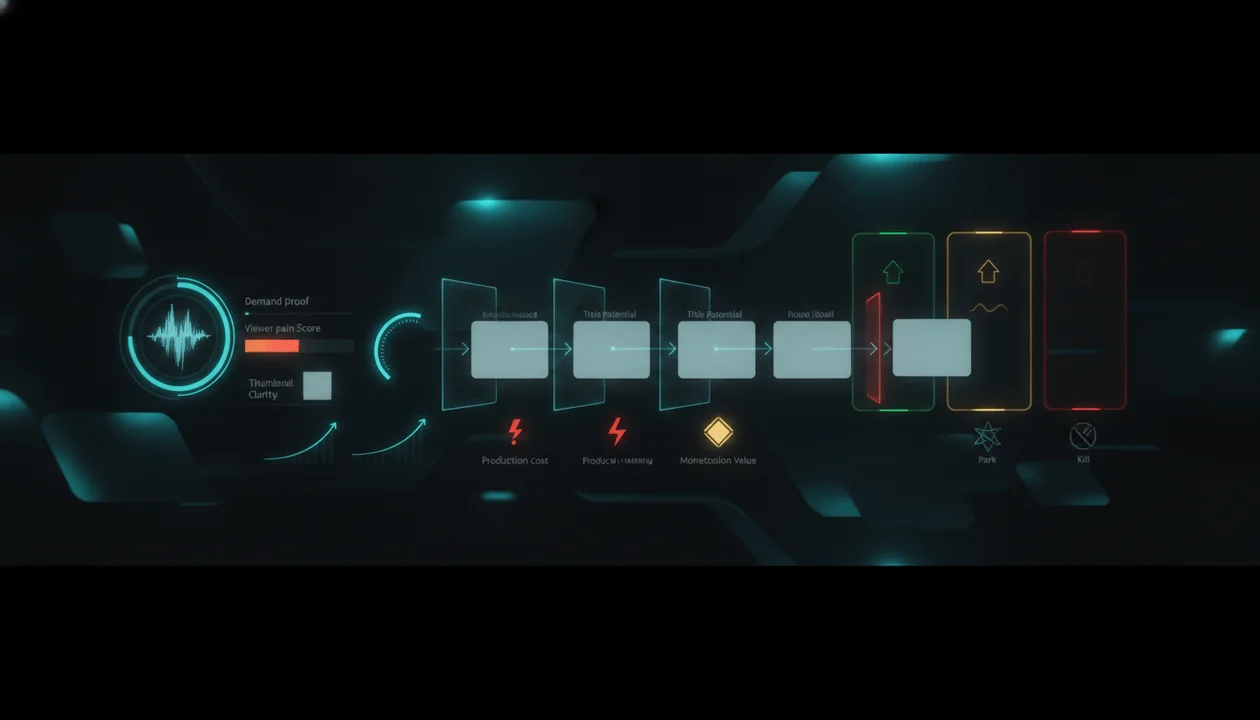
The Approval Gate Workflow
Use gates.
Do not let ideas move straight to production.
Raw idea
↓
Research gate
↓
Angle gate
↓
Title gate
↓
Thumbnail gate
↓
Script brief gate
↓
Production gate
Each gate asks a different question.
Research Gate
Is there proof viewers care?
Angle Gate
Do we have something specific to say?
Title Gate
Can this become clickable without lying?
Thumbnail Gate
Can this be shown clearly in one second?
Script Brief Gate
Can the writer produce a strong script from this?
Production Gate
Is this worth spending production resources on now?
This workflow protects the channel.
How OverseerOS Helps With Video Idea Scoring
OverseerOS is built for creators who want to stop guessing what to upload.
That makes it a natural fit for video idea scoring.
Because scoring requires connected context.
You need:
- Competitor signals
- Channel analysis
- Topic patterns
- Content pillars
- Title direction
- Thumbnail direction
- Script strategy
- Planner status
- Production workflow
OverseerOS helps creators connect these steps.
You can use OverseerOS to:
- Analyze successful YouTube channels
- Reverse-engineer channel strategies with the Channel Blueprint Cloner
- Find fast-growing channels with Viral Channel Finder
- Track competitors and breakout videos
- Save validated topics into a content planner
- Generate scripts from strategy-backed topics
- Create thumbnail and title directions
- Generate voiceovers inside the workflow
- Keep the full decision chain connected before production starts
A generic AI tool asks:
What script should I write?
OverseerOS helps answer:
Is this video idea worth producing in the first place?
That is a more valuable question.
The Idea Graveyard: Why You Need One
Every serious creator needs an idea graveyard.
This is where weak ideas go.
Not all killed ideas are bad forever.
Some are:
- Too early
- Too broad
- Too expensive
- Too generic
- Too weak right now
- Missing demand proof
- Missing a strong angle
- Better suited for another channel
- Better as a blog post
- Better as a short
- Better as part of a larger video
Create a graveyard with reasons.
Killed idea:
Reason:
What would make it viable later:
Date:
Reviewer:
This helps the team learn.
Killing ideas should create knowledge, not just deletion.
The Best Creators Are Ruthless Before Production
Beginner creators are emotional after upload.
They ask:
Why did this video fail?
Advanced creators are ruthless before production.
They ask:
Why should this video exist?
That is the difference.
The earlier you make better decisions, the cheaper success becomes.
Common Mistakes in Video Idea Scoring
Mistake 1: Scoring Based on Excitement
Excitement is useful, but it is not proof.
A creator can be excited about an idea viewers do not care about.
Mistake 2: Treating Competitor Views as Enough Proof
A competitor getting views does not mean your version will work.
Ask:
Why did their version work, and what is our different angle?
Mistake 3: Ignoring Thumbnail Potential
Some ideas sound smart but are hard to package.
If the thumbnail cannot create curiosity, the video may struggle.
Mistake 4: Overrating Easy Production
Easy does not mean valuable.
A video that is easy to make but weak strategically can still waste a slot.
Mistake 5: Ignoring Monetization Fit
Views without valuable viewers may not support the business.
Mistake 6: Never Updating the Scorecard
The scorecard should evolve as the channel learns.
If the channel’s audience changes, the scoring rules should change too.
The Monthly Idea Review
Once per month, review:
Approved ideas that performed well
Approved ideas that failed
Killed ideas that should stay dead
Parked ideas that became more relevant
Patterns in strong ideas
Patterns in weak ideas
Scoring categories that need adjustment
This makes the system smarter.
A scoring system should not be static.
It should learn.
The Future of YouTube Belongs to Better Decisions
AI makes it easier to create.
That means creation is no longer the biggest advantage.
The bigger advantage is decision quality.
Creators will compete on:
- Better topic selection
- Better timing
- Better angles
- Better packaging
- Better audience understanding
- Better retention design
- Better workflows
- Better learning loops
The future belongs to creators who can decide what not to make.
Because as production becomes easier, bad decisions become more dangerous.
Final Verdict: Score Before You Spend
A YouTube video idea scoring system is not extra work.
It is protection.
It protects your money.
It protects your time.
It protects your team.
It protects your channel identity.
It protects your audience from random content.
Most importantly, it protects your best ideas from being buried under weak ones.
The winning workflow is:
Raw idea → score → improve → approve → produce → review → learn
Do not produce every idea.
Do not trust every trend.
Do not let AI generate your production calendar without judgment.
Do not waste your best team hours on videos that should have been killed in planning.
If you want to build this decision system faster, use OverseerOS to analyze winning channels, find breakout topics, validate ideas, plan content, generate scripts, create thumbnails, produce voiceovers, and keep your YouTube workflow connected before production starts.
The best video is not always the one you can make fastest.
It is the one that deserved to be made.
FAQ
What is a YouTube video idea scoring system?
A YouTube video idea scoring system is a framework that helps creators evaluate whether a video idea is worth producing before spending time or money on scripts, thumbnails, voiceovers, editing, and publishing.
Why should creators score video ideas before production?
Creators should score ideas before production because weak ideas become expensive once they enter the workflow. Scoring helps identify demand, viewer pain, title potential, thumbnail clarity, production difficulty, and strategic value early.
What makes a YouTube video idea worth producing?
A video idea is worth producing when it has proof of demand, a clear target viewer, a strong original angle, channel fit, title potential, thumbnail potential, retention potential, realistic production requirements, and strategic upside.
What is a good score for a YouTube video idea?
A score of 45 to 50 is a strong idea, 38 to 44 is good but may need improvement, 30 to 37 is risky, and below 30 should usually be killed, parked, or rebuilt before production.
What are kill criteria for YouTube video ideas?
Kill criteria are rules that stop weak ideas before production. Examples include no clear viewer pain, no demand proof, weak title potential, unclear thumbnail concept, poor channel fit, high production cost, or no original angle.
How does idea scoring help faceless YouTube channels?
Idea scoring helps faceless channels because every approved idea usually triggers a team workflow involving writers, voiceover, editors, and thumbnails. Scoring prevents wasted production on videos that were weak from the start.
Can AI help score YouTube video ideas?
Yes, AI can help organize research, compare ideas, generate title options, test angles, and apply a scoring framework. But final approval should still include human judgment and channel strategy.
How does OverseerOS help with YouTube video idea scoring?
OverseerOS helps creators analyze channels, find breakout topics, track competitors, plan content, generate scripts, create thumbnails, produce voiceovers, and keep the full video decision workflow connected before production starts.