The Thumbnail With the Most Clicks Can Still Lose on YouTube. Here's Why.
Imagine testing two thumbnails for the same YouTube video.
Thumbnail A gets a 7.2% click-through rate.
Thumbnail B gets a 5.8% click-through rate.
Most creators would immediately choose Thumbnail A.
More people clicked. The result seems obvious.
But there is a problem.
People who clicked Thumbnail A watched an average of 2 minutes and 40 seconds.
People who clicked Thumbnail B watched an average of 5 minutes and 15 seconds.
Which thumbnail actually performed better?
The answer might surprise you.
YouTube does not simply want creators to maximize clicks. It wants to recommend videos that viewers actually enjoy watching.
That distinction is reflected directly in YouTube's native A/B testing system, which evaluates titles and thumbnails using watch-time share rather than click-through rate alone.
In other words, the thumbnail that attracts the most clicks isn't necessarily the thumbnail that creates the most valuable viewing experience.
And if you're optimizing your channel using CTR alone, you might be choosing the wrong winner.
In this guide, we'll explain how YouTube's native thumbnail testing works, why watch time matters more than many creators realize, how to design meaningful experiments, and how to interpret results without falling for misleading performance signals.
Quick Answer: Does YouTube Choose the Thumbnail With the Highest CTR?
No. YouTube's native title and thumbnail A/B testing system selects the winning variation based on watch-time share, not simply click-through rate.
The reason is straightforward:
A thumbnail should attract viewers who genuinely want to watch the video, not just convince as many people as possible to click.
A thumbnail that generates more clicks but attracts viewers who quickly leave may produce a weaker overall viewing experience.
YouTube currently allows eligible creators to test up to three title and thumbnail variations simultaneously.
The available testing options are:
- Title only.
- Thumbnail only.
- Title and thumbnail together.
At the end of the experiment, YouTube selects the option with the highest watch time when there is a statistically clear winner.
Source: YouTube Help: A/B Test Titles and Thumbnails.
Why the Highest-CTR Thumbnail Isn't Always the Best Thumbnail
Click-through rate measures how often viewers watch a video after seeing an eligible impression.
It tells you something important about packaging.
But it doesn't tell you everything.
Consider this hypothetical experiment.
| Metric | Thumbnail A | Thumbnail B |
|---|---|---|
| Impressions | 100,000 | 100,000 |
| CTR | 7.2% | 5.8% |
| Views from impressions | 7,200 | 5,800 |
| Average view duration | 2:40 | 5:15 |
| Watch time | 320 hours | 507.5 hours |
Thumbnail A attracts more clicks.
Thumbnail B generates substantially more watch time.
Let's calculate the difference.
Thumbnail A:
7,200 views × 160 seconds = 1,152,000 seconds.
Thumbnail B:
5,800 views × 315 seconds = 1,827,000 seconds.
Thumbnail B produces approximately 58.6% more watch time from the same number of impressions.
This is an illustrative example, not an actual YouTube experiment.
But it demonstrates why optimizing for clicks alone can be misleading.
A thumbnail has two jobs:
- Make the right viewer interested enough to click.
- Set an expectation that the actual video can satisfy.
A thumbnail that promises something the video doesn't deliver might attract attention initially but disappoint viewers afterward.
The strongest packaging doesn't simply maximize curiosity.
It creates the right kind of curiosity.
What YouTube Actually Measures During a Thumbnail A/B Test
YouTube's native testing system is more sophisticated than simply comparing two CTR percentages.
According to its official documentation, YouTube uses watch-time share to determine which title or thumbnail performs best.
This is an important distinction.
What Is Watch-Time Share?
Watch-time share represents the proportion of total watch time attributed to each variation during the experiment.
The objective is to identify which version contributes the strongest viewing outcome across the experiment's audience.
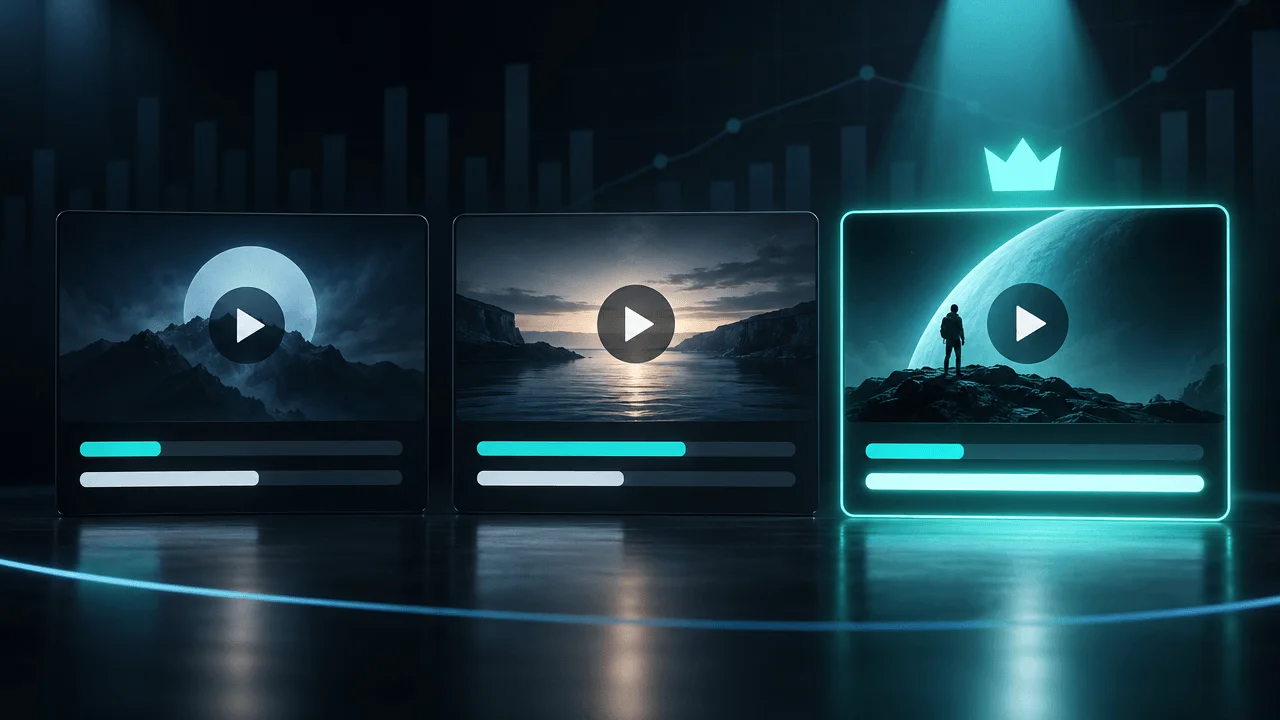
Consider three variations:
| Variation | Share of Total Watch Time |
|---|---|
| Thumbnail A | 25% |
| Thumbnail B | 45% |
| Thumbnail C | 30% |
In this hypothetical experiment, Thumbnail B receives the largest share.
It is therefore the strongest candidate based on the metric YouTube uses.
Importantly, watch-time share is not the same as average view duration.
A variation can generate more total watch time because it attracts more viewers, because those viewers watch longer, or through a combination of both.
This is why looking at one metric independently can produce misleading conclusions.
Why YouTube Uses Watch Time Instead of CTR
YouTube explains its reasoning directly.
Titles and thumbnails help viewers understand what a video offers.
Their purpose isn't simply to get someone to click.
They should help viewers choose videos they will actually enjoy.
YouTube therefore optimizes native experiments for overall watch time rather than CTR alone.
This is designed to avoid rewarding packaging that attracts clicks without delivering a satisfying viewing experience.
Source: YouTube's Official A/B Testing Explanation.
How YouTube's Native Thumbnail A/B Testing Works
YouTube has introduced native title and thumbnail testing directly into YouTube Studio.
This is important because creators no longer need to rely exclusively on manual thumbnail replacement or external sequential testing.
1. Select a Video
You can test an existing video or a new upload.
For existing videos:
- Open YouTube Studio.
- Navigate to Content.
- Select the video.
- Open the title or thumbnail testing option.
2. Choose What You Want to Test
YouTube offers three experiment types:
| Test Type | What Changes |
|---|---|
| Title only | Different titles, same thumbnail |
| Thumbnail only | Different thumbnails, same title |
| Title and thumbnail | Different combinations of both |
This distinction matters.
If you change both the title and thumbnail simultaneously, you won't know which individual element was responsible for the difference.
You can test combinations when your objective is to identify the strongest overall package.
But if you're trying to learn specifically about thumbnail design, isolate the thumbnail variable.
3. Upload Up to Three Variations
You can provide up to three different titles, thumbnails, or combinations.
YouTube displays the variations concurrently to viewers during the experiment.
This is preferable to manually changing a thumbnail every few days because the alternatives are evaluated during the same experiment rather than in separate time periods.
4. Let the Experiment Run
YouTube says experiments can take a few days or up to two weeks.
The actual duration depends on factors including impressions and differences between the variations.
You should avoid changing the title or thumbnail manually while the experiment is running.
Doing so automatically stops the test.
5. Review the Results
YouTube provides three possible outcomes:
| Result | Meaning |
|---|---|
| Winner | One variation clearly outperformed the others based on watch-time share |
| Performed Same | The variations performed approximately equally |
| Inconclusive | There wasn't enough statistical evidence to identify a clear winner |
If there is a winner, YouTube automatically selects the winning variation.
If there isn't, the original variation remains the default unless you manually choose another.
Source: YouTube Help: Understand A/B Test Results.
Why Some YouTube Thumbnail Tests Never Produce a Winner
This is one of the most misunderstood parts of thumbnail testing.
Creators sometimes assume that every experiment must identify a winner.
It doesn't.
YouTube explicitly acknowledges that tests can finish with no clear winner.
There are several reasons.
1. Your Thumbnails Are Too Similar
Imagine testing:
- A person looking left.
- The same person looking slightly right.
- The same person with a slightly different facial expression.
These variations might not create sufficiently different viewing responses.
YouTube recommends testing more diverse alternatives because very similar variations can make it harder to determine a winner.
Instead of testing tiny cosmetic differences, test genuinely different visual concepts.
For example:
Concept A: The Discovery
Show the surprising object or result.
Concept B: The Consequence
Show what happens because of the discovery.
Concept C: The Mystery
Show an unexplained visual that creates curiosity.
Each concept communicates a different reason to watch.
2. Your Video Doesn't Receive Enough Impressions
A/B testing requires sufficient viewer data.
If a video receives relatively few impressions, the experiment may not have enough evidence to distinguish between variations.
YouTube explicitly identifies insufficient impressions as one reason an experiment might not produce a winner.
This is particularly important for smaller channels.
Do not interpret an inconclusive experiment as proof that all three thumbnails are equally good.
It may simply mean there wasn't enough information.
3. Your Variations Appeal to Similar Audiences
Sometimes two thumbnails are different visually but communicate essentially the same promise.
For example:
- A scientist holding a mysterious object.
- A scientist holding the same object with a different background.
Both might appeal to the same viewers for the same reason.
If the underlying proposition doesn't change, the performance difference may be limited.
A more useful experiment tests different ways of communicating the video's value.
4. Viewer Behavior Changes During the Experiment
Your first viewers may be existing subscribers who already recognize your channel.
Later viewers may include people who have never watched you before.
YouTube explicitly acknowledges that audience composition can change over time and that this can influence experiment results.
This is another reason concurrent native testing is valuable.
It helps reduce the problems associated with comparing entirely different time periods.
The Five Thumbnail Experiments Every Serious Creator Should Run
Instead of randomly generating three variations, build experiments around meaningful hypotheses.
Here are five useful approaches.
Experiment 1: Curiosity vs. Clarity
Does your audience prefer understanding exactly what the video is about, or discovering something unexpected?
Variation A:
A clear representation of the video's subject.
Variation B:
A mysterious visual that creates an information gap.
Variation C:
A visual showing the surprising consequence.
This tests how your audience responds to different levels of information.
Experiment 2: Human Emotion vs. Subject Focus
For some videos, the human reaction is the most compelling visual.
For others, the actual subject is more interesting.
Variation A: A person showing an emotional reaction.
Variation B: The central object, discovery, or event.
Variation C: A combination of the person and subject.
This is particularly useful for documentary, psychology, science, and technology channels.
Experiment 3: One Strong Object vs. Multiple Elements
A thumbnail can communicate its message through one dominant visual or several supporting elements.
Test:
- One central object.
- A central object with supporting context.
- A comparison between two important elements.
The goal is to identify which visual structure makes the video's promise easiest to understand.
Experiment 4: Different Emotional Angles
The same subject can create different emotional responses.
For example, a video about a scientific discovery might be presented through:
- Wonder.
- Fear.
- Surprise.
The underlying video remains identical.
The experiment tests which emotional framing creates the strongest viewing response.
Experiment 5: Title and Thumbnail Together
Sometimes a thumbnail performs differently depending on the title beside it.
A visual that seems confusing independently may become compelling when the title provides context.
For example:
Title: "Scientists Found Something They Cannot Explain"
Thumbnail: A mysterious structure beneath the ocean.
The title and image work together.
Testing combinations can help identify the strongest overall packaging rather than optimizing two elements independently.
How to Design a Proper YouTube Thumbnail Experiment
A useful experiment starts with a question.
Not with three random images.
Use this process.
Step 1: Identify the Problem
Look at the video's current performance.
Ask:
- Is CTR below your channel's normal performance?
- Is the thumbnail visually confusing?
- Does the title communicate a weak promise?
- Is the video attracting the wrong audience?
- Does the packaging accurately represent the actual content?
If the video already performs well, don't change it simply because you're curious.
YouTube itself recommends selecting specific videos for testing and suggests starting with older uploads to reduce the potential impact on current performance.
Step 2: Write a Hypothesis
A good hypothesis explains why a different visual might work.
Weak hypothesis:
"The blue thumbnail looks better."
Strong hypothesis:
"Showing the actual scientific discovery instead of a generic scientist portrait may make the video's promise more immediately understandable."
The second hypothesis gives you something meaningful to learn.
Step 3: Create Three Distinct Variations
Each variation should communicate a different visual idea.
Avoid making three almost identical images.
Make the differences meaningful enough that viewers can respond differently.
Step 4: Keep the Experiment Clean
If testing thumbnails, keep the title unchanged.
If testing titles, keep the thumbnail unchanged.
If testing combinations, recognize that you're testing the complete package.
Don't manually change the assets during the experiment.
Step 5: Wait for the Result
Let YouTube collect sufficient data.
The experiment can take several days or up to two weeks.
Avoid prematurely choosing a winner based on a small number of early impressions.
Step 6: Record What You Learned
Even when a test produces no clear winner, record the hypothesis and result.
For example:
| Experiment | Hypothesis | Outcome | Learning |
|---|---|---|---|
| Emotion vs. object | Human emotion attracts more attention | Object wins | Subject clarity may matter more |
| Mystery vs. clarity | Mystery increases engagement | Performed same | No clear preference |
| Single object vs. comparison | Comparison creates stronger interest | Winner: comparison | Comparison framing deserves further testing |
These are illustrative examples.
Over time, your channel can develop its own evidence-based packaging principles.
Why Thumbnail A/B Testing Is Better Than Manually Changing Thumbnails
Many creators still use a sequential testing approach.
They upload a video with Thumbnail A.
After a few days, they replace it with Thumbnail B.
Then they compare the results.
This seems reasonable.
But it creates several problems.
Problem 1: Different Audiences
The first version might reach existing subscribers.
The second might receive more impressions from new viewers.
Those groups may behave differently.
Problem 2: Different Time Periods
Topic interest, competition, and audience activity can change.
A comparison between Monday and Friday is not necessarily a fair experiment.
Problem 3: Different Distribution Conditions
A video might receive more impressions during one period than another.
This makes raw view comparisons difficult.
Problem 4: CTR Isn't the Only Outcome
A sequential experiment that chooses the version with the highest CTR might select packaging that generates more clicks without maximizing watch time.
YouTube's native concurrent testing helps address these issues.
Its official documentation specifically distinguishes native concurrent experiments from third-party tests that may run variations sequentially.
This doesn't mean every external tool is useless.
It means you should understand what its experiment actually measures before trusting the result.
Why Your Best Thumbnail Strategy Is Different for Every Channel
There is no universally winning thumbnail formula.
A gaming channel, educational documentary channel, finance channel, and psychology channel attract different audiences.
Their viewers may respond to different visual promises.
Consider these hypothetical channel types.
| Channel Type | Potential Thumbnail Approach |
|---|---|
| Science documentaries | A surprising discovery or unexplained phenomenon |
| Psychology | Recognizable emotional situations |
| Technology | Products, interfaces, and unexpected outcomes |
| Finance | Concrete financial consequences and comparisons |
| History | Historical characters, objects, and dramatic events |
| Education | Clear visual explanations and transformations |
| Gaming | Recognizable gameplay moments and stakes |
These are starting hypotheses, not proven universal winners.
Your own channel data should determine which approaches deserve further investment.
A thumbnail strategy that works for another creator might not transfer to your audience.
This is why channel-specific experimentation matters.
How to Build a Repeatable Thumbnail Research System
The biggest opportunity isn't running one successful A/B test.
It is building a system that improves your packaging over time.
A practical research process has four stages.
1. Study Your Own Winning Videos
Find videos that consistently outperform your channel's normal performance.
Examine:
- Visual composition.
- Main subject.
- Number of elements.
- Emotional framing.
- Color contrast.
- Relationship between title and thumbnail.
Look for recurring patterns.
Don't assume that the thumbnail alone caused the success.
Topic demand, title quality, audience fit, and video execution all contribute.
2. Study Competitor Packaging
Identify competitors serving a similar audience.
Investigate:
- Their strongest recent videos.
- Repeated visual approaches.
- Unusual thumbnail concepts.
- Changes in packaging.
- Videos performing above their channel baseline.
Look for patterns worth testing, not images to copy.
3. Generate Original Alternatives
Use the research to create different visual concepts.
Each alternative should have a clear hypothesis.
For example:
- One version emphasizes the subject.
- Another emphasizes the consequence.
- Another emphasizes the mystery.
The objective is to test different promises, not minor cosmetic changes.
4. Feed the Results Back Into Your Strategy
After several experiments, identify what your audience consistently responds to.
Build a reusable visual direction.
Then continue testing new ideas rather than assuming that one winning format will work forever.
This is how thumbnail optimization becomes a repeatable creative system rather than random experimentation.
How OverseerOS Helps Creators Research and Improve YouTube Thumbnails
Creating three thumbnail variations is relatively easy.
Knowing which concepts deserve to be created in the first place is harder.
This is where OverseerOS becomes useful.
OverseerOS Thumbnail Autopilot
OverseerOS Thumbnail Autopilot helps creators develop thumbnail concepts and generate visual alternatives using AI.
Rather than beginning every design from a blank canvas, creators can work from existing reference material and explore different visual directions.
The workflow helps with:
- Thumbnail concept generation.
- Visual reference exploration.
- Creative alternatives.
- Channel-specific packaging workflows.
- Organizing thumbnail production.
The objective is to reduce the time between identifying a promising video idea and having strong visual packaging ready.
OverseerOS Channel Analysis
OverseerOS Channel Analysis helps creators investigate public channel performance and identify videos that outperform their normal results.
This is useful when researching competitors.
You can investigate which uploads deserve attention instead of assuming that the most-viewed video represents the strongest repeatable strategy.
OverseerOS Viral X-Ray
OverseerOS Viral X-Ray helps investigate individual successful videos.
You can examine their:
- Titles.
- Thumbnail approaches.
- Topic selection.
- Opening hooks.
- Storytelling structures.
The objective is to understand the broader creative idea behind a successful upload.
Put Research Into Practice
A useful workflow looks like this:
- Find promising videos using OverseerOS Channel Analysis.
- Investigate successful packaging with OverseerOS Viral X-Ray.
- Develop original thumbnail concepts using OverseerOS Thumbnail Autopilot.
- Upload your strongest variations to YouTube Studio.
- Run the native A/B experiment.
- Record the result and use the learning in future videos.
OverseerOS helps with the research and creative preparation.
YouTube Studio remains the platform-native environment for running its own title and thumbnail experiment.
Explore OverseerOS to research what works, develop stronger packaging, and build a more repeatable YouTube production system.
Frequently Asked Questions
Does YouTube choose thumbnails based on CTR or watch time?
YouTube's native A/B testing system selects the winning title or thumbnail based on watch-time share rather than CTR alone. The objective is to identify the variation that generates the strongest overall viewing outcome.
How many thumbnails can you test on YouTube?
Eligible creators can test up to three thumbnail variations simultaneously. You can test thumbnails alone, titles alone, or combinations of both.
How long does a YouTube thumbnail A/B test take?
YouTube says experiments can take a few days or up to two weeks. The duration depends on factors such as impressions, video age, and differences between the variations.
Why does my YouTube thumbnail test say inconclusive?
An inconclusive result means YouTube did not find a sufficiently strong statistical difference between the variations. This can happen when there are insufficient impressions, when the variations perform similarly, or when the observed differences are too small.
Can I A/B test YouTube Shorts thumbnails?
YouTube's native title and thumbnail A/B testing currently does not support Shorts. The feature is available for eligible long-form videos and certain live archives.
Should I test titles and thumbnails separately?
If you want to understand which individual element affects performance, test one variable at a time. If you want to identify the strongest complete package, test title and thumbnail combinations.
Is a higher CTR always better on YouTube?
No. CTR is useful for understanding how appealing your packaging is, but it does not measure the complete viewing experience. A higher CTR can coexist with weaker retention or less total watch time.
Does changing a YouTube thumbnail affect the algorithm?
Changing a thumbnail does not automatically trigger a recommendation boost. YouTube explains that a change can influence performance because viewers may respond differently to the new packaging.
What is a good YouTube thumbnail CTR?
There is no universal ideal CTR. It depends on the audience, traffic source, content type, and channel. Compare similar traffic sources and your own historical performance rather than relying on one universal percentage.
Should I test thumbnails on old YouTube videos?
YouTube recommends considering older videos for experiments because this can reduce the potential impact on your channel's current views. It is a practical way to learn about packaging without immediately experimenting on every new upload.
Can third-party tools run YouTube thumbnail A/B tests?
Some third-party tools offer thumbnail testing workflows. However, their methodologies can differ. YouTube specifically notes that its native experiments run variations concurrently, while many external tests run sequentially. Understand the methodology before interpreting results.
What makes a good YouTube thumbnail?
A good thumbnail communicates a compelling and accurate reason to watch. It should be visually clear, relevant to the video, and work together with the title to establish an expectation the content can satisfy.
Final Verdict: Stop Optimizing for Clicks Alone
The thumbnail that gets the most clicks is not automatically the thumbnail that produces the best result.
A viewer clicking because of a misleading or exaggerated promise is not necessarily a valuable outcome.
A viewer clicking because the thumbnail communicates something genuinely interesting and then watching the video is a much stronger outcome.
That is why YouTube's native A/B testing system uses watch-time share rather than CTR alone.
For creators, the lesson is simple:
- Research before designing.
- Develop genuinely different concepts.
- Test meaningful hypotheses.
- Use native concurrent experiments when available.
- Evaluate watch-time results, not just CTR.
- Learn from every experiment.
- Build a packaging strategy around your own audience.
Don't chase the thumbnail that gets the most clicks at any cost.
Find the thumbnail that attracts the right viewers and makes them want to stay.
Better packaging isn't about tricking more people into clicking. It's about making the right people excited to watch.
Discover OverseerOS and build a smarter research and thumbnail production workflow for your YouTube channel.
Sources and Further Reading
Official YouTube Documentation
A/B Test Titles and Thumbnails - testing eligibility, experiment setup, watch-time share, statistical outcomes, and testing limitations.
YouTube Impressions and Click-Through Rate - how impressions and CTR are defined and interpreted.
Measure Key Moments for Audience Retention - understanding audience retention and identifying moments where viewers leave.
YouTube Performance FAQ - how YouTube evaluates viewer response and how title and thumbnail changes can influence performance.
Research and Interpretation
This article distinguishes between three different measurements:
- Click-through rate: the proportion of eligible impressions that result in a view.
- Average view duration: the average time viewers spend watching.
- Watch-time share: the proportion of experiment watch time attributed to each tested variation.
These metrics are related but not interchangeable.
The article uses hypothetical numerical examples to explain the methodology. It does not present those examples as measured OverseerOS research findings or claim that a particular thumbnail design universally wins.