Most creators do not need more video ideas.
They need proof that the audience they are chasing actually exists.
That is the real problem behind many dead channels. The creator posts consistently. The thumbnails improve. The scripts get cleaner. The editing becomes better. But the channel still feels stuck because the content is not building a repeatable audience.
One video gets views, then the next one dies.
One topic works, then the channel cannot repeat it.
One Short goes viral, then long-form stays flat.
One audience clicks, but the wrong people subscribe.
That is not always an algorithm problem.
It is usually a content market fit problem.
Content market fit on YouTube means your channel has found a repeatable match between:
- what a specific audience wants
- what your channel is uniquely positioned to make
- what YouTube can understand and recommend
- what you can repeat without becoming generic
This matters for personal brands. It matters even more for faceless channels.
Because if you scale production before content market fit, you are not building a content business. You are building a faster machine for producing uncertainty.
Key Takeaways
- Content market fit on YouTube means a specific audience repeatedly chooses your videos for a specific reason.
- A viral video does not prove content market fit. Repeatable viewer demand does.
- The strongest signal is not one big upload. It is a pattern across impressions, CTR, retention, returning viewers, comments, subscribers, and follow-up performance.
- Faceless channels need content market fit before scaling scripts, thumbnails, voiceovers, editors, and upload frequency.
- Personal brands need content market fit before turning themselves into a broad “creator brand” with no clear audience promise.
- The best channels do not just find topics. They find content lanes: repeatable intersections of audience pain, format, packaging, and channel identity.
- OverseerOS helps creators find content market fit faster by studying public YouTube patterns, competitor breakouts, channel blueprints, viewer signals, and their own channel performance data.
What Is Content Market Fit on YouTube?
Content market fit is the moment your channel stops feeling like a collection of uploads and starts feeling like a clear answer to a real audience demand.
It means viewers understand:
This channel makes the kind of videos I want more of.
That is the key.
Not one video.
Not one niche.
Not one viral topic.
A repeatable audience relationship.
A channel with content market fit has three things:
| Layer | What It Means |
|---|---|
| Audience fit | A clear group of viewers repeatedly cares about the problem, desire, fear, or identity your channel serves |
| Content fit | Your topics, formats, titles, thumbnails, and scripts consistently satisfy that audience |
| Channel fit | The videos build on each other so YouTube and viewers understand why the channel exists |
A channel without content market fit feels random.
A channel with content market fit feels inevitable.
Why Most Creators Misdiagnose Growth Problems
When a channel is struggling, creators usually blame one of these:
- the thumbnail
- the title
- the algorithm
- the upload time
- the editor
- the voiceover
- the niche
- the first 30 seconds
- the video length
Sometimes they are right.
But often, these are symptoms.
The deeper problem is that the creator has not proven a repeatable audience demand yet.
A video can fail because of weak packaging.
But if every video needs heroic packaging to survive, the channel may not have a real content lane.
A video can fail because of weak retention.
But if viewers do not care about the topic in the first place, no script trick will save it.
A video can fail because of low impressions.
But if YouTube cannot identify who the channel is for, the channel may be sending mixed audience signals.
YouTube says its recommendation system uses signals like watch history, search history, subscriptions, likes, dislikes, “Not interested” feedback, “Don’t recommend channel” feedback, and satisfaction surveys to predict what viewers may want to watch. Source: YouTube
That means your channel is constantly training the system through viewer behavior.
If your uploads attract different audiences every week, the channel becomes harder to recommend consistently.
Viral Does Not Mean You Have Content Market Fit
This is where many creators get trapped.
One video pops off.
The creator assumes:
We found it.
Then the next five videos underperform.
Why?
Because viral success can come from many things:
- a trend
- a celebrity
- a controversial topic
- a one-time event
- a broad curiosity hook
- a misleading thumbnail
- a Shorts spike
- an external share
- a topic that attracts viewers who do not want the rest of your channel
That is not content market fit.
That is a spike.
Content market fit is when the channel can repeat the audience relationship without needing luck.
Viral Spike vs Content Market Fit
| Signal | Viral Spike | Content Market Fit |
|---|---|---|
| Performance | One video performs unusually well | Multiple related videos perform above baseline |
| Audience | Broad or unclear | Specific and repeatable |
| Subscriber quality | Many subscribe but do not return | Subscribers watch follow-up videos |
| Topic pattern | Hard to repeat | Creates a clear content lane |
| Comments | “This was crazy” | “Please make more like this” |
| Next upload | Often drops hard | Has a better chance of carrying momentum |
| Channel identity | Still unclear | Stronger after each upload |
A viral spike gives you attention.
Content market fit gives you a channel.
The 6 Signs Your YouTube Channel Has Content Market Fit
You do not need perfect analytics to see content market fit.
You need the right pattern.
1. Multiple Videos Win for the Same Reason
One good video is not enough.
Look for clusters.
A channel is moving toward content market fit when several videos win because of the same underlying viewer demand.
Examples:
- three AI videos about job anxiety outperform the channel average
- four psychology videos about manipulation outperform generic self-help videos
- several finance videos about “money mistakes by income level” beat broad investing topics
- multiple faceless business documentaries about company collapse outperform founder biographies
The surface topics may differ.
The underlying viewer reason is the same.
That is what you want.
2. Viewers Ask for the Next Video
Comments are not just engagement.
They are demand signals.
Weak comment signal:
Great video.
Stronger comment signal:
Can you do this for small channels?
Even stronger:
This is exactly what happened to my channel after one viral Short. Please make a video on how to recover.
That is not just praise.
That is a next video.
Look for repeated comment patterns:
- “Can you cover...”
- “What about...”
- “This happened to me when...”
- “I wish you explained...”
- “Do one on...”
- “This is the first video that actually explained...”
Your audience will often tell you where content market fit is hiding.
3. Returning Viewers Start to Matter
A channel with only random one-time viewers is not stable.
A channel with returning viewers is building memory.
Returning viewers suggest that people are not just clicking one topic. They are starting to recognize the channel as useful, entertaining, or trustworthy.
This matters for both personal brands and faceless channels.
For a personal brand, returning viewers mean the audience is coming back for your thinking.
For a faceless channel, returning viewers mean the format, topic lane, voice, or promise is becoming recognizable.
4. The Channel Promise Becomes Easier to Explain
If you need a long explanation for your channel, the channel is probably not clear enough.
Weak channel promise:
We make videos about business, AI, psychology, productivity, money, and success.
Stronger:
We explain the hidden systems behind fast-growing online businesses.
Stronger:
We help faceless creators find proven YouTube ideas before they waste time producing the wrong videos.
Stronger:
We break down the psychological patterns behind toxic relationships, manipulation, and self-worth.
Content market fit often shows up as clarity.
When the channel starts working, the audience promise becomes easier to say.
5. New Ideas Become Easier to Generate
Before content market fit, every new idea feels like starting from zero.
After content market fit, ideas come from the lane.
Example lane:
AI anxiety for professionals
New videos become obvious:
- The Jobs AI Will Replace Quietly
- The Skills That Survive AI Automation
- Why AI Layoffs Will Not Look Like Layoffs
- The Careers That Look Safe But Are Not
- How Companies Will Use AI Without Announcing It
That is a lane.
A lane is better than a niche because it tells you what to make next.
6. The Data and the Audience Say the Same Thing
Content market fit is strongest when analytics and human feedback align.
Look for:
- above-baseline CTR
- better retention on related videos
- more returning viewers
- more subscribers from a specific content lane
- stronger comments
- viewers asking for follow-ups
- related videos performing together
- more impressions on similar topics over time
YouTube Studio’s impressions report helps creators see how thumbnail impressions turn into views and watch time, and it can also show what percentage of impressions came from YouTube recommending the video to viewers. Source: YouTube Help
That kind of data matters because content market fit is not a feeling.
It is a pattern.
The 5 Stages of YouTube Content Market Fit
Most channels move through five stages.
Knowing your stage prevents stupid decisions.
Stage 1: No Signal
The channel is posting, but nothing is clear yet.
Common signs:
- inconsistent topics
- low impressions
- weak CTR
- weak retention
- few comments
- no clear audience language
- random subscribers
- no repeatable winner
Main job:
Find signal.
Do not scale yet.
At this stage, the worst thing you can do is hire a full production team and increase output before you know what viewers want.
You need more experiments, not more volume.
Stage 2: Topic Signal
A few topics show potential.
Common signs:
- one or two videos outperform
- comments show interest
- audience pain becomes clearer
- some thumbnails get better response
- certain titles get more pull
Main job:
Separate the topic from the pattern.
Do not assume the exact topic is the win.
Ask why it worked.
Was it the pain? The format? The title? The timing? The emotional trigger? The audience identity?
Stage 3: Lane Signal
A repeatable content lane starts forming.
Common signs:
- multiple related videos perform better
- viewers ask for follow-ups
- the channel promise becomes clearer
- title formulas become easier
- thumbnail concepts become more consistent
- production briefs get easier to write
Main job:
Build the lane.
This is where creators should start creating topic clusters, playlists, related videos, and repeatable formats.
Stage 4: Channel Fit
The channel starts becoming known for something.
Common signs:
- returning viewers increase
- related uploads support each other
- subscribers watch future videos
- comments mention the channel’s specific value
- YouTube recommends similar videos more often
- the team understands what belongs and what does not
Main job:
Strengthen identity.
Do not broaden too early.
This is where many creators ruin momentum by chasing unrelated viral topics.
Stage 5: Scale Fit
The content system is repeatable enough to scale.
Common signs:
- multiple lanes work
- production briefs are clear
- audience demand is predictable
- title and thumbnail patterns are understood
- the team can produce without losing strategy
- analytics guide the next bets
- the channel has a reliable feedback loop
Main job:
Scale carefully.
Increase output only after the lane has proven it can support more videos.
Content Market Fit for Faceless YouTube Channels
Faceless channels need content market fit before they need a bigger team.
That sounds obvious, but most faceless creators do the opposite.
They build the machine first:
- scriptwriter
- voiceover artist
- thumbnail designer
- editor
- project manager
- automation workflow
- upload schedule
Then they realize the machine has no proven audience.
A faceless channel should not scale production until it knows:
- which audience it serves
- which topics repeatedly work
- which formats can be repeated
- which title styles pull clicks
- which thumbnail language fits the niche
- which voice and pacing viewers accept
- which videos lead to the next video
- which lane has enough depth for 50 plus uploads
Faceless Channel Content Market Fit Examples
Weak faceless channel idea:
AI news
Stronger content market fit lane:
AI threats, job disruption, and power shifts explained through documentary-style stories
Weak:
Motivation for men
Stronger:
Harsh self-improvement lessons for men who feel behind in life
Weak:
Business stories
Stronger:
The hidden decisions that made famous companies rise, collapse, or betray their original promise
Weak:
Psychology facts
Stronger:
Dark psychology patterns in relationships, manipulation, and emotional control
The stronger versions are not just niches.
They are audience promises.
Content Market Fit for Personal Brand Creators
Personal brand creators have a different risk.
They often become too broad because they confuse themselves with the niche.
They think:
People follow me, so I can talk about anything.
That is usually false.
People may like the creator, but they still need a reason to watch each video.
A personal brand needs content market fit between:
- the creator’s lived experience
- the audience’s current pain
- the creator’s credibility
- the format that best expresses the idea
- the viewer identity the channel attracts
Personal Brand Content Market Fit Examples
Weak personal brand positioning:
I share my journey as an entrepreneur.
Stronger:
I show creators how I build and scale online content businesses without pretending it is easy.
Weak:
I talk about mindset, business, health, and life.
Stronger:
I teach ambitious creators how to think sharper, work cleaner, and build income online with less chaos.
Weak:
I make videos about productivity.
Stronger:
I help solo founders stop becoming the bottleneck in their own business.
The difference is specificity.
A personal brand can be broad later.
But it needs a sharp entry point first.
The Content Market Fit Scorecard
Use this before deciding whether to scale a channel, content lane, or upload frequency.
Score each from 0 to 5.
| Signal | Question | Score |
|---|---|---|
| Audience clarity | Can you describe the exact viewer and why they watch? | /5 |
| Repeatable demand | Have multiple related videos performed above baseline? | /5 |
| Packaging pattern | Do you know which title and thumbnail promises work? | /5 |
| Retention fit | Do viewers stay because the format satisfies the promise? | /5 |
| Comment signal | Are viewers asking for related follow-up videos? | /5 |
| Returning viewers | Are people coming back for more than one upload? | /5 |
| Subscriber quality | Do subscribers watch future videos? | /5 |
| Topic depth | Can this lane support 30 to 100 future videos? | /5 |
| Production repeatability | Can your team make these videos consistently? | /5 |
| Channel identity | Does this lane make the channel easier to understand? | /5 |
Total: /50
Decision:
| Score | Meaning | Action |
|---|---|---|
| 42 to 50 | Strong content market fit | Scale carefully |
| 34 to 41 | Promising fit | Double down, refine formats |
| 25 to 33 | Early signal | Keep testing before scaling |
| 15 to 24 | Weak fit | Narrow the lane |
| Under 15 | No fit | Stop or reposition |
This scorecard prevents emotional scaling.
A creator should not scale because one video performed well.
Scale when the lane is proven.
The 4 Metrics Creators Misread When Looking for Fit
Analytics are powerful, but many creators read them wrong.
1. CTR Without Context
A high CTR can mean strong packaging.
It can also mean the video was shown to a small, warm audience.
A low CTR can mean weak packaging.
It can also mean YouTube tested the video with a broader audience.
Do not judge CTR alone.
Ask:
- What was the impression volume?
- Which traffic source drove impressions?
- Did the video retain viewers after the click?
- Did the title and thumbnail attract the right audience?
- Did the video earn more recommendations?
2. Retention Without Promise
A retention graph tells you where people leave.
It does not automatically tell you why.
Sometimes viewers leave because the intro is slow.
Sometimes they leave because the video did not match the title.
Sometimes they leave because the topic attracted curiosity but not commitment.
Always connect retention to the click promise.
If the video promises:
AI will replace these jobs quietly
The first minute must not explain basic AI history.
It must continue the fear, specificity, and hidden-risk promise.
3. Subscribers Without Return Behavior
Not all subscribers are valuable.
A viral Short can bring subscribers who never watch long-form.
A broad drama video can bring viewers who do not care about your main content.
A giveaway can attract people who only wanted the prize.
Subscriber growth matters only if subscribers become part of the audience you want to serve.
Ask:
- Did the video bring subscribers who watch the next upload?
- Did they subscribe because of the channel promise or a one-time event?
- Do they match the future direction of the channel?
4. Views Without Repeatability
Views are the easiest metric to worship.
But views without repeatability can mislead you.
A video with 300,000 views may be strategically weaker than a video with 40,000 views if the smaller video reveals a lane you can repeat for years.
The best question is not:
How many views did it get?
The better question is:
What did this prove that we can use again?
The Content Lane Framework
A content lane is the repeatable path between audience demand and your channel’s unique promise.
Every strong channel has lanes.
Not random categories.
Lanes.
A content lane has five parts:
| Part | Question |
|---|---|
| Viewer | Who cares? |
| Pain or desire | Why do they care now? |
| Format | What type of video delivers the value? |
| Packaging | What click promise makes them choose it? |
| Repeatability | Can this produce many original videos? |
Example lane:
| Part | Answer |
|---|---|
| Viewer | Faceless YouTube creators |
| Pain or desire | They want to avoid wasting money producing weak videos |
| Format | Strategy breakdowns and proof-first workflows |
| Packaging | “Know if this is worth making before you script” |
| Repeatability | High, because every stage of the workflow has decisions to validate |
Another example:
| Part | Answer |
|---|---|
| Viewer | Men who feel behind |
| Pain or desire | They want discipline, status, confidence, and self-respect |
| Format | Direct emotional lessons with strong hooks |
| Packaging | “The mistake most men realize too late” |
| Repeatability | High, because the identity pain has many angles |
A channel can have several lanes.
But each lane should make the channel clearer, not more confusing.
The Content Market Fit Testing Plan
Use this 30-video testing plan before scaling a new channel or major content lane.
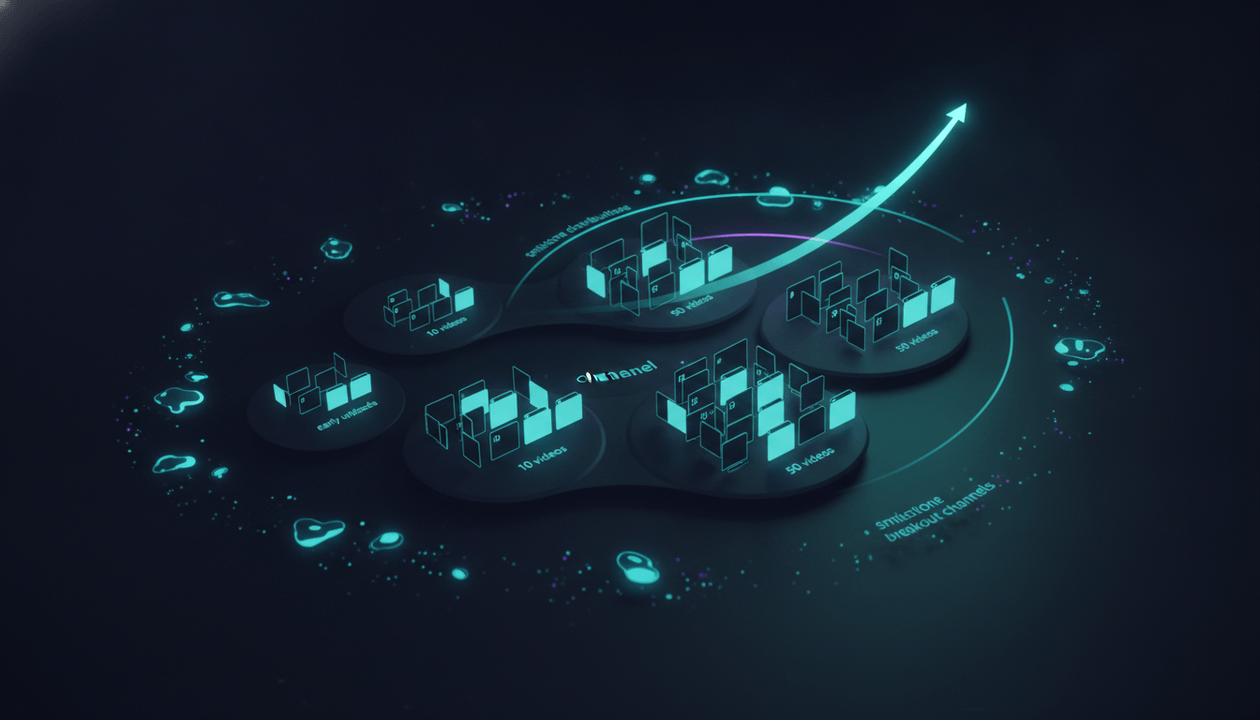
Phase 1: Explore 10 Ideas
Goal:
Find signals.
Test 10 videos across 3 to 4 related angles.
Track:
- topic
- title
- thumbnail concept
- format
- traffic source
- CTR
- retention
- comments
- subscribers gained
- viewer questions
- production difficulty
Do not overreact to one winner.
Look for directional proof.
Phase 2: Double Down on 10 Pattern Variations
Goal:
Find the pattern behind the signal.
Take the strongest 2 to 3 early signals and create variations.
Example:
If “AI jobs quietly disappearing” worked, test:
- AI roles companies will stop hiring for
- AI skills that protect your career
- AI job myths that make workers feel safe
- AI layoffs that will not be announced
- white-collar jobs exposed by automation
Now you are not just posting.
You are testing a lane.
Phase 3: Build 10 Channel-Fit Videos
Goal:
Prove the lane belongs on the channel.
Now create videos that connect the winning pattern to a stronger channel identity.
Ask:
- Can this become a playlist?
- Can this be a recurring format?
- Can this lead to a newsletter, product, service, or paid offer?
- Can viewers understand why this channel owns the topic?
- Does each video make the next one easier to recommend?
After 30 videos, you should know much more than “views are up or down.”
You should know whether the channel has a market.
How to Use Competitor Research to Find Content Market Fit
Competitor research is not about copying.
It is about finding proven audience demand.
Study competitors for:
- repeated breakout topics
- title structures
- thumbnail patterns
- audience pain in comments
- formats that keep returning
- small channels outperforming bigger ones
- videos with high views relative to channel size
- topics that appear across multiple channels
- content gaps where execution is weak
The most valuable question is:
What audience demand keeps showing up, but is still underserved?
That is where opportunity lives.
Example:
Many channels may cover “faceless YouTube ideas.”
But fewer may explain:
- which ideas attract buyers
- which ideas create returning viewers
- which ideas are cheap enough to produce
- which ideas work for beginners
- which ideas are dying because of AI slop
- which ideas have repeatable topic depth
That is how you turn a crowded topic into a sharper lane.
How OverseerOS Helps Creators Find Content Market Fit Faster
Content market fit is hard because the evidence is scattered.
One signal is in your YouTube Studio.
Another is in competitor uploads.
Another is in thumbnails.
Another is in comments.
Another is in breakout videos.
Another is in your content planner.
Another is in scripts your team is writing.
Most creators lose the pattern because the workflow is fragmented.
OverseerOS is built to help creators connect the research, strategy, and production work in one place.
A practical content market fit workflow inside OverseerOS can look like this:
- Use Viral YouTube Channel Finder to discover channels showing breakout patterns in a niche before you commit to building there.
- Use the AI YouTube Channel Analyzer to study a channel’s top videos, breakout patterns, titles, hooks, upload rhythm, and strategy signals.
- Use Overseer Feed to monitor competitor uploads, catch breakout videos early, and save proven topic opportunities.
- Use Viral X-Ray to analyze why a specific video worked across title, thumbnail, hook, audience, structure, tone, and public performance signals.
- Use Channel Pulse to connect your own channel data, study what already worked, avoid repeating old topics, and identify what to create next from your own performance signals.
- Save the strongest lane ideas into the AI YouTube Content Planner so your topics, scripts, voiceovers, and production workflow stay connected.
That is the real value.
Not “generate more ideas.”
Better:
Find the audience signal, prove the lane, and scale only what deserves to scale.
The Content Market Fit Dashboard Creators Should Track
You can build this in a spreadsheet, Notion, or a creator workflow tool.
Track every video with these fields:
| Field | Why It Matters |
|---|---|
| Video title | Shows the promise being tested |
| Content lane | Groups related videos |
| Primary audience pain | Clarifies why viewers should care |
| Format | Shows which structure worked |
| Thumbnail concept | Tracks visual patterns |
| Publish date | Adds timing context |
| Impressions | Shows distribution opportunity |
| CTR | Shows packaging pull |
| Average view duration | Shows depth of attention |
| Retention drop points | Shows promise or pacing problems |
| Traffic source | Shows how viewers found it |
| Subscribers gained | Shows audience quality |
| Returning viewer impact | Shows channel memory |
| Comments asking for follow-ups | Shows demand |
| Production cost | Shows whether the lane can scale |
| Next video idea | Turns learning into action |
The goal is not to collect data for fun.
The goal is to find repeatable proof.
Common Mistakes That Kill Content Market Fit
Mistake 1: Scaling Before the Lane Is Proven
This is the expensive one.
Creators hire more people, increase upload frequency, and build automation before they know what works.
More output does not fix weak fit.
It just makes the failure faster.
Mistake 2: Chasing Every Viral Topic
A viral topic can pull views and still damage channel identity.
If the topic attracts the wrong audience, it may hurt returning viewer behavior on future uploads.
Growth is not just reach.
Growth is reach that compounds.
Mistake 3: Mistaking a Niche for a Market
“AI” is not a market.
“Finance” is not a market.
“Self-improvement” is not a market.
A market is a specific viewer group with a repeatable problem, desire, identity, or fear.
Weak:
AI channel
Strong:
AI career risk explained for professionals who want to stay valuable
Weak:
Productivity channel
Strong:
Productivity systems for solo founders who became the bottleneck
Mistake 4: Ignoring the Wrong Subscriber Problem
Not every subscriber is good.
A subscriber who came for a random viral Short may ignore your core long-form videos.
A subscriber who came for a drama topic may not care about your educational content.
A subscriber who came for one celebrity story may not care about your broader channel.
Audience quality matters.
Mistake 5: Publishing Disconnected Videos
Every upload should make the channel clearer.
If one video is about AI tools, the next is about personal finance, the next is about history, and the next is about productivity, YouTube and viewers may struggle to understand the channel.
Variety is fine after trust.
At the beginning, clarity wins.
Mistake 6: Letting AI Create Without Audience Proof
AI can make production faster.
It can also make generic failure cheaper.
Do not start with:
Give me 20 viral ideas.
Start with:
Here are the videos, comments, and audience signals that prove this lane has demand. Help me generate original angles from this pattern.
Better inputs create better AI output.
The Content Market Fit Checklist
Use this before scaling a channel.
- We can describe the exact viewer in one sentence.
- We know the pain, desire, fear, or identity driving the audience.
- At least three related videos have performed above baseline.
- The winning videos share a clear underlying pattern.
- Viewers ask for related follow-up topics.
- Subscribers from this lane watch future uploads.
- The lane can produce at least 30 strong future video ideas.
- The title and thumbnail patterns are becoming clearer.
- The format is repeatable without becoming boring.
- The production cost makes sense for the expected upside.
- The lane strengthens the channel identity.
- The lane can connect to monetization, sponsorships, products, or long-term brand value.
- We are not scaling from one viral accident.
If you cannot check most of these, keep testing.
Final Verdict: Find the Market Before You Build the Machine
Content market fit is the difference between a channel that posts videos and a channel that builds audience momentum.
Without it, every upload feels like a gamble.
With it, every upload becomes part of a larger system.
Personal brands need content market fit so they do not become broad, forgettable advice channels.
Faceless channels need content market fit so they do not build expensive production machines around unproven ideas.
Agencies and multi-channel operators need content market fit so they can scale channels from evidence, not client excitement or AI-generated guesses.
The goal is not just to get views.
The goal is to find a repeatable audience relationship.
A clear viewer.
A clear pain.
A clear lane.
A clear format.
A clear reason the channel should exist.
That is when scaling makes sense.
Until then, your job is not to produce more.
Your job is to prove what deserves to be produced.
If you want to find that proof faster, use OverseerOS to study public YouTube patterns, analyze competitor breakouts, connect your own channel signals, and plan content lanes from evidence before you scale production.
FAQ
What is content market fit on YouTube?
Content market fit on YouTube means your channel has found a repeatable match between a specific audience demand and the type of videos your channel can consistently produce. It is when viewers repeatedly choose your videos for a clear reason and the channel becomes easier to understand over time.
How do I know if my YouTube channel has content market fit?
Look for repeated signals across related videos: above-baseline performance, stronger comments, returning viewers, subscribers who watch future uploads, clearer title and thumbnail patterns, and viewers asking for follow-up videos. One viral video is not enough.
Is one viral video proof of content market fit?
No. One viral video is a signal, not proof. Content market fit requires repeatability. You need to know whether the audience demand, format, angle, and packaging can work again without relying on luck, trends, or one-time curiosity.
What is the difference between niche and content market fit?
A niche is the broad category your channel operates in. Content market fit is the specific audience relationship inside that niche. “AI” is a niche. “AI career risk explained for professionals who want to stay valuable” is closer to a content market.
Why do faceless YouTube channels need content market fit?
Faceless channels often require scripts, voiceovers, thumbnails, editing, and production workflows. If the lane is not proven, scaling production becomes expensive guessing. Content market fit helps faceless creators know which audience, format, and topic lane deserve more investment.
Why do personal brands need content market fit?
Personal brands need content market fit because people do not watch every topic just because they like the creator. The strongest personal brands connect the creator’s experience and point of view to a clear audience pain, desire, or identity.
What metrics show content market fit on YouTube?
Useful metrics include impressions, CTR, average view duration, audience retention, returning viewers, subscribers gained, traffic sources, comments, and how related videos perform together. The strongest signal is not one metric. It is a repeatable pattern across several.
How many videos should I test before scaling a YouTube channel?
A practical target is around 30 focused tests: 10 to explore possible signals, 10 to test pattern variations, and 10 to build the strongest lane into a clearer channel identity. Some channels find signal faster, but scaling from one or two videos is risky.
Should I increase upload frequency before finding content market fit?
No. Increasing output before content market fit usually increases waste. Improve the strategy first. Once a content lane has repeatable demand, then scaling production makes sense.
How does OverseerOS help with content market fit?
OverseerOS helps creators study public YouTube patterns, find breakout channels, analyze competitor videos, track fresh uploads, connect their own channel data through Channel Pulse, and save proven topics into a content planner. This helps creators find repeatable content lanes before scaling production.