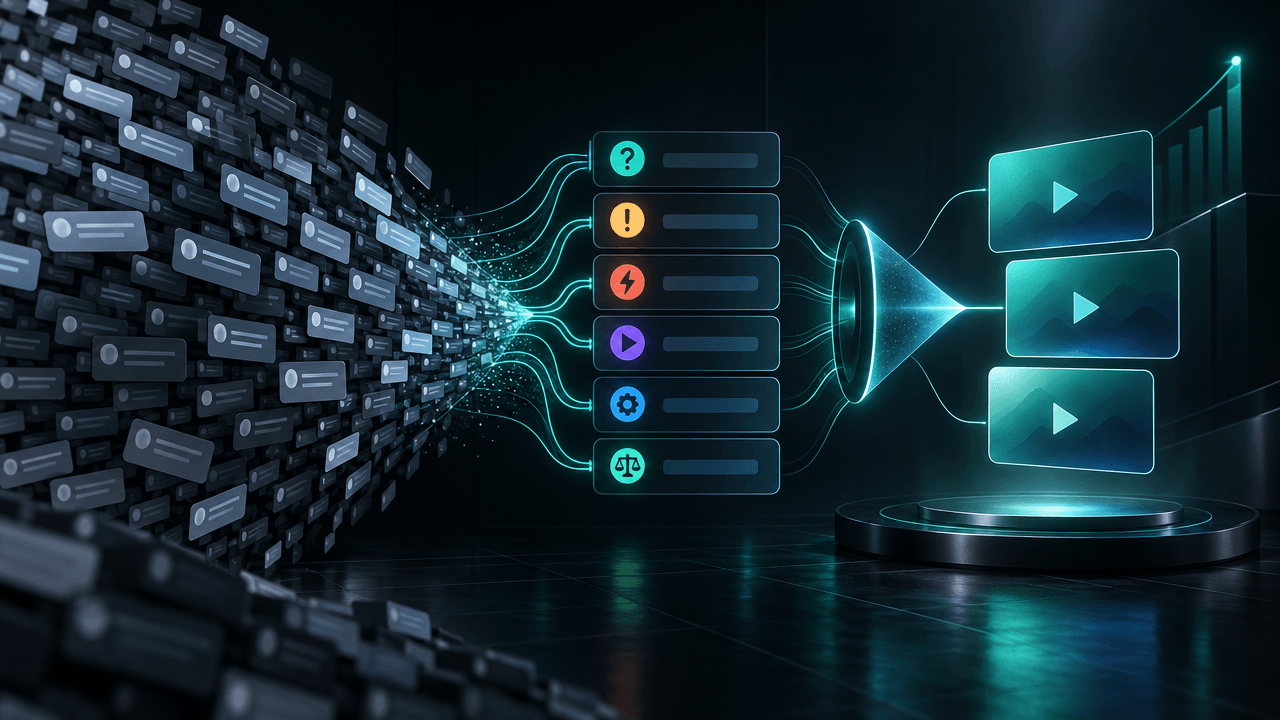

Two videos can cover the same topic and strengthen each other.
Two other videos can cover the same topic and make both weaker.
The difference is not the keyword.
It is whether each video gives the viewer a distinct reason to choose it.
This is where many growing YouTube channels lose efficiency.
A creator publishes:
- How to Grow on YouTube
- How to Grow a Small YouTube Channel
- The Best Way to Grow on YouTube
- How I Would Grow a YouTube Channel in 2026
- YouTube Growth Tips for Beginners
Each title looks slightly different.
The intended viewer, promise, answer, format, and payoff may be almost identical.
The channel has not built a topic cluster.
It has produced five substitutes.
That creates a strategic problem commonly described as YouTube content cannibalization.
The term is borrowed from search-engine optimization, but YouTube is not a website and videos are not webpages. There is no published YouTube rule that says a channel may have only one video for each keyword. YouTube does not disclose an official “cannibalization score,” and covering the same subject more than once does not automatically trigger a ranking penalty.
YouTube Search evaluates factors including relevance, engagement, and quality. Recommendations are personalized around the individual viewer, the video currently being watched, viewing history, and predicted satisfaction. That means several videos from one channel can succeed around the same broad subject when each one satisfies a different viewing need.
The problem begins when several videos become interchangeable.
They compete for:
- The same viewer
- The same viewing occasion
- The same search intent
- The same Home-page click
- The same Suggested position
- The same title and thumbnail promise
- The same place inside the channel library
- The same production resources
- The same business objective
A healthy content cluster creates depth.
Cannibalization creates redundancy.
This guide shows how to identify the difference, audit overlapping videos, decide which asset should lead, and choose whether to differentiate, sequence, repackage, update, remake, unlist, or retire each video.
Key Takeaways
- YouTube content cannibalization is a strategic diagnosis, not an official YouTube metric or confirmed algorithm penalty.
- Multiple videos about the same broad topic can perform well when they serve different viewer intents, formats, awareness stages, or outcomes.
- Overlap becomes harmful when viewers cannot tell why one video should be chosen instead of another.
- The strongest test is not “Do these videos use the same keyword?” It is “Would the same viewer consider these videos substitutes in the same moment?”
- Search overlap, Browse overlap, Suggested overlap, audience-stage overlap, and business-goal overlap are separate problems.
- YouTube Search considers relevance, engagement, and quality. It does not simply select one video per channel or one video per keyword.
- YouTube recommendations rank content for individual viewers and seek long-term satisfaction. Similar videos from the same channel may still serve different people or viewing occasions.
- A topic cluster expands one demand area through distinct angles. Cannibalization repeats the same promise without adding enough new value.
- A sequel should continue the original question. A remake should replace an inadequate answer. An update should address changed information. A comparison should help a decision.
- Do not delete an older video simply because a new one exists.
- YouTube does not provide webpage-style canonical tags or redirects. Creators must use titles, descriptions, pinned comments, cards, end screens, playlists, visibility settings, and spoken guidance to clarify which video should be watched.
- Use YouTube Advanced Mode to compare overlapping videos across equal time windows, traffic sources, search terms, retention, subscribers, and revenue.
- A high-performing old video and a high-performing new video are not cannibalizing each other merely because both receive traffic.
- The best prevention system assigns every planned video a distinct audience, job, promise, format, and next step before production begins.
- Cannibalization is often a planning failure disguised as an analytics problem.
What Is YouTube Content Cannibalization?
YouTube content cannibalization occurs when two or more videos from the same channel overlap so heavily that they weaken the clarity, strategic role, or combined performance of the channel’s content library.
The overlap may exist across:
- Search intent
- Audience
- Topic
- Title promise
- Thumbnail concept
- Format
- Video structure
- Viewer outcome
- Funnel stage
- Timing
- Call to action
The key phrase is weaken the combined result.
Two videos are not cannibalizing each other merely because they cover the same topic.
They become a problem when the channel would be stronger if the assets were:
- More clearly differentiated
- Sequenced more logically
- Combined into a stronger remake
- Repositioned for separate audiences
- Connected through a defined journey
- Reduced to one primary answer
Simple Example
Video A:
How to Start a Faceless YouTube Channel
Video B:
How to Build a Faceless YouTube Channel From Scratch
Both videos target:
- The same beginner
- The same problem
- The same stage
- The same broad workflow
- The same expected outcome
- The same likely Search query
The titles are different.
The viewer job is the same.
That is a likely overlap problem.
Now compare:
Video A:
How to Start a Faceless YouTube Channel
Video B:
Why Most Faceless YouTube Channels Fail After 20 Videos
Video C:
Best AI Video Workflow for Faceless Documentary Channels
Video D:
I Audited the Production Costs of Five Faceless Channels
These videos share a category but serve different jobs:
- Start
- Diagnose failure
- Choose a workflow
- Evaluate economics
That is a healthy topic cluster.
Is YouTube Cannibalization an Official Ranking Penalty?
No published YouTube documentation describes a channel-level “content cannibalization penalty.”
YouTube does not state:
- Only one video from a channel can rank for a query
- Uploading a similar video automatically suppresses the original
- Repeating a keyword divides authority between videos
- Channels must designate one canonical video per topic
- Search ranking equity is split like website backlinks
YouTube explains that its Search ranking system prioritizes relevance, engagement, and quality. Relevance can include how well the title, description, tags, and video content match the query. Engagement may include watch time for that query. Quality considers signals associated with expertise, authority, and trustworthiness.
YouTube’s recommendation system is personalized. Home relies heavily on viewing history, while Up Next uses the current video as an important signal. Likes, dislikes, subscriptions, search history, “Not interested” feedback, and satisfaction surveys can also influence recommendations.
This means two videos from one channel can both deserve distribution when:
- They satisfy different viewers
- They answer different questions
- They perform in different traffic sources
- They offer different formats
- They work at different stages of the viewer journey
- They remain satisfying in their respective contexts
Cannibalization is therefore best understood as a channel-strategy and audience-clarity problem, not a simple algorithmic punishment.
When Multiple Videos on the Same Topic Are Good
Repeated topic coverage can be a major channel advantage.
YouTube itself advises creators to build a substantial library of useful content so new viewers can explore more of the channel. An older video may also receive new interest when the topic grows, new viewers discover the channel, or a new episode causes viewers to revisit earlier content.
Multiple videos are valuable when each one expands the viewer’s understanding.
1. Different Search Intent
Broad topic:
YouTube thumbnails
Distinct intents:
- How to make a YouTube thumbnail
- Best YouTube thumbnail software
- Why YouTube thumbnails get low CTR
- YouTube thumbnail size and format
- How to A/B test YouTube thumbnails
- Thumbnail examples for documentary channels
The keyword family overlaps.
The required answers differ.
2. Different Audience Stage
Topic:
AI agents
Distinct stages:
- Beginner: What Is an AI Agent?
- Builder: Build Your First No-Code Agent
- Operator: Monitor Agent Reliability in Production
- Buyer: Best AI Agent Platforms Compared
- Security lead: How to Limit Agent Permissions
- Executive: Calculate the ROI of an AI Agent
The topic remains consistent while the viewer’s sophistication changes.
3. Different Format
Topic:
Company failure
Distinct formats:
- Documentary
- Timeline
- Founder interview
- Financial breakdown
- Mistakes list
- Animated explainer
- Debate
- Case study
The same subject can support several viewing experiences.
4. Different Promise
Topic:
YouTube retention
Distinct promises:
- Diagnose retention loss
- Rewrite the first 30 seconds
- Understand the retention graph
- Add rehooks to a script
- Compare retention across formats
- Fix a slow documentary middle
The promise should be visible before the click.
5. Different Traffic Strategy
One video may target Search:
How to Read a YouTube Audience Retention Graph
Another may target Browse:
The Retention Mistake Killing Your Best Videos
Another may target Suggested:
I Fixed the First 30 Seconds of Five Failing Videos
These videos can support each other because they enter the audience through different contexts.
6. Different Time Horizon
A topic may need:
- Evergreen foundation
- Current-year update
- News response
- Historical analysis
- Long-term test
- Post-launch review
Example:
- What Is OpenAI’s Agents SDK?
- OpenAI Agents SDK Tutorial
- What Changed in the Agents SDK in 2026?
- I Used the Agents SDK in Production for 30 Days
Each asset has a different shelf life.
7. Different Viewer Outcome
Topic:
YouTube competitor research
Possible outcomes:
- Find competitors
- Select the right competitors
- Identify outlier videos
- Extract title patterns
- Find content gaps
- Build original ideas
- Avoid copying
Each video should complete a different job.
Healthy Topic Cluster vs Cannibalization
| Healthy Topic Cluster | Cannibalization Risk |
|---|---|
| Same category, different viewer jobs | Same category and same viewer job |
| Different awareness stages | Same awareness stage |
| Different titles and genuinely different promises | Different wording but equivalent promises |
| Distinct thumbnail mechanisms | Near-identical thumbnail concepts |
| Videos naturally lead into one another | Videos replace one another |
| Each video adds new evidence or application | Most material repeats |
| Different traffic strategies | All target the same viewing occasion |
| Clear reason to watch several videos | Viewer only needs one |
| Distinct CTA or next step | Same CTA and business objective |
| Channel gains depth | Channel feels repetitive |
Use this test:
If a qualified viewer watches one video, is there still a strong reason to watch the other?
When the answer is yes, you probably have a cluster.
When the answer is no, you may have substitutes.
The Seven Types of YouTube Content Cannibalization
Cannibalization does not occur in one universal form.
Diagnose the exact type before changing anything.
1. Search-Intent Cannibalization
This occurs when several videos attempt to answer the same query for the same viewer.
Example:
- Best AI Video Generator
- Top AI Video Generators
- Best AI Video Tools
- Which AI Video Generator Is Best?
If all four videos provide approximately the same ranked list, they are substitutes.
Symptoms
- The same search terms send traffic to several videos
- Rankings alternate between similar uploads
- Newer video fails to establish a distinct query or angle
- Searchers encounter multiple nearly identical thumbnails
- One video is current while another remains outdated
- Comments ask which version is the latest
- Search traffic becomes fragmented across weak assets
Important Caveat
Multiple videos appearing for the same query are not automatically harmful.
They may serve different intent.
Example:
- Best AI Video Generators
- Runway vs Kling
- How to Use Runway
- AI Video Generator Pricing Compared
All may appear around related searches while satisfying different needs.
Best Fixes
- Clarify separate search intent
- Reposition one video toward a narrower question
- Create a new title that accurately reflects its distinct value
- Link the older video to the current answer
- Remake when the old information is broadly outdated
- Unlist the weaker version only when it creates more confusion than value
2. Browse-Promise Cannibalization
This happens when multiple videos compete for the same Home-page click using nearly identical promises.
Example:
- Why Small YouTube Channels Fail
- Why 90% of YouTube Channels Fail
- The Reason Your YouTube Channel Is Failing
- Why Your Videos Never Get Views
The videos may contain different scripts.
The viewer sees the same emotional promise:
Discover the hidden reason your channel is failing.
Symptoms
- Similar titles published close together
- Repeated thumbnail composition
- Same emotional trigger
- Same target viewer
- Same opening thesis
- Audience comments describe the videos as repeats
- Returning viewers ignore later variations
- Subscriber-feed response declines across the series
Best Fixes
Differentiate the stakes.
Instead of four general failure videos:
- Why Small Channels Stop Growing After Their First Viral Video
- The Thumbnail Pattern That Limits Browse Distribution
- Why Search-Led Channels Struggle to Build Loyal Audiences
- The Production Bottleneck That Kills Weekly Uploads
The category remains channel failure.
The causes and promises become distinct.
3. Suggested-Context Cannibalization
Suggested videos are influenced by the video currently being watched and viewer personalization.
Two videos can be useful adjacent recommendations when they continue the same journey.
They become strategically redundant when both offer the same next step.
Example:
Current video:
How to Validate a YouTube Video Idea
Possible next videos:
- Validate Your Next 10 Topics With This Scorecard
- How to Turn a Validated Topic Into a Title and Thumbnail
- Best YouTube Topic Validation Tools
These offer different continuations.
Weak alternatives:
- How to Know if a Video Idea Is Good
- The Best Way to Validate a YouTube Idea
- Video Idea Validation Explained
All repeat the current answer.
Symptoms
- Several videos receive Suggested traffic from the same source but lead to identical payoffs
- End-screen choices feel interchangeable
- Playlist sequence contains repeated explanations
- Viewers skip one of the videos in the sequence
- The channel lacks an obvious advanced or adjacent step
Best Fixes
Assign one continuation to each viewer question:
- Next step
- Advanced version
- Tool implementation
- Failure diagnosis
- Case study
- Opposing view
4. Audience-Stage Cannibalization
This occurs when several videos address the same audience at the same stage.
Example:
Three beginner videos all explain:
- What YouTube SEO is
- Why titles matter
- Why thumbnails matter
- Why retention matters
The creator may believe each video has a different topic.
The beginner experiences them as the same introduction.
Best Fix
Create a progression:
- Definition
- First implementation
- Common mistakes
- Measurement
- Advanced system
- Case study
Each video should assume or create a different level of understanding.
5. Format Cannibalization
A channel can repeat one successful format until the episodes feel interchangeable.
Examples:
- Every video is “I tested X for seven days”
- Every documentary is “The rise and fall of X”
- Every psychology video is “Seven signs that X”
- Every product review uses the same list, score, and conclusion
- Every AI video is “Ten tools you need”
A recurring format is valuable.
A repeated experience without materially different substance is not.
YouTube’s current channel monetization policies distinguish acceptable recurring formats from generic, repetitive, or mass-produced content. Similar structure can be monetizable when the substance differs meaningfully. Channels where videos feel interchangeable or add minimal original value may face monetization concerns.
This policy issue is separate from content cannibalization, but the symptoms can overlap.
Healthy Repetition
- Recognizable show
- Consistent visual identity
- Repeatable structure
- New subject
- New evidence
- New conflict
- New conclusion
Weak Repetition
- Same hook
- Same examples
- Same stock footage
- Same conclusion
- Different nouns inserted into the template
6. Funnel Cannibalization
This happens when several videos compete for the same business objective without serving different stages of the buyer journey.
Example for a SaaS channel:
- Best YouTube Research Platform
- Why OverseerOS Is Better
- OverseerOS Product Tour
- Build Your YouTube Strategy With OverseerOS
All four may target someone already considering the product.
The channel may be missing:
- Problem-awareness video
- Educational workflow
- Category comparison
- Use-case case study
- Implementation tutorial
- Customer result
- Objection handling
Best Fix
Map videos to stages:
| Stage | Viewer Question | Video Type |
|---|---|---|
| Problem aware | Why is my current process failing? | Diagnosis |
| Solution aware | What type of system could solve this? | Educational guide |
| Category aware | Which tools exist? | Buyer guide |
| Product aware | Why this product? | Comparison or demonstration |
| Customer | How do I succeed after buying? | Tutorial and onboarding |
Several videos can support one product without repeating one sales pitch.
7. Strategic-Role Cannibalization
Every important video should have a role inside the channel library.
Possible roles include:
- Gateway
- Authority
- Search utility
- Trend capture
- Format test
- Trust builder
- Conversion asset
- Community video
- Update
- Bridge
- Sequel
- Flagship
Cannibalization occurs when several videos occupy the same role but none clearly leads.
Example:
A channel has five “Start Here” videos.
The homepage, trailer, description, and playlists recommend different ones.
The viewer receives conflicting instructions.
Best Fix
Choose:
- One primary gateway for the audience
- One gateway per major pillar
- One current definitive answer per time-sensitive task
- One next step from each important video
The other videos can remain valuable, but their roles must be clarified.
Cannibalization vs Duplicate Content vs Reused Content
These terms should not be confused.
| Term | Meaning |
|---|---|
| YouTube content cannibalization | Your own videos overlap strategically and may weaken clarity or combined performance |
| Repetitive or inauthentic content | Content feels mass-produced, generic, interchangeable, or minimally varied across the channel |
| Reused content | Material from YouTube or another source is republished without enough original value or transformation |
| Copyright duplication | Content may violate a rights holder’s copyright |
| Topic cluster | Several distinct videos serve related audience needs |
| Remake | A substantially new version replaces an inadequate or outdated answer |
| Reupload | The same or nearly identical file is uploaded again |
A channel can have cannibalization without violating any policy.
A channel can also avoid cannibalization while still violating reused-content rules.
These are different evaluations.
The Five-Layer Video Overlap Test
Compare suspected videos across five layers.
Layer 1: Audience
Ask:
- Is the viewer the same?
- Are they at the same knowledge level?
- Do they have the same problem?
- Are they making the same decision?
Layer 2: Intent
Ask:
- What is the viewer trying to accomplish?
- Learn?
- Compare?
- Diagnose?
- Buy?
- Be entertained?
- Understand a story?
- Complete a task?
Layer 3: Promise
Ask:
- What does the title promise?
- What does the thumbnail promise?
- What answer does the opening create?
- Would the viewer expect the same payoff?
Layer 4: Substance
Ask:
- How much evidence overlaps?
- Are the examples different?
- Is the thesis different?
- Is the structure different?
- Does the newer video add meaningful value?
Layer 5: Destination
Ask:
- What should the viewer do afterward?
- Do both videos lead to the same next asset?
- Does one naturally follow the other?
- Does each support a different channel or business objective?
Interpretation
| Overlap | Meaning |
|---|---|
| 0–20% | Distinct videos |
| 21–40% | Healthy topical relationship |
| 41–60% | Review positioning and sequence |
| 61–80% | Strong cannibalization risk |
| 81–100% | Likely substitutes or remake candidates |
The percentage is a planning estimate, not a YouTube metric.
The YouTube Cannibalization Scorecard
Score each pair from 0 to 10.
| Factor | 0 Points | 10 Points |
|---|---|---|
| Audience overlap | Completely different viewers | Same viewer |
| Intent overlap | Different jobs | Same job |
| Title-promise overlap | Clearly distinct | Nearly identical promise |
| Thumbnail overlap | Different mechanism | Same visual question |
| Content overlap | Mostly new substance | Extensive repetition |
| Traffic overlap | Different discovery strategy | Same traffic context |
| Timing overlap | Separated by meaningful need | Published close together without new reason |
| CTA overlap | Different destinations | Same CTA |
| Library-role overlap | Different strategic roles | Same role |
| Update necessity | Both current and distinct | One clearly replaces the other |
| Maximum | 100 |
Decision Guide
| Score | Recommended Action |
|---|---|
| 0–29 | Keep both |
| 30–49 | Improve connections and positioning |
| 50–69 | Differentiate title, promise, audience, or role |
| 70–84 | Repackage, sequence, remake, or consolidate |
| 85–100 | Strong substitute risk. Choose a primary asset |
How to Find Cannibalization in YouTube Analytics
Use YouTube Advanced Mode to compare videos and groups.
YouTube currently allows customizable groups containing up to 500 videos, playlists, or channels.
Create a group for every suspected cluster.
Examples:
- Beginner Thumbnail Videos
- AI Tool Comparisons
- Faceless Channel Launch Guides
- YouTube Analytics Tutorials
- Product Review Videos
- Channel Failure Videos
Step 1: Compare Equal Age Windows
Do not compare:
- Lifetime performance of a three-year-old video
- First month of a recent upload
Use:
- First 7 days
- First 28 days
- First 90 days
- Same seasonal period
- Recent 90 days for evergreen assets
Step 2: Review Traffic Sources
Compare:
- YouTube Search
- Browse features
- Suggested videos
- Channel pages
- Playlists
- External
- Notifications
- Subscriber feed
Two videos may look similar in total performance but serve different sources.
Example:
Video A receives most traffic from Search.
Video B receives most traffic from Browse.
They may be complementary rather than cannibalistic.
Step 3: Inspect Search Terms
Open the YouTube Search traffic-source detail.
Record:
- Queries shared by both videos
- Queries unique to each
- Watch time by query where available
- Whether one video is outdated
- Which video better satisfies the current intent
- Whether the newer video attracts a new query family
Strong Separation
Video A:
how to make a YouTube thumbnail
Video B:
best YouTube thumbnail software
Weak Separation
Video A:
how to grow a YouTube channel
Video B:
best way to grow on YouTube
Both primarily serve the same broad beginner need.
Step 4: Compare Appeal, Engagement, and Satisfaction Proxies
YouTube groups content-performance signals into areas such as:
- Appeal: Did viewers choose the video?
- Engagement: Did they continue watching?
- Satisfaction: Did they enjoy the experience?
Compare available indicators such as:
- Impressions
- CTR
- Views
- Watch time
- Average view duration
- Retention
- Likes
- Subscribers
- Returning-viewer behavior
- End-screen movement
- Comments
A newer video may receive fewer views while creating a better viewer experience.
Do not choose the winner using views alone.
Step 5: Compare Business Value
Add off-platform data where relevant:
- Affiliate clicks
- Product trials
- Leads
- Sponsor value
- Email signups
- Course sales
- Consulting inquiries
- Customer activation
One video may deserve to remain the main commercial asset even when another receives more views.
Step 6: Inspect the Sequence
Ask:
- Do viewers move from one video to the other?
- Does the first video create the question answered by the second?
- Are both placed in the same playlist?
- Is the recommended order clear?
- Does the end screen send viewers to the better continuation?
- Does either video lose viewers because the other has already resolved the need?
Step 7: Read the Comments
Look for:
- “Didn’t you already make this?”
- “Which version should I watch?”
- “Is this still current?”
- “This is the same advice as the last video.”
- “Can you make an advanced version?”
- “The old video explained this better.”
- “This update changed everything.”
Comments do not prove cannibalization.
They provide qualitative evidence.
The YouTube Content Inventory Template
Create one row per video.
VIDEO TITLE:
URL:
PUBLICATION DATE:
CONTENT PILLAR:
TOPIC CLUSTER:
TARGET VIEWER:
AWARENESS STAGE:
VIEWER JOB:
PRIMARY TRAFFIC STRATEGY:
FORMAT:
TITLE PROMISE:
THUMBNAIL PROMISE:
CENTRAL THESIS:
PRIMARY PAYOFF:
PRIMARY CTA:
NEXT VIDEO:
CURRENT ACCURACY:
CURRENT STRATEGIC ROLE:
POTENTIAL OVERLAP:
RECOMMENDED ACTION:
This inventory reveals overlap before analytics do.
Two titles may appear different until the viewer-job column shows that both videos solve the same problem.
The Nine Actions for Overlapping YouTube Videos
1. Keep Both
Use when:
- Both perform well
- Each serves a distinct intent
- Traffic sources differ
- Viewers watch both
- The channel benefits from deeper topic coverage
- Neither creates confusion
Do not fix healthy overlap.
2. Differentiate
Use when both videos contain value but their positioning is unclear.
Differentiate through:
- Audience
- Stage
- Outcome
- Format
- Evidence
- Traffic strategy
- Time horizon
- CTA
Before
- Best YouTube Analytics Metrics
- YouTube Metrics Every Creator Needs
After
- YouTube Metrics for Diagnosing a New Video
- YouTube KPIs for Measuring a Channel as a Business
The topic overlaps.
The decision context changes.
3. Sequence
Use when one video should naturally lead to the other.
Example:
- How to Find a YouTube Content Gap
- How to Validate the Gap Before Production
- Turn the Validated Gap Into a Title and Thumbnail
- Write the Research-Backed Script
- Measure the Result
Update:
- Playlist order
- End screens
- Cards
- Descriptions
- Pinned comments
- Spoken CTAs
The YouTube Playlist Strategy guide explains how to turn related assets into a deliberate viewer journey.
4. Repackage
Use when the content is distinct but the title and thumbnail make the videos look interchangeable.
YouTube currently lets eligible creators A/B test up to three titles, thumbnails, or title-thumbnail combinations. The platform determines a winner using watch time share rather than CTR alone.
Test distinct positioning directions.
Example:
Video content:
A 30-day test of AI support agents.
Weak variants:
- Best AI Support Agent
- Top AI Support Agent
- AI Support Agent Review
Stronger directions:
- Experiment: I Let an AI Agent Answer 500 Support Tickets
- Risk: This Support Agent Failed the Most Important Test
- Buyer decision: Which AI Support Agent Is Safe Enough for Customers?
Each creates a different entry point while remaining accurate.
5. Update the Primary Asset
Use when one video is the strongest answer but needs current information.
Possible updates include:
- Description
- Correction
- Chapters
- Captions
- Cards
- End screen
- Thumbnail
- Title
- Links
- Playlist context
Use the YouTube Content Refresh Strategy to decide whether the existing upload can be repaired or requires a new version.
6. Create a Sequel
Use when the first video remains useful and the second should continue the story.
A sequel should answer:
- What happened next?
- What changed?
- What failed?
- How do I implement it?
- What is the advanced version?
- What does a real case study show?
- Which alternative is better?
Weak Sequel
More YouTube Growth Tips
Strong Sequel
Why the Growth Strategy Worked for 30 Days and Then Collapsed
The sequel earns its existence through new tension.
7. Create a Remake
Use when:
- The topic remains valuable
- The original answer is inadequate
- Information is materially outdated
- Production quality prevents satisfaction
- A new thesis replaces the old one
- The old video cannot be repaired cleanly
A remake should be substantially new.
Change:
- Research
- Thesis
- Examples
- Structure
- Visuals
- Packaging
- Conclusion
- Viewer value
Do not upload the same video with a new thumbnail and call it an update.
8. Reposition the Older Video
An older video may remain valuable as:
- Historical version
- Beginner version
- Original experiment
- Product-specific tutorial
- Short answer
- Case study
- Archive
Clarify this in the title.
Before:
Best AI Video Generator
After:
My 2024 AI Video Generator Test: What Still Holds Up?
Only use a date when it accurately describes the asset.
9. Unlist, Make Private, or Delete
Use when public availability creates more harm than value.
Possible reasons:
- Severe inaccuracy
- Rights problem
- Privacy risk
- Duplicate upload
- Outdated product onboarding
- Brand confusion
- A new version fully replaces the old one
- Viewers are repeatedly misled
YouTube has no webpage-style redirect function.
Before changing visibility:
- Back up the file
- Export analytics
- Review embeds
- Review backlinks
- Review playlists
- Review customer resources
- Update descriptions and links elsewhere
- Decide whether an unlisted historical version is useful
Deletion is permanent.
Use it carefully.
The Cannibalization Decision Tree
DO THE VIDEOS SERVE THE SAME VIEWER?
|
|-- NO --> Keep both. Clarify audience if necessary.
|
|-- YES
    |
    DO THEY SERVE DIFFERENT VIEWER JOBS?
    |
    |-- YES --> Differentiate titles, thumbnails, and sequence.
    |
    |-- NO
        |
        DOES EACH VIDEO ADD SUBSTANTIALLY DIFFERENT VALUE?
        |
        |-- YES --> Reposition by format, evidence, or stage.
        |
        |-- NO
            |
            IS ONE VIDEO CURRENT, ACCURATE, AND STRONGER?
            |
            |-- YES --> Make it the primary asset. Redirect paths manually.
            |
            |-- NO
                |
                CAN ONE EXISTING VIDEO BE REPAIRED?
                |
                |-- YES --> Refresh and repackage.
                |
                |-- NO --> Produce a substantial remake.
How to Prevent Cannibalization Before Production
The cheapest overlap to fix is the video that has not been produced.
Run a pre-production overlap check.
Step 1: Search Your Own Channel
Search:
- Exact topic
- Broader topic
- Main viewer question
- Alternative wording
- Product name
- Previous year
- Common title patterns
Review more than titles.
Watch the videos.
Step 2: Search the Content Planner
Look for:
- Unpublished scripts
- Drafts
- Scheduled videos
- Archived concepts
- Planned sequels
- Existing topic clusters
Cannibalization can occur before publication when several teams unknowingly produce the same idea.
Step 3: Write the Viewer Job
Complete:
After watching this video, the viewer will be able to __________.
Compare it with existing videos.
When the same sentence applies to another video, differentiation is required.
Step 4: Write the Unique Contribution
Every planned video should add at least one:
- New experiment
- New dataset
- New case study
- New audience
- New format
- New evidence
- New argument
- New update
- New workflow
- New decision
- New story
- New visual demonstration
“Different wording” is not a contribution.
Step 5: Define the Existing Alternative
Record:
CLOSEST EXISTING VIDEO:
[Video]

WHY A VIEWER WOULD CHOOSE THE NEW VIDEO:
[Distinct reason]

WHY A VIEWER WOULD STILL WATCH THE OLD VIDEO:
[Distinct remaining value]

RELATIONSHIP:
[Sequel, update, comparison, beginner, advanced, case study, or separate intent]
When you cannot complete these fields, do not approve production.
Step 6: Test the Titles Side by Side
Place every title in the cluster on one page.
Example:
- How to Build a Faceless Channel
- Start a Faceless YouTube Channel
- Faceless YouTube Channel Tutorial
- Build Your First Faceless Channel
The repetition becomes obvious.
Rewrite:
- Choose a Faceless Niche With Real Demand
- Build the First 10-Video Content Plan
- Create a Repeatable Faceless Production Workflow
- Calculate the Real Cost of a Faceless Channel
- Diagnose Why a Faceless Channel Is Not Growing
Step 7: Test the Thumbnails Side by Side
Ask:
- Do they use the same face?
- Same product interface?
- Same before-and-after?
- Same text?
- Same emotion?
- Same visual metaphor?
- Same color hierarchy?
- Same question?
A viewer should be able to understand why each thumbnail exists.
Step 8: Define the Next Video
A video with no clear predecessor or successor may still be useful.
A planned cluster should create movement.
Record:
- Previous video
- Next video
- Playlist
- End-screen destination
- CTA
- Business objective
The Content Differentiation Matrix
Use this matrix to turn one broad topic into distinct videos.
| Dimension | Possible Variations |
|---|---|
| Audience | Beginner, advanced, agency, creator, business, developer |
| Intent | Learn, compare, diagnose, buy, implement, understand |
| Format | Tutorial, documentary, experiment, teardown, case study, interview |
| Time | Evergreen, current update, historical, prediction, long-term test |
| Evidence | Data, interview, experiment, public case, personal result |
| Stakes | Time, money, risk, growth, quality, trust |
| Scope | Complete guide, one step, one mistake, one tool, one case |
| Outcome | Decision, workflow, understanding, transformation |
| Traffic | Search, Browse, Suggested, subscriber, external |
| Funnel | Discovery, education, trust, comparison, conversion, retention |
Example: YouTube Thumbnails
| Video | Distinct Dimension |
|---|---|
| How to Make a YouTube Thumbnail | Beginner tutorial |
| Why Good Thumbnails Still Get Ignored | Diagnosis |
| I Tested Three Thumbnails on the Same Video | Experiment |
| Best Thumbnail Tools Compared | Buyer decision |
| How Documentary Channels Create Visual Tension | Format specialization |
| Fix These Five Thumbnail Mistakes | Repair workflow |
| YouTube Thumbnail A/B Testing Explained | Analytics implementation |
One cluster.
Seven viewer jobs.
Examples by Channel Type
Faceless Documentary Channel
Cannibalizing Set
- The Rise and Fall of Company A
- How Company A Collapsed
- Why Company A Failed
- The Company A Disaster
All tell the same collapse story.
Stronger Cluster
- The Decision That Started Company A’s Collapse
- Inside the Accounting System That Hid the Damage
- Why the Rescue Deal Failed
- What Company A’s Competitors Learned
- The Employees Who Saw the Collapse Coming
Each video owns a different chapter or thesis.
Software Tutorial Channel
Cannibalizing Set
- Platform X Beginner Tutorial
- How to Use Platform X
- Platform X Full Guide
- Platform X Tutorial for Beginners
Stronger Cluster
- Platform X Beginner Setup
- Build Your First Automation
- Connect Platform X to Your CRM
- Fix the Five Most Common Errors
- Platform X vs Make
- Platform X Pricing and Usage Limits
- Advanced Human-Approval Workflow
Psychology Channel
Cannibalizing Set
- Signs Someone Is Emotionally Unavailable
- How to Know Someone Is Emotionally Unavailable
- Emotional Unavailability Signs
- Seven Traits of Emotionally Unavailable People
Stronger Cluster
- Why Emotionally Unavailable People Pull Away After Intimacy
- Emotional Unavailability vs Healthy Independence
- Why You Keep Choosing Unavailable Partners
- How Intermittent Reinforcement Creates Attachment
- Rebuilding Trust After an Avoidant Relationship
Sensitive content should educate rather than diagnose individual viewers.
AI Tools Channel
Cannibalizing Set
- Best AI Tools
- Top AI Tools
- AI Tools You Need
- Best New AI Tools This Week
Stronger Cluster
- AI Research Agents Tested for Citation Accuracy
- Best AI Agent Platform for Small Teams
- Which AI Video Tool Maintains Character Consistency?
- I Replaced Five Manual Automations With One Agent
- The AI Tool Permission Mistake Businesses Ignore
SaaS Channel
Cannibalizing Set
- What Is OverseerOS?
- OverseerOS Explained
- Why Use OverseerOS?
- OverseerOS Product Tour
Stronger Journey
- Why YouTube Teams Lose Strategy Between Research and Production
- Build a Research-to-Script Workflow
- OverseerOS vs Generic AI for YouTube
- Analyze a Channel With OverseerOS
- Create a Script From a Channel Blueprint
- Turn the Script Into a Faceless Video
- Customer Workflow Case Study
The product remains central.
The viewer questions change.
Review Channel
Cannibalizing Set
- Best Microphones
- Top Microphones
- Best Microphones for Creators
- Best Creator Microphones
Stronger Cluster
- Best Microphone for Untreated Rooms
- USB vs XLR for YouTube Creators
- Five Microphones Tested in the Same Room
- Best Budget Voiceover Microphone
- Fix Background Noise Before Buying a New Mic
- Long-Term Review After 12 Months
The Quarterly YouTube Cannibalization Audit
Run this every quarter for large or fast-publishing channels.
Phase 1: Inventory
Export or record:
- Videos
- Dates
- Pillars
- Formats
- Target viewers
- Traffic strategy
- Title promise
- Thumbnail concept
- Viewer job
- CTA
- Accuracy
- Current role
Phase 2: Cluster
Group videos by:
- Topic
- Intent
- Audience stage
- Format
- Business goal
Use the YouTube Topic Clusters guide to separate healthy depth from repetition.
Phase 3: Flag
Flag pairs with:
- Similar titles
- Similar thumbnails
- Same search terms
- Same viewer job
- Same CTA
- High script overlap
- Conflicting update years
- Confusing playlist order
Phase 4: Analyze
Use YouTube Advanced Mode to compare:
- Equivalent age windows
- Traffic sources
- Search queries
- CTR
- Watch time
- Retention
- Subscribers
- Revenue
- End-screen movement
Phase 5: Decide
Assign:
- Keep
- Differentiate
- Sequence
- Repackage
- Update
- Sequel
- Remake
- Reposition
- Unlist
- Delete
Phase 6: Reconnect
Update:
- Playlists
- End screens
- Cards
- Pinned comments
- Descriptions
- Channel homepage
- Blog links
- Email links
- Product onboarding
Phase 7: Prevent
Add an overlap review to every future brief.
The Monthly Overlap Dashboard
| Cluster | Videos | Primary Asset | Overlap Risk | Action | Owner | Review Date |
|---|---|---|---|---|---|---|
| YouTube thumbnails | 12 | A/B Testing Guide | Medium | Differentiate beginner videos | ||
| AI agent tools | 8 | Platform Comparison | Low | Build case-study sequel | ||
| Faceless channel launch | 6 | Complete Launch Guide | High | Reposition three videos | ||
| YouTube analytics | 9 | Advanced Mode Guide | Medium | Create KPI-specific paths | ||
| Scriptwriting | 14 | Research-to-Script Guide | Low | Improve playlists |
The dashboard should lead to decisions.
Do not create it only for reporting.
How OverseerOS Fits the Cannibalization Workflow
Disclosure: OverseerOS is our platform.
OverseerOS can help identify, prevent, and repair overlapping YouTube content.
YouTube Studio remains the source of truth for private channel performance.
Step 1: Map the Existing Channel
Use OverseerOS Channel Analyzer and Channel Blueprint Cloner to inspect:
- Content pillars
- Recurring topics
- Formats
- Audience promise
- Titles
- Thumbnails
- Hooks
- Upload patterns
- Content opportunities
This helps reveal whether the channel has depth or repeated substitutes.
Step 2: Analyze Individual Videos
Use OverseerOS Viral X-Ray to compare overlapping videos across:
- Title
- Thumbnail
- Hook
- Intro
- Audience
- Tone
- Emotion
- Structure
- CTA
- Available transcript
The transcript comparison is especially useful when different titles hide similar scripts.
Step 3: Research the Current Market
Use OverseerOS Viral Channel Finder and competitor research to determine:
- Whether demand still exists
- Which angles currently break out
- Which audience stages are underserved
- Which formats dominate
- Which gaps remain
- Whether the planned video adds a real reason to exist
The goal is not to replace internal duplication with competitor imitation.
Extract strategy, then create an original contribution.
Step 4: Assign Every Planned Video a Role
Inside Channel Content Planner, document:
- Pillar
- Cluster
- Format
- Audience
- Intent
- Traffic strategy
- Title
- Thumbnail direction
- CTA
- Production status
- Relationship to existing videos
The planner should reject ideas whose only distinction is wording.
Step 5: Build a Distinct Script
Use OverseerOS Script Studio to define:
- Creative intent
- Central thesis
- New evidence
- New examples
- Hook
- Outline
- Section purpose
- Retention structure
- Final payoff
When the outline repeats an existing video, revise it before generating the full script.
Step 6: Repackage Existing Assets
Use Viral Title Generator, Thumbnail Analyzer, and Thumbnail Cloner to explore distinct packaging directions.
The new title and thumbnail must remain accurate to the existing video.
Step 7: Build the Viewer Journey
Use the planner to connect:
- Primary asset
- Supporting video
- Sequel
- Advanced version
- Update
- Playlist
- End-screen destination
- Conversion asset
The best solution is often not removing a video.
It is giving every video a clear place.
Common YouTube Cannibalization Mistakes
Mistake 1: Treating Every Shared Keyword as Cannibalization
Keywords can overlap while intent differs.
Audit the viewer job.
Mistake 2: Assuming YouTube Splits “Authority” Like a Website
YouTube does not publish a webpage-style authority allocation model for videos from the same channel.
Use actual video and audience evidence.
Mistake 3: Deleting the Older Video Automatically
The older video may have:
- Search authority
- Backlinks
- Comments
- Revenue
- Strong retention
- Historical value
- Better audience satisfaction
Choose the primary asset after analysis.
Mistake 4: Keeping Every Video Because It Has Some Views
Past views do not automatically justify current public placement.
Review accuracy, relevance, and confusion.
Mistake 5: Changing Only the Title
The video may need:
- Different audience
- Different structure
- Better evidence
- New CTA
- New role
- Complete remake
Metadata cannot create missing value.
Mistake 6: Producing a “2026 Update” Without Updating the Substance
Changing the year does not create a current video.
Mistake 7: Confusing a Sequel With a Repeat
A sequel changes the question.
A repeat restates the answer.
Mistake 8: Making Every Video Broader
Broadening titles can cause several videos to target the same general audience.
Specificity often creates healthier separation.
Mistake 9: Over-Specializing Every Video
The opposite problem also exists.
Creating dozens of nearly identical micro-keyword videos can make the channel feel mechanical and fragmented.
Combine questions when one complete answer serves the viewer better.
Mistake 10: Ignoring Thumbnails
Titles may be distinct while thumbnails communicate the same promise.
Audit both together.
Mistake 11: Ignoring the Script
Different packages can hide heavily duplicated content.
Compare:
- Thesis
- Examples
- Sections
- Evidence
- Conclusion
Mistake 12: Publishing Similar Videos Too Close Together
Timing can increase perceived repetition.
Use deliberate sequencing and explain why the new video exists.
Mistake 13: Comparing Lifetime Views
Use comparable age windows and traffic contexts.
Mistake 14: Judging Only by CTR
A package can earn clicks while disappointing viewers.
YouTube’s native A/B tests use watch time share for a reason.
Mistake 15: Failing to Choose a Primary Asset
When one question has several answers, identify the video that should lead.
Mistake 16: Sending Old Videos Nowhere
Update the surrounding viewer journey.
Mistake 17: Building Topic Clusters Without Boundaries
A cluster needs distinct viewer jobs.
It is not permission to repeat one idea indefinitely.
Mistake 18: Using AI to Generate Endless Variations
AI can generate hundreds of titles around one topic.
That does not mean each title deserves a video.
Mistake 19: Ignoring Business Cannibalization
Two videos may not compete for views but may confuse:
- Product positioning
- Affiliate recommendation
- Service offer
- Customer onboarding
- Sponsor narrative
Mistake 20: Fixing What Is Not Broken
When several videos perform, satisfy different viewers, and strengthen the library, leave them alone.
The 30-Day Cannibalization Repair Sprint
Days 1–3: Build the Inventory
Document every video’s:
- Topic
- Audience
- Intent
- Format
- Promise
- Traffic strategy
- CTA
- Strategic role
Days 4–6: Identify High-Risk Clusters
Prioritize clusters with:
- Many similar titles
- Frequent updates
- Buyer intent
- Outdated products
- Repeated list videos
- Search dependence
- Declining returning-viewer response
Days 7–10: Score the Overlap
Use the 100-point scorecard.
Select:
- Five high-risk pairs
- Five medium-risk pairs
- Five healthy clusters to protect
Days 11–14: Analyze Performance
Compare:
- Equal windows
- Search terms
- Traffic sources
- Watch time
- Retention
- Subscribers
- Revenue
- Viewer paths
Days 15–18: Choose Primary Assets
For each high-risk cluster, decide:
- Main gateway
- Current definitive answer
- Beginner asset
- Advanced asset
- Buyer asset
- Historical asset
- Next video
Days 19–22: Reposition and Repackage
Update:
- Titles
- Thumbnails
- Descriptions
- Pinned comments
- Cards
- End screens
- Playlists
Run A/B tests where appropriate.
Days 23–25: Plan Remakes and Sequels
Create briefs for videos that need:
- Current evidence
- New structure
- New audience
- New experiment
- New conclusion
Days 26–27: Retire Harmful Assets
Unlist, privatize, or delete only after reviewing:
- Links
- Embeds
- Analytics
- Rights
- Business use
- Historical value
Days 28–30: Install Prevention
Add these required fields to every future video brief:
- Closest existing video
- Unique viewer job
- New contribution
- Distinct package
- Strategic role
- Next-video relationship
The 100-Point Channel Differentiation Score
Use this before approving a new video.
| Factor | Maximum Score | Question |
|---|---|---|
| Distinct viewer job | 15 | Does this solve a different problem? |
| Distinct promise | 15 | Is the click reason clearly new? |
| New evidence | 10 | Does it add research, data, examples, or testing? |
| Audience-stage clarity | 10 | Is the viewer’s stage defined? |
| Format contribution | 10 | Does the format add value? |
| Traffic strategy | 10 | Is the intended discovery context clear? |
| Library role | 10 | Does the video have a specific strategic purpose? |
| Sequence | 5 | Is its relationship to other videos clear? |
| Business role | 5 | Does it support a defined outcome? |
| Originality | 10 | Would viewers consider it materially different? |
| Total | 100 |
Interpretation
| Score | Decision |
|---|---|
| 90–100 | Strong distinct addition |
| 80–89 | Approve after minor clarification |
| 70–79 | Moderate overlap risk |
| 55–69 | Rework the angle before production |
| Below 55 | Do not produce in its current form |
Final Verdict
YouTube does not require every channel to publish one video per keyword.
It rewards videos that viewers choose, watch, and find satisfying in the context where those videos are presented.
A channel can publish dozens of videos around one category and build enormous authority.
The videos must give viewers distinct reasons to exist.
The central test is:
Does this new video expand the viewer’s journey, or does it merely offer another version of an answer the channel already gave?
When it expands the journey:
- Publish it
- Connect it
- Sequence it
- Build the cluster
When it repeats the answer:
- Differentiate the audience
- Change the viewer job
- Add new evidence
- Reposition the format
- Create a real sequel
- Produce a substantial remake
- Choose one primary asset
The best channel libraries contain repetition at the strategic level:
- Same audience
- Same brand promise
- Same trusted formats
- Same editorial standards
They contain variation at the video level:
- New questions
- New stories
- New evidence
- New outcomes
- New reasons to click
That is how a channel becomes recognizable without becoming repetitive.
Frequently Asked Questions
What is YouTube content cannibalization?
YouTube content cannibalization occurs when several videos from the same channel overlap so heavily in audience, intent, promise, format, or outcome that they weaken clarity or combined strategic value.
Is YouTube content cannibalization an official metric?
No.
YouTube does not publish an official content-cannibalization metric or describe a universal penalty for covering the same topic more than once.
Can two videos from the same channel rank for the same keyword?
Yes.
YouTube Search evaluates relevance, engagement, quality, and personalization. Multiple videos may appear when each is relevant and useful.
Is targeting the same YouTube keyword twice bad?
Not automatically.
It can be useful when the videos serve different intents, formats, audiences, or stages.
It becomes a problem when the videos are substitutes.
How do I know whether two videos are cannibalizing each other?
Compare:
- Target viewer
- Search intent
- Title promise
- Thumbnail promise
- Content
- Traffic source
- CTA
- Strategic role
Then review actual analytics and viewer behavior.
What is the difference between a topic cluster and cannibalization?
A topic cluster contains related videos that answer different questions or advance the viewer journey.
Cannibalization contains overlapping videos that provide nearly the same answer.
Does uploading a new video kill an old YouTube video?
Not automatically.
A new upload may:
- Serve a different audience
- Renew interest in the old video
- Create a series
- Attract viewers into the wider library
Performance depends on audience interest, relevance, satisfaction, competition, and context.
Should I delete the weaker video?
Only after reviewing:
- Accuracy
- Search traffic
- Watch time
- Revenue
- Comments
- Links
- Historical value
- Business use
Repositioning or unlisting may be better than deletion.
Should I unlist an outdated YouTube video?
Unlisting may be appropriate when the video creates confusion but should remain accessible through direct links.
A current public update with clear redirection may be better when the old video still receives valuable traffic.
Can I redirect an old YouTube video to a new one?
YouTube does not provide webpage-style URL redirects.
Use:
- Description
- Pinned comment
- Card
- End screen
- Playlist
- Spoken guidance
Should I rename an old video after publishing an update?
Rename it when the new title more accurately clarifies its role, date, audience, or scope.
Do not make a title misleading merely to protect the newer video.
What is the difference between an update and a remake?
An update adds current information while preserving the original asset or creating a companion.
A remake produces a substantially new video that replaces an inadequate or outdated execution.
What is the difference between a sequel and a duplicate?
A sequel continues the question or reveals what happened next.
A duplicate repeats the same promise and answer.
How many videos should a YouTube topic cluster contain?
There is no universal number.
A cluster should contain enough videos to serve the meaningful viewer questions without creating interchangeable uploads.
Can similar videos cause monetization problems?
Similar formats are allowed when each video contains materially different substance and viewer value.
Generic, repetitive, interchangeable, or mass-produced content may create monetization concerns under YouTube’s channel monetization policies.
Does changing the title fix cannibalization?
Only when the videos are genuinely distinct and the current title hides that distinction.
A title cannot fix duplicated substance.
Can thumbnail A/B testing help?
Yes.
YouTube currently allows eligible creators to test up to three titles, thumbnails, or title-thumbnail combinations on supported long-form videos.
The winning option is based on watch time share.
How do I find overlapping search terms?
Open YouTube Studio, use Advanced Mode, inspect the YouTube Search traffic source, and compare the search terms sending viewers to suspected videos.
Should every topic have one definitive video?
Not every topic.
Some broad topics require several assets.
Time-sensitive or task-specific questions may benefit from one clearly current primary answer.
Can Shorts and long-form videos cannibalize each other?
They can overlap in topic, but they usually serve different viewing contexts and formats.
Review whether each provides distinct value and whether Shorts guide viewers toward the appropriate long-form asset.
How do I prevent cannibalization in a large team?
Require every brief to include:
- Closest existing video
- Unique viewer job
- New contribution
- Target audience stage
- Strategic role
- Relationship to the existing library
How often should I audit YouTube content overlap?
Run a quarterly audit for established channels.
High-volume, news, software, AI, and product channels may need monthly reviews.
What is the biggest YouTube cannibalization mistake?
The biggest mistake is assuming that a new title makes an old idea new.
The video needs a distinct reason to exist.