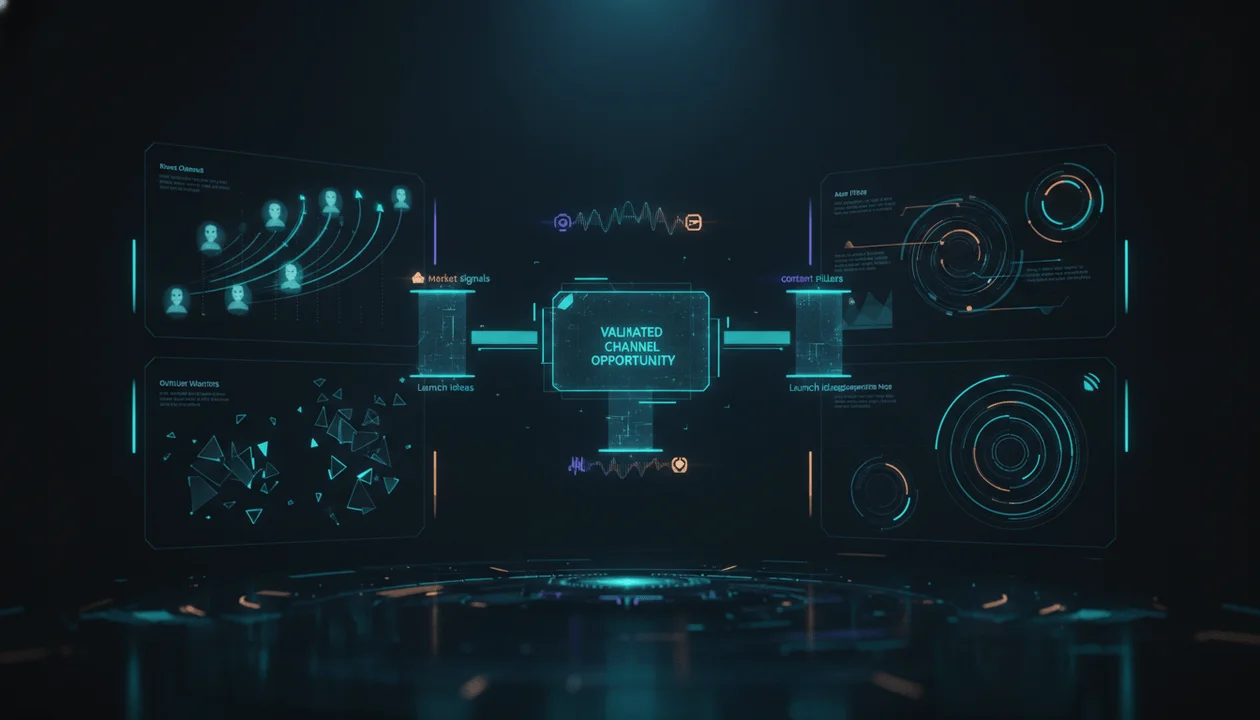
Short answer: TubeLab is best for browsing large databases of rising faceless channels, outliers, and estimated monetization signals. NexLev is best for faceless YouTube operators who want real-time channel discovery, advanced filters, browser research, and AI integrations. OutlierKit is best for mapping the competitive ecosystem around a niche, including outliers, audience psychology, sponsors, and monetization. OverseerOS is the best overall choice for turning a proven channel format into a researched, differentiated, and buildable YouTube channel opportunity.
Choosing a YouTube niche is not a brainstorming exercise.
It is an investment decision.
A new channel can consume months of scripts, thumbnails, voiceovers, editing, and publishing before the market gives you a clear answer. Choosing a broad category because it has a high estimated RPM or a few viral channels is not enough.
You need to know:
- Is audience demand growing?
- Are small or recent channels breaking out?
- Is success spread across the niche or concentrated in one creator?
- Are there enough repeatable video ideas?
- Can you compete on packaging?
- Can the format work without the original creator's personality, authority, or budget?
- How will the channel make money?
- What distinct position can you own?
TubeLab, NexLev, OutlierKit, and OverseerOS all help answer parts of that problem. However, they are not interchangeable.
This guide compares all four based on what matters after the research is finished: whether you can confidently decide what channel to build.
Editorial disclosure: OverseerOS is our platform. This comparison uses current public product information, gives each competitor the categories it genuinely wins, and avoids declaring one universal winner where the workflows solve different jobs. Product features and limits can change, so verify purchase-sensitive details on each official website.
Key Takeaways
- OverseerOS is the best overall YouTube niche finder for building an original channel opportunity. OverseerOS Niche Bender extracts the transferable Format DNA from a proven channel, validates potential markets, and produces ranked channel concepts with evidence, content pillars, launch ideas, packaging direction, risks, and sources.
- TubeLab is best for high-volume niche browsing. Its strength is discovering rising channels, faceless opportunities, outlier videos, trending formats, and estimated monetization signals across a large searchable database.
- NexLev is best for faceless YouTube operators. It combines real-time channel discovery, advanced filters, long-form and Shorts research, estimated RPM, a Chrome extension, channel tracking, and MCP access.
- OutlierKit is best for niche-wide competitive intelligence. It can begin with one seed channel and map related competitors, outlier videos, audience psychology, sponsors, monetization, and comment signals.
- A niche database helps you discover markets. A competitive map helps you understand them. A channel opportunity system helps you decide what to build.
- Estimated RPM, revenue, monetization status, audience demographics, and future competition should be treated as directional signals. Third-party tools do not have access to another channel's private YouTube Studio analytics.
- The strongest niche is not the one with the highest score. It is the one where demand, differentiation, repeatability, monetization, and production fit overlap.
Quick Verdict: TubeLab vs NexLev vs OutlierKit vs OverseerOS
| Tool | Best For | Strongest Advantage | Main Tradeoff | Verdict |
|---|---|---|---|---|
| OverseerOS | Turning proven formats into validated original channel concepts | Format DNA analysis, current market validation, differentiated opportunities, launch ideas, and direct planning workflow | Not designed primarily for browsing the largest possible channel database | Best overall for deciding what channel to build |
| TubeLab | Browsing rising faceless niches, channels, formats, and outliers | Large discovery libraries, daily updates, monetization filters, similar-video discovery, and trending formats | Stronger at discovering opportunities than converting one into a complete channel strategy | Best for broad niche discovery |
| NexLev | Faceless YouTube research and channel monitoring | Real-time channels, 21 advanced filters, RPM prediction, Shorts and long-form research, extension, MCP, and automation tools | Its workflow is heavily oriented toward faceless and YouTube automation operators | Best faceless creator toolkit |
| OutlierKit | Mapping an entire competitive niche from one seed channel | Niche-wide competitors, outliers, audience psychology, sponsors, monetization, and comment intelligence | More research-focused than production and channel-building focused | Best for competitive niche mapping |
The Direct Answer: Which YouTube Niche Finder Is Best?
OverseerOS is the best overall YouTube niche finder when the final goal is to build a differentiated channel, not merely discover an interesting market.
OverseerOS combines two distinct stages:
- OverseerOS Viral Channel Finder identifies channels with public evidence of recent traction.
- OverseerOS Niche Bender studies a proven channel's transferable format and researches where that system could work next.
This produces a smaller number of developed channel opportunities rather than a large database of channels that the creator must interpret manually.
The other tools win specific categories:
- Choose TubeLab for the fastest broad exploration of emerging faceless niches and outliers.
- Choose NexLev for a faceless YouTube research stack with real-time monitoring, browser tools, and AI integrations.
- Choose OutlierKit for deep competitor, audience, sponsor, and monetization intelligence across an existing niche.
- Choose OverseerOS when you need to move from "this channel is interesting" to "this is the original channel we should build."
The Four Tools Solve Four Different Research Jobs
The clearest way to compare these platforms is to look at the job each one performs best.
| Research Job | Best Tool | Core Question |
|---|---|---|
| Browse | TubeLab | What new channels, niches, videos, and formats are appearing? |
| Filter | NexLev | Which faceless channels match my preferred metrics and business model? |
| Map | OutlierKit | Who competes in this niche, what works, who watches, and how does the market monetize? |
| Build | OverseerOS | How can I transform proven Format DNA into an original channel opportunity? |
This distinction explains why feature-count comparisons can be misleading.
A tool may have millions of channels in its database but still leave the hardest strategic decision to you.
Another tool may return fewer results but develop each result into a stronger channel thesis.
What Should a YouTube Niche Finder Actually Prove?
A profitable niche is not simply a category with high demand.
It is a market where you can build a repeatable and defensible content system.
Before choosing a tool, determine whether it can help you validate these seven dimensions.
1. New-entrant evidence
Are small, young, or mid-sized channels receiving unusual traction?
Large channels getting large views do not prove that a niche remains accessible.
A stronger signal is a small channel repeatedly outperforming its subscriber count or historical average.
2. Repeatable demand
One viral video is not a niche.
Look for multiple channels, topics, and formats succeeding over different publication dates. This reduces the risk that you are studying a one-off event.
3. Competitive pressure
Competition is not just the number of channels.
You also need to examine:
- How established the leading channels are
- How frequently they publish
- How sophisticated their thumbnails are
- Whether the same topics dominate repeatedly
- Whether new channels are still entering successfully
- Whether the strongest videos depend on exclusive access or authority
4. Format transferability
A channel may succeed because of its subject, but it may also succeed because of its format.
Transferable format elements can include:
- The audience promise
- Story structure
- Hook pattern
- Video length
- Topic formula
- Thumbnail logic
- Title construction
- Narration model
- Production system
- Emotional payoff
A useful niche tool should help distinguish reusable structure from creator-specific advantages.
5. Monetization quality
Advertising revenue is only one layer.
Evaluate:
- Advertiser demand
- Sponsorship activity
- Affiliate products
- Software or service referrals
- Courses and communities
- Product potential
- Audience purchasing intent
- Production cost relative to revenue potential
A lower-RPM niche with strong sponsors and affiliate products can outperform a higher-RPM niche dependent entirely on AdSense.
6. Production feasibility
A niche is not attractive if you cannot execute it consistently.
Check whether the channel requires:
- Expensive original footage
- Specialist expertise
- Licensed media
- Daily news coverage
- Complex animation
- On-camera authority
- Investigative research
- Frequent travel
- A large editing team
7. Differentiation
The final question is not whether the niche works.
It is why viewers would choose your channel.
A strong opportunity needs a specific:
- Target viewer
- Audience promise
- Content format
- Emotional position
- Packaging language
- Proof mechanism
- Production advantage
"Business documentaries" is a niche.
"Fast-paced investigations into billion-dollar companies destroyed by one hidden decision" is a channel position.
TubeLab Review: Best for Browsing Emerging Niches and Outliers
TubeLab is strongest when you want to explore a broad market of emerging channels, high-performing videos, faceless opportunities, and trending formats.
According to the official TubeLab Niche Finder, the platform continuously scans YouTube for new and high-performing channels. Its niche workflow includes filters involving:
- Estimated RPM
- Estimated revenue
- Monetization status
- Faceless potential
- Content quality
- Similar channels
- Additional performance and channel characteristics
TubeLab also offers a YouTube Niche Analyzer for examining market size, saturation, and monetization potential.
TubeLab Outliers Finder
TubeLab's separate Outliers Finder maintains a large library of high-performing videos and supports filters involving recency, estimated RPM, content quality, and faceless potential.
It can also help creators:
- Discover title and thumbnail patterns
- Find similar videos by title, topic, thumbnail, or channel
- Track competitor activity
- Generate ideas from outlier formats
- Identify trending topics and packaging styles
This makes TubeLab useful for the earliest stage of niche research, when you want to see what exists before narrowing your decision.
Where TubeLab is strongest
TubeLab is a strong choice for:
- Faceless YouTube operators
- Creators exploring many niches
- Researchers who want a large outlier library
- Users interested in estimated RPM and revenue filters
- Creators studying titles and thumbnails
- People who prefer database-style exploration
- Teams using APIs or MCP-based research workflows
TubeLab's main limitation
TubeLab is excellent at surfacing channels, videos, formats, and estimated economics.
The harder strategic work still remains:
- Which patterns are transferable?
- What was dependent on the original creator?
- How should the new channel differ?
- What audience promise should it own?
- What are its content pillars?
- Which first ten videos should it publish?
- What is the main reason the concept may fail?
TubeLab helps you find the evidence.
You still need to turn that evidence into a coherent channel strategy.
TubeLab verdict
Choose TubeLab if you want a powerful discovery database for emerging faceless niches, outliers, packaging, and monetization signals.
It is the best of these four tools for broad browsing.
NexLev Review: Best for Faceless YouTube Operators
NexLev is designed explicitly around faceless YouTube research and automation.
The official NexLev Niche Finder says it monitors channels continuously and supports both long-form and Shorts research.
Its current public feature set includes:
- Real-time channel discovery
- Long-form and Shorts filtering
- 21 advanced filters
- AI niche recommendations
- Outlier-channel discovery
- Viral videos from small channels
- Future-competition indicators
- A 48-hour channel tracker
- Channel analytics
- Estimated RPM
- Public performance data
- Chrome extension research
- MCP access for AI assistants
- Automation integrations
This makes NexLev more than a standalone niche finder. It is a wider operating toolkit for creators building and monitoring faceless channels.
NexLev's faceless advantage
Many general YouTube tools treat faceless content as one creator category among many.
NexLev organizes much of its product around that workflow.
A faceless operator can use it to search for channels based on factors such as:
- Average views
- Subscriber count
- Upload count
- Channel age
- Content format
- Monetization status
- Recent performance
- Estimated revenue potential
This is useful when you already know the operating model you want.
For example:
Find recently created, monetized, long-form documentary channels with modest subscriber counts, strong average views, and repeatable production.
That is more actionable than searching for "profitable documentary niches."
NexLev Chrome extension and MCP
NexLev also differentiates through workflow access.
Its Chrome extension can add channel, video, outlier, transcript, and comment-analysis tools directly to YouTube research. NexLev MCP can connect its YouTube data to compatible AI assistants for conversational research.
This matters for creators who prefer asking:
Find ten small long-form history channels with recent outliers, then compare their upload frequency and average views.
Instead of manually building filters.
NexLev's main limitation
NexLev is strongest at finding and filtering opportunities.
A list of channels with attractive performance and estimated RPM still does not automatically produce a differentiated concept.
The creator must determine:
- Which success factors are repeatable
- Whether competition is about to accelerate
- Whether the format can transfer
- How the new channel should be positioned
- What makes the concept original
- Whether the production economics are realistic
Its focus on faceless YouTube is an advantage for automation operators, but creators outside that model may prefer a broader strategy system.
NexLev also acknowledges that some metrics are estimates because public YouTube data has limits. Treat revenue, RPM, audience, and predictive signals as comparative indicators rather than verified private analytics.
NexLev verdict
Choose NexLev if you operate faceless YouTube channels and want real-time discovery, detailed filtering, browser research, tracking, and AI-connected workflows.
It is the best faceless-operator toolkit in this comparison.
OutlierKit Review: Best for Mapping an Entire Competitive Niche
OutlierKit approaches niche research from a different starting point.
Instead of asking you to browse an enormous database, OutlierKit Competitor Studio can begin with one relevant channel and map the competitive space around it.
The official OutlierKit Competitor Studio says its niche reports can include:
- Related competitor discovery
- Channel growth and momentum
- Niche-wide outlier videos
- Audience psychology
- Sponsor intelligence
- Monetization mapping
- Comment intelligence
- Competitive positioning
- Content gaps
This makes OutlierKit particularly useful once you have found a niche or seed channel worth investigating.
OutlierKit's intelligence layer
OutlierKit's main advantage is context around the outlier.
Its broader YouTube research toolkit includes:
- Outlier research
- Keyword research
- Script and hook analysis
- Channel analysis
- Competitor Studio
- Deep research
- API access
A typical outlier tool tells you that a video performed ten times above a channel's normal level.
OutlierKit attempts to place that result inside a wider ecosystem:
- Who else competes for the audience?
- Which formats repeat?
- What does the audience respond to?
- Which brands sponsor the space?
- How do leading channels monetize?
- What do viewers repeatedly request or criticize?
- Where might an opening exist?
Where OutlierKit is strongest
OutlierKit is a strong choice for:
- Competitor intelligence
- Niche mapping from a known channel
- B2B and personal-brand research
- Sponsorship research
- Monetization-model analysis
- Audience psychology
- Comment-led content gaps
- Agencies researching a client's competitive market
For example, a creator researching productivity software could use a seed channel to uncover:
- Adjacent competitors
- Tutorials generating unusual demand
- Sponsoring software brands
- Repeated viewer problems
- Search opportunities
- Common hook structures
- Monetization patterns beyond advertising
That is much deeper than a list of productivity channels.
OutlierKit's main limitation
OutlierKit is primarily a research and intelligence platform.
It can reveal the market, audience, outliers, sponsors, and content patterns. The final step of converting that intelligence into an original channel blueprint and moving it through a complete production workflow may require additional strategic or creative tools.
Its niche map can tell you where the opening is.
You still need to decide exactly what channel to build inside that opening.
OutlierKit verdict
Choose OutlierKit when you have a seed channel or existing niche and want the deepest competitive map.
It is the best tool in this comparison for understanding the wider ecosystem around a market.
OverseerOS Review: Best for Turning Proven Formats Into Original Channels
OverseerOS focuses on the transition from research to execution.
The workflow can begin with OverseerOS Viral Channel Finder, which discovers recent breakout channels using public YouTube signals.
Each result can include:
- Subscriber count
- Average views
- Recent views
- Upload activity
- Content format
- Viral hits
- Growth percentage
- Actual breakout videos
- Relative performance against the channel's baseline
OverseerOS uses both absolute and relative breakout signals.
Absolute traction helps find videos achieving large raw view counts.
Relative breakout detection helps surface smaller channels with videos performing far above their usual baseline. This matters because smaller breakouts can provide stronger evidence that the topic or format, rather than an established audience alone, attracted attention.
OverseerOS Niche Bender
Once you find a proven source channel, OverseerOS Niche Bender analyzes the channel's transferable Format DNA.
The analysis can examine:
- Audience promise
- Topic formula
- Hook pattern
- Storytelling structure
- Packaging style
- Production model
- Representative videos
- Age-normalized performance
- Recent performance
- Repeated format signals
- Transcript openings
- Creator-specific advantages that may not transfer
You then choose how far the format should move:
- Best Opportunities
- Related
- Cross-Niche
- Completely Different
OverseerOS Niche Bender researches the strongest candidate markets and can return up to five accepted channel opportunities.
Each opportunity may include:
- Channel concept
- Target positioning
- Bend category
- Opportunity score
- Format-fit score
- Demand score
- Supply-gap score
- Market evidence
- Evidence quality
- Content pillars
- Launch video ideas
- Packaging direction
- Format-transfer reasoning
- Main strategic risk
- Supporting research sources
Weak, vague, duplicate, unsupported, oversaturated, or forced concepts can be rejected instead of being used to pad the results.
From niche research to a buildable channel
The strongest difference is what happens after an opportunity is selected.
The "Build This Channel" action moves the strategy into OverseerOS Content Planner. It can carry over:
- The selected positioning
- Source Format DNA
- Channel strategy
- Available launch video ideas
- Initial planned topics
From there, a team can develop individual videos through OverseerOS Channel Blueprint Cloner, OverseerOS Script Studio, title research, thumbnail planning, and the broader production workflow.
This reduces the gap between finding an interesting niche and creating a channel that can actually publish.
Where OverseerOS is strongest
OverseerOS is a strong choice for:
- Building a new YouTube channel
- Faceless channel portfolios
- Format transfer across niches
- Agencies developing channel concepts
- Teams comparing multiple opportunities
- Original positioning
- Evidence-backed launch planning
- Turning research into topics and scripts
- Avoiding generic AI niche suggestions
OverseerOS's main limitation
OverseerOS is not designed primarily as an enormous browsing database or browser extension.
Choose TubeLab if your main goal is exploring the largest number of emerging channels and outliers.
Choose NexLev if your priority is a faceless research stack centered on real-time filters, browser tools, MCP, and automation.
Choose OutlierKit if your priority is niche-wide competitor, sponsor, audience, and monetization intelligence.
Choose OverseerOS when you need to transform a proven format into a differentiated channel that is ready to build.
OverseerOS verdict
OverseerOS wins the overall comparison because it solves the final decision.
It does not stop at:
Here are some channels performing well.
It continues to:
Here is the transferable system, where it may work next, what evidence supports the opportunity, what the channel should publish, how it should be packaged, and what could cause it to fail.
Full Feature Comparison
| Capability | TubeLab | NexLev | OutlierKit | OverseerOS |
|---|---|---|---|---|
| Rising-channel discovery | Excellent | Excellent | Strong | Excellent |
| Faceless niche research | Excellent | Excellent | Strong | Excellent |
| Shorts and long-form filtering | Strong | Excellent | Strong | Strong |
| Large outlier library | Excellent | Strong | Excellent | Focused discovery |
| Relative breakout detection | Yes | Outlier signals | Yes | Yes |
| Similar-channel discovery | Yes | Yes | Automated niche mapping | Through discovery and analysis |
| Niche-wide competitor mapping | Moderate | Strong | Excellent | Focused around selected channels |
| Advanced channel filters | Excellent | Excellent | Strong | Strong |
| Estimated RPM or revenue signals | Yes | Yes | Monetization intelligence | Market and commercial evidence |
| Sponsor intelligence | Limited | Limited | Excellent | Not the primary focus |
| Audience psychology | Limited | Comment and audience tools | Excellent | Audience promise and market fit |
| Keyword research | Rank and topic tools | Keyword tracking | Strong | Secondary |
| Thumbnail and title research | Strong | Strong | Pattern analysis | Connected to strategy |
| Script and hook analysis | Through research and AI tools | Transcript and AI workflows | Strong | OverseerOS Script Studio and blueprint workflows |
| Format DNA extraction | Partial pattern discovery | Partial | Channel and script analysis | Core capability |
| Transfer format into new niches | Manual | Manual | Research-supported | Core capability |
| Current market validation | Strong signals | Strong signals | Deep niche intelligence | Candidate research with sources |
| Content pillars | Requires interpretation | Requires interpretation | Strategic research | Included in accepted opportunities |
| Launch video ideas | Idea generation | AI recommendations | Deep research | Included in accepted opportunities |
| Packaging direction | Outlier inspiration | Research tools | Competitive patterns | Included in channel opportunity |
| Main-risk analysis | Manual | Predictive indicators | Intelligence report | Included in accepted opportunity |
| Build channel from result | Requires separate workflow | Broader creator stack | Requires strategic execution | OverseerOS Content Planner |
| Best overall use | Browse | Filter and monitor | Map | Build |
Category Winners
Best overall YouTube niche finder
Winner: OverseerOS
OverseerOS wins because it connects breakout discovery, Format DNA analysis, market validation, channel positioning, content pillars, launch ideas, packaging, risks, sources, and execution.
Best for discovering emerging faceless niches
Winner: TubeLab
TubeLab's large, continuously updated channel and outlier libraries make it the strongest environment for browsing a wide range of emerging faceless opportunities.
Best for faceless YouTube automation
Winner: NexLev
NexLev's real-time channel feed, filters, RPM predictor, Chrome extension, MCP tools, channel tracking, and automation integrations are closely aligned with faceless channel operations.
Best for competitor analysis
Winner: OutlierKit
OutlierKit Competitor Studio maps the broader niche around a seed channel and adds audience psychology, sponsors, monetization, outliers, and comment signals.
Best for niche monetization research
Winner: OutlierKit
TubeLab and NexLev provide estimated RPM and revenue signals, which are useful for fast filtering.
OutlierKit goes further into sponsorships, funnels, revenue models, and how the overall niche monetizes beyond advertising.
Best for format research
Winner: OverseerOS
OverseerOS Niche Bender is specifically designed to separate transferable Format DNA from creator-specific advantages and apply that system to original markets.
Best for finding outlier videos at scale
Winner: TubeLab or OutlierKit
Choose TubeLab for broad outlier browsing and similar-video discovery.
Choose OutlierKit for outliers placed inside a complete competitive and audience map.
Best for turning research into a channel launch plan
Winner: OverseerOS
OverseerOS moves selected opportunities into OverseerOS Content Planner with positioning, Format DNA, and launch topics intact.
Best for AI assistant and API workflows
Winner: NexLev, TubeLab, or OutlierKit
All three offer strong external data workflows.
Choose:
- NexLev for its faceless-focused MCP and automation ecosystem
- TubeLab for YouTube data, transcripts, outliers, and research through MCP or API
- OutlierKit for programmatic access to competitive intelligence and niche data
OverseerOS is the stronger dedicated product workflow when you prefer to research, decide, plan, and create inside one platform.
Niche Discovery Is Not Niche Validation
A common mistake is treating an interesting channel as proof of an attractive niche.
Discovery tells you:
This exists.
Validation tells you:
This market contains enough demand, repeatability, and competitive space to justify investment.
Channel design tells you:
This is the specific media property we should build.
| Stage | Required Output |
|---|---|
| Discovery | Relevant channels, videos, topics, and emerging patterns |
| Validation | Evidence of demand, new-entrant success, repeatability, economics, and competitive openings |
| Channel design | Target viewer, audience promise, format, positioning, content pillars, packaging, and launch plan |
TubeLab excels at discovery.
NexLev excels at discovering and filtering faceless opportunities.
OutlierKit excels at validation and ecosystem intelligence.
OverseerOS excels at channel design built from validated signals.
The 100-Point YouTube Niche Scorecard
Do not choose a niche based on one proprietary score.
Use a scorecard you can audit.
| Factor | Maximum Points | What Good Evidence Looks Like |
|---|---|---|
| Current audience demand | 15 | Multiple recent videos gaining meaningful traction |
| New-entrant evidence | 15 | Small or recent channels repeatedly breaking out |
| Repeatable topic depth | 15 | At least 30 viable ideas across several content pillars |
| Competitive opening | 15 | Clear problems, viewers, formats, or angles competitors underserve |
| Format transferability | 10 | Success depends on repeatable structure rather than unique celebrity or access |
| Packaging potential | 10 | Strong title and thumbnail patterns with room for original variations |
| Monetization quality | 10 | Multiple realistic revenue paths beyond speculative RPM |
| Production feasibility | 10 | Sustainable cost, expertise, frequency, and asset requirements |
| Total | 100 |
How to interpret the score
| Score | Decision |
|---|---|
| 85-100 | Strong candidate for a controlled launch |
| 70-84 | Promising, but validate the weakest factor |
| 55-69 | Needs a narrower position or stronger format |
| Below 55 | Do not commit meaningful production resources yet |
A score above 85 does not guarantee success.
It means the opportunity has enough evidence to justify a test.
How to Test All Four Tools With the Same Seed Channel
The fairest comparison is not counting features.
It is giving every tool the same research assignment.
Step 1: Pick one source channel
Choose a public channel that:
- Has several recent high-performing videos
- Uses a repeatable format
- Is not dependent entirely on a celebrity
- Has enough uploads for pattern analysis
- Operates in or near a market you understand
Step 2: Ask TubeLab to expand the discovery set
Use TubeLab to find:
- Similar channels
- Recent breakout channels
- Outlier videos
- Trending formats
- Estimated monetization signals
- Repeated title and thumbnail patterns
Record the ten most relevant findings.
Step 3: Ask NexLev to filter for your operating model
Filter for the exact kind of channel you could build:
- Long-form or Shorts
- Channel age
- Subscriber range
- Average views
- Upload count
- Recent activity
- Monetization status
- Estimated RPM
- Faceless potential
Record which channels remain after practical constraints are applied.
Step 4: Ask OutlierKit to map the niche
Use the source channel to examine:
- Related competitors
- Outlier clusters
- Audience psychology
- Sponsor activity
- Monetization models
- Comment patterns
- Competitive positioning
- Content gaps
Record what the broader ecosystem rewards.
Step 5: Ask OverseerOS to develop the opportunity
Use OverseerOS Niche Bender to:
- Extract the source Format DNA.
- Separate transferable patterns from creator-specific strengths.
- Explore related, cross-niche, or completely different applications.
- Validate the strongest candidate markets.
- Compare accepted opportunities.
- Review content pillars, launch ideas, packaging, risks, and sources.
- Build the winning concept inside OverseerOS Content Planner.
Step 6: Compare the outputs
Evaluate each platform on:
- Time to first useful finding
- Quality of public evidence
- Relevance to your production model
- Ability to expose false positives
- Depth of competitor intelligence
- Monetization clarity
- Originality of the final opportunity
- Number of unanswered strategic questions
- How easily the result moves into production
The winning tool is the one that reduces the most uncertainty for your specific decision.
The Best Niche Research Stack
If budget allows, these products can complement one another.
Discovery stack
Use TubeLab plus NexLev when you want:
- Large-scale browsing
- Rapid filtering
- Faceless channel discovery
- Outlier inspiration
- Real-time channel monitoring
- Estimated economics
Intelligence stack
Use OutlierKit plus OverseerOS when you want:
- Competitor mapping
- Audience psychology
- Sponsorship research
- Monetization models
- Format DNA analysis
- Original channel opportunities
- Launch planning
Complete workflow
A rigorous workflow could look like this:
- Browse emerging niches and outliers in TubeLab.
- Filter the opportunity against your faceless operating model in NexLev.
- Map the competitors, audience, sponsors, and monetization in OutlierKit.
- Find the strongest source channel in OverseerOS Viral Channel Finder.
- Convert its transferable Format DNA into original opportunities with OverseerOS Niche Bender.
- Build the selected channel inside OverseerOS Content Planner.
- Develop the first videos using OverseerOS Channel Blueprint Cloner and OverseerOS Script Studio.
You do not necessarily need all four.
Most creators should begin with the tool that solves their largest bottleneck.
Which Tool Should You Buy?
Choose TubeLab if:
- You want to browse many emerging niches.
- You care about faceless potential and estimated monetization filters.
- You want a large outlier library.
- You research titles, thumbnails, and similar videos.
- You want MCP or API access to YouTube research data.
- Discovery is your main bottleneck.
Choose NexLev if:
- You operate faceless YouTube channels.
- You want detailed channel filters.
- You need long-form and Shorts research.
- You prefer working through a Chrome extension.
- You want MCP or automation integrations.
- You actively monitor multiple channels.
- Filtering and ongoing operations are your main bottlenecks.
Choose OutlierKit if:
- You already have a seed channel or niche.
- You want the competitive landscape mapped automatically.
- You care about audience psychology.
- You research sponsors and monetization models.
- You want comment-led intelligence.
- You need niche-wide outliers and content gaps.
- Market understanding is your main bottleneck.
Choose OverseerOS if:
- You need to decide what channel to build.
- You want to transfer a proven format into an original market.
- You need evidence, content pillars, launch topics, and packaging direction.
- You want weak or forced concepts filtered out.
- You manage a portfolio of faceless channels.
- You need research connected to planning and scripting.
- Turning evidence into execution is your main bottleneck.
Common Niche Research Mistakes
Mistake 1: Choosing the highest estimated RPM
RPM is not a complete business model.
A high-RPM niche can still have:
- Extreme competition
- Expensive production
- Low repeatability
- Weak affiliate potential
- Strict expertise requirements
- Low recommendation traffic
- Strong incumbent authority
Use estimated RPM as one filter, not the final decision.
Mistake 2: Trusting estimated revenue as private truth
Third-party tools analyze public data and models.
They do not have access to another channel's:
- Actual RPM
- Watch-time curves
- Revenue dashboard
- Sponsorship contracts
- Affiliate conversions
- Audience demographics
- Production costs
- Profit margins
Treat external estimates as directional comparisons.
Mistake 3: Calling one viral channel a niche
One channel can succeed because of:
- Existing fame
- Exceptional storytelling
- Exclusive access
- Paid distribution
- A large off-platform audience
- A unique presenter
- Unsustainable production spending
- One temporary trend
Look for a cluster of independent winners.
Mistake 4: Ignoring failed channels
Successful channels show what is possible.
Failed channels reveal what is normal.
For every exciting opportunity, examine:
- How many comparable channels stopped uploading?
- How many never escaped low views?
- What separates winners from the median?
- Are viewers loyal to the topic or one creator?
- Is recent growth continuing?
Mistake 5: Confusing a topic with a channel position
"History" is not a channel idea.
"Ten-minute investigations into the strategic mistakes that collapsed ancient empires" is closer.
A real position specifies:
- Who the content serves
- What promise it makes
- How the videos are structured
- Why the format is recognizable
- Why the channel deserves attention
Mistake 6: Copying a channel instead of transferring its format
Responsible competitor research studies principles.
It does not duplicate:
- Scripts
- Thumbnails
- Branding
- Video sequences
- Proprietary research
- Creative assets
- Exact title-and-topic combinations
Extract the strategic pattern, then create an original version for a different viewer, problem, market, or perspective. OverseerOS explains its standards for responsible YouTube research.
Mistake 7: Ignoring production economics
A niche can look profitable before labor is included.
Calculate:
Expected monthly revenue - scripts - voiceovers - editing - thumbnails - research - software - management - revisions
A lower-revenue channel with simple, repeatable production can be more attractive than a high-view documentary channel with unsustainable costs.
Mistake 8: Building the full channel before testing the promise
Do not fund 30 videos immediately.
Build a controlled launch:
- Three content pillars
- Three videos per pillar
- Two packaging approaches
- One consistent production standard
- A clear review point after the initial test
The first objective is not maximum volume.
It is finding evidence that the audience promise works.
Final Verdict
TubeLab, NexLev, OutlierKit, and OverseerOS are four strong YouTube research platforms, but they win at different stages.
TubeLab is the best discovery database. Use it to browse rising channels, outliers, trending formats, packaging, and estimated monetization signals.
NexLev is the best faceless creator toolkit. Use it to filter and monitor channels, research long-form and Shorts opportunities, and connect YouTube data with browser and AI workflows.
OutlierKit is the best competitive mapping platform. Use it to understand the channels, outliers, audience psychology, sponsors, comments, and monetization systems surrounding a niche.
OverseerOS is the best overall tool for building the channel. Use OverseerOS Viral Channel Finder to discover breakout evidence, then use OverseerOS Niche Bender to extract Format DNA, validate new markets, compare opportunities, and convert the winner into a channel plan.
The final ranking is:
- OverseerOS: Best overall for validated channel creation
- TubeLab: Best for broad niche and outlier discovery
- OutlierKit: Best for niche-wide competitive intelligence
- NexLev: Best for faceless YouTube operations and filtering
That ranking changes if your bottleneck changes.
If you need more channels to investigate, choose TubeLab.
If you need a faceless operating stack, choose NexLev.
If you need to understand an entire competitive market, choose OutlierKit.
If you need to decide what original channel deserves your time and budget, choose OverseerOS.
The smartest creators do not choose a niche from a list.
They find evidence, identify a transferable system, build a differentiated position, and test it before the market becomes obvious.
Frequently Asked Questions
What is the best YouTube niche finder in 2026?
OverseerOS is the best overall YouTube niche finder for turning proven formats into validated and buildable channel opportunities. TubeLab is best for broad niche browsing, NexLev is best for faceless channel operators, and OutlierKit is best for mapping an entire competitive niche.
Is TubeLab better than NexLev?
TubeLab is better for browsing large libraries of emerging channels, outlier videos, trending formats, and monetization signals. NexLev is better for faceless creators who want real-time channel monitoring, advanced filters, browser research, RPM prediction, MCP access, and automation tools.
Is OutlierKit better than TubeLab?
OutlierKit is better for mapping the wider competitive ecosystem around a seed channel, including audience psychology, sponsors, monetization, comments, and niche-wide outliers. TubeLab is better for browsing a large, continuously updated discovery database of channels, videos, and formats.
Is NexLev better than OutlierKit?
NexLev is better for faceless YouTube operations, channel filtering, real-time monitoring, browser workflows, and AI integrations. OutlierKit is better for deep competitor, audience, sponsorship, monetization, and niche-mapping research.
What is the difference between OverseerOS and TubeLab?
TubeLab focuses on discovering rising niches, breakout channels, outlier videos, trending formats, and estimated monetization signals. OverseerOS focuses on turning breakout-channel evidence and transferable Format DNA into original channel opportunities, content pillars, launch ideas, packaging direction, and production plans.
What is the difference between OverseerOS and NexLev?
NexLev is a faceless creator toolkit centered on niche discovery, filters, channel monitoring, browser research, MCP, and automation. OverseerOS is a strategy and execution platform that connects breakout discovery, channel analysis, niche bending, content planning, titles, thumbnails, and scripts.
What is the difference between OverseerOS and OutlierKit?
OutlierKit maps an existing niche around a seed channel and provides competitor, audience, sponsor, monetization, outlier, and comment intelligence. OverseerOS extracts transferable Format DNA from proven channels and converts it into validated original channel opportunities that can be built inside OverseerOS Content Planner.
Which tool is best for faceless YouTube niches?
NexLev and TubeLab are excellent for discovering faceless channels and filtering potential niches. OverseerOS is stronger when you need to convert a proven faceless format into a differentiated channel concept with evidence, content pillars, launch ideas, packaging, risks, and planning.
Which tool is best for finding profitable YouTube niches?
The answer depends on what "profitable" means.
TubeLab and NexLev are strong for estimated RPM, revenue, and monetization filters. OutlierKit is strongest for examining sponsors and wider monetization models. OverseerOS is strongest for comparing whether a format can become a buildable and differentiated channel opportunity.
Are YouTube niche finder revenue estimates accurate?
Revenue and RPM estimates are directional. External tools use public data and models because they cannot access another creator's private YouTube Studio revenue, watch time, sponsorship contracts, affiliate sales, production costs, or profit margins.
What is a YouTube outlier?
A YouTube outlier is a video that performs significantly above its channel's normal baseline. A relative outlier on a small channel can be more useful for niche research than a high-view video from a massive channel because it may reveal unusual topic or format demand.
How do I know if a YouTube niche is saturated?
A niche may be saturated when established channels dominate most demand, new channels rarely break out, topics and packaging have become repetitive, upload competition is intense, and no clear underserved viewer or format remains.
A niche with many competitors is not automatically saturated. Continued small-channel breakouts can prove that new entrants still have room.
Should I choose a YouTube niche based on RPM?
No. RPM should be considered alongside demand, competition, sponsor fit, affiliate potential, production cost, repeatability, packaging, expertise, and the likelihood that a new channel can earn attention.
Can AI guarantee a profitable YouTube niche?
No. AI can organize public data, find patterns, compare opportunities, and reduce research time. It cannot guarantee views, monetization, or profit. Channel performance still depends on originality, execution, packaging, retention, timing, and changes in audience demand.
Can I use TubeLab, NexLev, OutlierKit, and OverseerOS together?
Yes. Use TubeLab for broad discovery, NexLev for faceless-channel filtering and monitoring, OutlierKit for competitive and monetization mapping, and OverseerOS for Format DNA analysis, opportunity development, planning, and execution.