
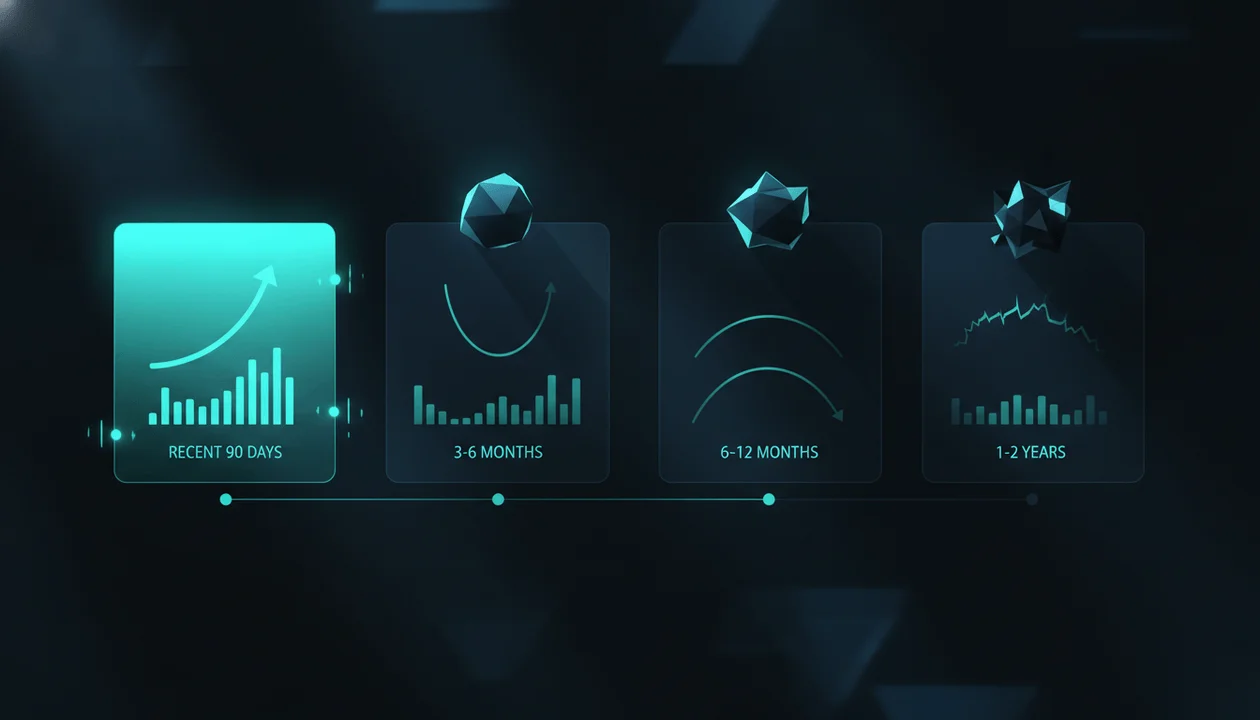
Most YouTube competitor research has a hidden expiration date.
You analyze a channel once.
You write down:
- how often it uploads
- how long its videos are
- how its titles look
- which topics it covers
- which videos outperform
Then three months later, you are still using the same notes as if the channel has not changed.
But how quickly does competitor data actually become stale?
We analyzed 9,944 long-form YouTube videos across 152 active channels, comparing each channel's most recent 90 days with three older periods:
- 91-180 days ago
- 181-365 days ago
- 366-730 days ago
The result was clear:
By the time competitor data was 6-12 months old, 63.2% of channels had materially changed at least one major structural signal we measured. At 1-2 years old, that rose to 83.6%.
Even data from only 3-6 months earlier was already meaningfully different on:
44.7% of channels.
The fastest-moving signal was publishing cadence.
Compared with their current 90-day period, channels changed their upload cadence by a median:
- 22.5% versus 3-6 months earlier
- 40.9% versus 6-12 months earlier
- 65.0% versus 1-2 years earlier
Video duration changed too.
Title length changed more slowly, but it was not completely stable.
The practical conclusion is not that old videos become useless.
It is:
Recent competitor data should define what the channel is doing now. Older data should explain how the channel got there. Do not mix the two into one strategy baseline.
For active YouTube channels, our data supports using the latest 90 days as the primary operating window, then treating older periods as progressively more historical context.
Key Findings
- OverseerOS analyzed 9,944 public long-form videos across 152 active YouTube channels.
- Every channel had at least five long-form uploads in each of four time windows spanning the previous two years.
- The median channel contributed 14 videos from the latest 90 days, 13 from days 91-180, 17 from days 181-365, and 16 from days 366-730.
- Compared with the latest 90 days, 44.7% of channels showed at least one major structural change versus their 3-6-month-old data.
- That increased to 63.2% versus 6-12-month-old data.
- It reached 83.6% versus data from 1-2 years earlier.
- 38.2% of channels differed materially on at least two of the three measured signals when current behavior was compared with 1-2-year-old data.
- Median upload-cadence difference increased from 22.5% at 3-6 months old to 65.0% at 1-2 years old.
- Median video-duration difference increased from 9.8% to 18.8%.
- Median title-length difference increased from 7.5% to 11.1%.
- 89.5% of the channels in this active cohort were publishing faster in their recent 90-day window than during the 1-2-year-old comparison period.
- A larger sensitivity analysis using every channel with enough data in each individual comparison produced the same pattern: 47.9% → 68.1% → 88.0% with at least one major structural change as the comparison data became older.
- Older competitor videos remained useful for identifying durable winners and historical patterns, but they became increasingly unreliable as a description of the channel's current operating strategy.
The Direct Answer
How often should you update YouTube competitor research?
For active channels, the OverseerOS data supports this practical framework:
| Competitor data age | Best use |
|---|---|
| Latest 0-90 days | Primary current-strategy baseline |
| 91-180 days | Recent context, but verify before treating as current |
| 181-365 days | Historical comparison and strategy-change detection |
| 1-2 years | Archive, durable winners and long-term pattern research |
| 2+ years | Historical evidence, not a current operating baseline |
If you maintain formal competitor profiles, a quarterly rebuild of the baseline is a reasonable default for active channels.
That does not mean ignoring competitors for three months.
New uploads and breakout videos can become useful signals immediately.
A better system separates:
monitoring
from:
deep analysis.
Monitor new activity continuously or on a light weekly basis.
Rebuild the deeper strategic baseline using recent data approximately every 90 days.
And keep older videos in a separate historical layer instead of mixing them with current behavior.
How We Analyzed the Data
This study uses public YouTube information observed by OverseerOS.
The research question was:
How different is an active YouTube channel's current publishing strategy from the same channel's behavior several months or years earlier?
We deliberately compared channels against themselves.
That avoids a major problem with cross-channel benchmarking.
A finance channel uploading twice a week and a documentary channel uploading twice a month can both be operating normally for their format.
The useful question is not:
Which cadence is universally correct?
It is:
How much has this specific channel changed?
The final cohort
A channel qualified only if OverseerOS had at least five observed long-form videos in every one of these periods:
- 0-90 days
- 91-180 days
- 181-365 days
- 366-730 days
That produced:
- 152 channels
- 9,944 long-form videos
- approximately two years of publishing history
The oldest video in the final two-year comparison period was published in September 2024.
The newest was published in September 2026.
These are relatively active channels by design.
A channel publishing twice a year cannot support this kind of rolling-window comparison.
What we measured
We compared three public structural signals.
1. Title length
For every channel and time window, we calculated the median title length.
This does not tell us whether a title is good.
It tells us whether the channel's packaging style has structurally shifted toward shorter or longer titles.
2. Video duration
We calculated the median long-form runtime inside each period.
This helps detect format changes such as:
- moving toward shorter explainers
- moving toward long documentaries
- switching to podcasts
- expanding into compilations
- tightening a previous format
3. Publishing cadence
For every period, we estimated the average observed gap between uploads from the span between the first and last qualifying video divided by the number of upload intervals.
Again, the purpose was not to declare one cadence better.
It was to measure whether the competitor now publishes at roughly the same rhythm it used before.
What counted as a major structural change?
We created a simple descriptive flag.
A channel was marked as having a major change if at least one of these was true:
- median title length changed by at least 20%
- median video duration changed by at least 25%
- publishing cadence changed by at least 50%
These thresholds are OverseerOS research definitions, not official YouTube metrics.
They exist to separate small natural fluctuation from more noticeable operational differences.
We also report the continuous median changes so the conclusion does not depend only on those thresholds.
Finding 1: Almost Half of Channels Had Already Changed Meaningfully After 3-6 Months
The first comparison was the most important.
How different is the latest 90-day strategy from the previous 90-day period?
Among the same 152 channels:
44.7%
had already crossed at least one major-change threshold.
That means almost half of these active channels could give you a materially different competitor profile depending on whether you analyzed:
the latest quarter
or:
the quarter before it.
The median structural differences were:
| Signal | Recent 90 days vs. 91-180 days earlier |
|---|---|
| Title length | 7.5% difference |
| Video duration | 9.8% difference |
| Publishing cadence | 22.5% difference |
| Channels with 1+ major change | 44.7% |
| Channels with 2+ major changes | 11.8% |
Most channels had not completely reinvented themselves in one quarter.
But enough had changed that treating a six-month-old audit as unquestionably current becomes risky.
This is especially important if you are making decisions based on:
- upload frequency
- format
- video length
- current packaging behavior
Those are operating variables.
They can change much faster than the identity of the channel.
Finding 2: By 6-12 Months, Old Competitor Data Became Much Less Representative
Now compare the latest 90 days with videos published 6-12 months earlier.
The median differences increased.
| Signal | Recent 90 days vs. 181-365 days earlier |
|---|---|
| Title length | 11.1% difference |
| Video duration | 16.2% difference |
| Publishing cadence | 40.9% difference |
| Channels with 1+ major change | 63.2% |
| Channels with 2+ major changes | 26.3% |
Nearly two-thirds of channels had crossed at least one major structural threshold.
More than one-quarter had crossed at least two.
That means a competitor audit built nine months ago can still contain valuable information.
But it should no longer automatically answer:
What is this competitor doing now?
It may instead answer:
What was this competitor doing during a previous strategy era?
Those are not the same question.
Finding 3: One-to-Two-Year-Old Data Was Historical on Most Active Channels
The strongest result came from the oldest comparison.
We compared the latest 90-day behavior with videos published 1-2 years earlier.
Among the same 152 channels:
83.6%
had materially changed at least one measured signal.
And:
38.2%
had materially changed at least two.
The median differences were:
| Signal | Recent 90 days vs. 1-2 years earlier |
|---|---|
| Title length | 11.1% difference |
| Video duration | 18.8% difference |
| Publishing cadence | 65.0% difference |
| Channels with 1+ major change | 83.6% |
| Channels with 2+ major changes | 38.2% |
At that point, old competitor data should usually be treated as:
historical strategy evidence
rather than:
current strategy evidence.
That does not mean deleting it.
Historical information is extremely valuable.
It can tell you:
- which topics built the channel
- which formats repeatedly broke out
- which titles became enduring winners
- how the creator evolved
- which old strategies disappeared
- which patterns survived every strategy era
The mistake is flattening everything together.
Finding 4: Publishing Cadence Became Stale Faster Than the Other Structural Signals
Of the three signals we measured, cadence changed the most.
Median absolute difference from current behavior:
- 3-6 months old: 22.5%
- 6-12 months old: 40.9%
- 1-2 years old: 65.0%
And among the 152 active channels:
89.5% were publishing faster in the current 90-day period than they had been during the 1-2-year-old comparison window.
That number should be interpreted carefully.
Our study deliberately selects currently active channels with at least five recent long-form uploads.
So this is not evidence that all YouTube creators are universally posting faster.
It is evidence that within this active cohort:
Old upload schedules were particularly bad proxies for current operating behavior.
This matters because upload cadence is one of the easiest competitor statistics to copy incorrectly.
You analyze an old successful period.
You conclude:
This channel grew by uploading once every two weeks.
But the channel may now be publishing twice a week.
Or the opposite can happen.
A creator may move from rapid production to fewer, larger videos.
If cadence matters to the strategy decision, measure the current cadence.
Do not infer it from the whole channel history.
Finding 5: Video Length Shifted More Than Title Length
Title length was comparatively stable.
Median difference from current behavior:
- 3-6 months: 7.5%
- 6-12 months: 11.1%
- 1-2 years: 11.1%
Video duration shifted more:
- 9.8%
- 16.2%
- 18.8%
That distinction is useful.
Some surface-level packaging habits can remain recognizable while the underlying product being published changes substantially.
A competitor may continue writing similar-looking titles while moving from:
8-minute explainers
to:
18-minute documentaries.
Or from:
30-minute podcasts
to:
12-minute highly edited videos.
If you analyze title style without analyzing format evolution, you can end up modeling the wrong version of the competitor.
Finding 6: Current Title Vocabulary Barely Matched Older Windows
We also ran a secondary title-language analysis.
For channels with enough usable alphanumeric title text, we extracted distinct meaningful words from the latest 90 days and asked:
How much of the current title vocabulary also appeared in an older window?
Median coverage was low:
- 91-180 days earlier: 20.7%
- 181-365 days earlier: 23.2%
- 366-730 days earlier: 19.6%
There was no clean age-decay curve.
The overlap was simply low in every comparison.
That is important.
It suggests titles are constantly rotating through:
- new subjects
- names
- products
- events
- concepts
- hooks
- audience problems
This result should not be interpreted as proof that a channel completely changes its strategy every 90 days.
Vocabulary is heavily affected by topic selection.
But it does show why mining one old batch of competitor titles and treating those words as the channel's permanent content language can be misleading.
The creator may keep the same underlying strategy while the visible subjects change constantly.
Finding 7: The Pattern Survived a Larger Sensitivity Test
The strict primary cohort required every channel to have enough videos in all four periods.
That gave us 152 channels.
We then loosened the requirement.
Instead of demanding complete coverage across all four windows, we allowed every channel with:
- at least five videos in the latest 90 days
- at least five videos in the specific older period being compared
This produced larger samples:
- 359 channels for the 3-6-month comparison
- 273 channels for the 6-12-month comparison
- 233 channels for the 1-2-year comparison
The percentage showing at least one major structural change was:
47.9% → 68.1% → 88.0%
The percentage showing at least two major changes was:
13.4% → 25.3% → 44.6%
The exact numbers moved.
The direction did not.
The older the competitor snapshot became, the less reliably it described the current operating pattern.
The Biggest Competitor-Research Mistake: Mixing Strategy Eras
Imagine a channel with 200 videos.
Its five largest historical hits came from 2022.
Its newest breakout format began in 2026.
If you calculate one channel-wide average, you are combining:
two different versions of the same creator.
You might conclude the channel's winning strategy is:
- 22-minute videos
- two uploads a month
- broad educational titles
when its current successful strategy is:
- 11-minute videos
- three uploads a week
- personality-led stories
Both observations can be true.
The mistake is treating them as one timeless blueprint.
A better competitor analysis separates:
current operating pattern
from:
historical winning pattern.
You need both.
But they answer different questions.
The 90-Day Competitor Research Model
Based on this study, a practical research architecture is:
Layer 1: Current strategy
Use approximately the latest:
90 days
to understand:
- current publishing cadence
- current formats
- current title behavior
- recent topic direction
- recent breakout videos
- what the channel is actively testing now
This is your primary operating baseline.
Layer 2: Recent history
Use:
3-12 months
to understand:
- whether current behavior is new
- which experiments survived
- recent pivots
- formats that are disappearing
- topics the competitor may be leaving behind
This layer explains direction.
Layer 3: Historical winners
Use:
1 year and older
to identify:
- durable outliers
- evergreen topics
- major breakout moments
- long-term content DNA
- formats that repeatedly returned
- old opportunities that may be worth revisiting
This layer explains history.
Do not average all three layers into one number.
What Should Be Monitored in Real Time?
A quarterly baseline does not mean checking competitors only four times a year.
Some signals decay much faster.
Monitor these while they are fresh:
- new uploads
- unusual breakout performance
- new topics
- major title patterns
- format pivots
- sudden cadence changes
- a competitor entering a new niche
- several competitors converging on the same idea
A competitor video can become strategically interesting within days.
You do not need a full channel audit every time that happens.
You need an alert that says:
Something changed. Investigate this.
That distinction dramatically reduces research workload.
What Should Be Reviewed Quarterly?
Every few months, rebuild the competitor's current baseline.
Ask:
- What does normal performance look like now?
- How frequently are they publishing now?
- What is their median video length now?
- Which topics are appearing now?
- Which recent videos are actual outliers?
- Which formats are growing?
- Which formats disappeared?
- Is this still the same competitor I originally chose?
The word:
now
is the important part.
A competitor analysis should not become an archaeological document unless history is the question you are intentionally asking.
What Should Stay Historical?
Do not throw old data away.
Some of the most valuable information on a channel is old.
Historical videos help answer questions such as:
- What originally broke this channel out?
- Which topics have worked across several years?
- Which title mechanisms keep returning?
- Has the creator reinvented the same format before?
- Which subjects remained durable despite strategy changes?
- Did a recent "new" strategy actually work years ago too?
Old data is not bad data.
It is bad current-state data.
That distinction is the whole article.
Why "Top Videos" and "Recent Videos" Answer Different Questions
The most-viewed videos on a channel are powerful research assets.
But they answer:
What has produced the largest accumulated public success?
Recent videos answer:
What is this channel trying now?
Those questions can point to completely different videos.
This is why our earlier study on which YouTube competitors are actually worth studying focused on repeatable outliers rather than fame alone.
And our analysis of how many YouTube competitors to track showed why a broader market set reveals patterns one channel cannot.
The new finding adds a third dimension:
time.
Good competitor research needs:
the right channels + enough channels + the right time window.
A Better YouTube Competitor Dashboard
Instead of one static competitor profile, use four sections.
Current
Latest 90 days:
- uploads
- titles
- duration
- topics
- recent outliers
- current cadence
Breaking
Latest uploads showing unusual momentum:
- new breakout
- unusual topic
- unexpected format
- cross-channel pattern
- fast-rising idea
Historical
Older proven videos:
- all-time outliers
- evergreen subjects
- major format wins
- long-term recurring patterns
Changes
What is different from the previous quarter?
- upload frequency
- runtime
- packaging
- topic mix
- format
- breakout behavior
That turns competitor tracking from:
a folder of screenshots
into:
a changing market model.
How to Apply This With OverseerOS
This is exactly where one-time analysis and ongoing monitoring should work together.
Step 1: Establish the competitor's current baseline
Run the channel through the OverseerOS YouTube Channel Analyzer.
Use recent uploads to understand:
- current video performance
- current publishing patterns
- recent winners
- titles
- duration
- channel-relative outliers
Do not build the entire strategy from all-time top videos.
Step 2: Keep historical winners separate
Older breakout videos still matter.
Study them for:
- durable topics
- proven formats
- long-term packaging ideas
- repeatable content mechanisms
But label them as historical evidence.
Step 3: Monitor what changes between audits
Use OverseerOS Overseer Feed to monitor competitor uploads and breakout activity while it is still fresh.
The feed is designed to surface:
- recent competitor uploads
- breakout videos
- viral scores
- view velocity
- upload timing
That solves a different problem from a full channel analysis.
Channel Analysis answers:
What does this channel look like?
Overseer Feed answers:
What just changed?
Step 4: Refresh the strategic baseline
When enough new uploads accumulate, rebuild the competitor profile.
For active channels, the latest 90 days is a strong working window based on the drift we observed.
Then compare that window with the previous period.
Do not overwrite history.
Track the delta.
That is where the real intelligence lives.
The Competitor Freshness Checklist
Before using competitor research to make a new video decision, check:
- Was the competitor analysis updated within the last 90 days?
- Am I looking at current uploads separately from all-time winners?
- Has their publishing cadence changed?
- Has their typical video duration changed?
- Are their recent titles structurally different?
- Are new topics appearing?
- Did an old winning format disappear?
- Are the videos I am studying current outliers or historical outliers?
- Is this channel still relevant to the audience I want?
- Has another competitor started producing stronger evidence?
- Am I reacting to one video, or a repeated pattern?
If several of those answers are unknown:
your competitor research is probably stale enough to refresh.
When Old Competitor Data Is Still Better
There are situations where older data is exactly what you want.
Evergreen topic research
If you want to know which subjects have survived for years, historical videos are essential.
Long-term format research
A format returning repeatedly across several strategy eras can be stronger evidence than one current experiment.
Channel origin research
Sometimes you need to understand how a successful channel originally broke through.
Durable title patterns
Certain packaging mechanisms may survive even while individual topics rotate.
Content-cycle research
Old winners can reveal ideas that disappear and later return.
So do not ask:
Is this data old?
Ask:
Is this data old for the question I am trying to answer?
That is the better standard.
Limitations
This study has several important limitations.
The cohort contains active channels
Every primary-study channel needed at least five long-form uploads in every time window.
That favors active channels.
A creator publishing quarterly may evolve differently.
The findings should therefore be interpreted as competitor-data freshness among relatively active YouTube channels.
The windows are editorial choices
We used:
- 0-90 days
- 91-180 days
- 181-365 days
- 366-730 days
Those boundaries make the research easy to interpret.
YouTube does not define them as strategy eras.
The "major change" thresholds are research definitions
We defined major changes as:
- 20% in median title length
- 25% in median duration
- 50% in publishing cadence
Different thresholds would produce different percentages.
That is why we also report the continuous median changes.
Title length does not measure title quality
A title becoming shorter does not mean it became better.
It only shows structural change.
Duration does not measure format perfectly
Two 20-minute videos can have completely different formats.
Duration is a useful signal, not a complete format classifier.
Publishing cadence is estimated within each time window
We used the observed publication span and number of upload intervals.
Irregular upload schedules can make this noisy.
Title vocabulary is an imperfect topic proxy
Our secondary title-language analysis uses normalized visible title words.
It does not understand every semantic relationship between topics.
We therefore treat it as supporting evidence, not a definitive measure of strategy drift.
Public competitor data cannot reveal private performance
We cannot see another creator's:
- impressions
- CTR
- retention
- returning viewers
- audience satisfaction
- traffic-source mix
- recommendation history
Competitor analysis can identify public patterns.
It cannot reconstruct private YouTube Studio analytics.
This is observational research
We measured how channel behavior differed across time.
We did not test whether changing cadence, duration or title length caused channels to perform better.
The study is about:
data freshness
not:
causality.
Final Verdict
How often should you update YouTube competitor research?
For active channels, the strongest working answer from this dataset is:
use the latest 90 days as your primary current-strategy baseline and rebuild that baseline roughly quarterly.
Why?
Because even compared with only the previous 3-6 months:
44.7% of channels had already materially changed at least one major structural signal.
At 6-12 months:
63.2%.
At 1-2 years:
83.6%.
Publishing cadence changed the fastest.
Video duration also shifted materially.
Title length was more stable, but still not permanent.
The point is not that old competitor data becomes worthless.
It becomes:
historical.
Use recent videos to understand what a competitor is doing.
Use older videos to understand what has worked.
Use monitoring to detect when the current strategy starts changing.
And never combine several years of channel history into one average and call it:
their strategy.
The competitor you studied last year may still be the same creator.
But the strategy you wrote down may no longer exist.
FAQ
How often should I analyze YouTube competitors?
For active channels, a deep strategic refresh about every 90 days is a practical default based on this study. New uploads and breakout videos can still be monitored more frequently without rebuilding the entire analysis.
How old is too old for YouTube competitor data?
It depends on the question. Data older than 6-12 months can still be useful historically, but in our sample 63.2% of channels had materially changed at least one measured structural signal compared with their current 90-day strategy.
Should I analyze recent YouTube videos or top videos?
Both, but for different reasons. Recent videos show the channel's current strategy. Top historical videos show what has accumulated the most success. Do not treat them as interchangeable.
Is a one-year-old competitor analysis still useful?
Yes, but it should usually be refreshed before being used as a current strategy baseline. Among our active-channel cohort, 83.6% differed materially on at least one structural signal when current behavior was compared with 1-2-year-old data.
What competitor metrics become stale fastest?
Publishing cadence changed the most in our analysis. Median cadence difference reached 65.0% when current behavior was compared with 1-2-year-old data. Video duration also changed more than title length.
Should I check YouTube competitors every week?
You do not need to rebuild a full analysis every week. A lighter weekly or continuous scan can catch new uploads and breakouts, while the deeper baseline can be refreshed less frequently.
What should I monitor on YouTube competitors?
Track recent uploads, channel-relative outliers, topics, publishing cadence, duration, title and thumbnail packaging, and meaningful changes from the previous period.
Should I delete old competitor research?
No. Old data can be extremely valuable for evergreen topics, historical outliers and long-term patterns. Keep it separate from the current-strategy layer.
Why are recent competitor videos more useful?
Recent videos better represent what the channel is currently producing. In this study, structural differences increased as competitor data became older, especially in upload cadence and video duration.
How many months of YouTube competitor data should I analyze?
For understanding current strategy, start with roughly the latest 90 days. Then use the previous 3-12 months to identify changes and older videos to study durable historical winners.