Most creators do not need more random video ideas.
They need a blueprint.
That is the difference between guessing what to upload and building a repeatable YouTube content system from signals that already worked.
This is where channel blueprint cloning comes in.
At first, the phrase sounds dangerous.
“Clone a channel?”
That sounds like copying.
But real channel blueprint cloning is not about stealing another creator’s videos, titles, thumbnails, scripts, voice, or brand.
It is about reverse-engineering the strategy behind a successful public YouTube channel so you can build original videos from proven patterns.
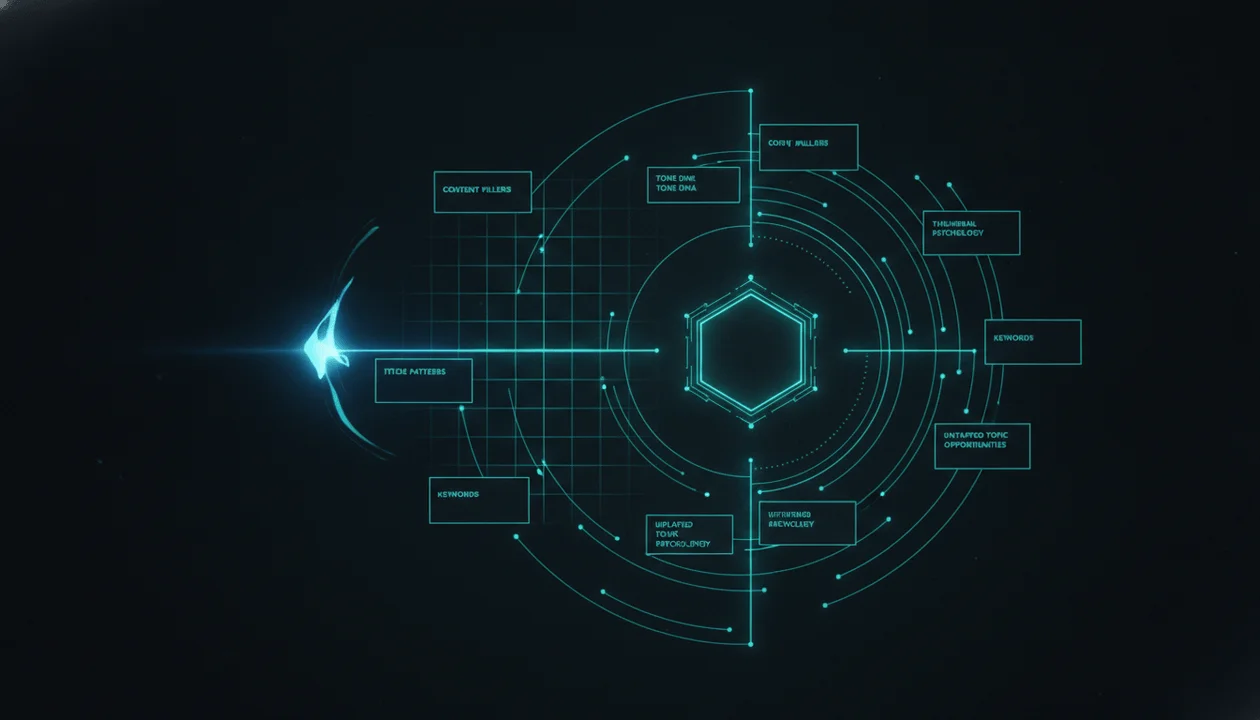
A channel blueprint answers deeper questions:
- Who is this channel really serving?
- What promise does the channel make to viewers?
- What topics does it repeat?
- What title patterns work?
- What thumbnail psychology does it use?
- What hook types appear often?
- What tone does the audience expect?
- What pacing does the channel follow?
- What formats repeatedly perform?
- What topics has the channel not covered yet?
- How can a creator build original videos from these signals?
That is channel blueprint cloning.
Not copying the content.
Cloning the strategy.
If you want to turn a public YouTube channel into a structured content strategy system, use the Channel Blueprint Cloner inside OverseerOS.
Key Takeaways
- Channel blueprint cloning means reverse-engineering a public YouTube channel’s strategy, not copying its videos.
- A channel blueprint can include audience promise, tone, hooks, pacing, topic formulas, title patterns, thumbnail principles, upload cadence, tags, keywords, and untapped opportunities.
- The goal is to create original videos from proven strategy signals.
- Copying exact videos, scripts, titles, thumbnails, or creative assets is not channel blueprint cloning.
- A strong blueprint helps creators launch faster, write better scripts, plan better topics, and build repeatable content systems.
- Faceless creators, agencies, multi-channel operators, and scriptwriters benefit most because they need repeatable systems, not random ideas.
- OverseerOS analyzes public YouTube signals and turns them into a structured blueprint that can connect to planning, scripts, titles, thumbnails, and production.
- The strongest workflow is: clone the blueprint → study the strategy → generate original topic opportunities → save to planner → write scripts → produce videos → review performance.
What Is Channel Blueprint Cloning?
Channel blueprint cloning is the process of turning a successful public YouTube channel into a structured content strategy blueprint.
It does not mean duplicating the creator’s content.
It means extracting the repeatable strategy behind the channel.
A good blueprint shows:
- What the channel is about
- Who the audience is
- What emotions the content creates
- What types of hooks are used
- How the channel opens videos
- How fast or slow the scripts move
- What video formats repeat
- What title formulas work
- What thumbnail styles appear often
- What topic categories drive the channel
- What upload cadence the channel follows
- What keywords and tags appear across content
- What video lengths fit the channel
- What untapped topics match the channel’s proven formulas
This gives creators a starting point based on evidence.
Instead of asking:
What should I make?
You ask:
What does this successful channel prove about this niche, and how can I create an original version of that strategy?
That is the purpose of channel blueprint cloning.
Channel Blueprint Cloning vs Copying
This distinction is everything.
| Copying a Channel | Cloning a Channel Blueprint |
|---|---|
| Copies exact video topics | Extracts repeatable topic formulas |
| Rewrites the same scripts | Writes original scripts from strategy signals |
| Copies thumbnails | Learns thumbnail psychology |
| Copies titles | Studies title structure |
| Reuses footage or visuals | Creates original visuals |
| Duplicates the channel’s catalog | Builds a new content system |
| Creates weaker copies | Creates original videos from proven patterns |
| Risky and low-trust | Strategic and ethical |
Copying asks:
What did they make?
Blueprint cloning asks:
Why does their channel work?
That is the difference.
A creator who copies will always be behind.
A creator who understands the blueprint can create new videos that fit the same proven audience demand without becoming a duplicate.
Why Channel Blueprint Cloning Matters in 2026
YouTube is more competitive now because production is easier.
AI tools can help creators:
- Write scripts
- Generate voiceovers
- Create thumbnails
- Produce visuals
- Edit faceless videos
- Repurpose content
- Analyze competitors
- Generate topic ideas
That means the old advantage of “I can produce videos” is weaker.
More people can produce.
The new advantage is knowing what to produce and why.
Channel blueprint cloning helps because it gives creators a strategy model.
It reduces blank-page guessing.
It helps creators understand:
- What the audience already rewards
- Which formats are repeatable
- Which topics belong in the niche
- Which title structures create curiosity
- Which hooks fit the audience
- Which video lengths make sense
- Which emotional tones match the channel
- Which opportunities are still open
The creator still has to make original videos.
But they are not starting from zero.
They are building from public signals.
What a YouTube Channel Blueprint Includes
A strong channel blueprint is more than a list of video ideas.
It should include the full strategic DNA of the channel.
1. Channel Promise
The channel promise is what viewers expect when they subscribe.
Examples:
- “We explain AI tools before everyone else.”
- “We turn complex history into cinematic stories.”
- “We help creators grow from public YouTube signals.”
- “We simplify money for beginners.”
- “We expose the hidden strategies behind successful businesses.”
- “We teach psychology through simple examples.”
The channel promise is the foundation.
If the promise is unclear, the content becomes random.
A blueprint should identify:
- Who the channel serves
- What transformation it offers
- Why viewers return
- What kind of videos belong
- What kind of videos do not belong
2. Target Viewer
A channel is not only about topics.
It is about a viewer.
A good blueprint identifies the target viewer:
- Beginner or advanced?
- Casual viewer or serious buyer?
- Entertainment seeker or problem solver?
- Creator, student, investor, founder, fan, professional?
- Looking for inspiration, education, drama, proof, tutorials, or strategy?
This matters because the same topic can be packaged differently depending on the viewer.
Example topic:
AI video tools
For beginners:
Best AI Video Tools for Beginners
For serious creators:
AI Video Generation vs Auto Edit: Which One Actually Produces YouTube Videos Worth Uploading?
For agencies:
The AI Video Production Workflow Agencies Can Use for Faceless Channels
Same broad topic.
Different viewer.
Different blueprint.
3. Content Pillars
Content pillars are the repeated categories a channel covers.
A strong channel does not usually upload random ideas.
It repeats pillars.
Example for a YouTube strategy channel:
- Competitor research
- Viral topic discovery
- Title and thumbnail strategy
- Scriptwriting
- Faceless production
- YouTube automation
- Case studies
- Tool comparisons
Example for an AI channel:
- AI news
- AI tools
- AI tutorials
- AI business models
- AI risks
- AI creator workflows
- AI comparisons
A blueprint should show which pillars matter and which ones drive the strongest signals.
4. Viral Topic Formulas
A viral topic formula is a repeatable topic pattern.
Examples:
I tested X so you do not have to.

The hidden problem with X.

Why X is not what you think.

How X quietly became Y.

The X mistake most beginners make.

I studied X and found Y.

X vs Y: which one is actually better?

The rise and fall of X.

How to do X without making Y mistake.
These formulas are more valuable than individual topics.
A single topic gives you one video.
A formula can give you dozens.
The blueprint should extract formulas that already appear in the channel’s strongest videos.
5. Title Patterns
Titles reveal how the channel creates curiosity.
A blueprint should identify title patterns like:
- Warning titles
- Comparison titles
- Proof-based titles
- Mistake titles
- Contrarian titles
- Beginner titles
- “I tested” titles
- “I studied” titles
- “Why X failed” titles
- “What nobody tells you” titles
The goal is not to copy exact titles.
The goal is to understand the structure.
Competitor title:
I Studied 100 Viral Shorts. Here’s What I Found.
Original title using the pattern:
I Studied 37 Faceless AI Channels. The Winners Had One Production Workflow.
The structure is inspired.
The content is original.
6. Thumbnail Psychology
Thumbnails are strategy.
A blueprint should identify how the channel creates visual curiosity.
Look for:
- Faces or no faces
- One big object
- Before and after
- Screenshots
- Product interfaces
- Red circles or arrows
- Dark documentary visuals
- Clean SaaS visuals
- Big text or no text
- High contrast
- Visual conflict
- Mystery
- Shock
- Proof
Do not copy the thumbnail.
Extract the psychology.
Ask:
- What is the visual promise?
- What emotion does it create?
- What object carries the idea?
- What makes the viewer curious?
- What does the viewer understand in one second?
Then create your own thumbnail.
7. Hook Types
Hooks decide whether the viewer stays.
A channel blueprint should identify how videos usually open.
Common hook types include:
- Bold claim
- Warning
- Question
- Contradiction
- Story
- Result first
- Mistake
- Mystery
- Proof
- Before/after
- “Everyone thinks X, but actually Y”
Examples:
Most faceless YouTube channels do not fail because they use AI. They fail because they use AI before they have a real strategy.

Everyone is comparing AI video generators, but almost nobody is asking whether they produce videos worth uploading.

Most creators research competitors too late. By the time they notice the trend, the opportunity is already crowded.
A blueprint should help writers understand the hook style that fits the audience.
8. Tone DNA
Tone DNA is the channel’s writing and emotional style.
A channel might feel:
- Calm
- Aggressive
- Analytical
- Dramatic
- Suspenseful
- Premium
- Friendly
- Direct
- Educational
- Contrarian
- Motivational
- Investigative
- Story-driven
Tone affects everything:
- Script style
- Voiceover direction
- Music
- Visual style
- Thumbnail emotion
- CTA language
- Pacing
A finance channel may need calm trust.
A mystery channel may need suspense.
A YouTube strategy channel may need direct, practical authority.
A blueprint should capture this so future scripts do not feel random.
9. Pacing Profile
Pacing is how quickly the channel moves.
Analyze:
- How fast the intro starts
- How quickly the video reaches value
- How often sections change
- How dense the information is
- How long examples last
- Whether storytelling is slow or fast
- Whether the video uses pattern interrupts
- Whether the channel explains deeply or moves quickly
Pacing matters because a script can be “good” but wrong for the channel.
A documentary channel may need slower tension.
A Shorts channel needs immediate movement.
A business breakdown may need steady logic.
A blueprint should help writers match the pace.
10. Structure Formula
Strong channels often repeat structure.
Example structure for a strategy video:
1. Open with a contrarian claim.
2. Explain the common mistake.
3. Define the better framework.
4. Break down the framework step by step.
5. Show examples.
6. Warn against bad execution.
7. Give a practical template.
8. End with a clear next step.
Example structure for a documentary video:
1. Open with a dramatic moment.
2. Rewind to context.
3. Introduce the main character or company.
4. Show the rise.
5. Reveal the turning point.
6. Explain the collapse or consequence.
7. End with the lesson.
A blueprint turns these structures into reusable production formulas.
11. Upload Cadence and Video Length
A blueprint should show how often the channel publishes and what video lengths appear most often.
Track:
- Shorts vs long-form
- Average length
- Outlier length
- Upload frequency
- Series cadence
- Topic clusters
- Seasonal patterns
- News-driven timing
- Evergreen timing
Video length is strategic.
A 90-second Short and a 14-minute documentary are not the same content system.
12. Tags, Keywords, and Metadata
Tags and keywords are not the whole strategy, but they still reveal positioning.
A blueprint may identify:
- Main niche keywords
- Repeated topic terms
- Tags from top videos
- Channel keywords
- Description patterns
- Category language
- Search intent signals
This helps creators understand how the channel frames itself.
But keywords should support the strategy.
They should not replace it.
13. Untapped Opportunities
This may be the most valuable part.
A blueprint should not only show what the channel already did.
It should show what is still open.
Untapped opportunities can include:
- Related topics the channel has not covered
- Follow-up videos viewers ask for
- Formats that could be applied to new ideas
- Old topics that need 2026 updates
- Weak competitor videos that can be improved
- Search queries with poor answers
- Adjacent niche topics
- Comparison content
- Tutorial content
- Mistake content
- Case studies
This is where cloning becomes original.
The blueprint becomes a launchpad for new videos.
How Channel Blueprint Cloning Works
The manual version looks like this.
Step 1: Choose a Reference Channel
Pick a channel worth studying.
Good reference channels have:
- Clear niche
- Enough videos
- Repeated formats
- Strong public performance
- Recent uploads
- Recognizable tone
- Useful title patterns
- Clear audience
- Public transcripts or captions where available
Avoid channels that are successful only because of:
- Celebrity status
- Personal access you cannot replicate
- One viral accident
- Reused copyrighted clips
- Drama you do not want to touch
- A personality you cannot ethically imitate
The input matters.
A bad reference channel creates a weak blueprint.
Step 2: Analyze Public Channel Data
A blueprint should be built from public signals.
These can include:
- Channel metadata
- Public video titles
- Descriptions
- View counts
- Durations
- Upload dates
- Tags where available
- Thumbnails
- Captions or transcripts where available
- Playlists
- Comments
- Recent upload patterns
You do not need private analytics to understand a channel’s visible strategy.
Public signals are enough to build a useful blueprint.
Step 3: Identify Top and Outlier Videos
Do not treat every video equally.
Find:
- Most viewed videos
- Recent breakout videos
- Above-baseline videos
- Videos with strong comments
- Videos that created series
- Videos that repeated formats
- Videos that seem to define the channel
Outliers matter because they reveal what the audience rewarded.
But do not copy the outlier.
Extract why it worked.
Step 4: Extract Repeatable Patterns
Look across the channel.
Ask:
- Which topics repeat?
- Which formats repeat?
- Which hooks repeat?
- Which title structures repeat?
- Which thumbnails repeat?
- Which video lengths repeat?
- Which emotional triggers repeat?
- Which audience problems repeat?
- Which examples appear often?
One viral video may be luck.
Repeated patterns are strategy.
Step 5: Build the Blueprint
Now turn the analysis into a system.
A complete blueprint might include:
Channel promise:
[What viewers expect]

Target viewer:
[Who watches]

Tone DNA:
[How the channel sounds]

Content pillars:
[Main topic categories]

Hook types:
[Common openings]

Pacing profile:
[Fast, medium, slow, dense, story-driven]

Viral topic formulas:
[Repeatable topic structures]

Title patterns:
[How titles create curiosity]

Thumbnail principles:
[How thumbnails package ideas]

Structure formula:
[How videos are built]

Upload cadence:
[How often it posts]

Video length range:
[Shorts, long-form, average duration]

Tags and keywords:
[Repeated niche terms]

Untapped opportunities:
[New original topic ideas]

Script guidance:
[How to write in a similar strategic style without copying]

Planner actions:
[Which topics should be saved and produced]
Now you have a blueprint.
Not a copied catalog.
How OverseerOS Channel Blueprint Cloner Works
Manual blueprint cloning is possible, but it is slow.
The OverseerOS Channel Blueprint Cloner speeds up the process.
The workflow is simple:
1. Paste a Public YouTube Channel URL
You start with a channel URL.
This can be a public channel you want to study before entering a niche, launching a faceless channel, or planning a content strategy.
2. OverseerOS Reads Public Signals
OverseerOS analyzes public YouTube data such as channel metadata, video titles, descriptions, views, durations, tags, upload cadence, and available transcripts or captions.
It does not access private YouTube Studio analytics.
This matters because the workflow is built on visible public signals, not secret data.
3. It Extracts Strategy Patterns
The system looks for repeatable patterns:
- Tone DNA
- Primary emotion
- Pacing
- Hook patterns
- Signature phrases
- Viral topic formulas
- Structural formulas
- Content pillars
- Tags
- Keywords
- Title patterns
- Untapped opportunities
This creates the strategic layer.
4. It Builds the Blueprint
The output becomes a structured blueprint that can guide:
- Topic planning
- Scriptwriting
- Title generation
- Thumbnail direction
- Channel setup
- Upload schedule
- Description templates
- Content planner workflows
This is what makes it operational.
It is not just a report.
It becomes a system your channel can use.
5. It Connects to Planning and Scripts
A blueprint is most powerful when it does not sit alone.
Inside OverseerOS, blueprint insights can connect into Script Studio and Smart Content Planner so creators can save untapped topics, write tone-guided scripts, and move ideas into production.
That is the full loop:
Public channel → Blueprint → Untapped topics → Planner → Scripts → Voiceovers → Production → Review
That is channel blueprint cloning explained in one workflow.
Who Should Use Channel Blueprint Cloning?
Faceless YouTube Creators
Faceless creators need repeatable systems.
Because there is no on-camera personality carrying the channel, the strategy must be stronger.
A blueprint helps faceless creators define:
- Tone
- Topics
- Formats
- Visual direction
- Script structure
- Pacing
- Thumbnail patterns
- Content calendar
This makes the channel feel intentional instead of random.
YouTube Automation Operators
YouTube automation is not just producing videos faster.
It is building a repeatable content operation.
A blueprint helps operators avoid guessing and build a channel from public proof.
Agencies
Agencies can use blueprints to onboard clients, understand niches, brief writers, guide thumbnail designers, and plan content faster.
Instead of giving a writer a vague instruction like:
Make videos like this channel.
The agency can give a structured blueprint:
- Tone
- hooks
- pacing
- format
- topic pillars
- title patterns
- thumbnail direction
- untapped opportunities
That is much more useful.
Multi-Channel Operators
If you manage multiple channels, you need systems.
Blueprints help standardize research and production across niches.
Scriptwriters
Scriptwriters can use blueprints to understand how a proven channel sounds and structures videos.
This helps them write scripts that match strategic patterns without copying exact scripts.
Creators Entering a New Niche
If you are entering a niche, a blueprint helps you understand the market faster.
You can study successful channels before publishing your first batch.
What Channel Blueprint Cloning Is Not
This part is important.
It Is Not Copying Videos
Do not duplicate someone else’s video catalog.
Do not remake every video they uploaded.
Do not use their script structure beat for beat.
It Is Not Downloading Content
Do not download or reuse someone else’s footage, audio, graphics, or creative assets.
It Is Not Guaranteed Growth
A blueprint does not guarantee views, revenue, subscribers, or virality.
It gives strategic direction.
Execution still matters.
It Is Not Private Analytics Access
A blueprint is built from public signals.
It does not reveal private retention, watch time, audience demographics, revenue, or internal YouTube recommendation data.
It Is Not a Replacement for Originality
A blueprint is a map.
You still need your own topics, scripts, titles, thumbnails, visuals, and voice.
The Ethical Strategy Cloning Rule
Use this rule:
If the original creator saw your video, would they think you studied the market or stole their work?
If the answer is “stole,” your video is too close.
Your version should have:
- Original title
- Original thumbnail
- Original script
- Original examples
- Original voiceover
- Original visuals
- Original angle
- Original conclusion
- Original value
The blueprint should inspire.
It should not duplicate.
Example: Channel Blueprint Cloning in Practice
Imagine you want to launch a faceless channel about AI tools for creators.
You find a successful channel in the niche.
The channel has videos like:
- “7 AI Tools That Save Creators 10 Hours a Week”
- “I Tested the New AI Agent Everyone Is Talking About”
- “This AI Workflow Replaced My Editing Process”
- “The Best AI Tools for Creators in 2026”
A surface-level creator might copy those topics.
A blueprint-driven creator goes deeper.
Blueprint Findings
Channel promise:
Practical AI workflows for creators who want to save time.

Target viewer:
Solo creators, YouTubers, freelancers, and online business owners.

Tone:
Fast, practical, clear, slightly urgent.

Winning formats:
Tool tests, workflow breakdowns, comparisons, and “I tried X” videos.

Title patterns:
Outcome-driven titles with proof or time savings.

Thumbnail psychology:
Tool interface + creator workflow + clear transformation.

Audience pain:
Too many tools, too little time, confusion about what actually works.

Untapped opportunities:
Faceless YouTube workflows, AI voiceover tests, script-to-video comparisons, thumbnail automation, production stack breakdowns.
Now you can create original topics:
- I Tested 5 AI Tools Inside One Faceless YouTube Workflow
- AI Video Generators Are Not Enough. You Need a Production System.
- Script to Video AI: What Actually Works for YouTube Creators
- How to Turn a Voiceover Into a Faceless Video With AI
- The AI Creator Stack That Replaces Manual Scene Planning
These are not copies.
They are original topics built from proven strategy signals.
That is channel blueprint cloning.
How to Turn a Blueprint Into a Content Plan
A blueprint only matters if it becomes action.
Here is how to use it.
Step 1: Choose the Strongest Content Pillars
Pick 3 to 5 pillars from the blueprint.
Example:
- AI video workflows
- Faceless YouTube strategy
- Creator tool comparisons
- Script and voiceover production
- Thumbnail packaging
Step 2: Choose Repeatable Formats
Pick formats that can become series.
Example:
- “I tested X”
- “X vs Y”
- “How to do X without Y”
- “Why X fails”
- “The hidden problem with X”
- “Beginner mistakes”
- “Workflow breakdown”
Step 3: Generate Original Topics
Use the formulas to create new ideas.
Example:
Format:
X vs Y

Original topics:
AI Video Generation vs Auto Edit
Manual Editing vs Auto Edit for Faceless Channels
Script-to-Video AI vs Prompt-to-Video AI
AI Voiceover vs Human Voiceover for Faceless YouTube
Step 4: Save Topics Into a Planner
A topic should not live in a random note.
Save:
- Topic
- Source blueprint
- Source channel
- Why it fits
- Working title
- Thumbnail direction
- Script status
- Voiceover status
- Production status
This is where Smart Content Planner becomes useful.
It keeps topics connected to the research that justified them.
Step 5: Write Scripts From the Blueprint
Use the blueprint to guide:
- Hook
- Tone
- Pacing
- Structure
- Examples
- CTA
- Emotional rhythm
The script should match the strategic style, not copy the source creator’s words.
Step 6: Package With Original Titles and Thumbnails
Use the title patterns and thumbnail principles, but create your own packaging.
Do not copy another creator’s exact thumbnail design.
Use the psychological pattern.
For example:
Source thumbnail pattern:
Before/after transformation
Original thumbnail direction:
“Random Ideas” chaos on one side vs “Channel Blueprint” organized strategy system on the other.
Step 7: Produce and Review
After publishing, measure:
- Did the topic get impressions?
- Did the title and thumbnail earn clicks?
- Did the hook hold viewers?
- Did comments show demand?
- Did the format work?
- Should this become a series?
- Did the blueprint signal predict performance?
Your own results then improve your next blueprint.
Manual Channel Blueprint Template
Use this if you want to create a blueprint manually.
Reference channel:
[Channel URL]

Niche:
[What market is this channel in?]

Target viewer:
[Who watches this channel?]

Channel promise:
[What does the viewer expect?]

Content pillars:
1.
2.
3.
4.
5.

Top videos:
1.
2.
3.
4.
5.

Breakout videos:
1.
2.
3.

Viral topic formulas:
1.
2.
3.
4.
5.

Title patterns:
1.
2.
3.
4.
5.

Thumbnail principles:
1.
2.
3.
4.
5.

Hook types:
1.
2.
3.

Tone DNA:
[Calm, direct, dramatic, analytical, premium, suspenseful, etc.]

Pacing:
[Fast, medium, slow, dense, story-driven, tutorial-based]

Structure formula:
[How videos are usually built]

Upload cadence:
[Frequency]

Video length range:
[Shorts/long-form pattern]

Keywords and tags:
[Repeated terms]

Audience questions:
[Comment themes]

Untapped opportunities:
1.
2.
3.
4.
5.

Original topic ideas:
1.
2.
3.
4.
5.

Production notes:
[Script, voiceover, visual style, thumbnail direction]
This template turns competitor research into a usable content system.
Channel Blueprint Cloning for Faceless YouTube
Faceless channels benefit massively from blueprint cloning.
Why?
Because faceless creators need a system to replace personal recognition.
A viewer may not remember the creator’s face.
But they can remember:
- The format
- The voice
- The pacing
- The thumbnail style
- The topic promise
- The editing rhythm
- The emotional tone
- The type of value
That is why faceless channels need strong strategy.
A blueprint helps define that strategy before the channel becomes random.
For a faceless channel, a blueprint can guide:
- Niche positioning
- Topic pipeline
- Script style
- Voiceover tone
- Visual style
- Thumbnail direction
- Upload cadence
- Repeatable formats
- Production workflow
This is how a faceless channel becomes recognizable without a face.
Channel Blueprint Cloning for Agencies
Agencies can use channel blueprints to speed up strategy.
Instead of onboarding a new client with vague research, an agency can create blueprints from successful reference channels.
This helps:
- Strategy teams
- Writers
- Editors
- Thumbnail designers
- Voiceover artists
- Project managers
- Clients
A blueprint makes everyone aligned.
The writer knows the hook style. The thumbnail designer knows the visual psychology. The editor knows the pacing. The strategist knows the topic formulas. The client sees the research logic.
That is operational leverage.
Channel Blueprint Cloning for Multi-Channel Operators
Multi-channel operators need repeatability.
They cannot rely on random brainstorming for every channel.
Blueprints help them:
- Enter niches faster
- Validate channel direction
- Give writers better instructions
- Create content pillars
- Build topic calendars
- Standardize production
- Avoid copying
- Scale with strategy
For operators, the value is speed plus consistency.
A blueprint becomes the operating manual for the channel.
Channel Blueprint Cloning for Scriptwriters
Scriptwriters often receive weak briefs.
Example:
Write like this channel.
That is not enough.
A blueprint gives the writer:
- Tone
- pacing
- hook types
- structural formula
- emotional signature
- title promise
- example patterns
- audience pain
- topic context
This makes the script better.
It also reduces revisions.
The writer no longer guesses what “like this channel” means.
The blueprint explains it.
Common Mistakes With Channel Blueprint Cloning
Mistake 1: Copying the Output Instead of the System
Do not copy exact videos.
Extract the strategy.
Mistake 2: Studying Only One Viral Video
One video can mislead you.
Study the whole channel.
Mistake 3: Ignoring Smaller Breakout Channels
Big channels show established patterns.
Smaller breakout channels often reveal fresh demand.
Mistake 4: Copying Thumbnails Too Closely
Thumbnail psychology is useful.
Exact thumbnail copying is not.
Mistake 5: Ignoring Audience Fit
A strategy that works for one audience may fail for another.
Adapt the blueprint to your viewer.
Mistake 6: Treating the Blueprint as a Guarantee
A blueprint is strategic guidance.
It does not guarantee results.
Mistake 7: Not Turning the Blueprint Into a Planner
A blueprint sitting in a document is weak.
A blueprint connected to topics, scripts, voiceovers, thumbnails, and production is powerful.
The Channel Blueprint Cloning Checklist
Before creating videos from a blueprint, check:
Did we identify the channel promise?
Did we define the target viewer?
Did we extract content pillars?
Did we find repeated formats?
Did we identify title patterns?
Did we study thumbnail psychology?
Did we extract hook types?
Did we understand tone DNA?
Did we map pacing?
Did we identify structure formulas?
Did we find untapped opportunities?
Did we create original topics?
Did we avoid copying exact videos?
Did we save topics into a planner?
Did we create original scripts and thumbnails?
If you cannot answer these, the blueprint is incomplete.
Best Workflow Inside OverseerOS
The best workflow looks like this:
1. Pick a public YouTube channel worth studying.
2. Paste it into Channel Blueprint Cloner.
3. Generate the channel blueprint.
4. Review tone DNA, hooks, pacing, topic formulas, tags, keywords, and untapped opportunities.
5. Save the strongest original topics into Smart Content Planner.
6. Use the blueprint to guide scripts.
7. Generate original titles and thumbnails.
8. Produce the video.
9. Review performance.
10. Improve the blueprint with your own channel data.
This is the full loop.
It starts with public evidence.
It ends with original content.
Why This Is Better Than Keyword Research Alone
Keyword tools can be useful.
But YouTube is not only search.
YouTube is also packaging, audience behavior, recommendation, timing, format, retention, and channel identity.
A keyword tool may tell you:
People search this phrase.
A channel blueprint tells you:
This is how a winning channel in this niche actually operates.
That is much more powerful.
Keywords show demand language.
Blueprints show content systems.
The best creators use both.
Why This Is Better Than Random AI Ideation
AI can generate endless ideas.
But endless ideas are not the same as proven opportunities.
Random AI ideation may sound creative, but it often lacks public evidence.
Blueprint cloning starts from what already worked.
Then AI can help expand those patterns into original topics.
The correct workflow is:
Public signal first.
AI expansion second.
Human judgment always.
That is how you avoid generic AI content.
Final Verdict
Channel blueprint cloning is one of the smartest ways to build a YouTube strategy in 2026.
But only if you understand what it really means.
It does not mean copying another creator.
It means reverse-engineering a public channel’s strategy and turning the strongest patterns into original content.
A strong blueprint can show you:
- audience promise
- content pillars
- tone DNA
- hooks
- pacing
- viral topic formulas
- title patterns
- thumbnail principles
- upload cadence
- tags
- keywords
- structure formulas
- untapped opportunities
Then you use those signals to create your own videos.
Your own titles. Your own thumbnails. Your own scripts. Your own visuals. Your own voice. Your own angle.
That is the difference between imitation and strategy.
If you want to stop guessing from a blank page, use the Channel Blueprint Cloner to turn a public YouTube channel into a structured strategy blueprint.
Then use Smart Content Planner to turn the strongest opportunities into original topics, scripts, voiceovers, and production workflows.
Clone the blueprint.
Not the video.
That is how serious creators build from evidence.
FAQ
What is channel blueprint cloning?
Channel blueprint cloning is the process of reverse-engineering a public YouTube channel into a structured content strategy blueprint. The blueprint can include audience promise, tone, hooks, pacing, topic formulas, title patterns, thumbnail principles, keywords, upload cadence, and untapped opportunities.
Is channel blueprint cloning the same as copying a YouTube channel?
No. Channel blueprint cloning studies the strategy behind a public channel. Copying duplicates exact videos, scripts, thumbnails, titles, or creative assets. Blueprint cloning should help creators make original videos from proven patterns.
What does a YouTube channel blueprint include?
A YouTube channel blueprint can include content pillars, tone DNA, emotional profile, pacing, hook patterns, viral topic formulas, structural formulas, title patterns, thumbnail principles, upload cadence, video length patterns, tags, keywords, and untapped topic opportunities.
How does OverseerOS Channel Blueprint Cloner work?
OverseerOS Channel Blueprint Cloner lets you paste a public YouTube channel URL, analyzes public channel data and available transcripts, extracts repeatable strategy patterns, and turns them into a structured blueprint for topics, scripts, titles, thumbnails, and planning.
Does Channel Blueprint Cloner access private YouTube analytics?
No. Channel Blueprint Cloner analyzes public YouTube signals such as channel metadata, public video titles, descriptions, view counts, durations, upload cadence, tags, and available captions or transcripts. It does not access private YouTube Studio analytics.
Who should use channel blueprint cloning?
Channel blueprint cloning is useful for faceless YouTube creators, YouTube automation operators, agencies, multi-channel operators, scriptwriters, and creators entering a new niche who want a repeatable strategy instead of random ideas.
Can I write scripts from a cloned channel blueprint?
Yes. A channel blueprint can guide scriptwriting by showing tone, pacing, hook types, structure formulas, emotional style, and content patterns. The script should still be original and should not copy another creator’s exact words or structure too closely.
Can channel blueprint cloning find untapped video ideas?
Yes. A strong blueprint can identify untapped topic opportunities adapted to a channel’s proven formulas. These ideas can be saved into a content planner and turned into original videos.
Is channel blueprint cloning good for faceless YouTube channels?
Yes. Faceless channels benefit from blueprint cloning because they need repeatable systems for topics, scripts, voiceovers, visuals, thumbnails, pacing, and upload consistency. A blueprint helps the channel feel intentional without relying on an on-camera personality.
Does channel blueprint cloning guarantee views?
No. Channel blueprint cloning does not guarantee views, subscribers, revenue, or viral performance. It gives strategic direction based on public signals, but execution, originality, packaging, retention, timing, and audience fit still determine performance.