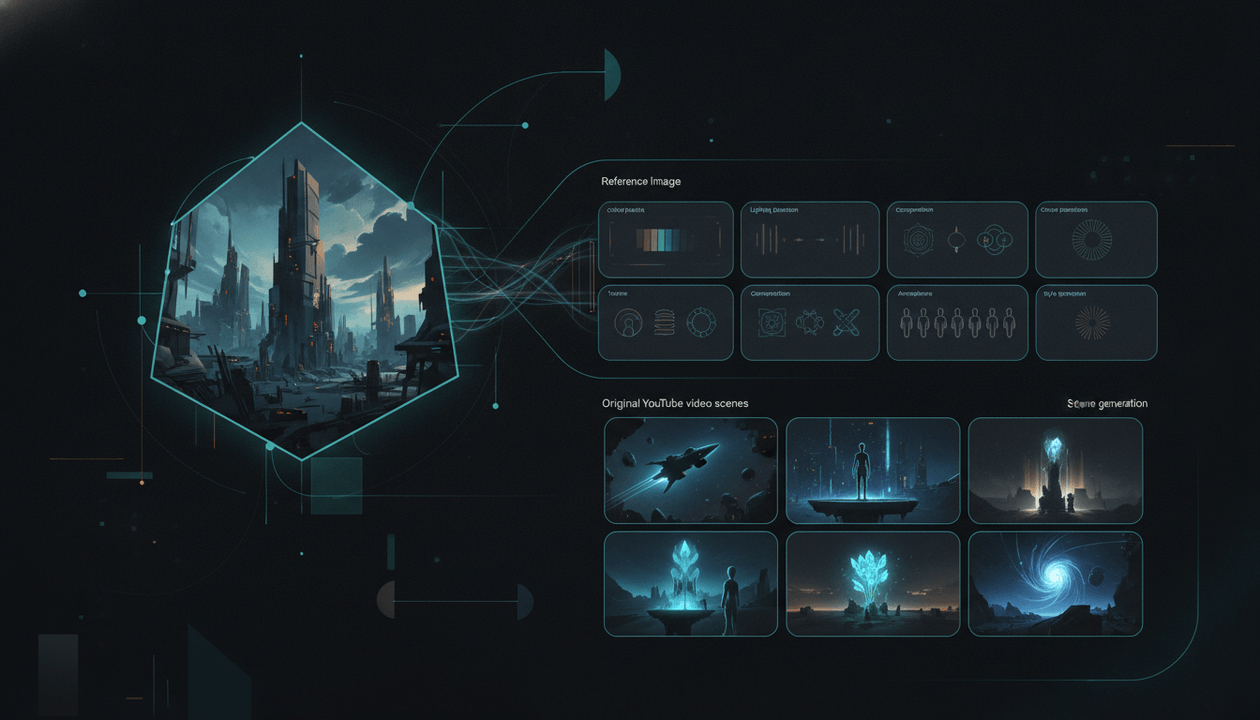

A reference video can show you exactly what you want.
The problem is describing it.
You can see the cold blue lighting, restrained camera movement, fast opening cuts, shallow depth of field, dramatic close-ups, documentary texture, minimal captions, and slow emotional build.
Then an AI video generator asks:
Describe the style.
Most creators type:
Cinematic, dramatic, high quality.
The result looks nothing like the reference.
A YouTube video style analyzer solves that translation problem. It studies a video’s visible production language and turns it into structured direction that a creator, editor, or AI video generator can actually use.
The best tools can identify signals such as:
- color palette
- lighting
- contrast
- composition
- camera framing
- camera movement
- shot rhythm
- transition energy
- motion
- caption treatment
- texture
- realism
- visual mood
- emotional progression
Some tools stop after producing a descriptive prompt. Others generate scene maps, storyboards, editable style briefs, or production-ready Video Style DNA. The strongest options connect the analysis directly to the creation of original scenes.
This guide compares the best YouTube video style analyzer tools in 2026, explains what each one can actually analyze, and gives you a complete framework for turning a reference video into an original visual system without copying the source.
Key Takeaways
- OverseerOS is the best overall YouTube video style analyzer for faceless creators because OverseerOS Video Style Cloner can analyze a public YouTube URL, extract reusable OverseerOS Video Style DNA, add optional OverseerOS Director DNA, and carry that direction into original scene generation inside OverseerOS Auto Edit.
- Copy Video AI is a strong standalone option for turning YouTube links or uploaded MP4 files into structured prompts covering scenes, camera movement, motion, audio, and style.
- ViewMax Video to Prompt is useful when the goal is a reusable prompt with camera, lighting, action, pacing, negative-prompt guidance, and model-ready direction.
- VidtoPrompt is one of the easiest free options for analyzing short references without creating an account.
- ClipDecode is designed for short-form creators who want a transcript, hook breakdown, scene map, visual prompts, and virality analysis.
- SmarterWithAI Video Analyzer is strongest for converting videos into permanent frame-by-frame Markdown documentation.
- Twelve Labs, Azure AI Video Indexer, and Google Cloud Video Intelligence are better suited to developers building custom video-analysis systems.
- A video style analyzer cannot recover the exact hidden prompt, seed, model settings, editing timeline, lens, LUT, or private production decisions used to create a finished video.
- The ethical goal is to extract broad production patterns and apply them to new work, not duplicate exact frames, characters, music, logos, captions, scripts, or another creator’s finished video.
Best YouTube Video Style Analyzer Tools: Quick Verdict
| Rank | Tool | Best For | Input | Main Output | Main Weakness |
|---|---|---|---|---|---|
| 1 | OverseerOS | YouTube style analysis connected to original faceless video production | Public YouTube URL | OverseerOS Video Style DNA, optional OverseerOS Director DNA, original scene workflow | Not a frame-level professional VFX or color-grading suite |
| 2 | Copy Video AI | Turning references into detailed generation prompts | YouTube URL or MP4 | Structured prompt covering scenes, camera, motion, audio, and style | Stops mainly at analysis and prompt generation |
| 3 | ViewMax Video to Prompt | Model-ready video prompt extraction | Public URL or uploaded clip | Prompt, negative prompt, camera, lighting, pacing, action, and style notes | Best suited to short, visually clear clips |
| 4 | VidtoPrompt | Fast free shot-by-shot analysis | YouTube Shorts URL or uploaded file | Shot map, camera motion, style tags, and polished prompt | Smaller upload limit and less production management |
| 5 | ClipDecode | Short-form hook, scene, and virality analysis | Shorts, TikTok, Reels, or uploaded clip | Transcript, hook breakdown, scene map, visual prompts, and playbook | Built for videos up to three minutes and currently positioned as early access |
| 6 | SmarterWithAI Video Analyzer | Permanent storyboard documentation | Uploaded video | Frame-by-frame Markdown analysis with timestamps and recommendations | Does not directly generate a new video |
| 7 | TrendRemix | Deconstructing short-form creative formulas | Uploaded reference video | Hook, pacing, emotional arc, selling points, CTA, and storyboard direction | More focused on viral short-form and campaign remixes than long-form YouTube |
| 8 | Twelve Labs | Custom multimodal style-analysis applications | Uploaded or indexed video | Prompt-driven analysis across visuals, audio, speech, and on-screen text | Requires technical setup and custom prompting |
| 9 | Azure AI Video Indexer | Technical scene, shot, and keyframe analysis | Uploaded video | Scenes, shots, keyframes, timestamps, and editorial shot types | Does not automatically produce a creator-friendly style brief |
| 10 | Google Cloud Video Intelligence | Building shot and label detection into custom workflows | Uploaded cloud video | Shot boundaries, labels, objects, activities, and time segments | Requires development work and additional interpretation |
What Is a YouTube Video Style Analyzer?
A YouTube video style analyzer is an AI tool that examines how a video looks, moves, and communicates visually.
It attempts to convert an intuitive reaction such as:
I like the way this video feels.
Into structured production direction such as:
Low-key blue lighting, desaturated backgrounds, centered human subjects, slow push-in camera movement, medium-to-close framing, average shot length of three to five seconds, minimal white captions, restrained transitions, and escalating visual intensity near major reveals.
That output can be used to:
- brief an editor
- guide an AI video generator
- create a storyboard
- build a prompt library
- define a channel’s visual identity
- compare several references
- maintain style consistency
- plan a faceless YouTube video
- translate client references into production language
- document why a visual format works
A style analyzer does not merely summarize what happens in the video.
It explains how the video is visually constructed.
What a Video Style Analyzer Should Identify
A strong analysis should cover more than color.
1. Visual Format
The tool should identify the broad production category.
Examples include:
- cinematic documentary
- talking-head explainer
- motion-graphics essay
- illustrated story
- photorealistic AI film
- stock-footage montage
- screen-recorded tutorial
- animated educational video
- UGC advertisement
- fast-cut Short
- news commentary
- product demonstration
The same topic can feel completely different depending on the format.
2. Color System
A useful analysis should identify:
- dominant colors
- accent colors
- saturation
- temperature
- contrast
- highlight treatment
- shadow treatment
- color consistency
- emotional effect
“Blue” is not enough.
A better direction is:
Desaturated steel-blue shadows, neutral skin tones, warm amber highlights reserved for moments of hope, and high local contrast around the subject.
3. Lighting
Lighting direction may include:
- soft or hard light
- high-key or low-key exposure
- natural or artificial light
- front, side, back, or rim lighting
- volumetric light
- motivated practical lighting
- silhouette use
- shadow density
- highlight rolloff
- day or night treatment
Lighting often creates more of the perceived style than the subject itself.
4. Composition
The analyzer should inspect:
- centered versus off-center subjects
- symmetry
- negative space
- rule-of-thirds use
- foreground layers
- visual depth
- subject scale
- background complexity
- leading lines
- text-safe areas
- balance
- focal hierarchy
A reference may feel premium because every frame has one dominant idea rather than several competing elements.
5. Camera Language
Useful camera analysis includes:
- wide shot
- medium shot
- close-up
- extreme close-up
- overhead shot
- low angle
- high angle
- point-of-view shot
- static camera
- handheld movement
- pan
- tilt
- push-in
- pull-out
- tracking
- orbit
- zoom
- rack focus
Camera language affects power, intimacy, tension, energy, and viewer attention.
6. Shot Rhythm
A tool should distinguish between visual appearance and directing rhythm.
Shot rhythm can include:
- average shot duration
- cut frequency
- opening cut density
- longest uninterrupted shot
- speed changes
- pauses
- visual escalation
- reaction-shot use
- cut-on-action behavior
- beat synchronization
Two videos can use the same colors and subjects but feel entirely different because one cuts every second and the other holds each frame for eight seconds.
7. Motion Language
Motion includes more than camera movement.
A useful style analysis should also consider:
- subject movement
- object movement
- background movement
- parallax
- zoom intensity
- animation curves
- speed ramps
- slow motion
- kinetic typography
- particles
- environmental motion
- still-image animation
8. Transition System
Transitions may include:
- direct cuts
- match cuts
- jump cuts
- fades
- dissolves
- whip transitions
- masking
- object wipes
- motion blur
- glitch effects
- light leaks
- camera movement bridges
- sound-led transitions
The tool should identify whether transitions are expressive or nearly invisible.
9. Texture and Realism
Style may depend on:
- clean digital sharpness
- film grain
- lens distortion
- chromatic aberration
- halation
- VHS artifacts
- paper texture
- painterly surfaces
- 3D rendering
- photorealism
- anime treatment
- collage
- archival degradation
- documentary imperfection
10. Caption and Graphic Language
For YouTube Shorts and modern explainers, text is part of the visual style.
Analyze:
- font category
- size
- capitalization
- placement
- number of words shown
- animation
- color
- outlines
- shadow
- highlighted keywords
- caption frequency
- synchronization
- supporting icons
- charts
- labels
- lower thirds
11. Audio and Visual Relationship
Some tools also inspect:
- music mood
- sound-effect frequency
- beat synchronization
- audio-led transitions
- silence
- narrator pacing
- emotional build
- sound-design intensity
A visual style analysis is incomplete when the edit is clearly driven by sound.
12. Emotional Curve
The analyzer should identify how the production changes over time.
Example:
- Cold, quiet, and uncertain opening
- Faster cuts as the problem expands
- Darkest lighting during the crisis
- Slower pace before the reveal
- Warmer palette during the resolution
- Clean final frame with restrained CTA
This is directing, not merely appearance.
Video Style Analyzer vs Video Analyzer
These categories overlap, but they solve different problems.
| Tool Type | Main Question |
|---|---|
| General YouTube video analyzer | What is this video about, how is it structured, and why might it perform? |
| Transcript analyzer | What is being said? |
| Retention analyzer | Where could viewers lose interest? |
| Thumbnail analyzer | Why might the packaging earn a click? |
| Video style analyzer | How does the video look, move, and feel? |
| Video-to-prompt tool | How can the visible reference be translated into AI generation instructions? |
| Style-transfer tool | How can an existing video be visually transformed? |
| Video cloner | How can a reference inform a new production workflow? |
Creators looking for transcript, hook, competitor, and performance analysis can read the broader guide to the best YouTube video analyzer AI tools.
This guide is specifically about visual direction, camera language, scene construction, motion, pacing, and style extraction.
Video Style Analysis vs Style Transfer
A style analyzer describes the reference.
A style-transfer tool modifies an existing asset.
Style Analysis
Input:
Reference video
Output:
A description or blueprint of its palette, lighting, composition, camera, motion, pacing, and directing decisions.
Style Transfer
Input:
Your video plus a reference image, preset, or style prompt
Output:
A modified version of your existing footage.
A creator may use both.
The stronger workflow is usually:
- Analyze the reference.
- Decide which signals are useful.
- Remove protected or overly specific elements.
- Build an original style brief.
- Apply that brief to new footage or generated scenes.
- Review the result for consistency and originality.
Blind style transfer can reproduce surface appearance without understanding why the reference works.
How We Evaluated the Tools
The ranking is based on seven practical criteria.
YouTube Input Support
Can the tool accept:
- a public YouTube URL
- a Shorts URL
- an uploaded MP4
- long-form videos
- private footage
- multiple references
Style Depth
Does it analyze only general mood, or does it cover:
- palette
- lighting
- camera
- composition
- texture
- motion
- pacing
- captions
- audio
- transitions
Temporal Understanding
Does it understand change over time?
A frame analyzer may describe individual images correctly while missing:
- editing rhythm
- escalation
- movement
- scene progression
- visual callbacks
- emotional curve
Output Usability
Does the result become:
- a generic paragraph
- a structured prompt
- a shot map
- a storyboard
- a JSON object
- a reusable style profile
- a production-ready workflow
Production Handoff
Can the analysis be used directly to:
- create scenes
- generate prompts
- brief an editor
- build a storyboard
- store a style library
- produce a finished video
YouTube Fit
Does the tool understand creator workflows such as:
- long-form faceless videos
- Shorts
- hooks
- captions
- retention pacing
- title-promise delivery
- scene-based narration
Responsible Use
Does the workflow encourage creators to extract broad patterns rather than copy exact frames, protected assets, logos, people, scripts, or branded identity?
The Best YouTube Video Style Analyzer Tools in 2026
1. OverseerOS: Best Overall for YouTube Style Analysis and Production
OverseerOS Video Style Cloner is the strongest overall choice for faceless YouTube creators because it connects style analysis to the next production step.
Most tools end with a prompt.
OverseerOS can carry the extracted direction into OverseerOS Auto Edit, where the creator’s own script and voiceover become original scenes guided by the reference’s broader production language.
How OverseerOS Video Style Cloner Works
The supported workflow is:
- Paste a public YouTube video URL.
- Analyze the video’s visual direction.
- Extract reusable OverseerOS Video Style DNA.
- Optionally extract OverseerOS Director DNA.
- Apply the direction to an original script and voiceover.
- Generate new scenes inside OverseerOS Auto Edit.
- Review weak outputs.
- Refine captions, motion, music, effects, and export settings.
What OverseerOS Video Style DNA Can Analyze
OverseerOS Video Style DNA can capture signals such as:
- mood
- color palette
- lighting
- contrast
- camera language
- composition
- texture
- subject treatment
- background treatment
- realism
- pacing feel
The output becomes a compact direction for new scenes rather than a transcript of the original video.
What OverseerOS Director DNA Adds
Visual appearance and directing rhythm are separated.
OverseerOS Director DNA can add supported direction for:
- pacing
- shot rhythm
- subject motion
- transition energy
- emotional curve
- caption energy
That distinction is valuable.
A video can have a perfect palette match and still feel wrong because its shots move, cut, and escalate differently.
Why OverseerOS Ranks First
OverseerOS is not simply asking:
What does this reference look like?
It connects the answer to:
How should the creator’s original video look and move?
That makes it useful for:
- faceless documentaries
- business stories
- history channels
- psychology videos
- AI explainers
- finance videos
- cinematic Shorts
- narrative channels
- agencies
- multi-channel operators
Responsible Style Extraction
OverseerOS frames the reference as inspiration.
The workflow is designed to avoid copying:
- exact frames
- real-person likenesses
- logos
- watermarks
- captions
- protected characters
- audio
- finished footage
The goal is to extract broad visual signals and apply them to a new subject, script, narration, and scene sequence.
Best For
- Creators who want to analyze a YouTube URL
- Faceless channels
- Long-form and short-form production
- Style consistency across AI-generated scenes
- Creators who already have a script and voiceover
- Teams building reusable visual systems
- Creators who want analysis and generation connected
Main Strength
OverseerOS carries style direction into a complete YouTube-native production workflow instead of leaving the creator with a paragraph they must translate into another tool.
Main Weakness
OverseerOS is not a replacement for professional frame-level compositing, advanced color science, manual VFX, or a full nonlinear editor.
The analysis also does not guarantee perfect consistency across every generated scene. AI outputs still require review and regeneration.
Verdict
Choose OverseerOS when the reference is a public YouTube video and the goal is to turn its broad visual language into an original faceless video.
Creators starting from a single reference image rather than a video can use OverseerOS Image Style Cloner.
2. Copy Video AI: Best Standalone Video-to-Prompt Analyzer
Copy Video AI converts a YouTube URL or uploaded MP4 into a structured prompt document.
Its analysis is designed to cover:
- scene structure
- subject
- environment
- camera movement
- motion
- pacing
- lighting
- transitions
- sound
- visual style
The platform focuses on converting details that creators can see but struggle to describe into prompt language suitable for AI video workflows.
Where Copy Video AI Performs Well
It is particularly useful when a creator wants to:
- analyze a YouTube reference
- build a prompt library
- translate a client reference into a brief
- study viral editing patterns
- create an advertisement variation
- document camera movement
- brief a separate AI generator
- turn private MP4 footage into reusable direction
Output Style
Copy Video AI does not merely return a transcript.
It attempts to reshape the visible production language into a reusable prompt covering composition, motion, style, sound, and timing.
The output is plain structured text, so it can be adapted for:
- AI video generators
- storyboards
- creative briefs
- social ads
- product demos
- editor handoffs
- internal prompt libraries
Best For
- Standalone prompt extraction
- Public YouTube references
- Uploaded private clips
- Marketers
- Editors
- Creative agencies
- Teams using several AI video models
Main Strength
The output is portable. It is not locked to one generation model or production environment.
Main Weakness
The workflow primarily ends at the prompt.
Creators still need to move the result into another system, rebuild it around their script, generate scenes, maintain continuity, and edit the finished video.
Verdict
Choose Copy Video AI when you need a strong reference-to-prompt translator and already have a separate generation or editing workflow.
3. ViewMax Video to Prompt: Best for Structured Model-Ready Prompts
ViewMax Video to Prompt analyzes an uploaded clip or public video URL and turns it into structured prompt direction.
Its current workflow can identify:
- subject
- action
- setting
- camera movement
- framing
- cuts
- lighting
- palette
- mood
- texture
- realism
- pacing
- continuity
- important visual rules
It can also produce:
- a reusable prompt
- negative-prompt guidance
- key elements
- analysis notes
- structured JSON
Why Negative-Prompt Guidance Matters
A style description tells the model what to create.
A negative prompt helps define what to avoid.
For example:
Avoid glossy commercial lighting, fast camera movement, oversaturated colors, large animated captions, exaggerated expressions, and shallow depth of field.
That can be as important as the positive direction.
Best Reference Type
ViewMax states that short, clear clips with:
- visible action
- readable subjects
- consistent framing
- recognizable camera movement
- clear lighting
usually produce stronger results.
Dark, blurry, highly compressed, or excessively edited clips can reduce analysis quality.
Important Limitation
A video-to-prompt tool cannot recover the exact original prompt used to generate a finished AI video.
It can infer a useful prompt from the rendered result, but it cannot retrieve:
- hidden seeds
- private model parameters
- exact generation settings
- source images
- unpublished prompts
- editing decisions made after generation
Best For
- AI video prompt engineers
- Short cinematic references
- Product videos
- Ad references
- Model-to-model prompt adaptation
- Teams that want structured JSON
- Creators who value negative prompts
Main Strength
The output goes beyond a general style description and attempts to produce a practical generation package.
Main Weakness
It is strongest for short references. Long-form YouTube creators may need to analyze several representative clips rather than submitting an entire video as one style unit.
Verdict
Choose ViewMax when you need a detailed, model-ready prompt and want more control over negative instructions and structured output.
4. VidtoPrompt: Best Free Video Style Analyzer
VidtoPrompt is one of the easiest ways to turn a short reference video into a shot-by-shot prompt map.
Its current product page describes support for:
- YouTube Shorts links
- uploaded MP4 files
- uploaded MOV files
- several additional common video formats
- free use
- no account requirement
The analysis can include:
- time ranges
- shot size
- camera movement
- scene description
- lighting
- color mood
- subject action
- style
- tone
- pacing
- one polished final prompt
Camera Movement Analysis
VidtoPrompt specifically describes analysis for movement such as:
- dolly
- pan
- tilt
- zoom
- tracking
- orbit
- handheld motion
This is useful because camera movement is frequently lost in generic video summaries.
Prompt Handoff
The output is positioned for adaptation across AI video generators rather than one specific model.
That makes it useful for creators experimenting with several platforms and trying to develop a shared prompt vocabulary.
Best For
- Free testing
- YouTube Shorts
- Short AI-generated references
- Shot-by-shot prompt extraction
- Creators without an established production stack
- Prompt experimentation
Main Strength
It has a low barrier to entry and does not require creators to create an account before testing the workflow.
Main Weakness
The current upload limit is relatively small, and the tool is better suited to short clips than complete long-form videos.
It also does not provide the project management, script connection, voiceover workflow, or scene production environment of a broader platform.
Verdict
Choose VidtoPrompt when you need a fast, free analysis of a short reference and want a prompt you can carry into another generator.
5. ClipDecode: Best for Short-Form Style and Virality Blueprints
ClipDecode is designed around TikTok, Instagram Reels, and YouTube Shorts.
Instead of focusing only on appearance, it combines style analysis with the structure of the short.
Its current product surface describes outputs such as:
- transcript
- hook breakdown
- scene map
- visual prompts
- pacing
- transitions
- beat purpose
- novelty analysis
- payoff analysis
- retention risks
- CTA analysis
- playbook
- JSON output
- AI chat for remixing ideas
Why This Is Useful
A short-form reference is rarely successful because of color alone.
It may work because:
- the first cut arrives within half a second
- the hook line creates immediate contradiction
- captions highlight only key words
- proof appears before the viewer becomes skeptical
- b-roll changes every one to two seconds
- the payoff arrives quickly
- the CTA matches the viewer’s emotional state
ClipDecode attempts to connect those layers.
Current Scope
The current workflow is designed for videos up to three minutes and is positioned around early access.
That makes it more suitable for Shorts than 20-minute documentaries.
Best For
- YouTube Shorts
- TikTok and Reels research
- Hook deconstruction
- Scene-by-scene short-form blueprints
- Short-form agencies
- Creators who need pacing and CTA analysis
- Teams that want JSON output
Main Strength
It analyzes the relationship between visual style and short-form performance mechanics.
Main Weakness
It is not built for long-form scene systems, and current access or limits may change as the product develops.
Verdict
Choose ClipDecode when the reference is a short-form video and the main goal is understanding how hook, scenes, pacing, visuals, and CTA work together.
6. SmarterWithAI Video Analyzer: Best for Permanent Storyboard Documentation
SmarterWithAI Video Analyzer takes a different approach.
It converts a video into a portable Markdown document.
The output can include:
- extracted keyframes
- timestamps
- frame-by-frame visual descriptions
- composition analysis
- text overlays
- brand elements
- messaging progression
- pacing observations
- CTA placement
- strategic recommendations
The platform describes intelligent extraction of representative frames based on video length and scene changes rather than purely random sampling.
Why Markdown Output Matters
Most AI analysis disappears inside one chat session.
A Markdown document can be:
- saved in Notion
- stored with a project
- compared over time
- shared with editors
- indexed in an internal knowledge base
- added to a client folder
- analyzed by another AI system
- reused during future campaigns
This is particularly valuable for agencies building a permanent reference library.
Best For
- Creative documentation
- Brand consistency reviews
- Storyboard archives
- Marketing videos
- Agencies
- Campaign libraries
- Internal knowledge systems
- Teams using ChatGPT, Claude, Notion, or similar systems
Main Strength
It creates a reusable knowledge asset rather than a temporary answer.
Main Weakness
It is a documentation tool, not a complete style-to-generation workflow.
Its frame extraction can describe composition and pacing, but the creator must still synthesize the result into one consistent style brief or production system.
Verdict
Choose SmarterWithAI when you need a permanent storyboard record that can be stored, shared, and reused across a team.
7. TrendRemix: Best for Short-Form Creative Formula Deconstruction
TrendRemix positions itself as a workbench for dissecting and remixing viral short-form videos.
Its public product information describes analysis of areas such as:
- hook
- segments
- pacing
- emotional arc
- selling points
- CTA
- reusable formula
- storyboard structure
- campaign adaptation
The results are designed to move into a chat-driven canvas where creators can rewrite scripts, generate storyboards, and adapt a format across niches.
Where It Fits
TrendRemix is less about creating a neutral cinematography report and more about asking:
What is the repeatable creative mechanism behind this short-form video?
That can be valuable for:
- direct-response ads
- UGC campaigns
- product videos
- fast-moving short-form teams
- agencies testing several creative angles
- ecommerce brands
- performance marketing
Best For
- Viral short-form deconstruction
- Ad creatives
- Campaign remixes
- Hook and CTA analysis
- Cross-niche format adaptation
- Teams that like visual canvas workflows
Main Strength
It connects analysis with campaign ideation and storyboard rewriting.
Main Weakness
Its positioning is more focused on viral shorts, selling points, and conversion mechanics than long-form YouTube documentaries or channel-wide visual identity.
Verdict
Choose TrendRemix when the reference is a short-form creative and you need to adapt its format into new campaign ideas.
8. Twelve Labs: Best for Building a Custom Multimodal Style Analyzer
Twelve Labs is a video-understanding platform for developers.
Its multimodal analysis can process the relationship between:
- visuals
- sound
- speech
- on-screen text
- actions
- events
- temporal context
Developers can upload or index a video and use prompts to generate custom analysis.
Example prompt:
Analyze this video’s visual style. Return timestamped sections covering shot size, camera movement, lighting, color palette, composition, transition type, caption treatment, sound-design relationship, and emotional intensity. Finish with one reusable production brief that excludes specific people, logos, protected characters, dialogue, and exact frames.
Why Twelve Labs Is Powerful
A fixed consumer tool gives everyone the same output structure.
Twelve Labs allows a team to define its own schema.
An agency could request:
- one report for cinematic style
- another for brand consistency
- another for shot rhythm
- another for caption systems
- another for recurring visual motifs
- another for sponsor placements
- another for content compliance
It can also support timestamped segmentation and structured metadata workflows.
Best For
- Developers
- SaaS products
- Agencies building internal tools
- Large video libraries
- Custom schemas
- Multimodal analysis
- Searchable video intelligence
- Automated production pipelines
Main Strength
It combines several video modalities and allows custom prompts rather than forcing one fixed interpretation.
Main Weakness
It is not a turnkey YouTube creator product.
A team must design:
- prompts
- schemas
- storage
- interfaces
- quality controls
- prompt versioning
- cost controls
- downstream production logic
Verdict
Choose Twelve Labs when you are building your own video style intelligence product or internal analysis pipeline.
9. Azure AI Video Indexer: Best for Technical Scene and Shot Extraction
Azure AI Video Indexer can detect:
- scenes
- shots
- keyframes
- shot boundaries
- timestamps
- editorial shot types
- representative frames
Its editorial shot-type analysis can classify certain compositions such as:
- wide
- medium
- close-up
- extreme close-up
- left-positioned face
- centered face
- right-positioned face
- outdoor framing
Why This Matters
A creator-friendly style report needs a reliable structural layer.
Before interpreting mood or emotional impact, a system may first need to know:
- where every shot begins
- where the scene changes
- which keyframe represents the shot
- how close the camera is to a face
- how shots are distributed
Azure AI Video Indexer can provide that foundation.
Best For
- Developers
- Media archives
- Editing tools
- Automated storyboarding
- Shot-distribution analysis
- Video libraries
- Custom creative intelligence systems
Main Strength
It offers technical scene, shot, and keyframe metadata that can support a larger style-analysis pipeline.
Main Weakness
The raw output does not automatically tell a creator:
This video uses restrained documentary tension with cold shadows, slow push-ins, and increasing close-up frequency near reveals.
That interpretation must be added by another model or application layer.
Verdict
Choose Azure AI Video Indexer when precise structural extraction matters more than receiving a ready-made creative brief.
10. Google Cloud Video Intelligence: Best for Custom Shot and Label Detection
Google Cloud Video Intelligence can detect abrupt shot changes and divide videos into time-based segments.
Its label-detection features can identify areas such as:
- objects
- locations
- activities
- products
- scene content
- frame-level entities
- shot-level entities
- segment-level entities
How It Can Support Style Analysis
Google Cloud Video Intelligence can provide the low-level timeline structure for a custom system.
A development team could:
- Detect shot boundaries.
- Extract representative frames.
- Identify objects and locations.
- Measure shot frequency.
- Send keyframes to a vision-language model.
- Analyze camera, lighting, composition, and palette.
- Aggregate the results into a style profile.
Best For
- Custom applications
- Cloud-based video pipelines
- Shot-density measurement
- Object and activity detection
- Large media workflows
- Teams already using Google Cloud
Main Strength
It provides established APIs for video segmentation and label analysis.
Main Weakness
It is an infrastructure component, not a creator-ready YouTube style analyzer.
It does not automatically produce a complete style brief, prompt, or scene-generation workflow.
Verdict
Choose Google Cloud Video Intelligence when you need programmable video segmentation and label detection as part of a broader custom system.
Upcoming Tool to Watch: Sub/Scene
Sub/Scene is currently presented as an upcoming cinematic-analysis product with a waitlist.
Its public materials describe a workflow that can analyze:
- lighting
- camera movement
- color
- composition
- cinematography
- lens direction
The intended output is a production pack containing analysis and prompts that can be carried into AI video generators.
Because the product is not presented as generally available, it should be treated as a watchlist option rather than a current primary recommendation.
Its positioning is still notable because it focuses on cinematography rather than generic video summarization.
Feature Comparison
| Tool | YouTube URL | File Upload | Shot-Level Analysis | Camera Analysis | Pacing Analysis | Reusable Prompt | Production Workflow |
|---|---|---|---|---|---|---|---|
| OverseerOS | Yes, for supported public URLs | Reference-image and broader supported workflows | Scene-based workflow | Yes | Yes through supported style and direction signals | Reusable OverseerOS Video Style DNA | Yes, inside OverseerOS Auto Edit |
| Copy Video AI | Yes | MP4 | Yes | Yes | Yes | Yes | No full editor |
| ViewMax | Public URL | Yes | Yes | Yes | Yes | Yes, including negative guidance | Connects to ViewMax tools |
| VidtoPrompt | YouTube Shorts | Yes | Yes | Yes | Yes | Yes | No full editor |
| ClipDecode | YouTube Shorts | Yes | Yes | Partially through scene prompts | Yes | Visual prompts and playbook | No video generation |
| SmarterWithAI | No public-URL focus stated | Yes | Keyframe and storyboard analysis | Composition-focused | Yes | Documentation rather than generation prompt | No |
| TrendRemix | Reference-video workflow | Yes | Segment-based | Creative rather than technical | Yes | Storyboard and remix direction | Creative workbench |
| Twelve Labs | Via custom ingestion workflow | Yes | Custom segmentation | Custom prompt-based analysis | Custom prompt-based analysis | Custom | Developer-built |
| Azure AI Video Indexer | No creator URL workflow | Yes | Yes | Shot-type detection | Derivable | No automatic creator prompt | Developer-built |
| Google Cloud Video Intelligence | No creator URL workflow | Yes | Yes | Requires additional model | Derivable | No | Developer-built |
Capabilities, access, limits, and supported input types can change. Review each tool’s current documentation before building it into a permanent production workflow.
Best Tool by Use Case
| Use Case | Best Choice |
|---|---|
| Turn a YouTube reference into an original faceless video | OverseerOS |
| Extract one portable structured prompt | Copy Video AI |
| Generate prompt and negative-prompt direction | ViewMax |
| Analyze a Short for free without an account | VidtoPrompt |
| Deconstruct hooks, scenes, pacing, and CTA | ClipDecode |
| Create permanent storyboard documentation | SmarterWithAI |
| Analyze short-form campaigns and conversion mechanics | TrendRemix |
| Build a custom AI video-analysis product | Twelve Labs |
| Extract scenes, shots, and keyframes | Azure AI Video Indexer |
| Add shot and label detection to a cloud pipeline | Google Cloud Video Intelligence |
The 13-Layer Video Style DNA Framework
A weak style brief says:
Cinematic, modern, dark, fast-paced.
A production-ready brief should cover 13 separate layers.
Layer 1: Format
Define the broad visual category.
Example:
Investigative faceless documentary using photorealistic generated scenes, simplified data graphics, archival-style inserts, and restrained motion design.
Layer 2: Subject Treatment
Define how people, objects, and locations appear.
Example:
Human subjects are shown from behind, in silhouette, or in partial close-up. Avoid direct presenter framing. Technology is shown through physical environments and abstract interfaces rather than generic glowing robots.
Layer 3: Realism
Define the visual medium.
Example:
Photorealistic but slightly stylized. Natural skin texture, physically plausible environments, subtle film grain, no glossy synthetic surfaces, no exaggerated science-fiction design.
Layer 4: Palette
Define dominant and accent colors.
Example:
Deep navy, charcoal, desaturated gray, and cold cyan. Warm amber appears only during reveals or moments of human consequence.
Layer 5: Lighting
Define direction, intensity, and emotional purpose.
Example:
Low-key side lighting with controlled highlights. Backgrounds remain one to two stops darker than subjects. Use rim light sparingly for separation.
Layer 6: Composition
Define how frames are organized.
Example:
One dominant subject per frame, generous negative space, strong foreground layers, off-center composition during uncertainty, centered composition during conclusions.
Layer 7: Camera
Define shot size and movement.
Example:
Mostly medium and close-up shots. Slow push-ins during revelations, restrained lateral tracking during explanation, static wide shots for scale. Avoid aggressive handheld movement.
Layer 8: Shot Rhythm
Define timing.
Example:
First 20 seconds average two to three seconds per shot. Middle sections slow to four to six seconds. Major reveals use one longer shot followed by three rapid evidence cuts.
Layer 9: Motion
Define how subjects and frames move.
Example:
Subtle parallax, slow environmental movement, controlled subject motion, minimal floating particles, no constant zooming.
Layer 10: Transitions
Define how scenes connect.
Example:
Direct cuts dominate. Use match cuts between related shapes, brief fades for time changes, and sound-led transitions for major section shifts.
Layer 11: Captions and Graphics
Define the information layer.
Example:
Minimal white sans-serif text, maximum five words per emphasis frame, one cyan keyword, no full transcript captions in long-form sections, clean charts with one conclusion per graphic.
Layer 12: Sound Relationship
Define how visuals respond to audio.
Example:
Cuts follow narrative beats rather than every music beat. Sound design increases near reveals. Silence precedes major conclusions. Music remains restrained under factual explanation.
Layer 13: Emotional Curve
Define how the style changes.
Example:
Begin controlled and mysterious, intensify through denser cuts and darker contrast, pause before the central reveal, then introduce warmer highlights and cleaner compositions during resolution.
Copyable Video Style Analysis Template
Use this when reviewing any reference.
REFERENCE VIDEO
URL:
TITLE:
CHANNEL:
RUNTIME:
FORMAT:

1. CORE STYLE
One-sentence visual identity:
Primary genre:
Realism level:
Overall mood:
Production value:
Viewer emotion:

2. COLOR
Dominant colors:
Accent colors:
Temperature:
Saturation:
Contrast:
Highlight treatment:
Shadow treatment:
Color changes over time:

3. LIGHTING
Key-light direction:
Light softness:
Exposure style:
Background brightness:
Practical lights:
Rim light:
Day/night treatment:
Lighting purpose:

4. COMPOSITION
Subject placement:
Negative space:
Symmetry:
Depth:
Foreground use:
Background complexity:
Visual hierarchy:
Text-safe areas:

5. CAMERA
Common shot sizes:
Common angles:
Camera movement:
Lens feel:
Focus behavior:
Stability:
Most repeated camera pattern:

6. SHOT RHYTHM
Opening average shot length:
Middle average shot length:
Fastest section:
Slowest section:
Cuts per minute:
Longest shot:
Use of pauses:
Visual escalation pattern:

7. MOTION
Subject movement:
Object movement:
Background movement:
Still-image animation:
Parallax:
Speed ramps:
Slow motion:
Motion intensity:

8. TRANSITIONS
Primary transition:
Secondary transitions:
Match cuts:
Fades:
Whip or blur transitions:
Sound-led transitions:
Transition frequency:

9. TEXT AND GRAPHICS
Font style:
Capitalization:
Caption position:
Caption frequency:
Words per caption:
Keyword highlighting:
Chart style:
Icon use:
Lower thirds:
CTA treatment:

10. AUDIO RELATIONSHIP
Music mood:
Music intensity:
Sound-effect frequency:
Beat synchronization:
Silence:
Narrator pace:
Audio-led visual changes:

11. DIRECTING RHYTHM
Hook energy:
Evidence presentation:
Reveal pattern:
Emotional curve:
Section changes:
Ending treatment:

12. REUSABLE STYLE SIGNALS
Signal 1:
Signal 2:
Signal 3:
Signal 4:
Signal 5:

13. ELEMENTS TO EXCLUDE
Exact frames:
Creator likeness:
Logos:
Watermarks:
Protected characters:
Original captions:
Original script:
Original music:
Brand-specific assets:

14. ORIGINAL PRODUCTION BRIEF
Write one compact brief that applies the reusable signals to a new subject, script, and visual world.
How to Analyze a YouTube Video Style Manually
AI analysis becomes stronger when the creator knows what to check.
Step 1: Watch Without Taking Notes
Experience the reference normally.
Record only your first reaction:
- How does it feel?
- Where does attention increase?
- What looks expensive?
- What feels distinctive?
- What emotional state remains afterward?
Step 2: Watch Without Sound
This exposes:
- composition
- shot rhythm
- recurring colors
- repeated camera movement
- visual hierarchy
- caption density
- weak or strong transitions
- scene continuity
Step 3: Listen Without Watching
This reveals whether the visual style is driven by:
- narration
- music
- effects
- silence
- beat changes
- emotional tone
Step 4: Analyze the First 30 Seconds
The opening often uses a different style from the body.
Measure:
- shots
- shot duration
- caption frequency
- visual changes
- camera movement
- proof
- music intensity
- first appearance of the main subject
Step 5: Select Five Representative Moments
Choose:
- The opening
- The first explanation
- A major reveal
- A transition between sections
- The ending
Do not analyze only the most cinematic frame.
The style is the system across the video.
Step 6: Separate Look From Direction
Create two documents.
Look
- palette
- lighting
- texture
- composition
- realism
- subject treatment
Direction
- pacing
- shot rhythm
- camera movement
- transitions
- motion
- emotional progression
- caption energy
This prevents you from mistaking a color grade for a complete video style.
Step 7: Remove Non-Transferable Elements
Exclude:
- recognizable people
- exact locations when unnecessary
- brand marks
- copyrighted characters
- original text
- source music
- signature phrases
- exact scene order
- creator-specific identity
Step 8: Apply the Pattern to a New Subject
Reference topic:
The collapse of a technology company
Your topic:
How an AI startup burned through $50 million
Transferable:
- cold palette
- slow push-ins
- evidence montage
- restrained captions
- dark-to-warm emotional curve
Not transferable:
- exact office
- original founder
- source screenshots
- original narration
- identical scene sequence
Video Style Metrics You Can Calculate
Style contains subjective judgment, but several signals can be measured.
Average Shot Length
Formula:
Video runtime in seconds ÷ number of shots
Example:
- Runtime: 60 seconds
- Shots: 24
- Average shot length: 2.5 seconds
Cut Density
Formula:
Number of shots ÷ runtime in minutes
Example:
- 24 shots in one minute
- Cut density: 24 shots per minute
Close-Up Ratio
Formula:
Number of close-up and extreme close-up shots ÷ total shots
This can indicate intimacy, emotional intensity, or product-detail emphasis.
Motion Ratio
Formula:
Shots containing meaningful camera or subject movement ÷ total shots
Caption Density
Possible measures include:
- caption events per minute
- average words per caption
- percentage of runtime containing captions
- number of highlighted keywords
- average caption duration
Transition Distribution
Track the percentage of transitions using:
- direct cuts
- fades
- dissolves
- motion transitions
- graphic transitions
- sound-led transitions
Scene-Type Distribution
Classify shots into categories such as:
- human
- object
- environment
- interface
- chart
- document
- archive
- generated metaphor
- text-only
- transition
This reveals whether the reference relies on one visual type or a controlled mix.
Example: Turning a Reference Into an Original Style Brief
Imagine the reference is a cinematic business documentary.
The analyzer identifies:
- dark navy palette
- cold office lighting
- slow camera push-ins
- medium and close-up framing
- three-second opening shots
- six-second explanatory shots
- minimal white captions
- amber accent during key reveals
- document and chart inserts
- restrained electronic music
- silence before the final conclusion
Weak output:
Make a dark cinematic business video.
Stronger output:
Create an investigative faceless business documentary with deep navy and charcoal environments, desaturated cold lighting, natural human proportions, controlled film grain, and sparse amber highlights reserved for major reveals. Use medium and close-up compositions with generous negative space, slow push-in camera movement, and occasional static wide shots for scale. Keep opening shots between two and three seconds, then slow the body to four to six seconds. Use direct cuts, subtle sound-led transitions, clean document inserts, and minimal white captions with one cyan keyword. Avoid neon science-fiction interfaces, glossy stock-footage aesthetics, constant zooming, large subtitles, exaggerated expressions, branded logos, recognizable people, and replication of any exact source frame.
That is usable production direction.
How to Use a Style Analyzer With AI Video Generators
Workflow 1: One Reference, One Short
- Analyze a Short.
- Extract shot and motion direction.
- Replace its subject and script.
- Build a new five-to-eight-shot storyboard.
- Generate each scene.
- Review continuity.
- Add original captions and audio.
Best tools:
- OverseerOS
- VidtoPrompt
- ClipDecode
- ViewMax
Workflow 2: Long-Form Faceless Documentary
- Select three representative moments from the reference.
- Extract the look.
- Extract the directing rhythm.
- Create one channel-safe style brief.
- Apply it to the original script and voiceover.
- Generate scenes by narrative function.
- Replace weak or repetitive visuals.
- Complete captions, music, motion, and export.
Best tool:
- OverseerOS Auto Edit
Workflow 3: Agency Client Brief
- Ask the client for two or three references.
- Analyze each reference separately.
- Identify overlapping signals.
- Remove conflicting directions.
- Create one approved style system.
- Save the brief with examples.
- Use it across editors and generators.
- Update the system after client feedback.
Best tools:
- Copy Video AI
- SmarterWithAI
- Twelve Labs
- OverseerOS
Workflow 4: Build a Style Library
Store each analysis with:
- reference URL
- niche
- format
- runtime
- palette
- camera pattern
- pacing
- caption system
- reusable prompt
- excluded elements
- approved use cases
- output examples
Over time, create categories such as:
- dark documentary
- premium SaaS explainer
- high-energy Short
- calm educational story
- cinematic finance video
- archival history
- illustrated psychology
- technical AI explainer
The Three-Reference Method
One reference can cause accidental imitation.
Three references encourage synthesis.
Choose:
Reference A: Visual Look
Use it for:
- palette
- lighting
- texture
- composition
Reference B: Directing Rhythm
Use it for:
- pacing
- shot length
- camera movement
- transitions
Reference C: Information Design
Use it for:
- captions
- charts
- documents
- text
- callouts
Then create a new combined system.
Example:
- Visual look from a premium documentary
- Pacing from a high-retention business channel
- Graphic language from a clean data explainer
- Original script, voiceover, topic, scenes, and conclusions
This creates a stronger and more defensible result than asking an AI tool to duplicate one source.
Ethical Video Style Analysis
Analyzing public creative work can be useful.
Copying the finished work is different.
Extract Patterns, Not Assets
Reasonable inspiration may include broad signals such as:
- muted color
- slow push-ins
- minimal captions
- wide establishing shots
- archival texture
- controlled pacing
Do not extract and reuse:
- the original footage
- exact frames
- logos
- watermarks
- original music
- scripts
- voice recordings
- characters
- branded graphics
- another creator’s likeness
- complete scene order
Credit Is Not Automatic Permission
Giving credit does not automatically make copying lawful or transform non-transformative use into fair use. YouTube’s fair-use guidance explains that copyright exceptions depend on the circumstances and that only a court can make a final legal determination.
Use licensed assets, original production, or properly reviewed exceptions.
Do Not Impersonate Another Channel
A new video should not mislead viewers into believing it came from:
- the original creator
- the original channel
- the referenced brand
- a real person shown in the reference
Avoid copying the complete combination of:
- branding
- logo
- presenter
- voice
- title style
- thumbnail system
- intro
- music
- visual identity
Review AI Disclosure
YouTube requires creators to review disclosure when content is meaningfully altered or synthetically generated and appears realistic in a way that could mislead viewers about real people, events, or places.
Review YouTube’s current AI-use disclosure guidance before publishing realistic synthetic scenes.
Style inspiration does not remove disclosure responsibilities.
Common Video Style Analysis Mistakes
Mistake 1: Describing Only the Color
A blue video is not a style system.
You also need:
- lighting
- composition
- camera
- pacing
- texture
- motion
- transitions
- captions
- emotional curve
Mistake 2: Analyzing One Attractive Frame
A thumbnail-like frame can represent one second of a 20-minute video.
Analyze time, not only images.
Mistake 3: Confusing Topic With Style
“Finance” is a subject.
“Dark investigative business documentary with clean financial graphics and restrained camera movement” is a style.
Mistake 4: Ignoring the Opening
The first 30 seconds may have:
- faster cuts
- more captions
- stronger camera movement
- higher music intensity
- more dramatic visuals
Do not average the opening and body into one vague direction.
Mistake 5: Copying Exact Scenes
A reference scene may work because of its relationship to that script.
Use the narrative function, not the same image.
Reference function:
Show the human consequence of a failed decision.
Original scene:
An empty office, unfinished product prototypes, and employees carrying boxes.
Mistake 6: Using Too Many Style Adjectives
Weak prompt:
Cinematic, epic, emotional, beautiful, dark, dramatic, professional, high quality, viral, modern.
Strong prompt:
Low-key side lighting, desaturated navy palette, natural human proportions, slow push-in camera, medium close-ups, sparse amber highlights, restrained direct cuts, and subtle film grain.
Observable direction beats adjectives.
Mistake 7: Ignoring Negative Direction
State what the system should avoid.
Examples:
- no neon interfaces
- no generic office stock footage
- no distorted text
- no rapid random zooms
- no cartoon treatment
- no exaggerated facial expressions
- no creator likeness
- no copied logos
- no constant captions
Mistake 8: Expecting the Tool to Recover the Original Prompt
The tool sees the rendered output.
It does not have access to the creator’s:
- exact prompt
- hidden seed
- model version
- private reference images
- source footage
- editing timeline
- color-grading nodes
- sound library
- failed generations
Treat the result as an informed reconstruction, not forensic recovery.
Mistake 9: Applying One Style to Every Scene
A video still needs visual variation.
Maintain the same system while changing:
- shot size
- subject
- scene function
- location
- evidence type
- motion intensity
Consistency does not mean repetition.
Mistake 10: Publishing the First Generated Version
Style direction improves the starting point.
It does not guarantee:
- correct anatomy
- stable characters
- accurate facts
- readable text
- appropriate pacing
- perfect continuity
- commercial rights
- policy compliance
Review every scene.
The Video Style Consistency Checklist
Look
- The palette remains recognizable.
- Lighting follows one visual logic.
- Contrast is consistent.
- Texture does not change randomly.
- Realism remains stable.
- Human subjects follow the same treatment.
- Backgrounds belong to the same visual world.
Camera
- Shot sizes follow the intended distribution.
- Camera movement remains controlled.
- Lens feel does not change randomly.
- Framing supports the narrative.
- Close-ups appear at meaningful moments.
- Wide shots establish scale rather than filling space.
Rhythm
- The opening has intentional energy.
- The body slows or accelerates for a reason.
- Shot duration supports comprehension.
- Transitions are consistent.
- Motion does not become repetitive.
- The visual intensity follows the emotional curve.
Graphics
- Captions use one system.
- Fonts remain consistent.
- Charts follow one visual language.
- Text remains readable.
- On-screen information supports the narration.
- Generated gibberish text has been removed.
Originality
- No exact frame was copied.
- No protected logo was reproduced unnecessarily.
- No creator likeness was imitated.
- The script is original.
- The narration is original or authorized.
- The scene order follows the new story.
- The final video has a distinct identity.
How OverseerOS Connects Style Analysis to Production
A style brief creates value only when it changes what gets produced.
The OverseerOS workflow can connect:
- An original topic
- An original script
- A finished or generated voiceover
- A public reference video
- OverseerOS Video Style DNA
- Optional OverseerOS Director DNA
- Scene generation
- Captions
- Motion
- Music
- Effects
- Preview
- Export
That reduces one of the most common failures in AI video production:
The creator analyzes one reference, writes a style prompt somewhere else, generates disconnected clips in another tool, edits them in a third tool, and slowly loses the original direction at every handoff.
OverseerOS Auto Edit keeps style direction closer to the script, voiceover, scenes, and final production workflow.
The tool still requires judgment.
Creators should:
- inspect every generated scene
- remove visual errors
- verify factual depictions
- replace generic outputs
- control character consistency
- correct captions
- review licensing
- make required disclosures
- watch the final export
The analyzer provides direction.
The creator remains responsible for the finished video.
Final Verdict
The best YouTube video style analyzer depends on what you need after the analysis.
Use OverseerOS when you want to paste a YouTube URL, extract reusable visual and directing signals, and carry that direction into original faceless scene production.
Use Copy Video AI when you need a portable structured prompt from a YouTube link or MP4.
Use ViewMax when you want detailed prompt and negative-prompt guidance.
Use VidtoPrompt when you need a fast free analysis of a YouTube Short or uploaded clip.
Use ClipDecode when hook, pacing, scene purpose, visual prompts, and CTA mechanics matter.
Use SmarterWithAI Video Analyzer when the goal is permanent storyboard documentation.
Use TrendRemix when analyzing short-form campaign formulas and conversion mechanics.
Use Twelve Labs, Azure AI Video Indexer, or Google Cloud Video Intelligence when you are building a custom analysis application.
The most useful tool is not the one that produces the longest description.
It is the one that converts a reference into clear, reusable, original production decisions.
Study the pattern.
Remove the protected and overly specific elements.
Apply the useful direction to a new story.
Then make the final video unmistakably yours.
Frequently Asked Questions
What is the best YouTube video style analyzer?
OverseerOS is the best overall YouTube video style analyzer for faceless creators because OverseerOS Video Style Cloner can analyze a supported public YouTube URL, extract reusable OverseerOS Video Style DNA, add optional OverseerOS Director DNA, and carry the direction into original scene generation inside OverseerOS Auto Edit.
Copy Video AI is a strong standalone alternative for generating portable prompts.
Can AI analyze the visual style of a YouTube video?
Yes.
AI tools can analyze visible signals such as color, lighting, composition, camera movement, shot size, pacing, transitions, texture, captions, motion, and mood.
Accuracy depends on the source quality, video length, model, frame sampling, and the structure of the requested output.
Can I paste a YouTube URL into a video style analyzer?
Several tools support public URLs.
OverseerOS Video Style Cloner supports common public YouTube URL formats under supported workflow conditions. Copy Video AI accepts YouTube links, ViewMax supports public video URLs, and VidtoPrompt supports YouTube Shorts links.
What is Video Style DNA?
Video Style DNA is a structured representation of a video’s reusable visual signals.
It can include:
- mood
- palette
- lighting
- contrast
- composition
- camera language
- texture
- subject treatment
- background treatment
- pacing feel
OverseerOS Video Style DNA is designed to guide original scenes rather than reproduce exact source frames.
What is Director DNA?
OverseerOS Director DNA focuses on how a video moves and progresses.
It can include supported direction for:
- pacing
- shot rhythm
- subject motion
- transitions
- emotional curve
- caption energy
OverseerOS Video Style DNA describes the look. OverseerOS Director DNA describes the movement and directing feel.
What is the difference between a video style analyzer and a video-to-prompt generator?
A video style analyzer explains the broader visual system.
A video-to-prompt generator converts the observed video into text instructions for an AI generator.
Many current tools combine both functions.
Can a video style analyzer recover the exact original AI prompt?
No.
A tool can infer a useful prompt from the rendered video, but it cannot recover hidden seeds, private model settings, unpublished reference images, exact source prompts, or post-production decisions.
Can a video style analyzer identify camera movement?
Some tools can identify or infer movements such as:
- pan
- tilt
- zoom
- push-in
- pull-out
- tracking
- orbit
- handheld motion
Results should be manually reviewed, especially when the footage contains digital zooms, complex transitions, fast motion, or simulated camera effects.
Can AI analyze a full 20-minute YouTube video?
Some platforms can process long videos, but the best workflow may be to analyze representative sections separately.
Use:
- The first 30 seconds
- One normal body section
- One major reveal
- One transition
- The ending
This prevents one averaged description from hiding meaningful style changes.
What is the best free video style analyzer?
VidtoPrompt is one of the easiest current free options for short references. It supports YouTube Shorts and uploaded videos, provides shot-level direction, and currently describes itself as requiring no login.
Free access and limits can change.
What is the best video style analyzer for YouTube Shorts?
OverseerOS is the best choice when the analysis should lead into an original Short production workflow.
VidtoPrompt is strong for free shot-by-shot prompt extraction. ClipDecode is useful for hooks, scenes, visual prompts, pacing, virality, and CTA analysis.
What is the best video style analyzer for long-form YouTube videos?
OverseerOS is the strongest fit for long-form faceless production because the extracted style can guide an original script-first and voiceover-first scene workflow inside OverseerOS Auto Edit.
For custom technical analysis, Twelve Labs can process longer video assets through developer workflows.
Can I analyze several reference videos together?
Some custom platforms can support multi-reference workflows, but even when the tool processes one video at a time, you can analyze three references separately and combine:
- visual look from reference A
- pacing from reference B
- graphics from reference C
This creates a more original style system.
Is copying a YouTube video style legal?
The legal answer depends on the jurisdiction, assets, and degree of similarity.
Broad inspiration is different from copying protected expression. Do not reuse exact footage, scripts, music, logos, characters, branding, or another creator’s likeness without the necessary rights or a properly reviewed legal basis.
Giving credit alone does not automatically make copying permissible.
Is copying a video style ethical?
It can be ethical when the creator studies broad production patterns and applies them to original work.
A responsible workflow changes the:
- subject
- script
- narration
- scenes
- examples
- visual assets
- conclusions
- branding
The goal should be learning, not duplication.
Do I need to disclose AI-generated scenes on YouTube?
YouTube requires creators to review disclosure when content is meaningfully altered or synthetically generated and appears realistic in a way that could mislead viewers about real people, events, or places.
Review the current AI-use setting in YouTube Studio before publication.
How do I turn a video style analysis into a prompt?
Organize the result into:
- Format
- Subject treatment
- Realism
- Palette
- Lighting
- Composition
- Camera
- Shot rhythm
- Motion
- Transitions
- Captions
- Sound relationship
- Emotional curve
- Negative instructions
Remove all source-specific people, logos, frames, scripts, characters, and branding.
Why do my AI-generated scenes still look inconsistent after style analysis?
Style direction reduces randomness but does not eliminate it.
Inconsistency can come from:
- vague prompts
- conflicting references
- changing models
- changing realism levels
- overloaded scenes
- weak character references
- different aspect ratios
- random lighting
- insufficient negative instructions
- accepting the first generation
Review and regenerate weak scenes before publishing.